1761: Isaac Darkin, dying game

On March 23, 1761, British highwayman Isaac Darkin — “Dumas” by a dashing alias — hanged at Oxford for robbery.

It might be Darkin’s misfortune to have been born just too late for the mythmaking golden age of highwaymen; a generation or two earlier he might have forged a reputation alongside a Dick Turpin. He was one of the last road agents whose career and genteel pretensions might have suited him for the firmament.

The suave outlaw, noted for his natty attire and correct address, first passed under the shadow of the noose in 1758 around age 18, when a death sentence earned for his first legal brush was respited in favor of conscription into the Seven Years’ War.

Darkin took the deal, but not the troop transport to Antigua: instead he devised a route to early retirement from the infantry by bribing the captain of a merchantman anchored nearby in the Thames to stow him away.

And then, quoth this history of highwaymen, our man “rioted all through the West of England, robbing wealthy travellers and gaily spending his takings on what he loved best: fine clothes and fine ladies. He was so attentive to business that he speedily made a name for himself, the name of a daring votary of the high toby.”

Arrested in Salisbury in 1760 for the famous robbery of a Lord Percival, Darkin beat that charge — but not before becoming a favorite of the city’s ladies who were reported to crowd his cell with callers and coo over him at fashionable tea-times. When “Dumas” escaped the noose on a technicality, some Salisbury women dedicated their enchanting Duval a come-hither ode.

Joy to thee, lovely Thief! that thou
Hast ‘scaped the fatal string,
Let Gallows groan with ugly Rogues,
Dumas mut never swing.

Does thou seek Money? — To thy Wants
Our Purses we’ll resign;
Could we our Hearts to guineas coin
Those guineas all were thine.

To Bath in safety let my lord
His loaded Pockets carry;
Thou ne’er again shall tempt the Road,
Sweet youth! if you wilt marry.

No more shall niggard travellers
Avoid thee — We’ll ensure them:
To us thou shalt consign thy Balls
And Pistol; we’ll secure ’em.

Yet think not, when the Chains are off,
Which now thy Legs bedeck,
To fly: in Fetters softer far
We’ll chain thee by the Neck.

Alas for its swooning authors, the handsome bandit had no interest in the bonds of matrimony, and just as well — for he would have left his mate a hempen widow.

A mere six weeks after this merry escape, he was snapped up again in Oxford, having returned inevitably to his career and calling.

This time there was no hope of escape and no technicality to hang his hat on.

There was nothing for it but to die “game” — that is, fearless of death — an underworld virtue Darkin carried almost to a fault. He spent his last days “with reading the Beggars’s Opera” and “said it was always his Determination, whenever he should have the ill Fortune to be taken, ‘to suffer without discovering the least Dread of Death; never to betray his Connections, but to die like a Hero.'”*

So indeed he did, as attested by a letter from Oxford published in the London Evening Post (March 21-24 1761) — hurling himself off the gallows without the hand of the executioner.

His Behaviour was extremely undaunted; for when he came out of the Gaol to the Ladder, he ascended it with the greatest Resolution; and the Cord being tied up by his own Desire over the Gallows before he came, he instantly went up four Steps higher than that on which he stepped off to hang himself, put the Cord round his own Neck and placed it, then descending the four Steps down, pulled out a white Handkerchief, tied it round his Eyes and Face, and went off without saying one Word.

His Body was ordered to be brought back into the Castle, to be conveyed to the Museum for Desection [sic]; but he declaring that he valued not Death, but only the Thoughts of being anatomized, a large Gang of Bargemen arose, took him a Way in Triumph, carried him to the next Parish Church; and while some rung the Bells for Joy, others opened his Belly, filled it full of unslick’d Lime, and then buried the Body.

* From Andrea McKenzie’s “Martyrs in Low Life? Dying Game in Augustan England” in the Journal of British Studies, April 2003. For more on the subject, also see the same author’s book-length treatment, Tyburn’s Martyrs: Execution in England, 1675-1775.

On this day..

1760: John Bruleman, weary of life

On this date in 1760,* silversmith and murderer John Bruleman (sometimes given as Bruelman or Bruellman) was hanged by his own wish. “Weary of life,” he “had committed the crime to escape from the toils and troubles of the world.”

The Boston Evening-Post of Nov. 3, 1760 records of the tragedy (line breaks have been added for readability):

PHILADELPHIA, Octob. 16.

John Bruleman, who was executed here the 8th inst. for the murder of Mr. Scull, had been an officer in the Royal American regiment; but being detected in counterfeiting, or uttering counterfeit money, was discharged: He then returned hither, and growing insupportable to himself, and yet being unwilling to put an end to his own life, he determined upon the commission of some crime, for which he might get hang’d by the law.

Having formed this design, he loaded his gun with a brace of balls, and ask’d his landlord to go a shooting with him, intending to murder him before his return, but his landlord not choosing to go escaped the danger.

He then went out alone, and on the way met a man, whom he was about to kill, but recollecting that there was no witnesses to prove him guilty, he let the man pass.

He then went to a public house, where he drank some liquor, and hearing people at play at billiards, in a room above stairs; he went up and sat with them, and was talkative, facetious, and good-humour’d; after some time, he called to the landlord, and desired him to hand up the gun. Mr Scull, who was at play, having struck his antagonist’s ball into one of the pockets, Bruleman said to him, — “Sir you are a good marks-man, — and now I’ll show you a fine stroke.”

He immediately levell’d his piece, and took aim at Mr. Scull (who imagined him in jest) and shot both balls thro’ his body. — He then went up to Mr. Scull (who did not expire nor lose his senses, till a considerable time after) and said to him, — “Sir, I had no malice nor ill-will against you, I never saw you before, but I was determined to kill somebody, that might be hanged, and you happen to be the man, and as you are a very likely young man, I am sorry for your misfortune.”

Advertisement in the Pennsylvania Journal, Oct. 2, 1760

Mr. Scull had time to send for his friends, and to make his will. He forgave his murderer, and if it could be done, desired he might be pardoned.

Bruleman did not think it worth his while to prepare for another world, notwithstanding sundry clergymen were continually soliciting him thereto; and would ot forgive his enemies, saying he left them to the mercy of the Almighty.

* Oct. 22 is a widely-cited date; however, it is unambiguously incorrect per the contemporary newspaper reports. It probably traces to the date (mis)reported in the Espy file of historical American executions.

On this day..

1765: Three Burglarious Johns

(Thanks to Meaghan Good of the Charley Project for the guest post. -ed.)

On this date in 1765, John Fagan, John Grimes and John Johnson alias Cochran were hanged in Burlington County, New Jersey in a rare triple execution.

The three Johns were convicted of home invasion robbery.


Wrong Three Johns.

On July 18 in Northampton Township, the three men, with their faces painted, burst into the house of Joseph Burr. By “threats of violence” they convinced Burr’s wife to give up her keys to the locked cabinets and made off with the following:

  • 1 silver sauceboat
  • 8 silver tablespoons
  • 9 silver teaspoons
  • A sum of money
  • A considerable quantity of shirts, aprons, caps and handkerchiefs
  • A great parcel of “wearing apparel made in the manner of people called Quakers”

They also took three valuable horses from Burr’s stable and rode off on them.

Burr and his wife told the authorities they knew the robbers were Irish because “they all had the brogue upon their tongues,” and it turned out three Irish laborers had gone missing from a farm near Mount Holly.

The thieves’ trail was discovered and a posse caught them red-handed, as it were, riding the stolen horses and carrying the stolen goods.

Justice acted quickly and Fagan, Grimes and Johnson were executed a mere six weeks after their crime. The Burlington County Treasury compensated the jailer his expenses in feeding the three men for 39 days.

According to Burlington County this Gallows Hill “stood not far from the Burlington-Mt. Holly Road (Rte. 541)” — perhaps the present-day Laurel Hill Cemetery.

On this day..

1762: Crown Prince Sado, locked in a rice chest

On this date in 1762, the Korean king Yeongjo had his son and heir Crown Prince Sado immured in a rice chest — where he would die after eight excrutiating days.

This bizarre incident, attested by the memoirs of Sado’s widow Lady Hyegyeong, continues to perplex down to the present day.

In Lady Hyegyeong’s telling, the tyrannical father warped the sensitive son, sending the latter into a destructive spiral of madness. As the 1750s unfolded, Sado’s behavior grew erratic, violent, and delusional. He was prone to sudden fits of rage, stalked and raped court ladies, and wandered Seoul streets in disguise. He eventually murdered numerous servants, eunuchs, and miscellaneous commoners — even his own concubine. The court lived in terror of the mad prince’s impunity; the ruling dynasty itself stood in peril.

Many years later, the prince’s desperate wife in her autobiography remembered Sado’s own mother finally appealing to the king to do the necessary, unthinkable thing:

“Since the prince’s illness has become quite critical and his case is hopeless, it is only proper that you should protect yourself and the royal grandson, in order to keep the kingdom at peace. I request that you eliminate the prince, even though such a suggestion is outrageous and a sin against humanity.

“It would be terrible for a father to do this in view of the bond of affection between father and son; but it is his illness which is to be blamed for this disaster, and not the prince himself. Though you eliminate him, please exert your benevolence to save the royal grandson, and allow him and his mother to live in peace.

Perhaps to avoid spilling the prince’s blood, the royal lunatic was that very day forced into a sturdy chest in a palace courtyard. The ferocious prince entered it placidly, and his living eyes never again beheld the outside of that box: it was nailed shut and buried. (A recently discovered inscription, however, perhaps implies that the king didn’t actually mean for eight days locked in a box to be fatal. If so, it certainly lends credence to the idea that Sado’s mistreatment in childhood lies behind the later psychotic breaks.)

The royal grandson was indeed spared. When that child, Jeongjo of Joseon, finally succeeded to the throne upon his grandfather’s death in 1776, he wasted little time restoring the honor of his dead father.

On this day..

1762: Francois Rochette and the Grenier brothes, the last Huguenot martyrs in France

In September 1761, a man named Francois Rochette was detained in Toulouse, France, having been arrested traversing the nearby countryside on suspicion of being one of that area’s robbers.

Rochette was not a robber.

He was much, much worse: a Huguenot minister.

Interrogation soon made the situation clear. Technically, his heretical calling could subject Rochette to the death penalty, but the authorities weren’t going to be unreasonable about this — and “as Rochette was not surprised in the exercise of his function, he might easily have escaped by concealing his profession. Those, who interrogated him went even so far as to point out to him this means of acquittal.”

Every legal regime needs a bit of discretion, a bit of look-the-other-wayism, lest the letter of the law excite a judicial slaughter that public sentiment could never support.

Francois Rochette wasn’t interested in signing himself off a clerk or a cloth-merchant and being on his cagey way. He would not elide his calling: would not abet an other-way look.

Rochette’s obstinately overt Protestantism and the prospect of juridical proceedings against him put the whole city on edge. Catholics and Huguenots armed themselves, bracing for a horrid St. Bartholomew’s Day replay. Three brothers named Grenier hastened to Toulouse to aid their fellow-Huguenots, and were arrested; miraculously, the feared citywide bloodbath never quite materialized.

But now Francois Rochette and his Grenier backers would stand trial, in an environment where authorities were disposed to view their offense as one not merely of wrongthink but of stirring up a civic disturbance and endangering the city itself. They were accordingly condemned to death by a now-stringent court for their literally dangerous heresy on February 18, 1762.

That night, the Huguenots’ last on earth, inevitably featured a visitation of Catholic priests come to save their souls.

“It is for your salvation,” said they, “that we are here.” The answer of one of the prisoners was, “If you were at Geneva, ready to die in your bed (for no one is slain there on account of his religion), would you be pleased if four ministers came, under the pretence of zeal, to persecute you until your last breath? Do not, then unto others that which you would not wish to be done unto yourselves.”

This is from the public-domain History of the Protestants of France, to whom we turn the fatal narration.

On the 19th of February, at two o’clock in the afternoon, the mournful procession started on its way. Rochette was, according to the terms of the sentence, bare-headed, bare-footed, with a halter hung about his neck, from which, before and behind, labels were suspended, with these words, Minister of the pretended Reformed religion.

When the array passed before the church of Saint Etienne, an attempt was made to force him, in pursuance of the terms of the Parliament’s condemnation, to kneel with a torch of yellow wax in his hand, and to ask pardon of God, the king, and justice, for all his crimes and misdeeds.

Rochette stepped down from the tumbril, and instead of abjuring or making a confession which his heart denied, he pronounced on his knees the following words: “I beseech God to pardon me for all my sins, and I firmly believe that they have been washed away by the blood of Jesus Christ, who has redeemed us so dearly. I have no pardon to ask of the king, whom I have ever honoured as the Lord’s annointed, and loved as the father of my native land; I have ever been a good and faithful subject, and of this I believe my judges to be convinced. I have always preached to my flock patience, obedience, and submission; and my sermons, which you possess, are summed up in these words: ‘Fear God, honour the king.’ If I have contravened the law touching religious assemblies, it was by God’s commandments I contravened them; God must be obeyed before men. As for justice and the law, I am guilty of no offence against them, and I pray God may pardon my judges.”

Every door, balcony, window, roof, and approach near to the place of execution, was covered with spectators. “Toulouse,” says Count de Gebelin, an eye-witness, who related these circumstances, “Toulouse, that city drunk with the blood of martyrs, seemed a Protestant town. People asked what was the creed of these heretics; and when they heard our martyrs speak of Jesus Christ and of his death, every one was surprised and afflicted. They were infinitely touched, also, with the lofty, yet mild bearing of the three brothers, which compelled their admiration almost as much as the inexpressible serenity of the minister, whose graceful and spiritual physiognomy, whose words full of firmness and courage, and whose youth, filled every beholder with interest, knowing, as all did, that he only died because he disdained to save his life by a lie.”

Rochette was executed first. He exhorted his companions until the end, and sang the canticle of the Protestant martyrs: This is the blessed day. “Die a Catholic,” said the executioner, moved with pity. “Judge which is the better religion,” replied Rochette, “that which persecutes, or that which is persecuted.”

The youngest of the thre brothers (he was only twenty-two years of age), hid his face in his hands to shut out this tragic scene. The two others contemplated it with calmness. As they were gentlemen, their sentence was, to be beheaded. Tyembraced each other, recommending their souls to God. The eldest offered his head to the axe first. When it came to the turn of the last, the executioner said: “You have seen your brothers die; change, lest you perish like them.” “Do thy duty,” said the martyr, and his head rolled upon the scaffold.

Count de Gebelin adds, as he concludes his recital: “Everyone present returned home in silence, in a state of consternation, and unable to persuade themselves that there could be such courage and such cruelty in the world; and I, who describe it, cannot refrain from tears of joy and sadness, as I contemplate their blessed lot, and that our church should be still capable of affording examples of piety and firmness that will compare with the most illustrious monuments of the primitive church.”

It was only days later — March 10, 1762 — that Toulouse followed up this example of piety and firmness by breaking Jean Calas on the wheel in another prosecution of a Huguenot driven by sectarian sentiment (albeit not directly for heresy, in the Calas case).

Backlash against the Calas case, led by Voltaire, helped put to the fore the long-percolating Enlightenment values of tolerance. Official persecution of Protestants slackened greatly in the years to come and never again rose to a death penalty situation; the whole policy was officially revoked in 1787.

On this day..

1761: Jacinto Canek, Mayan revolutionary

On this date in 1761, King Canek Chan Montezuma was torn apart in the main square of Merida.

This august regnal name was asserted by a shaman previously known as Jacinto Uc de los Santos (English Wikipedia entry | Spanish). “Canek” echoed the history of the Mayan Itza kings, but it was Jacinto in using it for a single month’s insurrection that fixed its immortality.

“Memory is not just a tool of the spirit for calling up the past. Rather it is a skill which allows us in a moment to see what is in its essence outside of time. Memory allows us to rise to a state, not available to the mind alone, where everything is present.”

Jacinto Canek’s life followed by just a few decades Spain’s final conquest of the last independent Mayan peoples, the Itza, in the 1690s, complete with the usual religious assimilation, political control, and enslavement.

Canek, a commoner (perhaps an orphan) with some education, mounted in November 1761 a surprise revolt at the village of Cisteil (or Quisteil). There he deposed the parish priest and preached from the Catholic pulpit in the Mayan tongue:

My beloved children, I know you yearn to throw off the heavy yoke you have labored under since the Spanish subjugation … Spanish rule [brings] nothing but suffering servility.

About this same time, a Spanish merchant on his routine business rolled into town, blithely unaware of the gathering rebellion. Canek found the interloper insolent, and had him killed.

Crowned the new Mayan king and asserting semi-divine powers, Canek rapidly gained the support of neighboring towns. Within a week, he fielded 1,500 Mayan soldiers to defend Cisteil against a Spanish force sent to suppress them. Hundreds died in a bitter hand-to-hand battle on November 26, 1761, and Cisteil burned … but the Spanish won, and Canek, following a short flight, was captured with his remaining followers.

The Spanish governor of Yucatan, Jose Crespo (Spanish link), ordered Canek to a tortuous execution: tortured, broken, burned, and his ashes scattered. Many of his other followers were also put to death in various ways around the same time.


Mural of Jacinto Canek’s torture by Fernando Castro Pacheco at the Palacio de Gobierno in Yucatan, Mexico. (cc) image from Yodigo.

The Spanish hadn’t heard the end of this.

In the next century, Canek’s name was on the lips of Mayan descendants and mixed-blood Mestizos when they revolted again in the long-running (1847-1901, or even later: Quintana Roo maintained itself semi-autonomous until the 1910s) Caste War against domination by the European-identifying peoples of what was now the independent state of Mexico.

For decades, large areas of the Mayan Yucatan remained deadly to enter for any white-skinned outsider.

Today, it’s safe to check out the monumental tribute to Jacinto Canek on the Merida boulevard that bears his name.

On this day..

1763: Gabriela Silang

On this date in 1763, the mestiza Philippines national hero Maria Josefa Gabriela Carino Silang was captured and summarily hanged — along with a number of the soldiers she had led against the Spanish.


Monument to Gabriela Silang in Makati City, Philippines. (cc) image from Jun Acullador.

Gabriela took primary leadership of a 2,000-strong rebel army after its co-leader, her husband Diego, was assassinated by his enemies in May 1763.

Said enemies were the Spanish colonial authorities, whom Diego and his helpmate Gabriela had raised revolt against and with an army wielding homemade muskets and blowguns, driven from the capital of Ilocos Sur. It was Great Britain’s occupation of the Philippines during the Seven Years War that opened the opportunity for the rebellion: the British even appointed Diego Silang governor of the province his army was in the process of conquering. They just didn’t actually help him.

Spain’s assault on the rebels, once organized, was sufficiently overwhelming to drive Gabriela Silang out of the city of Vigan, and then to repel her counterattack — the occasion for her capture and her death.

Gabriela Silang is memorialized in a number of monuments and place names in the Philippines; the women’s organization GABRIELA also engineered its acronym to pay tribute to her.

On this day..

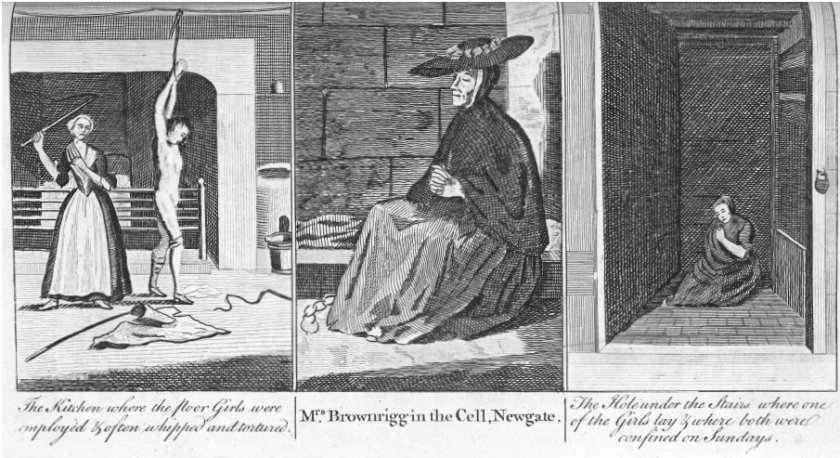
1767: Elizabeth Brownrigg

On this date in 1767, a jeering mob damning her to hell* saw Elizabeth Brownrigg hang at Tyburn.

“The long and excruciating torture in which this inhuman woman kept the innocent object of her remorseless cruelty, before she finished the long-premeditated murder,” says the Newgate Calendar, “more engaged the attention and roused the indignation of all ranks, than any criminal in the whole course of our melancholy narratives.” Hers is a very rich text.

As a middle-class midwife, Brownrigg mined the Foundling Hospital for young girls whom she would take on as apprentice domestic servants.

Brownrigg was far from the only one exploiting this ready pool of virtual slave labor, but it was her home’s marked sexualized sadism that really moved copy (pdf pamphlet). And Chateau Roissy it was not.

Elizabeth liked to keep the servants locked up, starving, usually naked, and would pinion their hands and inflict merciless corporal punishment for the least transgression against rules like “having any more bread”. The Old Bailey Online preserves one servant’s trial testimony:

Q. In what manner did she use to beat her?

M. Mitchel. She used to tie her up in the kitchen; when first she began to be at her, she used to tie her up to the water-pipe, with her two hands drawed up above her head.

Q. Describe that water-pipe.

M. Mitchel. That goes across the kitchen; the hooks that hold it are fastened into a beam.

Q. Had she used to have her clothes on when your mistress tied her up in this manner to beat her?

M. Mitchel. No, no clothes at all.

Q. How came that?

M. Mitchel. It was my mistress’s pleasure that she should take her clothes off.

Q. What had she used to beat her with?

M. Mitchel. She beat her most commonly with a horse-whip.

Q. How long did she use to beat her in this manner?

M. Mitchel. I cannot justly say, but she seldom left off till she had fetched blood.

This witness Mary Mitchel(l) was the lucky one of the Brownriggs’ last two Foundling Hospital charges: both girls had been stripped and horsewhipped so regularly that ulcerating, infectious sores — never able to heal before the next thrashing — pocked their bodies.

But Mary Mitchell at least survived. Her fellow-sufferer Mary Clifford was flat beaten to death, the body stuffed in the family coal-hole like so much rubbish. (In life, Mary Clifford was sometimes made to sleep there, too.)**


Detail view (click for a larger, three-panel image) of Elizabeth Brownrigg and her crimes illustrated in the Newgate Calendar.

For working-class Londoners struggling to navigate the dislocations of the Industrial Revolution, here was a villainess indeed. London was swelling, urbanizing, bustling with vulnerable orphans and abandoned children like our foundling Marys; all its working classes, for that matter, had reason to feel endangered in the face of fights for their lives against emerging commercial powers working hand in glove with the state — not excluding the ubiquitous threat of the gallows for pitiable property crimes.

And as Peter Linebaugh observes, “apprenticeship” by the 18th century “was less likely to involve the development of highly qualified, skilled labour power than to be the means of organizing the exploitation of young labour power.”† Like it’s not enough working your crappy dead-end unpaid internship; now, it comes with flogging?

Somehow, Brownrigg’s husband and son were convicted only of a misdemeanor and got off with a few months in prison, but Elizabeth bore all the hatred of Londoners more used to seeing apprentices swing than even the vilest master. The Murder Act which had appropriated even the corpses of London’s marginal people was applied to anatomize our former midwife; her skeletal remains were long displayed in a niche at the Royal College of Surgeons.

Oh, and the Foundling Hospital — which had cautioned the Brownriggs before about their excessive abuse of servants but not actually stopped sending them young girls to abuse — started finally instituting some oversight.


There’s a vicious and unsigned satire, “Elizabeth Brownrigge”, published in the September 1832 Fraser’s magazine. Over the years, it has occasioned a great deal of dispute among Thackeray scholars as to whether it might not have been an early creation of that master satirist’s pen. (Thackeray would have just turned 21 when it published.)

We’re not qualified to render judgment on the literary forensics, but the skewering of a murderess through the author’s mock-sympathy has a deliciously Thackerian flavor about it: the world was “incapable of understanding the height of her virtue.” It also underscores the continuing resonance of Elizabeth Brownrigg to Londoners 65 years after her execution.

The magnanimity of her soul, like Mr. Smeaton‘s pharos on the Eddystone, was firmly fixed upon the rock of the soundest principles, and diffused a light around it, for the guidance of those who were beating the waves upon the dark and troubled ocean of adversity, but was itself unshaken by the storm … [in prison] the fair and excellent Elizabeth adopted, as nearly as circumstances would allow, the same admirable disposition of her time to which she had been accustomed when inhabiting her own romantic bower in the village of Islington. She completed a large stock of baby-linen for the poor; she perused new publications of the day; and she composed an elaborate parallel between the characters of Socrates and Lady Jane Grey, after the manner of Plutarch. These are the two distinguished personages, in the whole range of authentic history, who in their strength of mind, purity of life, and extensive accomplishments, bore the strongest resemblance to herself; and to them, perchance, the attention of our heroine was more particularly directed in the quiet and retirement of her cell by the many points of similarity which subsisted between their destiny and her own.

Later, the fictional Elizabeth mounts a defense of such oblivious loathsomeness that it naturally impresses the judge:

“… punishment is a moral medicine. I may, perchance, actuated by too eager a desire for the rapid cure of my little and much-cherished patient, have dispensed my alternatives too liberally, and produced and untoward, an unexpected, and a most deeply-lamented consequence; but am I, therefore, to be condemned as guilty? In the analogous case of the physician, whose too-abundant anodynes may have lulled the sufferer to endless slumbers, or whose too copious phlebotomy may have let out the fever and the life at one and the same moment from the veins, would this most harsh and unmerciful measure be applied? … I demand from the justice of your lordship and a jury of my countrymen — as a matter not of mercy, but of right — the same impunity in my case which would be accorded, freely an unasked, under parallel circumstances, to the medical practitioner.”

Thackeray or whomever lay behind this pasquinade had a wider literary target in mind than simply Elizabeth Brownrigg(e)’s class. The short story is prefaced with a dedication to “the author of Eugene Aram“, meaning the popular novel published earlier in 1832 by Edward Bulwer-Lytton — a lifelong Thackeray bete noir. That novel concerned another renowned 18th century murderer, and it’s safe to say from the dedication that our satirist considered Bulwer-Lytton’s empathetic portrayal of the titular homicide a little, er, soft on crime.

I have been taught by Eugene Aram to mix vice and virtue up together in such an inextricable confusion as to render it impossible that any preference should be given to either, or that the one, indeed, should be at all distinguishable from the other … I had, indeed, in my dramatic piece, been guilty of an egregious and unpardonable error: I had attempted to excite the sympathies of the audience in favour of the murdered apprentices, but your novel has disabused me of so vulgar a prejudice, and, in my present version of her case, all the interest of the reader and all the pathetic powers of the author will be engaged on the side of the murderess.

* The Newgate Calendar: “On her way to the place of execution the people expressed their abhorrence of her crime in terms which, though not proper for the occasion, testified their astonishment that such a wretch could have existed: they even prayed for her damnation instead of her salvation: they doubted not but that ‘the devil would fetch her,’ and hoped that ‘she would go to hell.’ Such were the sentiments of the mob.”

** Elizabeth Brownrigg admitted to the Ordinary of Newgate the truth of Mary Mitchell’s horror testimony.

† Conversely, rogues who took to the highway and became working-class heroes were very often men who had absconded from their apprenticeship — for instance, Jack Sheppard and Dick Turpin.

On this day..

1768: Seven coal-heavers to crush the London port strike

On this date in 1768, a year of tremendous labor agitation in London, seven coal-heavers were hanged near the Shadwell dock.

With food prices surging,* the city’s hard-pressed urban proletariat was at peak militancy — which also lent violent energy the cause of hunted radical politician John Wilkes, who had returned from exile this year to stand for Parliament. Two principal loci of labor insurgency in 1768 were the Spitalfields weavers, whose struggle we have already observed, and the “coal heavers” — the men who did the grueling labor of offloading coal from Thames barges.

Coal-heaving was ill-paid and dangerous, and it was notoriously sensitive to fraud: workers (largely Irish: they’d been imported to hold down wages) being paid by the “sack” or the “vat” fought supervisors at riverside over just how fully loaded with coal such a sack or vat should be. Workers had their own recourse to “indirect Practises,” pilfering a few coals on the side to supplement pay up to within hailing distance of subsistence. The boss would call “theft” this grey-area practice harkening to labor traditions ancient and still-current. The rope would help him define it so.

Peter Linebaugh’s magisterial social history The London Hanged dramatically treats the fraught and violent months of the spring of 1768, when Irish workingmen were “bringing river traffic to a stand-still … [and] stopped the imperialist artery.”

Dockside taverns doubled as fraternal entities and regiments in the unfolding dock war. One John Green, keeper of a pub on New-Gravel Lane (not as scenic as the nearby Cutthroat Lane)

organized scab labour from [his] Roundabout Tavern. It was attacked in April with gunfire. A shoemaker bled to death on the pavement, a coal-heaver took a bullet in the head, ‘dropped down backwards, and never stirred’. The taverns were besieged, their furnishings destroyed. Gunfire was frequent. Green was acquitted of murder. Those testifying for him were mobbed and one witness had her jaw broken. The coal-heavers were as violent in word as in deed. ‘They would have Green’s Heart and Liver and Do for him’; ‘they would have him joint from joint’; ‘they would have his heart and liver, and cut him in pieces and hang him on his sign’; ‘they would hang him over his sign Post & cut him into Beef Stakes’.

Our seven — by name John Grainger, Daniel Clark, Richard Cornwall, Patrick Lynch, Thomas Murray, Peter Flaharty, and Nicholas McCabe — were indicted on grounds that they “with force and arms, with certain guns loaded with gunpowder and leaden bullets, feloniously, wilfully, and maliciously did shoot off at John Green.” Not quite cut into Beef Stakes, but it’ll get the job done.

Though the trials of Green, and then of Green’s assailants, were weeks apart, they concerned the very same disturbance on the night of April 20-21, when Green’s residence had been besieged by angry coal-heavers and Green with others had shot out the windows and killed at least two … but managed to hold his foes at bay during what must have been a harrowing night. Green wasn’t hurt, and gave evidence at the “shooting off” trial.

The London Irish had by 1768 an unparalleled knowledge of arms and armed struggle. They contributed to an insurrectionary impulse within the London working class. At the same time, as a consequence, the Irish had close knowledge of violent death. The intimacy of that knowledge was expressed in vivid euphemisms designed to reduce the terror of hanging. Seven coal-heavers received the ‘cramp jaw’ at the Old Bailey only after a new interpretation was placed upon the Waltham Black Act. The seven danced ‘a new jig without music’ on 26 July 1768. This particular ‘crack neck assembly’ was located in Sun Tavern fields, Shadwell … The move from Tyburn was designed to terrify the poor and working people of the river parishes. The ‘breath stopper’ was witnessed by 50,000 spectators, perhaps the largest crowd at such a scene since the hanging of the Earl of Ferrers eight years earlier. The Government anticipated disorders, if not rescue attempts, when these seven were to dance ‘tuxt de ert and de skies’. From 6 a.m. more than 600 soldiers patrolled the streets of Wapping and Shadwell. The Sheriff ordered all the constables of the Tower and Holborn divisions to assemble at the hanging site and to come armed with their staves. Thomas Turlis, the hangman, had stolen coal from a neighbour’s cellar five years earlier. But, that his work might not be interrupted, the Sheriff quickly obtained a pardon for him. He did his duty upon the coal-heavers, sent ‘a-spinning like a whirligig’. Once they had ‘peacably’ exited the world, many of the spectators may have gone for a drink as was customary:

Wid a facer we coddled our blood
For de wind id blows cold from de gibbett.

… The hanging at Sun Tavern Fields … taught a hard lesson about collective bargaining: attempts to counteract the rise in the price of provisions by improving wage rates would not be allowed. … the insurrectionary vanguard of the river proletariat was broken.

Or, as a more sanguine observer put it, after the hangings “the tumults immediately ceased, and peace and industry was happily restored.” And they all lived happily ever after.

* Bread prices doubled in 1768, leading to work stoppages, hoarding, and food riots throughout the city. Representative slogan shouted by desperate rioters: “We might as well be hanged as starve.” (George Rude, “The London ‘Mob’ of the Eighteenth Century,” The Historical Journal, Vol. II, no. 1 (1959))

On this day..

1760: Laurence Shirley, 4th Earl Ferrers

On this date in 1760, Laurence Shirley, 4th Earl Ferrers became the last member of the House of Lords to hang.

A violent-tempered man — madness was said to run in the family, and this was in fact the Earl’s defense at this trial — Ferrers’ nastiness ran his wife right out of the house. Consider this was the 18th century, he must have been some kind of intolerable.

Though it was directed at another member of the household, this anecdote from the Newgate Calendar may prove illustrative of the sort of fellow we’re dealing with:

Some oysters had been sent from London, which not proving good, his lordship directed one of the servants to swear that the carrier had changed them; but the servant declining to take such an oath, the earl flew on him in a rage, stabbed him in the breast with a knife, cut his head with a candlestick and kicked him on the groin with such severity, that he was incapable of a retention of urine for several years afterwards.

Right.

We’ve seen in these pages how a certain sort of ill-humored man would sooner go to the scaffold than subsidize his ex. Ferrers was this sort.

The arrangement for the Ferrers spouses (they weren’t divorced, just separated) was that Ferrers would pay her support via his old household steward. Chafing at the payments and resenting the middleman, Ferrers one day in January summoned him to his, theatrically accused him of breaking faith, and shot him through the chest.

The Earl was tried before the House of Lords (a jury of his peers, and Peers!),* but his sentence was straight from the Old Bailey: not just hanging, but anatomization.

However, his exalted rank did draw a few odd perquisites.

Most noticeably, perhaps, was the fact that Ferrers was allegedly hanged with a rope of silk, rather than hemp. For only the softest coiling around noble throats, you see.

The other, and in hindsight more consequential, was that he didn’t get the low-rent treatment of being shoved off a cart. Instead, the scaffold was surmounted with a small platform supporting a set of trap doors whose opening would suspend the malefactor for his asphyxiatory journey to the hereafter.

This, one of many illustrations of the hanging, suggests this novel feature:

This innovation presents us an obvious forebear of the now-familiar “drop” method of hanging which evolved over the subsequent centuries. Though the drop was not repeated at Tyburn, it became wholesale practice when hangings moved to Newgate Gaol; the drop itself thereafter became the very art of the hanging when it was lengthened and scientifically measured to snap the neck of the condemned on the fall instead of strangling him or her.

And you could trace it all back to May 5, 1760.

To judge from other engravings, this red-letter day did not want for witnesses.

Perhaps stage-frightened by all these eyeballs on their noteworthy prey, the executioners put on an amateur-hour show. They openly fought over the £5 tip Ferrers gave (he accidentally handed it to an assistant), and likewise again over the rope that conducted the sentence.

When next in London, wet your whistle at Streatham’s The Earl Ferrers, a local pub.

* Ferrers defended himself: a norm for the time, but to latter-day eyes rather hard to square with his insanity defense. You’ve got a lucid defendant relying upon his wits to save him in a juridical proceeding inquiring of his own witnesses, “Was I generally reputed a Madman?” (Ferrers’s defense, specifically, was “I’m periodically insane.” But when the wind is southerly, he knows a hawk from a handsaw.)

On this day..