On this date in 1776, footpad James Langar was hanged at Tyburn for robbing a Hyde Park gentleman of his watch and coat.
Actually, and despite a reputation for honesty attested by his fellow militiamen, Langar was implicated in several highway robberies on shaky witness testimony, prompting him to remark in disgust, “I see they are determined to swear my life away, I leave myself to the mercy of the Court.”
He didn’t get it.
A vanishing obscurity even in his own time, Langar has been making 21st century headlines based on a pair of researchers’ identifying him with a ghoulish ecorche sculpture known as “Smugglerius”.
That astonishing object, and its controversial identification with James Langar, are discussed in this previous Executed Today post.
At the Admiralty sessions, held at the Old Bailey, on the 17th of December, 1770, David Ferguson, master of the merchant-ship Betsey, was tried for the murder of his cabin-boy, a lad about thirteen years of age, during his voyage from Virginia to Antigua.
It appeared that four of Captain Ferguson’s crew died, and he was charged with the murder of them all. On one of these alleged crimes he was tried in Virginia, and acquitted.
Lord Botetourt, the then governor of that colony, transmitted the proceedings of the Court to the secretary of state for foreign affairs in London, with a favourable opinion thereon.
Though we have had too frequent occasion, in the course of this work, to state the wanton exercise of that power necessarily given to commanders at sea, yet we also know that the crew are too often ready to construe necessary correction into cruelty; and, should any of the hands corrected by the captain die, even by accident, or the common course of nature, they are sure to aggravate the affair, and persecute their commander.
The ship Betsey sailed from the Capes of Virginia in the depth of winter, when the cold is intense to a degree, of which Englishmen have hardly a conception. Heavy gales of wind and long falls of snow succeed each other, day after day. The shrouds and rigging are incrusted with ice, and they often snap from the tension thereby occasioned. The masts, thus deprived of their principal support, are often ready to fall by the board, while the deck is deeply covered with snow.
(Note: A shocking instance of the sad effects of these sudden snow storms, on the coast of America, happened to the officers of the Assistance man-of-war, lying off Sandy Hook, near New York, in the year 1784. Six seamen of that ship confederated to desert, jumped into the yawl, and pushed off from the ship towards the shore. Another boat was got ready for a pursuit, and was manned by the first lieutenant, eleven other officers, and one seaman. Before they could come up with the deserters, a snow storm came on, which, as is often the case, so overpowered them, and so darkened the horizon, that they lost sight both of the yawl and the ship, and were all, except one, next morning found dead on the beach, near Middleton Point, in New Jersey, most of them sticking in the mud.)
In such cases seamen do their duty with much reluctance; and, when their extravagance in harbour has deprived them of the means of laying in an allowance of brandy and tobacco, they grow clamorous to their captain for those indispensable articles, with which he is not bound to supply them; in fact, he generally provides little more than may serve himself.
Captain Ferguson’s crew, thus situated, were often remiss in their duty; and, on several occasions, his utmost exertions were called upon for the safety of his ship; but that he exceeded the bounds of moderation must be admitted, from his conviction by an English jury of the murder of his cabin-boy.
Perhaps the severity of the season, the crew being unprovided with liquor, and also without sufficient warm clothing, contributed more to the death of the remaining three that perished than correction. The survivors imputed the murder of them all to the cruelty of their captain.
To come to the charge on which he was convicted: it was proved that he had frequently beat the boy in a manner far too severe for his tender years to bear; and that he had knocked him down, and then stamped upon him. After this barbarous usage he confined him almost an hour upon deck, to the weather-side of his long- boat, when the weather was so severe that snow covered the deck, and the shrouds were snapping. That he again pushed him down, and trod upon him with both his feet.
The seamen said that the boy provoked this punishment by coming upon deck with only one stocking on. The sufferer did not make complaint of the effects of his usage until eleven o’clock at night; and the next day he fell into the hold, and was missing five hours. He was found dead upon the ballast.
In his defence Captain Ferguson proved the distress his ship was in from the weather, and the refractory spirit of the crew, several of whom he was obliged to force to their duty.
On the passage of the Betsey home to England, Major Watson and Captain Lilly, who were passengers, proved that she was wrecked on the coast of Sussex; and that it was owing to the resolution and good conduct of Captain Ferguson that they, together with the crew, were saved. It also appeared that many vessels at sea with the Betsey, on the coast of America, had several of their crews frost-bitten, which turning to gangrene, they died. The inference attempted to be made was that the frost had killed the cabin-boy.
Several respectable merchants gave the prisoner a good character for integrity and humanity; but the jury found him guilty, and sentence of death was passed upon him accordingly.
Considerable interest was made to obtain the royal mercy, and (a circumstance seldom granted to murderers, and then only when some doubts arise in the minds of the privy council on the case) he received a respite.
On the 4th of January, 1771, eighteen days after conviction, the warrant arrived for his execution; and the next day, attended by the marshal of the Admiralty, carrying a silver oar, he was carried from Newgate to Execution Dock, and there hanged.
His body was hung in chains upon the marshes of the river Thames.
Thus perished Captain David Ferguson, a victim to his ungovernable passion, in the twenty-sixth year of his age.
On this date in 1774, Peter Galwin and John Taylor were hanged together in Burlington in New Jersey.
Galwin was the principal of a small school in Northampton Township with a hankering for prepubescent children. According to court documents, Galwin raped or attempted to rape four young girls on four separate occasions in July and August 1774: Ann Prosser, Hope Reeves, Sarah Deacon and Ann Jones, all of them “infants under the age of ten years.”
The assault caused “great damage” to Ann Jones in particular. Whether or not the victims were his students is not known.
The crimes of John Taylor, alias John Philip Snyder, were still more exotic.
An itinerant farmhand, he allegedly stole money, “two items of female intimate apparel” and other items from his employer, a widow named Orpha Emlay, on August 13, 1774. She suspected him of the theft but lacked proof, so she decided to spy on him.
She wound up getting more than just an eyeful on the afternoon of October 2, 1774. It was then that the wary woman peeked into her barn and saw Taylor committing an act of gross indecency with a cow. Appalled, Emlay presumably let out a shriek because Taylor heard her. The naked pervert chased her down while brandishing a knife and a hammer. He smashed Emlay’s skull and slit her throat from ear to ear.
Understandably, public outrage against both offenders ran high in the community. Hearn notes that guards had to “prevent enraged onlookers from tearing both men apart before they reached the gallows.”
There is one example of this violation in Virginia, of a most striking and shocking nature; an example so horrid, that if I conceived my country would passively permit a repetition of it, dear as it is to me, I should seek means of expatriating myself from it. A man, who was then a citizen, was deprived of his life thus: From a mere reliance on general reports, a gentleman in the house of delegates informed the house, that a certain man had committed several crimes, and was running at large perpetrating other crimes; he, therefore, moved for leave to attaint him; he obtained that leave instantly … Without being confronted with his accusers and witnesses, without the privilege of calling for evidence in his behalf, he was sentenced to death, and was afterwards actually executed. Was this arbitrary deprivation of life, the dearest gift of God to man, consistent with the genius of a republican government? Is this compatible with the spirit of freedom? This, sir, has made the deepest impression in my heart, and I cannot contemplate it without horror.
On this date in 1778, attainted Revolutionary War-era outlaw Josiah Phillips was hanged in Virginia.
Contrary to Randolph’s recollection, the execution took place according to a regular jury verdict convicting Philips for stealing 28 hats and five pounds of twine — felony theft by the Bloody Code inherited from England.
Even so, it was the Act of Attainder voted unanimously by the Virginia legislature that stuck in the popular memory, so much so that even the likes of Randolph, a lawyer by trade and later the first Attorney General of the independent United States, misstated* it as the proximate cause of Phillips’s execution.
Another inheritance from the mother country, Acts of Attainder — wherein the legislature declares some party guilty of a crime and declares punishment without benefit of trial — were going right out of style in the twilight of the 18th century. The eventual U.S. Constitution would flatly abolish the practice; Britain herself has not enacted one since 1798.
So it comes as some surprise to see that Phillips was outlawed** at the instigation of no less a person than old Mr. Inalienable Rights himself, Thomas Jefferson. Jefferson’s Bill of Attainder gave Philips and his band a June 1778 deadline to turn themselves in voluntarily, or else they
shall stand and be convicted and attainted of high treason, and shall suffer the pains of death, and incur all forfeitures, penalties and disabilities prescribed by the law against those convicted and attainted of High-treason: and that execution of this sentence of attainder shall be done by order of the General court to be entered as soon as may be conveniently after notice that any of the said offenders are in custody of the keeper of the public gaol …
And that the good people of this commonwealth may not in the mean time be subject to the unrestrained hostilities of the said insurgents, be it further enacted that from and after the passing of this act it shall be lawful for any person with or without orders, to pursue and slay the said Josiah Philips and any others who have been of his associates or confederates at any time.
Now in fairness, Josiah Phillips was no ordinary hat-thief, regardless of what the charge-sheet read. He was a Tory marauder who led a gang of outlaws/guerrillas/terrorists who lurked in the Dismal Swamp and had just weeks before repelled a Commonwealth militia dispatched by Governor Patrick Henry.
For Henry, who sought the attainder, and for Jefferson the Phillips band looked like a clear security threat. “The delays which would attend the proceeding to outlaw the said offenders according to the usual forms and procedures of the courts of law would leave the said good people for a long time exposed to murder and devastation,” in the words of the attainder. And indeed, the rebellious colonies — ultra-patriotic Pennsylvania especially — had had regular recourse to Acts of Attainder against Tory loyalists over the span of the American Revolution. (Actual executions under attainders were extremely rare.)
However, the inconsistency of such an instrument long associated with monarchical tyranny with its author’s more usual Rights of Man fulminations had Jefferson still defending the Phillips attainder as late as 1815.
Whatever might have best suited Josiah Phillips, the last word on the matter in American jurisprudence has belonged to the overwhelming sentiment of his fellow-Founders … like James Madison, whose Federalist no. 44 flatly avers that Bills of Attainder “are contrary to the first principles of the social compact, and to every principle of sound legislation.”
* Randolph himself, as Virginia’s attorney general, made the call not to use the attainder against Phillips because of Randolph’s own discomfort with it. But his “misremembering” was convenient to a later interest in excoriating Patrick Henry.
** Arguably contravening Virginia’s existing 1776 Declaration of Rights. “In all capital or criminal prosecutions a man has a right to demand the cause and nature of his accusation, to be confronted with the accusers and witnesses, to call for evidence in his favor, and to a speedy trial by an impartial jury of twelve men of his vicinage, without whose unanimous consent he cannot be found guilty; nor can he be compelled to give evidence against himself; that no man be deprived of his liberty except by the law of the land or the judgment of his peers.”
On this date in 1771, Henry Stroud and Robert Campbell were hanged at Bethnal Green Road — a pointed message to the Spitalfield working class.
Their hanging was tit for tat in an exchange of deadly violence between the state and laboring Londoners.
Two years before, an anti-union law making it a capital crime to cut silk out of looms had actually been put to use with the hanging of two as part of the suppression of a Spitalfields weavers riot.
This execution provoked in the following months a horrifying mob vengeance against the independent weaver who had testified — falsely, it was suspected — against those hanged men. When said informer, name of Daniel Clark, was recognized walking in the area one day, an angry crowd formed and “stript him, tied his hands behind him, took him to a pond, threw him in, and then threw stones and brickbats at him for some time; then took him out, tied a cord round his neck, and threw him in the pond again, and then threw stones and brickbats at him till they beat out his brains.”*
Snitches get … brickbats.
Justice David Wilmot** determined to hunt out some of this lynch mob he could make an example of, not disdaining to resort to arm-twisting and witness-buying.† Wilmot’s advertisement for leads drew anonymous threats, which the justice scornfully published in newspapers to up the ante.
The writers of these letters … [are] pursuing with insatiable & heart felt revenge, their designs against you should any one person suffer from your busy concern. & know farther that having such connections at all your haunts, and free access at most time to your person, ’til not the whole third regiment of guards that can protect you from the well concerted plan for your destruction.
The result was a chaotic five-day trial, at which witnesses openly flinched at the prospect of popular vengeance waiting outside the Old Bailey doors.
Henry Stroud, nevertheless, was identified by several witnesses as having taken a prominent part in visiting popular justice upon Clark, in the form of two or three hurled bricks that knocked the victim down — while Robert Campbell was reputed to have thrust the bloodied Clark’s head into the pool.
They were pointedly put to death behind a heavily armed cordon near the very spot of the homicide. Stroud, at least, went to his death still vigorously protesting his innocence.‡
“Thus did the alternating pageants of ritual murder come to an end,” writes Peter Linebaugh of this exclamatory execution in The London Hanged. “A hundred bayonets from the War Office protecting the hangman and the magistrates. The scapegoating of the class antagonism concluded with this powerful, official display of power in the streets, where usually the trill of [weaving] shuttles would fill the air.”
* Quoted in Norma Landau’s “Gauging crime in late Eighteenth Century London,” Social History, 35:4.
** Not to be confused with Justice Wilmot, then the sitting Chief Justice of the Common Pleas. Justice David Wilmot’s credentials from this affair and otherwise established him as a hated enemy of the London working class, and consequently his home was torched during the proletarian Gordon Riots.
† viz., testimony of one witness among the several in the Old Bailey transcript who openly discuss payola: “another gentleman offered me fourscore pounds; a gentleman that brought me the summons; he said, you know one Bob Campbell; I said, I did not by name; he said, he would give me fourscore pounds; I was frightened, he said, I see you are a stranger; if you will but swear to the man I will give you fourscore pounds.”
‡ After the days-long prosecution, Stroud’s entire defense case ran two sentences: “I am as innocent of the affair as ever was a child in the world. I neither handled brick, stone, tile, nor anything, so help me God.”
“A most infernal plot has lately been discovered here, which, had it been put into execution, would have made America tremble, and been as fatal a stroke to us, this Country, as Gun Powder Treason would to England, had it succeeded.”
On this date in 1776, Continental Army soldier Thomas Hickey was hanged before “a vast concourse of people” for a plot that might have strangled the American Revolution in its crib.
That revolution was a highly uncertain venture at this moment, and in a different timeline Thomas Hickey might have been a British hero for squelching it. “These are the times that try men’s souls,” revolutionary firebrand Thomas Painewrote late in 1776. Hickey had to face his trial in the flesh.
George Washington had holed up in New York City in the spring to fortify it against an expected British invasion — an invasion that did indeed arrive and eventually drove the Continental Army all the way to Philadelphia.* As Paine beheld, the wrong turn of events here could have been decisive. The Continental Army was badly outnumbered and afflicted by desertion. The Continental Congress itself had to abandon Philadelphia not long after boldly declaring independence on July 4.
Whatever one might say of the great-man historiographical mood, you’d have to think that knocking out the rebel army’s top general at this juncture would have been a coup for the British.
In June of 1776, New York was tense ahead of the fighting. A British ship of the line sat forebodingly in the harbor, and even as she awaited the coming British force, her crew members rowed freely ashore for provisions. Plots went abroad among the mixed population of “Patriot” and “Loyalist” citizens. Nathan Hale would soon earn his martyr’s laurels in New York, trying to reconnoiter behind enemy lines as Washington staged a series of losing battles and a gradual retreat.
Somewhat below this plane of world-shaping combat and statecraft, a guy named Isaac Ketcham (or Ketchum) found himself clapped in gaol for counterfeiting the easily-counterfeited colonial paper currency. There, Ketcham caught jailhouse scuttlebutt of Loyalist plots afoot in New York. Realizing this could be his ticket out of prison, Ketcham wrote New York’s Provincial Congress informing on the schemes.
Sadly, Ketcham’s full memorandum has been lost, and as the ensuing trial records are circumspect the “plot” or “plots” in question are a bit of a historical muddle. Roughly, there are two discernible thrusts:
A fifth-column plot against the patriot position in New York, with Loyalist-inclined soldiers set to desert back to the arriving British army.
A plot against the person of George Washington himself.
Ketcham was eagerly interrogated by the Provincial Congress on these matters, and returned to his dungeon in the capacity of an informant. There, he made the acquaintance of the Irish-born Thomas Hickey, a member of George Washington‘s personal guards who had on June 15th been committed for doing his own bit of private currency-printing.
Representing himself as a Tory loyalist, Ketcham apparently induced Hickey to boast about something quite a bit more serious than counterfeiting.
“In different conversations he informed me that the Army was become damnably corrupted,” Ketcham told the court-martial that tried Hickey. “That the fleet was soon expected; and that he and a number of others were in a band to turn against the American Army when the King’s troops should arrive.”
The whole scheme went under the pay of Loyalist New York mayor David Mathews, who was also arrested by patriot troops — although Mathews, whose execution might have turned the British very nasty in the various diplomatic conferences ongoing during the New York campaign, was never even tried.** He escaped to British protection shortly after capture.
No kid gloves were available to the treacherous Irishman Hickey, however. Word of the conspiracy against the patriots had also been obtained from a businessman, William Leary, who reported the attempt of his former employee to recruit him into it. The sheer quantity of highly indiscreet men blabbing about it in taverns and jails and the like makes the whole thing seem crazy in retrospect, but if it had succeeded in, say, destroying Kingsbridge, it might have trapped the Continental Army on Manhattan where they would have been easy pickings for the vastly superior British. Someone surely had to pay for this.
Several of Hickey’s accomplices provided evidence against him, and the speedy conclusion of the military commission that tried him was that Hickey should hang in order to, as Washington wrote the Continental Congress, “produce many salutary consequences, and deter others from entering into like traitorous practices.” So far as is known, however, Hickey was the only person to suffer this extremity.
The unhappy fate of Thomas Hickey, executed this day for mutiny, sedition, and treachery, the General hopes will be a warning to every soldier in the Army to avoid those crimes, and all others, so disgraceful to the character of a soldier, and pernicious to his country, whose pay he receives and bread he eats. And in order to avoid those crimes, the most certain method is to keep out of the temptation of them, and particularly to avoid lewd women, who, by the dying confession of this poor criminal, first led him into practices which ended in an untimely and ignominious death.
Physician William Eustis (eventually the U.S. Secretary of War), who was among the 20,000 to see Hickey hanged, wrote a friend that afternoon of the execution.
Their design was, upon the first engagement which took place, to have murdered (with trembling I say it) the best man on earth: Genl Washington was to have been the first subject of their unheard of Sacricide: our magazines which, as you know, are very capacious, were to have been blown up: every General Officer and every other who was active in serving his country in the field was to have been assassinated: our cannon were to be spiked up: and in short every the most accursed scheme was laid to give us into the hands of the enemy, and to ruin us. (Source)
The scarcity of original documentation makes it very difficult to say with confidence just how impressive this accursed scheme really was. One can see from Eustis’s letter that it was understood immediately to have compassed the murder of George Washington. This prospective “Sacricide” of America’s founding father par excellence has been worth a good bit of embellishment; one bit of utterly insupportable folklore congenial to vegetable-hating schoolchildren is that Hickey arranged to have General Washington’s peas poisoned with arsenic, but the faithful housekeeper exposed the scheme in the nick of time.
Only a bit more fantastical is the video game Assassins Creed III, whose representation of the death of Thomas Hickey — this version of Hickey is a Templar agent — uses a wacky sequence that begins with the public execution of the game player’s own assassin character, complete with first-person, inside-the-hood perspective.
It might well be that Hickey had been engaged in a plot not to murder but to kidnap the rebel general. David Mathews, the New York mayor, would later tell a royal commission in London autopsying Britain’s Revolutionary War defeat, “I formed a plan for the taking of Mr. Washington and his Guard prisoners but which was not effected.” It’s been speculated that the Continental Army itself chose to play up the “murder” angle for public consumption in preference to “kidnap” — perhaps because the notion that the Tories had the strength to contemplate the more complex objective of snatching Washington away from his own army, and were in a position to use his very own guards to accomplish it, implied a weakness in the revolutionary cause far too grave to acknowledge openly.
* It’s from this position that Washington would [re-]cross the Delaware amid December ice floes to conduct a morale-salvaging raid on Hessian troops in New Jersey after many long months of reversals. The British, for their part, held New York for the balance of the war, and this helped make adjacent New Jersey a battleground between pro-British and pro-American militias.
** Mathews administered New York until 1783, when the British ceded it to the victorious colonists.
This date in 1777 saw the public execution of “John the Painter” — a Scotsman who had been christened “James Aitken” at his birth less than 25 years before, but who had run through countless aliases in his adult life as a (mostly) petty thief.
But this man was not a hapless victim of England’s Bloody Code, although he often enough offended the capital statutes against petty property crime.
Rather, the scraggly redhead with the thick Scottish brogue was the author of a stunning act of domestic terrorism, in England, in freelance support of the rebellious American colonies an ocean away.
“So dangerous an individual to the kingdom as this man perhaps never existed,” in the judgment of the Newgate Calendar, who knew him as “John Hill” — just one of Aitken’s many aliases. “and whose confession and repentence can hardly soften the abhorrence felt on the contemplation of the extent of his crimes.”
James Aitken, aka John Hill, aka John the Painter — for this last was, unfortunately, the unprofitable occupation of his apprenticeship training — fired the Portsmouth dockyards on December 7, 1776, then followed that up with an attack on the Bristol dock and city shortly after the New Year, as well as an unsuccessful attempt to ignite the Plymouth quay.
Although he was well-read for his class, he was not ideological, not a zealot of any creed religious or secular.
He was not American himself even in the loose sense that term could hold for the immigrant proto-nation. His only brush with that land was brief and unedifying: fearing his many thefts had made London a bit too hot for him, he signed on as an indentured servant and shipped out to the colonies in 1773 and slave-like labor in the fields. He escaped his master in 1775 and immediately shipped back to Europe, leaving no evidence of any revolutionary contacts.
And he wasn’t a madman. Just lonely, as evidenced, Warner says, by the “sad and always desperate invitations” to drink with which he plied the newest of acquaintances, to their discomfort. “He asked complete strangers to drink with him because he was lonely, and loneliness overrode his reason. His invitations always came too quickly, and his conversation and his manner always just a little off.” He even invited this indiscreet attention when on the incendiary job.
James Aitken reads like an Enlightenment version of the disaffected loser “going postal” on a world that could barely see him to tread upon him. His fondest desire from childhood was that classic Scots aspiration, the army commission. The closest he came was a series of short-term army enlistments to pocket the enrollment bonus, each of which he deserted as soon as practicable. (He did dream that his terrorism spree would earn him an appointment in the Americans’ Continental Army.)
Back in Britain after his unsuccessful foray in the colonies, Aitken conceived a disordered affinity for the burgeoning patriotic cause of the colonies he had recently fled. (Warner thinks he read Thomas Paine‘s Common Sense.) Only accidentally, when he overheard boozers at an Oxford pub chatting about the importance of the dockyards to the British Navy, did the heretofore aimless Aitken animate his wanderings with a new revolutionary purpose: he, scorned nobody, could win the War of Independence by crippling these facilities.
I spent two days in the contemplation of this malicious design, and promised myself immortal honour in the accomplishment of it. I beheld it in the light of a truly heroic enterprise, such as never would have been equalled to the end of time. I was persuaded it would entitle me to the first rank in America, and flattered myself with the ambition of becoming the admiration of the world! (Source)
Aitken was not a criminal mastermind, but there was a plausibility to the plot that fluttered the Admiralty’s heart once the details emerged. The dockyards were critical. They were also — Aitken readily perceived this as he began to case them — scarcely guarded; at Portsmouth, Aitken came and went as he pleased, freely schlepping his materiel in and out. (His attempt at Portsmouth set the subsequent facilities more on guard; the man’s initial plan to hit five different dockyards in sequence would ultimately have been as self-defeating as the 9/11 hijackers planning to commandeer a different plane on five consecutive days … but this was the way Aitken had to conceive it since he lacked the charisma or leadership aptitude to form a cell of fellow-travelers for a coordinated attack.)
Before launching himself into history, Aitken made an autumn 1776 visit to Paris to call upon the American representative there, Silas Deane.
Deane’s own recounting says he was struck by the wildness of Aitken’s scheme. But he was sufficiently taken with the prospective payoff to lend it his blessing, and “sponsor” it to the extent of giving the Scotsman a little pocket money to make his way back to England. He would later defend himself against “respectable persons,” presumably British ones, who “[regard] me equally criminal with the actor.”
[S]upposing me to be the liege subject, not of Great Brittain, but of a foreign independant Nation, at the Time at War with Great Brittain, and that imagining that I had found a favorable opportunity, & met with a proper Agent to destroy, at one blow, the Fleet & armaments preparing to carry, and to spread devastation, and bloodshed in my Country, and that I improved the favorable moment, and attempted through this agency, to effect this great object; on this view of the case I am confident that every one of common sense & impartiality must acquit me, nay more though they rejoice at the defeat of the enterprize they must approve of the motives, which influenced me to engage in it, motives no less than a desire to weaken a declared Enemy, and to preserve my Country, by every means in my power, from the horrors, and distress of Fire and desolation.
… if it was a noble, and most honorable Action in Lord Rodney to defeat the Count de Grasse, would not the Man who at equal hazard of his Life, had set fire to the Count’s Squadron in Brest, & thereby have equally defeated his expedition, been entitled (at least in the Court of Common sense) to the same Honors?
This was certainly good enough to convince Aitken that he torched in the name of Liberty, and he made his way back to set his plan in motion.
After botching his first attempt at Portsmouth and getting locked in the rope house — he pounded on the door until he got someone to open up, then bluffed his way out of the situation — Aitken got the least mileage possible from a superficially successful attack.
At about 3:30 p.m. on Saturday, December 7, Aitken fired three homemade incendiaries in the rope house and slipped away in what witnesses would later reconstruct as an evident state of agitation. The flames soon gutted the brick building (the damage would eventually reckon to £20,000) but he was this close to an exponentially more impressive bit of sabotage.
To begin with, many of his matches failed to start up Aitken’s jerry-built fuses. (This is also what caused his initial arson attempt to abort.) Having been once bitten by finding himself locked into the rope house at night, Aitken made his next trip earlier in the afternoon: that ensured that plenty of dockhands would still be in the vicinity to contain the fire to the one building. It also meant that the tide was in, and the nearby brig swollen with two thousand pounds of gunpowder could be easily put out to sea and away from danger as soon as the alarm went up.*
Admiralty investigators weren’t even sure at first that it was arson. Yards in the era of wood ships and wood buildings had a lot of flammable materials lying around. Fires happened.
Aitken soon dispelled any possible confusion.
Finding the Royal Navy dockyards at Plymouth too vigilant for his machinations, Aitken settled on an ambitious, and again somewhat plausible, scheme to engulf the densely-populated port of Bristol — dockyard and city alike. Repeatedly his blazes petered out or were suppressed. They did little consequential damage, but raised a rapidly-escalating panic at revolutionary incendiaries abroad, and it did not take long to link them to Portsmouth. (Copycat attempts and crackpot anonymous letters threatening same also started popping up elsewhere in the realm.)
“I have not the least doubt that the late fires have been the effects of premeditated malice,” wrote Bristol’s M.P. — the political philosopher Edmund Burke. Naturally this only had the effect of silencing potentially considerable pro-American sentiment in Bristol and throughout the realm. Lord Germain exploited the terrorist panic to push through a February 1777 Treason Act aimed at the American colonies. It authorized detention of suspected rebels without habeas corpus protection at His Majesty’s pleasure.
Aitken himself, though, was at the end of his own fuse. At Sir John Fielding‘s urging, the Admiralty posted an eye-popping £1,000 reward for the terrorists’ (multiple attackers were presumed, owing to the quantity of fires) capture. The arsonist was in irons with a week; a gaoler had noticed him and recognized Aitken’s fit to the description of the unknown Scotsman who had been seen in the vicinity of some of these blazes which Fielding had published in his crime clearinghouse periodical, Hue and Cry.** That man rode off after the suspect and overtook him in the village of Odiham,† where an exhausted and by now fatalistic Aitken surrendered without a fight.
The mizzenmast of the docked HMS Arethusa was removed and set up on land to hang this enemy of the navy outside the walls of the damaged Portsmouth dockyard.
Upon it, they would hang their man as high as Haman: after being turned off, a team of workmen hoisted Aitken’s still-strangling body 60 feet into the air. It’s reportedly the highest gallows ever known to be erected in England, and for the benefit of anyone who didn’t get a good enough look at the spectacle, his body remained conspicuously suspended in chains for years thereafter at Fort Blockhouse, overlooking the Portsmouth harbor as it rotted away.
One might expect that a man who had turned his face against king and country to such an extent would make his end defiantly. James Aitken, once again, defies expectations here, sounding submissive and contrite in the officially reported last words.
I asked John the Painter author Jessica Warner what it was that the state hoped a prisoner like Aitken would say from the scaffold. How did condemned prisoners typically come to shape their last words in (usual) conformity to the expected models? Was it usually necessary for somebody to convince them to do so?
JW: I can only speak for eighteenth-century England. The so-called “dying speeches” of the condemned follow a pretty predictable pattern: the condemned man expresses contrition for his crime, warns others against following his example, and says, in so many words, that he is reconciled with his Creator. That’s the official version, and really two things are going on here: the prisoner is in effect upholding the state’s right to take his life while also upholding the moral order of the Ancien Regime, its laws as much as its religious teachings. I say “official” because just about all dying speeches were penned by other people, the most notorious being the succession of chaplains (ordinaries) who presided over the condemned prisoners at Newgate. It was a bit of a standing joke that dying speeches were printed before they were delivered. The irony is that shorthand was used in the eighteenth century, and so theoretically it was possible to take down exactly what prisoners said.
Popular expectations, to the extent that they can be penetrated, also expected the condemned to make a good end, a good end being measured in terms of bravery bordering on contemptuous indifference to one’s fate. It’s hard to reconcile this indifference with the regret the prisoner was supposed to express.
ET: Did the fact that Aitken was a hated state criminal, rather than an everyday felon, alter anything about the role he was expected to play in the execution ritual?
JW: I don’t think so. The various accounts of his last moments read suspiciously like those you find in other dying speeches. Given the fact that he was a Scot who had poor social skills and who was also more than a little off his head, it beggars belief that he would have performed his part so well and in so conventional a fashion. I don’t doubt, though, that he made a brave end of it.
* The original Portsmouth plan was to start with a diversionary fire in the city itself, and then burn the dockyard while fire engines were occupied with the previous blaze. Again, his imagination outstripped his reach as a lone wolf: the attempt to kindle this preliminary fire just got him run out of his boarding-house and made the landlady a later witness against him.
** For more on Fielding’s criminal investigation reforms, see this post.
The Old Bailey Online site — “A fully searchable edition of the largest body of texts detailing the lives of non-elite people ever published, containing 197,745 criminal trials held at London’s central criminal court” — is one of the scaffold-chaser’s most outstanding resources and well worth perusing by anyone whose interests even remotely touch English crime and law from the Bloody Code to the eve of World War I.
Today’s post touches four such men, very distinctly non-elite fellows all sharing the same common Christian name, all hanged together at Tyburn for burglary. (Technically, John Creamer was hanged for returning from transportation, but he was transported in the first place for burglary.)
We begin as is our wont at the unhappy end. Here the Ordinary of Newgate — that “great Bishop of the Cells”, whose business was salvaging the souls of men whose flesh was forfeit — details the last hours of the doomed. Theirs is typical, even forgettable among scores of such accounts.
The condemned array themselves in various cuts of pathos, contrition, resignation. (Only Creamer somewhat objects to his sentence; this is almost beside the point.)
The clock ticks inexorably.
They’re turned off in the passive voice — who turned them? — crying out to God.
The prisoners were brought down from their cells about a quarter before seven. Their behaviour was every way becoming their unhappy situation.
The appearance of Sunderland and Jones was really moving and affecting by reason of their late illness of a bad fever, of which Sunderland was never expected to have recovered: He was so weak and low that he could scarcely support himself.
Chapman, while his irons were unloosing, said, ‘Ah! these will soon fall to the lot of some poor unhappy fellow!’ Sunderland and Jones were not fettered, the low and sickly condition they were in not requiring it.
Being now ready they went up to chapel, except Creamer, who was of the Catholic persuasion: Sunderland went up first: it was a few minutes before Jones and Chapman followed. In this short interval of time Sunderland said, ‘O how cold am I! I am now as cold as I have been lately hot and distracted with a fever, when I was so light-headed, that nothing run in my mind but a respite was come down, and wondered at their keeping me in my cells. Once upon a time little did I think of coming to this untimely end!’
When Jones came up (who had occasion to wait a little behind) he, with a very decent and christian-like behaviour, fell on his knees to ask God’s blessing.
After being severalty spoken to and prayed with, they were admitted to the Lord’s table, of which they partook, ’tis hoped, to their everlasting comfort.
They were then again recommended in prayer to the mercy of Christ; desiring them stedfastly to look to him as crucified for them, and to be sensible that their sentence was just, but that he, the innocent and immaculate Lamb of God, suffered, the Just for the unjust, and was treated with the greatest shame and ignominy, to take away their curse. They were once more reminded to look unto him, and to let nothing, that might pass on their way, divert their attention from him.
The clock striking eight, Sunderland listed up his hands and said, “We have not three hours more to live in this world.”
Service being ended, they went down from chapel to be made ready. Creamer, while the halter was fixing about him, wrung his hands and wept bitterly, and said, at going out, “God forgive them that have taken away my life for returning back to my own country!”
They arrived at the place of execution at half past ten; and when tied up, I went to perform the last office to them. They behaved with decency. And having again acknowledged that their sentence was just, except Creamer, who thought it rather hard, as he had committed no robbery since his return; but he was told to remember, that he had deserved to die before, and had received mercy: “True, says he, it is so; well, God forgive every one.”
They were once more recommended in prayer to the mercy of God, and then soon were turned off, crying out, Lord, receive our spirits.
Four burglars gone to the Tyburn tree.
In the period after the Seven Years’ War, housebreaking was a boom industry — there was a jaw-dropping eightfold increase in documented burglaries in London from 1766 to 1770. “The material civilization of the urban bourgeoisie became more refined, its belongings — ever increasing in variety and number — became arranged with a view to display and security.” (Linebaugh) Said period also corresponded to the demobilization of some 100,000 soldiers, blithely dumped from the late global war into an economy destitute of social welfare buttressing.
Each veteran “must return to some vocation which he has forgot, or which is engrossed by others in his absence,” lamented The Gentleman’s Magazine. “He must sue for hard labour, or he may starve. If human nature cannot submit to that, cannot he lie down in a ditch and die. If this disbanded brave man should vainly think he has some right to share in the wealth of his country which he defended, secured, or increased, he may seize a small portion of it by force — and to be hanged.”
For the enterprising criminal, the growing quantities of plunder available from a domestic raid exceeded by orders of magnitude the coppers one might riskily expropriate in the streets by main force or dextrous digits.
Entrepreneurial thieves accordingly developed an astonishing felicity for breaking and entering, often (as was the case with all this day’s hanged Johns) penetrating occupied domiciles where the soon-to-be-dispossessed owners dozed.
The blind magistrate and police reformer Sir John Fielding was at this time leading the uphill struggle to control the breaking-and-entering epidemic. (His testimony to Parliament is the source of those “octupling burglary rate” figures.)
Fielding’s anti-burglary agenda included strengthening the city’s embryonic policing, as well as killjoy social measures like shuttering taverns and suppressing the Beggar’s Opera; that very year of 1772, he debuted a (still-extant) magazine to circulate the descriptions of wanted fugitives. And trying to force pawnbrokers and other potential fences into monitoring their inventory sources, Fielding successfully prevailed on Parliament to expose the receivers of stolen goods to the same criminal sanctions as the thieves themselves. (See The First English Detectives: The Bow Street Runners and the Policing of London, 1750-1840)
All these would have limited effect against London’s ingenious burglars. But our four Johns were the kind of men Fielding meant to put out of business.
John Jones and John Sunderland were a team. Six weeks before their hanging, they broke into a home and bent their backs under an entire wardrobe’s worth of booty: “one silver saucepan, value 10 s. one pair of silver knee buckles, value 4 s. and one pair of silver-garter buckles, value 2 s. the property of the said Aaron Franks, Esq; one gold watch-chain, value 20 s. two seals set in gold, value 10 s. six linen stocks, value 3 s. eight pair of silk stockings, value 30 s. two silk pocket handkerchiefs, value 4 s. five other pocket handkerchiefs, value 5 s. five linen-shirts, value 40 s. one pair of pocket pistols, value 40 s. one flannel waistcoat, value 5 s. and one pair of laced ruffles, value 40 s. the property of Jacob Franks, Esq; one cloth coat, value 20 s. one cloth waistcoat, value 5 s. two other linen shirts, value 4 s. one cornelian seal set in silver, value 2 s. one pair of silk stockings, value 1 s. and one pair of thread stockings, value 6 d. the property of Joseph Grover; four other shirts, value 16 s. two pair of worsted stockings, value 3 s. the property of Phineas Ghent, and one thickset frock, value 15 s. the property of Richard Varley , in the dwelling house of the said Aaron Franks, Esq.” (Grover and Ghent were servants. Everyone got cleaned out … and nobody woke up.)
The tricky and essential part of the burglary business, as Sir John Fielding recognized, was getting rid of the loot. Jones and Sunderland were shopped by a suspicious man to whom they attempted to sell some of the clothes.
John Chapmanjimmied open the shuttered and barred window of a St. George in the East residence while its owner slept upstairs and emptying the place of “a silk handkerchief, and two linen handkerchiefs, value 2 s. four China bowls, value 20 s. one earthen bowl, value 6 d. one pair of gold weights and scales, value 1 s. one leather box, value 1 s. and thirty-six half-pence.” The theft was only discovered in the morning when a neighbor noticed the broken window and raised the alarm; Chapman was traced when one of the China bowls later turned up, but by that time he’d already notched another successful midnight home invasion. He drew death sentences in both cases.
His 17-year-old accomplice turned crown’s evidence, and described the method in that latter instance:
John Chapman had a chissel in his pocket, a long chissel, a rusly one; he bid me look out that no-body came by; I stood within a yard or two of him; he put his shoulder to the bolt, and pulled very hard, and broke it open; after we had broke it open, the watchman came by to call the hour, past one; we put the shutters to and went a little further down a turning, till he went to his box again. When the watchman went to his box we got in; John Chapman struck a light; we both went in, and shoved the window up; we pulled the window shutter to again, and he had a key that he pulled out of his pocket, or was in the bureau; he pulled the door open; he had a candle in his pocket, wrapped up in a bit of paper, and a tinder box and matches, and pulled the drawers open, one at a time, and took out what was in them; there was a blackish gown, and some cotton to make shirts of, some striped cotton, and a great large table cloth flowered; there were a great many more things I cannot justly mention.
Bonanza.
we went on three or four steps the same side of the room, where there was a good deal of china; we saw the pepper castor with some pepper in it, and a silver spoon; one spoon bigger than a tea spoon; there were two bottles with liquor, one wine I believe; Chapman drank, and then said to me drink; I did; we laid the things upon the ground. I went backwards and searched where the coppers were, there I found half a dozen of tea spoons, in a cupboard where was victuals; the handles of the spoons did not turn up, they went downwards.
…
We looked down upon the ground, there was a great deal of copper saucepans and some shoes; I took some of the buckles of …
We tied them up in bundles, and brought them over the fields; he carried me down Old Gravel-lane, to (I believe the place is) Broad-street where Mrs. Nimmy lives; he carried them up stairs, and I lay with him all night … Chapman carried the things away in the morning; I got the cotton to make some shirts of; I brought it to Mrs. Nimmy; I knew her very well; she asked me whose they were; I said my brother bought them for me; I said I was going apprentice, and my mother would pay her, when they were made; I cannot tell where any of the other things were carried; Chapman gave me 12 s. for my share; he sold the things.
Creamer’s was the least impressive heist of the bunch, perhaps little more than a crime of opportunity. Short on cash to pay for a pot of beer late one night at his lodging-house, he went upstairs, broke into a fellow-lodger’s room while the fellow-lodger slept, and absconded with 8 3/4 guineas. He not only paid for the beer, he went right out that night carousing and spending freely in the sight of many witnesses. He was traced because one of the coins he parted with had a distinctive “white spot like silver”; the victim, who suspected Creamer to begin with, was able the next day to track down that coin where it had been spent and tie it back to the miscreant.
On this date in 1778, Patrick McMullen was hanged on the Philadelphia commons for deserting, repeatedly, the Continental Army.
This poor fellow had started off (promisingly enough for the colonies) by deserting the British.
Such documentation as remains easily accessible isn’t very detailed about his pre-war background; the British had recently passed a Recruiting Act authorizing press gangs to shanghai Scotsmen into the royal army, but that measure was only 99 days old at this time. There were also many Scots-Irish who had already immigrated to the Pennsylvania colony or thereabouts.
This Irishman, however, enlisted pre-1775 in the British 38th Regiment of Foot, deserted, presumably served in a Continental Army unit at some point thereafter, and then by 1778 was back in British colors for the Battle of Monmouth, after which he deserted once again. Maybe he even changed teams four times, instead of twice.
“A good number of men switched sides, some several times, during the war,” said Don Hagist of the fascinating British Soldiers, American Revolution blog. “For many of them it did not impugn their reputations as soldiers; for example, many British prisoners of war escaped from captivity, joined in the American army as a means to get close to the front lines, then deserted again to rejoin the British army.
“At least, that is the story they’d give when brought to trial. Even when acquitted, sometimes these same men deserted yet again. When McMullen returned to the British army, he may have given the popular story that he was kidnapped by Bostonians and carried away from the garrison. This happened to a number of British soldiers in 1774 and early 1775; some turned up years later and gave their stories in court.”
McMullen had the bad luck to have to give this story to a court in Philaelphia at the time of that patriotic city’s maximum hostility following the British occupation.
Philadelphia’s Revolutionary military governor at this time was Benedict Arnold — still two years from his infamous betrayal, but even now finding himself stressed by the revolutionary extremism of his charges. Never a fire-eater himself, Arnold personally wrote to the Continental Congress with his own pitch for showing McMullen a bit of brotherly love, vouchsafing the view that our deserter’s culpability “is in his [Arnold’s] opinion insufficient” to warrant execution.
A Congressional committee respectfully disagreed, judging McMullen “a person of a most atrocious character” and directed that the hanging proceed.
One of these two gentleman might well be the flesh-and-bones person behind the ghoulish ecorche sculpture known as “Smugglerius”.
This beautifully ghastly item was commissioned of sculptor Agostino Carlini by the anatomist William Hunter: it is the cast of a hanged man, meticulously flayed of his skin to reveal the musculature for the convenience of future students’ sketches. Those students gave their subject the jocular nickname, since in life it was thought to be a smuggler.
For good measure, Carlini posed the corpse in the manner of the Hellenistic marble Dying Gaul.
Dying Gaul (known in the 18th century as Dying Gladiator), one of the world’s best-known classical sculptures. (cc) image from Tom Magliery.
He recked not of the life he lost, nor prize,
But where his rude hut by the Danube lay,
There were his young barbarians all at play,
There was their Dacian mother, — he their sire,
Butchered to make a Roman holiday; —
All this rushed with his blood; — Shall he expire,
And unavenged? — Arise! ye Goths, and glut your ire!
A copy of Agostino Carlini‘s bronze cast of “Smugglerius”, displayed in Edinburgh. (cc) image from Chris Hill.
So that is Smugglerius, an astonishing artifact. For decades, it (actually a copy of Carlini’s original, which is long lost) has been parked at the Edinburgh College of Art, translating thence into countless students’ anatomical sketch pads.
To trace the ecorche‘s origin, we have, to start with, this letter from John Deare … not the tractor guy, but a noteworthy Liverpool sculptor. At time of writing in 1776, he was a 15-year-old matriculating art student:
One of the men bid me tell you, that Mr. Carter would give me half-a-guinea, at least, a week, for the first part of my time, and fifteen shillings for the latter part; but you will write to him, and ask him what he proposes: he is, just as they say, a blustering fellow, but a good man. I have seen two men hanged, and one with his breast cut open at Surgeons’ Hall. The other being a fine subject, they took him to the Royal Academy, and covered him with plaster of Paris, after they had put him in the position of the Dying Gladiator. In this Hall there are some casts from Nature that are cut from the middle of the forehead down to the lower part of the body, one part excoriated, and the other whole.
With the direct reference to the Dying Gladiator/Dying Gaul pose, we seem very clearly to have a bead on the creation of Smugglerius, and the letter suggests that it was one man taken from a pair of hanging subjects. Conveniently (or inconveniently) there were just two such pairs of executions at Tyburn in the spring of 1776: those of Benjamin Harley and Thomas Henman on May 27; and, those of Samuel Whitlow and James Langar on April 12.
Now, artist Joan Smith and anthropologist Jeanne Cannizzo have recently, and very publicly, argued that Smugglerius is not Harley or Henman, but James Langar — a man from the earlier hanging pair. This claim even teased an exhibition carrying the perhaps unfortunate title Smugglerius Unveiled.
The case for Langar basically has two components:
Deare dated his letter about the “Dying Gladiator” on May 1, so the executions must precede that date — which means that it’s one of Langar or Whitlow.
It’s more likely that Langar, a soldier, would have had the outstanding physique to attract Hunter’s interest. (Whitlow was a domestic servant who robbed his master in an unrelated crime.)
Headlines aside, this sleuthing obviously falls well shot of airtightness.
Historian Tim Hitchcock, incidentally a moving spirit behind the creation of the invaluable Old Bailey Online database, doesn’t find James Langar a persuasive candidate. In private communication with this site (4 April 2012), he remained “still very much of the opinion that [Smugglerius] is either Thomas Henman or Benjamin Harley … I am even more convinced now than before.” Here’s the case for one of the Harley/Henman pair:
Harley and Henman were smugglers. You know … like Smugglerius?
Trial records indicate death-sentenced prisoners also condemned to anatomization, and they do not say that about Whitlow and Langar, who were merely thieves
Harley and Henman, by contrast, had killed; they were therefore subject to the Murder Act, and accordingly sentenced “to be afterwards dissected and anatomized; which sentence was executed upon them”*
All things equal outside of the date on Deare’s letter, Harley and Henman look much the likelier source of Smugglerius. (If so, we seem to lack any good reason to prefer Harley as the Smugglerius model as against Henman, or vice versa. Flip a coin.)
The historiography for Langar depends inordinately upon the present-day interlocutor’s confidence in the “1 May” date a Georgian-era teenager slapped onto a bit of personal correspondence with, one can be sure, nothing resembling academic gravity. May 1 could be mistaken outright (maybe it was June 1, and he wrote “May” out of the previous 31 days’ habit); or, it could be only a reference to when Deare began a letter that he might have composed over several weeks; or, it could be that the author had some trivial reason of personal expediency to backdate.
Maybe so, maybe not. But who would have thought anyone would be interested in Harley or Henman (or Langar) going on two and a half centuries after their deaths.
Executed Today had occasion to discuss this fascinating object d’art and its discomfiting origin with one of Hitchcock’s collaborators, IUPUI Professor of British History Jason M. Kelly.
ET: What’s the background? Why is Smugglerius being produced at all in 1770s Britain?
JK: Well, 1768 marked the establishment of the Royal Academy of Arts. It took over 20 years to create.
The idea was to give Britain a school of art — of painting, sculpture, and architecture — to rival its continental peers. The French had established art academies in the previous century; they were among the premier art schools in Europe, if not the premier schools.
The British didn’t have anything comparable. And, in an age of rivalries, both political and cultural, artists and patrons alike saw the Royal Academy as central to British national identity.
The Academy hired William Hunter to be the professor of anatomy. He was an anatomist — a doctor — by training, not an artist, so he was very interested in teaching things like musculature, skeletal structure, and the circulatory system.
Smugglerius was not William Hunter’s only ecorche. He had made at least one other as a teaching aid, and he was proud to associate himself with it. He even poses for a portrait with a miniature version of it.
They had to get the body from the gallows to the art academy. Then they flayed it. In this case, somebody decided to pose the corpse as the Dying Gladiator.
They had some time prior to rigor mortis to get everything situated. in this case, they flayed him, posed him, then let him dry out, possibly overnight, so that they could make a mold of his body.
Beyond its immediate use as a teaching device, it’s also an art object for appreciation in its own right. How do you read that phenomenon?
This is very much a representation of the power of the state, the unrestrained power.
The execution itself is a display of power, but the government went further when in 1752 it passed the Murder Act allowing the College of Surgeons to get six bodies a year to dissect.
Ordinary people had no desire to have their remains used in this way. In the example of Smugglerius, the criminal was executed. Then, the body was desecrated — transformed into an art object for elite connoisseurs.
The sculpture was meant to represent ideal beauty as well as the terrifying strength of the state. The very people who were meant to appreciate the model of the Dying Gaul were the same people holding the reigns of power. In a sense, this image reinforced the elites’ view of the world, both aesthetically and politically.
Why pose the figure in this way, as the Dying Gaul or Dying Gladiator?
There’s one reading of Smugglerius to the effect that it was very subversive because the Dying Gladiator was seen as emblematic of the decline of Rome: the sculpture represented Rome’s decadence and corruption.
an inveterate abuse, which degraded a civilised nation below the condition of savage cannibals. Several hundred, perhaps several thousand, victims were annually slaughtered in the great cities of the empire; and the month of December, more peculiarly devoted to the combats of gladiators, still [in the early 5th century] exhibited to the eyes of the Roman people a grateful spectacle of blood and cruelty … which had so long resisted the voice of humanity and religion.
So, you could speculate that this pose slyly represented contemporary executions under the Bloody Code in the same critical way.
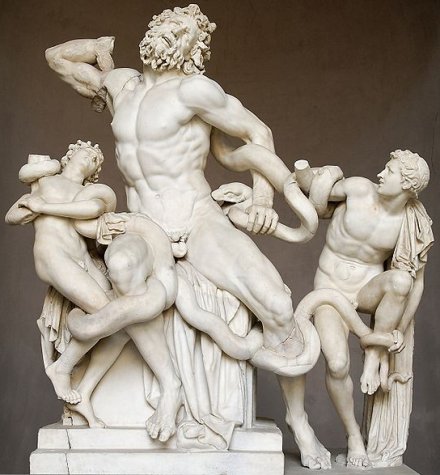
The Gladiator was also one of the best-known and -admired classical sculptures in all of Europe, along with the Laocoön.
In the 18th century they were compared as two examples of dignified dying. Contemporaries saw a certain stoicism in the sculptures — even though Virgil wrote that Laocoön cried out.
Ultimately, Smugglerius reminds us what happens when power is unrestrained. In a world where most people don’t have a voice, the state can ignore the rights and dignity of individuals. The real story here is the story of arbitrary authority and the importance of an enfranchised citizenry with the ability to put limits on those wielding power.
* Hanged felons not sentenced to anatomization could still wind up being taken apart in an operating theater, either as a result of their striking a direct bargain with the surgeons, or involuntarily via London’s growing trade in illicit corpses.

 But this man was not a hapless victim of England’s Bloody Code, although he often enough offended the capital statutes against petty property crime.
 One of these two gentleman might well be the flesh-and-bones person behind the ghoulish