1793: A Lyon mitraillade

The executions on December 14, 1793 illustrated above (image from here) date to Revolutionary France’s violent suppression that month of the France’s second city for its resistance to Jacobin power.

We have alluded before to this bloody interim, led by the National Convention‘s ruthless emissaries Collot d’Herbois and Joseph Fouche — two men well aware that any appearance of undue leniency in the chastisement of Lyons might send their own heads under the guillotine back in Paris.

To accomplish such an urgent task, they dispensed with the mere guillotine and rolled out a new death-dealing technology: the mitraillades, or execution by grapeshot.*

This bizarre killing method involved lining up the prisoners to be executed — scores or hundreds at once at the height of the Lyons crackdown — before the mouths of cannon loaded with anti-infantry balls. When the cannons fired, they mowed down the victims en masse. And then, gloated the executioners’ Convention ally Barere, “the corpses of the rebellious Lyonese, floating down the Rhone, would warn the citizens of Toulon of their coming fate!”

Now, grapeshot is an outstanding weapon in the right spot, but it is not at all certain to kill its targets. On the battlefield, mangled survivors were just about as good as dead bodies when it came to mauling the soldiery.

But executioners usually aim for something a bit more predictably lethal. The mitraillades could not offer anything close to dependable, near-universal slaughter … and so the horror of the artillery discharge was followed (as one sees in the drawing above) by the horror of the many stunned and injured survivors of the cannonade being finished one by one at close quarters with muskets and bayonets. Though a single coup de grace might count as a mercy, a hundred at once made for simple butchery.

The mitraillade did such brutal work that the national government soon ordered its Lyons deputation to lay off the innovation and return to the standard device for a Republican execution — the guillotine.

* Present-day Francophones will most likely associate the word mitrailleuse with the machine gun. That term dates to a a 19th century “volley gun” capable of spitting out 25 rounds from a cluster of rifle barrel activated by a single crank; for obvious reasons, this weapon inherited its name from the French word for grapeshot, mitraillade.

On this day..

1793: Antoine Barnave, constitutional monarchist

I want a hero: an uncommon want,
When every year and month sends forth a new one,
Till, after cloying the gazettes with cant,
The age discovers he is not the true one

Barnave, Brissot, Condorcet, Mirabeau,
Petion, Clootz, Danton, Marat, La Fayette
Were French, and famous people, as we know;
And there were others, scarce forgotten yet,
Joubert, Hoche Marceau, Lannes, Desaix, Moreau,
With many of the military set,
Exceedingly remarkable at times,
But not at all adapted to my rhymes.

-Lord Byron, Don Juan

On this date, French Revolution orator Antoine Barnave — a founder of the short-lived Feuillants faction — became short-lived himself courtesy of the Paris Terror.

Just one of the side courses when the Revolution devoured its own children, Barnave (English Wikipedia entry | French) was a smart young avocat in the 1780s who distinguished himself at the Parlement of Grenoble.

Avant-garde ideas like political power redistributed to reflect “the new distribution of wealth” were just the sort of revolution that a wealthy lawyer could get behind.

Duly elected at the ripe old age of 27 to France’s watershed (and last) Estates-General of 1789, Barnave was a very early member of the Jacobin Club. You know, before it was cool.

Barnave’s genteel vision of the Revolution transferring the estates of the ancien regime into the mercantile hands of his friends in the bourgeoisie fell spectacularly to pieces in 1791.

That April, Mirabeau died. He was Barnave’s great debating rival in the Jacobin Club, but both men actually represented the same fundamental persuasion: constitutional monarchy. Needless to say, this Revolution was not built to halt at that particular milepost.

Within mere weeks, almost as if the players had been awaiting the literal death of Mirabeau’s moderation, events hurtled past Barnave’s sensibilities. The desperate royal family made its ill-chosen flight to Varennes in June, and the well-regarded Barnave was one of the Constituent Assembly delegates sent to escort Louis XVI back to a Paris now boiling with republican sentiment. Did not the sovereign’s literally attempting to desert from his patrimony entail an abandonment of his station?

In perhaps the pinnacle of Barnave’s rich career in political oratory, he delivered to the National Assembly on July 15 a thundering no to that proposition, challenging his fellow delegates to choose “between attachment to the Constitution and resentment against a man.”

I ask to-day of him among you who may have conceived every kind of prepossession and the deepest and most violent resentment against the executive power — I ask him to tell us whether his anger with that power is greater than his attachment to the law of his country.

Those who would thus sacrifice the Constitution to their resentment against one man seem to me far too liable to sacrifice liberty in their enthusiasm for another; and since they love a republic, now is the time to say to them: How can you wish for a republic in a nation where you hope that the action, easily pardoned after all, of an individual who has much to plead in his justification, that the action of an individual, who though certain qualities of his are now condemned, long possessed the people’s affection — when, I say, you hoped that the deed he has done might change our Government, how was it that you were not afraid that this same variableness of the people, if once they were moved by enthusiasm for a great man, by gratitude for great deeds — because the French nation, you know it, can love much better than it can hate — would overthrow your absurd republic in one day? (Source)

Barnave, to his grief, was entirely clear on what he desired in July of 1791: “all change is fatal now; all prolongation of the Revolution is disastrous now; the real question to my thinking is this, and the national interest is bound up with it; are we going to end the Revolution, or are we going to begin it again?”

His speech carried the motion on July 15th: Louis remained king. Still, the Revolution did not exit into past tense on Barnave’s say-so, and certainly not on so insubstantial a basis as “a resolve to be peaceful, a common resolve, a drawing together.”

He had the applause of the Assembly, which printed his speech for national distribution. But tempestuous debates broke out in Jacobin clubs and other radical circles, and amid intemperate accusations of treasonable conduct by the all-change-is-fatal-now crowd there were oaths sworn never to recognize the kingship of Louis XVI.

On July 17, a huge crowd led by Georges Danton filled the Champs de Mars to petition Louis’s removal. And in response to the Jacobin Club’s announced intention to support this demonstration — which turned into a galvanizing massacre when the Marquis de Lafayette had his national guardsmen fire on the protesters — Barnave with his friends and political allies Adrien Duport and Alexandre Lameth dramatically abandoned the Jacobins and split off the rival Feuillants.

In their day, this so-called “triumvirate” had been the Jacbins’ left wing. By now, they were the the revolution’s conservatives: the monarchists against the republicans, and the guys who liked the Revolution’s existing changes just fine.

“If the Revolution takes one more step, it cannot do so without danger,” Barnave intoned in that July 15 address of his. (Source) “If it is in the direction of liberty, the first act to follow could be the destruction of royalty; if it is in the direction of equality, the first act to follow could be the violation of property … is there still to be destroyed an aristocracy other than that of property?”**

Not everyone found those one-more-steps quite so terrible to contemplate as did the the silver-tongued Grenoble barrister.


Political cartoon of the Janus-faced Barnave — the man of the people in 1789, turned the man of the royal court in 1791.

If we have the luxury from posterity to smile at the notion of the Revolution’s peacably halting itself in 1791, the Feuillants had cause in their moment to think they could pull the trick.

Their move at first dramatically weakened the Jacobins, as the ranks of moderates flocked to Barnave’s prestige and eloquence. The Paris Jacobin Club lost three-quarters of its membership almost overnight, and most of its Assembly deputies. Public sentiment, at least so well as its contemporaries could discern, veered towards Barnave as well, and he was able to finalize the long-awaited Constitution of September 1791 preserving a number of important executive powers for the king’s own person.

The period of governance under that constitution opened with an address by the king that Barnave had written for him; its first few months are the “Feuillant Ministry”. Barnave was the beleaguered royal family’s chief advisor in this period.

But the Feuillant Ministry was crumbling almost from its inception. Its supporting club was founded on abhorrence for the popular politics whose force was still being uncovered in the Revolution; Barnave wanted nothing so much as the end of such societies altogether. So while the monarchists had secretaries exchanging delegated backslaps at private confabs, the reduced Jacobins — now the most passionate rump, helpfully purged of their milquetoast liberals — redoubled themselves under the sway of men like Marat and Robespierre. Barnave’s apparent alignment with the now-constitutional monarch gave legs to the “royalist” charge that was more and more laid at his feet, and Jacobin Clubs soon began receiving as prodigals former members who had found their dalliances with the Feuillants unsatisfactory.

Barnave and his faction came under relentless siege by pamphleteers, journalists, and radical democrats. One wonders if, in the end, Barnave took some cold comfort in having seen an implacable antagonist like Brissot precede him to the guillotine when his own Girondin faction, formerly the fire-eaters, tipped over the Revolution’s starboard bulwarks.

Meanwhile, the impolitic demand emanating from Marie Antoinette’s brother, the Holy Roman Emperor that the French royal family be safeguarded put France on its way to war with Austria, an outcome entirely contrary to not taking one more revolutionary step.

The hounded Barnave retired to Grenoble in January 1792 by which time the constitution he had so diligently promulgated had already virtually ceased to function, and he himself lost influence with both the king and the Assembly. In the months to follow the war tocsin undid his fellow-constitutionalists remaining in Paris. Consigned to the sidelines, their faction was arrested as royalists after the August 10, 1792 overthrow of the Bourbons.

Barnave’s papers were inventoried for hints of treasonable correspondence with the fallen king and queen, but as the curtain had not yet raised on the Terror — and Barnave had not been deported to the prisons of the capital in time for the September Massacres — he had an uncommonly lengthy period of political imprisonment. Barnave exercised this time composing his De la Révolution et de la Constitution (later published as Introduction à la révolution française), an economic history arguing that the rise of industry and manufacturing had transferred the leading role from France’s aristocrats to her bourgeoisie.

With the onset of the Terror, he was shipped to Paris to face treason charges owing to correspondence with Marie Antoinette, where his famous oratory took its last public turn for an audience that had stopped up its ears.

Finally, citizens, I recall this to you; I might have left France in all safety. Perhaps those who still love me will have reason to lament that I did not do what was so easy for me; but, whatever happens, I shall not have to reproach myself with having challenged the judges of my country, with having cast doubts on their integrity, their justice. I shall be sacrificed perhaps, but I had rather owe my ruin to human error than have pronounced my own condemnation. I shall carry to the scaffold the same calmness which you have seen me show in the debate, and to the last moment I shall pray for the welfare of my country. (Source)

He was beheaded with four other people at the Place de la Revolution on the morning of the very next day.

French speakers might enjoy this public domain book by Jules Gabriel Janin. This post has also quoted several times from Eliza Dorothy Bradby’s 1915 English biography of the man.

* It later emerged that Mirabeau was being paid by the royalist party.

** One of the steps towards equality so troubling to Barnave had been a push among Jacobin radicals to resolve upon the emancipation of black slaves in the colonies. Fretting the loss of, e.g., the lucrative sugar revenues of Saint-Domingue (Haiti), Barnave staunchly opposed this; he was one of the leading lights of the pro-slavery Massiac Club. (French link)

On this day..

1795: David McCraw, “blasted all our conjugal happiness”

On this date in 1795, Donald McCraw was hanged in Perth, Scotland. A weaver by trade, McGraw joined the great human migrations the Industrial Revolution was stirring by migrating from the Highlands to Perth’s booming textile industry.

There, he laments in a bracingly emotional confession published as a broadside on the day before his execution,

[I] might have lived very comfortable, if it had not been for that curse to all peace and happiness, an overbearing temper in myself, and a fractious discontented temper in my unfortunate wife, [which] blasted all our conjugal happiness, so that instead of bearing with one another, as we are commanded in scripture 1 Pet. 3:7-11, our time was unhappily spent in mutual railings, upbraidings, threatenings, and even blows. In this most disagreeable life we lived for several years, but wickedness did not stop here, which may teach those who have the pattern of dreadful example before them, how dangerous a thing it is to live a wicked life, and how any vice persevered in grows in us like a second nature, and rare if it be ever left off.

I had long made a practice of beating my unhappy wife, custom made me almost think it no crime till it ended in the horrid crime of murder! And that at a time, which made it a double crime, when she had only one month between her and childbed.

Oh how unhappy have I been, to embrue my hands in the blood of my helpless wife, and my innocent unborn offspring. I no sooner committed the horrid crime, and saw her lying lifeless, than I was seized with such a trembling horror, that had I been lord of a thousand worlds, I would freely have given them all to have had the horrid deed recalled; but alas! it was done past recalling.

McCraw at first fled his crime but after running just a few miles he

began to reflect that I could not fly from the presence of an all-seeing God, nor run from the guilty conscience that now overwhelmed my heart; for should I fly to the uttermost corner of the earth, I would still be in his presence, and my guilt would accompany me. I therefore thought it would be better to give myself up to justice, and suffer what I justly deserv’d, than live with the pangs of a guilty conscience which are worse than death.

After hanging, McCraw was delivered to the city’s doctors for dissection.

On this day..

1793: Madame Roland, éminence grise

(Thanks to Amelia Fedo, a graduate student in French literature, for the guest post.)

On this date in 1793, Manon Roland (née Phlipon)* was guillotined as part of the Girondist purges in the Paris Terror.

As Olympe de Gouges — who preceded her to the guillotine by only a few days — observed, being a woman may have prevented her from holding political power under her own name, but it didn’t stop her from losing her own head.

Born in Paris to a bourgeois engraver, she married up through her alliance with quasi-aristocrat Jean-Marie Roland de la Platière. Twenty years her senior, he was chosen by her for his class status and intellect rather than for the love he inspired.

Ambitious from the start, Madame Roland took advantage of her husband’s (and later, her Girondin not-quite-lover François Buzot‘s) engagement in civic life to catapult herself into the role of behind-the-scenes stateswoman. She had been prepared for this role since childhood, when she had voraciously read Rousseau and Plutarch. Unlike Olympe de Gouges, she internalized the idea that women did not belong in politics — yet still she yearned to have an influence on the Republic.

And she did indeed succeed in wielding political power, with enough competence that Robespierre wanted her guillotined at least as much as her husband: everyone knew that she was the real force to be reckoned with.

Her political career was inextricably tied to her husband’s. Unable to hold political office herself, she lived vicariously through him. At first he was a bureaucrat, and she his secretary and personal assistant; but then he became involved in Parisian politics and was eventually appointed Minister of the Interior.

It was his wife who encouraged him to accept the position; for a year now she had been hosting salons frequented by a wide range of political movers and shakers, and she was itching to get in the game.

Monsieur Roland did not have a brilliant career as minister. His wife was the one with the vision and energy (the historian Lucy Moore claims that every good idea he had was hers); although devoted to Republican ideals he remained something of a milquetoast, and was attacked both by the snobby old guard (the lack of buckles on his shoes caused a scandal) and by the extreme left.

Although Madame Roland identified with Robespierre and was a good deal more radical than the Girondins (especially in her feelings about the monarchy), she and her husband were still officially associated with them. As such, they were swept up in Robespierre’s purges.

There were a few pre-Terror false alarms: a warrant was issued for Monsieur Roland’s arrest after the September Massacres, which Danton put the kibosh on; and in 1792, Madame Roland was dragged into court on trumped-up charges of corresponding with émigrés, but was able to use her oratorical skills to get herself acquitted.

When the Terror began, Monsieur Roland opted to keep his head down in the hopes of keeping it on, and resigned from his post as minister.

It was too late. In May 1793 Madame Roland was arrested again — unaccompanied by her husband, who had managed to escape into hiding.

She was subjected to a show trial like so many before and after her; although she had prepared a defense, she was not allowed to read it. Given that she was accused of “conspiring against the unity and the indivisibility of the Republic and attempting to introduce civil war,” neither her verdict nor her sentence are much of a surprise.

She was preoccupied with her husband (whom she declared would be driven to suicide by her execution), with Buzot (who was in grave danger of suffering her same fate), and with her own legacy. She seized the opportunity to be a martyr like the men she so admired — men who had been able to act in the open, rather than behind the scenes — and took advantage of the free time she had in prison to write her memoirs.

Most sources give similar accounts of her behavior before and during the execution. Content to die for her principles — or, perhaps, simply resolved to make a show of contentment — she maintained great calm and resignation in her final hours. The only favor she asked of anyone was that her childhood friend Sophie Grandchamp wait for her on the Pont-Neuf so that they could see each other when the tumbrel passed.

Influencing people up to the very end, Roland’s last political act was an attempt to impart some of her courage to the man who would share her tumbrel, a forger of assignats named Lamarche.

Lacking the sort of great social narrative that would give meaning to his death (such as a personal feud with Robespierre), Lamarche did not share Roland’s sanguine attitude; he thus found himself the recipient of a performance designed to alter his mood, consisting mostly of jokes, distractions, and modeled behavior. The events surrounding her execution have passed into legend, but various sources agree that she quipped to Lamarche after his hair was cut, “It suits you wonderfully. You have the head of a Roman.”

She also urged the executioner to leave her own hair long enough to serve as a suitable handle — for him to show her head to the crowd, of course.

As much as she detested Danton, it appears she had a few things in common with him after all.

Counterintuitively, it was considered a privilege to be guillotined first; it was merciful, the reasoning went, to kill someone before they could see others die. Roland chose to pass up this “privilege”; most attribute this to her desire to spare Lamarche the sight of her death, but Lucy Moore points out in Liberty: The Lives and Times of Six Women in Revolutionary France that she may have rejected the logic of such a “mercy” altogether and wished to live — like Madame du Barry — even a few moments longer.

After mounting the scaffold, she addressed a statue of Marianne, left over from a festival held in the Place de la Révolution; she is traditionally said to have exclaimed, “O liberty, what crimes are committed in your name!”, although a less reputable source (i.e., the apocryphal Sanson memoirs) assigns her the more prosaic last words, “Oh! Liberty, how they’ve tricked you!”

As she had predicted, her husband committed suicide two days later, falling on his sword as soon as he learned of her fate.

*This is only one of many names she has been called; Siân Reynolds explains in Marriage and Revolution: Monsieur and Madame Roland that “Manon” is a childhood name, and her adult name remains mysterious; it was either “Marie,” “Jeanne,” or “Marie-Jeanne.”

A few books about Madame Roland

On this day..

1792: Three of the H.M.S. Bounty mutineers

On this date in 1792, three men were hanged from the yardarms of the H.M.S. Brunswick in Portsmouth Harbor.

Their crime was participating in that famous or infamous act of seaborne resistance, the Mutiny on the H.M.S. Bounty.

There are so many excellent resources already for enthusiasts of this adventure that a generalist site such as this one can scarcely hope to contribute. Much of the commentary through the years has gravitated towards asserting (by implication at least) the ought between the allegedly oversensitive first mate Fletcher Christian and his allegedly tyrannous captain William Bligh.

Their confrontation is too well mythologized to require commentary here. We only wish to note that this workplace spat occurred in furtherance of a mission whose purpose was the application of the lash to other laborers than the Bounty‘s Able Seamen.

Lord Byron fictionalized Bligh’s and other mariners’ accounts to render “The Island”, a poem surprisingly sympathetic (given Byron’s radical proclivities) to the officers mutinied upon. In it, he depicts the Eden-like plenty of Otaheiti

The gentle island, and the genial soil,
The friendly hearts, the feasts without a toil,
The courteous manners but from nature caught,
The wealth unhoarded, and the love unbought;
Could these have charms for rudest sea-boys, driven
Before the mast by every wind of heaven?

The Bread-tree, which, without the ploughshare, yields
The unreaped harvest of unfurrowed fields,
And bakes its unadulterated loaves
Without a furnace in unpurchased groves,
And flings off famine from its fertile breast,
A priceless market for the gathering guest …

Those fertile-breasted breadtrees were the object of Bligh’s voyage: they were to be acquired, potted, and sailed onward to the Caribbean where they’d be transplanted in hopes of providing a cornucopia … of profits to sugar plantations whose slaves’ hands an “unreaped harvest of unfurrowed fields” would free for an added margin in the export economy.*

The Bounty bartered for and potted up over 1,000 specimens during a protracted five-week layover Tahiti, a literal Bounty that the crew would prove to prefer to the floating despotism under Capt. Bligh.

Those mutineers turned the breadfruit-ship ’round and settled themselves back on Tahiti or on Pitcairn Island,* burning the Bounty in hopes of simply disappearing from imperial Britain’s circuits of maritime accumulation.

Cast adrift in the Pacific, Bligh somehow guided the 7-meter open launch 6,700 kilometers to Timor, losing only one of his 18 loyal passengers along the way — a feat of seamanship Bligh himself told all about in a first-person account. From the East Indies, Bligh caught a ride back to England and reported the insurrection to the Admiralty in March 1790, more than two years after his ill-starred voyage had set sail from Spithead.

So in 1791, a 24-gun ship called Pandora set out carrying a box of evils for the mutineers. The latter had, in this time, found the comforts of the South Pacific at least somewhat less congenial now that they proposed to make themselves permanent residents and moreover anticipated native deference to their race despite having opted themselves out of the authority that underwrote said privilege. Fletcher Christian himself is thought to be among the mutineers who died in conflicts with the natives.†

Still, the Pandora found 14 of the Bounty‘s former crew to round up and return for British judgment. (The Pitcairn settlement escaped notice altogether; it was only chanced upon by an American ship in 1808 by which time nobody had any interest in persecuting the last remaining mutineer.)

The three featured today were, perhaps surprisingly, the only ones to pass through all the filters from detention to execution, filters that one might have thought would winnow only fleetingly in the case of such an impudent rebellion.

  • To begin with, the Pandora ran aground on the Great Barrier Reef on its return voyage. Only at the last moment did a boatswain unlock the cell where the prisoners were being held — and only 10 of the 14 managed to escape being swallowed up by the seas.
  • The ensuing court-martial acquitted outright four of those remaining ten — men whom Bligh himself described as innocent loyalists who had been forced to remain with the mutineers.

The Admiralty court-martial had a job to fix the six other sailors in their right spots along the spectrum from “enthusiastic mutineer” to “passive participant” to “had to go along with events outside of their control.” It took a good deal of testimony from Bligh’s loyalists about who was armed, who gave a sharp word, and so forth, during the critical moments of Fletcher Christian’s coup. (Legal proceedings in the Bounty case are collected in their entirety here, part of a rich trove of primary sources related to the incident.)

In the end, all six whom Bligh did not vouch for got the same sentence — death — but the court endorsed several for royal mercy. The three who eventually hanged on October 29, 1792 were:

  • Able Seaman Thomas Burkitt or Burkett. Multiple witnesses made him an armed and active member of the mutiny from its very first stroke, assisting Fletcher Christian’s nighttime seizure of the sleeping captain.
  • Able Seaman John Millward. He too was placed among the armed mutineers by witnesses; in fact, prior to the mutiny, he had attempted with two other crewmates to abscond from the Bounty and spent three weeks hiding out in Tahiti before recaptured.
  • Able Seaman Thomas Ellison. Just 16 or 17 years old at the time of the mutiny, Ellison was made to hand over his watch at the helm to a mutineer. His efforts at court to portray himself as loyal to Bligh and only unwillingly swept up in events were contradicted by one of the men set adrift with the ex-captain, but have been favorably received by many later interlocutors. The Charles Nordhoff-James Hall novelization Mutiny on the Bounty presents Ellison as an innocent.

Three others condemned with this trio at the same court-martial who might have shared their execution date were spared that fate.

  • Able Seaman William Muspratt copped a stay and eventually a commutation of sentence based on having been prevented from calling his desired witnesses. He returned to active duty at sea.
  • James Morrison, notable for having built a schooner on Tahiti with which he attempted unsuccessfully to sail for the East Indies, was recommended for mercy by the court which condemned him. While incarcerated, Morrison wrote a journal giving his account of the mutiny; he too returned to active service as a gunner.
  • Midshipman Peter Heywood, the only officer charged, was like Morrison pardoned at the court’s recommendation. He put in many years of respectable service at sea, eventually retiring with the rank of post-captain. Anticipating his being tongue-tied when the pardon was announced to him, he had a note ready-written to hand the angel of his deliverance: “when the sentence of the law was passed upon me, I received it, I trust, as became a man; and if it had been carried into execution, I should have met my fate, I hope, in a manner becoming a Christian … I receive with gratitude my Sovereign’s mercy; for which my future life shall be faithfully devoted to his service.” (London Times, Oct. 30, 1792)

* This breadfruit scheme was the brainchild of Joseph Banks, an empire-minded botanist who was also a leading advocate of diverting the convict labor formerly exported to America to Australia instead.

After all the mutiny business had been sorted out, Bligh commanded a second, do-over voyage to dump breadtrees on Jamaica. Slaves’ distaste for the delicacy caused the voyage’s immediate objectives to fail; however, the imported fruit would eventually become a Jamaican culinary staple.

** Descendants of the Bounty mutineers and native women still inhabit Pitcairn to this day. It’s the smallest self-governing national jurisdiction in the world.

† The last mutineer on Pitcairn gave vague and contradictory accounts of Christian’s death. It was long rumored that he might actually have escaped Pitcairn and secretly returned to England: if so, he was never exposed.

On this day..

1796: Thirty Jacobins for the Affaire du camp de Grenelle

On this date in 1796, 30 Jacobins were shot by a military commission in under the French Directory for attempting to subvert the army.

This final, failed enterprise of Gracchus Babeuf‘s “Conspiracy of Equals” took place months after Babeuf himself had been arrested on the eve of his envisioned revolution.

“Song of the Equals”
Babouvist popular song from 1796

For too long a wretched code
Enslaved men to men:
May the reign of the brigands fall!
Let us finally know what our condition is
Awaken to our voice
And leave the darkest night behind,
People! Take hold of your rights,
The sun shines for all.

You created us to be equal,
Nature, oh beneficent mother!
Why, in property and labors,
This murderous inequality? Awaken!

People, smash the ancient charm
Of a too lethargic slumber:
With the most terrible of awakenings
Spread alarm to grinning crime.
Lend an ear to our voice
And leave the darkest night behind.
People, take hold of your rights,
The sun shines for all.

In the uncertain aftermath of Robespierre’s fall, the interregnum of the Directory saw both royalists and republicans jockey for a restoration of their former prerogatives (and jockey against one another, of course). Babeuf’s conspiracy might have been the boldest stroke of all had it come off; instead, a projected rising for May 11, 1796 was scotched by Babeuf’s pre-emptive arrest.

But to strike the head was not to slay the movement. The economy was a mess and the political authority a rudderless, unpopular clique. The coup attempt didn’t happen but Jacobin agitation continued to mount — met in its turn by royalist agitation, the two parties dangerously hellbent for one another’s blood. The imprisoned Babeuf (he wouldn’t be guillotined until the following year) made one such focus of agitation — and eventually, of more conspiring.

Babeuf’s allies conceived a plan of swaying the regiment of dragoons then encamped on the plain of Grenelle outside of Paris. (Today, part of the 15th arrondissement.)

On the night of September 9-10, several hundred armed Jacobins assembled and descended on the camp of Grenelle — intending not to fight, but to fraternize, hoping that sympathetic soldiery could be swung to liberate Babeuf and mount a rising against the Directory. This strange and desperate episode was in the end the acme of babouvisme, and was crushed out of hand by officers of the regiment.

Most of the would-be fraternizers scattered but 132 were arrested. At snap military trials — legally questionable since most of the instigators were civilians — 33 death sentences were meted out. Three were delivered in absentia; the 30 others were all enforced by musketry on this date.

The most notable casualties among those 30 were (these are French Wikipedia links all):


More about Babeuf, “the first modern communist”, by the speaker in this lecture here.

* All three had in their day voted the death of King Louis XVI.

On this day..

1793: Walter Clark, hanged women’s father

On this date in 1793, Walter Clark was executed for burglary at Morpeth, with one Margaret Dunn. Clark rates a mention in the spirit of the apple not falling far from the tree: a year before Clark’s conviction and hanging, his two daughters Jane and Eleanor had suffered the same fate with William Winters for a murder committed just up the road from Morpeth.

On this day..

1792: William Winter, Elsdon Moor gibbet habitue

Atop a hill called steng Cross at the Northumberland village of Elsdon stands an eerie heirloom of England’s gallows history: Winter’s Gibbet. (Or “Winter’s Stob”, to use the local parlance.)


(cc) image from Flickr user johndal

It was here — within sight of the spot where he had murdered an old shopkeep to plunder her stores — that William Winter was gibbeted in chains following his August 10, 1792 hanging at the Westgate of Newcastle. In this fate, he followed his father and brother, hanged four years prior at Morpeth.

According to William Weaver Tomlinson’s Comprehensive Guide to the County off Northumberland,

In 1791 there lived here an old woman named Margaret Crozier, who kept a small shop for the sale of draper and other goods. Believing her to be rich, one William Winter, a desperate character, but recently returned from transportation, at the instigation, and with the assistance of two female faws [vendors of crockery and tinwork] named Jane and Eleanor Clark, who in their wanderings had experienced the kindness of Margaret Crozier, broke into the lonely Pele on the night of 29th August 1791, and cruelly murdered the poor old woman, loading the ass they had brought with her goods. The day before they had rested and dined in a sheep fold on Whisker-shield Common, which overlooked the Raw, and it was from a description given of them by a shepherd boy, who had seen them and taken particular notice of the number and character of the nails in Winter’s shoes, and also the peculiar gully, or butcher’s knife with which he divided the food that brought them to justice. No news, however, of Jane and Eleanor Clark’s fate.

This last line, however, is mistaken: Jane and Eleanor were hanged with William Winter. Indeed, “such was the uncommmon strength of William Winter, that, after receiving sentence of death, he carried both his female companions, one under each arm, from the bar, and across a wide street to the old Castle; supporting, at the same time, his own heavy chains, as well as the irons affixed to the women.” Afterwards, these lightweights weren’t gibbeted, but given over for dissection.

Winter’s rotting corpse hung for many years on his gallows. After it fell apart, the structure was dismantled — but in 1867 the English naturalist Walter Trevelyan, now landlord of the site, had a replica erected with a wooden mannequin. That figure was in its turn stolen, and over the years only the oft-stolen and -replaced wooden head has remained; even the gallows itself was torn down at least once. But it has weathered the years and borne the dim memory of William Winter down to the present day.


At the base of the Winters Gibbet sits a stone that was once the base of a Saxon cross that gave Steng Cross its name — an old medieval marker on the road from Elsdon to Wallington and Morpeth.

(cc) images above from Flickr users Phil Thirkell (first two) and just1snap (last two)

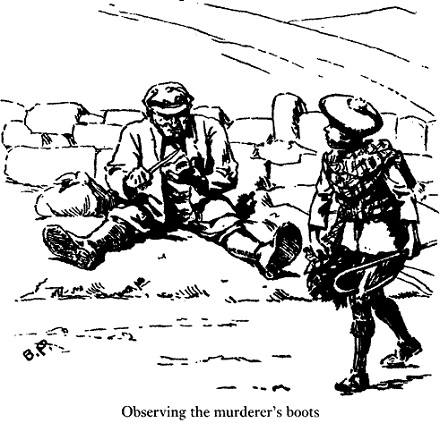
That legend alluded to by Tomlinson, that the shepherd’s boy was able to identify Winter by the pattern of his hobnails, was later exploited as an exemplar of watchfulness in Lord Baden-Powell‘s seminal Scouting for Boys, the book that launched the scouting movement.

“The following story, which in the main is true, is a sample of a story that should be given by the Instructor illustrating generally the duties of a Boy Scout,” runs the introduction to a three-page exegesis on the “strong, healthy hill-boy” who easily covered several miles after passing Mr. Winter, came upon the scene of the crime, recognized the bootprints, and summoned constables whom he guided back to the escaping murderer.

Thus the boy did every part of the duty of a boy scout without ever having been taught.

He exercised —
Woodcraft
Observation without being noticed
Deduction
Chivalry
Sense of duty
Endurance
Kind-heartedness

That last virtue Baden-Powell attributes by dint off the youth’s being broken-hearted at beholding the gibbet, to realize he had caused the criminal’s death. “You must not mind that,” says a magistrate to the child in a fabricated dialogue. “It was your duty to the King to help the police in getting justice done, and duty must always be carried out regardless of how much it costs you, even if you had to give up your life.”


Illustration from Baden-Powell’s Scouting for Boys.

The historical Robert Hindmarsh sort of did pay that most extreme price for his duty; allegedly he was so terrified of reprisals that it led him to an early grave just a few years later. This circumstance, instructive of the marauding family’s reach and impunity, might be further bolstered by the popular superstition that Elsdon Moor is also haunted: a “Brown Man of the Moors” tale predates this crime, but is also sometimes conflated with the purported apparition of William Winter himself.

On this day..

1794: Rosalie Lubomirska, mother of Balzac’s antagonist

On this date in 1794, the Polish princess Rosalie Lubomirska was guillotined during the Paris Terror.

The hottest thing to come out of Chernobyl before 1986, the glamorous young Lubomirska had it all going for her before Europe turned revolutionary.

Her support for the reformist Patriotic Party in her homeland required her flight on to France when a Russian invasion defeated that movement in 1792. Indeed, short as her own thread was cut, Rosalie Lubomirska was only barely outlived by the Polish-Lithuanian Commonwealth itself.

But escaping to her friend Marie Antoinette in France might not have been the savviest choice.

The irrepressible Melanie “Madame Guillotine” Clegane, author of such topical historical fiction as The Secret Diary of a Princess: A Novel of Marie Antoinette, has everything you need to know about Rosalie Lubomirska’s activities from that point in this post: going royalist after the execution of Louis XVI, taking Vendee rebels into her salon and/or bed, and seeing her lovers precede her to the guillotine while she desperately bought time by feigning pregnancy.

She left behind a young daughter. In much later years, this little girl grown up and married to noted Orientalist scholar Waclaw Seweryn Rzeuwski would manifest as a side character in a very different story: she is “Aunt Rozalia”, whose niece was Ewelina Hanska, the admirer turned wife of the novelist Honore de Balzac. Aunt Rozalia was a bitter foe of Ewelina’s declasse romance with the bourgeois scribbler and to judge by the correspondence of the lovers was continually trafficking in rumors that Balzac — who was in actuality a legendary workaholic — was a gambler, boozer, or suchlike dissipated wastrel.

Balzac gave his antagonist the gift of literary immortality by using her as an inspiration (one inspiration: his own mother was another) for the titular killjoy spinster in his novel Cousin Bette.

On this day..

1795: Ignac Martinovics and the Magyar Jacobins

On this date in 1795, Ignac Martinovics was beheaded in Budapest with other leaders of a Hungarian Jacobin conspiracy.

A true Renaissance man, Ignac (Ignatius) Martinovics (English Wikipedia entry | the more detailed Hungarian) earned doctorates from the University of Vienna as both a scientist and a theologian.

He ditched a youthful commitment to the Franciscan order and went on a European tour with a Galician noble named Count Potoczki,* rubbing shoulders with the likes of Lalande and Condorcet.**

This journey stoked Martinovics’s political interests along with his scientific ones.

After spending the 1780s as a university instructor at Lwow, the ambitious scholar became the Austrian emperor’s “court chemist” — a position that got pegged back almost immediately upon Martinovics taking it by the 1792 death of the scientifically inclined Emperor Leopold II.

This at least gave Martinovics ample time to devote to his interest in the political secret societies coalescing in sympathy with the French Revolution. Despite his authorship of tracts such as Catechism of People and Citizens, his overall stance in this movement is debatable; Martinovics was also a secret police informant, and some view him as more adventurer than firebrand.

But the adventures would worry the Hapsburg crown enough for martyrs’ laurels.

Tiring of whatever gambit he was running in the imperial capital, Martinovics returned to Hungary and marshaled a revolutionary conspiracy by fraudulently representing himself as the emissary of the Parisian Jacobins.

About fifty Hungarian conspirators were arrested when this plot was broken up, resulting in seven executions. These “Magyar Jacobins” are still honored at Budapest’s Kerepesi cemetery.


(cc) image from Dr Varga József.

* A much later Count Potoczki was assassinated by a Ukrainian student named Miroslav Sziczynski (Sichinsky) in 1908, who was in turn death-sentenced for the murder. Sziczynski won a commutation, and was eventually released from prison, emigrated to the United States, and became a respectable statesman for the Ukrainian national cause.

** See Zoltan Szokefalvi-Nagy in “Ignatius Martinovics: 18th century chemist and political agitator,” Journal of Chemical Education, 41, no. 8 (1964).

† Martinovics’s chemistry experimentation in this period led him to oppose Lavoisier‘s theories of combustion. The two shared the same fate, whatever their differing hypotheses.

On this day..