1792: Arnaud de La Porte

Ancien regime minister Arnaud de La Porte was guillotined on this date in 1792* by the new order.

Stock of a long line of Versailles courtiers, de La Porte (English Wikipedia entry | French) followed his father into administration with a specialty in naval finances. He knocked around maritime bureaus from the time he was a whelp of 18 in 1755; he was at last named Louis XVI‘s Minister of the Navy on July 12, 1789 — two days before the Bastille fell.

He had both the wisdom to immediately expatriate himself to Spain, and the loyalty to answer his harried sovereign’s summons to return; by December 1790, he was appointed intendant of the Civil List and minister of the king’s household.

This made de La Porte the bagman in the king’s campaign to buttress the Revolution’s moderating forces — writers, thinkers, and artists in the constitutional monarchist camp, as against the Marats — to which end some 200,000 livres dropped from his fingers every month. All was to little avail.

De La Porte’s position made him a close confidante of the royal family. When the latter attempted the ill-starred flight to Varennes, it was de La Porte who was entrusted to present the absconded king’s Dear John note to his jilted subjects in the Constituent Assembly.

With the king’s embarrassing capture, the Capets’ confinement became ever more uncomfortably close, and with them that of a loyal aide who must have passed a few moments contemplating the Iberian charms he had abandoned to share this bitter draught — until the following summer when Danton et. al. finally overthrew the monarchy on August 10, 1792.


A bad day for Arnaud de La Porte: the storming of the Tuileries Palace on August 10, 1792, by Jean Duplessis-Bertaux.

De La Porte was overthrown with them.

While revolutionary Paris is synonymous to posterity with frightful political trials, it was in the aftermath of the August 10 revolution that they began, and then as novelties. (The guillotine at this point was itself just a few months old.)

Endeavoring to cement their triumph, the revolutionaries constituted a tribunal to try the deposed royalist ministers as traitors for their maneuverings. (They also obviously blocked any prosecution of their own number for massacring hundreds of Swiss Guards who fought to defend the king.) These can be accounted among the first overt political trials of the revolution, the harbingers of the coming Terror and ill omen for the judgments the Revolution would levy against king, queen, and royals all. De La Porte in his closing address to the court fervently hoped his nation would not follow that dark road.

Citizens — I die innocent, notwithstanding that appearances are against me. May my blood, which is to be shed for the expiation of a crime of which I am not guilty, restore tranquility to this empire: And may my sentence be the last unjust arret which shall be pronounced by this Tribunal. (via the London Times, Aug. 30, 1792)

With the post-Napoleonic restoration, the man’s son — also named Arnaud — was created a hereditary baron in recognition of his ancestor’s service to the crown.

* The dates for these trials are very sloppily accounted for; this is also true of Durosoy, whose head was chopped off the next day.

As of this writing, de La Porte’s Wikipedia entries both French and English misdate his execution to August 23 (actually the date his examination began), and one will find sources placing it as late as August 28 whose attribution traces all the way back to the erroneous initial publications of the tribunals. To be sure, the trial against de La Porte had an unusual internal clock reflecting the revolution’s ad hoc process: it unfolded over the two days, and after conviction the accused was beheaded the same day, but not immediately — instead, de La Porte was returned from his court to prison for a few hours, where he dined before going to the scaffold in the evening.

By way of substantiation, we find that under an August 25 dateline (printed in the August 29 edition), the London Times correspondent reports from the scene thus:

The new criminal Tribunal, instituted for the trial of persons supposed to be concerned in treasonable correspondence with the late Executive Government, proceed in a very summary manner on the trial of those persons who have been so unfortunate as to fall into the hands of the mob. M. de la Porte, the late Intendant of the Civil List, was yesterday convicted, after a trial of 37 hours. Sentence of death was immediately passed on him, and at night he was conducted to the Place de Carrousel, where he was executed. During the whole of his examination at the bar, as well as at the place of execution, he behaved with great firmness, and declared his innocence to the last …

The principal evidence against M. de la Porte was, that he had employed the public money to libel the new Constitution, by employing different Journalists to write down the Jacobin faction … The proof against him was so slight and contradictory, that it was with great surprise and indignation that the sober part of the citizens heard of his conviction. He certainly fell a victim to the Royal cause and to justice.

On this day..

1791: William Jones, “in a country out of the reach of my enemies”

On this date in 1791, a man named William Jones hanged in Newark, N.J.

Jones cut an apologetic figure at his public execution, and a confession he signed off in the hours before was widely reprinted in New England newspapers. (This transcription is from the Boston Independent Chronicle of May 26, 1791.)

Knowing that without repentance there can be no salvation, and without a sincere confession of our public transgressions, there can be no true repentance, therefore I would give glory to God, exonerate and ease my own wretched mind; and as far as possible, afford that satisfaction to the public, by confessing my crimes, that others may take warning by my awful but just end, and be preserved from such horrid iniquities. This is the only reparation I can make to society, for the evil I have done, for which I am righteously, in the midst of my days, cut off from among men.

I confess I have been exceedingly wicked from my youth. I have been habitually addicted to Sabbath breaking, swearing, keeping evil company, gaming, drinking to excess; and when in liquor, passionate and quarrelsome, and have indulged myself to a high degree in other base and horrid abominations.

But the crime for which I am now to die, I would, with the greatest exactness relate. — I solemnly declare, I never intended to kill Mr. Shotwell, nor had I, at any time, as far as I know, murderous intentions in my heart against him, yet, I was the unfortunate man, that, to gratify my wicked passions, was the occasion of his death. I had long had a spite against Shotwell, because I looked upon it, that he & another man had injured me much, and were the cause of my being obliged to settle a civil prosecution, commenced against me, greatly to my wrong. Therefore I had often said, I would whip, beat or flog Shotwell, but as I never had a thought in my heart to murder him; as a dying man, I never said, I would kill him.

On the evening of Friday the 1st day of April, about or a little after sun down, I saw Samuel Shotwell pass my mother’s house driving cattle or a pair of oxen. In sometime, afterwards, I arose, went out into the road, and followed after him. I met Letts and stopped and talked with him for some minutes perhaps six or eight; then we parted and I followed after Shotwell. I crossed the fence in order to cut off a crook in the road and re-crossed the fence into the road still behind him. About three quarters of a mile from where I had seen Letts, I overtook Shotwell, and, without speaking a word to him, or he to me, I knocked him down with my fist, and there kicked him in the face and head, having on a pair of strong heavy shoes. I then passed the fence into the field opposite to where Shotwell lay. In a short time I saw him rise and go on the road, and I went along in the field. I had thoughts of going to a certain house, at no great distance before us, but before I came to the house, I altered my purpose, and so passed the fence into the road before Shotwell and going back along the way, I presently met him. I knocked him down again with my first, and again kicked him, and left him, and went on the road home. After sitting by the fire a little while, I went to bed, but was very uneasy lest I had beat Shotwell too much.

With regard to the club, of which much was said in the course of my trial, I never had it in my hand, nor did I ever see it, till the next day at the Coroner’s inquest. It was not the weapon I made use of nor had I any weapon whatsoever; but by knocking down Shotwell and kicking him in the manner related, I was the unhappy cause of his death.

I leave this testimony and confession, that my awful conduct may be a warning to others, that they by my dreadful fate, may be admonished to refrain from evil company, and from allowing themselves in drunkenness, wrath, malice or intemperate passions. My wickedness has brought me to this just and awful doom. May all others hear and fear!

WILLIAM JONES

A sad end for Messrs. Jones and Shotwell both; readers of the 21st century as well as the 18th ought to hear and fear.

But to the end of this awful but uncomplicated tragedy, we have this curious broadsheet published later in 1791.

What to make of this artifact?

One notices at first blush that as the document was printed in broadsheet form, it was presumably intended for the enrichment of its publisher … and we might suppose treacherous albeit not unpassable footing on the route from anyone actually party to such an occult missive in real life to a hustler harvesting gawkers’ pennies on the incredible secret. Indeed, it would be a profoundly ill turn for Jones or his correspondent, for no better reason than a gloat, to expose the physician of his deliverance to the sanctions that might attend unmasking. If this pamphlet’s remarkable claims were recapitulated in any other media at the time, I have not been able to locate it.

Even presuming that we have a sensational forgery, our bulletin does have something to say to us yet, and not only about the evergreen human fascination with surviving an execution.

This is a document from the Enlightenment, an interval where the vaunting progress of human ingenuity designed even to steal a march from the reaper himself by reviving the drowned or reanimating the dead.

Hangings were survived sometimes — not commonly, but often enough that the phenomenon was familiar and occasionally the enterprising condemned even schemed to accomplish it intentionally. Such a scenario necessarily inspired artists, whose fabulisms would only have reflected the fancies of their audiences. The scaffold was already being given over routinely as the portal to spiritual escape for the penitent knave crushed by his sin … why not the escapism of the flesh, too?

Maybe our broadsheet publishers took inspiration from the fantastic story a couple of years prior of a different man living through his hanging in Massachusetts. Though that earlier tale was perhaps more overtly crafted for moral instruction, the particulars of the harrowing procedure are much the same: the assistance of an obligingly altruistic doctor, the agonizing pain of resuscitation, and the convenient vanishing into unverifiable distant anonymity. Even Nathaniel Hawthorne would allude via a minor character in The Blithesdale Romance to the legend that an English banker executed in the 1820s had duped the hangman — and not unlike our William Johnson, Hawthorne judged that living phantom and his stolen years “a mere image, an optical delusion, created by the sunshine of prosperity, … [who] seemed to leave no vacancy.”

On this day..

1794: Nicolas Luckner, German marshal of France

On this date in 1794, Nicolas Luckner was guillotined in Paris.

A count with his own manor on the German-Danish frontier, Luckner (English Wikipedia entry | German, where he’s Nikolaus von Luckner) made the sort of cross-national career pivot that was still possible in the pre-revolutionary world by going from commanding hussars against France in the Seven Years’ War to serving in the Bourbon army.

Allegedly convinced that Marie Antoinette had blocked his advancement, Luckner supported the French Revolution, and by 1791 had summited his profession as Marshal of France.

He was the very commander of the Army of the Rhine to whom Rouget de Lisle dedicated the 1792 Chant de Guerre pour l’Armée du Rhin … the marchable tune which later became the Marseillaise. (Luckner’s name also appears on the Arc de Triomphe.)

Things did not go as swimmingly with the Army of the North, where he bogged down in the Low Countries — and the incriminating defection of the Marquis de Lafayette to France’s royalist enemies did him no favors in the court of Jacobin opinion. Luckner was relieved of his command by the impatient National Convention.*

This septuagenarian foreign count showed a lordly blindness to his adoptive country’s situation both fiscal and political by journeying to Paris later in 1793 to complain that his pension was not being funded in full. Other officers had already fallen under the Terror’s blade for command failure, where any shortcoming in the field could be readily conflated with treachery — and Luckner, no surprise, was soon denounced as a royalist.

City hall in the small Bavarian town of Cham, where Luckner was born in 1722, still chimes the Marseillaise every day to honor its native son … whose name also associates with Germany’s World War I naval hero Felix von Luckner, the great grandson of our man Nicolas.

* The Convention’s emissary on this occasion was Choderlos de Laclos … best known now (and then) as the author of the viperous epistolary novel of ancien regime misbehavior Les Liaisons Dangereuses.

On this day..

1794: Edmund Fortis, in the hands of God

On this date in 1794, Edmund Fortis was hanged in Dresden, Maine* — at the time still a part of the Commonwealth of Massachusetts.

Fortis was born a slave in Virginia but escaped and slipped into the wage economy by hiring out as a seaman on a ship bound from Alexandria, Va., to England. According to his dying confession he was a habitual petty thief; by the time he had made his way to Maine, “my life was dreadful — Drinking, stealing and gaming.”

Fortis admitted to, and even pleaded guilty to, the rape-murder of a young girl named Pamela Tilton whom he saw by chance and waylaid on a country road on May 18. This confession “the evidence of credible witnesses on oath … abundantly confirmed.” That’s from the sentencing oration of Justice Robert Treat Paine, via The Oracle of the Day (Portsmouth, N.H.), July 26, 1794, which continues with flourishes of hellfire —

This sentence, when executed, will remove you from this world, where you have proved yourself so unworthy an inhabitant, to a state of existence where you must reap the fruits of your past life; where you must appear before the awful tribunal of that holy Being, who cannot be deceived and who will not be mocked, and who will judge you for this and all the other sins in your life …

you have cast off the fear of God from your eyes, and all restraint of reverence to him from your thoughts, words, and actions, till your unbridled lust and malicious disposition had arrived to full ripeness, and urged you to the commission of crimes, at your own relation of which, nature revolts and the human heart is rent with agony. To what a pitch of brutal lust must you have arrived, that a person of your nation, your age, having a wife and children in the neighborhood, should so inhumanly assault and violate the chastity of that young girl in spight of her intreaties and remonstrances, and then with all the savage cruelty of a ruffian and an assassin, deaf to those cries and supplications which would have melted any heart but one lost to every humane feeling, you barbarously strangled to death the inoffensive victim of your lustful crime; thus in a short space of time destroying life, the first right of all mankind, and chastity, the second right of woman.

… repent and live … so, although your aggravated crimes must bring you to an untimely and disgraceful death, yet that you may escape that weeping, wailing and gnashing of teeth, that destruction from the face of the Lord, that bitterness of misery which cannot be discribed nor conceived, which will be inflicted on all the enemies of the holy Governour of the Universe, and that your soul may be happy forever in the heavenly world.

But Fortis did not need much convincing of his soul’s peril.

The bulk of his confession is taken up describing the transformative apparition of God’s grace as he awaited arraignment in prison — the appearance of which is precisely what induced him to plead guilty to the charge, lest he “lie against God.”

I could not rest, there was no comfort or peace for me: I tho’t no person was so bad as I, my whole life filled with sin, stealing, lying, whoring and drinking, and now murder. At length I got up, and endeavoured to pray, but my heart was hard as a stone, and it seemed bound up; still I thought I would keep praying to the Lord whether he had mercy on me or not.

On Saturday morning it seemed as if I had more desire to pray and plead with God than before; and in the afternoon it seemed as if my heart was in some degree melted, and there was some hope. I heard something like a voice, saying “verily, verily give him a new heart,” and it seemed as if a man was in me working downward, and clearing or cleaning my heart. I thought I could breathe out my heart to God, and could see a light shining from heaven, brighter than snow, and in the light it seemed as though a great many angels were singing, which drowned my groans and prayers; and I cried O Lord! and looked up, and I saw in a corner of the prison something red like fire, and thought it was the Devil. I found I had another feeling, and I cried to the Lord. I now felt relieved; but was doubtful whether it could be true that the Lord had mercy on me, and wanted to see the light again.

On Lord’s day morning I felt more contented; but could hardly believe what I saw, and felt. I looked out of the grates, and all things looked strange, as if in another place; the birds seemed to come near the Goal and sing. Putting myself in the same place where I first saw the light, I prayed, and said, O Lord, for thy dear Son Jesus’ sake, who died for sinners, have mercy on me! And immediately the same angels began to sing again; and I believed in the Lord, and loved every body. I felt cool and calm; all the dread and fear which I had suffered were gone.

When I was brought to the bar, a gentleman spoke to me, and advised me to plead not guilty: Oh! I thought he wanted me to lie against God; and I considered how dreadful it was for a man that could read to give such advice. When the indictment was read, and the judge asked me whether I was guilty or not guilty, I felt very calm, and answered, guilty. And when I was brought the next day to hear my sentence, I felt perfectly resigned and thankful to the court, God knows their sentence was just. I now wait for the last stroke of death. I can trust my soul in the hands of the Lord, and am willing to do, or suffer any thing God shall lay upon me; and if he should cast me off, it will be right for I deserve it.

However wondrous this gallows-foot conversion was for Edmund Fortis, it augured ill for some other residents of the Commonwealth.

A Henry McCausling (or McCaslane), whose own minister also tended to Fortis, took from this example the prospect of using the murder-repentance two-step as a back door into heaven.

It appears that M’Causling has lately become deluded in matters of religion. For some time he has principally associated himself with a party of baptists, living on a plantation back off Pittston, headed by one Stinson, and two or three others. In one of his paroxisms of religious insanity, he burnt an elegant church in the town of Pittston. He says that Stinson told him, that his brother Edmund Fortis, who was lately executed for the murder of Pamela Tilton, was certainly gone to heaven, and that the road to Heaven was marked with blood. M’Causling thought, that as Fortis had gone to heaven, he should go there too, provided he was to use the same means. (Boston Gazette and Weekly Republican Journal, Nov. 17, 1794)

Consequently, McCausling stalked a Mrs. Warren** “in a dark night, through woods and over rivers which were almost impassable by day” until he finally came upon her at her sick mother’s house, tending to her, and thereupon

he flung her back with his left hand, and with his right, drew a knife from his pocket, where he had concealed it, and instantly cut her throat, without her being able to say more than this — “M’Causling, are you going to murder me!” He immediately fled, but was soon arrested and committed to gaol, where he must remain for the sentence which awaits him.

Like his predecessor, McCausling also pleaded guilty to his crime; the court judging him quite mad, he was balked of his objective in this world at least: how he has fared in the next we dare not guess.

* The Pownalborough Court House, which doubled as a jail, can still be seen today. It’s where Fortis spent his last days, although he was not tried in that building.

** From the press accounts I have seen, she is identified only as “the wife of a Mr. Pelton Warren.”

On this day..

1792: Barnabé Farmian Durosoy, royalist journalist

Litterateur Barnabé Farmian Durosoy was guillotined in Paris on this date in 1792.

Playwright, poet, and (most problematically) journalist, Durosoy‘s newspaper Gazette de Paris took issue with the French Revolution’s radical and anti-clerical turn — incurring the dangerous denunciation of Marat.

Durosoy had the boldness to denounce in print the 10 August coup whereby Georges Danton and the Paris Commune* toppled the monarchy.

“If these rebels dare to degrade the king then they dare to judge, and if they judge then their verdict is death!” Durosoy thundered.

He would not even live long enough to see his prophecy fulfilled: the Gazette was immediately suppressed and Durosoy brought to trial as “cashier of all the Anti-revolutionists of the interior.” (Carlyle)

He was the first journalist guillotined in revolutionary France — noting that he died as a royalist ought on the feast day of St. Louis.

* No, not that Paris Commune.

On this day..

1795: Jerry Avershaw, contemptuously

From the Newgate Calendar:


A century since highwaymen were as common as insolvent debtors are now.

Public vehicles were then little known. The roads were covered with night travellers, either on horse or foot, who became the easy prey of one or two armed and desperate ruffians. Turpin, Sixteen-String-Jack, and others of less notoriety, almost made these criminals fashionable; for, strange to say, there is a fashion even in crime.

Their daring was great; and in a country where personal prowess and high courage were so much prized, it was not to be wondered at that such characters should obtain a sort of fame. Now that our roads are covered with stage coaches, the race of highwaymen is extinct; solitary individuals of the species may be now and then met with, but the “calling” has decidedly fallen into disuse; pickpockets have succeeded them, and robberies are thus achieved with greater facility, less danger of personal violence, and with less dread of legal punishment.

The callosity of London thieves is dreadful. The Rev. Mr. Cotton is ordinary of Newgate, and in allusion to that gentleman’s spiritual consolation on the fatal platform, they call hanging, “dying with your ears stuffed with cotton.”

A pickpocket lately gave it as his reason for following his profession, “That it didn’t hurt above the arm pits;” i.e. that if discovered, the punishment was transportation, not hanging.

None of the numerous depredators we have already noticed, can excel in villainy, the subject of the present memoir. He was one of the most fierce, depraved, and infamous of the human race.

From early life he exhibited in his disposition a combination of the worst feelings of our nature, which, as the period of manhood approached, settled into a sort of prerogative of plunder and depredation, by which he seemed to consider himself as entitled to prey on the property, and sport with the lives, of his fellow creatures, with the most heartless impunity.

He attached himself to gangs of the most notorious thieves, and imposters, over whom, by a kind of supererogatory talent for all sorts of villainy, he very soon acquired unlimited influence and command, and by whose aid he committed such numerous and daring acts of highway-robbery, house-breaking, and plunder, as made him the dread and terror of the metropolis and its vicinity.

Kennington Common, Hounslow Heath, Bagshot Heath, and indeed all the commons and roads for several miles round London, were the scenes of the predatory depredations of Avershaw and his associates; and such a degree of terror had his repeated acts of robbery and brutality inspired, that the post-boys, coachmen, and all whose duty compelled them frequently to travel over the theatre of his exploits, trembled at his name and dreaded his visitation.

Although the peculiar features of the criminal laws of our country for a long time operated to the impunity of this abandoned ruffian and desperado, the cup of his iniquities was gradually filling, and he at length fell under the hand of outraged justice; but not till, unhappily, he had added a new act of murder to the long and black catalogue of his unatoned crimes: and it is lamentable to record that so base, so villainous, and so bloody a being, should have found creatures, bearing the form and name of men, so entirely forgetful of their duties to society and to God, as not only to become the admirers and apologists of what they misnamed the valour of Avershaw, but who absolutely affected to trace something prophetic in the fiendlike declarations he had too often made, that “he would murder the first ****** who attempted to deliver him into the hands of justice,” because, in the spirit of his diabolical declarations, he did actually shed the blood of a fellow-creature, who in the performance of his duty as a police officer, essayed the arrest of this most notorious of culprits.

Jerry Avershaw was the son of a laboring man who worked at one of the dye houses at Bankside — his father having met with a severe accident, was rendered incapable of following his usual employment — the support of the family consequently devolved upon the mother who took in washing, and was very indulgent to her family.

Jerry was educated in the parochial school of St. Saviour’s, Southwark — and at an early age resorted to places of public amusement which were then established in the neighborhood of St. George’s fields, where he soon became distinguished by his extravagant style of dress and profuse expenditure.

He associated at that time with many respectable young men, who were unacquainted with his real character, and way of living. This however became at length so notorious that he was obliged to seek associates in the lowest pot-houses, where from his superior address and appearance — and the liberal manner in which he spent his money — he was always welcome. Without reference to his other crimes, we shall proceed to give an account of his remarkable trial.

Jeremiah Avershaw, alias Abershaw, was tried before Mr. Baron Perryn, at Croydon, July 30th, 1795.

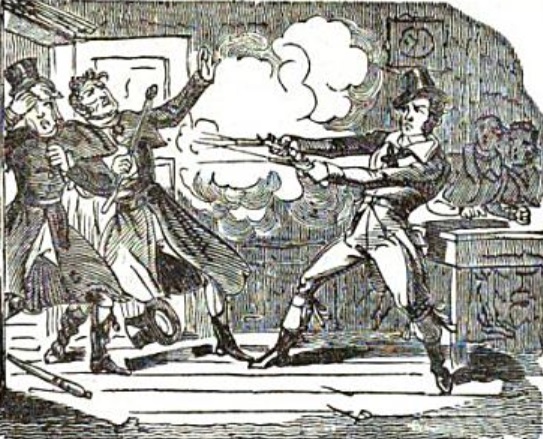
The prisoner was charged on two indictments; one for having, at the Two Brewers Public-house,* Southwark, feloniously shot at and murdered D. Price, an Officer belonging to the Police-Office, held at Union-hall, in the Borough. The other indictment was for having, at the same time and place, fired a pistol at Bernard Turner, another officer attached the office at Union-hall, with an intent to murder him.

Mr. Garrow, the leading counsel for the prosecution, opened the case to the Court and jury, by stating, that the prisoner at the bar, being a person of very ill fame, had been suspected of having perpetrated a number of felonies. The Magistrates of the Police-Office in the Borough of Southwark, having received information against the prisoner, sent, as was their duty, an order for his apprehension.

To execute the warrant, the deceased Price, and another officer of the name of Turner, went to the Two Brewers, a public-house, in Maid Lane, where they understood he was then drinking, in company with some other persons.

At the entrance of a parlour in the house, the prisoner appeared in a posture of intending to resist. Holding a loaded pistol in each of his hands, he with threats and imprecations desired the officers to stand off, as he would otherwise fire at them.

The officers, without being intimidated by those menaces, attempted to rush in and seize him, on which the prisoner discharged both the pistols at the same instant of time, lodging the contents of one in the body of David Price, and with the other wounded Turner very severely in the head. Price after languishing a few hours died of the wound.

Mr. Garrow was very pathetic and animated in his description of the several circumstances composing the shocking barbarity. To prove it, he would call four witnesses, whose evidence, he said, would be but too clear to establish the prisoner’s guilt.

The Jury would be enabled to judge from the facts to be submitted to them, and would undoubtedly decide on the issue joined between the Crown and the prisoner at the bar.

The learned counsel accordingly called Turner, the landlord of the house, a surgeon, and a fourth witness; but as the substance of their evidence is comprised in Mr. G’s opening of the indictment, it would be superfluous to repeat it. Turner said positively, he saw the prisoner discharge the pistols, from one of which he himself received his wound, and the contents of the other were lodged in the body of Price, who died very shortly after. The surgeon proved that the death was in consequence of the wound.

Mr. Knowles and Mr. Best were counsel for the prisoner, but the weight of evidence against him was too strong to be combatted by any exertions.

Mr. Baron Perryn summed up the evidence, on every essential part of which his lordship made several apposite, pointed, and accurate observations. The counsel for the prisoner, he remarked to the jury, had principally rested his defence on the circumstances of several other persons being present when the pistols were discharged, by some of which they contended the death wound might possibly have been inflicted. But, with respect to that part of the transaction, it would be proper for the jury to observe, that the witness Turner, had sworn positively to his having seen the prisoner in the act of discharging the contents of the pistol.

The jury, after a consultation of about three minutes, pronounced the dreadful verdict of — Guilty.

Through a flaw in the indictment for the murder, an objection was taken by the counsel. The indictment did not state that Price died in St. Saviour’s parish. This was argued nearly two hours, when Mr. Baron Perryn intimating a wish to take the opinion of the Twelve Judges of England, the counsel for the prosecution, waiving [sic] the point for the present, insisted on the prisoner’s being tried on the another [sic] indictment, for feloniously shooting at Barnaby Windsor, the officer who apprehended him after he had shot Price, which the learned counsel said, would occupy no great portion of time, as it could be sufficiently supported by the testimony of a single witness. He was accordingly tried and found guilty on a second capital indictment.

The prisoner, who, contrary to expectation, had in a great measure refrained from his usual audacity, began with unparalelled insolence of expression and gesture, to ask his lordship if he “was to be murderd by the evidence of one witness?” several times repeating the question, till the jury returned him Guilty.

When Mr. Baron Perryn put on the judicial cap, the prisoner, unconscious, and regardless of his dreadful situation, at the same time put on his hat, observing the judge with contemptuous looks while he was passing the sentence. When the constables were removing him from the dock to a coach, he continued to vent torrents of abuse against the judge and jury, whom, he charged with, as he styled it, his murder.

As his desperate dispostion was well known, he was, to prevent resistance, hand-cuffed, and his thighs and arms also bound strongly together, in which situation he was conveyed back to prison.

So callous was this ruffian to every degree of feeling, that on his way to be tried, as he was passing near the usual place of execution on Kennington Common, he put his head out of the coach window, and with all the sang froid imaginable, asked some of those who guarded him, if they did not think he would be twisted on that pretty spot by Saturday.

He was executed on Kennington Common, on the 3rd of August, 1795, with James [John] Little for the murder of Mr. Macevoy and Mrs. King at Richmond, and Sarah King for the murder of her new born bastard, at Nutfield, Surrey, in the presence of an immense multitude of spectators, among whom he recognized many acquaintances and confederates, to whom he bowed, nodded, and laughed with the most unfeeling indifference.

He had a flower in his mouth, and his waistcoat and shirt were unbuttoned, leaving his bosom open in the true style of vulgar gaiety: and, talking to the mob, and venting curses on the officers, he died, as he had lived, a ruffian and a brute! He was afterwards hung in chains upon Wimbledon Common.

The infamy of his life, and the atrocity of his deeds, rendered him a fit object for the posthumous punishment of hanging in chains on the arena of his crimes, and (painful as is the record, the truth must be told,) while the disgusting carcass of this malefactor, devoured by the birds and withered by the elements, gradually disappeared, the spot on which he had been gibbetted was converted into a temple of infamy, to which the thieves and vagabonds of London resorted in a sort of pilgrimage; and while the leading ruffians of the flash school, of which Avershaw was the child and champion, procured from his decaying and piece-meal carcass the bones of his fingers and toes to convert into stoppers for their tobacco-pipes, the tyro villains contented themselves with tearing the buttons from his clothes, as mementos of the estimation in which they held their arch prototype.


The newsmen effected horror that “Abershaw continued to the last moment of his existence in the same hardened state” (Telegraph, Aug. 4, 1795) and “took no notice either of his fellow-sufferers, or what the clergyman endeavoured to say to him” — then “when the executioner took the whip and touched the horse, made a spring from the cart, and was heard to repeat a horrid curse the last word he spoke.”

Avershaw’s larger-than-death performance of “dying game” would in subsequent years be a much-honored exemplar among kindred spirits who would not occasionally be required to attempt to outdo him in dramatic contempt of the gallows.

On this day..

1799: Elizabeth Lavender, teenage Fairlight infanticide

London Chronicle, Feb. 2-5, 1799

On Sunday se’nnight the body of a new-born male infant, with its throat cut, was discovered, concealed in a small tub, among some cordwood, in a cellar at Fairlight in the county of Sussex. The fact appearing to have been recently committed, and suspicion falling on a young woman, resident in an adjoining apartment, named Lavender, she was taken into custody and a surgeon sent for, who declared she had been very lately in travail; and the Coroner’s Jury having on view of the body, returned a verdict of wilful murder against the said Lavender, she was committed to Horsham gaol. The wretched girl hath scarcely attained her eighteenth year.

London Oracle and Daily Advertiser, July 19, 1799

LEWES. — At our Assizes, which commence here on Friday morning next, before Lord Chief Justice Buller,* we have the satisfaction to say, there are but seven prisoners for trial, viz.

Elizabeth Lavender, aged 19 years, charged with the wilful murder of her male bastard child at Fairlight.

James Medhurst, alias Miles, aged 24 years, for feloniously stealing one barrow hog, the property of Thomas Davis.

Daniel Noyell, aged 20 years; John Gardiner, 21 years; and John Twiney, 22 years, for divers felonies in the town of Brighton.

William Jackson, aged 23 years, for feloniously entering the dwelling-house of Henry Karn, of Tillington, in June last, and stealing therein to the amount of twelve shillings in money, a silver watch, some wearing apparel, and other articles, the property of the said Henry Karns.

William Hodson, otherwise Powell, aged 28 years, charged with having stolen on Westbourn Common, a black gelding, the property of William Churcher; also with having stolen and rode away from a lane, in the parish of New Fishbourn, a grey poney gelding, the property of John Hardham.

Should the business at nisi prius prove as light as that on the Crown side, we shall have a very short Assize.

London Sun, July 25, 1799

LEWES, July 22

At the Assizes for this County, which ended here on Saturday morning last, seven prisoners were tried, five of whom were capitally convicted, and received sentence of death, viz.

Elizabeth Lavender, for the wilful murder of her male bastard child, at Fairlight. — John Gardiner and John Twiney, for felonies in the town of Brighton. — William Jackson, for a felony in the dwelling house of Henry Karn, at Tillington. — And William Hodson, otherwise Powell, for horse-stealing.

The four men were reprieved before the Judges left the town; but the unhappy woman was left for execution, and is this day to suffer at Horsham, after which her body is to be dissected and anatomized.

True Briton, Aug. 2, 1799

LEWES, July 29

Last Monday Elizabeth Lavender was executed at Horsham, pursuant to her sentence at our late Assizes, for the murder of her male bastard child. Her behaviour at the gallows was such as became one in her unhappy situation. She trembled and wept much, but nevertheless seemed to listen to the Clergyman who attended her, and having expressed a hope that all other females would take warning by her untimely fate, she was turned off about half past twelve, and expired without any apparent agony.

* Buller is most (in)famous now for allegedly issuing the judicial standard permitting a man to beat his wife with a rod, provided it was no thicker than his thumb. It’s quite dubious whether he ever did so rule, and indeed whether any such rule has ever existed; nevertheless, Buller was lampooned in his own day as “Judge Thumb”.

More historically verifiable is his role on the judicial panel upholding the right of the slaveship Zong to throw all its cargo into the sea.

On this day..

1797: David McLane, an American traitor in Quebec

On only one occasion has the sentence of hanging, drawing and quartering been executed on the soil of the (eventual) United States.

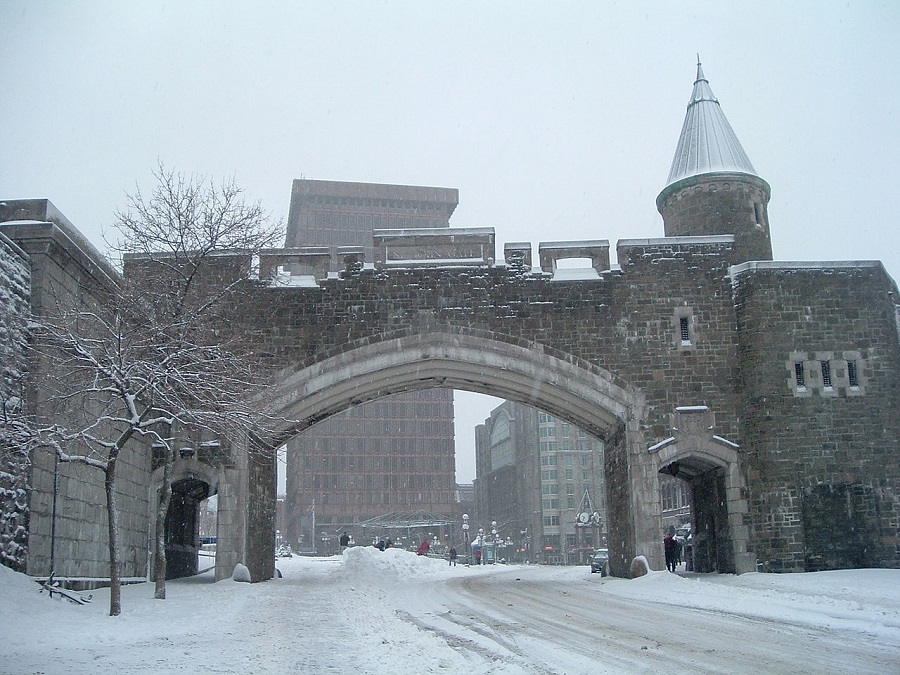
But on this date in 1797, that terrible death was visited on American citizen David McLane in Quebec for attempting to topple British authority in that Canadian province.

David McLane, a Rhode Island merchant, was arrested in the suburbs of Quebec City in May of 1797 and accused of conniving with French diplomats to recover their former colony by dint of an invasion of raftborne pikemen across the St. Lawrence to support a planned French landing. This tome claims it to be Quebec’s first treason trial under British rule; the Attorney General prosecuting it thought it the first in the North American colonies since Nicholas Bayard‘s in 1701. (Cobbett’s State Trials has the entire trial transcript.)

The Quebecois spectators crowded the courts in dread of hearing the ancient English punishment pronounced. They were not disappointed.

Writing many decades later about an execution he had witnessed as a 10-year-old boy, Philippe Aubert de Gaspe recollected its grisly particulars — and the surprising (to the audience) fact that McLane was hanged to death before the emasculating-and-disembowelling portions of the sentence were visited on him.*

The government having little confidence in the loyalty which the French Canadians had proved during the war of 1775, wished to strike terror into the people, by the preparations for the execution. From the early morning was heard the noise of the pieces of aitillery that were being dragged to the place of execution outside St. John’s gate; and strong detachments of armed soldiers paraded the streets. It was a parody on the execution of the unfortunate Louis 16th and all to no purpose.

I saw McLane conducted to the place of execution, he was seated with his back to the horse on a wood-sleigh whose runners grated on the bare ground and stones. An axe and a block were on the front part of the conveyance. He looked at the spectators in a calm, confident manner, but without the least effrontery. He Was a tall and remarkably handsome man. I heard some women of the lower class exclaim, whilst deploring his sad fate:

Ah if it were only as in old times, that handsome man would not have to die! There would be plenty of girls who would be ready to marry him in order to save his life!

And even several days after the execution, I heard the same thing repeated.

This belief then universal among the lower class must, I suppose, have arisen from the fact that many French prisoners, condemned to the stake by the savages, had owed their lives to the Indian women who had then married them.

The sentence of McLane, however, was not executed in all its barbarity. I saw all with my own eyes, a big student named Boudrault, lifted me up from time to time in his arms, so that I might lose nothing of the horrible butchery. And Dr. Duvert was near us, he drew out his watch as soon as Ward, the hangman, threw down the ladder upon which McLane was stretched on his back, with the cord round his neck made fast to the beam of the gallows; thrown sideways by this abrupt movement the body struck the northern post of the gallows, and then remained stationary, with the exception of some slight oscillations.

“He is quite dead,” said. Dr. Duvert, when the hangman cut down the body at the end of about twenty-five minutes; “he is quite dead, and will not feel the indignities yet to be inflicted on him.” Every one was under the impression that the sentence would be executed in all its rigor, and that the disembowelled victim, still alive, would see his own entrails burnt but no; the poor unhappy man was really dead when Ward cut him open, took out his bowels and his heart which he burnt in a chafing dish, and cut off his head which he showed all bloody to the people.

The spectators who were nearest to the scaffold say that the hangman refused to proceed further with the execution after the hanging, alleging “that he was a hangman, but not a butcher,” and it was only after a good supply of guineas, that the sheriff succeeded in making him execute all the sentence, and that after each act of the fearful drama, his demands became more and more exorbitant. Certain it is that after that time Mr. Ward became quite a grand personage; never walking in the streets except with silk stockings, a three-cornered hat and a sword at his side. Two watches, one in his breeches pocket, and the other hanging from his neck by a silver chain, completed his toilet.

I cannot refrain, in parting from this doer of worthy deeds, from relating a fact which I have never been able to account for. When I arrived in Quebec in order to go to school, at about nine years of age, people seemed to regret a certain good hangman named Bob; he was a negro, whom every one praised. This Ethiopian ought to have inspired the same horror which is always felt towards men of his calling; but, on the contrary he visited at all the houses like the other citizens, enjoyed a name for unimpeachable honesty, ran errands, in fact was a universal favorite. As well as I can remember, there was something very touching in Bob’s history; he was a victim of circumstances, which compelled him to become a hangman in self-defence. He used to shed tears when he had to perform his terrible task. I do not know why my memory, generally so tenacious concerning all I saw and heard in my early childhood, fails me in the matter of explaining the reason of the universal sympathy extended to Bob.**

Now I return to McLane. Such a spectacle as I have described could not fail to make a great impression on a child of my age; hence it arises that I have thought a great deal about the fate of a man, whom many people looked upon as a victim to the politics of the day. I have tried to satisfy myself as to his greater or less guilt. I could say a great deal on this subject; but I will be silent. Suffice it to say, that if in these days a boasting Yankee were to proclaim to all comers, that with five hundred able men, armed with sticks hardened in the fire, it would be easy to take the town of Quebec, the young men would crowd round him to humor him and encourage him to talk, and then giving him lots of champagne to drink, would laugh heartily at him, without the government dreaming of having him hung, drawn and quartered.

It has been said that McLane was an emissary of the French government; I do not myself believe so; the French republic, at war with all the European powers, had too much work on its hands to concern itself about a little colony, containing some millions of acres of snow; to use an expression not very flattering to us.

The policy of our then rulers was crafty and hence cruel. Every where they thought they discovered emissaries of the French government. There were two Canadians banished from the country, their crime being that they had been to Martinique in, I believe, an American vessel, to transact some commercial business: they granted them the favour of allowing them to take with them their wives and children.

* Actual complete hung, drawn, quartered sentences were already passe in Great Britain.

** Colonial Quebec had several black executioners; the best-known was Martinican slave Mathieu Léveillé from 1733 to 1743. (There an interesting .pdf about Leveille and his world here.)

The identity of the affable “Bob” our narrator half-remembers is a bit of a mystery; he has been identified with George Burns, a black man who held the job in the early 1800s, but the timetable isn’t quite right relative to de Gaspe’s admittedly distant memories. (The diarist thinks Bob was the former executioner by the time concerned with our post.) Frank Mackey in Done with Slavery: The Black Fact in Montreal, 1760-1840 suggests we take the name at face value and identify this executioner as either or both of “Bob a Nigro man” jailed as a felon in 1781 (we don’t know that Bob a Nigro man became a hangman), or “Robert Lane the Hangman” who was charged with a crime in 1789 (we don’t know that Robert Lane the Hangman was African). Mackey suspects that these are one and the same man.

On this day..

1799: Simon Taylor, for indulging in drunkenness

From the public-domain An Account of the English Colony in New
South Wales From Its First Settlement, in January 1788, to August 1801
(pdf):


April 1799

On the first of this month the criminal court sat for the trial of a soldier belonging to the regiment, who had a few days before stabbed a seaman of the Reliance, who insulted him when centinel at one of the wharfs at Sydney. The man died of the wound; the soldier, being called upon to answer for his death, proved to the satisfaction of the court, that it had been occasioned by the intemperance of the seaman, and he was accordingly found to have committed a justifiable homicide.

This accident was the effect of intoxication, to which a few days after another victim was added, in the person of a female, who was either the wife or companion of Simon Taylor, a man who had been considered as one of the few industrious settlers which the colony could boast of. They had both been drinking together to a great excess; and in that state they quarrelled, when the unhappy man, in a fit of madness and desperation, put an untimely end to her existence. He was immediately taken into custody, and reserved for trial.

To this pernicious practice of drinking to excess, more of the crimes which disgraced the colony were to be ascribed than to any other cause; and more lives were lost through this than through any other circumstance; for the settlement had ever been free from epidemical or fatal diseases. How much then was the importation of spirits to be lamented! How much was it to be regretted, that it had become the interest of any set of people to vend them!

Several robberies which at this time had been committed were to be imputed to the same source.

May 1799

Several offenders having been secured for trial, it became necessary to assemble the court of criminal judicature; and on the 16th Simon Taylor was brought before it, accused of the murder of his wife [Ann Smith was her name -ed.]; of which offence being clearly convicted, he received sentence of death, and was executed on the 20th at Parramatta. This unhappy man was thoroughly sensible of the enormity of his guilt, and in his last moments admonished the spectators against indulging in drunkenness, which had brought him to that untimely and disgraceful end.

At the same court, one man, Robert Lowe, was adjudged corporal punishment, and one year’s hard labour, for embezzling some of the live stock of Government, which had been entrusted to his care. He was a free man, and had been one of the convicts who were with Captain Riou in the Guardian, when her voyage to New South Wales was unfortunately frustrated by her striking upon an island of ice; on account of which, and of their good conduct before and after the accident, directions had been given for their receiving conditional emancipation, and being allowed to provide for their own maintenance.

Few of these people, however, were in the end found to merit this reward and indulgence, as their future conduct had proved; and this last act of delinquency pointed out the necessity of a free person being sent out from England to superintend the public live stock, with such an allowance as would make him at once careful of his conduct, and faithful in the execution of his trust.

It should seem that the commission of crimes was never to cease in this settlement. Scarcely had the last court of judicature sent one man to the gallows, when a highway robbery was committed between the town of Sydney and Parramatta. Three men rushed from an adjoining wood, and, knocking down a young man who was travelling to the last mentioned town, rifled his pockets of a few dollars. On his recovering, finding that only one man remained, who was endeavouring to twist his handkerchief from his neck, he swore that no one person should plunder him, and had a struggle with this fellow, who, not being the strongest of the two, was secured and taken into Parramatta. A court was immediately assembled for his trial; but the evidence was not thought sufficient to convict him, and he was consequently acquitted. The want of any corroborating circumstance on the part of the prosecutor compelled the court to this acquittal.

On this day..

1791: Alessandro Cagliostro condemned

On this date in 1791, the Inquisition in Rome condemned magician Alessandro Cagliostro to death — a sentence immediately commuted to imprisonment for the remainder of his life, which turned out to be only four more years.

Cagliostro’s rich career as European courts’ thaumaturge of choice might have been decreed by the stars right down to his pitch-perfectly sinister moniker. Is this the shadowy diabolist whom the title character of in The Cabinet of Dr. Caligari is meant to evoke?

In fact, his birth name was Giuseppe Balsamo.
Naughty by nature from the time of his youthful expulsion from the Order of St. John, Balsamo — the hobgoblin familiar haunting the adult prophet’s cimmerian shadows — hailed originally from a penniless Sicilian family. (Though Cagliostro claimed for himself a suitably exotic childhood in Arabia and Egypt)

What he wanted in native wealth he more than made up for in enterprise — both for self-education in sorcery, alchemy, and other forbidden arts, and for leveraging his expertise in lustrous capers.

Hopping from court to court, Cagliostro carved out a career moving forgeries of spiritual or temporal potency alongside his legitimate profession as a doctor and chemist and his growing public profile as an influential spiritualist. He broke through as a young man in the train of a cardinal in Rome, using this in to market on the side fake artifacts alleged to have been pilfered from the Vatican’s mysterious Egyptian troves, as well as to seduce a local girl named Serafina whom he married at age 18. Serafina would be his lifelong companion on his adventures.

Cagliostro turned up over the ensuing two decades in Russia, Poland, Germany, and England, where he was inducted into the Freemasons in 1776. He’s been credited with creating masonry’s Egyptian Rite, and with energetically propagating it in the 1780s;* indeed, it was his adherence to Freemasonry — and his sacrilegious boldness opening a masonic lodge in Rome under the nose of the pontiff — that led to his 1789 arrest.

His seances and magic potions made him a great favorite of the Versailles court for a number of years, until a glancing association with the Affair of the Diamond Necklace so damaging to the reputation of Marie Antoinette forced Cagliostro’s expulsion from France.

Considering his Mephistophelian** reputation, now very well known in Europe, Cagliostro’s return thereafter to the belly of papal power seems most unwise. Perhaps (as this biographer supposes) it was the influence of Serafina, homesick after so many years separated from her native haunts. Cagliostro’s next ports of call were the Vatican’s Castel Sant’Angelo and (after an escape attempt) the lonely Fortress of San Leo — and even his end was so shrouded in mystery and conjecture that the subsequent conqueror Napoleon commissioned an official investigation to convince everyone that he’d really shuffled off the mortal coil.

Giuseppe Balsamo, attainted and convicted of many crimes, and of having incurred the censures and penalties pronounced against heretics, dogmatics, heresiarchs, and propagators of magic and superstition, has been found guilty and condemned to the said censures and penalties as decreed by the Apostolic laws of Clement XII and Benedict XIV, against all persons who in any manner whatever favour or form societies and conventicles of Freemasonry, as well as by the edict of the Council of State against all persons convicted of this crime in Rome or in any other place in the dominions of the Pope.

Notwithstanding, by special grace and favour, the sentence of death by which this crime is expiated is hereby commuted into perpetual imprisonment in a fortress, where the culprit is to be strictly guarded without any hope of pardon whatever. Furthermore, after he shall have abjured his offences as a heretic in the place of his imprisonment he shall receive absolution, and certain salutary penances will then be prescribed for him to which he is hereby ordered to submit.

Likewise, the manuscript book which has for its title Egyptian Masonry is solemnly condemned as containing rites, propositions, doctrines, and a system which being superstitious, impious, heretical, and altogether blasphemous, open a road to sedition and the destruction of the Christian religion. This book, therefore, shall be burnt by the executioner, together with all the other documents relating to this sect.

By a new Apostolic law we shall confirm and renew not only the laws of the preceding pontiffs which prohibit the societies and conventicles of Freemasonry, making particular mention of the Egyptian sect and of another vulgarly known as the Illumines, and we shall decree that the most grievous corporal punishments reserved for heretics shall be inflicted on all who shall associate, hold communion with, or protect these societies. (Source)

Thereafter widely denounced and renounced as a rank charlatan, Cagliostro at the very least rates as of the more outstanding adventurers of his time — a distinction that bequeathed him an impressive artistic afterlife from Alexandre Dumas to Christopher Walken.

Nor have his grander poses entirely wanted for supporters in posterity, particularly among adherents to the still-extant Masonic rite he initiated. (Aleister Crowley also suggested that he might have been Cagliostro in a previous incarnation.)

W.R.H. Trowbridge’s 1910 biograhy Cagliostro: The Splendour and Misery of a Master of Magic is in the public domain and available free online.

* Cagliostro might also have written a classic occult volume, The Most Holy Trinosophia.

** “Mephistophelian” might be the literally applicable word. When the mysterious Cagliostro’s possible identity as the exiled Sicilian swindler Balsano was first exposed, eventual Faust author Johann von Goethe happened to be in Palermo — and he took it upon himself to investigate personally by calling on Balsano’s family. (“You know my brother?” “All Europe knows him.”)

On this day..