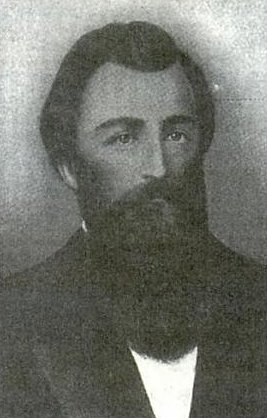
1865: Chief Ahan of the Tsilhqot’in

“The Indian Ahan,” read the dispatch in the British Columbian this date in 1865, “will have expiated his crime upon the gallows ere these lines meet the public eye. The execution will take place in the rear of the jail early this morning.”

Ahan and another Tsilhqot’in (or Chilcotin) were of the party of Klatsassin, whom we have already met in these pages. Months after the Chilcotin War‘s mass execution, the luckless pair were arrested trying to pay what would have been a routine-for-them bit of blood money.

Both were condemned; Lutas received clemency, and his freedom. (“I eagerly availed myself of some favorable circumstances in the case of Sutas and sent him back pardoned to his tribe. A sufficient number of Indians has now perished on the scaffold to atone for the atrocities committed last year.”)

Documents related to this proceeding are archived at a canadianmysteries.ca page on Klatsassin.

Ahan’s execution in New Westminster, now part of the Vancouver, B.C. metropolis, isn’t dead, though — and isn’t even past.

Over the course of the past year, a public school project in the city that had been built over an old pauper’s grave that might have become the hanged man’s resting place was gravely (ahem) complicated by the continuing Tsilhqot’in search for Ahan’s remains. While Ahan’s own situation remains unresolved, the suit on his behalf eerily outlined the macabre past lurking everywhere beneath our workaday feet.

On this day..

1867: Emperor Maximilian I of Mexico, “Archdupe”

On this date in 1867, a firing squad disabused a Habsburg heir of his pretensions to the throne of Mexico.

A little bit loopy, a little bit liberal, and fatally short of common sense, Ferdinand Maximilian Joseph* decamped from the easy life at his still-under-construction dream palace outside Trieste for an exalted title that really meant playing catspaw for Napoleon III‘s Mexican land grab.

(To assuage the pangs of imperial adventurism upon our tender-headed hero, Maximilian had been “invited” to assume the Mexican throne by a convention handpicked to do just that.)

There the puppet emperor with the silver spoon in his mouth found himself pitted in civil war against the Amerindian peasant from the school of hard knocks: Benito Juarez, one of Mexico’s great liberal statesmen.

As the tide turned in favor of Juarez and the liberals, and Napoleon’s attention increasingly fixated on problems closer to home, the French threw in the towel.

But Maximilian had too much honor or too little sense to heed his patron’s advice to get out while the getting was good; sticking it out with “his people,” he was captured in May, 1867.

Juarez desiring to give any future bored European nobles second thoughts about New World filibustering, Maximilian got no quarter.**

While Louis Napoleon emceed a world’s fair on the other side of the planet, Maximilian was shot with two of his generals, Miguel Miramon and Tomas Mejia.


Manet’s The Execution of Maximilian, showing an obvious compositional debt to Goya’s Executions of the Third of May. Further analysis: written English; video Spanish.

Maximilian’s widow Charlotte — “Carlota”, when trying to blend with her adoptive subjects — descended into a long-lived madness back in the Old World, but was rumored to have borne with one of Maximilian’s French officers an illegitimate child who would go on to become an infamous Vichy collaborator.

Books about Emperor Maximilian

This sensational affair attracted plenty of coverage in the ensuing years; as a result, there is a good deal of topical material from near-contemporaries now in the public domain. Maximilian in Mexico: A Woman’s Reminisces of the French Intervention 1862-1867 (Gutenberg | Google Books) is a zippy read.

* Brother to Austrian Emperor Franz Joseph.

** Spanish trial records are here. European appeals for clemency poured in, but Maximilian had doomed himself with the “Black Decree” of 1865, ordering summary executions of captured Republicans.

The time for indulgence has gone by: it would only encourage the despotism of bands of incendiaries, of thieves, of highwaymen, and of murderers of old men and defenseless women.

The government, strong in its power, will henceforth be inflexible in meting out punishment when the laws of civilization, humanity, or morality demand it.

Juarez answered the clemency appeal of Princess Salm-Salm with solemn words:

If all the Kings and Queens in Europe [pled for Maximilian] I could not spare that life. It is not I who take it; it is the people and the law, and if I should not do their will the people would take it and mine also.

On this day..

1864: Doctor Edmond-Désiré Couty de la Pommerais, poisoner

At dawn this morning before the walls of La Roquette, a homeopath convicted of poisoning his mistress was beheaded for one of Paris’s most sensational crime dramas of the 1860’s.

The ill-fated Madame de Pauw had fallen suddenly ill and expired in the doctor’s care; means and opportunity were obvious, and motive readily adduced from the handsome life insurance policies of the expired woman.

La Pommerais was convicted on this basis of killing his paramour in the midst of a farcical insurance scam, with noted forensic scientist Ambroise Tardieu establishing to the court’s satisfaction the presence of the poison digitalin.

(One can read a detailed 1865 critique of Tardieu’s conclusions and testimony, a reminder that the criminal justice system’s struggles with the uses and limitations of forensic science are a longstanding concern. This (if one takes it as such) murder, which reads in retrospection like a classic in the genre of comedic criminality, might have been the perfect crime absent an obvious pecuniary design: the death was put down to a routine cause and only scrutinized when an anonymous tip and/or the suspicious insurance adjusters led the authorities to exhume the body 13 days after burial.)

American newsman George Alfred Townsend chanced to be abroad in Paris on this occasion, and recorded the scene as “thousands of Parisians bent their steps the night before the execution” in Campaigns of a Non-combatant — excerpted at length here for its topicality to this blog.

The news had gone abroad that la Pommerais would not be pardoned. It was also generally credited that this would be the last execution ever held in Paris, since there is a general desire for the abolition of capital punishment in France, and a conviction that the Legislature, at its next session, will substitute life-imprisonment.* This, with the rarity of the event, and that terrible allurement of blood which distinguishes all populaces, brought out all the excitable folk of the town; and at dusk, on the night before the expiation, the whole neighborhood of La Roquette was crowded with men and women. All classes of Parisians were there, — the blouses, or workingmen, standing first in number; the students from the Latin Quartier being well represented, and idlers, and well-dressed nondescripts without enumeration, — distributing themselves among women, dogs, and babies.

Venders of galeaux, muscles, and fruit were out in force. The “Savage of Paris,” clothed in his war plumes, paint, greaves, armlets, and moccasins, was selling razors by gaslight; here and there ballad-mongers were singing the latest songs, and boys, with chairs to let, elbowed into the intricacies of the crowd, which amused itself all the night long by smoking, drinking, and hallooing. At last, the mass became formidable in numbers, covering every inch of ground within sight of the prison, and many soldiers and sergeants de ville, mounted and on foot, pushed through the dense mass to restore order.

At midnight, a body of cavalry forced back the people from the square of La Roquette. A number of workmen, issuing from the prison-gates, proceeded to set up the instrument of death by the light of blazing torches. The flame lit up the dark jail walls, and shone on the helmets and cuirasses of the sabre-men, and flared upon spots of the upturned faces, now bringing them into strong, ruddy relief, now plunging them into shadow. When the several pieces had been framed together, we had a real guillotine in view, — the same spectre at which thousands of good and bad men had shuddered; and the folks around it, peering up so eagerly, were descendants of those who stood on the Place de la Concorde to witness the head of a king roll into the common basket. Imagine two tall, straight timbers, a foot apart, rising fifteen feet from the ground. They are grooved, and spring from a wide platform, approached by a flight of steps. At the base, rests a spring-plank or bascule, to which leather thongs are attached to buckle down the victim, and a basket or pannier filled with sawdust to receive the severed head. Between these, at their summit, hangs the shining knife in its appointed grooves, and a cord, which may be disconnected by a jerk, holds it to its position. Two men will be required to work the instrument promptly, — the one to bind the condemned, the other to drop the axe. The bascule is so arranged that the whole weight and length of the trunk will rest upon it, leaving the head and neck free, and when prone it will reach to the grooves, leaving space for the knife to pass below it. The knife itself is short and wide, with a bright concave edge, and a rim of heavy steel ridges it at the top; it moves easily in the greased grooves, and may weigh forty pounds. It has a terrible fascination, hanging so high and so lightly in the blaze of the torches, which play and glitter upon it, and cast stains of red lights along its keen blade, as if by their brilliance all its past blood-marks had become visible again. A child may send it shimmering and crashing to the scaffold, but only God can fasten together the warm and throbbing parts which it shall soon dissever. And now that the terrible creature has been recreated, the workmen slink away, as if afraid of it, and a body of soldiers stand guard upon it, as if they fear that it might grow thirsty and insatiate as in the days of its youth. The multitude press up again, reinforced every hour, and at last the pale day climbs over the jail-walls, and waiting people see each other by its glimmer. The bells of Notre Dame peal out; a hundred towers fall into the march of the music; the early journals are shrieked by French newsboys, and folks begin to count the minutes on their watches. There are men on the ground who saw the first guillotine at work. They describe the click of the cleaver, the steady march of victims upon the scaffold-stairs, the rattle of the death-cart turning out of the rue Saint Honore, the painted executioners, with their dripping hands, wiping away the jets of blood from the hard, rough faces; nay! the step of the young queen, white-haired with care, but very beautiful, who bent her body as she had never bent her knee and paid the penalty of her pride with the neck which a king had fondled.

At four minutes to six o’clock on Thursday morning, the wicket in the prison-gate swung open; the condemned appeared, with his hands tied behind his back, and his knees bound together. He walked with difficulty, so fettered; but other than the artificial restraints, there was no hesitation nor terror in his movements. His hair, which had been long, dark, and wavy, was severed close to his scalp; his beard had likewise been clipped, and the fine moustache and goatee, which had set off his most interesting face, no longer appeared to enhance his romantic, expressive physiognomy. Yet his black eyes and cleanly cut mouth, nostrils, and eyebrows, demonstrated that Couty de la Pommerais was not a beauty dependent upon small accessories. There was a dignity even in his painful gait; the coarse prison-shirt, scissored low in the neck, exhibited the straight columnar throat and swelling chest; for the rest, he wore only a pair of black pantaloons and his own shapely boots. As he emerged from the wicket, the chill morning air, laden with the dew of the truck gardens near at hand, blew across the open spaces of the suburbs, and smote him with a cold chill. He was plainly seen to tremble; but in an instant, as if by the mere force of his will, he stood motionless, and cast a first and only glance at the guillotine straight before him. It was the glance of a man who meets an enemy’s eye, not shrinkingly, but half-defiant, as if even the bitter retribution could not abash his strong courage … he seemed to feel that forty thousand men and women, and young children were looking upon him to see how he dared to die, and that for a generation his bearing should go into fireside descriptions. Then he moved on between the files of soldiers at his shuffling pace, and before him went the aumonier or chaplain, swaying the crucifix, behind him the executioner of Versailles — a rough and bearded man — to assist in the final horror.

It was at this intense moment a most wonderful spectacle. As the prisoner had first appeared, a single great shout had shaken the multitude. It was the French word “Voila!” which means “Behold!” “See!” Then every spectator stood on tiptoe; the silence of death succeeded;** all the close street was undulant with human emotion; a few house roofs near by were dizzy with folks who gazed down from the tiles; all the way up the heights of Pere la Chaise, among the pale chapels and monuments of the dead, the thousands of stirred beings swung and shook like so many drowned corpses floating on the sea. Every eye and mind turned to the little structure raised among the trees, on the space before La Roquette, and there they saw a dark, shaven, disrobed young man, going quietly toward his grave.

He mounted the steps deliberately, looking towards his feet; the priest held up the crucifix, and he felt it was there, but did not see it; his lips one moment touched the image of Christ, but he did not look up nor speak; then, as he gained the last step, the bascule or swingboard sprang up before him; the executioner gave him a single push, and he fell prone upon the plank, with his face downward; it gave way before him, bearing him into the space between the upright beams, and he lay horizontally beneath the knife, presenting the back of his neck to it. Thus resting, he could look into the pannier or basket, into whose sawdust lining his head was to drop in a moment. And in that awful space, while all the people gazed with their fingers tingling, the legitimate Parisian executioner gave a jerk at the cord which held the fatal knife. With a quick, keen sound, the steel became detached; it fell hurtling through the grooves; it struck something with a dead, dumb thump; a jet of bright blood spurted into the light, and dyed the face of an attendant horribly read; and Couty de la Pommerais’s head lay in the sawdust of the pannier, while every vein in the lopped trunk trickled upon the scaffold-floor! They threw a cloth upon the carcass and carried away the pannier; the guillotine disappeared beneath the surrounding heads; loud exclamations and acclaims burst from the multitude; the venders of trash and edibles resumed their cheerful cries, and a hearse dashed through the mass, carrying the warm body of the guillotined to the cemetery of Mt. Parnasse. In thirty minutes, newsboys were hawking the scene of the execution upon all the quays and bridges. In every cafe of Paris some witness was telling the incidents of the show to breathless listeners, and the crowds which stopped to see the funeral procession of the great Marshal Pelissier divided their attention between the warrior and the poisoner, — the latter obtaining the preponderance of fame.

(This attention-getting execution attracted an apocryphal story† (pdf) that the severed head of La Pommerais was subject to a “wink test” to determine whether consciousness survived the fall of the blade.)

The doctor bequeathed the world a book on homeopathic medicine, which the discerning reader of French can peruse free.

* Actually, the last execution in France was still 113 years away.

** Rashomon-like, not all observers concurred as to the event’s quiet solemnity. The New York Times reported that

[t]he language of those non-official persons who assembled to witness this expiation of a great crime was brutal to the last decree. They hissed and hooted as the convict was about to mount the ladder, and were loudest in their brutal demonstrations when the crucifix was pressed to his lips. The blade had scarcely severed his head from his body, when a rush was made to do violence to the trunk. The troops were obliged to interfere, and had some difficulty in repelling the crowd, which was excited by the sight of a ‘gentleman criminal’ to a pitch of savage ferocity … The Pays, in noticing this expiation of a great crime, states that the crowd retired in silence. But I am in a position to affirm that the contrary was the cxase.

† Put about — as a hoax? — by Auguste Villiers de l’Isle-Adam.

On this day..

1862: William B. Mumford, flag desecrator

On this date in 1862, a 42-year-old gambler hanged at the New Orleans mint where, six weeks before, he had pulled down the Stars and Stripes of the arriving Union occupiers to the delight of a Confederate mob.

Moving to secure the Mississippi, Northern forces had the Big Easy encircled and about to surrender when, an advance team landed in the undefended city and pulled down the Stars and Bars over the mint on Esplanade Avenue.

William Bruce Mumford was among the Confederate loyalists who took exception to the Yankee flag, so he chopped it down and dragged it through the street (provoking a cannonade from a Union warship). The flag was little but tatters by the time he had through with it.

Although the city was not officially occupied at the time of this incident, the mint was a federal building. Army General Benjamin Butler resolved to make a salutary example out of the incident to quell any possible civil unrest.

I find the city under the dominion of a mob. They have insulted our flag — torn it down with indignity. This outrage will be punished in such a manner as in my judgment will caution both the perpetrators and abettors of the act, so that they will fear the stripes, if they do not reverence the stars of our banner.

Butler, it should be allowed, had some reason for this conclusion. The Picayune exulted the act as, well, a call to resistance.

The names of the party that distinguished themselves by gallantly tearing down the flag that had been surreptitiously hoisted, we learn, are W. B. Mumford, who cut it loose from the flag-staff amid the shower of grape. Lieutenant N. Holmes, Sergeant Burns and James Reed. They deserve great credit for their patriotic act. New Orleans, in this hour of adversity, by the calm dignity she displays in the presence of the enemy, by the proof she gives of her unflinching determination to sustain to the uttermost the righteous cause for which she has done so much and made such great sacrifices, by her serene endurance undismayed of the evil which afllicts her, and her abiding confidence in the not distant coming of better and brighter days — of speedy deliverance from the enemy’s toils — is showing a bright example to her sister cities, and proving herself, in all respects, worthy of the proud position she has achieved. We glory in being a citizen of this great metropolis.

This free book argues that Butler’s clemency a few days before to a group of condemned southern enlisted men made mercy politically impossible in the Mumford case, lest the citizenry interpret executive weakness as an invitation to lawlessness.

If that was Butler’s calculus, Confederate die-hards did not appreciate it.

Accordingly, when Mumford was “hung … from a flag-staff projecting from one of the windows under the front portico” of the mint, he won promotion into the pantheon of southern martyrs.

Confederate President Jefferson Davis issued an order condemning General Butler, and even his officers, to death, along with some outsized bluster about embargoing prisoner exchanges that the Confederacy had not the manpower to seriously intend:

William B. Mumford, a citizen of this Confederacy, was actually and publicly executed in cold blood by hanging alter the occupation of the city of New Orleans by the forces under the command of General Benjamin F. Butler when said Mumford was an unresisting and non-combatant captive, and for no offense even alleged to have been committed by him subsequent to the date of the capture of the said city …

the silence of the Government of the United States and its maintaining of said Butler in high office under its authority for many months after his commission of an act that can be viewed in no other light than as a deliberate murder, as well as of numerous other outrages and atrocities hereafter to be mentioned, afford evidence only too conclusive that the said Government sanctions the conduct of said Butler and is determined that he shall remain unpunished for his crimes:

Now therefore I, Jefferson Davis, President of the Confederate States of America, and in their name do pronounce and declare the said Benjamin F. Butler to be a felon deserving of capital punishment. I do order that he be no longer considered or treated simply as a public enemy of the Confederate States of America but as an outlaw and common enemy of mankind, and that in the event of his capture the officer in command of the capturing force do cause him to be immediately executed by hanging; and I do further order that no commissioned officer of the United States taken captive shall be released on parole before exchange until the said Butler shall have met with due punishment for his crimes.

And whereas the hostilities waged against this Confederacy by the forces of the United States under the command of said Benjamin F. Butler have borne no resemblance to such warfare as is alone permissible by the rules of international law or the usages of civilization but have been characterized by repeated atrocities and outrages

… (examples of atrocities omitted) …

I, Jefferson Davis, President of the Confederate States of America and acting by their authority, appealing to the Divine Judge in attestation that their conduct is not guided by the passion of revenge but that they reluctantly yield to the solemn duty of repressing by necessary severity crimes of which their citizens are the victims, do issue this my proclamation, and by virtue of my authority as Commander-in-Chief of the Armies of the Confederate States do order-

1. That all commissioned officers in the command of said Benjamin F. Butler be declared not entitled to be considered as soldiers engaged in honorable warfare but as robbers and criminals deserving death, and that they and each of them be whenever captured reserved for execution.

2. That the private soldiers and non-commissioned officers in the army of said Butler be considered as only the instruments used for the commission of the crimes perpetrated by his orders and not as free agents; that they therefore be treated when captured as prisoners of war with kindness and humanity and be sent home on the usual parole that they will in no manner aid or serve the United States in any capacity during the continuance of this war unless duly exchanged.

3. That all negro slaves captured in arms be at once delivered over to the executive authorities of the respective States to which they belong to be dealt with according to the laws of said States.

4. That the like orders be executed in all cases with respect to all commissioned officers of the United States when found serving in company with armed slaves in insurrection against the authorities of the different States of this Confederacy.

The Confederates never got a chance to enforce the order; he resumed his colorful political career and died in 1893 hailed as Massachusetts’ greatest citizen-soldier. Complain (pdf) as they might of his iron-heeled rule, the residents of New Orleans had good cause to appreciate the relatively early and orderly occupation of their city, which spared it the flames visited on more recalcitrant rebel strongholds.

For the South, the loss of its largest city and the gateway to the Mississippi was a severe blow. As the rebel position crumbled in the months to come, Jefferson Davis must have had a worry for his own neck.

Somehow, he and every other Southerner escaped execution for their treasonable design, which leaves William Bruce Mumford, the riverboat gambler who tore down Old Glory, as the only American since at least the War of 1812 to be put to death for treason against the United States.*

* Anti-slavery rebel John Brown was hanged for treason in 1859, but it was treason against the state of Virginia — not against the U.S. Julius and Ethel Rosenberg were electrocuted for espionage, not treason.

On this day..

1861: Paula Angel … but why?

Thanks to Laura James for the guest post, which originally appeared on her outstanding blog CLEWS Nov. 9, 2005. Laura’s first book, The Love Pirate and the Bandit’s Son, hits the shelves on May 5.

It’s not clear today how old she was — nineteen, maybe, or twenty-six, or twenty-seven — the reports all differ. It’s not even clear what her true name was: Paula Angel by most accounts, but she was also called Pablita Martin. But the most pressing questions, still unanswered nearly 150 years after her execution, are why she was hanged in the first place and how the sheriff managed to bungle the job so badly.

Paula Angel was the first and last woman ever executed in New Mexico (while it was yet a territory). Her crime: she stabbed her married lover, Juan Miguel Martin, to death when he tried to end their affair. Her execution was on April 26, 1861, in San Miguel, now Las Vegas.

Anyone familiar with historical crimes and trials, particularly those involving women, will marvel at such an outcome. A capital conviction for stabbing a lover, a crime passionel? That’s certainly not the outcome one would expect for that era (or this era, for that matter; today we’d label it second-degree murder at worst).

One explanation for Miss Angel’s hanging is that the newspapermen never got the story. Decades later, the wire services circulated very brief accounts of her trial and execution under headlines such as “The Story The Newspapers Missed.” So she may well have lacked the greatest champion anyone facing a murder charge can have: public opinion — the verdict of the greater jury. Throughout the nineteenth century, there was a universal revulsion for the execution of women, no matter what their crime, and judges and juries were anxious to find a reason to acquit a woman.

But the authorities in New Mexico Territory were eager to see her hanged. The accounts that survive today report that the jailer taunted her every day leading up to her execution — “I’m going to hang you until you’re dead, dead, dead,”* is the quote attributed to the sheriff.

What was her social status? Was she a prostitute? Was she a violent menace to the community? Had she committed other terrible acts? Was she unrepentant? Did she sullenly testify at her trial and put in a poor appearance on her own behalf? Most importantly, was she ugly? The accounts available today don’t say.

When it came time to launch Angel into eternity, the sheriff did not build a gallows. He selected a sturdy cottonwood tree outside of town. Paula Angel was driven there on a wagon, forced to ride on her own coffin to the site of her execution, which was witnessed by ranchers and townsmen. The sheriff fixed the rope to the tree, garlanded her with hemp, and then resumed his seat on the wagon and hawed the horses. But he’d made an error. He forgot to tie her hands behind her.

Paula Angel managed to get her fingers underneath the rope in a last pitiful effort to save her own neck, and she struggled on the end of the rope. It must have been an awful sight to see. The crowds surely voiced loud complaints. The sheriff was forced to put the wagon beneath her a second time, to cut her down, retie the rope amid the jeers and catcalls, properly secure her hands and feet, and to repeat the process. She did not survive her second hanging.

And there hasn’t been one woman executed in New Mexico since. Rarely has any woman from that state even faced the possibility, though a few years ago Linda Henning nearly became the second woman executed there — and she certainly deserved it. Fans of Court TV will recognize the name, since Court TV has rebroadcasted Henning’s bizarre trial more than once. She was tried for the cooly planned and bloody murder of Girly Chew Hossencofft, the estranged wife of her boyfriend, in one of the weirdest trials of the century. But the jury rejected the death penalty. The reason Henning agreed to involve herself in the murder of a woman she had not even met: Henning was convinced that Girly Chew was a reptilian alien queen from another galaxy.

You read that right: an alien queen from another galaxy. You can’t make this stuff up.

***

Recommended reading: Death on the Gallows : The Story of Legal Hangings in New Mexico, 1847-1923 by West Gilbreath (High Lonesome Books, 2002).

For the stories of the men executed in New Mexico see the excellent compilation by Mark Allan of the Angelo State University Library. [Note: link updated from Laura’s original post. -ed.]

For more on the Hossencofft case see the website of author Mark Horner.

* [Shades of Billy the Kid. Maybe it was something lawmen said to lend it that Wild West atmosphere. -ed.]

[Former New Mexico state historian Robert Torrez unpacks the Paula Angel story and reprints a corrido (folk ballad), “La Homicida Pablita” written by her cousin in Myth of the Hanging Tree. -ed.]

On this day..

1868: Henry James O’Farrell, would-be assassin

On this date in 1868, the first Australian known to have attempted a political assassination received the short drop and sudden stop that often constitutes the wages of that distinguished profession.

It was March 12 — less than six weeks before — that Henry James O’Farrell, Dublin-born alcoholic vegetable merchant fresh from the asylum, had shot the visiting Prince Alfred, Duke of Edinburgh at a picnic in the Sydney suburb of Clontarf.

Someone was smiling down on Alfred that day, because the shot was deflected by a metal buckle and inflicted only a flesh wound. Onlookers tackled the assailant before he could finish the job.

O’Farrell claimed affiliation with the Irish nationalist Fenian brotherhood, which inflamed anti-Irish passions (some cynically whipped up by New South Wales Prime Minister Henry Parkes). Paranoia redoubled when a Fenian assassin killed a Canadian politician a few weeks later.*

Under the circumstances, it was a hopeless struggle for O’Farrell’s attorney, who strove to demonstrate (probably accurately) that his charge was not so much a terrorist as a madman. Even the Duke of Edinburgh’s own intercession for clemency did not secure it, eager as the populace was to make an offering of its loyalty.**

* Irish convicts transported to Australia, especially after the 1798 uprising, formed a significant demographic among early New South Wales settlers. (Source)

** Another offering was a still-extant hospital in Sydney named for Prince Alfred.

On this day..

1865: Not George S.E. Vaughn

On this date in 1865, Abraham Lincoln had a date for Ford’s Theater — and with John Wilkes Booth’s single-shot Derringer pistol.

Abraham Lincoln was famous for his clemencies.

But Honest Abe had one last order of business to attend to before his carriage called him away to destiny: the pardon of a convicted Confederate spy due to be shot in St. Louis two days hence. Lincoln’s handwritten clemency for George Vaughn was the last official act of his presidency.

Lincoln in Story (“The Life of the Martyr-President told in Authenticated Anecdotes,” a light 1901 volume for popular consumption) relates:

Before the war Vaughn, with his wife and children, lived in Canton, Mo. He was a friend of Martin E. Green, a brother of United States Senator James S. Green, both strong pro-slavery men. At the opening of the war Martin E. Green recruited a regiment and received a colonel’s commission from the Confederate Government. George Vaughn enlisted under Green’s command and fought through the war.

After a period of fighting, Green and Vaughn crossed into Mississippi from Tennessee, camping at Tupelo, Miss. Not having heard from his family, Green was anxious to hear from his old home, so he delegated Vaughn to go on the mission of delivering letters to his wife.

Vaughn had almost completed his trip, having reached La Grange, six miles south of Canton, when he was captured by a squad of Federal troops.

They searched his person, and, finding letters and papers concealed about him, he was tried as a spy and sentenced to be shot. John B. Henderson, Senator from Missouri, finally succeeded in getting an order from the President for a retrial, but the verdict remained as hitherto. Again Henderson appealed to Lincoln, who granted a third trial, with the same result.

Henderson was not disconcerted, and again went to Lincoln. It was on the afternoon of April 14, 1865 — a melancholy date — that the Senator called at the White House. He called the attention of Lincoln to the fact that the war was practically closed, and said: “Mr. Lincoln, this pardon should be granted in the interest of peace and conciliation.”

This story gravitates naturally to the clemency of “the Great Heart” (as, for instance, D.W. Griffith called Lincoln). Far be it from us to say otherwise, but this is also self-evidently a story of the unusual prerogatives of the well-connected: not just any accused spy could get two trial do-overs and then a pardon free and clear ordered straight from the White House.

Mr. Lincoln replied: “Senator, I agree with you. Go to Stanton and tell him this man must be released.”

Henderson went to the office of the Secretary of War. Stanton* became violently angry, and swore that he would permit no such procedure.

Vaughn had but two days to live, and Henderson hastened to make one more stand. After supper he went to the White House. The President was in his office, dressed to go to Ford’s Theatre, when the Senator entered and told of the meeting he had had with Stanton.

Lincoln turned to his desk and wrote a few lines on an official sheet of paper. As he handed it to Senator Henderson he remarked: “I think that will have precedence over Stanton.”

It was an order for an unconditional release and pardon — the last official paper ever signed by Abraham Lincoln.

Lincoln was dead within hours. Vaughn passed away in 1899 in Maryville, Mo.

* Stanton is supposed to have delivered the remark as Lincoln’s deathbed, “now he belongs to the ages” … an alleged epitaph whose actual content is subject, like all biography, to textual uncertainty and ideological redefinition.


Update: The excellent tale of a different soldier pardoned on this same date has recently been debunked by the National Archives in an academic scandal: in January 2011, researcher Thomas Lowry confessed to altering the pardon order for one Patrick Murphy from the true (and much less dramatic) date of April 14, 1864 to April 14, 1865.

Vaughn was actually pardoned just before Lincoln went to Ford’s Theater; Murphy (totally unconnected to Vaughn) was pardoned 365 days prior.

On this day..

1864: Two Dodds, as two spies, in two states, and twice botched

On January 8, 1864, young David Owen Dodd was hanged in Little Rock for spying on federal troops … and cavalryman Ephraim Dodd (no known relation) suffered the same fate for the same crime in Knoxville.

Just one of those strange coincidences.

Ephraim Dodd

Ephraim Shelby Dodd is the subject of an outstanding HistoryNet profile whose contents this blog can not so much improve upon as summarize.

A member of Terry’s Texas Rangers (“men who ride like Arabs and fight like devils”) Dodd was captured in December 1863 and convicted by his diary — a particularly harsh reading of his diary in which a reference to having passed himself off as a Yankee was interpreted as evidence of espionage. (The diary is available online and as part of a book on Terry’s Rangers.)

Knoxville worthies rallied to save him and Ephraim Dodd insisted upon his innocence, but not so vociferously that he displayed any terror of his fate.

Do not grieve for me, my dear parents, for I am leaving a world full of crime and sin for one of perfect bliss.

The hanging itself wasn’t bliss, exactly, despite a well-planned soundtrack.

From the “Death March” the music gradually slid into “Mary’s Dream,” and then we were carried back by the magic of the plaintive notes to juvenile days; to visions of “Sandy far at Sea,” and to the sad cadence of that fading refrain,

“When, soft and low, a voice she heard
Saying, Mary, weep no more for me.”

The solemn march, the wailing notes of the fife, and perhaps above all the calm, unmoved, manly bearing of the prisoner — so we thought — produced a mournful impression upon the spectators.

Points earned on artistic merit, however, were deducted for technique.

At a signal the bolt was now withdrawn, the culprit fell, but the cotton rope broke by the sudden tension, and the man lay stretched and stunned upon the frozen ground below. A mummer of horror, mingled with expressions of pity, ran through the assembled crowd. Recovering for an instant from the shock — for his neck was not broken — he said — perhaps incoherently: “Release me quick, if you please.” For some ten minutes the unfortunate man lay thus upon his back, without moving a muscle. Meantime the officers and men, whose painful duty it was to see to the execution of the law, adjusted this time two parts of the same rope instead of one, and the half-conscious man was borne up the fatal steps a second time, being partly supported upon the drop until the double noose had been adjusted. Not a word or sign of suffering all this time escaped his lips. In another moment the drop fell, and prisoner’s form now hung by the neck — the knot behind the head. Death finally ensued by strangulation. In ten minutes, Dr. Cogswell, the officiating surgeon, pronounced life extinct, and the body was taken down and buried.

David Owen Dodd

A few hours later and 500 miles down the way, the entirely unrelated hanging of David Owen Dodd proceeded in Little Rock, Ark.

David Dodd’s final resting place at Mount Holly cemetery. Image courtesy of Richard Theilig.

Only 17 at his hanging and not physically robust enough to get his brains blown out at Gettysburg, Dodd was sent by his father on a business trip across Union lines — everything legit, and carrying a pass — but got busted with morse code notations of Union troop strength in the city.

Unlike Ephraim, who was basically a normal soldier thrust into incriminating-looking circumstances by the chance of war, young David Dodd was rightly accused.

He didn’t bother protesting his innocence, but he also kept mum about his contacts. (Suggestively, a teenage girl and her father were whisked out of town and kept under guard in Vermont for the rest of the war.) That proud silence has won him quite a reputation in Arkansas as the Boy Hero of the Confederacy.

But similarities between the condemned men extended beyond their names. David’s parting filial reassurance could pass for a paraphrase of Ephraim’s.

[D]o not weep for me for I will be better off in heaven. I will soon be out of this world of sorrow and trouble.

And the hanging itself, conducted in a tense atmosphere, was likewise a botched job. In this case, the slight young man didn’t fall hard enough to break his neck, but did fall far enough to get his tiptoes on the ground, initiating an agonizingly protracted strangulation which the soldiers on detail expedited by (accounts differ) pulling on David Dodd’s legs and/or pulling up on the rope.

On this day..

1862: Asa Lewis, Confederate deserter

On this date in 1862, a 19-year-old Confederate infantryman became the tragic victim at Murfreesboro, Tenn., of his army’s need to shore up military discipline.

Kentuckian Asa Lewis was shot for desertion, for having returned home after his enlistment expired in order to help his family plant the season’s crops.

“French leave”,* it’s sometimes called — an illicit but temporary and often unpunished absence from the unit.

According to Mark Weitz’s More Damning Than Slaughter: Desertion in the Confederate Army, it was a pervasive phenomenon — as were more permanent desertions which menaced the small Confederate army, fighting amid the soldiers’ own farms, whose languishing from the conscription of able-bodied men presented a constant temptation to depart.**

[The South’s] white population combined with its preferred form of agriculture to create a potential pool of men who could hardly be called disposable … To find the Southern soldier one must go down the food chain into that vast sea of men referred to as yeomen and poor whites. These men and their sons would form the backbone of the Southern army, an army of farmers, men whose lives were as governed by the seasons as the lives of their fathers and grandfathers before them. These men could not be spared in the same way as their Northern counterparts without affecting the quality of their families’ lives — and often those families’ very survival.

Under less urgent circumstances, Lewis would be the poster child for the guy who would sort of deserve to slide for the odd spell of French leave.

He’d fought with distinction, earning decorations and promotions, and his mother and sisters were reportedly starving without his help. He was only being kept in the army after his term of engagement by the 19th-century equivalent of a stop-loss policy.

But Lewis had the bad fortune to go AWOL — it seems he did intend to return — right when the urgency of the army-wide desertion situation was becoming apparent to Confederate brass … and while serving under the general who Weitz says took it most seriously.

Gen. Braxton Bragg had issued an amnesty earlier that fall to clear the decks, and then declared pitiless treatment of desertion going forward.

Bragg understood something that his superiors, peers, and colleagues did not: the Confederacy had an army of farmers … Bragg knew that these men were fighting at home, that they would [sic] were being drawn back there, and that he had to take immediate steps to close off the avenues of departure.

Bragg tightened the screws on soldiers who straggled on the march (a common strategy to slink away), on grunts seeking medical furloughs (already establishing themselves as a halfway house towards a discharge), and on Confederate prisoners obtained by exchange for Union POWs (who were no longer paroled back home, but kept with the army).

Asa Lewis was hardly the only man shot under the policy. But construing mere French leave as capitally punishable “desertion” gave the general a chance to put the fear of a Confederate firing squad into other potential stragglers and malingerers — and the Kentuckian campaign to obtain clemency for the poor kid probably only helped Bragg’s purpose.

The next day’s Rebel Banner (cited in this free Google books offering) ran this item:

[A]midst a drenching rain-storm, Asa Lewis, member of Captain Page’s company, Sixth Kentucky regiment, was shot by a file of men. He was executed upon a charge of desertion, which was fully proven against him. The scene was one of great impressiveness and solemnity. The several regiments of Hanson’s brigade were drawn up in a hollow square, while Generals Breckinridge and Hanson, with their staffs, were present to witness the execution. The prisoner was conveyed from jail to the brigade drill-ground on an open wagon, under the escort of a file of ten men, commanded by Major Morse and Lieut. George B. Brumley. Lewis’s hands were tied behind him, a few words were said to him by Generals Brekinridge and Hanson, and word fire was given, and all was over. The unfortunate man conducted himself with great coolness and composure. He was said to have been a brave soldier, and distinguished himself at the battle of Shiloh.

Official journos may have been approving — Weitz says a contemporary newspaper report approvingly claimed that “when Bragg saw his army melting away from desertion he began shooting every man convicted by a court-martial, and that as a result his army had become ‘well disciplined'” — but less charitable interpretations of Bragg would hew more to the line that the man was simply being a petty, vindictive tyrant.

The aforementioned execution witness Breckinridge, for instance, was a Kentuckian himself and hated Bragg’s guts. (A week later, Bragg would waste 10,000 Confederate lives at the Battle of Stones River, and the rift became irreparable.)

* The French call it “English leave”.

** Other able-bodied farm laborers in the South, of course, were better inclined to back the Union.

On this day..

1869: Hamiora Pere, Maori “traitor” to the Queen

On this date in 1869, Hamiora Pere became the only New Zealander ever executed for treason.

Maurice Shadbolt’s Season of the Jew is a historical novel of the conflict that doomed Hamiora Pere. It’s told from the standpoint of Te Kooti, who liked to compare the Maori cause to that of the Israelites resisting Egypt, and founded a religious sect that still persists today.

Pere* came by the distinction quite accidentally — even setting aside the queer circumstance of his “betraying” a state on the opposite side of the globe by resisting its claim to his ancestral homeland.

Hamiora Pere was one of five Maori prisoners from the Siege of Ngatapa during Te Kooti’s War — an indigenous resistance against British colonization — to face the fatal charge.

The crown handled these cases carefully.

Though all five men drew death sentences (mandatory for treason), the government was evidently trying to stay out of the martyr-making business — as revealed by a judge’s comment during official deliberations.

I believe the result is the very best that could have been arrived at. I am glad to know that Mr McLean thinks that one execution will be useful as more would have been by way of example and caution.

Unfortunately for Hamiora Pere, the one of those five who was most likely set up to be the “example,” Wi Tamararo, committed suicide in prison shortly after his sentence.

Pere seemingly became the next in line for hanging because he was associated with murders in a noteworthy massacre at Matawhero that slew 33 Europeans and 37 of their Maori allies. Notably, however, the charge of murder actually filed against him was dropped prior to trial since he could be placed at the scene of the attack, but not directly shown to have killed anyone. Even off the indictment, it may have been the thing that doomed him.

Whatever the nature of the deliberations — and this report (pdf) of New Zealand’s Waitangi Tribunal inconclusively attempts to unpack the story with the patchy evidence available — the remaining convicts got clemency. Four years later, they were pardoned outright.

Pere got the noose at Wellington, and the accidental historical footnote. He would seem destined to maintain his unusual distinction indefinitely, since New Zealand has abolished the death penalty altogether.

Fear of Death

It is the circumstantial distinction of his case that earns Pere his place in this blog out of the numberless thousands to meet his same fate.

But in the end, he faced the gallows in that existential nakedness common to all us mortal wretches beholding death. Many in these pages meet their ceremonial end with with bravado; Hamiora Pere, by contrast, suffered all the pitiably human torments of fear, according to the report of the Daily Southern Cross:

He received the notice of his approaching death with calmness, and it was not until the morning before the execution that he gave any outward sign that he realised his terrible position. … [after his last farewell with his family he] became terribly distressed. He evidently fully recognised his position; he knew that he had looked for the last time on those from whom only he had any right to expect sympathy; every incident was reminding him how rapidly his term of life was decreasing, and it was not until his spiritual adviser … had been with him some time, that he became more composed.

[on the morning of the execution, Pere’s] responses [to his spiritual advisor] were accompanied by a peculiar moaning, and by convulsive sobbing. … the prisoner, quite a young man, and with nothing in his general appearance worthy of special remark, was sobbing bitterly, and was evidently suffering from intense mental agony; he looked anxiously around, yet stood firm and erect while he was being pinioned, repeating, as well as his trembling voice would allow, the prayers that were being offered on his behalf. … At the foot of the steps [to the gallows] the prisoner halted a moment, but, being led up, was quickly placed in the centre of the platform, under the noose, which was immediately fixed round his neck. From the time the prisoner left his room, until the rope was adjusted, he continued praying in a low moaning tone, interrupted frequently by violent sobbing …

* Also spelled “Peri” and, occasionally, “Pera”.

On this day..