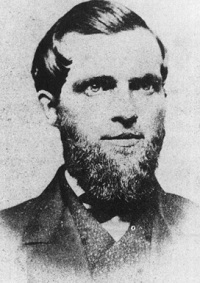
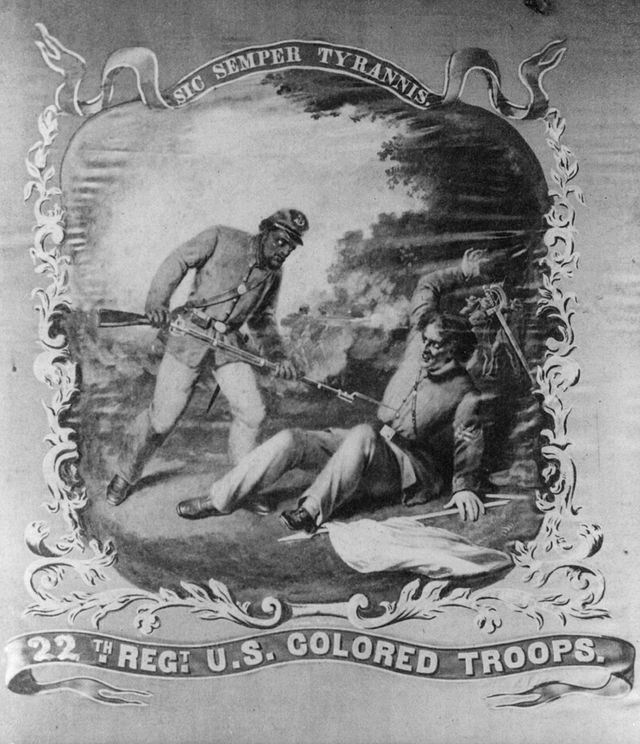
1864: Kastus Kalinouski, Belarus revolutionary

On this date in 1864, Kastus Kalinouski was hanged in a public square in Vilnius.

A peasant revolutionary from the European frontiers of tsarism, Kalinouski is a present-day independence hero for Poland, Belarus, and Lithuania. (His name is variously rendered Konstanty Kalinowski, Kastus Kalinouski, and Konstantinas Kalinauskas for those respective homelands.)

These various polities had been joint constituents of the old Polish-Lithuanian Commonwealth, gobbled up by Russia at the end of the 18th century.

Dissatisfaction with membership in this adoptive empire progressed differently among different demographics of the old Commonwealth, but it really blossomed in the wreckage of the 1850s Crimean War. Chastened after being drubbed by an industrial power, Russia finally emancipated her serfs — but the emancipation proved to bear as much confiscation as liberation, to the chagrin of the emancipatees.

In Poland, Belarus, and Lithuania, peasant anger at the raw deal dovetailed nicely with stirring national sentiment. Kalinouski, a young barrister, launched the flagship (clandestine) publication for that audience, Muzyckaja Prauda (Peasant’s Truth). It was one of the first periodicals published in Belarusian, and it was not calculated to reconcile his countrymen to Moscow.

Six years have passed since the peasants’ freedom began to be talked about. They have talked, discussed, and written a great deal, but they have done nothing. And this manifesto which the tsar, together with the Senate and the landlords, has written for us, is so stupid that the devil only knows what it resembles-there is no truth in it, there is no benefit whatsoever in it for us.

-From the first issue of Peasant’s Truth

Kalinouski’s literary adventures mirrored a prominent role among the leadership of the January Uprising to throw off the Romanov yoke.

But it proved to be the case that, although scrapping with Great Britain might be one thing, the Russian army was more than a match for her internal foes. It crushed the January Uprising.

In prison awaiting execution, Kalinouski bequeathed one last literary vindication, his Letters from Beneath the Gallows.

Friends, my brothers!

From under the Russian gallows I am writing to you for the last time. It is sad to leave my native land and you, my dear people. My breast sighs and my heart is sore, but it is not a sad lot to perish for your truth. Hear my last words in sincerity, my people, for it is as if they were written from this world only for your good … as day and night do not reign together, so also true learning does not go together with Russian slavery. As long as this lies over us, we shall have nothing. There will be no truth, no riches, no learning. They will only drive us like cattle not to our well-being, but to our perdition.

… go and fight with the whole people for your human and national rights, for your faith, for your native land. For I say to you from beneath the gallows, my people, you will only then live happily, when no Russian remains over you! (Source)


A plaque in Vilnius marks the spot of Kastus Kalinouski’s execution on 22 March 1864 (10 March by the Julian calendar).

On this day..

1861: The Bascom Affair hangings, Apache War triggers

The retaliatory executions a U.S. Army lieutenant carried out on this date in 1861 helped set in motion a decade-long war with the Apaches.

Three years out of West Point and brand new to Arizona’s Fort Buchanan, George Bascom in retrospect was probably not the ideal ambassador to send out with orders to retrieve a young half-Apache boy kidnapped from a ranch by an Indian raid. (Along with all the cattle.)

Since nobody was present at the time, the identity of the raiders just wasn’t known — but someone’s suspicions affixed on the wily and dangerous* Chiricahua warrior Cochise. The Chiriachuas were just one group among the Apache peoples; they ranged from Mexico to southeastern New Mexico and southwestern Arizona, and were divided into many small local groups each with their own leader — like Cochise.

Lt. Bascom would be killed in a Civil War engagement a year after the events in this post without leaving posterity his memoirs, so his understanding of Apache society can only be guessed at. But his on-the-make bullheadedness is universal to every time and place where young men can be found. “Bascom was a fine-looking fellow, a Kentuckian, a West Pointer, and of course a gentleman,” Arizona frontiersman Charles Poston later remembered. “But he was unfortunately a fool.”


Lt. Bascom and Cochise.

The greenhorn lieutenant rode out with 54 cavalrymen to Apache Pass and lured Cochise to a confabulation. Cochise showed up with his brother, wife, and children — clearly expecting some sort of social call.

Cochise was entirely unaware of the kidnapping, and unaware that Bascom considered him the kidnapper. He offered to find out about it and retrieve the boy from whomever had him.

Bascom, whose troops had surrounded the tent during the parley, accused Cochise of lying to him. Cochise had twice the impertinent lieutnant’s years and at least that multiple of Bascom’s sense, and must have been affronted by his opposite number’s behavior — but when Bascom announced that he would be taking Cochise and his companions as prisoners pending the return of the raiders’ spoils, the Apache commander whipped a knife out of its sheath and instantly slashed his escape route through the wall of the tent. Bursting past the shocked troops (they were as inexperienced as their officer), Cochise escaped into the twilight. This “Bascom Affair” (to Anglos) is remembered more evocatively by Apaches as “Cut Through The Tent”.

But the tent-knifing was only the start of it.

Cochise’s party did not manage to follow his escape, so Bascom now held Cochise’s brother, wife, son, and two other warriors. The Apache tried to put himself in a negotiating position by seizing hostages of his own — first a Butterfield stagecoach stationmaster named Wallace, and later three white men seized from a passing wagon train.

Nor were the hostages’ the only lives at stake. Cochise’s band, including the soon-to-be-legendary Geronimo, had assembled and their campfires burned menacingly in the hills around the little stage station where Bascom’s force fortified themselves. Bascom could have defused it all with a hostage swap, but the kid had his orders and stubbornly refused to make the trade unless it included the one hostage Cochise didn’t have: that little boy from the ranch.

At length, reinforcements for the beleaguered cavalry began arriving, one such party bringing three other Apaches captured en route and entirely unrelated to Cochise. “Troops were sent out to search for us,” a much older Geronimo recalled in his memoirs. “But as we had disbanded, it was, of course, impossible for them to locate any hostile camp … while they searched we watched them from our hiding places and laughed at their failures.”

Despairing now of seeing his family again, Cochise had his hostages killed and dispersed, leaving the mutilated remains to be discovered by his antagonists with the help of circling buzzards. When they did so, they retaliated in fury — releasing only Cochise’s wife and child, but hanging the six other hostages, including Cochise’s brother. In the narration of Sgt. Daniel Robinson,

After witnessing the fiendish acts committed by the Apaches, the minds of our officers and men were filled with horror, and in retaliation, it was decided in Council, that the captive Indians should die. On the 19th we broke camp to return to our respective posts leaving a Sergeant and eight men to take charge of the station until relieved. We halted about half a mile from the station where there was a little grove of Cedar trees. The Indians were brought to the front with their hands tied behind their backs, and led up to the trees. Noosed picket ropes were placed around their necks, the ends thrown over the limbs of the trees and manned by an equal number of willing hands. A signal was given and away flew the spirits of the unfortunate Indians — not to the happy hunting grounds of Indian tradition. According to their ideas or belief in a hereafter, those who die by hanging can never reach that region of bliss. I was in an ambulance with the other Sergeant, and must confess it was a sad spectacle to look upon. An illustration of the Indians sense of Justice: “That the innocent must suffer for the guilty.” And the white man’s notion — “That the only good Indians are dead ones.” Whatever it may be, I do not think it was much worse than the present policy of penning them up on Reservations and starving them to death. (See Cochise: Firsthand Accounts of the Chiricahua Apache Chief.)

A devastating decade-long war against Cochise and his equally able father-in-law Mangas Coloradas ensued, and right when the army most needed its military resources for the Civil War. The conflict claimed hundreds or thousands of lives, crippled mining and ranching, and depopulated fearful white settlements around Apache country in favor of “gravestones … by the road-side like sentinels, bearing the invariable description ‘Killed by the Apaches'”.

A fort near the Texas border was later named for Bascom. The kidnapped boy was never recovered and grew up in a different Apache tribe.

The events of, and following, the Bascom Affair were depicted on the silver screen in the 1950 Jimmy Stewart western Broken Arrow and its 1952 prequel Battle at Apache Pass — among many other cinematic adaptations.


Tom Jeffords (Jimmy Stewart): “Cochise didn’t start this war! A snooty little lieutenant fresh out of the east started it. He flew a flag of truce which Cochise honored, and then he hanged Cochise’s brother and five others under the flag.”

* Cochise was officially at peace with the Americans at this point and hostile to Mexicans. In “Cochise: Apache War Leader, 1858-1861,” in the Journal of Arizona History (Spring 1965), Barbara Ann Tyler argues that the reality of the situation was that his warband flexibly shifted between temporary peace and opportunistic small raids, moving north and south of the Mexican border as convenient.

On this day..

1865: Henry Regley and Charles King, General Sheridan’s deserters

On this date in 1865, two Union soldiers were shot as spies at Winchester, Virginia.

Union General Philip Sheridan and his famed Napoleon complex* were wintering in Winchester, Va. where he had recently clinched northern control of the Shenandoah Valley, and put its fertile farmlands to the torch to cripple the rebel army.

Sheridan, who had in the course of that campaign made his lasting fame by rallying his troops after an initially devastating Confederate surprise attack, was highly concerned at the prospect of rebel spies and infiltrators.

Our two poor fellows, Henry Regley and Charles King, were actually nothing of the sort — just bounty jumpers who donned the blue uniform to collect a cash reward for joining up, and then deserted at the first opportunity. Given the state’s primitive tools in the 1860s for monitoring individual citizens or verifying identity, many bounty jumpers simply repeated the enlistment-desertion cycle several times.

Being shot as a deserter was one of the occupational hazards — a small one, but a real one. But being shot as a spy? Well, General Sheridan was on the lookout.

These deserters on their way out of camp happened to bump into a patrol of “Confederates”: actually a Union detail Sheridan had uniformed like the enemy for sneaky reconnaissance. What ensued next was your basic comedy of mistaken identity … with a double execution at the end.

The following is a newspaper dispatch filed a few day later by one of their fellow soldiers writing under the pen name “Manatom” for the Newark Daily Advertiser; it comes from New Jersey Butterfly Boys in the Civil War: The Hussars of the Union Army

Henry Recli [sic] of Co. L and Christian A. Gross, alias Charles King of the same Company, a German by birth, left the regiment while at the present camp. A party of scouts led by Major [Young] of Gen. Sheridan’s staff, at their head, dressed in rebel uniforms met these men up the valley, a number of miles outside the picket lines. As they conversed with them, the deserters supposing them to be genuine rebels, gave them the contraband information, and stated that they had been trying to desert for some time. They assented to a proposal to exchange clothing, and then were arrested.

I am informed by Chaplain John L. Frazee, whose trying duty it was to be with the condemned during their last hours, that both persisted in their innocence to the last. When told by the Provost Marshall Lee, that they were to die at noon, they said they knew that the night before, when they were in Winchester, at which place Gross, who had always signed his name as Charles King, wrote a letter to friends in Philadelphia, signed Christian A. Gross, in which he expressed his doubts of the carrying out of the sentence. The chaplain believes this idea deceived them until the last moment, although they yielded a sort of mechanical compliance with the solemn services held with them in private, and kneeled in prayer before being taken from prison.


Private Friederich Jaeckel’s drawing in his diary of the two deserters, again via New Jersey Butterfly Boys. Though that book’s caption places this on January 6, 1864, context suggests this must in fact be our 1865 incident; there is no indication I can find of an executed pair in the army dating to exactly one year before.

The details of the execution of this kind are terribly formal and impressive. Fully three thousand cavalrymen were drawn upon three sides of a square upon a gentle slope a little way from headquarters. Each regimental and brigade staff was with its organization and centrally stationed was Gen. Custer and his staff and body guard. When the Division was arranged, Provost Marshall Lee gave orders that the condemned should be brought forth, and thoroughly unused as I was to seeing death in that shape, the memories clustering about that slow moving group, seem as if burned in my brain.

The Provost Marshall, preceded by the band, with a small body guard, led — then the firing party, made up of twelve picked men from our own regiment. A large open wagon, drawn by four white horses, came next — in which there were two coffins, upon each of which sat a doomed man riding backwards, with feet ironed and hands tied behind. Each had a long white scarf about the head. Besides these rode the Chaplain and a proper guard dismounted closed the rear.

The fine brigade band, which had marched in silence until near the Division, when the first side of the square was reached, began playing a Dead March, and thus did this little group march slowly around inside the whole army, and at last halt at an open grave — dug in the center.

The men were now lifted from the wagon, the Coffins duly placed, and the men seated as before facing the whole Division. Marshall Lee then, from his horse, read the order and warrant … brief religious services were held, the Chaplain reading a portion of the burial service, and offering prayer for the condemned. Neither had anything to say, and the Chaplain retired a few paces. The faces of the men were then covered, and the firing party quickly drawn up in line with pieces previously carefully loaded and placed in their hands. One of the twelve had, by a merciful regulation in the Articles of War, a blank cartridge, and each comrade had the hope that he should send no fatal ball.

More rapidly than I can trace this account was the preparation done. Ten paces off stood the line — each man sternly appreciative of his fearful duty.

“Attention” Ready! Aim! Fire! The report was almost as if one carbine had responded. Two bodies fallen backwards and dead were all that remained of Recli and Gross. The surgeon in a few moments pronounced life extinct; and the scene closed by marching the whole body of troops past their Coffins, lying as they fell — this most solemn warning one can imagine to the soldier — to be faithful to himself, his oath and his Country. MANATOM

* Abraham Lincoln’s hilarious description of the 1.65-meter (5′ 5″) “Little Phil”: “A brown, chunky little chap, with a long body, short legs, not enough neck to hang him, and such long arms that if his ankles itch he can scratch them without stooping.”


General Sheridan

On this day..

1868: Thomas Jones, bad uncle

(Thanks to Meaghan Good of the Charley Project for the guest post. -ed.)

Four days after Christmas in 1868, Thomas Jones was executed in London, Ontario for one of the most sensational murders perpetrated in the region at the time. He had brutally slaughtered his twelve-year-old niece in the town of Delaware.

Early that year, according to this article on the case, Jones had tried to rob his own brother’s house while wearing a false beard to disguise his identity. Unfortunately for him, young Mary Jones recognized her uncle and subsequently testified against him in the ensuing trial. Thomas Jones held this against her, as did Thomas’s daughter Elizabeth, who was thirteen.

On June 11, 1868, Mary’s mother sent her to Uncle Thomas’s house to fetch a cup of flour. (One wonders why she did so, given the history of bad blood between uncle and niece.) Mary never returned.

Suspicion inevitably fell on Thomas, who insisted she’d come and gotten the flour and left his home alive and well. Forty-eight hours after Mary’s disappearance, the search party got fed up, grabbed Thomas’s ten-year-old son and threatened to kill him if he didn’t tell what happened to his cousin.

The boy led them to her body, hidden in the woods under a fallen tree. Her skull had been fractured.

According to the child, both his father and his sister Elizabeth had participated in Mary’s murder. Public feeling ran high against the accused and the entire family had to be taken into custody and transported from Delaware to London to avoid a possible lynching. Only Thomas and Elizabeth faced murder charges, but according to this account, Thomas’s wife and younger son were kept in jail for four months and his two older sons, both in their teens, remained there until well after their father’s death.

The prosecution’s theory was that either Thomas had murdered his niece after Elizabeth lured her into the woods at his direction, or Thomas talked Elizabeth into committing the murder.

At trial, Elizabeth tried to take the rap for her father, claiming she’d beaten Mary to death entirely on her own and Thomas had only helped her hide the body. Thomas’s youngest son testified in support of this, saying he’d witnessed his sister striking Mary with a club.

Thomas used his underaged daughter’s statements like a shield — he would maintain his innocence to his dying breath — but in the end the jury convicted him of murder. What may have tipped the balance was the medical evidence, which indicated Mary had been dealt some powerful blows, stronger than a child could have inflicted.

Elizabeth was convicted of manslaughter and sentenced to ten years for her role in the crime, in spite of her youth. The older two of Thomas’s three sons, ages seventeen and fifteen, were finally released without charge in the spring of 1869. Elizabeth served seven years before she was freed.

In spite of the bitter cold many residents of Delaware came to watch Thomas hang at the Middlesex County Gaol. Around six thousand people were in the crowd — approximately half the population of London. This would be the last hanging in Middlesex county.

On this day..

1865: William Corbett and Patrick Fleming

(Thanks to Ramicles, the pseudonymous 19th century Chicago correspondent of the Providence Press, for this eyewitness account of a December 15, 1865 hanging of two hired assassins. It appeared under a December 16 dateline in that paper’s December 21, 1865 edition. -ed.)

I have promised the numerous readers of the EVENING PRESS a description of a death scene, and I will keep my word. But believe me, it is no welcome task; my heart is not in it. On my mind one solemn moral is impressed — one moral only: the terrible reality of crime, the terrible reality of punishment. One naturally follows the other, as night follows day.

At the hour of three, lacking ten minutes, on yesterday afternoon, I saw two men, William Corbett and Patrick Fleming, take a formal farewell of this world and enter an untried existence. Those who love to linger on the few hours which the wretched men passed, in the anticipation of that final scene, may do so. I will not. They knew that they had incurred the law’s extreme penalty, and must suffer that penalty. There is a disposition on the part of doomed men to “die game;” and much of the apparent heartlessness is bravado only.

As I have said in a former letter, Fleming has for several days seemed indifferent or defiant. Whether he had faint hopes of pardon, I know not; but there seemed to be something in his manner that showed his reliance to some extent on the mobid [sic] humanitarianism of the age, (as exhibited in the case of the Malden murderer Greene,) and had not finally made up his mind for death.

Those who had not made human nature a study, were therefore unprepared to see the difference in demeanor of the two men, on the scaffold. Corbett, who, since his sentence, has seemed to realize his solemn situation, and has been much depressed, because, as his last moments drew near, cheerful and even jubilant, and the gloomy Court House echoed his hilarious merriment, which was startlingly horrible, as wild laughter wakened in the throat of death. There is something grotesquely awful in hearing a man laugh while the rope is around his neck. (The Republican reporter styled that death “ecstacies!” [sic] I had always supposed that ecstacy was less boisterous; but I am ready at all times to receive new ideas and novel definitions. — Who ever knew a man in Chicago to be wrong? “If any, speak, for him have I offended.”) The conduct of Flemming [sic] was in striking contrast. He seemed chilled with the thought of death, and was so lost in contemplation that he scarcely heard the voice of the clergyman admonishing him to pray.

He indeed repeated the words of the prayer, but so unconsciously that it seemed only mechanical. His eyes were vacantly staring, and his countenance was ghastly in its expression of deadly fear. Was that gaze fixed on vacancy alone? Was it a retrospective vision of the soul gazing on itself, and with reversed sight recalling all the past — the hours of childhood — the fleeting moments of early manhood — the years whose only noteworthy incidents were damning deeds of midnight robbery — that night of blood — that death-cry of his victim — the fatal shot — the flight — the vision of justice and the avenging Nemises [sic] following his track — the arrest — the trial — the death sentence, and the lingering death of expectation preceding its infliction? Or was there one more torture? Was his the gift of prescience, and the power to look beyond the Shadow of the Dark Valley, and was it what he there saw that transfixed him into a statue of cold horror? Who shall say?

Those were my reflections when I looked on the miserable man; and I unconsciously repeated to myself the heartfelt words of the psalmist: “Cut me not off, O, my God, in the midst of my days!”

I shuddered as I thought that the doomed one might be silently repeating the same prayer, and II, by mesmeric rapport or sympathy, had caught up his inaudible petition. Then came another hideous laugh from the lips of Corbett — a few hasty words of farewell — a slight gliding sound as the well oiled bolts slid swiftly back — and two forms shrouded in white cloth were spasmodically struggling with death. The drop was located in the east wing of the Court House, the trap being constructed in the floor. After the two surgeons in attendance had pronounced them both dead, the bodies were lowered into the coffins, as usual, and a few had a curiosity to look at the faces. Singular as it may seem, Flemming had undoubtedly suffered the least pain of the two. The features were somewhat distorted and discolored. But Corbett’s face was a sight such as one would look on but once, and wish to efface [sic] the memory of that one look, and think of it no more forever. The tongue protruded fearfully from the mouth, and the teeth had bitten through it, in that last agony of dissolution. Truly is an execution a moral lesson which no one may witness without a thrill of horror whatever one may think of the theory of capital punishment.

There was one fact in connection with the affair, which I cannot understand. The widow of the murdered man repeatedly made application to the Sheriff for permission to see the hanging and it was refused. At an early hour I saw a lady dressed in deep mourning standing at the Court House gate and I was informed that it was Mrs. Maloney. After all was over, she still stood there, shivering in the intense cold, the bitter freezing cold. It appears some one had told her that the men who had murdered her husband and left her desolate, would be reprieved, and that only increased her anxiety to see the sentence of the law fulfilled.

Hour after hour she waited, while stout men, wrapping more closely their overcoats and mufflers around them, hurried on more rapidly as they felt the keen blast which swept across the square. Several times she was assured that the criminals were hanged; but she refused to believe it, till an acquaintance in whom she had confidence told her, and then with an expression of relief and satisfaction on her face, she suddenly left for home, and I saw her no more. Poor woman! the wrong done her and her child had been avenged. Justice had vindicated itself. Who shall say but half the sorrow of bereavement was lifted from her heart by the knowledge that the slayers of her husband had tasted the bitter waters of death, held to their unwilling lips by the hand of Retribution? Why was it that the satisfaction of witnessing the punishment was denied her? I may be wrong, but I only repeat the sentiments of many men here and elsewhere when I say: Hangings should be public.

I have heard and read many objections to public executions; but I am convinced that whatever may be said of the rude and brutal deportment of the crowd — the levity — the profanity, &c. &c., I am convinced that no man ever saw an infliction of the Death Penalty, and forgot it. Men may read the long accounts given by newspaper reporters, but the reality beggars description. The reader can get but a very poor idea from the most graphic account, and like any other item of news, it is not long remembered. If the grand object is to warn men, by impressing on their minds the terrible consequences of crime, then that warning should be given in the most public manner possible.

When I commenced this communication I had no thought of making a plea for the gallows; and I will only say, that until some more fearful mode of punishing the crime of murder can be invented, hanging commends itself to the approval of reflecting people. It is a severe remedy, but it is the only effectual one; and those individuals who oppose capital punishment so zealously, may easily find other ways to vent their sentimentalism. Sympathy for those whom crime has injured would be better placed than sympathy for criminals. You will hear from me on this subject no more until Jeff. Davis is hanged, and then I shall probably have some comments to make, as I shall endeavor to “be there to see.”

On this day..

1865: The Jacksonville Mutineers

On this date in 1865, six African-American infantrymen were shot in Fernandina, Florida, for the Jacksonville Mutiny.

Formed in 1863, the 3rd Infantry Regiment, United States Colored Troops served in the trenchworks around Fort Wagner — the grinding siege in the summer of 1863 that followed the bloody attempt to storm the fort immortalized in the 1989 film Glory.

The Third was subsequently transferred to Union-occupied Jacksonville, Florida for duty garrisoning a conquered town of the Confederacy whose white citizens chafed doubly at their presence. But the unit had weathered both the boredom of the garrison and the hostility of white Floridians, and was set to muster out and return home on Halloween of 1865.

All U.S. Colored Troop regiments were officered by white men, putting an inevitable racial tinge on the inherent potential tension between enlistees and their commanders — the triggering event in our story. Heading the Third was a fellow named John L. Brower, Lieutenant Colonel by rank courtesy of his political connections but of nearly no actual military experience.

Ohio National Guard Judge Advocate General Kevin Bennett, in his 1992 article about the mutiny,* calls Brower a “martinet”; elevated to command of the Third on September 12 for what should have been a mostly ceremonial interim, Brower delighted in enforcing stringent wartime discipline months after Appomattox. While no man welcomes the taste of the lash when he’s one foot out the door back to civilian life, excess discipline meted out by cruel white overseers was particularly bad form for Colored Troop regiments.

From the standpoint of black Americans, the war had been all about destroying slavery; they had practically had to force this objective, and their own presence,** into the conflict. Being strung up by the thumbs for petty theft — Brower’s decreed punishment for one of his charges on October 29 — was far too evocative of the hated Slave Power.

“Inexperienced officers often assumed that because these men had been slaves before enlistment, they would bear to be treated as such afterwards,” one white Colored Troop commander later remembered. “Experience proved to the contrary. Any punishment resembling that meted out by the overseers caused irreparable damage.”†


The inclination of black troops to reject servile treatment and the anxiety that this provoked among their officers and the larger white community must surely be read in view of the perplexing new conditions following the Civil War.

Even among whites who supported it in principle, slavery abolition meant an unsettling and uncertain rearrangement of civilization — or at least, it potentially meant that. Would the economy continue to function without slavery? Would the daily conventions and assumptions that had sustained whites north and south have to be entirely renegotiated?

“Once let the black man get upon his person the brass letter, U.S., let him get an eagle on his button, and a musket on his shoulder and bullets in his pocket, there is no power on earth that can deny that he has earned the right to citizenship,” Frederick Douglass had proclaimed. Now that the war had finished, what else did those musket-toting sable fellows think they had earned the right to?

Press reports over the course of 1865 show a continuing theme of “Negro mutinies”: it is for wiser studies than this post to determine whether the trend such stories represent is disturbances among the black soldiery, or an exaggerated preoccupation among their white countrymen. In either event, Jacksonville was very far from unique even if the punishments were exemplary.


From the June 16, 1865 Cleveland Plain Dealer, concerning black soldiers on a steamer bound for Texas calling at Fort Monroe who, chagrined at the assignment, refused to permit the steamer’s resuming its journey.


From the June 19, 1865 Philadelphia Inquirer, concerning a company refusing to embark for Texas. “Certain evil disposed persons put it into the heads of these credulous colored soldiers that they were to be sent to Texas as servants for the white troops,” runs the report. “Doubtless some secret enemies of the Government instilled similar subtle falsehoods into the simple minds of the blacks who were disarmed at Fortress Monroe a few days ago.”


From the September 30, 1865 Daily National Intelligencer (Washington, D.C.), concerning a mutiny reported near Hilton, N.C.


From the Oct. 1, 1865 Daily Constitutionalist (Augusta, Ga.), reporting a disturbance begun when a black regiment demonstrated against a court-martial for one of their comrades accused (and acquitted) of stealing a hat.

In the midst of all of this — right about the time of the incident in this post, in fact — bulletins reached American shores of the Morant Bay Rebellion, a bloody rebellion of black laborers in British-controlled Jamaica. Slavery had been abolished on that Caribbean island more than 30 years prior: what did that uprising augur for the races in these United States?


Subtext becomes text: the Norwich (Conn.) Aurora, December 23, 1865. “The African released from restraint, and the passion of the savage provoked, will realize the scenes formerly witnessed in Hayti.” (The full article (pdf))

For our case, the name of the man punished like a slave is lost, but we do know what he did: steal some molasses from the kitchen. That’s how six of his comrades ultimately wound up looking down the barrels of their executioners.

A Lt. Greybill caught the greedy nosher and decreed a rough summary punishment, which the arriving Brower arrived helped to enforce on the resisting prisoner. “Tying up by the thumbs” was a brutal and humiliating treatment that lifted the man by those digits (often dislocated in the process) until only his toes remained on the ground, barely supporting his weight, and left him there for hours. In the film 12 Years a Slave, we see a man subjected to this sort of tiptoeing, but with a rope about the neck instead of about the thumbs.

Other enlisted men gathered around this pitiful scene, complaining about what they saw. A Private Jacob Plowden, who will eventually number among our day’s six executees, cried out that “it was a damn shame for a man to be tied up like that, white soldiers were not tied up that way nor other colored soldiers, only in our regiment.”

Plowden announced that “there was not going to be any more of it, that he would die on the spot but he would be damned if he wasn’t the man to cut him down.” Another private, Jonathan Miller, joined the incitement — “Let’s take him down, we are not going to have any more of tying men up by the thumbs.” A number of the black soldiers, 25 to 35 or so, began advancing on Brower and the hanging molasses-thief. Brower drew his sidearm and fired into them, wounding a man and sending the soldiers scurrying — some dispersing, but other dashing off to tents to arm themselves.

Several non-lethal fights now occurred in various spots around the camp between soldiers and officers, and eventually between the disaffected soldiers and arriving brethren from Company K, who had been summoned to calm the situation.

Lt. Col. Brower exchanged shots with several of the men who armed themselves, and in a bit of symmetry with the distasteful punishment that had started the whole mess, he had his thumb shot off in the process. One of the privates who had been heard complaining of the thumb-hanging, now playing peacemaker, grabbed the injured officer and escorted him to a safe building, warning some men who tried to pursue them to “stop their damn foolishness.”

Elsewhere, a Lt. Fenno sabered a protestor, and got bashed over the head with a fence-post in response. Neither injury was life-threatening to its recipient. Some shots were exchanged elsewhere in camp and/or fired demonstratively into the air, again to no fatal effect. And a Private James Thomas cut down the post where the source of all the disturbance, the fellow who just wanted an extra ration of molasses, was hanging.

This was the whole of the commotion, which Company K reinforcements soon quelled.

In a speedy series of court-martials lasting from Oct. 31 to Nov. 3, thirteen men were convicted of mutiny in this affair, and a fourteenth of conduct prejudicial to good order (his offense: not during the mutiny but after all was over, saying of Brower, “the God-damned son of a bitch, he shot my cousin. Where is he? Let me see him.”) A fifteenth man was acquitted. All 15 accused mounted their own defense, without counsel or aid — generally endeavoring to show that they had either not armed themselves or (and this was the decisive factor for the six whose conviction carried a death sentence) not fired their weapon.

The trial itself posed interesting procedural dilemmas, which Bennett explores at length in his article: first, because it was a mutiny case, the white officers of the Third who comprised the jurors were also, awkwardly, the brother-officers of the witnesses who testified against the mutineers.

And second, although the Civil War was over, Florida still technically remained in a state of rebellion, and this enabled the unit to convene a general court-martial, issue death sentences, and even carry them out without allowing any appeal to Washington. General John Foster gave the final approval to the sentences and transmitted case files to Washington after the fact; that was all the six condemned had by way of legal or executive review.

On December 10, he received a telegraph ordering him to suspend one of the death sentences in response to an inquiry raised by U.S. Senator Edgar Cowan: Cowan had been contacted by one of his constituents, who represented that Private David Craig, whom the constituent had raised from childhood, had written him complaining of his wrongful conviction. According to Sen. Cowan, the allegation was that Craig had been directed to collect arms from the mutineers as the disturbance came to an end, but was thereafter arrested in the confusion for being armed with the weapons he collected. But December 10 was nine days too late, and the late Private Craig’s case file disturbingly seems to have been lost from the National Archives.

The other five shot by musketry this date were:

  • Joseph Green
  • James Allen
  • Jacob Plowden
  • Joseph Nathaniel
  • Thomas Howard

Lt. Col. Brower only testified at one of the courts-martial, and was sent home almost immediately afterwards. He’d lost his thumb for his adventure as an officer and a gentleman, but between the original provocative punishment that he helped enforce, and then inflaming a tense situation by shooting at his soldiers, the brass was probably just as pleased to see him go as were his subordinates.

The non-executed mutineers who received prison terms (up to 15 years) had their sentences commuted following a review in 1866. The rest of the regiment mustered out as scheduled at the end of October, two days after the Jacksonville Mutiny.

* B. Kevin Bennett, “The Jacksonville Mutiny”, Civil War History, Volume 38, Number 1, March 1992. Bennett’s article is the source of all of the quotes in this post not otherwise cited.

** See I Freed Myself, or this podcast interview with its author, David Williams.

† See here for a fascinating instance of this at sea in June 1865, by the author of Becoming American under Fire: Irish Americans, African Americans, and the Politics of Citizenship during the Civil War Era

On this day..

1864: Franz Muller, “Ich habe es getan”

On this date in 1864, German tailor Franz Muller hanged before an unruly London mob estimated near 50,000 angry souls.

Muller was among Britain’s last public hangings, before executions disappeared behind prison walls four years later. But what he’d done was a first, and father to a legion of detective novels and dinner theater: Muller committed the first murder on a British train.

Certainly Muller’s motive was as pedestrian as his locomotion was novel, for the victim was a 69-year-old banker who was relieved of a gold watch and gold spectacles, then pitched out of his compartment onto an embankment on a North London commuter train.

This operation was facilitated and — so conceived a public that was spellbound by the crime — poor Mr. Thomas Briggs’s escape from his attacker prevented by the then-prevalent use of the compartment coach, a railcar design without any interior corridor communicating between the berths. As each compartment opened only to the outside, passengers were stuck in their rooms between stations (and ticket-takers had to scuttle hazardously along exterior running-boards). Known in much of Europe as the English coach, these designs would quickly lose popularity thanks in part to this very affair.*

In a sense, these spaces just translated into the industrial era the age-old terrors that had always stalked travelers. It must be this that accounts for the extraordinary interest the public took in Briggs and Muller: in a sealed compartment, face to face with a desperate man, one would be as nakedly vulnerable as the mail coach on the roads of yesteryear quailing at the shadow of Dick Turpin. London businessmen did not expect such harrowing encounters on their daily commute.

A reward soon yielded a tip that put police onto this working-class immigrant Muller — the man sure ticked every box for a proper moral panic — who had dropped into a Cheapside jeweler’s** shop two days after the murder to exchange a gold chain (later identified as Briggs’s chain), and hopped a ship to New York soon thereafter. Inspectors took a faster ship and beat him to the Big Apple. He still had Briggs’s watch and top hat on his person, the latter ingeniously cut down.†

In a recent book about Briggs’s murder, Kate Colquhoun argues that despite the verdict, Britons “never quite felt they got to the bottom of” why the murder occurred. It’s commonly supposed that Muller didn’t intend to slay his victim and perhaps didn’t even realize he had done so.

Muller’s disarmingly amiable personality contrasted sharply with the circumstantial but persuasive evidence of a violent bandit; he struck the men who awaited him in New York as having been genuinely surprised by his arrest. Muller himself denied his guilt throughout a breathlessly reported three-day trial and even pressed for a stay of execution claiming to have developed new evidence of his innocence.

There was no stay, and only at the very last moment before the drop fell did the condemned youth succumb to the pressure of the German-speaking Lutheran clergyman who had been his companion in the last days to confess himself of the crime with the words Ich habe es getan.

Rev. Louis Cappel, whose immediate public announcement of this solemn unburdening played better as theater than as ministry, later explained in a letter to the London Times‡ (Nov. 16, 1864) that

the unhappy man declared he was innocent not while, but before, the Sacrament was being administered to him. Soon after entering his cell on the last morning I asked Muller again whether he was guilty of this murder. He denied it. I then said, “Muller, the moments are precious; we must turn our minds wholly to God; I shall question you no more about this, but my last words to you will be, ‘Are you innocent?'”

He remained silent for a minute or two, but presently exclaimed, his eyes full of tears, and clasping his arms round my neck, “Do not forsake me; stay with me to the last.”

* As a stopgap safety measure in the following years, before the widespread introduction of cars with interior corridors, existing compartment coaches were fitted with peepholes (called “Muller’s lights”) between compartments as well as wires enabling passengers to ring the alarm

** Submitted without comment: the jeweler’s name was John Death.

† Muller’s truncated-top-hat design actually enjoyed a brief fashion vogue that became named for him as a “Muller cut-down”.

‡ Consonant with the growing elite consensus on the matter, half the Times‘ execution coverage — a full column and a half of newsprint — was dedicated to excoriating the “lawless ruffianism” of the jeering hang-day mob.

On this day..

1864: Four Confederate soldiers, under Burbridge’s Order 59

The Martyrs Monument of Midway, Ky., honors four Confederates publicly executed by the Union one hundred fifty years ago today.

A brutally contested frontier zone between North and South, Kentucky at this point was under martial law, governed by General Stephen Burbridge — but nearly anarchic on the ground in some areas.

In an effort to quell the activities of Confederate guerrillas-slash-outlaws, Burbridge issued a still-notorious directive called Order 59: Citing the “rapid increase in this district of lawless bands of armed men,” the order threatened to expel Southern sympathizers and seize their property. Moreover, it warned: “Whenever an unarmed Union citizen is murdered, four guerrillas will be selected from the prison and publicly shot to death at the most convenient place near the scene of the outrages.”

The outrages in question for this occasion were raids on Midway horse farms* (allegedly led by “Sue Mundy”) that, on November 1, resulted in a shootout fatal to one Adam Harper Jr.

Agreeably to Order 59, Burbridge had four of his prisoners — men with no specific connection to Harper’s death — shot on the town’s commons, forcing the local populace to attend the scene.

Rest
Soldiers
Rest
Thy
Warfare
Oe’r [sic?]

M. Jackson
J. Jackson
C. Rigsner
N. Adams

Shot by order of
Genl. Burbridge
Nov. 5 1864
In retaliation

Our Confederate Dead

Burbridge would be dismissed, and his Order 59 revoked, early the next year. “Thank God and President Lincoln,” was the reaction of the Louisville Journal.

Three other similar monuments in Kentucky (in Eminence, Jeffersontown, and St. Joseph) honor other soldiers executed under Burbridge’s retaliation policy.

* Midway knows from horses.

On this day..

1865: Gerardo Barrios, Salvadoran statesman

August 29 is a National Day of Commemoration in El Salvador, honoring the execution on this date in 1865 of the country’s beloved ex-president Gerardo Barrios.

Today, you’ll find Barrios (English Wikipedia entry | Spanish) entombed adjacent Francisco Morazan, an apt deposition for both those great statesmen of Central American union. Barrios was just old enough — he enlisted at age 14 — to have served in Morazan’s army of the United Provinces of Central America, the abbreviated political expression of a wonderful vision for Spain’s former possessions. “This magnificent location between the two great oceans,” Bolivar once enthused of Central America,

could in time become the emporium of the world. Its canals will shorten the distances throughout the world, strengthen commercial ties with Europe, America, and Asia, and bring that happy region tribute from the four quarters of the globe. Perhaps some day the capital of the world may be located there, just as Constantine claimed Byzantium was the capital of the ancient world.

El Salvador was the capital of this prospective emporium, and not only in the sense that its government met at San Salvador.* As the “provinces” of Guatemala, Honduras, Nicaragua and Costa Rica pursued more autonomy and, eventually, outright independence, El Salvador was also the bastion of support for the failing union. It’s where Morazan fell back to as the United Provinces fractured, and it’s where he landed to mount a doomed reunification campaign.

Gerardo Barrios, come to political maturity as well as to manhood in Morazan’s service, was a Senator by the time the union ended. He followed Morazan into exile, and he raised a battalion for the abortive restoration attempt that cost Morazan his life.

After Morazan’s execution, Barrios increasingly became the key leader of remaining unionist aspirations, which also meant leadership of El Salvador’s liberal faction. This was the country — independent at last because all her sister provinces had declared independence from her — that Gerardo Barrios assumed leadership of in 1859,** a generation on from Morazan’s execution. Actual political reunification of the former provinces was by then as distant and gauzy a dream as Bolivar’s Byzantium; perhaps their most noteworthy common-purpose act in the meantime had been the coordinated defeat of American filibuster William Walker, an operation for which Barrios provided essential behind-the-scenes diplomacy.

So Barrios’s executive tenure would be a crucial period of state-building for Nicaragua: building up roads, schools, and other pillars of civil infrastructure; professionalizing the army; promulgating a comprehensive legal code; and economic development.†

It is from this farsighted era that Barrios won lasting fame as his country’s great statesman. And crowning the period with martyrs’ laurels has surely not done his reputation a bit of harm. His regional rivalry with the Guatemalan caudillo Rafael Carrera broke out into war in 1863, which quickly pulled in Honduras (on the side of El Salvador) and Nicaragua and Costa Rica (on the side of Guatemala). The populist Carrera, Guatemala’s “supreme and perpetual leader for life,” had been the central anti-unionist and anti-liberal figure dating back to the Morazan era, and besides his international alliances he gained the support in 1863 of Salvadoran Catholic clergy opposed to the secularization part of Barrios’s modernizing project. Finally encircled by his enemies in a besieged San Salvador in October of that year, Barrios was once again forced into exile.

Carrera died on April 14, 1865‡ and with the passing of the local hegemon Barrios — by now cooling his heels in Panama — saw an opportunity to regain leadership of his country. But the attempted rising that was to augur his re-entry into El Salvador came to nothing, and Barrios realizing the failure turned around to return to Panama almost as soon as he had arrived. Alas for him, a storm grounded his schooner in Nicaraguan waters.

Nicaragua extradited Carrera back to his native soil, albeit with an arrangement that the prisoner — who had been declared a traitor in absentia during his exile — would not face the death penalty. Once the man was in hand, El Salvador reneged on that part of the agreement and subjected Barrios to a military trial. “Today Duenas pronounces my sentence,” Barrios observed of his successor and enemy late the night of August 28, when the tribunal condemned him to be shot just hours thereafter. “But tomorrow I receive the verdict of history.”

The latter judgment has been an unmitigated victory for our man. His life is taught to schoolchildren and his image has graced the Salvadoran currency repeatedly. Two Salvadoran towns (Gerardo, and Barrios) are named in his honor, and many others have streets or plazas that bear his name, including a huge one in the center of San Salvador, ornamented with a monumental equestrian statue of its namesake.


(cc) image from Bradier044 of the Barrios statue in San Salvador’s Plaza Gerardo Barrios, also known as Plaza Civica.

* San Salvador, which is the present-day capital of El Salvador, was the capital of the United Provinces from 1834. Prior to that time, the capital was Guatemala City.

** Barrios had also been president on a brief interim basis for a few months in 1858.

† If you enjoy brewing a morning pot of El Salvador’s top agricultural export, coffee beans, tip your mug to Barrios: he’s credited with introducing coffee cultivation in the country.

‡ The same date John Wilkes Booth shot Abraham Lincoln.

On this day..

1864: Barney Gibbons, chance recognition

One hundred fifty years ago today, Barney Gibbons was executed by musketry by the Civil War Union army in St. Louis, Missouri.

Gibbons was among the many soldiers in that chaotic war who in the time before identity cards and omnipresent databases deserted the respective armies at their convenience. Whatever the fulminations of the right-thinking against such behavior, only a slight risk of capture and exemplary punishment attended such an act.

Gibbons’ own slip into the statistically improbable might be the slightest imaginable risk of them all.

The New York native was enlisted in the Seventh Infantry Regiment when it was sent at the outset of hostilities to the New Mexico theater of the war; there he slipped away from the march one day and re-enlisted in the Confederate army, serving against his former comrades in several battles — notably Glorieta Pass.

Then Gibbons deserted the Confederate army as well, turned up as a teamster in New Orleans, and eventually made his way to St. Louis.

And that was that, or at least it often would have been. By 1864, who could bother to search out an obscure private fallen off the march three years before?

One summer’s day in 1864, however, a former 7th Infantry sergeant named Richard Day chanced to pass Barney Gibbons on the street and somehow recognized him. “He has a cut upon his lip, and a peculiar manner of walking,” Day would later insist at the court-martial. “Capt. Jones of our company was always at him because he never could walk like a soldier, he would throw his head forward and his arms to the rear. He always walked with his hands open and fingers apart even when he had gloves on.”

Now, despite the certitude of our verbiage so far, the fact of the matter is that “Gibbons” denied all this all the way to the stake — and there were no better forensics on offer than Day’s personal recollection. That was pretty much state of the art, even if we now know that eyewitnesses are highly error-prone.

We pick up Gibbons’s horrifying last moments (following Catholic baptism) via the New York Times correspondent, as reprinted by the Cleveland Plain Dealer on August 23, 1864:

Although there is not at the post of St. Louis an officer who ever witnessed an execution, the preliminaries were conducted in a skillful, orderly and decent manner. — All the troops of the post were in attendance, and a hollow square having been formed with one side open toward the embankment of the for, the condemned man was placed beside a post, with a seat attached, his common pine coffin lying on the ground beside him. After making a brief statement, in which he denied having deserted, but said that he straggled and was overtaken by the rebels, he pronounced his sentence most unjust …

He was seated, and his arms tied behind the post, a white cap was drawn over his face, and six musketeers drawn up within fifteen feet of his breast. The command was given:

“Make ready.”

“Aim.”

“Fire” and two bullets entered the abdomen. And now succeeded a few seconds in which transpired a scene which shook the stoutest heart, and made every human creature present shudder. From beneath the ghastly cap came a wail of agony which pierced every ear, and as the utterance “Oh! oh! too low,” escaped from the lips of the quivering form writhing in the throes of a horrible death, every one seemed paralyzed with horror. With a quick motion the officer of the squad waved the six muskets aside and four others took their place. “Make ready.” “Aim” — but mercifully before the third command was given, the four pieces were discharged, three leaden messengers of death entering the sternum, and a mighty convulsive shudder ended the being of the poor deserter. What an eternity of woe in those intervening few seconds! What a crowding of events from infancy, hallowed by a mother’s love and prayers to the dreadful details of the present scene! Yet, all passed before the mind’s eye of the dying man, and the wonderful palimpsest of his brain touched by the consciousness of instant death, gave him to see in a second all that had been for years forgotten, ere he entered upon the unknown.

The error in firing arose from the fact, discovered too late for remedy, that the sights of the muskets were set for long range.

On this day..