1868: Stefan Karadzha, Bulgarian national hero

On this date in 1868, the Ottoman Turks executed Bulgarian revolutionary Stefan Karadzha.

Karadzha was one of several nationalist cheta (guerrilla) leaders aspiring to father the future sovereign Bulgaria.

Operating from adjacent, and conveniently independent, Romania, around 1866-1867, Karadzha and others of his ilk — Hadzhi Dimitur Nikolov, Filip Totyu, and the dramatically mustachioed Panayot Hitov — slipped over the mountainous border to organize revolutionary cells and foment ill-feeling towards the Sublime Porte.

In Bulgaria’s late 19th century progress towards independence, these figures are transitional characters between the vanguard leadership of Georgi Rakovski, and the ensuing primacy of Vasil Levski.

Levski himself was a guerrilla in this period; after the cheta legions suffered some backbreaking defeats in the field — one of which saw our man Karadzha captured so badly wounded that he was “half-dead before the emergency Turkish court”* when condemned to hang — Levski set about honeycombing his country with the revolutionary network that would shape the future revolutionary struggle.

A national hero of lesser stature than Levski, which is sure no disgrace, Karadzha has a village named after him.

* The quote is from the unimpeachable source of Karadzha’s Wikipedia page.

On this day..

1864: Nikolay Chernyshevsky’s “civil execution”

On this date in 1864, the Russian writer Nikolay Chernyshevsky was publicly executed in St. Petersburg.

Then he was shipped to Siberia.

Chernyshevsky’s punishment was only a pantomime “civil execution,” somewhat akin to the symbolic executions by effigy elsewhere in Europe. In this case, the faux death penalty was imposed not upon a peeling portrait but on Chernyshevsky’s actual person: “The hangmen led Chernyshevsky to the scaffold on Mytninskaya Square in St. Petersburg, made him kneel down, broke a sword over his head and then chained him to the pillory. Chernyshevsky stood calmly under the rain waiting for this mockery to come to an end.” (Source)

The pillory, exposed to the hoots and brickbats of an offended populace, was supposed to be a humiliation to its sufferer; occasionally, it even proved lethal. Not so for Chernyshevsky: the crowd stood silently. Someone threw a bouquet of flowers.

This ludicrous theater was enacted to punish Chernyshevsky for his leadership of the St. Petersburg intellectual circle that gave birth to the Narodnik movement. Literally “going to the people,” this was a peasant-focused populist-democratic-socialist philosophy paradoxically germinated among Russia’s small coterie of intellectual elites.

Think Marxism for a feudal society here: the Narodnik adaptation was the hope that Russia’s vast peasantry could be roused to serve the part of a revolutionary working class, and skip Russia directly to a socialism still preserving communal traditions unsullied by that interim period wherein (per Marx in the Communist Manifesto) capitalism had “pitilessly torn asunder the motley feudal ties … [and] left remaining no other nexus between man and man than naked self-interest.”

This is why Chernyshevsky and the Narodniks viewed the “emancipation” of serfs of 1861 with a gimlet eye: it was a shift towards capitalist property relations, in which the feudal shackles were merely replaced with new, and heavier irons. Chernyshevsky subversively urged his “emancipated” countrymen to view the move as a heist.

It is of course unlikely that many of the actual peasant malcontents stirred up in the wake of the emancipation perused Chernyshevsky’s “To the Manorial Peasants from Their Well-Wishers, Greetings”. But other bourgeois radicals who did read that sort of thing would in due time — after the suppression of the Narodniki in the 1860s and 1870s drove its underground remnants to terrorism — spawn the revolutionary network Narodnaya Volya, and assassinate the tsar who enacted that emancipation, Alexander II.

Chernyshevsky was more a writer than a fighter. He spent his pre-“execution” imprisonment in Peter and Paul Fortress forging his definitive contribution to the movement — the novel What Is To Be Done?.*

(Our own Sonechka regards What Is To Be Done? as quite possibly Russia’s single worst literary product, but the didactic novel imagined (in the dreams of its principal character, Vera Pavlovna) an egalitarian future, including for women. Chernyshevsky himself wrote that he “possess[ed] not one bit of artistic talent … any merit to be found in my tale is due entirely to its truthfulness.”)

Whatever its artistic shortcomings, What Is To Be Done? entered the revolutionary literary canon. Vladmir Ilyich Ulyanov — better known as Lenin — wasn’t even born until 1870 but as a young man he admired What Is To Be Done? In 1902 Lenin himself published a political pamphlet under that same title.

Far less impressed were the likes of Dostoyevsky, himself a former radical who also underwent mock execution in his time. Unlike Chernyshevsky, Dostoyevsky apostasized from his revolutionary credo; Dostoyevsky’s 1864 Notes from the Underground is “a bitter artistic answer” to (and in several spots a direct parody of) Chernyshevsky’s magnum opus.

* What Is To Be Done? responds to Turgenev‘s Fathers And Sons. A previous Narodnik classic by Alexander Herzen asked the parallel question Who Is To Blame?.

On this day..

1866: Mokomoko and the Maori killers of Carl Volkner

On this date in 1866, five Maori men hanged for the murder of a German proselytizer.

Hesse-born Carl Sylvius Völkner* arrived in New Zealand as a Lutheran missionary in 1849; by 1861, he was directing an Anglican-run mission at Opotiki, the center of Maori Te Whakatohea territory.

Unfortunately for Volkner, his mission to win souls overlapped with the British mission to win land.

This same early 1860s period saw a sharpening of the European-Maori conflict on the North Island where Volkner kept his mission — the bloodshed in turn fostering the militant Pai Marire or Hau Hau faith in place of the settlers’. Though the Te Whakatohea weren’t directly involved in this war, they had felt its effects: refugees, food shortages, disease outbreaks.

Volkner, who was seen by Maori as a pro-government character and a British spy,** was warned that under the fraught circumstances he might be wise to extend his most recent trip to Auckland indefinitely and wait for things to simmer down.

He did not heed that warning.

On March 2, 1865, the day after Volkner’s return to Opotiki, a group of Pai Marire hanged the missionary to a willow tree outside his Church of St. Stephen, then butchered the dead body.

The Pai Marire leader Kereopa Te Rau then preached from the church’s pulpit with Volkner’s severed head at his side, in the course of which he tore the eyeballs from his grisly prop and, calling one “the Queen” and the other “Parliament”, theatrically devoured them. (Kereopa Te Rau is nicknamed “Kai whatu”, “the eyeball eater”.)

Old eyeball eater would eventually hang for this display as well, but he avoided capture until the 1870s — so this narrative takes its leave of him here.

The slaughter of the European evangelist at the very steps of the protomartyr’s church in turn fired the fury of white New Zealand.

The most immediate response was the government’s landing 500 soldiers in Opotiki in September 1865. From there they raided throughout Te Whakatohea territory (confiscating some 240,000 hectares that would feed white settlers’ surging demand for real estate) and put crops to the torch until the tribe surrendered up some 20 chiefs for punishment of the Volkner affair.

Five of those eventually hanged for their participation: Heremita Kahupaea, Hakaraia Te Rahui, Horomona Propiti and Mikaere Kirimangu … and a man named Mokomoko who was then and remains now the most controversial execution of the bunch.

Mokomoko’s guilt was sharply disputed by eyewitnesses who gave conflicting accounts of whether he was even present at the church on March 2. It was Mokomoko’s rope that strangled Carl Volkner, but the man himself insisted that he was not present. (The three witnesses who placed him on the scene said he carried the rope, suggesting participation far exceeding a bystander.)

Maori tradition preserved Mokomoko as an emblem of wrongful persecution, along with his song Tangohia mai te taura i taku kaki kia waiata au i taku waiata (Take the rope from my neck that I may sing my song):

Violent shaking will not rouse me from my sleep
They treat me like a common thief
It is true that I embrace eternal sleep
For that is the lot of a man condemned to die.

Shielded from the harsh light
With narrow eyes I reflect on the retribution taken at Hamukete
Remember how I was taken on board ship (chained)
The memory of it burns me with shame.

Bring me justice from distant lands to break my shackles
Where the sun sets is a government in Europe
It is for them to say that I must hang
Then shut me in my coffin box.

Under pressure from Mokomoko’s descendants, latter-day New Zealand has made a number of gestures of apology for Mokomoko’s hanging over the past 20-odd years, culminating in a posthumous pardon.

* A copse of rocks sprouting out of New Zealand’s Bay of Plenty is named for our man — the Volkner Rocks, also known as Te Paepae o Aotea.

** He sent reports to the government about subversive activity.

On this day..

1862: Mary Timney, the last woman publicly hanged in Scotland

On this date in 1862, Mary Timney was hanged at Buccleuch Street in Dumfries, Scotland.

The penniless 27-year-old occupied the stone cottage adjacent to her victim’s way out in the countryside at Carsphad — near the fringe of present-day Galloway Forest Park. Timney was Ann Hannah’s tenant, but the two were known to have a fractious relationship and often cross words. Timney had borrowed so often that Hannah grew deaf to her importunities; Hannah suspected Timney of stealing firewood, and Timney suspected Hannah of stealing her husband’s caresses.

On January 13, 1862, Hannah was discovered breathing her last on that cottage floor in a puddle of her own blood, splatters of which also decorated the little home like a slasher movie. The obvious suspect had some incriminating bloodstains on her person. Timney claimed that Hannah started the fight by kicking the younger woman, and in the ensuing fracas Timney grabbed the weapons ready to hand (a knife, a poker, and a wooden mallet: seems like more than you’d need) and mauled her neighbor to death.

“Oh, my Lord, dinna do that,” Timney cried out in court when the judge donned the black cap to impose her death sentence. “Give me anything but that, let the Lord send for me!”

Mary Timney was initially regarded by her former neighbors in Carsphad as a monster. But as her execution approached, sentiment underwent a surprising reversal. The pathos of leaving the young woman’s four children motherless, or else the simple discomfiture of publicly swinging a woman from the gallows-tree,* soon led to a strong local push for mercy. “The great majority of the public of Dumfries were horrified and indignant that this butchery should be permitted in their streets,” one paper reported.

The Crown saw no grounds to extend it, and swore in an extra 200 constables to manage the crowd.

In a stateof near collapse, Mary Timney went to the gallows this date before 3,000 solemn spectators. She was still pleading. “Oh no, no, no! My four weans, my four weans.” (See this book)

The scene appalled everyone so entirely that it was never repeated: Mary Timney was the last woman publicly executed in Scottish history.

Coincidentally, Dumfries would also have the distinction — on May 12, 1868 — of hosting the last legal public hanging of a male offender, shortly before Parliament moved all UK executions behind prison walls.

There’s a recent book about Mary Timney’s case which appears easier to find stocked in Britain than stateside.

* Scottish streets at this moment had not witnessed any woman’s hanging for nearly a decade.

On this day..

1860s: Sokichi, crucified servant

The trailblazing Italian-British photographer Felice (Felix) Beato was one of the first people to shoot in east Asia.

In 1858, he captured the aftermath of the 1857 “Sepoy Rebellion” in India (with possibly the first photography of corpses on a battlefield); in 1860, Beato documented in images military campaigns of the Second Opium War.

[Upon entering the conquered Taku Forts] a distressing scene of carnage disclosed itself; frightful mutilations and groups of dead and dying meeting the eye in every direction.

I walked round the ramparts on the west side. They were thickly strewed with dead — in the north-west angle thirteen were lying in one group round a gun. Signor Beato was here in great excitement, characterising the group as “beautiful,” and begging that it might not be interfered with until perpetuated by his photographic apparatus, which was done a few minutes afterwards. –David Field Rennie

In 1863, Beato moved to Yokohama, Japan and spent the next several years capturing historically invaluable images of Japan at the close of the Edo period.

In this capacity, Beato captured the execution of a young servant by the eye-catching means of Japan’s distinctive spread-eagled crucifixion. The caption on the image reads, the servant Sokichi, crucified at the age of 25* for killing Nikisasuro, son of his master Nuiske in the village of Kiso. Exact year unknown.


Original versions of this image here and here.

To my knowledge, there is no further documentation available about this execution that would, er, affix it to a specific date or even a specific year. But we don’t exactly have a multitude of photographed executions by crucifixion, so we’re not going to be picky about it.

While we’re on the subject, we also have from Beato on the same trip an image called “the executioner” — topical for this blog even though it looks completely staged. This photograph makes use of hand-coloring, for which Beato often engaged Japan’s artisan illustrators. (The crucifixion image is reproduced in monochrome, but it, too, was artificially colored.)

Some Felice Beato photography books

* Various ages of 22 to 25 are given in various locations for the executed servant.

On this day..

1860: Ann Bilansky

On this date in 1860, Ann Bilansky was hanged in St. Paul, Minnesota.

Bilansky — her Christian name is given as Ann, Anne, or Anna in various reports — was condemned for poisoning her husband, an immigrant Polish saloonkeeper named Stanislaus, so that she could get with her bit on the side.

Just a couple of weeks before Stanislaus’s unexpected March 1860 demise, Ann had gone with a friend to a local drug store and picked up a bit of the deadly powder, allegedly to deal with vermin. (This was arsenic’s very common, legitimate use.) She suspiciously tried to get her friend to put the purchase in her name.

The community suspected Ann a murderess as soon as Stanislaus dropped dead. She showed far less evident grief about her spouse than could possibly suffice for decency, and one local snoop peeped on her being a very merry widow indeed with her suspected paramour … on the very day after the funeral. Call it one for the road: the late husband’s stomach, when autopsied, had revealed that suspicious rat poison. She was soon behind bars, and would be convicted with ease.

(In July 1859, she escaped through a window of the barely-secure jail, rendezvoused with her old lover, and fled to the countryside. It was a week before the law collared her.)

Ann Bilansky continued to maintain her innocence at trial, in jail, and all the way to the scaffold. She reveled in the attention her case garnered and plied numerous visitors with claims of innocence and minute supposed errors in her trial. “She was a complete pettifogger,” said a newspaperman, “and had imbibed an opinion, which is common among better informed people, that technicalities could defeat justice in every case.”

But the versions of events she pushed on her many callers stood so starkly at odds with the evidence and the popular sense of her guilt that she even found her way into the local idiom for a time: a St. Paul resident could drolly call b.s. on someone by remarking, “You have been to see Mrs. Bilansky.”

Still, she was a condemned woman — and from the sound of it a rather appealing one — who asserted her innocence, and this meant she did not want for supporters. Legislators were among her jailhouse social circle, and she had enough sympathetic lawmakers that both the House and Senate actually passed a private bill for commutation of her sentence. Gov. Alexander Ramsey vetoed it.

Other visitors arrived bearing more forceful means of liberation: one slipped her chloroform, to disable the guards; a female visitor got caught in the act of trying to swap clothes with the doomed woman. Ann Bilansky even copped to having a specific family that she had arranged to hide out with if she could get out.

She just never quite managed the trick.

Ann Bilansky’s death was accounted a good one by the metrics of gallows-conduct: she did not faint or quail at the sight of the rope, or beg unbecomingly for mercy. But her last words plainly indicate that although she may have reconciled herself to death, she was not in the end at peace with the events that had brought about her end. (Many observers thought she entertained hope for the dramatic arrival of a last-second pardon.)

I die without having had any mercy shown me, or justice. I die for the good of my soul, and not for murder. May you all profit by my death. Your courts of justice are not courts of justice — but I will yet get justice in Heaven. I am a guilty woman I know, but not of this murder, which was committed by another. I forgive everybody who did me wrong. I die a sacrifice to the law. I hope you all may be judged better than I have been, and by a more righteous judge. I die prepared to meet my God.

Bilansky was the first woman executed in the state of Minnesota. (Minnesota had just become a state in 1858.) She remains to this date the last, and since Minnesota has no death penalty at present, she figures to keep the distinction for the foreseeable future.

Source: April 3, 1860 New York Herald

Part of the Themed Set: Arsenic.

On this day..

1865: Amy Spain, liberation anticipation

This date in 1865, just weeks before the final collapse of the Confederacy, a slave named Amy was hanged on a sycamore tree before the courthouse of Darlingon, S.C., for anticipating her liberty a little too exuberantly.

Mopping up after his march to the sea, Union Gen. William T. Sherman proceeded to South Carolina. After occuping the capital, Columbia, Sherman’s army made a northerly progression towards North Carolina.

In early March, Union Cavalry appeared in Darlington. Our 17-year-old principal, the domestic of a local lawyer named A.C. Spain,* exulted at this arrival.

“Bless the Lord, the Yankees have come!” Harper’s Weekly** would later report her to have exclaimed.

The long night of darkness which had bound her in slavery was about to break away. It was impossible to repress the exuberance of her feelings; and although powerless to aid the advancing deliverers of her caste, or to injure her oppressors, the simple expression of satisfaction at the event sealed her doom.

But the Union men were not long for the town. It was just a scout party; constrained by strategic objectives, and hindered by swollen early-spring rivers, the main body of Union forces passed Darlington by.

Anticipating an occupation that was not about to occur, Amy recklessly declared herself free and took some of the Spain household’s possessions — the fruit of her own involuntary labor. Whatever her exact actions in those days, they were frightfully punished — over the objection of A.C. Spain himself, who reportedly served as her advocate at the rebel military trial that condemned her.

Her persecutors will pass away and be forgotten, but Amy Spain’s name is now hallowed among the Africans, who, emancipated and free, dare, with the starry folds of the flag of the free floating over them, speak her name with holy reverence.

-Harper’s Weekly

* Spain was also a Confederate commissioner to Arkansas at the start of the Civil War, in which capacity he successfully urged Arkansas into the rebel camp.

** Septemer 30, 1865.

On this day..

1868: Joseph Eisele, honest, kind-hearted triple murderer

On this date in 1868, several thousand folk braved knee-deep mud to converge on Parkersburg, West Virginia for the last public hanging in Wood County.

Joseph Eisele was a German immigrant who worked at a furniture shop. He had, he would admit, manifested a predilection for crime from his childhood in Germany, on account of which he’d begun going by “John Schafer” once he pulled up stakes for America.

“Joseph Eisele is five feet nine inches high, stoutly built, somewhat round shouldered, and weighs one hundred and seventy pounds,” ran the introduction to Joseph Eisele’s own confessional pamphlet about Joseph Eisele.* “He is thirty-four years of age, with a complexion quite fair and florid, his light brown hair is worn short, and his beard shaved clean, except a light moustache, which gracefully shades a slightly sensual, though well shaped mouth, his nose is straight, well cut and proportioned, his gray eyes are somewhat deep set, and of a mingled expression of sadness and timidity, not in keeping with the open, genial brow, square jaw, strong chin, and other features of his manly and prepossessing countenance.”

It’s a description aiming to suggest a physiognomy of queer contrasts, mirroring the cold-blooded series of crimes committed by a seemingly conscientious and thoughtful man.

Even while “prowling around nightly with his terrible hatchet in his pocket, seeking more victims, he was sustaining a character for industry, frugality, temperance, honesty, kind-hearted liberality, and all the house-hold and domestic virtues, together with a dignity, modesty and intelligence rare among men in his walk of life,” a correspondent mused to the Cincinnati Enquirer.

Eisele murdered three men, Joseph Lilienthal, Aloys Ulrich, and Rudolph Tsutor, and robbed them, and did so with a carelessness for his own safety that would astonish once it became public. Lilienthal he killed in daylight behind an occupied boarding house. Ulrich’s distinctive possessions were sold off with little attempt to disguise them. Tsutor Eisele slew at his home at 10 in the morning, miraculously without being observed coming or going. Then the killer paid out his debts that same day.

Since it looks like Sherlock Holmes wouldn’t be on this case, it would be up to Eisele’s prey to help themselves.

Finally in early January 1868, Eisele clobbered a creditor across the neck in an attempt to take his fourth victim. John White fought back with “almost superhuman strength and courage” as his attacker later put it admiringly. The melee careened out into the street where finally, finally, Eisele was detected in his crime. He managed to flee the scene as bystanders came running, but was arrested shortly after.

At this point, the dignity, modesty, and intelligence stuff resurfaced.

Eisele’s trial began at 2 p.m. on January 20, and so ready was the defendant to expiate his guilt that the verdict was in the books before dinner. In a prepared statement that a translator read from Eisele’s native German (which also begged his adoptive countrymen not to think ill of Germans), Eisele foreswore any defense.

I want no witness and no defense, and can not really give any reason for my misdeeds, except that the evil spirit led me into temptation, and I could not resist it. I am willing to sacrifice my blood and life for my crimes, and hope the Almighty God will forgive me, and after death receive me into his kingdom. I therefore beg the people present for their forgiveness. I have no enmity towards any one in the world, and acknowledge that I deserve all that may befall me and am ready to bear it all with patience.**

There’s apparently some sentiment to mark the spot of the historic hanging in Parkersburg.

* As of this writing, Eisele’s book is available on Amazon! The quotes from it source to the Cincinnati Daily Enquirer, March 11, 1868.

** Cincinnati Daily Gazette, Jan. 27, 1868.

On this day..

1860: Khan Bahadur Khan Rohilla, Bareilly rebel

On this date in 1860, the British hanged Khan Bahadur Khan Rohilla, a Pashtun leader who when India revolted in 1857 set up a short-lived independent government at Bareilly.*

Having word of the burgeoning rebellion elsewhere on the subcontinent, Bareilly’s native troops mutinied on May 31, 1857. Three captured European civilians were shot that evening; three more followed the next day.

Though Bareilly did not furnish the most spectacular massacre of the rebellion, it was one of several** that became grist for industrial Britain’s burgeoning mass media … and reports of bloody deeds prepared the British public to respond in kind. One Englishman wrote the London Times on June 3 (it was published on July 14): “When this crisis shall have passed, stern and unflinching vengeance on those who have mutinied and been guilty of atrocities, tempered with judicious and gracious clemency to those who were only misled into a willingness to joining them, will, I fondly hope, tend greatly to create and consolidate a lasting loyalty throughout our native troops.”

Other Britons were far more interested in the unflinching vengeance than the lasting loyalty. Outraged at the news that the Governor-General of India was offering mutineers amnesty, one wrote in a private correspondence on October 4,

I wish I were Commander in Chief in India. The first thing I would do to strike that Oriental race with amazement (not in the least regarding them as if they lived in the Strand, London, or at Camden Town), would be to proclaim to them in their language, that I considered my Holding that appointment by the leave of God, to mean that I should do my utmost to exterminate the Race upon whom the stain of the late cruelties rested; and that I begged them to do me the favor to observe that I was there for that purpose and no other, and was now proceeding, with all convenient dispatch and merciful swiftness of execution, to blot it out of mankind and raze it off the face of the Earth.

That imperial genocide enthusiast was a liberal man of letters known to be downright softhearted when beholding his own countrymen condemned to death singly: Charles Dickens.

After the initial shock of the various risings, Great Britain set about methodically putting down the revolt.

In 1858, it was Bareilly’s turn. Fresh off defeating the most vigorous rebel commander Tantia Tope, the British commander Colin Campbell wrapped up the Indian campaign by marching his Highland regiments “in red coats, kilt, and feather bonnet, under a blazing sun, showing 112 degrees in the shade.”

That wished-for stern and unflinching vengeance marched with them.

Sergeant David McAusland of the 42nd Highland Regiment recalled that during his service in Bareilly during the Rebellion, “three scaffolds and six whipping posts stood outside of the town along side of the jail and there [took place] executions to the number of six every day.” The judge in charge of trials had lost his wife during the conflict, and had told McAusland, “if ever I get the chance of [judging] these Black rebels I will hang a man for every hair that was in my wife’s head.” McAusland responded by asking him how many men he had executed already, “he told me close on 700 well I said if you just continue you will have made good your work and turning to Sergt … Aden I said you mind what Sir Colin [Campbell] said to us at Cawnpore that every man that had a black face was our enemy and we could not do wrong in shooting him so you know how to act here.” (Source pdf, an essay eventually integrated into the author’s book-length study Martial Races: The Military, Race and Masculinity in British Imperial Culture, 1857-1914

As the man who had styled himself chief of Bareilly in opposition to British power could scarcely expect to escape such indiscriminate revenge.

“The complicity of this wretched man in the atrocities committed at Bareilly admits of no doubt whatever, and to allow him to escape from the gallows would be an outrage upon the memory of his unhappy victims,” the London Times reported on April 21, 1860, upon receiving (much belated) word of his execution.

* Great Britain’s initial seizure of Bareilly (Rohilkhand) from Khan Bahadur Khan’s ancestors in a 1774 war became part of the impeachment case Edmund Burke leveled against colonial official Warren Hastings. As we’ve seen elsewhere on this site, that remarkable charge also involved a shady execution.

** The largest and most inflammatory, of course, was Cawnpore/Kanpur.

On this day..

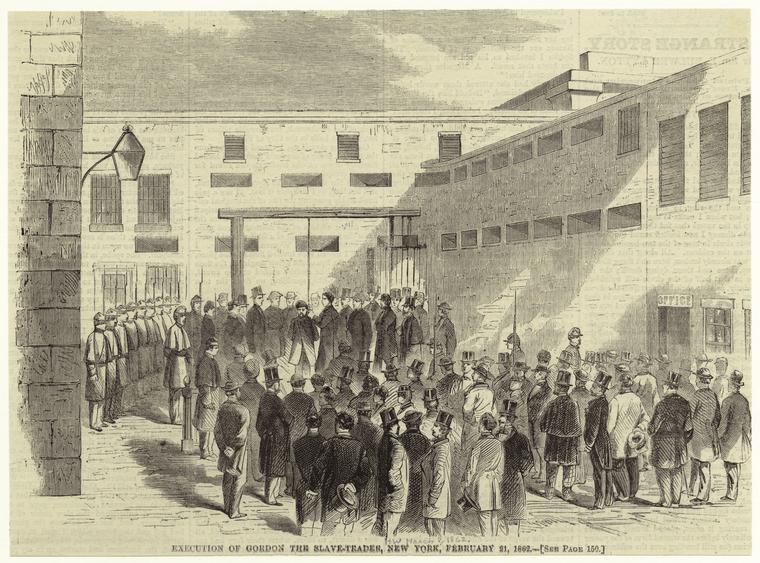
1862: Nathaniel Gordon, slave trader

On this date in 1862, the American commercial shipper Nathaniel Gordon was hanged at the Tombs for slave trading.

Importing slaves to the U.S. had been nominally illegal for over half a century, but had never been strongly enforced. In 1820, slaving (regardless of destination) had even been defined as piracy, a capital crime.

Importation of kidnapped Africans into the United States did significantly abate during this period, and that was just fine with U.S. slaveowners ever paranoid of servile rebellion.

But a voracious demand for conscript labor persisted elsewhere whatever the legal situation. About 3 million slaves arrived to Brazil and Cuba, the principal slave shipment destinations, between 1790 and 1860 — even though the traffic was formally illicit for most of this time.

Great Britain was endeavoring to strangle the Atlantic slave trade, but the diplomatic weight she had to throw around Europe didn’t play in the U.S. Washington’s adamant refusal to permit the Royal Navy to board and search U.S.-flagged ships made the stars and stripes the banner of choice for human traffickers profitably plying the African coast. “As late as 1859 there were seven slavers regularly fitted out in New York, and many more in all the larger ports,” one history avers.

Hanging crime? No slave-runner had ever gone to the gallows as a “pirate” — not until Nathaniel Gordon.

The U.S. Navy did mount its own anti-slaving patrols, but the odd seizure of human cargo was more in the line of costs of doing business than a legal terror for merchants.

So Gordon, son of triangle trade port Portland, Maine and a veteran of several known slaving runs, didn’t necessarily think much of it on August 8, 1860, when the Mohican brought Gordon’s ship to bear 50 miles from the Congo with 897 naked Africans stuffed in the hold, bound for Havana. Half of his slaves were children.

“The stench from the hold was fearful, and the filth and dirt upon their persons indescribably offensive,” Harpers reported.

Gordon chilled in very loose confinement in the Tombs, even enjoying family leave furloughs as he readied for the customary slap on the wrist.

But with Abraham Lincoln’s election in 1860, Gordon was promoted to demonstration case.

After a hung jury in June 1861, the feds won a conviction and death sentence on those long-unused piracy laws in November 1861.

Many New Yorkers were shocked at the prospect of such draconian punishment.

Abraham Lincoln found himself besieged by appeals public and private against the unprecedented judgment. “For more than forty years the statute under which he has been convicted has been a dead letter, because the moral sense of the community revolted at the penalty of death imposed on an act when done between Africa and Cuba which the law sanctioned between Maryland and Carolina,” Gordon’s counsel Judge Gilbert Dean wrote in an open letter to the President* — an argument that could hardly be more poorly calibrated to impress in 1862.

Despite Lincoln’s famous proclivity for the humanitarian pardon, he stood absolutely firm on the precedent Gordon’s hanging would set — especially in the midst of a bloody civil war driven by the very legal sanction Dean had cited so approvingly. As Lincoln wrote on February 4, 1862,

I think I would personally prefer to let this man live in confinement and let him meditate on his deeds, yet in the name of justice and the majesty of law, there ought to be one case, at least one specific instance, of a professional slave-trader, a Northern white man, given the exact penalty of death because of the incalculable number of deaths he and his kind inflicted upon black men amid the horror of the sea-voyage from Africa.

Gordon’s hanging was the one case — the only one ever.

* New York Times, Feb. 21, 1862.

On this day..