1864: Bizoton Affair executions

On this date in 1864, a bustling market Saturday in Port-au-Prince, Haiti was enlivened with the public executions of eight Haitians for cannibalistic murder.

It was perhaps the signal event in a long-running campaign against vodou (voodoo, vaudoux) in whose service the murder was supposedly committed. The charge sheet had it that a man intent on an occult rite to propitiate the spirit world had slaughtered his own young niece and with several friends and family devoured her remains.

It made for some great copy.

“The eye of the law has penetrated into the midst of the bloody mysteries of this religious cannibalism, against which all the teachings of Catholicism have remained powerless,” breathed the world press in salacious revelry.


Sketch of the Bizoton Affair accused from Harper’s Weekly.

Within Haiti and without, vodou itself stood in the dock alongside its adherents. This was quite likely the very point of the trial.

The popular syncretic religion, heavily derived from Haitian slaves’ African roots, represented to Haitian elites and European observers alike all that was most barbarous about the one place that had run white slavers off. Just a few years ago as I write this, the U.S. televagelist Pat Robertson claimed that Haiti had come by its liberty due to a long-ago pact with the devil. That “pact” was a secret vodou ceremony launching the rebellion that became the Haitian Revolution.

Vodou persisted throughout the 19th century — it still persists today — among Haiti’s underclasses. Though frequently persecuted, vodou enjoyed the support and personal devotion of Emperor Faustin Soulouque, a former slave who ruled Haiti in the 1850s. When Soulouque was overthrown by Fabre Geffrard in a coup backed by Haiti’s elites, dissociating from vodou was one of his principal tasks.

As the history blogger Mike Dash explains in a detailed exploration of the case’s background, the deeply Catholic Geffrard had come to an arrangement with the Vatican that

committed the president to making Catholicism Haiti’s state religion — and the executions of February 1864, which so clearly demonstrated Christian “orthodoxy,” took place just weeks before the priests of the first mission to the country arrived from Rome. The trial was followed up, moreover, by a redrafting of Haiti’s Code Pénal, which increased the fines levied for “sorcery” sevenfold and added that “all dances and other practices that … maintain the spirit of fetishism and superstition in the population will be considered spells and punished with the same penalties.”

The original records of the trial are long lost, meaning the surviving accounts are typically the very partisan ones already convinced that pagan vodou cannibalism was rampant in Haiti. The British charge d’affaires Spenser St. John* has one of the best-known and most influential from his 1887 memoir of Haiti. (St. John attended the trial personally with other European dignitaries.)

St. John considered the case self-evident, and dwelt on its lurid revelations of the cannibalism scene — the flaying of little Claircine’s body, the palm of the hand savored by one cannibal as the choicest morsel. Cannibal testimony was St. John’s own choice morsel; in his view, Haitians extremely “sensitive to foreign public opinion” obstinately threw up a collective wall of silence on a practice that “every foreigner in Hayti” just knew was everywhere around him. But even when St. John published, after another 20-odd years past the Bizoton trial to gather evidence of anthropophagism, all that he managed to produce were two highly dubious second-hand accounts of white men allegedly sneaking into vodou ceremonies under cover of blackface and reporting the sacrifice of children. In the hands of Victorian writers prone to still further embroidery these few sketchy dispatches — and the notorious Bizoton case — would help to cement vodou’s sinister reputation.

St. John’s American counterpart was less impressed with the show trial, its moral panic scenario, and the thrashings administered to the accused to force their confessions.

It was not a fair trial; the evidence was extracted by torture. There was a report in circulation. It caused great excitement. Government took it up, and was determined to convict, because it was a seeming stain on their race. The verdict was forced.

Per St. John, the execution itself was badly botched. “The prisoners, tied in pairs” were “fired [at] with such inaccuracy” by their respective shooting teams “that only six fell wounded on the first discharge.” It took half an hour and much reloading to complete the executions, “and the incidents were so painful, that the horror at the prisoners’ crimes was almost turned into pity at witnessing their unnecessary sufferings.”

* As a consular official in a previous post on the opposite side of the globe, St. John accompanied two of the earliest ascents of Mount Kinabalu in Borneo; as a consequence, one of that mountain’s peaks bears his name.

On this day..

1868: Three Italian bandits

On this date in 1868, a trio of notorious Italian brigands went under the French guillotine in Marseilles.

Joseph Coda-Zabetta, the leader, had escaped a hard labor sentence in Italy and fled to France where he founded a large band of robbers who terrorized France’s Mediterranean countryside from Nice to Marseilles for some months in 1867.

From raiding unoccupied country homes the gang soon progressed to bold invasions of occupied houses and waylaying travelers. “In one instance,” a press report of their trial reported,* “six of the band attacked a convoy of carriers, one of whom received a pistol-shot in the breast and a stab with a knife, from which injuries he afterwards died.”

Twelve of the band faced trial, and four of their number received death sentences. (Seven others had long prison sentences; a man named Muletto was acquitted.)

Coda, Antoine Quaranta, and Felix Mardi (Italian pdf) were all guillotined on this date in 1868. (They died, it was said, repentant (French).) The fourth condemned prisoner, Jacques Mulatere, had his death sentenced commuted to life at hard labor.

* London Times, Dec. 20, 1867

On this day..

1869: William German, surprising Klan lynch victim

(Thanks to Meaghan Good of the Charley Project for the guest post. -ed.)

On this date in 1869, a man named William German was lynched by the newly formed Ku Klux Klan.

German, a white man, had been hanged for killing a black man, Bill Cullum.

Yes, you read that right.

Bill Cullum was a former slave; William German, a former soldier in the Confederate Army. German was living on a farm he’d rented from a white plantation owner, Alvin Cullum, who had been Bill’s owner.

German was ordered to clear off the land so the ex-slave could live there instead. Furious, German put on KKK robes and, with another man, tracked down Bill Cullum and shot him several times. The dying man was able to crawl to a nearby house and name his attacker before he expired.

The local KKK chapter was outraged. William German had committed his act wearing their garb, but without their authorization and against their rules.

What happened next was recounted in the Memphis Daily Appeal (now called The Commercial Appeal):

The Union and American of Saturday says: “By a private letter from a trustworthy gentleman residing at Cookville in Putnam County, we give some further information in regard to the recent execution near Livingston, in Overton County, by a body of supposed Ku-Klux, of the young man Wm. German, an account of which we published Thursday morning. “He says that a few days before the execution, German shot and badly wounded, and supposed he had killed, a Negro man living in his neighborhood. The shooting took place in a public road, and the Negro managed to crawl to the house of his employer, where he told who had shot him. The Negro had the character of being a quiet, peaceable man, and as there had been no previous trouble between him and German, it was supposed the crime was perpetrated in pure wantonness.

It is thought that the persons by whom German was killed were members of a secret organization, to which he belonged — but whether Ku-Klux or not, nobody in the neighborhood appears to know. The body of men concerned in the execution numbered about 200, and none of them were identified by citizens who witnessed their appearance and departure. Accounts reported Bill German was found hanged in a nearby barn; a sign posted there declared: Hung for shooting a Negro, Bill Cullum, and violating the laws of Ku Klux.”

These days, this story has been used by the KKK as evidence that they are a peaceable organization and not at all racist, honest, pinky-swear.

An aside: executions ran in the German family. William German’s brother, Columbus C. “Lum” German, had also served in the Confederate Army and also met his death at the end of a rope, in 1866.

On this day..

1864: Samuel Wright, by contrast

Samuel Wright and George Townley both murdered romantic partners late in 1863. Both were tried, convicted, and condemned to hang in very short order and both the subjects of intense pressure for a crown commutation of sentence.

Only one of those men hanged. It was 150 years ago today.

George Townley

Townley lived near Manchester and was courting a young woman named Bessie Goodwin from Derbyshire. Described as a man from a respectable upper middle class family with “refined manners,” and an intelligent linguist* to boot, Townley was nevertheless a rung or two below Miss Goodwin on the wealth and status ladder.

He was, accordingly, frustrated of his designs when the young lady accepted a clergyman’s proposal and broke off her previous engagement to Townley. Despite being disinvited by ex-fiancee, Townley took a train to her village and pressed his company on her. The two went for a walk that evening, and Townley stabbed her in the throat — a fact which he confessed on the scene to the first person who responded to the commotion and found Miss Goodwin staggering towards her home with a fatal gash in her neck.

In the great tradition of weird stalkers everywhere, Townley then helped the Good Samaritan carry the dying woman home, and kissed her tenderly, all the while bemoaning to arriving gawkers his guilt. “She has deceived me, and the woman who deceives me must die,” he responded chillingly to the inquiries of his would-be father-in-law. “I told her I would kill her. She knew my temper.”

This is all a very bad hand to deal a defense barrister.

Having little to work with, his superstar attorney — remember, the family had money — went with an insanity defense, aided by the lunacy diagnosis of prominent psychiatrist Forbes Winslow.** There was some history of insanity in his family, and everyone seemed agreed on the point that Townley didn’t set out with the intent to commit murder, but impulsively — madly? — took that course as he realized during his interview that he would surely not be putting a ring on that.

The legal standard of the time gave no purchase to this sort of thing. Townley’s judge instructed the jury to find insanity only if he “was under delusions … [and] supposed a state of things to exist which did not exist, and whose diseased mind was in such a condition that he acted upon an imaginary existence of things as if those things were real.” This is the M’Naghten rule, a historically pivotal and also highly restrictive insanity definition dating to 1843.

On December 12, 1863 Townley was sentenced to death for the murder, with the hanging scheduled for the approaching New Year’s Day. According to the London Times report the next week (Dec. 18), the sentence “has not made the slightest alteration in his demeanour. He partakes of his meals heartily, sleeps well, and repeatedly asserts that he was perfectly justified in taking away his victim’s life, and that he feels no remorse for the deed.”

Nevertheless, Townley’s well-off family and friends had enough pull to pry open a previously little-known legal escape hatch.

Upon the judge’s own request, the crown empaneled a committee to adjudicate Townley’s sanity for his mercy petition. But a sloppily written law actually allowed any two doctors plus any two magistrates to issue a formal certification of madness which would compel the prisoner’s removal to the asylum. Townley’s own solicitor simply assembled himself a quartet so minded and presented their finding to the Home Secretary, forcing his hand — to a great deal of public outrage once the obscure mechanism became known.

“Good friends and abundant means may give a convicted criminal unexpected advantages over an ordinary offender,” the Times complained in an editorial. (Jan. 27, 1864) Plus ça change.

Samuel Wright

Samuel Wright was not a man of means or linguistic gifts, but a bricklayer who lived in a Waterloo Road public house in Surrey, on London’s southern outskirts.

On December 13, 1863, he slashed the throat of his live-in lover Maria Green after they’d both been on a drinking bout. On December 16, mere three days later, Wright voluntarily pleaded guilty and received a death sentence.

A hue and cry for Wright’s sentence to be abated soon arose among London’s working classes, especially in the wake of Townley’s commutation. Wright had a good reputation, while Green was known for her violent temper. Wright intimated that she had menaced him with a knife during a quarrel.

Was this not a case like George Townley’s, only more so?

The contrast in the fates between the two murderers did not flatter. The crimes were analogous even to the mode of slaying.† If anything, the rich man’s suggested a more egregious context: Townley’s victim appeared more sympathetic, and Townley had gone out of his way to track her down in order to kill. Why was Townley’s heat of passion “insanity” but Wright’s was motive and deliberation?

The Home Secretary offered his sympathy but not his mercy. After all, Wright himself agreed that he intentionally killed Green. “To commute the sentence on the grounds on which it has been pressed would, in fact, be to lay down a rule of law as to the distinction between murder and manslaughter contrary to that which is well established,” wrote a Home Office spokesman on Jan. 7 in response to three separate petitions submitted on Wright’s behalf. Maybe they thought the same thing about Townley … but that decision was out of their hands.

In one of the period’s characteristic hanging broadsides, the balladeer has Wright lament,

Friends, for me have persevered,
To save me from the gallows high;
Alas! for me there is no mercy,
Every boon they did deny,
While others who was tried for murder,
And doomed to die upon a tree,
Through friends and money has been pardon’d
who deserved to die as well as me.

But, oh! my friends, you must acknowledge
what I say has oft been said before.
Some laws are made to suit two classes,
One for the rich, one for the poor;
So it is with me and Townley,
A reprieve they quickly granted he,
He was rich, and I was poor, —
And I must face the fatal tree.

The mood of the populace for the hanging at Horsemonger Lane Gaol this date in 1864‡ was decidedly ugly. On the night of the 11th, when it became clear that the many last-ditch bids for commutation — directed not only at the Home Secretary but even to Queen Victoria and even to the Prince of Wales appealing for a boon on the occasion of his first son‘s January 8 birth§ — a handbill circulated in the prison’s neighborhood entreating its denizens to protest the execution by shuttering all windows. “Let Calcraft and Co. do their work this time with none but the eye of Heaven to look upon their crime.”

Indeed this summons was widely obeyed.

A small crowd only turned out for the occasion, and shouted their disgust for the proceedings: “Shame!” and “Judicial murder!” and “Where’s Townley?” Even many months later, at the controversial August 10 hanging of Richard Thomas Parker, the crowd chanted Townley’s name, now the emblem of the unequal justice of the law.

One diarist’s entry for the day recalled that “[t]he blinds were down in all the neighbouring streets and the military were called out in case of an attempted rescue. When the unfortunate man appeared on the scaffold, loud cries of ‘Take him, take him down’ were heard in every direction, to which the unhappy man responded by repeated bows to the multitude, he still continued bowing and was actually bowing when the drop fell.”

Postscript

The language of the law that permitted Townley his backdoor commutation was revised by Parliament within weeks.

As to Townley himself, another panel appointed by the Home Office found him fully cogent, which meant that officially, he had become insane after his death sentence and the insanity abated thereafter. While this finding theoretically reinstated the death penalty, actually hanging him after these circumstances was thought to be inhumane, and he was reprieved. One supposes there must have been some thought for the potential disturbance Townley’s hanging would have occasioned.

On February 12, 1865 — a year and change after escaping the noose that claimed Samuel Wright — George Townley hurled himself headlong off a high staircase onto a stone floor in Pentonville Prison, where he had been transferred as an ordinary inmate. He died on the spot.

* Of course, he could never hope to match the linguistic’s fields most famous English murderer.

** You might recognize this distinctive name from our Winslow’s son, L. Forbes Winslow, a figure in the Jack the Ripper investigation.

† An additional unflatterering comparison point to Derbyshire contemporaries: a proletarian named Richard Thorley had been hanged in Derby in 1862 for a very similar crime: he slashed his girlfriend’s throat when she tried to break up with him.

‡ Among the very last public hangings at Horsemonger Lane Gaol. All UK hangings were conducted behind prison walls by 1868.

§ This infant, Prince Albert Victor, is the royal eventually identified with Jack the Ripper by a particularly inventive hypothesis.

On this day..

1864: Bill Sketoe, hole haunt

On this date in 1864, a hulking Methodist minister by the name of Bill Sketoe was hanged in Newton, Alabama … but his ghost story was only just beginning.

Sketoe’s life is nearly as spectral as his death, but he is known to have been a longtime denizen of Newton’s Dale County where he preached the gospel and fathered a biblically-appropriate brood of seven children.

The easiest version says that Sketoe deserted the Confederate army to care for his sick wife. However, there’s no documentary evidence that Sketoe actually served under arms in the Civil War, although two of his sons did. He might actually have been suspected of aiding Unionist raiders haunting the forests — men like John Ward, a local pro-Union guerrilla with whom Confederate guards had just days before fought a skirmish.*

For whatever reason, a local Confederate cavalry militia under one Captain Joseph Breare seized the preacher near the Choctawhatchee River on December 3, 1864, and hanged him to a convenient tree.

Now, Bill Sketoe was a large man, and the bough of the Post Oak that supported his noose bent to his weight until Sketoe’s toes touched the ground. For an ad hoc execution, an ad hoc solution: one of Breare’s so-called “Buttermilk Rangers” simply dug out the ground around Sketoe’s feet until they dangled free in the hole and their owner could strangle to death properly.

Beloved Alabama storyteller Kathryn Tucker Windham immortalized “The Hole That Will Not Stay Filled”, one of the chapters of her 13 Alabama Ghosts and Jeffrey. Local legend, it seems, held that whenever someone later filled in Sketoe’s dangling-pit — with dirt, rubbish, or anything else — it would be mysteriously un-filled within hours.

Unfortunately the present-day skeptic will not be able to put geist to test because “Sketoe’s Hole” was destroyed in a 1990 flood, and is today covered over with tons of rocks supporting a bridge strut — too much infill even for spooks. (Though not enough to deter visitors.)

Sketoe’s executioner Joseph Breare resumed his law practice after the war … until a falling tree killed him during a storm in 1866.

* David Williams develops the John Ward connection in Rich Man’s War: Caste, Class, and Confederate Defeat in the Lower Chattahoochee Valley. A few months later an incursion of different irregulars led by a Dale County Confederate officer who deserted to the Union, Joseph Sanders, precipitated the Battle of Newton.

On this day..

1864: George Nelson, Indiana Jones rapist

(Thanks to Meaghan Good of the Charley Project for the guest post. -ed.)

On this day in 1864, Private George Nelson of Company F of the 13th United States Colored Troops was hanged for rape in Nashville, Tennessee.

He committed his crime on November 13, 1863. Nelson and two other men were on Nashville Pike outside of the town of Dickson when they encountered an unmarried white woman named, no lie, Indiana Jones.

They asked her where she lived and she said her house was about a mile away. The men claimed they’d been fighting with some rebels near her house and said she must go with them.

Miss Jones refused, and Nelson threatened to shoot her if she did not comply. She went with him for about 250 yards, begging him to release her. Private Nelson put a bayonet to her side and told her to come into the woods with him or he would run her through. Miss Jones started crying then, and he threatened to strangle her with a rope if she did not shut up. They went into the woods together while the other two men held the horse.

As Miss Jones later testified, “I again begged of him to let me go, when he cocked his gun and said if I did not be still he would blow my brains out. He then took hold of me, threw me down, and committed a rape on my person.”

When he was done he robbed her of $1.50, but the other soldiers made him give the money back. Then they let her go.

George Nelson’s accomplices were tried separately, and on cross-examination the victim was asked, “Did you use your utmost endeavors to prevent him from executing his desires, or did you simply cry out, thus yielding a tacit consent?”

As if she could have done anything else with a gun trained on her!

The three defendants were all court-martialed. President Lincoln approved the death sentence for Nelson in August 1864 and he hanged the following month. His partners-in-crime got twelve and ten years in prison respectively.

On this day..

1864: Li Xiucheng, Taiping Rebellion general

On this date in 1864, Qing commander Zeng Guofan had executed his opposite number in the destructive Taiping Rebellion, previously surveyed in these pages.

Stephen Platt‘s acclaimed 2012 history Autumn in the Heavenly Kingdom: China, the West, and the Epic Story of the Taiping Civil War depicts this war along with Li, the illiterate peasant farmer whose brilliance in command flowered as the Taiping undid ossified class hierarchies.

Li’s generalship kept the Taiping in the fight for a long, long time: the war spanned 14 years, with some 20 million estimated killed. In July of 1864 the central government finally overran the rebel capital of Nanking/Nanjing and put that city to a frightful sack. Here’s Platt on Li’s fate:

Zeng Guofan seeded his reports on the fall of Nanjing with fabrications, claiming that a hundred thousand rebel soldiers had been killed in the fighting, inflating the glory of his family and his arm, masking their looting and atrocities against cvilians. He kept careful control over what the cout would know. To that end, from the day he arrived in Nanjing he took over the interrogation of Li Xiucheng for himself. The Hunan Army commanders had already secured a long confession from Li Xiucheng in the weeks since he had been captured — pages upon pages detailing his origins and the history of the war and explaining the tactical decisions he had made, many of which they still did not understand. The honor of beginning the questioning had fallen to Guoquan, who had taken to the job with undisguised relish; his primary tools were an awl and a knife, and he managed to cut a piece out of Li Xiucheng’s arm before the others made him slow down.

When Zeng Guofan took over the interrogations on July 28, at last the two hoary, weatherbeaten commanders in chief of the civil war faced each other in person for the first time: square-shouldered Zeng Guofan on the one side, the weary-eyed scholar, his long beard turning gray;wiry, bespectacled Li Xiucheng on the other, the charcoal maker who had risen to command the armies of a nation. It would be no Appomattox moment, however. There was no wistful air of regret and respect between equals. For the defeated, it was no prelude to reconciliation, to twilight years on a rolling plantation. This war ended not in surrender but in annihilation. Zeng Guofan would spend long hours of the following evenings editing his counterpart’s fifty-thousand-word confession, striking out passages that didn’t paint his own army in a good light and having it copied and bound with thread for submission to the imperial government, before casually ordering Li Xiuceng’s execution — in spite of orders he knew were coming from Beijing, that the rebel general be sent to the Qing capital alive.

On this day..

1863: John P. Wood, of the Army of the Potomac

This dispatch to the New York Herald was published on June 16, 1863.

Mr. W. Young’s Letter.
Near Beallton Station, Va., June 14, 1863.

THE DESERTER J.P. WOOD.

John P. Wood, of Company F, Nineteenth Indiana, who had deserted once or twice before, again deserted on the 28th of May, and was subsequently arrsted at Aquia Creek, tried by court martial, and sentenced to be shot on Friday last.

Wood was about nineteen years old, quite intelligent, and when arrested was dressed in rebel uniform and represented himself as belonging to the Nineteenth Tennessee.

He alleged that he deserted because he had come to the conclusion that the war was not right, and he could not therefore go into action. He admitted that when he volunteered his views were somewhat different, and that he enlisted because he did not wish to see the Union dissolved.

He regarded his sentence as just, and expressed the belief that his execution for desertion would be of more service to the army than he could render it in any other manner.

THE EXECUTION, AND THE EFFECT UPON THE ARMY.

As this is the first instance of an execution for desertion in the Army of the Potomac, it created considerable sensation.

The sentence was executed upon the prisoner on Friday, near Berea church. About two P.M., near Berea church, the corps was halted. The First brigade was ordered out, with the balance of the division to which the prisoner belonged, the First brigade in advance.

Two ambulances, in the first of which was seated the prisoner, and the other containing his coffin, at the head of the division, advanced about half a mile, when the division was drawn up, occupying three sides of an oblong parallelogram. On the fourth side were placed the coffin, the criminal and the guard. The men were selected to do the firing, and received their muskets from the guard properly loaded.

HIS LAST MOMENTS.

A clergyman —- was with the prisoner, who displayed no emotion. General Wadsworth then went to the men who were to perform the duty of execution, and spoke to them in regard to the disagreeable nature of the duty to be performed — the shooting of a comrade — and urged them, as a matter of humanity, to take good aim.

The General then returned to the right, Colonel Morrow to the left. The guard was then withdrawn, and the Provost Marshall, Lieutenant Rogers, took the prisoner to the coffin, upon which he was seated, his eyes blindfolded, his hands tied behind him, his knees tied together and his breast bared.

All having retired, except the executions and the Provost Marshal, the order to take aim was given. Before the order to fire was given two pieces were discharged, but without effect.

At the order to fire, the remainder of the men — ten in number — fired. The prisoner fell backward, and the Provost Marshal went up to him. He struggled for an instant, and then all was over.

An additional detail from the Pioneer corps were called up and began to dig the grave, and the division marched off in perfect order, much impressed by the solemn scene which they had witnessed.

On this day..

1866: Anton Probst, “I only wanted the money”

(Thanks to Meaghan Good of the Charley Project for the guest post. -ed.)

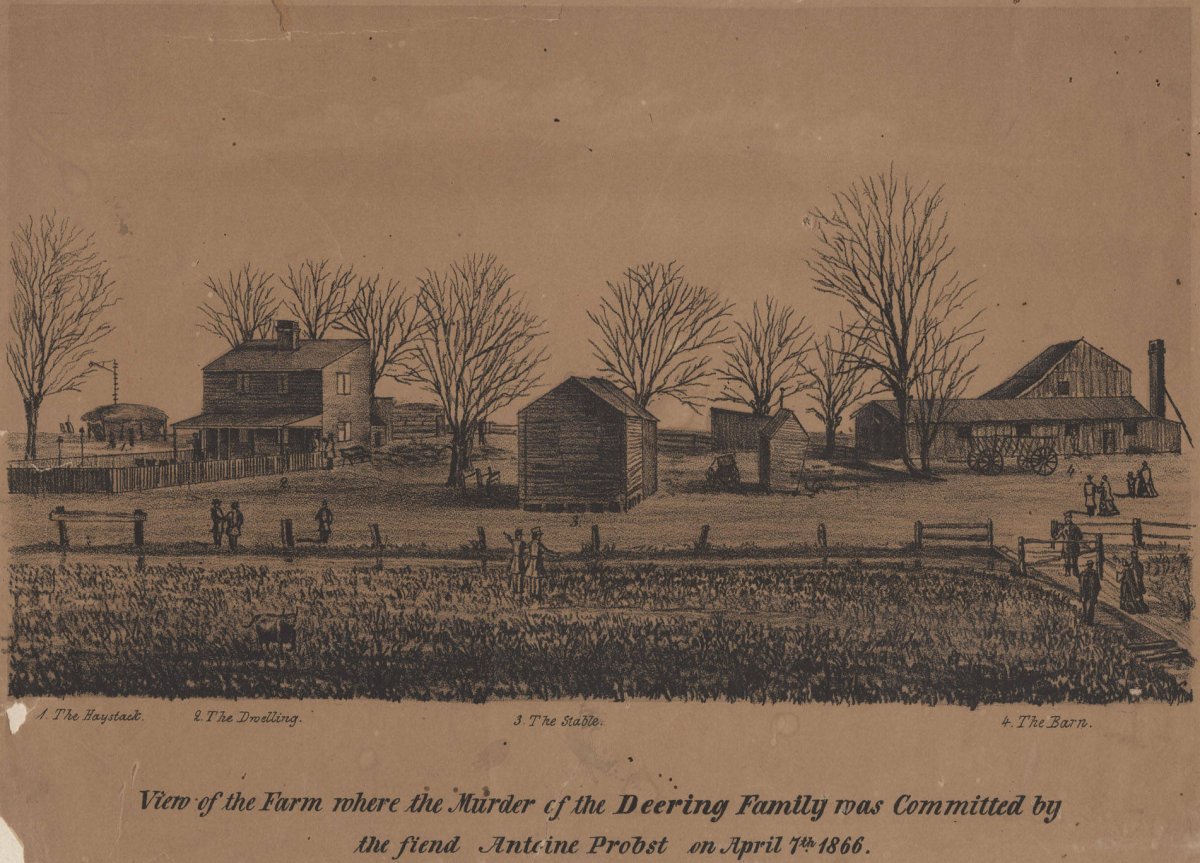
On this date in 1866, mass murderer Anton Probst (sometimes called “Antoine”) was hanged in Philadelphia, Pennsylvania. He made national headlines in its time, but today he is forgotten except among serious students of violent crime.

Probst was a native of Germany, the son of a carpenter. He later claimed he had a normal childhood and “never did anything wrong” until after he had left his home country.

He moved to the United States in 1863, in the middle of the Civil War, and became a professional “bounty jumper”: he would join up with a Union Army regiment, collect the $300 enlistment bonus, desert as soon as he could, then enlist with another regiment and start the cycle over again. He made a tidy living for himself this way until 1865, when he accidentally shot his thumb off and was discharged from the military for good.

Probst squandered his enlistment bounties on liquor and and rapidly fell into post-discharge penury. This was why, in the fall of 1865, he hired himself out as a farmhand to Christopher Deering, an Irish immigrant who lived in a rural part of Philadelphia with his wife and five children.

Deering offered Probst a salary of $15 a month plus room and board. Probst quit after only a few weeks, though, not being accustomed to honest labor.

He soon fell ill and, without a source of income, wound up in the workhouse. In dire straits, he returned to the Deering farm on February 2, 1866 and begged for his job back. And, although Probst’s behavior from before had given Christopher’s wife the creeps, the farmer took pity on him and re-hired old Thumbless.

Things went well for the next two months. But unbeknownst to his employer, Probst had thought of another way to get money.

Christopher’s nearest neighbor, Abraham Everett, lived a quarter of a mile away. Everett subscribed to several local weekly newspapers and, every weekend, Christopher would send his son to borrow the previous week’s editions.

One Saturday, the boy never showed up.

Nor did he arrive on Sunday.

Or for the next several days after.

By Wednesday, Everett was getting worried and decided to go to the Deering place and see if they were all right. He found the farm deserted and the horses inside the barn, nearly dead of thirst and starvation. After giving food and water to the distressed animals, he went and looked through the window into the Deering family’s house and saw it had been ransacked.

Seriously alarmed now, Everett forced the window open and climbed inside, and found every room in the house in a state of disarray. In the bedrooms, the beds had been torn and flipped upside down, dresser drawers had been rifled through and clothes were scattered everywhere. There was not a soul to be seen.

At this point, Abraham Everett went off to get help, summoning another neighbor and then the police. Inside the barn they found something Everett had missed while he was helping the horses: Christopher Deering’s body, partially covered in hay, alongside the body of a cousin visiting from New Jersey.

“His head,” crime historian Harold Schechter reports in his book Psycho USA: Famous American Killers You Never Heard Of, “was crushed to pieces, almost to powdered bone, and his throat was cut … from ear to ear.” Christopher’s cousin had similar injuries. A search of the barn turned up the bodies of Christopher’s wife, Julia, and four of the couple’s five children, stacked in the corncrib.

All of them had their throats cut and their skulls bashed in.

The only survivor in the family was the oldest child, ten-year-old William Deering, who had been staying with his grandparents at the time of the murders. And so the family line did not die out: according to this Philadelphia Inquirer article, William has 60 descendants.

The murder weapons were lying around bloodstained and in plain sight on the property: a hammer, a small hatchet and a full-sized ax. Hours later, the police found the last body hidden in a haystack a few hundred yards from the barn: seventeen-year-old Cornelius Carey, one of the Deerings’ farmhands.

The other farmhand was missing and, under the circumstances, had to be viewed as the prime suspect in this massacre. Nobody knew much about him, but the neighbors recalled that missing right thumb, spoke poor English with an accent, and was called something like “Anthony.”

Fortunately, he would not prove hard to find. “It might be supposed,” Harold Schechter says,

that a man who had methodically slaughtered eight people, including three prepubescent children and a fourteen-month-old infant, would lose no time in putting as much distance between himself and the crime scene as possible. For all his low cunning, however, Anton Probst was incapable of prudent calculation. Indeed, from all available evidence, he thought of nothing beyond the gratification of his immediate physical needs.

Hours after the murders, Probst was no further away than a house of ill repute on Front Street in Philadelphia, where he spent the night with a $3 prostitute. For the next few days he hung around his favorite bars drinking, making occasional excursions to pawn items he’d stolen from the Deering farm. He was in no hurry to leave.

Only the day after Probst’s grisly crimes were discovered, a police officer named James Dorsey spotted him strolling around near Market Street. Something about his bearing, and the way his hat was pulled low over his eyes, made the lawman suspicious. He walked up to him and noticed the stranger’s right thumb was missing.

Dorsey pulled Probst’s hat off to have a look at his face and said, “Good evening.” Probst mumbled a reply and Dorsey, noting the accent, said, “You’re a Dutchman?”

“No,” Probst answered. “Me a Frenchman.”

“You are, are you? Take a walk with me.” Dorsey grabbed the murderer’s arm and hauled him off to the nearest station house. There the police searched him and determined he was wearing Christopher Deering’s clothes, and carrying the farmer’s snuffbox and pistol. Probst had left Elizabeth Dolan’s carpetbag at a tavern earlier that day; it contained a number of small items, including cheap children’s toys, all of which were from the Deering farm.

The police had to transfer Probst from the Philadelphia City Jail to Moyamensing State Prison for his own safety, after a would-be lynch mob stormed the jail. Probst claimed he had only killed Cornelius Carey and tried to blame the other murders on an imaginary accomplice; at his trial (which began on April 25, less than three weeks after the murders) his lawyers argued that the case against him was strictly circumstantial and not proved beyond a reasonable doubt. But the trial’s outcome was clear from the beginning. The jury deliberated for only twenty minutes before convicting.

Death row agreed with Probst; he seemed at ease and actually gained twelve pounds in the five weeks between his trial and execution. On the morning of May 7, exactly one month after the murders, he finally confessed that his accomplice didn’t exist and he’d acted alone. He was “quiet, undemonstrative, cool and unembarrassed” as he told his story, “without the least trace of shame or remorse.”

You can read it all here in his very own words, or below, in mine. At first his intention had just been to rob the family of everything they had, then flee. But he found himself unable to accomplish this because there were always too many people around.

About a week before the murders, it occurred to Probst that perhaps murder might be necessary to facilitate the robbery. At first he thought he could just kill Christopher Deering, but as he mulled the matter over he decided the rest of the household would have to die as well.

First to go was Cornelius Carey as they were working together in the field. Then Probst went into the barn and lured the others in one by one, killing them as they each came inside: eight-year-old John Deering, then the mother, Julia, then the rest of the children: six-year-old Thomas, then four-year-old Annie, and finally the baby, Emma. Probst estimated that it all took about half an hour.

Christopher Deering was off picking up that visiting cousin from the ferry, and they didn’t arrive back at the farm until the afternoon. Probst was waiting for them. While the guest Elizabeth Dolan went into the house, Probst told Christopher one of the animals was sick and he had to go inside the barn. There he killed him like the others, then called Miss Dolan to the stable. She was the last one to die.

If we are to believe the killer’s account, the victims all died quickly and quietly, and did not suffer. None of them, he said, so much as cried out after the first blow.

Once finished, Probst tore the house upside down looking for things to steal, washed, shaved, changed out of his bloody clothes and put on some of Christopher’s, and had himself a snack of bread and butter. At sunset he headed off to town.

Schechter records:

When asked by Chief Franklin why on earth he had perpetrated such an atrocity, Probst gave a little shrug. “I only wanted the money,” he said. “I killed the boy Cornelius first so that he could not tell on me. I killed the two oldest children so they would not afterwards identify me. I killed the two youngest as I did not wish to leave them in the house alone without someone to care for them. I had no ill feeling to anyone in the family. They always treated me well.”

Probst submitted meekly to his execution, which went off without a hitch. The public understandably rejoiced at his death and the New York Times, in its report of how Probst “shuffled off his mortal and disreputable coil,” called him “the greatest criminal of the nineteenth century.”

Probst was permitted to write to his family in Germany. He told them of “the terrible fate which has befallen me,” admitted to the eight slayings, and blamed his bad behavior on his experiences in the Union Army, where he “heard nothing but cursing and swearing, and soon became a sharer in every wickedness.”

Whatever, Anton.

After his death, Probst’s body was handed over to the physicians at Jefferson Medical College, who subjected it to a series of bizarre experiments with electricity. When they finished with their fun they performed an autopsy. Probst’s brain turned out to be unusually small, almost a full pound lighter than average. What, if anything, this has to do with his apparent psychopathy is anyone’s guess. His head and arm were later displayed in the Jefferson Medical College museum.

On this day..

1868: Joseph Brown, for arson, murder, and money

On this date in 1868, Joseph Brown hanged in Hudson, N.Y..

He and his wife Josephine had recently moved to the hamlet of Canaan just this side of the Massachusetts border. With them was a twelve-year-old daughter.

On the night of December 5, 1867, they left little Angie in their basement rental and called on neighbors for the evening — and the house went up in flames. Neighbors rushing to the emergency had to force their way through the doors to extinguish the blaze, and discovered the Angie’s scorched remains amid several bushels of suspiciously flammable rubbish. Some neighbors thought the Browns had not hurried to the scene as they ought, and found their expressions of grief unconvincing.

These dubious circumstances could hardly help but lift an eyebrow, but in the end there was little for it and a coroner ruled the death accidental, perhaps caused by the unattended child attempting to fill a lighted kerosene lamp.

However, the fate of “poor little Angie” took on a decidedly more sinister cast when the Browns turned around and filed for a $5,000 life insurance benefit on Angie’s bones — a short-term, three-month policy due to expire in two weeks. A suspiciously dead child was one thing, but now there was money at stake. Travelers Insurance — the present-day corporate conglomerate then in its infancy, carving out its titular niche with innovative policies insuring against once-dangerous rail travel — put some real investigative muscle into the situation before it paid up.

The facts as developed by Travelers made a damning circumstantial case against the couple that was soon taken over by the criminal authorities: “a reflected glow of guilt,” in the summing-up of the state’s attorney who prosecuted Joseph.

Angie turned out not to be the couple’s own child at all, but a loaner from a woman in their hometown of Dayton, Ohio. She had given permission for her daughter to accompany the couple on a trip to Connecticut. (A weird arrangement in which the child was to call them “mother” and “father”, but one made innocently by the victim’s natural mother so far as anyone could determine.)

En route, Joe and Jo insured the life of this child who was not their own. And by the time they got to Canaan, Joseph had indiscreetly negotiated to purchase some property, intimating an ability in no way justified by his pre-fire resources to pay several thousand dollars cash on the nail.

To cinch Joseph’s conviction, physicians hired by Travelers testified that Angie had not inhaled smoke … meaning that she was dead before the fire started at all.

“I have told the insurance company that I would give them the policy if they would let me go,” a desperate Joseph at one point said in a police interview. He should have thought of that sooner.

But he was, as he said on the scaffold, “not an accomplished man” and he could only complain confusedly about minor points of the trial he considered prejudicial while maintaining a general insistence upon his innocence that persuaded nobody.

At the time of this hanging, Josephine Brown still lay in the Columbia County jail awaiting her turn at the bar in the same affair. But despite the sense among many participants in the case that it was she who instigated her cloddish husband to the lucrative homicide, the prosecution couldn’t assemble a satisfactory case and dropped charges later that year.

On this day..