1863: William Francis Corbin and Thomas Jefferson McGraw

On this date in 1863, two men were shot* on the beach at Johnson’s Island in Lake Erie, site of a Civil War prison. Their crime: recruiting for the Confederate army behind Union lines.

After a short-lived attempt to maintain a posture of “armed neutrality” vis-a-vis the Civil War combatants, Kentucky became the uncertain and bloodily contested frontier march between the rival governments.

With the 1862 invasions of Kentucky by armies North and South, sides had to be chosen. Corbin enlisted with some local militia mates in the Confederate army; after wintering in Virginia, he was dispatched back to his native Campbell County, Ky. — now under Union control — to beat the bushes for more Confederate enlistees. With him was another Campbell County native son now serving in the Southern army, Jefferson McGraw.

In April 1863, a Union patrol out hunting Confederate guerrillas accidentally caught wind of the recruiters’ activities and followed McGraw to the Rouse’s Mill safe house where he was to rendezvous with the waiting Corbin.

Several days after the recruiters’ capture, Union Gen. Ambrose Burnside issued General Order 38, threatening the death penalty for “all persons found within our lines who commit acts for the benefit of the enemies of our country.” This order explicitly compassed “Secret recruiting officers within our lines.”


Not to be confused with Order 66.

This book has a chapter about the Corbin-McGraw case.

General Order 38 was viewed as targeting “Copperheads” and other anti-war northern agitators — and it almost immediately resulted in the arrest of Ohio Democrat Clement Vallandigham** — but it was the less august Corbin and McGraw who paid the heavier penalty.†

Again, General Order 38 postdated Corbin and McGraw’s arrest. They had expected, and perhaps were even directly assured by their captors, to be treated as regular prisoners of war. On the other hand, Order 38 aside, these men were undoubtedly working covertly behind Union lines, and risked harsher treatment on that basis alone.

At any rate, the two were condemned to die by a military commission in Cincinnati for violating Order 38 by recruiting behind Union lines. Neither Gen. Burnside nor Abraham Lincoln himself — who were both besieged by petitions for clemency — would consent to spare them.

Corbin, who was a church elder in his home environs, led a prayer service for guards and inmates alike at the prison chapel on the morning of his execution. Writing 34 years later, a witness recalled the moment:

That scene, and the words which fell from his lips on that occasion, are indelibly stamped on my memory …

After reading and prayer by Captain Corbin, he said, in part, speaking of himself, that “life was just as sweet to him as any man, but if necessary for him to die in order to vindicate the law of the country, he was ready to die, he did not fear death; he had done nothing he was ashamed of; he had acted on his own convictions and was not sorry for what he had done; he was fighting for a principle, which in the sight of God and man, and in the view of death which awaited him, he believed was right, and feeling this he had nothing to fear in the future.” He closed his talk by expressing his faith in the promises of Christ and his religion.

To see this man, standing in the presence of an audience composed of officers, privates, and prisoners of all grades, chained to and bearing his ball, and bearing it alone, presenting the religion of Christ to others while exemplifying it himself, was a scene which would melt the strongest heart, and when he took his seat every heart in that audience was softened and every eye bathed in tears.

After Corbin and McGraw were shot, two Union prisoners of war in Confederate custody were selected by lot for a retaliatory execution. With some diplomatic maneuvering (and a Union threat to retaliate for the retaliation by executing Robert E. Lee’s captured son), they managed to avoid that fate. (One of these men almost executed in retaliation, Henry Washington Sawyer, went on after the war to build the still-extant Chalfonte Hotel in his hometown of Cape May, N.J.)

There is a weathered but still-visible monument to Thomas J. McGraw erected in 1914 by the Daughters of the Confederacy at the Flagg Springs Baptist Church cemetery where his remains were interred. (Corbin’s remains are at a family cemetery in Carthage.)

* Corbin and McGraw were set up for execution seated on the edges of their own coffins, so that the force of the firing detail’s barrage would knock them conveniently back in. That’s efficiency.

** General Order 38 also resulted in the arrest of an Indiana legislator named Alexander Douglas. Douglas beat these charges thanks to the energetic defense mounted at the tribunal by his neighbor, attorney Lambdin P. Milligan … and the fame thereby falling to the latter man would eventually help to fix his own name into the jurisprudential firmament as the subject of the landmark Supreme Court ruling Ex parte Milligan. For more background, see this pdf.

Nobody else was ever executed under General Order 38.

On this day..

1860: William Fee, the only person hanged in Wayne County

On this date in 1860, William Fee became the only person ever executed in Wayne County, New York.

Fee’s alleged victim is not distinguished by a name, at least not one known to Fee’s prosecutors. The anonymous woman turned up dead September 26, 1859 on Wayne County’s old Montezuma Turnpike. She had been strangled, the coroner said — and ravished.

Though she was a stranger, the victim had been seen in the area inquiring about employment. Fee and another man named Muldoon had been observed following her the day previous, and that “following” was cast in a sinister light by their now-unknown whereabouts. Both men were laborers working on an enlargement of the Erie Canal around Lyons, N.Y.

Fee was eventually arrested in New York City; Muldoon, in Scranton, Pa. We’ll return to Muldoon later.

Fee and his ill-favored “Hibernian countenance” stood trial from January 30 to February 3, 1860. “Seats were at a premium in the court room and in the gallery behind the curtains there was a crowd of ladies, listening breathlessly to the testimony,” ran a retrospective from 1913. “During the noon hour, seats were bargained for and sold at 10 cents to 50 cents apiece.”

And though he maintained a superficial calm when the jury returned a guilty verdict against him — “Damn tough, but I’m not going to lie awake thinking about it” — William Fee broke down sobbing when the judge finally sentenced him.

The kid came from a working-class family and had a scrappy reputation. It wasn’t clear as he approached execution that he was handling it with the gravity expected for the occasion by right-thinking gentlemen. Then there was the worry for his eternal salvation: born of mixed Protestant/Catholic parents, he was essentially irreligious and indifferent to a parade of ministers who called upon his cell. (Fee accepted the ministrations of a couple of Catholic priests in his very last hours.)

While clerics kneaded the hard clay of Fee’s soul, municipal officials took a chisel to logistics. Since this was the first (and last) hanging in these parts, the equipment had to be obtained on loan: they borrowed the upward-jerking gallows recently used to execute Ira Stout in upstate New York.*

The gallows was erected in one of the small halls of the jail … four upright posts twelve feet high and five feet apart. Across the top was an oak timber projecting two feet or more beyond the frame. At the front end, above where the prisoner was to stand was a grooved wheel or pully; and another was inserted in the timber over the centre of the frame. The main rope ran over these rollers, one end falling in front, to which the halter was attached, the other dropping to the centre of the gallows frame, where heavy weights were attached. These weights, in all 254 pounds, were suspended by a small cord passing through the main timber above and over it to a pin. The weights had a fall of perhaps eight feet. When the cord was severed by a blow of the axe, the weights fell and jerked the main rope running over the grooved wheels. In order that there should be no failure, Sheriff Snedaker had the gallows put up in the court house and fully tested before removing it to the jail. (New York Herald, April 3, 1860)

Fee came to this device still asserting his innocence, but also asserting that Muldoon wasn’t involved. Don’t worry if those seem a bit at odds; the execution party was confused enough to require clarification, too. Cut him some slack: those 254 pounds of weights weren’t going to cut him any.

The hanging went off without difficulty and, whether influenced by Fee’s parting attempt at exoneration or otherwise, Muldoon was never ultimately brought to trial. The evidence against him being unsatisfactory, he was released some months later.

William Fee’s afterlife — apart from this blog post — is allegedly spent haunting his old Lyons Jail (today, the Wayne County Museum).

* From reports, Wayne County didn’t return the gallows: it was eventually scrapped (someone made a chair out of part of it), and the Lyons Republican nicked the hanging-weight to use as a doorstop.

On this day..

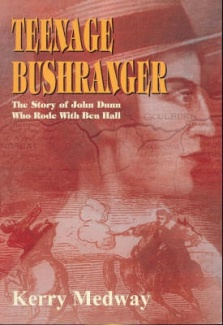
1866: John Dunn, teenage bushranger

On this date in 1866, 19-year-old Australian bushranger John Dunn was hanged at Darlinghurst Gaol.

Young master Dunn, deft hand with a horse and a firearm, in 1864 joined a notorious outlaw gang then under the leadership of Ben Hall and John Gilbert.

This gang very quickly came to grief as both Hall and Gilbert were shot dead by police in May 1865. They’d been outlawed under new anti-bushranger legislation (pdf) enacted in 1865 by a parliament impatient with “the constant outrages on person and property of which the interior has for years been the scene.”

This new Felons Apprehension Act — despite its name — empowered people to kill alleged bushrangers without attempting to detain them. It did this by setting up a fast-track process to legally outlaw (pdf) individuals by name.

Dunn done did his own part to stir up this legal hornet’s nest by killing a constable named Samuel Nelson (father of eight children!) during a hotel stickup at the New South Wales hamlet of Collector.


(cc) image from AYArktos.

But the kid had better elusiveness than his bosses.

Dunn managed to escape the shootout that killed Gilbert and disappear for the best part of a year. Only in December of 1865 was he finally recognized and captured. (Then he escaped from detention, and had to be re-captured.)

Once they could keep him long enough to try him, Dunn was done for. It took a jury ten minutes to order him to hang.

Dunn’s godmother buried him at Sydney’s Devonshire Street Cemetery under a headstone reading, “He has gone to his grave but we must not deplore him though sorrow and darkness encompass his tomb — the Saviour has passed through its portals before him and the light of his love was the lamp through his doom.”

On this day..

1862: Margaret Coghlan, the last woman hanged in Tasmania

(Thanks to Meaghan Good of the Charley Project for the guest post. -ed.)

On this date in 1862, Margaret Coghlan (sometimes spelled “Coughlin” or “Coghlin”) was hanged in Tasmania, Australia for the murder of her husband.

Described as a “gray-headed old woman,” Margaret was, like many residents of the colony, a transported convict.

The murder happened on January 5, less than six weeks before Margaret’s date with death. It was a fairly typical domestic homicide: the Coghlans had a drunken quarrel and Margaret’s husband threw an iron bar at her. He missed and she picked it up and beat him until he was unconscious and perhaps dead.

This much might be colored self-defense, but then Margaret administered coup de grâce by slitting her husband’s throat.

In an act worthy of one of those “dumb criminals” books, she then placed the razor in her husband’s own hand to try to make it look like he committed suicide. But the authorities did not believe the man could have beaten himself to death with the iron bar, cut his throat afterwards and left someone else’s fingerprints in blood on the razor.

According to newspaper coverage of the event, Margaret made the usual scaffold speech acknowledging the justice of her sentence and the foulness of her crime:

I acknowledge fully the justice of my sentence, I deserve this, and a thousand deaths, if that were possible, for the horrible crime I have committed. Drink, the curse that has been on me, strong drink, has caused all my misery—everything has been sacrificed for strong drink … May all forgive me whom I have injured, offended, or scandalised, by my evil living.

She was hanged by Solomon Blay, “the colony’s most unpopular public servant.” He was a convict like Margaret, transported from England after he pleaded guilty to counterfeiting. Margaret would turn out to be the last woman hanged in Tasmania, although the state didn’t abolish the death penalty for more than a hundred years after her execution.

On this day..

1864: The Kinston hangings

Even the most casual student of the U.S. Civil War will know of Confederate Gen. George Pickett, namesake of Pickett’s Charge during the 1863 Battle of Gettysburg.

But it was for what Pickett did on this date in 1864 — much less well-recalled today but to the 1864 New York Times correspondent exemplifying “the madness of rebel leaders” — that he had to flee to Canada after the war, for fear of being prosecuted for committing a war crime.

Book CoverGeneral Pickett is far removed now from the high-water mark of the Confederacy, scrapping in eastern North Carolina, where loyalties in the Civil War are quite divided.

There, the federals had held the town of New Bern going on two long years. Pickett was detailed to mount an assault upon it, which failed, but netted him a number of Union prisoners.

Desertion plagued the Confederate army in general.

North Carolina men in particular had a reputation (of arguable veracity) for absenting themselves; and, as the state as a whole was the most reluctant (and last) seceder, no small number of those deserters were ducking out for ideological reasons. Plenty of onetime Confederate conscripts who conceived greater loyalty to the Union than to their state shed gray uniforms for blue.

Licking his wounds from the New Bern sortie down the road at Kinston, Pickett recognized a couple of his prisoners as his own former soldiers. They had a testy exchange with the beaten general, and Pickett had them up for a summary court martial in a flash. On February 5, Joe Haskett and David Jones were hanged for desertion.


There followed an interesting exchange between the rival commanders.

Intending to forestall any tit-for-tat killings of POWs, the Union general warned Pickett to treat them humanely.

Major-General Pickett,
Dept. of Virginia and North Carolina, Confederate Army:
General: I have the honor to include a list of 53 soldiers of the U. S. Government who are supposed to have fallen into your hands on your late hasty retreat from before New Berne. They are the loyal and true North Carolinians and duly enlisted in the Second North Carolina Infantry. I ask for them the same treatment in all respects as you will mete out to other prisoners of war.

I am, very respectfully, your obedient servant,
JOHN J PECK

Pickett must not have appreciated having his martial prowess busted on by his opposite number, because he returned a sarcastic reply promising to use Peck’s list to identify deserters. (In a subsequent letter, he threatened to meet retaliations with 10-for-1 hangings. Pickett showed an “imperious and vaunting temper” in the postwar judgment of Attorney General Holt. Or more directly put, he comes off as an asshole.)

GENERAL: Your communication of the 13th instant is at hand. I have the honor to state in my reply that you have made a slight mistake in regard to numbers, 325 having “fallen into your(our) hands in your (our) late hasty retreat from before New Berne,” instead of the list of 53 with which you have so kindly furnished me, and which will enable me to bring to justice many who have up to this time escaped their just deserts. I herewith return you the names of those who have been tried and convicted by court-martial for desertion from the Confederate service and taken with arms in hand, “duly enlisted in the Second North Carolina Infantry, U S Army.” They have been duly executed according to law and the custom of war.

Your letter and list will, of course, prevent any mercy being shown any of the remaining number, should proper and just proof be brought of their having deserted the Confederate colors, many of these men pleading in extenuation that they have been forced into the ranks of the Federal Government.

Extending to you my thanks for your opportune list,

I remain, very respectfully, your obedient servant,
G. E. PICKETT

He did it, too.

The Confederate chaplain John Paris recounted for his side’s press the scene, a baker’s dozen of men on a large platform, heads sacked, an unknown cross-eyed executioner waiting to strip the bodies of their clothes as payment. Most were local boys, dying shockingly under the eyes of their own family and acquaintances. Reportedly, a number of shaken Confederate soldiers deserted to New Bern after witnessing the scene.

The thirteen marched to the gallows with apparent resignation. Some of them I hope were prepared for their doom. Others I fear were not. On the scaffold they were all arranged in one row. At a given signal, the trap fell, and they were in eternity in a few moments. The scene was truly appalling. But it was as truly the deserters doom. Many of them said I never expected to come to such a end as this. But yet were deserters, and as such they ought to have expected such a doom. The names of these misguided men were, John I Brock, Wm. Haddock, Jesse Summerlin, A I Brittain, Wm. Jones, Lewis Freeman, Calvin Huffman, Stephen Jones, Joseph Brock, Lewis Taylor, Charles Cuthrell, W. C. Daughtry and John Freeman.

The knell of vengeance has sounded. … deserters in North Carolina must now open their eyes, from the mountain to the seaboard. Desertion has become in our army a desperate disease, and desperate cases require desperate remedies. Let fathers, mothers, brothers, sisters and wives, exhort their friends at all times to be faithful to their country under all circumstances.

In all, 22 alleged deserters hanged over the course of February in this affair, the 13 executed together on February 15 obviously accounting for the lion’s share. The incident is the likely inspiration for the novella published later in 1864 by a Confederate North Carolina cavalryman: The Deserter’s Daughter; most certainly, Kinston made the rounds in the North to great indignation.

And an event so notorious was bound to draw attention with the end of the war: even in 1864, the New York Times had editorialized demanding “instant and relentless retaliation … there could be no such thing as acquiescence or empty protest. Even if the Government could bring itself to this abject mood, the public indignation would not tolerate it.” Officers who had been stationed at New Bern did not neglect to keep this sentiment alive in the chain of command, pushing for punitive action to avenge their former comrades.

In the end, there would be none.

Playing it safe, Pickett skipped out for Canada (and even changed his appearance) in 1865 as a board appointed by Secretary of War Edwin Stanton opined that he and other parties to the hangings were “guilty of crimes too heinous to be excused by the United States government … there should be a military commission immediately appointed for [their] trial … to inflict upon [them] their just punishment.” That was especially so as it emerged that some of the hanged had “deserted” from stuff like bridge guards and state militias — not (in the view of prosecution-minded Unionists) the Confederate army proper.

But as the investigations continued into 1866, they zeroed in on Pickett as their specific target. And, they ran out of steam — or into a stone wall.

In 1866, Pickett appealed from exile to Ulysses S. Grant, who just so happened to be an old West Point chum of Pickett’s.* “Certain evil disposed persons,” Pickett wrote, “are attempting to re-open the troubles of the past.” With the Supreme Court’s Ex parte Milligan ruling, the prospect of a military tribunal evaporated.

Grant had the case shelved, even against Congressional appeals, until everybody just gave up and dropped it. “I do not see how good, either to the friends of the deceased, or by fixing an example for the future, can be secured by his trial now,” Grant said once of his old associate. Plus ça change.

Pickett lived until 1875, selling insurance without legal molestation but also shadowed by the dark cloud of Kinston. After his death at age 50, his wife went on to rehabilitate Pickett’s reputation in the popular eye.

But not in every eye.

As late as the turn of the century, a veteran’s polemic was dedicated to excoriating not only Pickett, but Grant and the Union men who had declined to punish him.

We’ve only outlined the Kinston story in this post, but much more detailed narratives can be found at:

* In fairness to U.S. Grant, we are bound to report his stated reason for opposing any prosecution of Pickett: it would violate the grant of clemency he himself had made to secure General Lee’s surrender at Appomattox.

On this day..

1862: Samuel Calhoun, antebellum serial killer

On this date in 1862, Private Samuel H. Calhoun of the 2nd Kentucky Infantry was executed by the Union Army in Bardstown, Kentucky, for murdering a local farmer.

(Calhoun had previously killed the farmer’s pig, and the farmer had Calhoun arrested. So this was settling the score.)

“I shall pass away, the moral wreck of a degenerate age,” he signed off in his published confession, dictated to Jonathan Harrington Green. “Adieu.”

If the confession is to be believed the farmer was just the last of maybe dozens of Calhoun’s victims, slain remorselessly everywhere from North Carolina to Mexico over the preceding years. But is this unverifiable

Read on for the full story in a post at Civil War Medicine guest-authored by one of our favorite crime-history bloggers, Robert Wilhelm of Murder by Gaslight.

On this day..

1863: Mangas Coloradas, Apache leader

One hundred and fifty years ago, day to day,* the Apache chief Dasoda-hae — better known as Mangas Coloradas, “red sleeves” — was extrajudicially executed by U.S. Army soldiers at Fort McLane, New Mexico.

This legendary Apache statesman’s nickname was Spanish, because he’d spent the 1830s and 1840s fighting Mexicans seeking bounties on Apache scalps. Indeed, when the U.S. in 1846 attacked Mexico, Mangas Coloradas gave U.S. soldiers safe passage through Apache territory, and subsequently signed a treaty with the victorious Americans. (There’s a handy map of the scene in this pdf.)

He did his utmost to keep relations with the gigantic industrial society on his borders safely diplomatic, but over the 1850s Apaches spiraled into conflict with aggressive Anglo settlers drawn by the call of gold. In 1861 Mangas Coloradas married his daughter to another Apache chief, Cochise. These two were able to keep whites at bay with raids for a short time (and given a big assist from the resource diversion of the Civil War). But there was only one way this was going to end.

In January 1863, Mangas Coloradas — about 70 years old and still alive to the impossibility of long-term success by force of arms — arrived under a flag of truce to negotiate a ceasefire with Brigadier General Joseph Rodman West. West had him clapped in irons instead, and let his soldiers know exactly how to handle their prisoner.

Men, that old murderer has got away from every soldier command and has left a trail of blood for 500 miles on the old stage line. I want him dead or alive tomorrow morning, do you understand? I want him dead.

That night, Mangas Coloradas was tortured with red-hot bayonets and shot “trying to escape.” The Apache Wars would expand calamitously in the years to come.

The army medical officer David Sturgeon took the Apache’s scalped head (they scalped him, too), eventually bringing it to Ohio after he left the service. Sturgeon finally presented his prize to Prof. Orson Squire Fowler; Fowler examined it and published a description in his 1873 work Human Science: Or, Phrenology: Its Principles, Proofs, Faculties, Organs, Temperaments, Combinations, Conditions, Teachings, Philosophies, Etc., Etc..**

The fate of this horrid trophy after it passed through Fowler’s hands is a mystery. It’s rumored that the Smithsonian received it, and perhaps surreptitiously got rid of it; while the institution has always denied ever having the skull of Mangas Coloradas, it is a fact that the Smithsonian collected and still possesses an alarmingly enormous trove of Native American remains.

* It appears to me that Mangas Coloradas entered into army custody on January 17, and was shot just about midnight that night: the exact moment of the incident could be either the 17th or the 18th. An eyewitness account from one of the soldiers on night watch describes giving over the watch to George Lount until midnight. When the first watchman returned at that time, he noticed that “Mangas arose upon his left elbow, angrily protesting that he was no child to be played with. Thereupon the two soldiers [who had been torturing Mangas], without removing their bayonets from their Minie muskets, each quickly fired upon the chief, following with two shots each from their navy six-shooters.”

** What did the skull-measurer make of his prize? “It bulges out at its side in the region of Secretion, Caution, and Destruction, beyond anything I ever saw. Cunning is his largest organ, and far exceeds any other development of it I have ever seen, even in any and all Indian heads. It is simply monstrous. Yet Destruction also far exceeds any other development of it I ever saw …

“Conscience and Worship are unusually large, both absolutely and relatively, which coincides with the scrupulous fidelity with which he kept his promises. He doubtless thought he was but doing his duty in avenging the injuries white men had done to his tribe, by torturing and killing them. He must also have been a devout worshipper of the Great Spirit and extremely superstitious. Benevolence is very poorly developed indeed.”

(Mangas Coloradas actually was a very tall man with a very large head: a number of accounts attest to this.)

On this day..

1864: Five Virginia City road agents

The frontier town of Virginia City, Montana, saw a quintuple hanging on this date in 1864, authored by the local vigilance committee.


(cc) image from Rich Luhr of the hanged men’s gravestones at Virginia City’s Boot Hill. (It’s one of several American West cemeteries known as “Boot Hill”)

A miners’ boom town since prospectors struck gold nearby the previous year, Virginia City was even, briefly, the capital of the Montana Territory.

For order, it depended upon a Vigilance Committee of local grandees … and that committee had just days before carried out the hanging of Henry Plummer, the sheriff of the nearby mining town of Bannack and a reputed outlaw gang boss.

Plummer’s supposed “road agents” did the wilderness-trail robbery act familiar of the western milieu, but on a nearly industrial scale: it was suspected that “horses, men and coaches” traveling around Bannack and Virginia City were systematically “marked in some understood manner, to designate them as fit objects for plunder.”

The next act in the Vigilance Committee’s confrontation with these highwaymen and bywaymen was to bust up the Plummer network by seizing and hanging five supposed road agents on this date.

The evidentiary basis for these conclusions was varied, and in most cases less than what you’d call ironclad; the club-footed cobbler George Lane was thought to be marking stages for outlaws to hit, but the crippled rancher Frank Parish? Or Jack Gallagher, who wasn’t even on the list of wanted road agents the vigilantes were working from?

(The Vigilance Committee’s Parish Pfouts would record in his diary “that every man executed by the Vigilance Committee at that time was proved to be a murderer or highway robber.” The unsavory whiff of lynch law notwithstanding, those vigilantes have not wanted for latter-day defenders.)

This text summarizes all the accused men’s backgrounds, including the colorful Boone Helm.

Upon the Vigilance men’s summary and predetermined judgment, the quintet was marched down the street to a then-unfinished log structure and strung up on an inside beam.

That log store can still be seen in Virginia City, where it’s kitschily advertised as the Hangman’s Building.

On this day..

1868: Priscilla Biggadike, exonerated Stickney murderess

On this date in 1868, Priscilla Biggadike withstood one last gallows-foot plea from her minister to admit to poisoning her husband.

‘I implore you not to pass away without confessing all your sins; not only generally, but especially this particular case, for which you are about to suffer. I had hoped that you would have made that confession, and thus have enabled me, as a minister of Christ, to have pronounced the forgiveness of your sins … It has grieved me much to find that [you] still persist in the declaration, that you are not accountable for your husband’s death; that you still say that you did not administer the poison yourself; that you did not see any other person administer it, and that you are entirely free from the crime. Do you say so, now?

The Prisoner, still in a firm voice, said, yes.

The Chaplain. — There is only one [hope] left, that you have endeavoured to confess your sins to God, though you will not to your fellow creatures. All I can now say is that I leave you in the hands of God; and may he have mercy on your soul. What a satisfaction it would be to your children, to your friends, to your relations, to know that you had passed from death into life, in the full persuasion that your sins were forgiven you … I am sorry I cannot exercise that authority [to pronounce sins forgiven] at the present moment.

Then, at the stroke of 9 a.m., she was hanged by ten-thumbed executioner Thomas Askern. True to form, Askern made a mess of it, and Biggadike painfully strangled to death with the rope’s knot infelicitously positioned under her chin* … although, since this execution was behind the walls of Lincoln Castle (in fact, it was the first female hanging after an 1868 Act of Parliament had made all hangings private), at least it didn’t incense a vast concourse of onlookers.

Posterity, though, has taken plenty of umbrage at Priscilla Biggadike’s fate.

She and her late husband Richard kept two lodgers in a two-room house in the village of Stickney.

Richard already suspected an affair between Priscilla and one of those lodgers, Thomas Procter (or Proctor), when he returned home from work on September 30, 1868, enjoyed tea and cakethat his wife had made for him, and then fell violently, fatally ill. The post-mortem examination showed Richard Biggadike had been poisoned with arsenic.

Priscilla Biggadike and Thomas Procter were both arrested on suspicion of murder but charges against Procter were soon dropped.

Priscilla was known to have quarreled with her husband over that whole infidelity thing, and she had alluded at least once to having arsenic around for killing mice. She was accordingly found guilty of poisoning him, though “only,” in the words of the jurors when the judge pressed the question, “upon the ground of circumstantial evidence.”

Indictment, trial, conviction, and execution for the “Stickney Murderess” wrapped up in two months’ time. But the discharged co-accused, Thomas Procter, years later made a deathbed confession that it was really he who poisoned Richard Biggadike.

(During the investigation, Priscilla had even attempted to blame Thomas Procter, reporting that on one occasion prior to the murder he’d even made what looked like an attempt to poison Richard by mixing white powder into his tea, after which Richard became sick. Police didn’t regard the accused as a particularly credible source for obvious reasons, but it’s hard to believe anyone would have failed to follow up on that sort of lead.)

On account of that whole wrongful-hanging mix-up, Priscilla Biggadike received a posthumous pardon. She’s even had a short musical made about her conviction, which was recently performed in Lincoln Castle. If you visit, you can still see the cell where she passed her final days.

* The bad botch of this job led Lincolnshire officials to audition for their next execution a local cobbler and amateur noose enthusiast destined to revolutionize the British hanging with his scientific approach: William Marwood.

On this day..

1861: Christopher Haun, potter and incendiarist

Christopher Alexander (“Alex”) Haun was perhaps the finest potter in antebellum Tennessee. He never had the chance to become the finest in post-bellum Tennessee because he was hanged in Knoxville this date in 1861 as an incendiarist.

While Tennessee seceded with the Confederacy in the U.S. Civil War, East Tennessee was a Union stronghold. This was the native soil of pro-Union “War Democrat” (and future U.S. President) Andrew Johnson.

Soon after the war began, Unionist east Tennesseans started slipping over the border to northern-controlled Kentucky, where they hatched a plot to burn railroad bridges throughout East Tennessee.

Hand of Bridge

Besides being good fun, the conspiracy promised an effectual blow against the Confederacy inasmuch as the East Tennessee & Virginia and East Tennessee & Georgia lines constituted the South’s most reliable rail and telegraph link between its capital at Richmond, Va., and the Deep South. This plan’s author, Rev. William Carter, went to Washington and had his scheme personally approved by President Abraham Lincoln, Secretary of State William Seward, and Gen. George McClellan.

The rest of the plan called for the Union army to invade East Tennessee on the heels of the bridge-burnings and occupy the area. Just a few months before, McClellan’s troops had similarly occupied the pro-Union western mountains of secessionist Virginia, which is why there’s a state of West Virginia today.

But there’s no state of East Tennessee, is there?

The bridge-burning conspiracy would go down as one of the great, failed guerrilla operations of the war.

Burning Your Bridges

With authorization straight from the top, the conspirators got going. A Captain David Fry** was tasked with targeting the Lick Creek bridge, located in northeastern Tennessee† near the settlement of Pottertown, so named for the ceramics craftsmen attracted to the area’s excellent clay.

After dark fell on Nov. 8, 1861, the local Union sympathizers recruited to the plot — Christopher Haun among them — gathered at the house of a local landowner, Jacob Harmon, Jr. There they took a dramatic lantern-lit oath on the Union flag, each to “do what was ordered of him that night and to never disclose what he had done.”

Then a party of some 40 to 60 mounted raiders stole out for the Lick Creek bridge two miles distant.

Around 2 a.m., they overpowered the small Confederate sentry detail assigned to Lick Creek, and forced the sentries to watch as they fired the bridge. That same night, several other parties elsewhere along the line all the way down to Alabama also burned, or tried to burn railroad bridges and cut telegraph lines.

These “deep-laid schemes … by an organization of Lincolnite traitors” (as the Knoxville Register accounted matters) brought a predictably furious Confederate response — and the audacious saboteurs would discover only after the fact that the planned East Tennessee invasion had been aborted by William T. Sherman without alerting his pyrotechnic fifth-column allies.

A Bridge Too Far

Within three days of the “treason,” East Tennessee had been clapped under martial law. A number of bridge-burners were also arrested (although many others escaped), and here the Lick Creek men would pay dearly for their recklessly humane decision to release their captured sentries. (pdf) As a result, several of them were captured in the days following their attack.

Confederate Secretary of War Judah P. Benjamin had a ruthless order for East Tennessee’s military authorities.

I now proceed to give you the desired instruction in relation to the prisoners of war taken by you among the traitors of East Tennessee.

First. All such as can be identified in having been engaged in bridge-burning are to be tried summarily by drum-head court-martial, and, if found guilty, executed on the spot by hanging. It would be well to leave their bodies hanging in the vicinity of the burned bridges. [emphasis added]

Second. All such as have not been so engaged are to be treated as prisoners of war, and sent with an armed guard to Tuscaloosa, Alabama, there to be kept imprisoned at the depot selected by the Government for prisoners of war.

Two men, William Hinshaw (often called “Hensie” in the period’s reports) and Henry Fry, were condemned by such a tribunal on Nov. 30 and immediately hanged — their bodies left exposed at the Greeneville Station for a day or more, until the stench became overpowering.

Haun was condemned on Dec. 10.‡ Confederate Brigadier General William H. Carroll telegraphed Benjamin for Jefferson Davis‘s confirmation of sentence.

The court-martial has sentenced A.C. Haun [sic], bridgeburner, to be hung. Sentence approved. Ordered To be executed at 12 o’clock tomorrow. Requires the approval of the President. Please telegraph.

Benjamin replied within hours, telling Carroll to make with the noosing.

Execute the sentence of your court-martial on the bridge-burners. The law does not require any approval by the President, but he entirely approves my order to hang every bridge-burner you can catch and convict.


Haun takes leave of his pregnant wife and four children before execution. Illustration from this 1862 propaganda volume by the Unionist publisher of the Knoxville Whig.

Six days after Haun hanged at Knoxville, the landowner who hosted the conspirators, Jacob Harmon, also went to the gallows, along with his son Henry. It seems someone in the incendiary party had carelessly dropped the name “Harmon” in conversation while the bridge sentries were in custody within earshot.

(Several others only narrowly avoided execution, or lynching, for the conspiracy. Given hundreds of other arrests of even merely suspect East Tennesseans and the very nasty feelings engendered by the Unionists’ attempt, it’s something of a wonder that only five were executed.)

Water Under the Bridge

Today, the Harmons are buried at Pottertown Harmon Historic Cemetery in rural Green County, Tenn., where a hexagonal monument commemorates all five executees (with an extra panel for summary text). There’s an annual ceremony there to commemorate the East Tennessee bridge burners.

Or, pay your respects any time by using the cemetery as the trailhead for the Civil War Bridge Burners’ Bike Ride (pdf). You’ll find the spot just off Bridge Burners Blvd.


View Larger Map

All the hanged incendiarists were posthumously enrolled in Company F of the 2nd Tennessee by Congress in 1862, a gesture of appreciation which also conferred on their heirs the right to survivors’ benefits.

In addition to the resources linked here, see Donahue Bible’s “Shattered like earthen vessels,” Civil War Times, Dec. 1997.

* Later to become the East Tennessee, Virginia & Georgia Railway, and then the Southern Railway, and then a big band hit.

**The intrepid Captain Fry would escape immediate capture, gather a few hundred Unionists as a guerrilla band, and eventually get caught, sent to Georgia, and condemned to death as a spy. Fry escaped by breaking out on the eve of his Oct. 15 hanging, in the company of some of the men arrested for the Great Locomotive Chase. He rejoined Union forces, was captured again, and survived the war, finally dying in 1872 … when he was hit by a train.

† The other bridges successfully torched by the conspiracy included two over the Chickamauga in southeastern Tennessee, and the theme of Civil War bridge-burning in that sector can’t help but suggest Ambrose Bierce’s “Occurrence at Owl Creek Bridge”. (The other details are nothing alike, so Bierce’s story clearly isn’t about this incident.)

‡ The railroad bridge at Lick Creek was back in action by this time.

On this day..