1868: Sam Dugan lynched in Denver

Like San Francisco and other western cities dissatisfied with the half-lawless frontier atmosphere, the city of Denver formed a “Vigilance Committee” — ominously known as “The Stranglers” — to maintain rough quasi-justice, “meted out innocent and guilty alike.”

This date in 1868 marks the end of one of the guilty.

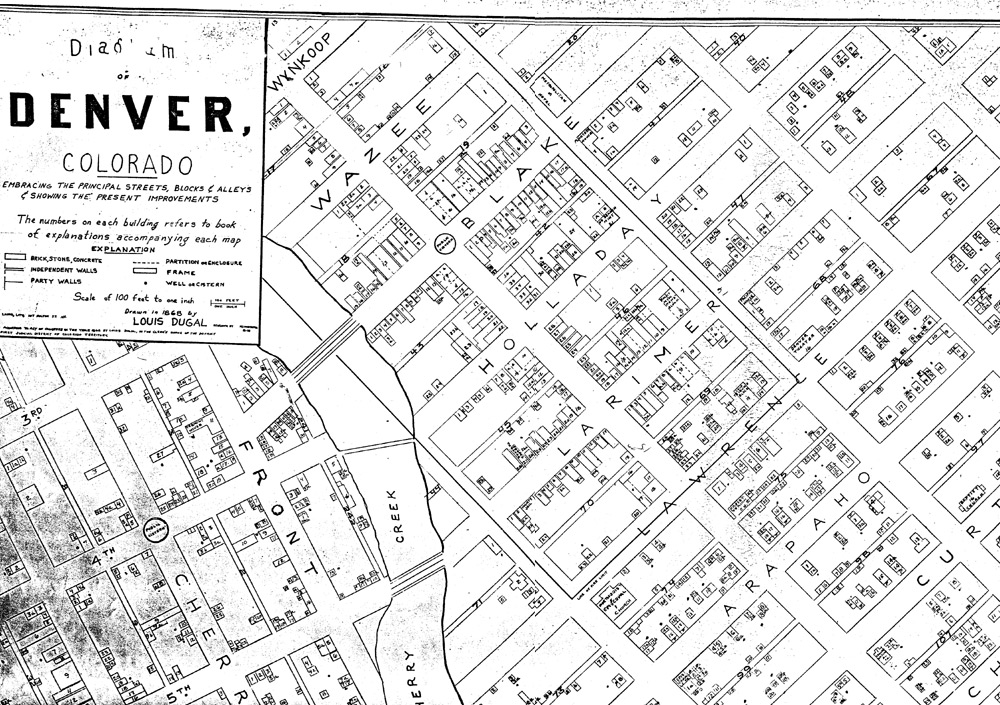
Sam Dugan, aka Sanfourd Dougan, is seen here lynched to a cottonwood tree at Cherry Street, midway between 4th and 5th streets, in Denver.

(Denver’s city plan has changed quite a bit since those days, but I believe the present-day location of this lynching would be approximately Speer Blvd. in a knot of paving the edge of the downtown University of Colorado campus.)

The photo, snapped by the morning light of Dec. 2, 1868, showed the previous night’s work of the Vigilance Committee.

Dug(g)an was a young (23 years old) knockabout in the territories with a blackhearted reputation, having been thought to have killed a man at a camp the year before.

In 1868, he and buddy Ed Franklin robbed a justice of the peace, one Orson Brooks, at gunpoint. As one can imagine, Brooks was one of the little town’s more prominent citizens and the crime outraged residents.

Denver lawmen chased Brooks’s assailants to nearby Golden, Colo., where Dugan’s accomplice Franklin — blind drunk — was shot dead resisting arrest. An innocent Golden citizen named Miles Hill also died when he was caught up in the the shootout to take Dugan … but Dugan himself escaped.

Public fury over this bloodshed (on Nov. 22) precipiated the Nov. 23 lynching of already-jailed outlaw L.H. Musgrove from a Cherry Creek bridge, not far from where Dugan would soon stretch hemp. (Musgrove had ridden in a murderous gang with the late unlamented Ed Franklin.)

Our surviving fugitive Dugan, meanwhile, made a run for Wyoming but was picked up within a few more days at Fort Russell after he stole a mail carrier’s horse. Marshal David Cook, whose public-domain Hands Up! or Twenty Years of Detective Work in the Mountains and on the Plains is a major source for this post, went to retrieve him.

Given the Musgrove lynching, Cook must have had an idea of the danger Dugan would face in Denver. Denver papers anticipating the party’s arrival said that Cook’s team “will bring the prisoners dead or alive. The former condition would be preferred by many.”

About 90 to 100 vigilantes made that preference into fact after dark on Tuesday, Dec. 1, stopping a police wagon moving Dugan between lockups, just as it was crossing a bridge over Cherry Creek.

The hijackers redirected the wagon around the corner to a copse of trees and “in a moment a rope was thrown over the limb, and in another moment, Dugan was standing in the wagon immediately under the fatal noose.”

That’s from a newspaper report that appeared in several publications; our cite is from the Milwaukee Daily Sentinel on December 21, 1868.

Dugan, “completely unmanned, crying and sobbing like a baby,” wheedled and stalled, begging for a Catholic priest and making various professions of innocence or mitigation that would cut no ice with his judges.

After he had said all that he had to say, the order was heard, “Drive on,” and the wagon which had served as his frail bulwark between life and eternity moved from under, and the spirit of Sanford S.C. Dugan took its flight into the presence of Him who shall judge us all according to the deeds done in the body. The fall, about eighteen inches, broke his neck. He was a man six feet two inches in height, and weighed 205 pounds.

Cook, in Hands Up!, says he “would gladly have prevented” the lynchings, “but it was useless for [lawmen] to fly in the face of an entire community, which had been outraged and which was aroused, not so much to vengeance as to the necessity of protecting itself against the rough element of the plains.”

On this day..

1868: Giuseppe Monti and Gaetano Tognetti, by the Papal guillotine

On this date in 1868, Italian revolutionaries Giuseppe Monti and Gaetano Tognetti were guillotined in Rome.

Theirs was a passion of the Risorgimento, the 19th century drive to unify as a single nation the peninsula’s quiltwork of minor kingdoms, duchies, and city-states.

Following the Third Italian War of Independence, this had largely been accomplished … with the notable exception of the Papal States surrounding Rome. You can hardly have Italy without the Eternal City.

So national liberator Giuseppe Garibaldi gathered a force under the slogan Roma o morte and prepared to march … while Pope Pius IX began receiving reinforcements from the sympathetic French emperor Napoleon III.

Inside Rome, Monti and Tognetti prepared a little morte of their own. Intending to mount a fifth-column uprising to coincide with the arrival of Garibaldi’s army, the two detonated a couple barrels of gunpowder under the Serristori barracks, killing 23 French zouaves and four Roman civilians. (All links in this paragraph are Italian.)

Unfortunately for the bombers, no general rising ensued, and the Papal and French armies subsequently repulsed Garibaldi at the Battle of Mentana on Nov. 3, 1867 — extending the papal enclave’s lease on life only slightly, but just enough to deal with Monti and Tognetti.

Their fate at the hands of the civil and religious authorities (one and the same, at this time), is dramatized in the 1977 Italian film In Nome Del Pap Re. (This Google books freebie purports to relate their final days.)

The triumph, such as it was, was short-lived for the Papal States: these were the very last executions by guillotine in Rome; the Papal States polity as a whole had time for only two more executions in its history before the Italian nationalist army completed the risorgimento by capturing Rome in 1870.

The two are memorialized in a celebratory ode by Giosue Carducci.

PER GIUSEPPE MONTI E GAETANO TOGNETTI
MARTIRI DEL DIRITTO ITALIANO

I
Torpido fra la nebbia ed increscioso
Esce su Roma il giorno:
Fiochi i suon de la vita, un pauroso
Silenzio è d’ogn’intorno.

Novembre sta del Vatican su gli orti
Come di piombo un velo:
Senza canti gli augei da’ tronchi morti
Fuggon pe ‘l morto cielo.

Fioccano d’un cader lento le fronde
Gialle, cineree, bianche;
E sotto il fioccar tristo che le asconde
Paion di vita stanche

Fin quelle, che d’etadi e genti sparte
Mirar tanta ruina
In calma gioventù, forme de l’arte
Argolica e latina.

Il gran prete quel dì svegliossi allegro,
Guardò pe’ vaticani
Vetri dorati il cielo umido e negro,
E si fregò le mani.

Natura par che di deforme orrore
Tremi innanzi a la morte:
Ei sente de le piume anco il tepore
E dice – Ecco, io son forte.

Antecessor mio santo, anni parecchi
Corser da la tua gesta:
A te, Piero, bastarono gli orecchi;
Io taglierò la testa.

A questa volta son con noi le squadre,
Né Gesù ci scompiglia:
Egli è in collegio al Sacro Cuore, e il padre
Curci lo tiene in briglia.

Un forte vecchio io son; l’ardor de i belli
Anni in cuor mi ritrovo:
La scure che aprì ‘l cielo al Locatelli
Arrotatela a novo.

Sottil, lucida, acuta, in alto splenda
Ella come un’idea:
Bello il patibol sia: l’oro si spenda
Che mandò Il Menabrea.

I francesi, posato il Maometto
Del Voltèr da l’un canto,
Diano una man, per compiere il gibetto,
Al tribunal mio santo.

Si esponga il sacramento a San Niccola
Con le indulgenze usate,
Ed in faccia a l’Italia mia figliuola
Due teste insanguinate. –

II
E pur tu sei canuto: e pur la vita
Ti rifugge dal corpo inerte al cuor,
E dal cuore al cervel, come smarrita
Nube per l’alpi solvesi in vapor.

Deh, perdona a la vita! A l’un vent’anni
Schiudon, superbi araldi, l’avvenir;
E in sen, del carcer tuo pur tra gli affanni.
La speme gli fiorisce et il desir.

Crescean tre fanciulletti a l’altro intorno,
Come novelli del castagno al piè;
Or giaccion tristi, e nel morente giorno
La madre lor pensa tremando a te.

Oh, allor che del Giordano a i freschi rivi
Traea le turbe una gentil virtù
E ascese a le città liete d’ulivi
Giovin messia del popolo Gesù,

Non tremavan le madri; e Naim in festa
Vide la morte a un suo cenno fuggir
E la piangente vedovella onesta
Tra il figlio e Cristo i baci suoi partir.

Sorridean da i cilestri occhi profondi
I pargoletti al bel profeta umìl;
Ei lacrimando entro i lor ricci biondi
La mano ravvolgea pura e sottil.

Ma tu co ‘l pugno di peccati onusto
Calchi a terra quei capi, empio signor,
E sotto al sangue del paterno busto
De le tenere vite affoghi il fior.

Tu su gli occhi de i miseri parenti
(E son tremuli vegli al par di te)
Scavi le fosse a i figli ancor viventi,
Chierico sanguinoso e imbelle re.

Deh, prete, non sia ver che dal tuo nero
Antro niun salvo a l’aure pure uscì;
Polifemo cristian, deh non sia vero
Che tu nudri la morte in trenta dì.

Stringili al petto, grida – Io del ciel messo
Sono a portar la pace, a benedir –
E sentirai dal giovanile amplesso
Nuovo sangue a le tue vene fluir…

In sua mente crudel (volgonsi inani
Le lacrime ed i prieghi) egli si sta:
Come un fallo gittò gli affetti umani
Ei solitario ne l’antica età.

III
Meglio così! Sangue dei morti, affretta
I rivi tuoi vermigli
E i fati; al ciel vapora, e di vendetta
Inebria i nostri figli.

Essi, nati a l’amore, a cui l’aurora
De l’avvenir sorride
Ne le limpide fronti, odiino ancora,
Come chi molto vide.

Mirate, udite, o avversi continenti.
O monti al ciel ribelli,
Isole e voi ne l’oceàn fiorenti
Di boschi e di vascelli;

E tu che inciampi, faticosa ancella,
Europa, in su la via;
E tu che segui pe’ i gran mar la stella
Che al Penn si discovria;

E voi che sotto i furiosi raggi
Serpenti e re nutrite,
Africa ed Asia, immani, e voi selvaggi,
Voi, pelli colorite;

E tu, sole divino: ecco l’onesto
Veglio, rosso le mani
Di sangue e ‘l viso di salute: è questo
L’angel de gli Sciuani.

Ei, prima che il fatale esecutore
Lo spazzo abbia lavato,
Esce raggiante a delibar l’orrore
Del popolo indignato.

Ei, di demenza orribile percosso,
Com’ebbro il capo scuote,
E vorria pur vedere un po’ di rosso
Ne l’òr de le sue ruote.

Veglio! son pompe di ferocie vane
In che il tuo cor si esala,
E in van t’afforza a troncar teste umane
Quei che salvò i La Gala.

Due tu spegnesti; e a la chiamata pronti
Son mille, ancor più mille.
I nostri padiglion splendon su i monti,
Ne’ piani e per le ville,

Dovunque s’apre un’alta vita umana
A la luce a l’amore:
Noi siam la sacra legion tebana,
Veglio, che mai non muore.

Sparsa è la via di tombe, ma com’ara
Ogni tomba si mostra:
La memoria de i morti arde e rischiara
La grande opera nostra.

Savi, guerrier, poeti ed operai,
Tutti ci diam la mano:
Duro lavor ne gli anni, e lieve omai
Minammo il Vaticano.

Splende la face, e il sangue pio l’avviva;
Splende siccome un sole:
Sospiri il vento, e su l’antica riva
Cadrà l’orrenda mole.

E tra i ruderi in fior la tiberina
Vergin di nere chiome
Al peregrin dirà: Son la ruina
D’un’onta senza nome.

On this day..

1864: Retaliatory executions by John Mosby

Though executioners don’t quite bat 1.000 — who does, at any human endeavor? — the field on the whole succeeds more often than not.

On this date in 1864, the Confederate guerrilla John S. Mosby had seven Union prisoners executed, but he only managed to kill three of them — an efficiency very well below the Mendoza Line for the executioner’s trade.

It was a rare competence gap for the brilliant cavalryman.

The irregulars Mosby commanded in the Shenandoah Valley had frustrated for six months the consolidation of rampant northern armies, thereby preserving the Confederate capital of Richmond and extending the Civil War.

The situation had quick become intolerable for the Union, and Gen. Ulysses Grant emphasized (pdf) to Gen. Phil Sheridan the cruel anti-insurgent tactics he would countenance for “the necessity of clearing out the country so that it would not support Mosby’s gang. So long as the war lasts they must be prevented from raising another crop.”

By way of example-setting, the Union army had summarily executed six of Mosby’s rangers at Front Royal in September — followed by a seventh who was captured in early October in Rappahanock County.

Incensed, the Confederate “gray ghost” began stockpiling blue bodies from the offending command of George Armstrong Custer — yes, the Little Bighorn guy; he was perceived by Mosby to be responsible for the atrocity, although the actual paper trail on the execution order seems to be a little sketchy.

Mosby, who fancied himself the genteel sort who would closely abide the laws of war when fighting for the right to maintain human chattel, sent a lawlerly appeal up the chain of command seeking permission “to hang an equal number of Custer’s men.” General Robert E. Lee and Confederate Secretary of War James Sedden granted it.

Twenty-seven captives were therefore assembled and subjected to a lethal lottery. Jay Simson’s Custer and the Front Royal Executions of 1864 recounts this horrible affair in an excrutiatingly page-turning narration.

The preparations began innocently enough on a quiet Sunday morning (November 6, 1864) when 27 Union prisoners of war were ushered with no explanation about what was happening out of a brick storehouse located in Rectortown, Virginia …

[They] were then marched to the banks of Goose Creek, about half a mile away. some, but definitely not all, of this specially selected pool of 27 prisoners belonged to Custer’s commands both past and present … [but] of the seven men eventually selected to die on Mosby’s orders only two were actually members of the Michigan Cavalry Brigade.

All 27 of the prisoners were lined up along Goose Creek and then made to draw slips of paper from a hat. Twenty of those slips of paper which were part of the macabre lottery were simply that, blank pieces of paper. The other seven — one for each of Mosby’s men executed at Front Royal and in Rappahanock County — were marked with a number …

Of the men who were forced to draw those slips of paper, some of them simply stared into space. Others, once they understood what was happening, prayed. There were a few of them who simply broke down.

Among the prisoners was a young drummer boy … who broke down completely, sobbing … He drew a blank slip and immediately proclaimed: “Damn it, ain’t I lucky!” When a second drummer boy was found to be unlucky enough to have drawn one of the marked slips of paper, upon the request of the men who had been spared, Mosby personally ordered the boy to be released from the seven condemned prisoners and the 18 remaining prisoners (excluding the first drummer boy) drew from the slips of paper for a second time.

Then one of the seven adults also got himself swapped out of the scrap by flashing a Masonic sign at a Confederate lodge member. The things that stand between life and death.

Out of the nine to come under death’s pall and the seven who were actually marched overnight to the place of execution (as close to Custer’s camp as Mosby dared) only three were there successfully ushered past death’s threshold.

At 4 a.m. on Monday, November 7, 1864 (the day before the election which would give Abraham Lincoln his second term in the White House and would therefore become the signature on the death warrant of the Confederacy), the Rangers and their prisoners reached the execution site in Beemer’s Woods, a mile west of Berryville, and the executions were carried forward. However, everything did not go exactly according to plan.

In the pre-dawn darkness and confusion (either through carelessness or lack of caring for their orders, since none of the prisoners had actually been involved in depredations against Confederate civilians) the Rangers allowed two of the seven prisoners (one of whom, G.H. Soule, 5th Michigan Cavalry Regiment, punched out a guard) to escape outright. Two other prisoners were apparently shot in the head, but surviving, having only been grazed, also escaped since they pretended, and were apparently believed, to be dead. The remaining three prisoners were hanged. The identities and whether or not these three prisoners were members of either Custer or Powell’s commands are unknown. Lt. Thompson, in accordance with his orders attached a placard to one of the hanged men (just as similar placards had been attached to the bodies of all three of Mosby’s hanged men). Mosby’s placard read: “These men have been hung in retaliation for an equal number of Colonel Mosby’s men hung by order of General Custer at Front Royal. Measure for Measure.”

Believing his purpose accomplished, or at any rate close enough for rebel government work, Mosby then wrote to Union General Sheridan justifying the action and assuring him that future “prisoners falling into my hands will be treated with the kindness due to their condition, unless some new act of barbarity shall compel me, reluctantly, to adopt a line of policy repugnant to humanity.”

The letter, and the 3-out-of-7 reprisal, actually worked — with no further measures exacted for measure or tits given for tat. For the waning months of the war the rival forces confined themselves to killing one another on the battlefield, and not in the stockade.

Well, mostly: one of the conspirators in the plot to assassinate Abraham Lincoln in April 1865 — which did assassinate Lincoln, but was really a wider attempt to decapitate the entire northern government — was a former Mosby’s ranger named Lewis Powell aka Payne. Lincoln killer John Wilkes Booth also seemed to flee in Mosby’s direction (Mosby’s units were still in the field, not covered by the April 9 Appomattox surrender.) There exists an unproven but delicious speculative hypothesis that the hand of John Mosby was among those behind an exponentially more ambitious “line of policy repugnant to humanity.”

Be that as it may, Mosby actually became a Republican after the war — for which he received some Southern death threats — and lived fifty eventful years. Among other things, the aged Mosby regaled the young George Patton (whose father Mosby knew) with Civil War stories.

On this day..

1865: Paul Bogle

On this date in 1865, Baptist deacon Paul Bogle was hanged at the Morant Bay courthouse for his part in that locale’s eponymous rebellion.


Third World’s “1865 (96 degrees in the shade)” celebrates Paul Bogle: “Today I stand here a victim the truth is I’ll never die”

Bogle helped lead of the protests-cum-riots that became that rebellion.

Baptists played an essential role in the affair, which has led some to call it the “Native Baptist War”. And indeed, Baptism had long intertwined with underclass resistance: Jamaica’s most famous slave rebel, Samuel Sharpe, was also a Baptist deacon. A previous royal governor in Jamaica had once warned that “the worst evil which hangs with a menacing aspect over the destinies of this island is the influence exercised with baneful effect by the majority of Baptist missionaries.”

From the standpoint of the powerful in Jamaica and Britain, 1865 would vindicate that warning.

A (white) Baptist missionary named Edward Underhill had penned a January 1865 letter bemoaning the miserable condition of most Jamaicans and starkly disputing received wisdom that blacks were just too lazy to work: “The simple fact is, there is not sufficient employment for the people; there is neither work for them, nor the capital to employ them.” (Underhill later wrote a book on the events, The tragedy of Morant Bay, a narrative of the distrubances in the Island of Jamaica in 1865.)

Underhill’s letter got into public circulation and as a result there were a number of “Underhill meetings” perhaps comprising an “Underhill movement” on the island in 1865 — essentially a going social campaign that rooted deeply in Jamaica’s native Baptist communities. Though “native Baptists” is a vague term, it distinguishes not only black from white but, in the words of Mary Turner, a whole “proliferation of sects in which the slaves developed religious forms, more or less Christian in content that reflected their needs more closely than the orthodox churches, black or white.”

William Gordon had switched his religious allegiance to native Baptist and was known to speak at Underhill meetings: that’s part of what got him hanged.

Likewise, our day’s focus, Paul Bogle, was a native Baptist minister, in the St. Thomas-in-the-East parish — and it was the protest of Bogle and his supporters against an unjust prosecution that started the whole rebellion off.


Statue of a militant Paul Bogle (that’s a sword in his hands) outside the Morant Bay courthouse where all the trouble started. (cc) image from dubdem sound systems.

There was, accordingly, an immediate reward out on Bogle’s head, and an immediate demonization in the respectable English press. There, he was “the notorious Paul Bogle,” in the words of one letter to the editor (London Times, Nov. 18 1865), in whose Baptist chapel rebellious “panthers” wantonly “drank rum mixed with gunpowder and the brains of their victims.”

By the time that letter had been dispatched, Bogle’s purported orgies had long since been interrupted: captured by Maroons, he was delivered to custody, instantly tried, an hanged that very day in a batch of 18 rebels.

A horror to Victorian planters, Bogle has won the reverence of posterity as a freedom fighter and national hero.


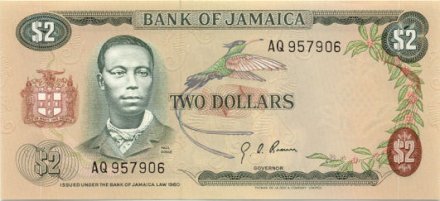
Paul Bogle on the (now out-of-circulation) Jamaican two-dollar bill.

On this day..

1865: George William Gordon, Jamaican politician

“No incident of the dreadful story” of Morant Bay, wrote Edward Underhill, “produced a more painful impression than the arrest, trial, and execution of Mr. G.W. Gordon” this date in 1865.

The son of a white planter and a mulatto slave, George William Gordon was an able businessman and became a Jamaican assemblyman.

In that capacity, he was a vocal critic of British colonial maladministration, an advocate for blacks, and a political foe of Jamaica’s governor, Edward John Eyre. He’d already had government commissions canceled because of his politics.

Gordon had nothing to do with the Morant Bay outbreak. He was away from the disturbance altogether, in Kingston, when it broke out.

But he was regarded by many white elites as a class enemy, and Eyre did not intend to miss this opportunity to eliminate him. A few years later, a French tribunal would express the rationale as it cracked down on the Paris Commune: guilty or no, “a prudent and wise Government must rid itself [of troublemakers] when it finds a legitimate occasion to do so.”

Accordingly, Gordon was arrested by civil authorities in Kingston — he actually turned himself in when he heard there was a warrant out on him — and then transferred into the hands of the drumhead military tribunals that were operating in the conflict zone, obviously with the intent of terminating a gadfly.

This extra-legal act is discussed in greater detail here, but the long and short of it was tartly summarized by no less than the sitting Lord Chief Justice:

[Kingston authorities] were not the ministers or apparitors of the martial authority, and did not possess the power to take up Mr. Gordon for the purpose of handing him over to the martial law. Nevertheless, they did it. They did it by the exercise of the strong hand of power, because it was thought that a conviction could not be got at Kingston. It was altogether unlawful and unjustifiable. To Mr. Gordon it made the difference of life or death.

Gordon, in his last letter to his wife, took it all in an understandably contemptuous stride:

General Nelson has just been kind enough to inform me that the court-martial on Saturday last has ordered me to be hung, and that the sentence is to be expected in a hour hence, so that I shall be gone from this world of sin and sorrow.

I regret that my worldly affairs are so derranged: but it cannot be helped … I never advised or took part in any insurrection. All I ever did was to recommend the people who complained to seek redress in a legitimate way … It is however the will of my heavenly Father that I should thus suffer in obeying His command, to relieve the poor and needy, and to protect, as far as I was able, the oppressed …

do not be ashamed of the death your poor husband will have suffered. The judges seemed against me; and from the rigid manner of the Court, I could not get in all the explanations I intended. … It seemed that I was to be sacrificed.

Much of what Governor Eyre did in those desperate days skirted, at best, the edges of what might be legally colorable. But at least those instances, in the main, were directed at people alleged to have been actual rebels or rioters. Eyre could safely expect wide latitude where the security of the realm was at stake.

In Gordon, however, there was a man whose crime was nothing other than to have sympathized with the real and crushing plight of the lower orders and advanced their cause politically. Eyre’s magistrates made that fact alone into sedition, and twisted the rules of their own courts-martial to pin it on Gordon.

Given the exceptionally lawless nature of this scenario — and Gordon’s own visibility as a colonial elite — his became the lightning-rod case for English liberals incensed at Eyre’s behavior. John Stuart Mill, Charles Darwin, Herbert Spencer, and others demanded Eyre’s prosecution for the affair, Thomas Huxley writing for the faction,

the killing of Mr. Gordon can only be defended on the ground that he was a bad and troublesome man; in short, that although he might not be guilty, it served him right.

I entertain so deeply-rooted an objection to this method of killing people — the act itself appears to me to be so frightful a precedent, that I desire to see it stigmatised by the highest authority as a crime.

It can hardly surprise the reader, versed as we are by this late date in official impunity, that not Eyre nor any lieutenant was ever thus stigmatised.

While Eyre evaded due punishment, Gordon could not escape the plaudits of posterity. He’s been honored as a Jamaican National Hero, and the very building where the present-day parliament sits is called the Gordon House in his honor.

On this day..

1865: Johnson Speed, arson bystander

The line between a snap military tribunal with a preordained outcome, a summary execution in the field, and simple murder blurs over in this affair where the word of any armed man in a British uniform had virtual color of law.

This account of one poor sod flogged within an inch of his life and then summarily shot when his captor soldiers took it into his heads that he might have had something to do with some fire comes from Illustrations of Martial Law in Jamaica: Compiled from the Report of the Royal Commissioners, and Other Blue Books Laid Before Parliament.


On [October] the 22nd four white soldiers were taken by Mr. Christopher Codrington to his house at Rose Garden, where they had dinner. When they returned in the evening to David Mayne’s shop, at Long Bay, two constables were there with two prisoners, James Sparkes and Johnson Speed.

They tied the former to a tree, and gave him 100 lashes.

They then tied up Johnson Speed, and gave him eighty-five lashes, when the cat broke.

One of the soldiers ran into the shop and brought a horsewhip, but another one interfered as it was not a thing to beat a man with. Another looker-on was here asked whether Johnson Speed had done anything during the disturbance, and he replied that when Mr. Hinchelwood’s house was burning Speed was there. Then the soldier said, “Where is my rifle?”

The man cried out, “Lord, I don’t do nothing, and I am going to dead.”

The soldier fired, but his rifle had no ball in it, or he had missed. He loaded the gun afresh, and hit the man in the middle of the back as he was tied to the tree. Another one went up, as he dropped writhing to the ground, and put a rifle to his ear and blew out his brains. These were soldiers of the 2nd Battalion of H. M. 6th Regiment of Foot. Mr. Christopher Codrington, a Justice of the Peace, was present.


The above is one of the very last accounts in a tome heavy with atrocities destined never to be punished in this world.

It seems apt both for the subject matter of this site and for laying bare the biases of the source to include the very last few paragraphs that follow.


David Burke was shot at Manchioneal. The soldiers ordered him to go before and point out rebels. “He was a big stout young man,” said a witness, ” and he walked quite lumber-like, and they said he was a rebel too, and shot him dead”.

Andrew Clarke was shot in his own house, at Manchioneal, under the following circumstances, as described by his widow :—

I was sitting with the baby, and I saw a black soldier, and he asked Andrew Clark, “Where are all the men’s goods you have ? Please bring them out.” Clarke said, “I have been sick three months, and I did not interfere.” The soldiers searched and found nothing. Then I was sitting down, and three soldiers came in, and a man named Saunders came in with them, and I explained that it was John Murray’s house, and the soldier dropped him, and he dropped on his side and bawled for mercy. The soldier told me, “Take yourself right out,” and I came out, and another soldier said, “Put another bullet into that fellow’s head,” and they blew out his brains. They burnt the house with fire from the kitchen.

These are samples of the scenes enacted in the beautiful island of Jamaica under pretence of repressing disturbances. My task has not been undertaken in vain if it tends to deepen the resolve of my countrymen to resist at all hazards, the preposterous pretensions of Colonial Governors and military officers, to deal with human life and property as they please, without responsibility to the laws which bind society together, or to the nation which places the sword in their hands for the purposes of justice and mercy.

On this day..

1865: An unnamed Obeah man

From William James Gardner’s (public domain) A History of Jamaica:

On the 21st a circumstance occurred which created much controversy. A reputed Obeah-man was tried by court-martial and convicted. One of the favourite assertions of these people has been that “Buckra can’t hurt them.” Colonel Hobbs directed him to be placed on a hill-side, about four hundred yards from the firing party. The bullets caused almost instantaneous death, and it is stated that the effect on the minds of the prisoners was so great, that the colonel felt at liberty to release a considerable number then in his camp, many of whom were heard to say they never would believe in Obeah again.

On this day..

1865: William Grant, evidently a ringleader, a persuader, and adviser

The account below of a forgotten saddler hastily attainted a participant “in the background” in the Morant Bay rebellion comes from Illustrations of Martial Law in Jamaica: Compiled from the Report of the Royal Commissioners, and Other Blue Books Laid Before Parliament.


Another victim was William Grant, saddler, of Morant Bay. The following record of the proceedings in his case is probably unique in the history of judicial or quasi-judicial investigations :—

October 20th, 1865.
Drum-head Court Martial.

President:—Lieut. H. Brand, E.N.
Members:—Lieut. Errington, K.N., Ensign Kelly, 4th W.I.R.

William Grant, charged with being one of the ringleaders and originators of this rebellion.

The Provost sworn states :—

About four or five days ago I was informed that this man was the originator and founder of the party who raised the rebellion, that he was not likely to be seen himself, but makes the others. He keeps a saddler’s shop, where the secret meetings took place. On the road from St. Thomas-in-the-East to the Guinness (Ginnep) tree, where placards had been posted, calling secret meetings, I searched the house of Chisholm, also a confederate, and in the presence of Mr. Jones, E.A., I took a blue card, as an admission ticket to a Society of Friends, printed William Grant, Founder. That card I sent to the Governor.

The prisoner Duncan Stuart, in his defence, when called upon by Captain Astwood, voluntarily made this statement. He had previously made it in the presence of Mr. Miller, J.P., whose signatures I here produce. “Grant called Bogle at Dr Alveranga’s, and said, ‘Don’t pull this down, wait a little, don’t join with the Volunteers, when you see what they do, run in.’ Grant said, ‘Now is the time to vindicate.’ ”

Mr. Miller, Justice of Peace, for St. Thomas-in-the-East, sworn:—

That statement was voluntarily given and sworn to before me.

Geo. F. Judah, Sergeant-Major of Volunteers:—

I gave the prisoner my rifle to repair on the morning of the riot, and he has kept it, and I have never seen it since.

The prisoner in his defence merely states that he never knew anything about the riot before it actually broke out. He has acknowledged to having corresponded with Mr. Gordon, but that, he states, was quite private, about some land.

This man was evidently a ringleader, a persuader, and adviser, and did his utmost to keep in the background and push the ignorant on to rebel.

Found Guilty, October 20th, 1865. Sentence, Death.

H. Brand, President,
Lieutenant E.N.
Approved and confirmed,

A. A. Nelson,
Brig. Genl. Commanding Field Force.

[The proceedings of the Courts-martial were retained by the Commissioners, and they refused to exhibit them to the Counsel for the parties complaining of the measures of suppression. General Nelson and others were therefore not cross-examined in reference to these trials.]

The first witness, Ramsay, the Provost-Marshal, told the Court only of what he had been informed — the great crime of the prisoner apparently being that he was the founder of a Society of Friends, and had actually a blue card of membership in his house.

The witness, Duncan Stewart, was not called. He had already been tried and was under sentence of death, and was duly hanged the same evening along with Grant. (See List). A so-called statement of this man was produced in writing. It will be noticed he spoke only of “Grant” having used certain words. Three Grants were hung at Morant Bay, and a William Grant was convicted by a Special Commission at Kingston, while the Royal Commissioners were sitting, and sentenced to penal servitude for life. It is clear from the evidence then given that the William Grant alluded to by Duncan Stewart was the one who was then sentenced. John Dickenson, on being examined by the living William Grant at that trial said:— “There was a William Grant, a saddler, who is hung. You are left. You are the man.” (No. 355 of Papers laid before the Royal Commissioners by Mr. Eyre).

Ramsay had evidently a strong interest in the conviction of this prisoner. He sent the following letter to Captain Luke, on 16th October, 1865:— “I also personally apprehended William Grant, the founder of the Society of Friends. I hope I may not be thought seeking for pecuniary benefit alone in claiming the rewards for information against G. W. Gordon at large, seizure of Chisholm, Grant, and Miles.”

Brand, the President of the Court-Martial, seems to have felt the evidence was weak, and he supplemented it by the following statement of his own. “This man was evidently a ringleader, a persuader, and adviser, and did his utmost to keep in the back ground and push the ignorant on to rebel.” The Judge having thus convinced himself, by his own conclusive testimony, adds “Found guilty. Sentence, death,” and, as a matter of course, the experienced officer of Her Majesty’s Service, who was the revising officer, adds:—”Approved and confirmed. A. A. Nelson, Brig.-Genl., Commanding Field Force, Morant Bay, 20th October, 1865.”

It is unnecessary to add that in the list of the executed is to be found the name “William Grant, under date of the 20th October. Charge, ringleader of rebellion!”

On this day..

Daily Quintuple: The Morant Bay rebellion

In 1865, British-controlled Jamaica faced an economically-driven revolt that altered its history.

Though slavery had been abolished in the British empire during the 1830s, emancipation had not come with land reform. Ex-slaves and their descendants remained desperately poor. Indeed, Britain’s near-simultaneous liberalization of the sugar trade had cratered prices for Jamaica’s top export — and with it, cratered most of the Caribbean economy.

To a petition early in 1865 for access to crown lands to relieve these dire conditions, Queen Victoria had extended a familiar classic of cruel and condescending economic catechism: shut up and work.

“The prosperity of the Labouring Classes, as well as of all other Classes,” quoth the piece that would be published as “The Queen’s Advice”,

depends, in Jamaica, and in other Countries, upon their working for Wages, not uncertainly, or capriciously, but steadily and continuously, at the times when their labour is wanted, and for so long as it is wanted; and if they would use his industry, and thereby render the Plantations productive, they would enable the Planters to pay them higher Wages for the same hours of work than are received by the best Field Labourers in this country; and as the cost of the necessaries of life is much less on Jamaica than it is here, they would be enabled, by adding prudence to industry, to lay by an ample provision for seasons of drought and dearth; and they may be assured, that it is from their own industry and prudence, in availing themselves of the means of prospering that are before them, and not from any such schemes as have been suggested to them, that the must look for an improvement in their condition; and that her Majesty will regard with interest and satisfaction their advancement through their own merits and efforts.

So your average Jamaican fieldhand’s “merits and efforts” became so much dry tinder accumulating, just waiting for the spark. (Note: Princeton has an album of photographs from this period here.)

In October 1865, flint struck steel with the prosecution of a poor black laborer for trespassing onto unused land.

The ensuing protest mushroomed into the Morant Bay rebellion: a scuffle with police, leading to proscriptions, leading to a more confrontational mob, an outnumbered and trigger-happy militia, and a full-fledged riot that seized the town of Morant Bay and proceeded to attack nearby plantations.

Dreadful reports, more terrifying for their scantiness and uncertainty, went abroad in those days, of “atrocities revolting to human nature.” That’s the New York Daily News, which ran a letter from Kingston, Jamaica, reporting “the whites who have fallen into the hands of these savages have been doomed to slaughter without distinction of age or sex. They tear out the tongues of their victims, cut off the breasts of women, strangle and mutilate little children.”*

Fearing a Haiti-like general revolution, Jamaican Governor Edward John Eyre — once an Australian explorer, which is why you can find his name on a New South Wales wine label — bloodily crushed the uprising.

Hundreds were put to death, either summarily in the field or after proceedings that would have wanted twice the deliberation to rise to the level of perfunctory. Hundreds more, including pregnant women, were flogged. Being in the wrong place at the wrong time without a demonstrable alibi ready to hand was liable to be worth a body’s life.

We note over the next five days two famous cases and three obscurities that may give a sense of how things were in those days — though Morant Bay depredations could in fact sustain several numbing weeks in these pages. For instance, a missive dated October 19 reports in passing the capture of “a number of prisoners from the rebel camp. Finding their guilt clear, and being unable either to take or leave them, I had them all shot. The constables then hung them upon trees, eleven in number.”

One officer** who showed excessive (read: any) exactitude for process was ordered in writing to emulate a comrade “doing splendid service … shooting every black man who cannot account for himself.”

Nelson at Port Antonio hanging like fun by court martial. I hope you will not send any black prisoners.

All this “fun” would put Governor Eyre in the eyre of a storm back in the home country.

These executions — but most especially that of colonial assemblyman George William Gordon — had little or no color of law, and spurred many English liberals to demand Eyre himself be prosecuted for murder. Nor was this merely an elite predilection: English working classes then in the midst of their own push for representation rallied in support of the Jamaicans, even burning Gov. Eyre in effigy. British Tories and propertied Jamaicans called Eyre a hero.

Ultimately, this furious “Eyre Controversy” proved insufficient to generate an actual criminal procedure against an agent of the empire, which would have entailed clearing a very high bar indeed. Recourse to the civil courts produced a landmark 1870 decision, Phillips v. Eyre whose upshot was to validate a law Eyre had the Jamaican assembly hastily enact retroactively legalizing his behavior and thereby rule out the prospect of a tort claim.

That Jamaican assembly was spooked enough that in 1866 it renounced its own power and made Jamaica into a Crown Colony directly governed by its British executive.

But if the need of the moment was to suppress the uprising, the need of history was to celebrate it — and the hero for posterity would not be Governor Eyre. The Morant Bay insurgents, a bare few of whom we will meet over the next days, have been valorized as slave rebels even if they weren’t quite literally slaves, and generally occupy an honored place in Jamaica.

* Cited in London Times, Nov. 13, 1865 — by which time the actual revolt was well over.

** That reluctant officer complied with his orders, but threw himself into the sea when recalled to England for subsequent the parliamentary inquiry.

On this day..

1866: Dmitry Karakozov

On this date in 1866 (September 3 O.S.; September 15 N.S.), Russian revolutionary Dmitry Karakozov was hanged in Peter and Paul Fortress for attempting to assassinate Tsar Alexander II.

Karakozov was a son of noble stock — the self-hating variety, obviously, and suicidally disturbed into the bargain. He supposedly hailed from a terrorism cell branding itself “Hell”, although this was bandied about by the police afterwards and conveniently supported a hunt for radicals.

Karakozov, at least, considered the state of tsarist Russia positively infernal, and on April 4, 1866, he went to scourge it — firing a shot at the monarch at St. Petersburg’s Summer Garden. He missed.

The tsar’s guards tackled him as he fled, and the unharmed Alexander walked up to the gunman and asked him, “What do you want?” He may have been genuinely bewildered: Alexander was the guy trying to liberalize Russia. Just a few years before, he had freed the serfs.

“Nothing,” Karakazov replied. “Nothing.”

A statement of implacability: no progress would be bargained with even the most progressive despot. The despotism itself must go. A manifesto addressed to “Friends-Workers” was found in his pocket underscoring the point; it read in part (translated from p. 21 of this Russian pdf):

I have decided to destroy the wicked Tsar, and to die for my beloved people…

If I accomplish this deed, I will die with the thought that in death I did something good for my dear friend, the Russian peasant.

If I do not accomplish it, then others will follow my path. Where I fail, they will succeed, and my death will be their example and inspiration.

Others would follow him, and in time successfully murder Alexander II after all.

Karakozov himself, the first Russian revolutionary to attempt regicide, didn’t seem to have revolutionary satisfaction on his mind at the end. He converted to Orthodox Christianity in prison, sought “as a Christian, of a Christian” his prospective victim’s clemency … and multiple newspaper accounts report him kneeling to kiss a cross presented to him on the scaffold by the priest. (All via Odd Man Karakozov, which argues that all this need not imply such a reversal of conscience as it might appear.)

What certainly did happen — more immediately than those copycat assassinations — was a reactionary wave of national chauvinism, whose more wretched manifestations will not be unfamiliar to the present day. The patriotic Glinka opera Ivan Susanin was staged a few days later at the Bolshoi in Moscow. According to an eyewitness account of Tchaikovsky quoted in Romanov Riches: Russian Writers and Artists Under the Tsars, this salute to a Russian peasant’s sacrifice for the Romanov dynasty went a little bit off-script.

I think the Moscow audience went beyond the bounds of sense in their outburst of enthusiasm. The opera was not really performed, for as soon as the Poles appeared onstage, the whole theater shouted, “Down with the Poles!” and so on. In the last scene of Act 4, when the Poles are supposed to kill Susanin …

… the actor playing him started fighting the chorus members who played Poles, and being very strong, knocked down several of them, while the rest of the extras, seeing that the audience approved this mockery of art, truth, and decency, fell down, and the triumphant Susanin left unharmed, brandishing his arms, to the deafening applause of the Muscovites.

If true, that is little short of fantastic.

The apparatus of state went so far as to build up a new Susanin for the occasion at hand, hyping a questionable story that a young peasant named Osip Komissarov — who was from Susanin’s own province of Kostroma — had jostled Karakozov just as he took the shot, causing it to go awry. The good-natured bumpkin was rewarded with summary ennoblement as “Komissarov-Kostromskoy” and eye-rollingly terrible poetic tributes from the likes of Vyazemsky and Nekrasov. However, Komissarov’s embarrassing stupidity and want of manners would eventually necessitate Komissarov-Kostromskoy’s being packed out of polite society to country estates on a generous pension to bankroll his ample appetite for liquor.

So Dmitry Karakozov did do something for the Russian peasant after all.

On this day..