1866: Frank Ferris, a Portuguese ax murderer in New York

New York Times, Oct. 19, 1866:

FRANK FERRIS, the unfortunate man who is condemned to be executed to-day for the murder of his wife, has been positively refused a further respite by GOV. FENTON. No efforts have been spared by the Portuguese Minister, or Mr. Kintzing, his counsel, to secure a commutation of sentence to imprisonment for life. Both these gentlemen have personally importuned the Governor, but without avail, as he yesterday declared, for the last time, that he could see no reason for clemency in this case.

The murder of which FERRIS was convicted was committed on the night of the 9th of September, 1964, and seems to have been as deliberate as it was horrible. After having announced his purpose, he went to the room occupied by his wife, and after breaking in the door with an ax, beat her brains out with the same instrument. He was arrested by the side of his victim, with the murderous weapon in his hand.

He was formally indicted, tried, and, on conviction, sentenced to be hanged in April last. The case was appealed, and after a review of the proceedings he was resentenced. A respite was granted form the 17th of August until to-day, when the execution will take place.

FERRIS has been a very troublesome prisoner during his incarceration, his querulous and jealous disposition occasioning the keepers much trouble. He found fault with everybody and everything that came near him — the physicians, the keepers, his counsel, his friends, his food and his accommodation, and even so late as yesterday, repeated to our reporter the long list of fictitious grievances which have troubled his mind so much. His nature seemed to be devoid of gratitude, and for all the favors gratuitously heaped upon him by the representatives of his country, his counsel and the prison officials, he has had no word of thanks, but rather of censure.

Although he has been carefully examined by experts in reference to his sanity, and pronounced a responsible person, there are certain points upon which his perverseness would seem to amount to insanity. He says that he has forgiven all his enemies and is prepared to die, yet speaks with great bitterness regarding some of the witnesses who testified against him, and persons who have been of service to him since his arrest.

Twice since his sentence was pronounced he has been deprived of the means of self-destruction. Once he made a great fuss because he had no looking glass. One was furnished him, and shortly afterward a quantity of strychnine was found concealed between the glass and the frame. Subsequently an apple was found in his cell stuck full of matches. Matches had been furnished him for lighting his pipe, and he had stuck the ends of these, which contained the phosphorous and brimstone, into an apple, doubtless intending, when a sufficient supply of the poison was obtained, to eat the apple.

FERRIS had been attended constantly of late by Fathers DURANQUET and MCKENNA, who have endeavored to prepare him for his fate. While he talks fairly upon religious subjects, it is evident from the manner in which he converses upon other subjects, that his thoughts are “of the world worldly.” He appears in good health, is strong and vigorous, and says he will walk manfully to his death. He did contemplate making a speech under the scaffold, but at the instance of his spiritual advisers has relinquished the idea.

All the preparations for the execution are completed. The gallows — on which GONZALES and PELLICIER were hung last Friday — was erected yesterday, and the usual preliminaries arranged. During the erection of the gallows, FERRIS was removed from the condemned end of the first floor of the prison to one in the second corridor, where the sound of the carpenter’s hammer could not reach his ears. The execution will take place around 10 o’clock to-day.

New York Times, Oct. 20, 1866:

FRANK FERRIS, alias FRANCISCO FERREIRA, was executed yesterday morning at the Tombs for the murder of his wife, MARY FERRIS, on the night of Sept. 9, 1864. The murderer was a Portuguese, 36 years of age, and was a sea-faring man. His victim was an Irish woman, the mother of three children, two of them by a former husband. FERRIS was an intemperate man, of violent temper, and often had severe quarrels with his wife. Instead of contributing to the support of his wife and children, FERRIS squandered in drink the money earned by his wife by washing and ironing. He enlisted as a private soldier in a Massachusetts regiment early in 186, but after a few months’ service was discharged for disability. He returned to New York, resuming his old habits, and his wife refused to live with him. He became jealous, and in his drunken frenzy frequently threatened to take her life. Unfortunately those threats were not heeded, and the brutal murder was committed.

THE MURDER.

MARY FERRIS, the wife of FRANK FERRIS, occupied the top floor of the tenement-house, No. 31 James-street. She was living with her children apart from her husband. She is spoken of by some as a hard-working, industrious, patient woman. Others alleged, and her husband among their number, that she was a prostitute and a disorderly character. No evidence of this kind, however, was adduced at the trial, but a good character was given her.

Her husband had been striving to insinuate himself into her lodgings for weeks, and on her refusal to live with him, had beaten her repeatedly. But a short time before the murder he had assaulted her with an ax, and inflicted such wounds upon her that her life was despaired of. At the instance of her friends she procured the arrest of her husband, and on her complaint he was sentenced to the Penitentiary.

Upon the expiration of his sentence, FERRIS returned to New-York and commenced a search for his wife, but for two or three days he was unable to find her. He finally traced her to her lodgings, and on the 9th of September he called there. MRS. FERRIS was not in and he went away. He had been drinking freely, and while in the house where his wife lived he made terrible threats against her. At one place where he called on that afternoon to inquire for her, he knelt in the middle of the room and said: “I swear by the Virgin Mary and Jesus Christ that I will kill her before 9 o’clock to-night …”

He also swore that he would kill himself.

When asked what would become of his children, he replied that they could go on the island. He was observed during the day sharpening a knife on the curbstone in front of the house in which his wife lived. When MRS. FERRIS returned from her work she was informed of the threats made by her husband, and, yielding to the entreaties of her friends, she removed her children and some of her things to the room of a neighbor on a lower floor of the building, where she gave the children supper and put them to bed, intending to remain there with them.

About 8 o’clock in the evening, FERRIS, armed with a heavy, dull ax, went to his wife’s room, and finding the door fastened broke it in with the ax. Disappointed at not finding his wife within, he commenced destroying the furniture. MRS. FERRIS hearing the noise, and hoping to save her furniture, rushed up to her room despite the warnings of her friends. She found the door shut, and a few words were exchanged by her on one side of the door and him on the other. The door then opened, and the woman passed into the room. A moment later she appeared at the window, screaming “Murder, watch!”

UNDER THE GALLOWS.

Yesterday morning about 200 persons gathered within the walls of the prison to witness the execution. Capt. JOURDAN, of the Sixth precinct, was in attendance with a force of 150 policemen, for the purpose of preserving order within and without the prison. The clergymen were saying the last prayers in company with the prisoner in his cell as the spectators were assembling. Sheriff KELLY was with him also most of the morning, and superintended his dressing for the scaffold. The fatal cord was adjusted about his neck, and the black cap was fitted to his head by Mr. GEORGE ISAACS, upon whom the duty of executioner devolves.

FERRIS then bade good bye to all present, and everything being in readiness the solemn procession moved toward the gallows, FERRIS walking between Sheriff KELLY and Mr. ISAACS, preceded by the clergymen. As they emerged from the cell the condemned man began singing, in a clear and distinct voice, a Portuguese hymn, usually sung by his countrymen when the holy sacrament is being given to a dying man. He continued singing as he walked through the line of spectators, concluding the hymn as he took his place beneath the gallows.

In his hand he carried an ebony crucifix, and as he ceased singing he kissed this several times. He then knelt down between the priests, the Sheriff and his assistants kneeling also, and the last prayers were said. He then rose to his feet, and on being asked if he wished to say anything, he replied that he did. In a clear voice, but in scarcely intelligible English, he spoke as follows:

HIS LAST WORDS.

My Dear Gentlemen: I am going to die, and I am innocent of the crime for which I suffer. I do not mean I did not do it, but, though my hand is guilty, my heart is innocent. But for Father DURANQUET and the good Sisters of Mercy, I would have had more to say, and give an account of some people. Good bye, my dear brothers — Amen.

He then thanked Sheriff KELLY for his kindness to him, and resumed his position under the rope. Mr. ISAACS then pulled the black cap over his face, adjusted the rope which was around his neck to that dangling from the beam and all was ready. The Sheriff, with his handkerchief, gave the signal, and with the fall of the heavy weights behind the screen, the body of FRANK FERRIS was drawn into the air. There were a few spasmodic twitchings of the limbs, a convulsive clutching of the hands, and then all was quiet. It was just 9 o’clock and 50 minutes when the weights fell, and in fifteen minutes pulsation had ceased. The body was partially lowered and examined by several physicians, and a few minutes later was taken down and deposited in a plain coffin.

BURIAL.

The body of FERRIS is to be buried in Calvary Cemetery, the Portuguese Consul having made arrangements to that effect, and defraying the expenses of burial.

THE CHILDREN.

The orphan children of FRANK FERRIS and his murdered wife have been cared for by the Catholic charitable institutions of the City. The Sisters of Mercy have taken the two girls, and the Brothers of Mercy the little crippled boy. The injury to this child was received after the incarceration of the father, and while in the care of Mrs. FERRIS’ sister. The father manifested much affection for the boy, and not till recently, if ever, forgave his sister-in-law for her carelessness in permitting the child to fall out of a window.

On this day..

1862: Ten Confederate hostages in the Palmyra Massacre

On this date in 1862, Union Gen. John McNeil had ten Confederate soldiers shot in what history has recorded as the Palmyra Massacre.

The Slave Power’s northern salient, Missouri was surrounded to the east, north, and west by free soil — which made it an antebellum flashpoint since the days of the Missouri Compromise.*

In the 1850s, the Missouri conflict spilled into neighboring Kansas as the enemy sides of the slavery question fought to determine whether Kansas would enter the Union as slave state or free. The Missouri borderlands of Bleeding Kansas was where the radical abolitionist martyr John Brown made his name, commanding free state militia in a guerrilla war that presaged the coming clash of North and South.

By the time we lay our scene in 1862, John Brown has exited courtesy of Virginia’s gallows, and the dragon’s teeth sown in Missouri and Kansas and everywhere else had sprung to horrible life. Missouri’s own civil war pitted neighbor against neighbor throughout the state in a bushwhacking conflict that extended locally for many years after Appomattox.**

The nastiness of the years to come is aptly suggested by this date’s events.

Like neighboring Kentucky, Missouri was a border state with a Union government, albeit one contested by a rival Confederate government. From the standpoint of the North, all Confederate activity there was behind its lines and the perpetrators therefore potentially subject to treatment (up to and including execution) as spies, saboteurs, and the like.†

Joseph Chrisman Porter, a Confederate officer, was one such possible client of this here site, tapped as he was for recruiting and raiding operations in northeast Missouri. His Union adversary Gen. John McNeil saw Porter as basically a terrorist. In August of 1862, Porter’s aide Frisby McCullough fell into McNeil’s hands: the Union general had McCullough shot.

On September 12, Porter raided the town of Palmyra, where McNeil held a number of Confederate prisoners. In the course of the raid, he kidnapped Andrew Allsman, a 60-year-old Palmyra resident. “It was said of him that he was able to inform the military authorities of certain movements of the enemy, and that he gave definitive information as to the homes and whereabouts of many men of Confederate leanings,” in the words of this pro-Confederate 1902 pamphlet on the incident. “Naturally, this placed him in disfavor with the Southern sympathizers and those who were fighting in that cause.”

What happened next — though it was not known to the Union at the time — was that Allsman was shot. The pamphlet just cited attempts to obfuscate this event into the fog of war and not really Porter’s fault. The bare fact is that his raiders had gone out of their way to seize an aged non-combatant and then summarily executed him.

Not knowing Allsman’s fate, McNeil responded with an ultimatum to his opposite number.

Palmyra, Mo., Oct. 8, 1862.

To Joseph C. Porter.

Sir: — Andrew Allsman, an aged citizen of Palmyra and a non-combatant, having been carried away from his home by a band of persons unlawfully arraigned against the peace and good order of the State of Missouri, and which band was under your control, this is to notify you that, unless Andrew Allsman is returned unharmed to his family within ten days from date, ten men, who have belonged to your band, and unlawfully sworn by you to carry arms against the government of the United States, and who are now in custody, will be shot as a meet reward for their crimes, amongst which is the illegal restraining of said Allsman of his liberty, and if not returned, of presumptively aiding in his murder. Your prompt attention to this will save much suffering.

Yours, etc.,

W.R. Strachan
Provost Marshal General Northeast District of Missouri
By order of Brigadier General commanding McNeil’s column

The Confederates, of course, could not produce Allsman.

So, on the evening of Oct. 17, five rebel prisoners in the Palmyra stockade plus five more held in Hannibal were informed that they would be shot the next afternoon, in ruthless enforcement of the threat.

The men who died this date in 1862 by a volley of musketry at the Palmyra fairgrounds were:
  • Captain Thomas Sidenor
  • William T. Baker
  • Thomas Humston
  • Morgan Bixler
  • John McPheeters
  • Hiram Smith
  • Herbert Hudson
  • John Wade
  • Marion Lair
  • Eleazer Lake

Their names adorn the base of a monument erected in Palmyra in 1907 commemorating the so-called “Palmyra Massacre”. The state of Missouri as a digital archive of original documents relating to the affair available here.

* Missouri was where the slave Dred Scott lived; his owner taking him to the neighboring free state of Illinois and thence points north occasioned the notorious Supreme Court case that bears his name.

** Frank and Jesse James were Confederate partisans for William Quantrill in the Missouri war; they segued directly into their more celebrated career in outlawry right after the war ended — robbing banks whilst settling scores with pro-Union men for the rest of the 1860s, before branching out to other points on the frontier.

† The Union might obviously have chosen to treat the entire Confederacy as a treasonable enterprise rather than a legitimate enemy belligerent. As a historical matter, it did not take this perspective.

On this day..

1867: Not Santa Anna

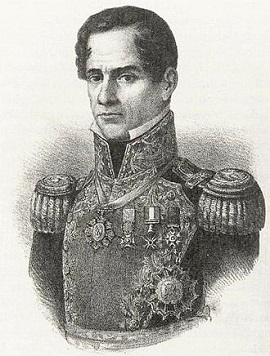
On this date in 1867, the Mexican general and onetime president Antonio Lopez de Santa Anna avoided execution at his court-martial.

Best recognized north of the Rio Grande for overrunning the Alamo, Santa Anna actually enjoyed an amazing career with a near half-century as Mexico’s definitive caudillo.

Antonio López de Santa Anna joined the military he would come to personify as a 16-year-old cadet in 1810 … except it was the Spanish colonial army, where he had hands-on training in the cold counterinsurgency tactics he would subsequently apply in his maturity.

Within barely a decade, the ambitious young officer was advanced to general — the last step by dint of his timely adherence to the incoming emperor of now-independent Mexico, Agustin de Iturbide.

Iturbide was destined for a firing squad, but Santa Anna had a better knack for tacking with his new country’s political gales — turning against his recent patron just in time to help depose the guy.

Santa Anna’s P.T. Barnum*-quality panache for shameless self-promotion — at one pont he repelled Spain’s last attempted reconquista and pronounced himself the “Napoleon of the West” — soon self-promoted himself right to the presidency. From 1833 to 1855, he held the office during 11 distinct stints.

His dictatorial exercise of power and abundant graft aroused resistance from more than just Texan Anglos, so he was often engaged in suppressing internal rebellions, and occasionally in being chased by them into exile. His last turn at president was aborted in 1855 by liberal reformers. Santa Anna fled to Cuba.

Considering the mad twists of fortune in his long career, it’s a miracle that none of his enemies ever actually executed Santa Anna. He was: both adoit and lucky to avoid purging during the tumultuous 1820s; captured by rebelling Texans, who preferred to avenge Alamo by forcing him to treaty terms; handed over to the U.S. government, which eventually sent him back to Mexico; captured again by rebelling Indians in Veracruz who sold him to the Mexican government which sent him to exile; and, tried by the liberals who finally toppled him, but in absentia since he had escaped once more. He had more lives than a cat; small wonder that here in his sixties and seventies he still wasn’t done plotting.

A full decade out of power, Santa Anna spent 1866-1867 in Staten Island, New York,** until the fall of Mexico’s French-backed Emperor Maximilian induced him once more — at the age of 73 — to sail for home with one last summons to his banner. Instead he was captured in a position that must have looked like curtains for sure.

The New York Times actually reported on July 5, 1867 that Santa Anna had been summarily executed; in fact, the restored liberal government of Benito Juarez clapped the nettlesome general in prison and subjected him to a court martial that ran Oct. 7-10. Juarez allegedly expected the old snake to be convicted of treason and finally executed, but like the Times, Juarez too was frustrated: the commission sentenced Santa Anna to exile and he was carried away to Havana once again.

It proved to be a waking death: cheated of the glory of a firing squad, the old general was pitiably forgotten.

“His schemes” — for still he schemed — “became increasingly the ravings of an old, deluded, sick man,” writes Robert Scheina in Santa Anna: A Curse Upon Mexico.

Permitted with Juarez’s death in 1874 to return to Mexico, Santa Anna now fought only for a pension. (He lost that fight.) So long his country’s first man, he “became increasingly depressed which was only relieved by his increasing senility. Santa Anna was suffering the worst possible punishment — obscurity and irrelevancy.” He died penniless of diarrhea in 1876.

* Santa Anna eventually came to hobble about on a cork leg, courtesy of a war wound. The leg was captured during the Mexican-American War, and Barnum put the artificial limb on exhibit.

That limb has never been returned to its native soil: Santa Anna’s prosthesis remains available to the Yankee gawker at the Illinois State Military Museum in Springfield.

** Santa Anna’s legacy in the United States (apart from that Alamo unpleasantness) was the importation of chicle, which the general liked to chew. Santa Anna’s American secretary, Thomas Adams, used it to create the chewing gum marketed as chiclets.

On this day..

1864: William Howe, deserter

From the Philadelphia Daily Age, Aug. 30, 1864.


In view of the coming draft the Government has found it necessary to hang a man.

The victim selected was a poor man, with a wife and children living in Perkiomen township, Montgomery county. He was a small farmer, with six acres, and engaged occasionally in the manufacture of tobacco and cigars. He lived in a Democratic county and township, where trouble was possible as to the draft, and certain at the election.

He was a man of good character, and ordinarily of gentle disposition. His dying words were: “I commend my wife and little ones to the charity of the world, and I ask pardon of those I may have injured and hope they will forgive me and pray for my soul.”

He was a brave man, had proved it on the battle-field, and as the press report says he told his counsel, “he faced the last music like a soldier.”

Such, in brief, was William H. Howe, of Montgomery county, who, on Friday last, was hanged at Fort Mifflin, where, one of the “loyal” newspapers of this city remarks, “the proceedings were conducted most harmoniously.”


Fort Mifflin as it appeared in 1870. William Howe was the only prisoner ever known to have been executed there.

But this is not all: the Government, in selecting this victim and making this example, was determined to show the Democrats of Montgomery county, that no antecedent merits or services could soften its heart or mitigate its doom of vengeance.

Howe was one of those unfortunate men who, excited by prevalent enthusiasm, and imagining that the authorities would protect their soldiers, enlisted two years ago in a Pennsylvania volunteer regiment. He entered the service in August, 1862, just before Antietam — when Pope‘s army was defeated, and Washington was threatened, and Mr. Lincoln frightened out of his wits.

Howe was one of those of whom Mr. Seward wrote to Mr. Dayton: “Our new levies are coming in in great numbers and in high spirits.” He went through the whole campaign at Fredericksburg, being

one of the five men who came off the field with the colors of his regiment! He exchanged his musket for an Enfield rifle, and again went upon the field with our skirmishers, and remained there all night till next day. He escaped by swimming the Rappahannock river.

Such were his merits, who was ignominiously hanged last Friday.

Now, a word as to his delinquencies. We again quote the loyal reports:

At the time he left the regiment he was suffering from inflammation of the bowels, and the regimental hospital being burned down, and having neither surgeons nor medicines, he, with some twenty others, determined to look out for themselves for treatment and reported themselves to the hospitals at Washington. Afterwards he and Augustus Beiting, a member of his company, returned to their homes.

For some two months afterwards Howe was confined to his bed.

This, we presume, was called “desertion.”

Two poor fellows, wasted by the most agonizing of diseases, with no hospital roof to cover them, and, mark this! gentle reader, who hear of champagne dinners and tableaux in our suburban hospitals, “having neither surgeons nor medicines,” wander back to their homes, and lay their wearied limbs and throbbing temples on the humble bed in Perkiomen. This was the initiate crime, though not the one for which he died. Let us see what that was, for we have no wish to do injustice to the executioners. We do not at all agree with the Press, which says “that having once given the facts, a further statement is superfluous.”

The scene of the crime was his home in Montgomery county.

That county has a Perkiomen township, and a Chiltern township, not many miles apart. Little over a year ago, in the latter township, a poor but most respectable white man, Mrs. Butler’s gardener, walking quietly on a public road, was shot down like a dog by a negro soldier, and died in agony.

For this dark deed of blood, the penalty was a mild conviction for manslaughter, — which it as much resembled as it did arson or burglary, — a sentence for a few years, and, if we mistake not, a pardon.

The negro ruffian, unlike poor Howe, had never done a deed of valor, or probably fired a musket till he pulled the trigger at the wayfarer on the Chiltern lanes. He was one of the League pets — a Chestnut street darling, and had a claim on the sympathy and mercy of those who judge always gently a negro’s fault.

Not so William H. Howe, the white Perkiomen soldier.

His deed of wrong was this: About midnight of the 21st June, 1863, he was awakened from a deep sleep — till then the sleep of innocence — by an alarm supposed to be given by the companion who had accompanied him home, that the Provost Marshal was coming to arrest him.

The first impulse was incredulity. The next, to try to escape. The last, resistance.

The words Provost Marshal, associated in a soldier’s mind with thoughts of severity, and cruelty, and sternness, have an awful sound by day or night. Those who think all Provost Marshals resemble the effeminate fribbles who superintend the draft in our streets, can form no idea of the real spectre.

Howe seized his musket, probably the one he brought in triumph from the bloody field of Fredericksburg, and fired it in the darkness, killing the enrolling officer.

The negro’s deliberate homicide is manslaughter. The white man’s rash or passionate misadventure is capital murder.

“I never,” said Howe on the scaffold, “sought the life of the man I killed. I never wished it, and I feel God will pardon me for taking it as I did.”

This, then, is the deed for which this poor fellow was condemned and died — and for which, in view of the draft, no mercy was found in the hearts of Joseph Holt and Abraham Lincoln.

Of the trial by some unknown, irresponsible military court, of which the prisoner’s prosecutor was the President, we do not care to speak. We think of it as history does of the judges who, a hundred years ago, sent to his bloody grave, according to the forms of martial law, a gallant English sailor, whom the hard-hearted monarch of that day refused to pardon, but executed “to encourage the others.” It is a sad record altogether.

And then the feeble attempt at a habeas corpus in the Federal Court, and the citation of Wolfe Tone‘s case, with its suggestive hint at suicide! The whole thing seems like a hideous mockery.

The Judge’s idea that Howe, like Tone, had waived the writ by appearing before the court martial, seems a little odd, but we do not presume to criticise judicial action, and we are very sure the Judge must have been reluctant to deny relief to a Montgomery county man, one of his former constituents. The writ, however, was refused, and last Friday, the white man was hanged, and the enrolling officer was avenged.

Howe died like a brave man. He parted with his wife and three little children with deep emotion, and then his work was done.

He was taken in an ambulance by a back way from the Penitentiary, now, it seems, used as a military prison, to the river and thence in a boat to Fort Mifflin.

“Neither guard nor prisoner,” says the North American, “uttered one word during the run down to the Fort.” There was quite a crowd to welcome him.

“The steamer Don Juan,” says the Press, “was chartered for the purpose and took down the members of the Press club.”

“The gallows,” kindly loaned by the Inspectors of the County Prison, says the same paper, “was the one on which the Scupinskis, Arthur Spring and Maddocks were hanged.” In other words, the brave Fredericksburg soldier — the Perkiomen volunteer — was ostentatiously disgraced by being put on a level in this respect with mean, mercenary murderers — and Howe died without a murmur or complaint, keeping his word that “he would face the music like a soldier.” And thus the hideous narrative concludes: “The body was taken down and placed in charge of Mr. Black, the Government undertaker, who had it embalmed yesterday afternoon and sent to Howe’s widow.”

And it will be carried to his home — and the embalmer, proud of his skill, will take off the coffin lid, and the widow and the three little children will look at the swollen and blackened features of him they loved so well, and they will think of the pride with which he used to tell, and the interest with which they used to listen to the tale of his rescuing the regimental flag at Fredericksburg — and the neighbors will come and look, and in many a lacerated and agonized heart the question will be asked, “why was there no mercy for him?”

The Fishing Creek Confederacy details Civil War draft resistance in a different Democratic region of Pennsylvania.

To us the whole thing seems simply horrible; and badly as we think of it, doubly atrocious will have been the deed, if the reason given for this execution be the true one. The Press, which may certainly be considered the organ of the Administration here, thus accounts for the severity in this case:

The deceased exhibited great bravery at the first battle of Fredericksburg, and after several color bearers had been shot down, he seized the standard and bore it through the heat of the contest. These were noble traits, which he is yet entitled to. It is very evident that he did not intend to kill Mr. Bartlett, but society at that time, in that part of Pennsylvania, was tainted with Copperheadism, and it may be well supposed that the draft resisting, dark lantern conspirators had the effect to instil in the mind of Howe some of the poison for which their victim was hung instead of themselves.

According to this, this brave soldier was hanged because he lived in a Democratic region. The negro of the Chiltern Hills was spared because Government bankers, and Abolition lecturers and shoddy contractors there do congregate, and the township gives a Republican majority.

The patience of the people of Pennsylvania really seems inexhaustible; and all we can hope to do is to help to make up the awful record of atrocity for the long deferred, but inevitable day of retribution.

On this day..

1861: Robert Thomas Palin, under Ordinance 17 Victoria Number 7

On this date in 1861,* Western Australia’s Ordinance 17 Victoria Number 7 claimed its one and only victim.

Implemented early in Western Australia’s convict era as the influx of criminals made existing settlers jumpy, this law made a wide variety of violent but non-fatal crimes potentially subject to the death penalty when committed by an escaped fugitive.

Robert Thomas Palin was a newcomer to Australia, having debarked from a convict ship only in January 1860. Despite his burglary conviction back in the mother country, he was an exemplary prisoner and earned his ticket of leave (a sort of limited furlough). He even kept a house in Fremantle and took lodgers.

In May 1861, he threw every away every bit of good will and more by burgling another Fremantle home. A Mrs. Susan Harding awoke in the moonlight to find this invader looming over her bed — and he greeted her in that classic of convict argot, “Your money or your life.”

Mrs. Harding didn’t have any — in the words of her testimony on July 3:**

He repeatedly told me to “hush.” He took hold of me by the arm and pulled my hair about, and then pulled the bed clothes down, and felt about the bed. I was afraid he was about to commit some assault — he touched my night dress, not to move it, and then I got so dreadfully alarmed, that I jumped out of bed on the opposite side of the bed. I went to my looking-glass drawer, and took out a watch and chain, which I handed him, and prayed him to leave me.

Palin did so.

Although terrifying for Susan Harding, the encounter did not result in any injury; as Palin’s boot-prints were easily followed back to his own house, even her watch and chain were recovered. To send this offender to the gallows seemed like a punishment out of the wrong century, as Perth’s Inquirer and Commercial News editorialized (June 10):

Burglary attended with violence, however brutal that violence might be, so long as it did not result fatally, is not punished with death in the United Kingdom.

… What was the violence on this occasion? Catching hold of the arm of the principal witness; and it does not appear from the evidence that even the grasp was violent, nor was it necessary to be so according to the acceptation of the meaning of the word laid down for us. It was propounded by the Chief Justice that, strictly speaking, merely laying a hand upon a person, under such circumstances, constituted violence. Is this truly the spirit of the law? …

Palin might have taken everything in that house, yet he would not have been hung. He might have threatened with the presumed pistol, have gesticulated, have stormed and terrified the occupant of the chamber almost to the verge of insanity, and yet he would not have been hung, but he touched her arm, and death is the penalty. There is something horrible in this. But there is something more fearful still when we further look into the matter and find that had he committed any enormity, even to the shedding of blood, he could not have had awarded to him a more extreme measure of punishment. …

[It is our] fervent hope that never again may the pages of our Colonial History be inscribed with so terrible a record; that never again will it be our province to allude to an event of so dreadful a character as that which has lately passed away.

The fervent hope was realized. In the only other case where Ordinance 17 Victoria Number 7 was used to secure a death penalty for an ordinarily non-capital crime, the sentence was commuted.

* As of this writing, Wikipedia avers July 6. References from 1861 newspapers make it clear that this is erroneous. (example, another).

** Yes, that’s six days before the execution occurred.

On this day..

1865: Okada Izo, barbarian-expeller

On this date in 1865, the Japanese samurai Okada Izo was dispatched by crucifixion.

He was one of* the “Four Hitokirimanslayers — whose legendary blades coruscated in the Bakumatsu era that marked Japan’s pivot from an isolationist feudal state, one where samurai were big men on prefectures, to a burgeoning modern power ruled by industry and mass conscription.

The irony was that dinosaurs like the Hitokiri helped bring the asteroid down on their own heads.

During the chaotic Bakumatsu period, triggered by Japan’s becoming involuntarily opened to the outside world, the emperor — long a figurehead marginalized by the shogun — entered the political fray under the xenophobic banner “revere the emperor, expel the barbarians.”

Warriors/assassins like the Hitokiri were wooed by the imperial camp and the promise of a policy that would maintain the purpose and privilege of elite swordsmen. But once power was conquered, the Meiji emperor repaid those knights’ exertions by doing the modernization thing that Hitokiri types had hoped to avoid.

Okada Izo was among the first barbarian-expellers to be caught up by the policy swing. After a couple of years running amok in Kyoto, the anti-foreigner movement was suppressed and its leader forced to commit seppuku, which was still more deference than Izo received.

The execution, usually conceived as the end, is the jumping-off point for the surreal time-and-space-hopping 2004 Takasha Miike bloodbath Izo, “one of the most difficult works of art to be made in recent times.”

* Along with fellow-execution victim Kawakami Gensai, and two other guys who met violent deaths that were not (more’s the pity for this site) executions.

On this day..

1862: James Andrews’s raiders, for the Great Locomotive Chase

On this date in 1862, seven federal raiders were hanged in Atlanta for the daring heist of a Confederate train two months prior. Among them were some of the very first Congressional Medal of Honor awardees.

In terms of its impact on the Civil War, the “Great Locomotive Chase” was a bust. But as pure Americana, you’ll have a hard job to top this caper.

The chase began a year to the day after the first shots had been fired between North and South. Despite the anniversary, the occasion promised nothing but the routine northbound passenger run for the locomotive General from Atlanta to Chattanooga, Tenn.

This line was a spur of the Confederate rail network, and we have already noted in these pages the interest that network held for pro-Union saboteurs. Chattanooga was its great hub: telegraph and rail lines from every quarter of the Confederacy converged there like the center of a spiderweb.

For this reason, Union Gen. Ormsby Mitchel, who had just occupied Huntsville, Ala., aspired to swing his army north to strike this vital city. His bold commandos nonchalantly boarding the northbound train this day were part of Mitchel’s larger operation: cut the rail line from Atlanta to prevent timely reinforcement of Chattanooga, then quickly conquer the strategic city.* Gen. Mitchel was 28 miles from Chattanooga on April 12, 1862, and if his special agents could turn their trick then the whole course of the war might change.

Not long after 5 a.m. on that April 12, the General pulled into a depot at Big Shanty (today, Kennesaw, Ga.). It had a short layover there for breakfast at the adacent Lacey Hotel.

But more important to the raiders’ leader James J. Andrews was what Big Shanty did not have: a telegraph.

While the train’s passengers and crew were settling in for the most important meal of the day, Andrews’s raiders efficiently decoupled the locomotive, its coal tender, and three box cars from the passenger cars. Most of the raiders loaded into the boxcars to be ready as muscle for the crazy flight ahead. But the day was to be a match of speed and ingenuity between the Union daredevil Andrews, and the Confederate train conductor William Fuller — who for the start could only watch in astonishment over his coffee as his General unexpectedly pulled away.

With no telegraph in the vicinity, Fuller had no way to send word up the line to stop the General. But umbrage either patriotic or professional carried him from that first moment in a Javert-like pursuit of his commandeered locomotive.

Fuller dashed out of Big Shanty and up the train tracks on foot with his team. It’s not as crazy as it sounds: negotiating hilly terrain, the General would be making only 15 or 20 miles per hour at speed — and she stopped regularly, to foul the rails behind her, and to cut the telegraph wire. Throughout the chase, or at least until its very last stretch, the Union men managed to keep the next station ahead ignorant of the General‘s treasonable mission by snipping telegraph wire, so on the occasions when they had to stop and answer to a Western & Atlantic Railroad official they were able to bluff their way onward with a story about driving a “powder train” requisitioned by General Beauregard himself.

But those stops took time, and Fuller’s dogged pursuit did not leave Andrews’s raiders much of that to spare.

A couple of miles up the line, Fuller et al found an old handcar, and were able to take to the rails themselves. Near 20 miles into the chase, they were able to commandeer a short-line locomotive, which took them to Kingston where they switched to a mail train. Neither of these vehicles could match the General‘s horsepower; however, Andrews had to keep stopping to cut more telegraph wires or to pry up a rail, and he really got pegged back when the General had to defer to other rail traffic on the single-line route. For instance, the Union commandos spent a frustrating hour on the siding at Kingston waiting out southbound trains.

Andrews’s party did not know for sure at this point that there was a pursuer making good use of this hour. But even so, they had a challenge to spend the scarce resource of time with their hijacked locomotive to best effect.

The objective of the raid was to wreck the Atlanta-Chattanooga rail line, in a way that would put it out of commission for many days and give Gen. Mitchel leave to overwhelm Chattanooga — something like firing a bridge or collapsing a tunnel. The stops they made as they passed various stations to cut the telegraphs or laboriously crowbar up a bit of the rail were essential to give them the ability to cover the next few miles, and bluff past the next station. But thanks to Fuller’s pursuit, there was not after these time-consuming little acts of sabotage a sufficient opportunity to accomplish the tactical purpose of the hijacking.


An extensive collection of links and images relating to the entire route of the chase is here.

In the coolest final stage, the segment most properly called the “Great Locomotive Chase”, Fuller’s gang grabbed a southbound locomotive, the Texas, and without bothering to turn it around they slammed it into reverse in hot pursuit of the northbound General.

The federals in the General tried dropping timbers, and even cutting loose boxcars behind them as railbound battering rams aimed at their inexorable hunter. The Texas kept coming.

By the time the Union boys reached a wooden covered bridge over the Oostanaula, it was apparent that the locomotive would soon exhaust her fuel. Still, the churning plumes of the backward Texas loomed just a few minutes behind. In his last chance to do what he had set out for, Andrews torched his final remaining box car and released it into the wooden bridge, hoping to set the entire structure ablaze and collapse it into the river. Unhappily for the General‘s illicit crew, looking backwards with desperate hope as their ride chugged off, boards sodden by a week’s worth of springtime rain showers stubbornly refused to kindle … and then the Texas arrived to clear away the incendiary.

As its fuel dwindled and its adversary closed, the General came to the end of her legendary run about 18 miles from Chattanooga. Andrews and party abandoned their engine to history and scattered into the woods — but none escaped the immediate Confederate manhunt.


The twenty raiders, plus two others who were supposed to be part of the operation but missed their rendezvous, were all court-martialed as spies: “lurking in and around Confederate camps as spies, for the purpose of obtaining information,” a description bearing very scant resemblance to their actual activities. Eight would hang on this basis.

The intrepid ringleader James Andrews, who was a civilian, was executed in Atlanta on June 7, all alone. His mates only learned of his fate while sitting at their trial in Chattanooga — an experience described in a memoir by one of their number, William Pittenger.

As the trial of different ones proceeded, we had still greater encouragement from the court itself. Members called on us, and told us to keep in good heart, as there was no evidence before them to convict any one. This cheered us somewhat, but there was still one thing which I did not like, and which looked as if something was wrong. The court would not let our boys be present to hear the pleading of counsel on either side, though they urgently requested it. They could neither hear what our lawyers had to say for them, nor what the Judge Advocate urged against them.

The trials proceeded rapidly. One man was taken out each day, and in about an hour returned. The table in the court room was covered with bottles, newspapers, and novels, and the court passed its time during trial in discussing these. This was very well if the trial was, as they said, a mere matter of formality; but if it was a trial in earnest, on which depended issues of life or death, it was most heartless conduct.

At last the number of seven was reached, and they would probably have proceeded in trying others, had not General Mitchel, who was continually troubling them, now advanced, and shelled Chattanooga from the opposite side of the Tennessee river. This at once broke up the court-martial, and sent the officers in hot haste to their regiments to resist his progress. Soon after, General Morgan advanced through Cumberland Gap, and threatened Knoxville, which also rendered it necessary to remove us.

Evacuated to Atlanta, they there “remained for a week in quietness and hope, thinking the worst of our trials were past,” Pettinger wrote. “Little did we foresee how fearful a storm was soon to burst over us.”

For its topicality to our site, we here excerpt Pettinger’s chapter 11 at some length:

One day while we were very merry, amusing ourselves with games and stories, we saw a squadron of cavalry approaching. This did not at first excite any attention, for it was a common thing to see bodies of horsemen in the streets; but soon we observed them halt at our gate, and surround the prison. What could this mean?

A moment after, the clink of the officers’ swords was heard as they ascended the stairway, and we knew that something unusual was about to take place. They paused at our door, threw it open, called the names of our seven companions, and took them out to the room opposite, putting the Tennesseeans in with us. One of our boys, named Robinson, was sick of a fever, and had to be raised to his feet, and supported out of the room.

With throbbing hearts we asked one another the meaning of these strange proceedings. Some supposed they were to receive their acquittal; others, still more sanguine, believed they were taken out of the room to be paroled, preparatory to an exchange.

I was sick, too, but rose to my feet, oppressed with a nameless fear. A half crazy Kentuckian, who was with the Tennesseeans, came to me and wanted to play a game of cards. I struck the greasy pack out of his hands, and bade him leave me.

A moment after, the door opened, and George D. Wilson entered, his step firm and his form erect, but his countenance pale as death. Some one asked a solution of the dreadful mystery, in a whisper, for his face silenced every one.

The raiders hanged June 18, 1862

  • William Hunter Campbell, a civilian
  • Pvt. Samuel Robertson
  • Sgt. Major Marion Ross
  • Sgt. John Scott
  • Pvt. Charles Shadrack
  • Pvt. Samuel Slavens
  • Pvt. George Davenport Wilson

“We are to be executed immediately,” was the awful reply, whispered with thrilling distinctness. The others came in all tied, ready for the scaffold. Then came the farewells — farewells with no hope of meeting again in this world! It was a moment that seemed an age of measureless sorrow.

Our comrades were brave; they were soldiers, and had often looked death in the face on the battle-field. They were ready, if need be, to die for their country; but to die on the scaffold — to die as murderers die — seemed almost too hard for human nature to bear.

Then, too, the prospect of a future world, into which they were thus to be hurled without a moment’s preparation, was black and appalling. Most of them had been careless, and had no hope beyond the grave. Wilson was a professed infidel, and many a time had argued the truth of the Christian religion with me for a half day at a time; but in this awful hour he said to me:

“Pittenger, I believe you are right, now! Oh! try to be better prepared when you come to die than I am.” Then, laying his hand on my head with a muttered “God bless you,” we parted.

Shadrack was profane and reckless, but good-hearted and merry. Now, turning to us with a voice, the forced calmness of which was more affecting than a wail of agony, he said:

“Boys, I am not prepared to meet Jesus.”

When asked by some of us in tears to think of heaven, he answered, still in tones of thrilling calmness, “I’ll try! I’ll try! But I know I am not prepared.”

Slavens, who was a man of immense strength and iron resolution, turned to his friend Buffum, and could only articulate, “Wife — children — tell” — when utterance failed.

Scott was married only three days before he came to the army, and the thought of his young and sorrowing wife nearly drove him to despair. He could only clasp his hands in silent agony.

Ross was the firmest of all. His eyes beamed with unnatural light, and there was not a tremor in his voice as he said, “Tell them at home, if any of you escape, that I died for my country, and did not regret it.”

All this transpired in a moment, and even then the Marshal and other officers standing by him in the door, exclaimed:

“Hurry up there! come on! we can’t wait!”

In this manner my poor comrades were hurried off. Robinson, who was too sick to walk, was dragged away with them. They asked leave to bid farewell to our other boys, who were confined in the adjoining room, but it was sternly refused!

Thus we parted. We saw the death cart containing our comrades drive off, surrounded by cavalry. In about an hour it came back empty. The tragedy was complete!

Later in the evening, the Provost-Marshal came to the prison, and, in reply to our questions, informed us that our friends “Had met their fate as brave men should die everywhere.”


((cc) image from Jason Riedy).

The next day we obtained from the guards, who were always willing to talk with us in the absence of the officers, full particulars of the seven-fold murder.

When our companions were mounted on the scaffold, Wilson asked permission to say a few words, which was granted — probably in the hope of hearing some confession which would justify them in the murder they were about to commit. But this was not his intention. It was a strange stand — a dying speech to a desperate audience, and under the most terrible circumstances.

But he was equal to the occasion. Unterrified by the near approach of death, he spoke his mind freely. He told them that “they were all in the wrong; that he had no hard feelings toward the Southern people for what they were about to do, because they had been duped by their leaders, and induced by them to engage in the work of rebellion. He also said, that though he was condemned as a spy, yet he was none, and they well knew it. He was only a soldier in the performance of the duty he had been detailed to do; that he did not regret to die for his country, but only regretted the manner of his death. He concluded by saying that they would yet live to regret the part they had taken in this rebellion, and would see the time when the old Union would be restored, and the flag of our country wave over the very ground occupied by his scaffold.”

This made a deep impression on the minds of those who listened, and I often afterward heard it spoken of in terms of the highest admiration. When he ceased, the signal was given, and the traps fell!

Five only remained dangling in the air; for two of the seven, Campbell and Slavens, being very heavy men, broke the ropes, and fell to the ground insensible. In a short time they recovered, and asked for a drink of water, which was given them. Then they requested an hour to pray before entering the future world which lay so near and dark before them. This last petition was indignantly refused, and as soon as the ropes could be adjusted, they were compelled to re-ascend the scaffold, and were again turned off!

The whole proceeding, from beginning to end, was marked by the most revolting haste. They seemed to wish, by thus affording no time to prepare for death, to murder soul and body both. Even the worst criminals in our country are allowed some weeks to ask for God’s mercy, before they are thrust into his presence; but our poor boys, whose only crime was loving and trying to serve their country, were not allowed one moment! Could the barbarity of fiends go further?

That afternoon was one of deepest gloom for those who remained. We knew not how soon we might be compelled to follow in the same path, and drink the same bitter cup our comrades drank. Once during the trial we had offered to accept the award of the court in one of the cases as the sentence of all, since we could not see the slightest reason for leaving some and taking others. At that time, however, we believed that all would be acquitted. Now every hope had vanished.

But even without the addition of fear for ourselves, the parting from our loved friends, whose voices were still ringing in our ears, while they themselves had passed beyond the gates of death into the unknown land of shadows, was enough to rend the stoutest heart. There were tears then from eyes that shrank before no danger.

But I could not shed a tear. A cloud of burning heat rushed to my head that seemed to scorch through every vein. For hours I scarcely knew where I was, or the loss I had sustained. Every glance around the room, which revealed the vacant places of our friends, would bring our sorrow freshly on us again. Thus the afternoon passed away in grief too deep for words. Slowly and silently the moments wore on, and no one ventured to whisper of hope.

Fearing they could suffer snap execution at any moment, the remaining raiders made their own hope.

Weeks later, a jail breakout freed eight; all eight covered the hundreds of miles to Union lines safely.

The last six, Pettinger included, were captured in the attempt and remained as war prisoners until the following March, when they were swapped back to the Union in a prisoner exchange.

Strange to say, the United States at the outset of the Civil War did not have a standing military decoration. One of the fruits of this fratricidal conflict was the creation of the Congressional Medal of Honor, which remains to this day the highest honor bestowed within the U.S. armed forces. Abraham Lincoln signed the enabling legislation in July of 1862; they were minted beginning at the end of that year and formally became available as decorations on March 3, 1864.

Our last six survivors — the six exchanged for Confederate POWs — presented themselves to Secretary of War Edwin Stanton on March 25, 1863. In the course of the visit, Stanton presented them with the first six Medals of Honor ever awarded; ultimately, 19 of Andrews’s Raiders received the award — whether living or dead. (Andrews himself was not eligible for it, as a civilian.)


We have included here several clips of the 1956 Disney film The Great Locomotive Chase. This escapade was also the subject of a 1926 Buster Keaton silent comedy, The General, which can be enjoyed in full online:

For a look at the real General in action in 1962 for the Great Chase’s centennial, take a gander at this video. The Texas is on public display at Atlanta’s Southern Museum‘s exhibit on the Great Locomotive Chase.

* In the event Union forces would probe Chattanooga in 1862, but that city was only besieged in earnest and captured at the end of 1863: it was from Chattanooga that Gen. William T. Sherman launched his famous march to the sea.

On this day..

1868: Michael Barrett, the last public hanging in England

England held its last-ever public execution on this date in 1868, and made it big game indeed: Fenian Michael Barrett, whose Clerkenwell Prison bombing long remained one of the most infamous atrocities of the Irish nationalist cause.

The bill certifying the end of that distinctive institution, the public hanging, would be finalized three days hence, so the occasion’s milestone was anticipated in advance. Elites increasingly disdained the boorish carnivals that unfolded under the gallows, like Dickens who complained that “no sorrow, no salutary terror, no abhorrence, no seriousness; nothing but ribaldry, debauchery, levity, drunkenness, and flaunting vice in fifty other shapes” redeemed the 1840 hanging of Courvoisier.


“The Great Moral Lesson at Horsemonger Lane Gaol”, Punch magazine’s view of the notoriously rowdy mob at Frederick and Marie Manning execution.

“The crowd was most unusually orderly,” ran the Times‘ report of Barrett’s death — a sort of dual eulogy — “but it was not a crowd in which one would like to trust.”

It is said that one sees on the road to the Derby such animals as are never seen elsewhere; so on an execution morning one see faces that are never seen save round the gallows or near a great fire. Some laughed, some fought, some preached, some gave tracts, and some sang hymns; but what may be called the general good-humoured disorder of the crowd remained the same, and there was laughter at the preacher or silence when an open robbery was going on. None could look on the scene, with all its exceptional quietness, without a thankful feeling that this was to be the last public execution in England. Towards 7 o’clock the mass of people was immense. A very wide open space was kept round the gallows by the police, but beyond this the concourse was dense, stretching up beyond St. Sepulchre’s Church, and far back almost, into Smithfield — a great surging mass of people which, in spite of the barriers, kept swaying to and from like waving corn. Now and then there was a great laughter as a girl fainted, and was passed out hand over hand above the heads of the mob, and then there came a scuffle and a fight, and then a hymn, and then a sermon, and then a comic song, and so on from hour to hour, the crowd thickening as the day brightened, and the sun shone out with such a glare as to extinguish the very feeble light which showed itself faintly through the glass roof above where the culprit lay. It was a wild, rough crowd, not so numerous nor nearly so violent as that which thronged to see Muller or the pirates die. In one way they showed their feeling by loudly hooting a magnificently-attired woman, who, accompanied by two gentlemen, swept down the avenue kept open by the police, and occupied a window afterwards right in front of the gallows. This temporary exhibition of feeling was, however, soon allayed by coppers being thrown from the window for the roughs to scramble for. It is not right, perhaps, that a murderer’s death should be surrounded by all the pious and tender accessories which accompany the departure of a good man to a better world, but most assuredly the sight of public executions to those who have to witness them is as disgusting as it must be demoralizing even to all the hordes of thieves and prostitutes it draws together. Yesterday the assembly was of its kind an orderly one, yet it was such as we feel grateful to think will under the new law never be drawn together again in England.

Michael Barrett’s ticket to this last assembly was punched by a different execution six months previous — the hanging of the Manchester Martyrs. This trio of Irish patriots were part of a mob who liberated some comrades from a police van, shooting a policeman in the process — though it was far from certain that any of these three actually fired shots.

Of importance for our purposes today was the crackdown on other Fenians occasioned by the Manchester affair. In November of 1867, a Fenian agent named Richard O’Sullivan Burke was arrested with his companion Joseph Casey in London purchasing weapons for the movement. They were clapped in Clerkenwell Prison pending trial.

The bombing that brought Michael Barrett to the gallows was a bid to liberate these men … and it did not pause for subtlety. The conspirators simply wheeled a barrel of gunpowder up to the wall of the facility when they expected the inmates to be at exercise in the adjacent yard. The explosion blasted a 60-foot gap in the wall; the inward-collapsing rubble might easily have been the death rather than the salvation of the prospective beneficiaries, except that they weren’t actually in the yard at all — nobody was there, and nobody escaped Clerkenwell.

But numerous working-class families lived in little tenements opposite the prison and were there, and in fact Clerkenwell had a reputation for political radicalism and Fenian sympathy. This monstrous new “infernal machine” tore through Clerkenwell homes, leaving 12 people dead and numerous buildings near to collapse, while windows and chimneys shivered to pieces all up and down the block.


Improvised struts shore up damaged buildings opposite the wall of Clerkenwell Prison reduced to rubble by the December 13, 1867 Fenian bombing.

Karl Marx, a strong supporter of the Irish cause, despaired this counterproductive turn towards terrorism: “The London masses, who have shown great sympathy towards Ireland, will be made wild and driven into the arms of a reactionary government. One cannot expect the London proletarians to allow themselves to be blown up in honour of Fenian emissaries.”

English reformer Charles Bradlaugh agreed. “The worst enemy of the Irish people could not have devised a scheme better calculated to destroy all sympathy,” he wrote.


Punch magazine depicts the Clerkenwell bomber(s) as the “Fenian Guy Fawkes“.

Considering the magnitude of the crime, someone would have to pay for it. That Barrett was that someone did not sit well for many.

Five men and a woman stood trial at the Old Bailey in April for the Clerkenwell outrage, but Barrett was the only one of them convicted, a terribly inadequate investigation/prosecution outcome given the infamy of the crime.

That conviction stood on the basis of disputed eyewitness identifications: Barrett produced witnesses who said he was in Glasgow when the bomb went off, while the crown found others who would swear he was actually in London. (The length of Barrett’s whiskers on specific dates in late November and early December forms a running subplot of the dueling testimonies.)

The reliability and even the good faith of all such winesses might well be impugned. A highly questionable stool pigeon named Patrick Mullany who ducked prosecution by turning crown’s evidence, charged that Barrett personally set off the ordnance.

Despite his certain doom, Barrett eloquently vindicated himself at his sentencing

To give me credit for such an undertaking is utterly absurd; being, as I am, a total stranger to acts of daring, and without any experience which would in any way fit me for engaging in such an enterprise. Is it not ridiculous to suppose that in the City of London, where … there are ten thousand armed Fenians, they would have sent to Glasgow for a party to do this work, and then select a person of no higher standing and no greater abilities than the humble individual who now stands convicted before you? To suppose such a thing is a stretch of imagination that the disordered minds of the frightened officials of this country could alone be capable of entertaining.

If it is murder to love Ireland more dearly than life, then indeed I am a murderer. If I could in any way remove the miseries or redress the grievances of that land by the sacrifice of my own life I would willingly, nay, gladly, do so. if it should please the God of Justice to turn to some account, for the benefit of my suffering country, the sacrifice of my poor, worthless life, I could, by the grace of God, ascend the scaffold with firmness, strengthened by the consoling reflection that the stain of murder did not rest upon me, and mingling my prayers for the salvation of my immortal soul with those for the regeneration of my native land.

Benjamin Disraeli’s government could not in the end realistically entertain the agitation from liberal and radical circles for sparing Barrett, because that would mean that nobody would hang for Clerkenwell. But as the next day’s edition of Reynold’s News noted, “Millions will continue to doubt that a guilty man has been hanged at all; and the future historian of the Fenian panic may declare that Michael Barrett was sacrificed to the exigencies of the police, and the vindication of the good Tory principle, that there is nothing like blood.”

Three months after Barrett made that expiation, England officially began its era of fully private hangings behind prison walls.

* James Joyce hung out with a (much-older) Joseph Casey in Paris in the early 20th century. Yes, that’s in Ulysses too: “He prowled with Colonel Richard Burk, tanist of his sept, under the walls of Clerkenwell and crouching saw a flame of vengeance hurl them upward in the fog. Shattered glass and toppling masonry. In gay Paree he hides, Egan of Paris, unsought by any save by me.”

Part of the Themed Set: Terrorism.

On this day..

1865: Not Lambdin P. Milligan, ex parte man

This date in 1865 was the originally scheduled hanging of Indiana pro-slavery gadfly Lambdin P. Milligan — a sentence respited two days prior by President Andrew Johnson, and then subsequently commuted, for which reason Milligan survived to attach his surname to a landmark Supreme Court decision the following year.

During the Civil War, the state of Kentucky was a borderlands claimed by, and viciously fought over, by both North and South. “I hope to have God on my side, but I must have Kentucky,” Abraham Lincoln wrote in 1861.

Kentucky’s northern neighbor, the Union breadbasket Indiana, had little fighting and no hint of Confederate power — but it was a hotbed of so-called “Copperheads”, northern Democrats who opposed Lincoln’s willingness to prosecute the civil war. So fraught was the Hoosier political situation that in 1862, Indiana’s Republican governor refused to call the Democrat-dominated legislature for fear that it might vote a secession bill or attempt to withdraw Indiana from the war.

The inevitable existence of northern domestic opposition to the war came joined at the hip to impossible statecraft conundrums. Just how much wartime dissent and/or resistance could be countenanced — as a legal matter, and a practical one? President Lincoln would not have received an A+ from the American Civil Liberties Union; he suspended the writ of habeas corpus in the Union and resorted to military tribunals and martial law in some places.

Our man Milligan was one of these Copperhead Indiana Democrats born to test Washington’s elasticity. He was an exponent of the Knights of the Golden Circle,* a pro-slavery secret society whose name denoted their aspiration to the antebellum filibusters‘ dream of a human-bondage empire to ring the Caribbean basin.

An attorney,** Milligan briefly became the toast of Democrats nationwide (whatever was left of the nation) for his robust defense of Clement Vallandigham when the former Congressman was prosecuted under the anti-Copperhead General Order 38.

At this point, Milligan was very well-known in what was then called the Northwest, and he was a major political player in Indiana — a pivotal state in the 1864 election.

But according to federal spies who tailed him in 1863-64, his interests in governance ran to more illicit grants of state power. Milligan was arrested in October 1864 as a principal in what was dubbed the “Northwestern Conspiracy”: a plot to mobilize the antiwar factions in that part of the country. This was no mere matter of pamphleteering; the “visionary and desperate” scheme aimed to prolong the hopes of the now-fading South by instigating an armed uprising in the Northwest that would relieve Union pressure on Dixie and perhaps turn the tide of the war.

Milligan was among several of the conspirators swept up in arrests in the following weeks, then tried by military tribunal for treason and sedition. It’s hard to argue that the plot was anything but.

But why a military court? This is the question in Milligan’s great legacy to posterity, the Supreme Court ruling Ex Parte Milligan.†

Milligan himself was not a soldier, and had not been in a war zone. He was a civilian, and Indiana’s regular civilian courts had never ceased to function. The question at stake in Milligan’s appeal to the Supreme Court was whether there was any legitimate recourse to a military tribunal under such conditions — well behind the lines, as it were.

On the morning of March 5, 1866, 34-year-old Republican U.S. Representative James Garfield — the future president whose assassin would command contentious caselaw all his own — strode into the U.S. Supreme Court to eloquently argue Milligan’s side.

“Such a doctrine,” Garfield intoned of the civilian courts’ being intentionally bypassed on national security grounds, “is too monstrous to be tolerated for a moment; and I trust and believe that … it will receive its just and final condemnation. Your decision will mark an era in American history. the just and final settlement of this great question will take a high place among the great achievements which have immortalized this decade. It will establish forever this truth, of inestimable value to us and to mankind, that a republic can wield the vast enginery of war without breaking down the safeguards of liberty; can suppress insurrection, and put down rebellion, however formidable, without destroying the bulwarks of law; can, by the might of its armed millions, preserve and defend both nationality and liberty … if the protection of the law shall, by your decision, be extended over every acre of our peaceful territory, you will have rendered the great decision of the century.

The high court found for Milligan unanimously, establishing as a constitutional bedrock Garfield’s proffered principle that civilian courts must try civilians wherever those courts are open, and ordered Milligan’s release. Although re-indicted by a civilian grand jury, Milligan was not re-prosecuted; he resumed his law practice and died near Fort Wayne, Indiana on December 21, 1899.

* Also known as the Sons of Liberty, a callback to revolutionary patriots.

** Milligan studied law in Ohio, his native soil; his class of nine also included Edwin M. Stanton — Lincoln’s War Secretary during the events of this post. Milligan himself reflected that “I should have probably been hung” but for his fortuitous ancient friendship with Stanton.

† Court precedents with names like Furman v. Georgia are most familiar to us, signifying two disputing parties; by contrast, the phrase ex parte (by/for the party) theoretically indicates a decision issued on behalf of the named party, without need of any opposing party’s intervention. (Ex parte Quirin is another notable death penalty case using this terminology.)

While the ex parte locution was once a common one for habeas corpus appeals, such cases were in practice almost invariably contested by some organ of the state — as Milligan’s was.

On this day..

1864: Thomas Dawson, manhood sealed

(Thanks to Robert Elder of Last Words of the Executed — the blog, and the book — for the guest post. This post originally appeared on the Last Words blog here. Fans of this here site are highly likely to enjoy following Elder’s own pithy, almanac-style collection of last words on the scaffold. -ed.)

“You may break my neck, but you won’t break the seal of manhood.”

-Thomas R. Dawson, convicted of desertion and rape, hanging, Virginia.
Executed April 25, 1864

An Englishman who had served in the Crimean War, Dawson was already the recipient of both the Victoria Cross and the Cross of Honor. [but see this post’s comments -ed.] He had been serving in Company H, Twentieth Massachusetts Infantry, when he was convicted. “He was an excellent soldier,” according to the infantry record, “intelligent and obedient.” On the gallows, a misjudgment of rope length caused Dawson to hit the ground standing when he fell through the trapdoor.

Panicking, the executioner grabbed the end of the rope “and jerked the prisoner upwards until death slowly came.”

On this day..