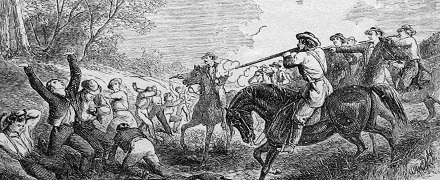
1868: Robert Smith, the last publicly hanged in Scotland

Robert Smith hanged in Dumfries on this date in 1868 — the last man publicly executed in Scotland* before the advent of private hangings later that same month of May.

Though inclement Scottish weather kept the crowds at bay on the occasion, Robert Smith was a notorious villain for his season in the public eye, as the ensuing newspaper reports will attest.

His death mask is still kept at the Dumfries Museum and Camera Obscura.

The Sheffield & Rotherham Independent, Feb. 8, 1868:

FRIGHTFUL CRIMES IN DUMFRIES-SHIRE

On Sunday, the Scotch police apprehended in Carlisle, Robert Smith, whitewasher, aged 20, for an awful crime. On Saturday evening, near Cummertrees, Dumfries-shire, he took a girl, aged 14, into a wood, where he robbed her of 7s. 6d., hung her to a tree, and when dead cut her body down. Afterwards he entered a cottage at Longford, and stabbed a woman named Jane Paterson so fearfully about the neck that death is expected.

The following are additional particulars of this shocking crime: — A murder bearing a horrible resemblance to that lately committed at Alton has just startled the county of Dumfries. It appears that on Saturday afternoon, between 3 and 4 o’clock, a young man, named Smith, who earns a living by jobbing and labouring about the country, was observed by a woman, named Patterson, to take into a wood near to Cummertrees, a village between Annan and Dumfies, a girl, about fourteen years of age.

The woman, as it turned out, had been observed by the ruffian, for some time afterwards he entered her house at Longford-cottages and felled her to the ground. While down he attacked her with his knife and inflicted five stabs about her neck. Her cries alarmed three young men who were passing, and who rushed in to her assistance. The ruffian had meanwhile escaped.

On the poor woman recovering, she related what she had seen near the wood. Information was given at the nearest police-station, and on the party going to the wood they saw a horrible sight. The girl with whom the villain had been seen was found to have been robbed and murdered, after another atrocious crime had been committed. The murderer had hanged her up to a tree & then cut down her body.

Pursuit was at once commenced, and Smith was apprehended on Sunday. He had gone to a farm-house, where blood was observed on his clothes, and in his pocket was found a leather shoelace tied in a noose. There is little doubt that he is the murderer.

The atrocious affair has created the utmost horror. Another account states that the poor little girl is the daughter of a shoemaker at Cummertrees, named Scott, and that she was going to Annan to purchase groceries; that she stopped for shelter at a cottae on the road, and the supposed murderer, Robert Smith, a farm labourer, aged 20, known in the neighbourhood, arranged to accompany her. The man and girl left the cottage together at noon, and the latter was never seen alive again. It was 3 in the afternoon before Smith returned to the cottage and made the murderous attack upon the woman, with the design, as it is supposed, of preventing her from giving evidence against him.

Some additional facts have come to light.

It appears that the prisoner had, after murdering the little girl, gone on to Annan, and there purchased a pistol, with the necessary ammunition, such as powder, shot, and caps. The pistol has since been found in Longford Cottage, and the woman, who can tell a short story, states that after being struc she heard a pistol fired off, though she was stunned at the time.

Robert Smith, or Colvan, the perpetrator of the shocking outrage, is a native of Eaglesfield, near Kirtlebridge, in the county of Dumfiresshire. His mother died when he was about eight years of age. He was then taken charge of by an uncle, named Michael Smith, whose name he has since borne, though Colvan is his right name.

At the age of nine he was cast on the world to fight for himself. He commenced to work about some limekilns in the neighbourhood, and subsequently as a farm servant. During last harvest he found work on Longford Farm, where also the husband of the woman he so brutally mangled was employed.

Mrs. Creighton is progressing more favourably than was at first anticipated, and hopes are now entertained of her recovery.

Nottinghamshire Guardian, Apr. 24, 1868:

THE DUMFRIESSHIRE MURDER.

At the Dumfries Spring Court of Justiciary on Tuesday, Robert Smith, alias Colwin, was charged with the murder, on the 1st of February last, of Thomasina Scott.

The deceased, a girl of tne, was the daughter of a small shopkeeper at Cummertrees. On the morning in question she left home to go to Annan, a neighbouring town, and on her way thither she called at the house of an acquaintance, Mrs. Creighton.

The prisoner, who was a farm labourer, was in the house at the time, and when the deceased departed he too left the house. Some distance from that place the two were seen together.

Two hours later the prisoner returned alone, made a desperate attempt on the life of Mrs. Creighton, and then fled.

Subsequently the deceased was missed and a search in a plantation in the locality discovered her violated and murdered body. Death had been caused by strangulation.

The prisoner pleaded guilty to having committed a criminal assault. — His counsel contended that he was at the time in the state of mind called “moral mania.” — The Jury returned a verdict of guilty; and the prisoner was sentenced to be hanged on the 12th May.

Cheshire Observer and Chester, Birkenhead, Crewe and North Wales Times, May 16, 1868:

EXECUTION AT DUMFRIES.

On Tuesday morning, at eight minutes past eight o’clock, Robert Smith, or Colvin, was hanged at Dumfries Goal [sic], for the murder and rape of Thomasina Scott, a girl, on the first of February last.

Since his conviction the culprit seemed thoroughly resigned to his fate, and recognised the fact that the atrocity of his crime placed the commutation of his sentence beyond the reach of hope.

He expressed contrition for what he had done, and had written to th emother of his victim, asking her pardon.

His demeanour was, however, firm, and even stolid; and though he listened with attention to the ministrations of the chaplain (the Rev. Mr. Cowans), their effect upon him was not very visible. On Monday night he took supper at seven, and the chaplain remained with him till eight; when asked, he declined to receive any other minister.

The culprit rose about six on Tuesday morning. He stated that he had slept well — never better in his life; and, while taking breakfast, he conversed about his impending death with the utmost equanimity. The county authorities assembled in the prison about half-past seven, shortly after which the executioner, Thos. Asern, of York (Calcraft being retained to hang Barrett), was introduced to the condemned man.

He submitted to the process of pinioning, and in the procession to the scaffold he walked with firmness. On the platform he never once faltered, but stood with patience while the hangman rectified an error which he had made, and through which the noose had to be taken off and readjusted.

The drop fell at eight minutes past eight; the culprit struggled and swung a little, but in two minutes the body ceased to quiver.

The weather was raw and wet, and, in consequence, the assembled crowd was small. Some women shrieked when the unfortunate youth was led up the ladder, but otherwise all was orderly.

* By coincidence, Dumfries also hosted Scotland’s last public hanging of a woman.

On this day..

1867: Modiste Villebrun, but not Sophie Boisclair

(Thanks to Meaghan Good of the Charley Project for the guest post. -ed.)

On this date in 1867, Modiste Villebrun was hanged in Sorel, Quebec, in what would be the last execution before Canada became its own country. His partner in crime, Sophie Boisclair, might very well have been executed alongside him had she not been pregnant.

Villebrun, a lumberjack from St. Zephirin, was having an affair with Boisclair and they wanted to get married. They had two slight problems to deal with, in the form of their respective spouses. In those times, divorce was unthinkable. Murder, apparently, was not.

Jeffrey E. Pfeifer details their crimes in his book Death By Rope: An Anthology of Canadian Executions:

The first victim was Villebrun’s wife, and their plan seemed to work well. No one suspected foul play when the previously healthy woman died, or at least no one could prove anything. Braced by their success, the lovers soon turned their attention to Boisclair’s husband, Francois-Xavier Jutras. Boisclair suggested to her husband that they should allow Villebrun to move in with them since the death of his wife had left him all alone. Jutras agreed to his wife’s request and almost immediately Boisclair began to lace his food with her “special” ingredient. It was not long before the strychnine took effect and Jutras was dead.

Unfortunately for the two lovers, a suspicious doctor demanded an autopsy, which revealed the dead man’s body was saturated with poison. Villebrun and Boisclair soon found themselves arrested.

They were tried separately and both were convicted in short order and sentenced to death. When asked, at sentencing, whether she had anything to say, Boisclair announced she was expecting a baby. She got a temporary reprieve until delivery, and got the opportunity to watch Villebrun’s execution from the window in her cell.

Ten thousand people attended his hanging.

Seven months later, Boisclair gave birth to his child, and her sentence was commuted to life imprisonment.

“Boisclair ended up serving 20 years in the penitentiary,” records Pfeifer, “before being released, a broken woman.”

On this day..

1868: Eleven samurai, for the Sakai Incident

On this date in 1868,* eleven samurai committed seppuku before the French consul in Japan spared their nine comrades.

The affair was stunning punishment for what’s known as the Sakai Incident — an offense eight days prior that occurred during Japan’s Boshin War, a last rearguard battle of loyalists to the (now officially ended) Tokugawa Shogunate against the rising imperial party of the Meiji Restoration.

What’s noteworthy for our purposes in this period is that the Meiji espoused an anti-foreigner policy — one that was not the less intently felt by the Meiji base for being entirely insincere on the part of elites.

It was in this tense context that a boat full of French sailors from the corvette Dupleix called on March 8 at Sakai — a port city whose shogunate forces had routed. It had been recently occupied by imperial troops.

Japan had only been opened to the west 15 years before, and access was still quite restricted; there might have been a misunderstanding between the French sailors and Sakai’s Tosa clan occupiers over whether this city was open at all. There was definitely a misunderstanding once the tourists ran into samurai on shore, and before you know it high words and suspicious glares turned into a street skirmish that left eleven Frenchmen dead.


Illustration from Le Monde Diplomatique (1868)

This Sakai Incident (English Wikipedia entry | French) incensed western powers, and not only the French: the British, Dutch, Prussians, Italians, and Americans all pulled down their embassy colors in solidarity pending adequate satisfaction for the French. Japan at this moment was not at all in a position to take a stand against foreign gunships over this dust-up, and it met the conditions — which consisted of some personal groveling by a state minister, the payment of a 150,000-piastres indemnity, and the execution of the officers and soldiers involed. The punishment would be self-administered by seppuku at a Sakai shrine. This set the scene for a powerful climax, in which the soldiers one by one tore out their own guts in a ceremony that must have played as defiance no less than submission.

Quoting the Moniteur, the London Morning Post of May 19, 1868 (news was slow in those days) describes the operatic punishment.

On the 15th [a Japanese] high functionary brought a written reply from his Government conceding all the satisfaction required. On the following day Captain du Petit-Thouars, commander of the Dupleix, landed at Sakai to witness the execution of two officers, a subaltern, and 17 Japanese soldiers, condemned to death as the principal authors of the aggression. The two chiefs were the first put to death, after which nine others perished successively. Captain du Petit-Thouars then seeing that the Japanese Government was decided on carrying out its engagements to the end, and ceding to a feeling of humanity, stayed the execution, declaring that he considered the reparation sufficient, and that he proposed to ask the Minister of France to intercede for a commutation of punishment in favour of the other condemned.

The last nine beneficiaries of the captain’s clemency were sent into internal exile instead.

The Japanese writer Mori Ogai wrote a short story about this affair, Sakai Jiken. (See Suicidal Honor: General Nogi and the Writings of Mori Ogai and Natsume Soseki.)

* There are some citations that give the date as the 23rd. The original reporting I have located unambiguously asserts that the execution occurred on the 16th.

On this day..

1864: Three Idaho robbers, choked on gold

On this date in 1864, Doc Howard, Christopher Lowery and James Romaine hanged at Lewiston for “the strangest and darkest chapter in north Idaho’s criminal annals.”

Lured west by prospecting’s siren song, explorers struck gold in Idaho in the 1860s and poured in, dragging in their wake the lawlessness characteristic of boom towns.

Idaho and eastern Washington, a correspondent wrote to the Baltimore Sun by way of summing-up the bonanza year of 1863,* “is exceedingly rich in deposits of gold” to the delight of “thousands of sturdy miners from California and Oregon.”

“It is estimated that the mines situated in Washington and Idaho Territories yielded for the year 1863 some $20,000,000, and it is thought that next year this amount will be doubled … coin is almost unknown in the various mining towns, and even the ost trivial transaction of business has to be paid for in gold dust.”

As usual in these cases precious few of the miners hit the mother lode; it was the contractors who supplied them best positioned to make out. In August 1863 Lloyd Magruder, a prosperous and respected pack train operator who had once sat in the California legislature, embarked one of his mule convoys heavy with mining goods from Lewiston, over the imposing Bitterroot Range, and bound for the burgeoning mining colony of Virginia City.**


The Bitterroot Mountains. (cc) image by Eric Gross.

But the hills held other treasures than merely retail markups.

A day after Magruder’s slow pack train set out, three rough frontiersman — our three men, Howard, Low(e)ry and Romaine — left Lewiston, too. Overtaking Magruder on the road, they joined his traveling party on an amiable basis; by the time they reached Virginia City, Magruder trusted them to help sell off his mining supplies. Business complete, Magruder was ready to return to Lewiston, he had $25,000 in gold revenue in his pockets and not an inkling that the boon companions he now hired as his guards meant to take it from him. That’s the gold … that’s what it makes us.

Deep in the mountains one night, the wicked trio — joined by a trapper, Billy Page, who was inducted into the plot (so he said) by means of the sure understanding that to refuse was death — murdered Magruder and four other men traveling in the party.

A night was chosen when they were encamped on a ridge which broke off on one side almost perpendicular for several hundred feet into a canyon or mountain gorge. Near the summit was a spring which furnished men and animals water. From a confession made by Page, the trapper, it appears that on the night selected for the massacre, Page was put on guard and told what was going to happen, and ordered to keep still under penalty of death. Magruder and Lowry were also on guard away from the camp in an opposite direction, while Phillips, Allan and the other men were fast asleep in their blankets near the fire. During the first watch of the night, Lowry, who was on guard with Magruder, approached within striking distance, and dealing him a powerful blow with an axe which he had concealed under his coat, awaiting the fatal moment, knocked him senseless to the ground, where he was speedily dispatched. The killing of the sleeping men in camp was then quickly accomplished. Page, the trapper, who was watching the mules near by, claimed that he saw the murders committed. As soon as daylight arrived, the mules were brought up and five of the best were selected, four for saddle mules for the men to ride and one to pack their plunder. The other animals were then driven into a deep canyon and they, too, were murdered. They tied the murdered men in blankets and dropped them over the bluff near camp, into the bottom of the canyon, several hundred feet below, after which, having secured the gold dust, they made a bonfire and burned all the camp equipage, including the aparejos and other paraphernalia of a pack train. (Early History of Idaho)

The murderers made for the coast, slipping quietly back into Lewiston and grabbing the first stagecoach out in the morning, en route to Portland, Ore. But a friend of Magruder’s, sensing in their furtive and ill-favored manner — buying tickets in disguise; heedlessly abandoning valuable mules and camp supplies — something of their villainous design, set a Javert-like pursuit upon their booted heels.

He would pursue them at his own expense, leaving behind the inn he operated in Lewiston, all the way to San Francisco whence they journeyed to have their gold shavings coined by the mint. Page earned his freedom for giving evidence against the others; the remaining three attained the distinction of suffering the first legal executions in the history of the Idaho Territory.

* Letter dated Jan. 1, 1864; it was published Mar. 24.

** Today a hamlet (Wikipedia pegs its population under 200) in the state of Montana; at the time, a Wild West boom town in the Idaho Territory whose tenuous order was maintained by a vigilance committee.

On this day..

1864: The pirates of the Flowery Land

On this date in 1864, four Philippines Spaniards and a Greek Ottoman who once numbered among the crew of the Flowery Land hanged together in London as mutineers and murderers.

The July preceding, that 400-ton merchant barque had set sail from London to Singapore with a cargo of wine. Outfitted for economy,* her crew numbered only 19 souls.**

This floating hamlet manifested in motley miniature Britain’s sun-never-sets empire. Its chief was a Scotsman with the solid name of John Smith; also on board as a passenger was a 20th man, Smith’s brother George.

The skipper’s seconds were two more British mates, names of Carswell (or Karswell) and Taffer (Taffir, Taffar).

Aboard the Flowery Land — aptly named for this metaphor — the Brits had mastery of a mixed-blood crew from many quarters of the globe. It is apparent from the testimony recorded at the Old Bailey that the men had no one lingua franca among them, but got by as can with ad hoc translation and the pidgin cant of the sea. Spanish was frequently heard among the crew: no surprise considering its composition. (The captain was also described as a capable Spanish speaker.)

The accounts identifying the Flowery Land‘s human cargo give perplexing and partial selections, with varying reports of nationalities. The flexible spelling accorded to proper names of the day, a multitude of aliases, and the infelicity most of these men had with English surely contributes to the confusion. But after the captain, the captain’s brother, and the two mates, the ship’s complement appears to have consisted of the following:

  • Six Spanish/Filipino sailors from Manila: John Leone or Lyons, Francisco Blanco, Mauricio Duranno, Basilio de Los Santos, Marcelino Santa Lacroix, and Miguel Lopez aka Joseph Chancis
  • A Levantine Turkish subject of Greek ancestry, Marcus Vartos (called “Watter” in the Old Bailey records)
  • George Carlos, a Greek from Greece
  • Two Spaniards, Jose Williams and Frank Paul or Powell
  • Michael Andersen, a Norwegian
  • Frank Candereau, a Frenchman
  • Frank Early, a 17-year-old English cabin boy
  • A Malay steward, a Chinese cook, and a Chinese lamp-trimmer boy, sometimes described together as “three Chinamen”

According to the evidence, much of it given via translators, during the dark hours before dawn on September 10, several of the Manila crew members surprised first mate Carswell while he was walking a routine nightwatch, beat him wickedly, and pitched him into the sea. The disturbance roused the captain and as he emerged he too was beaten and stabbed to death, as was his brother the passenger.


Are they coming for your daughter next? Cover illustration for the “penny dreadful” Police Crimes.

Having disposed of both the ranking mariners, the mutineers approached Taffer with a classic offer one can’t refuse: as the last capable navigator aboard, he would guide the ship to the Rio de la Plata.

After a three-week journey that was surely very frightening for Taffer, they reached the mouth of that river dividing Argentina from Uruguay and there scuttled the Flowery Land and put ashore in skiffs. Or at least, most of them did so. Ordered off the boat, the Malay steward refused until the Manila conspirators pelted him with champagne bottles from the ship’s store of cargo, finally driving him into the waves where he drowned; John Lyons remarked on some private grievance that must have been shared by his fellows. The Chinese cook and boy apparently suffered a like fate, being left to go down with the sinking ship … or at least that is what the survivors later deposed wish to have understood. Two little boats made landfall from the ill-starred hulk and each boat’s party reports not having the Chinese aboard or seeing what became of them. There is racism, sure — Taffer doesn’t even know the cook’s name — but it seems bizarre and sinister that two people among they this tiny group of seaborne intimates die completely offstage and the rest barely even think to wonder about them. (“I then missed the cook and the lamp-trimmer,” Taffer deposed pre-trial. “Lyons said they had gone down in the ship.” (Glasgow Herald, Jan. 15, 1864)) Be that as it may, the fate of these unfortunates was very far down the list of injuries done by the mutineers to the British Empire and nobody appears to have been inclined to inquire too closely.

So we take them for dead. Strangely, having slain six people, the mutineers did not make Taffer the seventh — a clemency that Taffer did not anticipate, and with which he would soon punish them. Once the remaining crew had made landfall, Taffer well understood how his dangerous position stood in this party and contrived to escape it at the first opportunity.

Once away, he made for Montevideo and presented himself and his shocking story to British authorities. His 13 former mates, many of whom were pretending to have escaped the wreck of an American guano freighter with an eye to hitching on with some other crew and vanishing into the circuits of imperial trade, were soon recognized or rounded up. By December, all 14 survivors were en route to England.

The inexact process of dividing mutineer from bystander had already begun by now, closely tracking racial proximity. The two British subjects, Taffer and Early, shipped home not as pirates but as witnesses, as did the Norwegian and the Frenchmen. The other ten returned in manacles.

Upon inquiry back in London, it was decided that the two Spaniards (the two from Spain, not Manila) could not be shown to have joined or supported the mutiny, only to have gone along with it when it was a fait accompli. They were set at their liberty.

The remaining eight men — the six from Manila plus the Greek from Turkey and the Greek from Greece — faced trial. All but John Carlos were convicted and condemned to death; Carlos, acquitted of the murder of Captain Smith, was vengefully re-indicted that same day for property destruction committed by scuttling the Flowery Land, and caught a 10-year sentence for that.

The why of the mutiny is frustratingly — or conveniently — elided in the testimony that crew members gave the court, and we are perhaps meant to understand broadly, as does this author, that “such a ‘dago’ crew” is ever prone to becoming “saucy” and imperiling all order.

As we query beyond a colonial power’s heart of darkness we quickly enter territory that the original documents did not bother to chart. With any mutiny one’s mind flies to that ancient maritime grievance, “bad usage”. The record gives us only guarded indications, but it touches on poor rations and brutal corporal punishments, albeit isolated ones† (e.g., Michael Andersen: “I have seen the captain strike some of the crew … he struck Watter with his flat hand at the side of the head — I did not see that more than once.”)

Those prosecuted, strangers in a foreign land, do not appear to have made any declaration explaining their own conduct even after sentence was secured though the London Times (Feb. 23, 1864) said that they had communicated to their gaolers that they had been driven to desperation by a mean water ration in the tropical swelter. One British newsman reporting the hanging also marked the omission in a voice that, however tinged with racial condescension, empathizes surprisingly with the hanged.

Nothing can extenuate the ferocity of the group of murders they committed, for the lowest savage is bound to observe the instincts of humanity. But God judges provocations, and weighs the frenzy of ignorant men, goaded to crime, in a finer balance than any earthly one. He knows what secrets are gone down with the Flowery Land, and the dead bodies of her captain and mate; knows whether these five men — now also dead — were treated as it is the custom to treat such poor sweepings of maritime places. The evidence hinted strongly at something of the kind — foul water to drink, and little of it under the tropics, insufficient food, and anger and blows; because, having shipped his crew from Babel, the captain and officers could not understand them or be understood … with decent management this kind of tragedy is next to impossible. Had the crowd at the execution been of the same color and vocation as themselves, sympathy would not have been wanting. It would have been believed — justly or not — from the experience of a hundred miserable voyages, that, knowing no Spanish, their officers had made kicks and cuffs interpret for them, as is the case in many a vessel. If it was so in theirs, how could they explain it? Our language, our courts, our long delays between crime and its penalty, were to them all one mystery. They are of a race that prefers to die and be done with it, rather than to fret and fuss too much against the will of Fate; and though we believe that none of the five were guiltless, we have an uncomfortable suspicion that, had they been English, some different facts would have been brought out at the trial … let us not be suspected of pitying a dusky murderer while we have no compassion for his victims of our own color if we demand that the moral of this offensive sight should be drawn in Manillese as well as English — that captains should learn to treat their lascar like a human being, if they would not have his thick Oriental blood boil into the fury of the brute which they have helped to make him.

The prospect of favoring the London mob with a the group hanging of seven “dusky murderers” — a quantity not seen at Newgate or anywhere else in England in decades — excited quite a lot of fretful commentary both moral and logistical. In the event, Basilio de Los Santos and Marcelino Santa Lacroix both received royal mercy on the strength of a petition, supported by the Spanish consulate and by some of the jurors, claiming diminished responsibility for the maritime coup.

That still left five to swing, which promised a remarkable novelty. There had been hangings of six, seven, and even eight on single occasions at Newgate in the 1800s up until the 1820s. The last such event was a septuple hanging on July 22, 1829. But by the 1840s and 1850s hangings had become solo affairs almost all the time; as of 1864, Londoners had not set eyes on a double execution — to say nothing of larger crops — in full 12 years.

Liberal-minded British elites and especially Fleet Street gasbags were already at this point in high dudgeon at the uncouth behavior of the rabble that flocked to public hangings. They approached this spectacle, whose victims had been hissed by the throngs who hemmed the Old Bailey when they arrived for their trial, pre-outraged, as it were — certain that their countrymen and (what is worse) women would soon set a-gnash all the teeth of the right-thinking.

Under the pious headline “Morality, as taught by Professor Calcraft” — that is, the notorious public executioner — the Newcastle Daily Journal of February 17, 1864 wrote (prior to the reduction of two of the seven sentences):

Next Monday morning, at eight o’clock, the gentle successor of Mr. John Ketch, “assisted” by some twenty thousand blood-thirsty ruffians of every grade and station, — ruffians with “handles to their names” from Belgravia, and ruffians with a score of aliases rom the Seven Dials, — will have the gratification of butchering seven of his immortal fellow-creatures, in the name of Justice and with the sanction of the Gospel — as represented by the Rev. John Davis, Ordinary of Newgate. What a thrill of delight will run through his veins as he draws the bolt and offers up this seven-fold sacrifice! How intensely pleasing must be the effect produced upon the spectators by the sight of seven dying men writhing in the agonies of the last struggle at the self-same moment! And what a grand sensation picture will the whole affair form for the pen of Monsieur Assolant, or any other French critic on English manners who may chance to be present!

[W]e are compelled to inquire whether something cannot be done to put a stop to those public exhibitions, so brutal in themselves, and so demoralising in their results, of which we are on Monday next to have so terrible a specimen. Public opinion may, for many years to come, sanction the punishment of death, but it cannot much longer permit the most awful of all spectacles to be made a show for the gratification of the vilest of either sex.

Only those whose misfortune it is to have been compelled to attend public executions, can form any conception of their unspeakable horrors, or of the injurious influence they exercise upon the mob who witness them. Let our readers thank God that it has never been their awful duty to … stand upon the scaffold whilst one of God’s creatures, made in His own image, is thrust into Eternity amid shrieks and blasphemies so appalling that the infernal world itselff could scarcely equal them. And let them on no account imagine that this is an over-drawn picture. It was such a spectacle as this that a few heart-sickened men were compelled to witness, less than twelve months since, in this very town of Newcastle, as they gathered round George Vass in his cell and on the scaffold; and those who heard the yells of positive exultation, the screams of delight with which the victim of the law was hailed on that occasion when he appeared before the herd of brutes assembled to see him die, and who afterwards heard the conversation which filled every tavern in the neighbourhood, must have had all preconceived notions with respect to the beneficial influence of capital punishments upon the public forevver dispelled … it is only gross ignorance or hardened sin that can venture to maintain that a public execution is other than a public lesson in blasphemy, murder, and infidelity.

Certainly execution day turned out the city in quantity. Following the funereal procession from within prison walls, the Times of London (Feb. 23, 1864) heard “the shouts and cries and uproar of the mob” as “a loud indistinct noise like the roar of the angry sea.” This sea swelled 20,000 strong or 25 or 30, and adjacent apartments with suitable sightlines reportedly renting for 75 guineas. As he zoomed upon the end of his life in the insane eye of such a spectacle, one of the mutineers, Duranno, swooned in vertigo and sagged against the already-attached noose until warders could retrieve a stool to prop him up while his fellows were marched out in turn.

Was it wise, just, and conducive to moral hygiene to expose such scenes to the general public? Even if the tide was turning against that classic tableau, and would before the 1860s were out be resolved to the permanent detriment of public executions, many still rose to defend their propriety. The exceptional character of the Flowery Land case made it a sure candidate for the respective partisans in that argument who wished — to appropriate a latter-day shibboleth — to control narrative. Each found on the Newgate gallows what they wished and expected to see; indeed, found with suspect familiarity.

The Feb. 23 Daily Telegraph, which supplies us the humane remarks on treating lascars like human beings extensively excerpted above, was full aghast.

The five pirates have died that horrible death by which it is still believed evil natures are terrified from crime, and society edified as to the sacredness of human life. We wish that we could think so in view of that surging, blasphemous, excited crowd that treated the occasion as a drama of the liveliest sensational kind — with nothing to pay for a place — and homicide, not fictitious, but natural and authentic, perpetrated before their eyes. In grimy, haggard thousands, the thieves and prostitutes of London and the suburbs gathered about the foot of the big gallows, jamming and crushing each other for a share of the spectacle. … The accounts of the demeanor of the crowd answer the question, whether it is good to gather for such a sight the scum and dregs of a vast city. Coarse, heartless, bestial, and brutalised by the official manslaughter which they had witnessed, the drabs and pickpockets made a “finish” of it in the public-houses, canvassing the skill of Jack Ketch and the “gameness” of each of his swarthy patients. The hideous roar that went up at the various stages of the sight was not the expression of gratified justice: it was the howl of the circus at the smell of blood — the grunt of what is hog-like in our nature at suffering we do not share. … Let us dismiss this devilish carousal of agony on one side, and eager excitement on the other, with its accompaniment of brutality and disorder ten times aggravated, and ask whether such a sight was wisely furnished, since we cannot call in question its jutice, so long as blood is purged with blood and a Mosaic law governs a Christian nation?

Whew!

The Times for its part had no use for the fainting-couch routine, insisting that reverent “deep silence” had reigned among the rude multitude once the moment of execution arrived, broken only as “the gibbet creaked audibly.” Opposite the detailed report of its delegate to Newgate, it presented a pseudoymous letter quite at odds with the Telegraph:

Sir, — I am not ashamed to avow that I went this morning to the hanging of the five pirates at the Old Bailey, and I am concerned to state my impressions at this public spectacle, because they were so utterly different from all which I have heard or read, or which it is the current fashion or folly to express at such exhibitions.

It was to me the most solemn sight I ever witnessed — an instance of the punishment which awaits a bloody crime, where mercy is not prostituted or justice defrauded by the mitigation, without reason, of a salutary doom.

As I watched from a commanding position an enormous crowd of spectators, which I should not hesitate to compute at as many as 20,000 or 25,000, chiefly men, and surveyed the sea of faces at the fatal instant when the drop fell and their expression was generalized by a sudden and common emotion, I should say that the pervading feeling was a cordial acceptance of the act then transacted before them, and a complete recognition that it was just and inevitable.

I am convinced that there were few present who could have escaped this emotion and conviction, from the sudden silence and entranced interest of this multitude of men; and if there had been previously some levity on the part of the lowest who had waited for this catastrophe, I am satisfied that at the last moment the better nature of all responded in concert to the terrible appeal, and that the sum total was a public good.

This is so different from the effect which others ascribe to such scenes that I ask to state my own conviction, and to subscribe myself

Yours faithfully,
VIGIL

Neither the dignified decorum nor the raucous carousing of the crowd under the Newgate gallows prevented the infamous crime from doing a sharp trade in the mass entertainment ventures of the day, from disposable true-crime pulp to Allsop’s Waxwork Exhibition. Sir Arthur Conan Doyle, a boy still shy of his fifth birthday at the moment the traps opened, surely absorbed some of this cultural ejecta in his growing-up years; he eventually dramatized “The True Story of the Tragedy of Flowery Land” in a short story.

* Since barques could be handled by a small crew, they had carved out a large slice of the world’s shipping lanes in the Golden Age of Sail … right before steam power showed up and relegated them to the sideline.

** Compare to the likes of the HMS Bounty, with a complement of 46 — requiring a numerically wider network of plotters. This vulnerability a minimalistic crew had to a mere handful of malcontents appears again a decade later with the mutiny of the Lennie (crew: 16).

† One possible way to interpret the evidence is that the first mate Carswell was the brutal overseer. In a deposition that Taffer only passingly alludes to during his Old Bailey testimony, he described how Carswell thrashed John Carlos when the latter, citing sickness, refused to take his turn at the watch, and even lashed Carlos to the mast. The captain arrived a few minutes later and had Carlos untied and sent back to berth, with medicine. The mate is also the man to whom Taffer attributes some “corrective” beatings with ropes.

One can at a stretch imagine what occurred on September 10 as an attempt “only” to murder Carswell, perhaps then to attribute his absence come morning to some mysterious nighttime accident overboard — but that the personal settling of scores mushroomed into a full-blown mutiny when the captain presented himself and the logic of the situation required his destruction, too. Taffer said that the mutineers had to confer among themselves where to make him steer the ship they had taken possession of, perhaps corroborating a more improvised series of events. This, however, is an entirely speculative reading; there is plenty of other evidence to suggest intentional coordination.

On this day..

1864: Private Samuel Jones, in retaliation for Private Daniel Bright

The New York Times of January 23, 1864

Gen. Getty:

DEAR SIR: We, the subscribers, request to say that there was found this morning a dead man, and still hanging, in our neighborhood, as the inclosed scrip which was found pinned to his back, will show you by whom it was done. We have made a suitable box and buried him near the place he was found hung. Should his friends wish to get his body, they can get it by applying to any of the subscribers. We trust that you will not attach any blame to any of the citizens of this neighborhood, as we were entirely ignorant of any of the circumstances until we found the body. From all we can learn, he was brought across the Chowan River to this place, and as soon as the men who had him in charge hung him, they went back.

It was signed by ten people of Pasquotank County, North Carolina.

The note they enclosed, retrieved from the hanging body, read:

NOTICE

Here hangs Private Samuel Jones, of Company B, Fifth Ohio regiment, by order of Maj.-Gen. Pickett, in retaliation for Private Daniel Bright, of Company L, Sixty-second Georgia regiment, hung Dec. 18, 1863, by order of Brig.-Gen. Wild.

Bright, a member of the newly-formed 66th North Carolina guerrillas, had been hanged as a spy. Jones had been obtained by casting lots among Union prisoners of war held at the Confederate capital of Richmond, in response to Pickett’s demand for some Yankee to execute tit for tat. (Pickett’s proclivity for retaliatory executions would soon require him to quit the country at the end of the Civil War.)

On this day..

1863: William Ockold, the last hanged at Worcester

This date in 1863 saw the last hanging ever at Worcester — that of a decrepit old drunk, William Ockold, either 69 or 70 years of age, who had beaten his wife to death in one of the brutal thrashings that had been a mainstay of their half-century of married life.

We’ll let the period’s press tell the tale.

Birmingham Daily Post November 10, 1862

On Saturday morning a shocking murder was committed at Hales Owen Street, Oldbury, and as might be expected, the inhabitants of that locality manifested no small interest in the matter.

The facts, so far as we have been enabled to ascertain at present are as follow: — William Ockold, tailor, in his 70th year, and his wife, Sophia Ockold, aged seventy-three, lived together in the above-named street. They lived in a very poor way, and were known to indulge together in intoxicating drinks.

For a few days prior to Saturday last Mrs. Ockold was unwell, but not confined to her bed; and at about a quarter past nine on the morning in question a young woman, named Maria Glazebrook, aged about nineteen or twenty years, went into the house to enquire as to Mrs. Ockold’s health. The young woman was very intimate with the Ockolds, and though not related to them, she called them respectively “grandfather” and “grandmother.” She is a domestic servant at the George and Dragon public house, in Hales Owen Street.

When she went to Ockold’s house she asked him how “grandmother” was.

He replied, “I don’t know.”

The girl then said, “Where is she? Is she in bed?”

Ockold made answer, “I suppose she is.”

The girl then noticed that there was some blood upon Ockold, and she said to him “Laws, grandfather, how did that come there?” and he said, “I have given the old woman a punch or two.”

The girl then went to the foot of the stairs, and called out “grandmother,” and, receiving no answer, she asked Ockold if his wife was asleep. She again called at the foot of the stairs two or three times, and still receiving no answer, she said she would go upstairs. Ockold told her she must not; but he did not get up to prevent her doing so, but continued as he had been during the time of the ialogue given above, working on the board. She, however, said “I will go up,” and went upstairs accordingly.

Here a shocking spectacle presented itself to the view of the affrighted girl. The body of Mrs. Ockold was stretched upon the floor, covered with blood, life being quite extinct.

The girl screamed out, and ran down stairs, exclaiming, “Why, grandfather, you have killed her.”

He said “Her ain’t dead, is her?” and the girl replied “She is, though.”

She then ran out of the house, and fetched in some neighbours, Mr. Weston, butcher, who lives next door, with his wife, being the first to come into the house. In the meantime Ockold went upstairs, took up the body of his murdered wife, and laid it upon the bed.

The police were then communicated with, and Sergeant Simmons was speedily in attendance.

By the time he arrived the news of the sad affair had spread rapidly through the town, and a crowd of from 200 to 300 persons had assembled. Mr. Simmons went into the house, and saw the old man standing in the chimney corner apparently careless of what was going on around.

The officer went upstairs, and briefly examined the body of deceased, observing that the face was covered with blood, and that one of the eyes presented the appearance of having been battered in. He came downstairs, and then observed that there was blood all the way down …

No one saw the murder committed, yet the facts are so concise and significant that there exists not the slightest doubt as to how and when it was done. When the body was found life had not been extinct more than an hour or two, and the heart was still warm. It is supposed that Ockold had been at work al night, that he had been disagreeing with his wife, and that in a moment of passion he committed the awful crime.

There are rumours abroad that deceased and his wife were heard having high words at four o’clock on the morning of the murder, and the police-constable on duty heard him cursing her at about that time. Another rumour is that the old woman was heard begging for mercy at about the hour named. A broken mopstick was found in the pantry by Sergeant Simmons, and this leads to the suggestion that the prisoner broke it over the head of his victim. Deceased and her husband were well known in the parish, the latter for certain peculiarities of conduct in working all night and playing all day. They frequently went out together drinking, and used to return home arm in arm, the worse for what they had taken.

The prisoner had half-a-pint of beer at six o’clock on the morning of the murder. There is some pretence that he was very much vexed at his wife for having been drinking with another man; but this seems to be too ridiculous a notion to be entertained seriously, especially as deceased had been very unwell for two or three days prior to her death …


Birmingham Daily Post, December 15, 1862

WORCESTER WINTER ASSIZES

Mr. Benson proceeded to the task of defending the prisoner. The learned counsel, in a powerful speech, contended, first that there could not have been any motive on the part of the prisoner to murder his wife. It had been shown that for almost half a century the deceased had shared the humble bed and board of the prisoner, and in the manner of the rough part of the country in which they lived, they lived in terms of conjugal love and fellowship …

That the wife fell by the hand of her husband he would at once concede, but arguing upon the absence of motive, of malice, or forethought, the learned counsel, contended that the crime of the prisoner was not greater than the crime of manslaughter, and asked the Jury to spare the prisoner the few short years which Providence might still allot to him, and not send his tottering feet to the gallows, and leave a gibbet over the prison gate as a legacy of their labours that day.

There was no doubt that on the night when the woman met her fearful death, the husband and wife were quarrelling, and the man made use of passionate words, which would in all probability be met with taunting words by his wife … The man had gone upstairs to get his wife from bed, and used the violence which had caused her death in a moment of passion; he appeared indifferent the next morning when asked where his wife was, for the simple reason that he in ungoverned anger had thrown his wife down without knowing that he had hurt her. He was callous, harsh, brutal if they would, but not guilty of murder and malice aforethought. The learned counsel went into a careful and searching analysis of the evidence offered on behalf of the prosecution, and concluded by an eloquent appeal to the Jury for the life of the old man at the bar.

The learned Judge then proceeded to sum up to the Jury, and charged them to disabuse their minds of all compassion and indignation, and return a verdict which would be a just one. He carefully stated to the Jury the facts which had been brought before them, and fully explained the law of the case.

The Jury then retired, and after an absence of an hour returned into Court. The prisoner was brought up from the cell and again placed at the bar. The indifferent look which he had borne during the trial was now passed away, and his twitching lips and moistening eye showed the state of his feelings.

Amid solemn silence the Foreman of the Jury said that they had found the prisoner guilty, but desired to recommend him to mercy, on the ground that nothing had transpired during the trial which was adverse to his previous good character, and also on account of his extreme age.

The Clerk of Arraigns called upon the prisoner whether he had anything to say why sentence should not be pronounced upon him, and his lips moved as though he would have spoken, but the words died in his throat, and he stood calm and silent.

The learned Judge then assumed the black cap, and in a tremulous voice addressed the prisoner and said: William Ockold, you have been found guilty of this dreadful crime, the murder of your wife, to whom you had been married, by your own statement made to your son, near upon fifty years.

It is a most painful thing indeed to see a man at your advanced period of life, convicted of such a crime, and a crime committed against the wife whom you had sworn to love and cherish.

The Jury have recommended you to mercy. That recommendation I shall take care to transmit to the proper quarter. I have no power whatever to hold out any hopes to you; the power is entirely vested in the breast of the Sovereign, and it is only from her clemency that any possible mitigation of your sentence can proceed. What may be the course taken is not for me to say, and I should be deceiving you if I were to hold out hopes of any remission of the sentence.

I beseech you, therefore, by penitence and prayer to apply yourself to the Throne of Mercy, that you may obtain that mercy which you denied your poor ailing unfortunate wife, and that the short remainder of your days may be spent in preparation for the doom which awaits you, and the other Judge, before whom you will have to stand; and may God in his infinite mercy have mercy upon your soul.

His Lordship then passed sentence of death in the usual form, and the prisoner was removed from the dock.


Birmingham Daily Post, December 16, 1862

In the name of humanity as well as of justice, we feel bound to call attention to the case of William Ockold, found guilty and sentenced to death, on Saturday, at Worcester Assizes, for the murder of his wife.

The facts of the sad history may be very briefly told. Ockold, who is in his seventieth year, was a tailor at Oldbury, his wife, who was about the same age, assisting him in his business. They seem to have been very poor, and their means were still further reduced by their addiction to drinking. Drink led to its natural result, — frequent quarrels, accompanied by violence; and, indeed, the wretched pair seem to have led a sadly dissipated, wrangling, miserable kind of life — tolerably good-tempered when sober, but when drunk perpetually quarrelling. Several witnesses deposed to this — one of them adding that “the people round there [the place where Ockold lived] are very rough people.”

On the 7th of November Mrs. Ockold was ill — as one of the witnesses stated, “she was groaning very much and seemed in great pain.” Ockold, evidently disbelieving his wife’s illness, expressed great annoyance at having been kept awake by her groans during the previous night, and declared that she should not keep him awake again — evidently meaning that he would give her a beating.

In the night a policeman heard the wife groaning and the prisoner cursing her from the bottom of the stairs; but such noises being frequently heard upon his beat the officer took no further notice of them. On the morning of the 8th Mrs. Ockold was found dead in her bedroom, death having evidently resulted from blows inflicted on the head with a mopstick.

Ockold who was seated at work downstairs admitted at once that he had beaten his wife, but was evidently unconscious that the poor woman was dead. Dead, however, she was, manifestly killed by the blows inflicted by her husband.

On this evidence the Jury returned a verdict of wilful murder, coupled with a recommendation to mercy; but the Judge while promising to send the recommendation to the Home Office, held out no hope that it would be complied with.

We call attention to this case because while entirely assenting to the recommendation of the Jury, we dissent from the grounds on which their merciful conclusion was arrived at. The Jury endeavoured to save the life of the unhappy convict “because nothing had transpired during the trial which was adverse to his previous good character, and also on account of his great age.”

The latter reason is a good ground for abstaining from hanging this wretched old man, but the former, if acted upon, would free from punishment half the murderers who are arraigned at the bar of justice.

The strongest ground in favour of a remission of sentence is, we think, that urged by Mr. Benson, the prisoner’s counsel — that the prisoner was deeply irritated in a quarrel with his wife, that the blows were given in a moment of uncontrollable passion, without premeditation, and with no design to cause death; and therefore, that the offence was not murder but manslaughter.

With all respect for the Jury, we submit that the whole probabilities of the case favour this view, and that it is very hard to reconcile the incidents narrated by the witnesses with any other. The girl Glazebrook proved that Ockold did not believe in the reality of his wife’s illness, the policeman and a neighbour deposed to the occurrence of a quarrel in the night, and the demeanour of the prisoner next morning was perfectly consistent with the supposition that he meant to beat his wife, but did not mean to kill her. There was plenty of evidence to support this view of the case; but none at all to indicate the malicious motive and design which the law regards as the very essence of murder.

If we felt sure that the recommendation of the Jury would produce its effect we should not trouble our readers with these remarks. But we are inclined to think that some further effort may be needed to induce a reconsideration of the case; and as there is no time to spare, we urge some benevolent persons to take the matter in hand at once.

To hang a gray-headed man, who has nearly run out the period allotted to human life, would be bad enough under any circumstances; but it would be infinitely worse in a case like this where so much doubt hangs over the nature of the offence.

Even if he were guilty of murder, what would justice gain by hanging this wretched old man, already tottering on the brink of the grave, and so sunk in ignorance, so debased by constant association with scenes of violence that he scarcely knows the character or the consequences of his acts? In the “rough neighbourhoods” of the black country blows and curses are unhappily the commonest arguments of domestic life, and a passionate man living within constant sight and hearing of such teaching might easily carry his violence to a fatal issue, without the least intention either to kill his victim or to bring himself within the grasp of the law.

We have no doubt that this was Ockold’s case, and therefore we feel that, despite the serious nature of his crime, it would be a grievous perversion of justice to hang an old man, with the snows of seventy winters upon his head, for an offence which substantially does not amount at the utmost to more than aggravated manslaughter.


Aris’s Birmingham Gazette, December 27, 1862

THE CONDEMNED CONVICT, W. OCKOLD

Unless the sentence of death passed upon this old man at the late Worcestershire Assize, for the murder of his wife, is commuted, the dreadful spectacle of an execution will be witnessed in Worcester city on Friday next. A memorial to the Home Secretary, praying for a commutation of the sentence, has been got up, and there is a strong feeling that it will meet with success, and that the prisoner will not be hanged.


The Morning Post, January 01, 1863

THE CONDEMNED CONVICT OCKOLD

This wretched old man, now lying in Worcester county gaol, condemned to death for the murder of his wife at Oldbury, will, it seems, be executed.

Friday next is the day fixed for the execution, and workmen are already engaged in erecting the drop.

On Tuesday the following communication was received from the Home-office, in answer to a memorial sent up by the city magistrates, praying for some commutation of the sentence: —

Whitehall, Dec. 27, 1862.

Sir, — I am directed by Secretary Sir George Grey to acknowledge the receipt of a memorial presented by you from the mayor and magistrates of Worcester, on behalf of William Ockold, now under sentence of death for the murder of his wife.

Sir George Grey would have been very glad if he could have satisfied himself that there were sufficient grounds for complying with the prayer of this memorial, and of another which he had previously received, which prayed for the commutation of the sentence on the ground that the prisoner was not of sound mind when he killed his wife.

Of the latter allegation — which, indeed, is rather suggested as probable than affirmed as a fact — there is no evidence whatever.

He has, therefore, only to consider the evidence given at trial, which he has carefully read, and the recommendation to mercy with which the verdict was accompanied.

The attack by the prisoner on his wife appears from the evidence to have been wanton and unprovoked. She was so weak and ill as to be unable to make any effectual resistance, and the violence used and the repeated blows which must have been struck were such as, under such circumstances, would not fail to produce death.

She was heard crying out to him “not to kill her,” or “that he would kill her;” and the state of her body, as proved by the medical witness, afforded ample evidence of the determination with which the prisoner acted in the commission of the crime.

The jury recommended the prisoner to mercy on account of his extreme age, and nothing having transpired detrimental to his previous character. Character may be entitled to much weight where doubt exists as to the facts, but not so where the crime is clearly proved to have been committed; but were it otherwise, the recommendation on the ground of character seems in this case scarcely consistent with the evidence of the bad feeling of the prisoner towards his wife, and of the language used by him to her.

The age of the prisoner, Sir George Grey is informed, is 69. He cannot agree in the opinion that a murder committed by a person of this age is on that account only to be exempt from the penalty attached to it by law. He fears that if he yielded to the consideration, he should be establishing a precedent which would be detrimental to the due administration of the criminal law.

Under these circumstances, he much regrets that he oes not feel it consistent with his duty to advise any interference in this case with the ordinary course of law.

–I am, sir, your obedient servant,
H. Waddington
Sir E. Lechmere, High Sheriff of Worcestershire


Birmingham Daily Post, January 3, 1863

THE OLDBURY MURDER.
EXECUTION OF OCKOLD, YESTERDAY.
(From our own Reporter.)

Within the calm old city of Worcester, yesterday — in the early light of the second morning of this new year — while we were yet keeping high festival in honour of Christmas — and while the departing echoes of that angel-song of peace and goodwill, sung eighteen centuries ago, still lingered on the confines of thes eason — William Ockold, a hale old man of seventy, white-headed, rosy-faced, and kindly-looking, was publicly hanged, in the presence of gaping thousands, for the wilful murder of his wife, at Oldbury.

It was a harrowing spectacle — a sight to make the heart sick.

Hard upon threescore and ten years had the old man journeyed through time, and for nearly half a century had the old woman, who was older than he by some three or four years, borne him company. They had children; and, on the whole, seem to have lived as happily as people in their class of life and of their tastes do in the Black Country.

When the old man — who was a tailor — worked, the old woman helped him; when he went out drinking — which was often — she went with him, and they generally staggered home in company.

They mostly lived upon the parish, and spent their scant earnings in drink.

Occasionally the old man best his wife, but not very often and not very badly — perhaps not oftener than he conscientiously thought she deserved it, for he does not look like a cruel man, and report speaks somewhat kindly of him for a drunkard.

And thus they travelled on through life — loving each other very much, in their rude way, at times, and falling out now and then when provisions or money ran short. It was a long journey in married life — fifty years; and they had nearly completed it. A peaceful grave lay before them, and a few more tottering paces would have brought them to it. The old woman, indeed, was well nigh there, for she was very infirm and sorely diseased.

But they were never destined to reach it.

In the last stage, just before the final step was to be taken, the old man either unwittingly or wilfully — a Jury of his countrymen say wilfully — hurled the old woman into eternity before her time, and followed her, red-handed, to the presence of their common Maker, by way of the gallows, yesterday.

It is a fearful story.

Instead of waiting a few brief moments, till Death came, the hoary patriarch dragged his seventy years through blood to meet him, and while earning for himself a murderer’s grave, leaves nothing to his children but the bitter legacy of shame and sorrow.

And what is more dreadful is the fact that he never seems to have realised to the full the enormity of his crime.

Utterly ignorant, accustomed no doubt in his younger day to constant scenes of brutality, his mental acuteness blunted by the wear of drunk and years, and his dim notions of right and wrong almost entirely obliterated, he has shown hardly any symptom either of sorrow for what he has done, of pity for his victim or of fear regarding his own fate. He seems indeed to have been a man, not brutal by nature, but one who overcome by the stupor of ignorance, mingled blindly with the class amongst whom he fell; never dreaming, even, that there was anything nobler in life than eating and drinking, and sleeping and dying.

And to this besotted callousness rather than to any actual, premeditated guilt perhaps his violent death yesterday was owing.

Imminent death upon the scaffold seemed to have no terrors for him, and as to that mystic other world, he did not comprehend it. The chaplain of the gaol (the Rev. J. Adlington) was unremitting in his endeavours to impress the old man with a due sense of his position, but without any apparent effect.

Sometimes he would sit and listen as to a strange story that had pleased him, and at others as to a dreary narration that wearied him, but at no time did he seem to grasp hold of and understand the truths laid before him.

With what he occupied his mind during the long night watches in the silence of the condemned cell is a secret that none mortal may know, for he revealed his mind to no one … when he displayed any emotion of the mind at all it was generally of a cheerful character; as, for instance, when on one occasion he congratulated himself that the prison apartments were like those of a palace when compared with his wretched home at Oldbury.

[F]rom first to last, his conduct was that of an old, old man, whose uneducated faculties were dimmed by age, who had no very refined ideas of right and wrong, who thought beating a righteous correction for a wife who displeased him, and who, in an untoward moment of passion, under-rated his own strength, over-rated his poor old wife’s powers of endurance, and dealt her a blow that unhappily proved fatal to both of them.

And so the old man of seventy, half unconscious of having committed any crime at all, utterly incapable of comprehending the enormity of it, and too sunken in ignorance to lay hold on the comforts of religion, was publicly and judicially strangled in front of the County Gaol at Worcester, yesterday.

And thousands came as witnesses. Not many thousands — four or five perhaps — of whom several hundreds were strangers in the city. The mere anticipation of the sickening sight had proved sufficiently attractive to bring crowds from their warm beds miles away, and that on a miserably windy stormy night.

Early on the previous evening the wind blew up briskly, and brought with it some sharp sprinklings; and as the night wore on the breese [sic] broke up into cold gusts, and bore upon its wings still heavier loads of rain. It whistled dismally through the streets all night long, and sung mournfully through the gallows which had been put up ere midnight.

Some few hundreds of citizens ventured out in the storm to see it, but after gazing at it, and finding no signs of early crows, they shivered drearily, and betook themselves homewards. As time went on, and three and four o’clock came, a pedestrian party or two from the black country, drenched but hilarious, tramped up to the gaol front, and finding all still clear, sauntered off to neighbouring public-houses. Five came, and with it a continual plashing of footsteps along the sloppy streets. More people had come in from the country, some in traps and some on foot, and there were two continual streams of them passing each other to and from the gallows; for few cared to take their places even yet.

At six, however, the wind came unladen with rain, and from that time onward sunk to a low soft breeze. And then the crowd began to assemble in Infirmary Walk, a road running straight out in front of that part of the gaol on which the drop had been erected. Some few had come from Birmingham overnight.

Seventy years ago it seems the old man was born there, and six and fifty years ago he was apprenticed by his mother, who carried on business as a pawnbroker, to a tailor in Steelhouse Lane … From the villages and hamlets immediately around Worcester, too, there came a large sprinkling of agricultural labourers. But what was most revolting was the fact that women and children formed a very large part of the crowd. There were mothers there — not one or two, but many — with infants in their arms, and there were old men with their grandchildren.

There were people of all ages, from the man well stricken in years to the baby in arms; there were people of all classes, from the well-to-do tradesman to the pauper; and there were hundreds of little boys and girls mingling with them everywhere.

And by half-past seven in the gray morning they had crowded up the three avenues to the gaol. And there they stood gazing upon the gallows fixed high up on the castellated gaol, and looking more like some ghastly remnant of feudal barbarity than an engine of modern punishment in a Christian land.

As the morning light intensified, and the sky cleared, the crowd thickened, and then some three or our Scripture-readers made their appearance to “improve the occasion” — some by distributing tracts, and two by preaching extempore sermons. And so the crowd waited on, very orderly in its conduct, more than usually so, for the harrowing scene to follow.

A strong body of the county police, under the charge of Superintendent Phillips, were the duty inside the gaol railings, and a strong body of the city police, under the charge of Chief-superintendent Power, were on duty outside. But their services were not required.

Meanwhile, the old man inside the gaol was being made ready for death.

He went to bed on the previous night at nine, fell asleep directly, and woke at two. During the remainder of the night he only slept at intervals, and seemed restless but still indifferent. The warder who was with him thought proper to remind him that he was spending his last morning on earth, to which the old man replied, almost jocularly, “That’s a pretty thing to tell a fellow, that is.”

The whole of his conversation during the night was of a similarly cheerful character. Between six and seven he got up and dressed himself, and had breakfast — tea and bread and butter, of which he ate and drank as heartily as usual. At half-past seven he was visited by the chaplain, who remained and prayed with him, the old man remaining to all appearance indifferent the while, until the hour fixed for the execution.

He would have been hanged at eight, but the Governor had deferred the execution till after the arrival of the morning post, hoping to the last that a reprieve would arrive. Shortly before half-past eight Mr. Hyde, the Under-Sheriff, accompanied by his javelin men — for the ceremony was performed in the ancient manner — arrived. The morning post was in, and no reprieve had come, so the usual procession was formed, and the old man was led out of the condemned cell in the east wing, to death.

The chapel bell clanged out three weird notes — and three more — and three more.

And while that awful funeral cortege moved slowly on to the gallows, and that hoar old man was listening to the reading of his own burial service, a dreadful hush ran through the crowd without.

Then followed a brief low murmur of excitement and a gentle surging down upon the gaol railings. And then there were a few brief moments of eager expectancy. The procession had halted in the porter’s tower in order that the old man might be bound. Arrived there he calmly sat down upon a seat provided for him, and was pinioned without displaying the least sign of fear or emotion of any kind until he was told to set forward again.

Then, and not till then, a tear stealing out of his eye rolled down his cheek, and he paled and began to tremble violently. The bell again clanged out three dismal notes, and there was another hush in the crowd without. And then, one by one, the execution[er]s and their victim glided out upon the scaffold.

First came six javelin men, who ranged themselves in front of the scaffold, then six warders, who ranged themselves behind it. Then came the Governor of the Gaol and the Under Sheriff, and then Calcraft — for he had been engaged to end the ceremony — leading along the old man, at sight of whom, bare-headed, pale and trembling, his long white hair fluttering in the morning breeze, the very crowd who came to see him hanged sent up, with one consent, a long low utterance of pity.

Still he was led on, along the scaffold, up the rude steps, beneath the gallows, on to the drop. Once there, while the burial-service was being ended, he looked calmly down upon the thousands of upturned faces before him. The Chaplain, who, though not seen could be distinctly heard, then paused, and Calcraft came forward — with some difficulty drew a too small cap over the white flowing hair, over the furrowed face, down to the thin gaunt neck of the old man — quietly dropped the noose upon his shoulders, while the victim trembled in every joint — drew it tight around the throat — adjusted the knot with deadly nicety upon the blue scaly prominent vein — fillipped the other end of the rope over the cross-beam, looped it into a knot around it — grasped the shrivelled hand in token of farewell — buckled a strap around the thin weak legs — grasped the hand again — and was about to retire, when the old man questioned him.

“I suppose I’m goin now, aint I?” he asked.

“I’ll let you know that,” replied the hangman, and retired.

Then there was one moment in which the chaplain’s voice rose up in the midst of the surrounding silence, and the old man’s weaker voice joined with it, in the antiphon, “Lord have mercy upon us; Christ have mercy upon us; Lord have mercy upon us.”

The words were scarcely ended ere there was a rattling of bolts. The drop fell with a horrible clatter; a wild wail, acute, heart-piercing, arose from the crow, and the body of William Ockold, after a few brief nervous contortions, swung lifeless in the breeze.

In that one moment the pains, many, and the pleasures, few, of a long, sad life were ended — the memories of seventy years driven rudely from their storehouse. In that one moment the soul of the old man had learned more than seventy years could teach it, and appallingly ignorant as he was, that one “leap in the dark” made him wiser than all living.

In one instant the clutch of man had released him from the clutch of man, and had rendered him up to the hand of that All Wise One who will try him truly, judge him righteously, and temper mercy with justice, in a way of which we blind mortals know little and perhaps guess hardly.

As soon as the body had ceased to move the greater part of the crowd dispersed, but large numbers still remained to see it cut own. After it had hung an hour it was removed. It was then found that the neck had been broken and the jugular vein burst in the fall. Cessation of sensation must, therefore, have been instantaneous, and the convulsions after the fall the result of unconscious vitality. The body was at once buried beside those of two other murderers, under the western wall of the prison, hard by the debtors’ promenade.

This makes the seventh execution at Worcester since 1832. In that year two brothers, James and Joseph Carter, were executed the highway robbery near Bewdley; in 1834, Robert Lilley was executed for the murder of Jonathan Wall, at Bromagrove; in 1837, William Lighthand was executed for the murder of Joseph Hawkins, at Areley Kings; in 1849, Robert Pulley was executed for the murder of Mary Ann Staight, at Broughton; in 1855, Joseph Meadows was executed for the murder of his sweetheart, Mary Ann Mason, at Kate’s Hill, near dudley; and now, in the first week of 1863, William Ockold, an old man of seventy, has been executed for the murder of his wife, at Oldbury.

On this day..

1864: James Utz, St. Louis spy

Confederate agent James Morgan Utz had a blue Christmas indeed in 1864, awaiting his December 26 execution for espionage.

The Missourian had been captured traveling with a small band out of St. Louis disguised in Union uniforms and carrying supplies and ciphered messages for the invading Confederate army of General (and former governor) Sterling Price.

The federals handled Utz as a spy and a military court sentenced him to hang — a sentence that had already been carried out by the time President Lincoln’s grant of executed clemency arrived.

Tuesday morning last I was horrified at the announcement by a friend that Jas. Utz, Paul’s companion and leader in their attempt to go South, had been executed, being hung on Monday, the day after Christmas, in the jail yard.

It plunged me in a stupor or excitement from which my mind was not free for the entire day. The sentence barely issued and the punishment instantly carried out! The hurry, the suddenness was most revolting. No time given for taking leave of family, friends! No time for appealing for mercy or for a reprieve. No time allowed for composing himself for death!

Diary of a family member of Paul Fusz, one of Utz’s secret party. (Fusz, only 17 when captured, was pardoned after serving six months at hard labor.)

On this day..

1863: James Murphy, after a reunion

On November 6, 1863, Old Geelong Gaol (op. cit.) hosted the hanging of James Murphy.

This horse thief, having been put to some light piece of penal servitude cleaning up the Warrnambool courthouse, noticed his minder kneeling over the fireplace and bashed that constable’s head with a three-point mason’s hammer.

Murphy made good his escape … for two days. He paid for those meager hours of harrowed liberty with his neck: a remarkable occasion, for it was noted that

[t]he executioner was a man sent down from Melbourne for the purpose, and a rather affecting scene took place when he was first introduced to his victim. It appeared the condemned man and he had been intimate friends in Tasmania, and as soon as he recognised him the tears began to roll down at the idea of his having to carry out the grim sentence of the law upon his old mate. He soon recovered his composure, however, and got through the remainder of his thankless office creditably.

The death mask taken from Murphy is still exhibited, and a display at the Old Gaol purports to re-create Murphy’s hanging. (His was the first of only two executions to take place within the gaol’s walls.)

On this day..

1863: William Griffith, for the Marais des Cygnes massacre

One of the signal outrages of Bleeding Kansas was avenged with a hanging on this date in 1863.

“Bleeding Kansas” was the guerrilla war over slavery in the late 1850s that presaged the conflagration about to consume the Republic; here on the frontier, pro- and anti-slavery partisans traded atrocities in their respective campaigns to secure Kansas’s imminent entry to the Union as either a slave or a free state. The stakes, had America continued her antebellum course, were vital Congressional votes on which the continuance of the peculiar institution might one day hang.

The naked brutality of the conflict shocked its contemporaries; as one particularly notorious example, the sons of abolitionist crusader John Brown executed pro-slavery captives with broadswords.

The Marais des Cygnes massacre was one of the last major horrors of that conflict: a party of 30 or so pro-slavery men led by Charles Hamilton seized 11 Free-Staters. They were mostly people who knew Hamilton personally, and seem to have gone along without resistance not anticipating what he had in store for them.

But Hamilton had told his men that on this campaign, “we are coming up there to kill snakes, and will treat all we find there as snakes.” (Source)

Much to their chagrin, these “snakes” were driven into a narrow ravine and lined up before Hamilton’s men’s guns. The volleys they delivered before fleeing back over the porous border into equally restive Missouri “only” killed five of their hostages: the other six survived by playing dead.


(Via)

Five years later, one of those survivors, William Hairgrove, supplied the identification that damned William Griffith — whose claim that he only helped capture the Marais des Cygnes victims, and didn’t help shoot them was an especially lame offering at the height of the Civil War.

According to Legal Executions in Nebraska, Kansas and Oklahoma Including the Indian Territory: A Comprehensive History, Griffith paid the forfeit for his role in the massacre “in a wood west of [Mound City, Mo.] on the opposite bank of Little Sugar Creek” before a crowd of thousands. There,

[a] little after noon Griffith was conveyed to the wood where he stepped onto the wooden platform a few inches above the ground. His wrists, knees and ankles were bound and the noose was adjusted. The black cap was pulled over his face at 1:07 p.m., and in but a moment William Hairgrove, one of the survivors of the massacre, cut the restraining rope with a hatchet; the four hundred pound weight dropped, jerking Griffith upward. The body rebounded and hung motionless while the attending physicians monitored his vital signs, and in twenty-five minutes they pronounced him dead.

Today, the site of the massacre is a U.S. National Historic Landmark. Quaker abolitionist poet John Greenleaf Whittier also memorialized the blood that was shed there in a poem titled “Le Marais du Cygne”:

A blush as of roses
Where rose never grew!
Great drops on the bunch-grass,
But not of the dew!
A taint in the sweet air
For wild bees to shun!
A stain that shall never
Bleach out in the sun!

Back, steed of the prairies!
Sweet song-bird, fly back!
Wheel hither, bald vulture!
Gray wolf, call thy pack!
The foul human vultures
Have feasted and fled;
The wolves of the Border
Have crept from the dead.

From the hearths of their cabins,
The fields of their corn,
Unwarned and unweaponed,
The victims were torn,—
By the whirlwind of murder
Swooped up and swept on
To the low, reedy fen-lands,
The Marsh of the Swan.

With a vain plea for mercy
No stout knee was crooked;
In the mouths of the rifles
Right manly they looked.
How paled the May sunshine,
O Marais du Cygne!
On death for the strong life,
On red grass for green!

In the homes of their rearing,
Yet warm with their lives,
Ye wait the dead only,
Poor children and wives!
Put out the red forge-fire,
The smith shall not come;
Unyoke the brown oxen,
The ploughman lies dumb.

Wind slow from the Swan’s Marsh,
O dreary death-train,
With pressed lips as bloodless
As lips of the slain!
Kiss down the young eyelids,
Smooth down the gray hairs;
Let tears quench the curses
That burn through your prayers.

Strong man of the prairies,
Mourn bitter and wild!
Wail, desolate woman!
Weep, fatherless child!
But the grain of God springs up
From ashes beneath,
And the crown of his harvest
Is life out of death.

Not in vain on the dial
The shade moves along,
To point the great contrasts
Of right and of wrong:
Free homes and free altars,
Free prairie and flood,—
The reeds of the Swan’s Marsh,
Whose bloom is of blood!

On the lintels of Kansas
That blood shall not dry;
Henceforth the Bad Angel
Shall harmless go by;
Henceforth to the sunset,
Unchecked on her way,
Shall Liberty follow
The march of the day.

On this day..