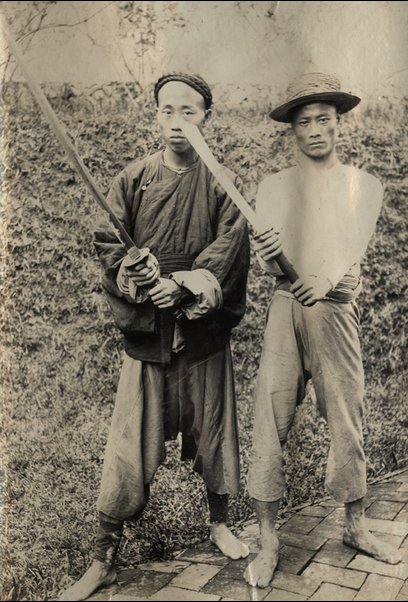
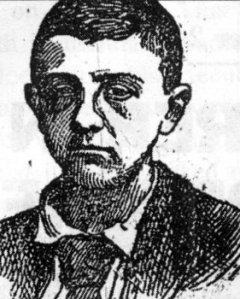
1897: Ernest and Alexis Blanc, brothers in blood

On this date in 1897, some 4,000 residents of Lafayette turned up to watch the hanging of two Parisian-born young men.

It had been nearly a full year since Martin Begnaud was discovered bound, gagged, and stabbed over 50 times in his general store at Scott, Louisiana, just outside Lafayette. That was on April 22, 1896.

The motive was self-evident: the prosperous late burgher had been plundered of several thousand dollars. But who did it?

The matter remained a mystery for many months, although two men were indicted for the deed — and blessedly never brought to trial.

But a few days after the murders, brothers Ernest and Alexis Blanc, teenage French orphans who were sharecropping on a plantation in April 1896 also abruptly disappeared without even bothering to sell their crop shares. This naturally raised suspicion as well, but their whereabouts were totally unknown and as months passed any hope of finding them had practically vanished.

Just after New Year’s 1897, the Blancs made a slight miscalculation: they turned up again in Scott and applied to work at their old plantation.

They were swiftly arrested and questioned separately. It did not take long for them to crack; indeed, full of guilt as they were, one might speculate whether these young Catholics didn’t return with the subconscious desire to purge themselves.

The older sibling Ernest explained that they had

secured the loan of a book treating of the daring deeds of Jesse James. From reading this book originated the idea and our plans for the murder. Seeing how poor we were, and how difficult to otherwise better our situation, we made up our minds to emulate the examples inculcated by the book.

(In those days, television was called ‘books’.)

The boys executed this plan with something less than the steel-hearted aplomb of a seasoned outlaw, however. Having gained access after hours to Begnaud and his store on the pretext of making a purchase, the brothers nervously bought tobacco … and then sardines … and then made small talk about mouse traps … all the while trying to screw up the nerve to do the deed, and get Begnaud to turn his back on them so they could have the advantage. When Ernest (as he claimed) finally murdered the shopkeep, “my hand trembled. The triangular instrument burned my hand. I shut my eyes.”

(Both of the previous two quotes are as per the January 9, 1897 Lafayette Advertiser.)

After that, they took off on a travel spree which ought to have carried them safely away from the scene of their crime for good. Instead they returned, like a dog to vomit, and gave up their lives to unburden their hearts. “We have talked too much,” Alexis said matter-of-factly to a reporter before their sentencing. “That is all. Had we kept the secret and not confessed, we would not be here.”

The fact that there was a sentencing at all was a bit of an achievement, and the Blancs have generally been considered the first legal hangings in Lafayette Parish. Actual or suspected malefactors were typically handled with more dispatch and fewer legal niceties previously (also making it something of a miracle that the original, wrongly-accused pair was still around to draw breath). Both Ernest and Alexis spent a good deal of their time jailed in New Orleans for their own protection.

But that protection ran out today.

The boys went to their death in good humor, never adding a failure of nerve to their account of sins. Ernest even joked on the platform at the sight of so many people scrambling up trees to catch a glimpse of the hanging that “There are some who will surely have their necks broken in advance of ours.”

The Lafayette Gazette scored a coup by securing a lengthy confessional from the hands of the doomed lads themselves, which ran on April 3 and reiterated the role of leisure reading in the crime spree.*

It was a life of tranquility, sweet and honest, which we regret having discarded to follow the evil promptings of ambition; the love of fortune, and the desire for gold which the devil suggested to us through the leaves of a book entitled the “James Boys.”** It was by reading this book we were lead to steal. Why work in the field? Why walk behind a plow? And at the end of the year receive not enough to buy clothes to put on our backs?

To rob one of his gold in a single night appeared to us much easier. The birds had eaten the crops and we were discouraged.

The murder itself, they said, had not been premeditated. But

[w]e were discussing the manner in which we would tie [Begnaud] so that he could not give the alarm before morning, when he said:

“Do not destroy my account books nor my private papers, without which I cannot make a living.”

In the silence of the night this sonorous voice appeared probably stronger than it really was and impressed us with a feeling impossible to express, and we rushed to his room and I (Ernest) stabbed Martin who was sitting on his bed. How many times I stabbed him I know not, nor did I ever know.

The Blancs logged some serious mileage in their months living on the Begnaud score. But Catholic guilt aside, it sounds as if their capture might really be attributed more to the country’s miserable economic situation.

After visiting Belgium and England we boarded a steamer for New York City arriving there on the 12th of July. We had already spent the greater portion of the $3,000 [stolen from Begnaud]. Then we commenced our journey across the United States, visiting Chicago, St. Paul, Helena, Portland, Sacramento, San Francisco, Los Angeles, El Paso, Salt Lake City, Ogden, Omaha, Council Bluffs and St. Louis. In the latter city we spent the remainder of our money. Each one having ten dollars, we took the Frisco line on foot, passing through Missouri, Arkansas, Indiana Territory and Texas, and followed the Texas Pacific as far as Mexico, where we rested a few days. All along the route we tried to get work, but failed. There was nothing for strangers to do. It is in this manner that we reached Lafayette on January 2, 1897. Knowing so many people there we thought it would be easy to find employment. We knew that we were risking our necks, but being so miserable, did not care very much.

And this decision to risk returning in preference to starvation is, after all, nothing but the same calculation of risk and reward that people at the economic margins have always made: to descend a lethal mine to feed one’s family; to seek one’s fortune on the treacherous seas; or if it should come to that, not to walk behind the plow but to follow the lead of the James boys and make one’s bread by banditry.

* According to No Spark of Malice: The Murder of Martin Begnaud, the Gazette cleverly obtained the full rights to all the Blancs’ prison writings, and were able to turn them into a 23-page French pamphlet La Vie, le Crime et les Confessions d’Ernest et Alexis Blanc; ou, L’Histoire d’un Crime Horrible. This sold like hotcakes after the hangings and would now be in the public domain; sadly, it does not appear to be available online as of present writing.

** There were probably several books of this title then, just as there have been several since. This volume has a 1911 copyright, but if it is not a version of the same book the Blancs read, it’s surely not too far distant.

On this day..

1892: Four anarchists in Jerez

On this date in 1892, four anarchists named Burique, Lamela, Lebrijano and Zarzuela were publicly garroted on a large stage in front of the prison at the Andalusian city of Jerez (or Xeres).

Spain, like many other European states, grappled with anarchists in the late years of the 19th century.

Revolutionary peasants made the rich agricultural lands of Andalusia among the anarchist strongholds: the shadowy La Mano Negra, the “Black Hand”, had been smashed up with a number of executions in the early 1880s. This was not the end of agitation, however: its successor movement, Los Desheredades, “the Disinherited,” continued to grow.

On the night of January 9, 1892, a band of several hundred agricultural workers boldly raided Jerez in an attempt to free some anarchist prisoners. They were driven off after a night’s fearful fighting — a prototype “anarchist outrage” for headlines the world over. It was, for Federico Urales, “an act of dreams. Sticks and sickles to beat the well-fed lords of Jerez, from the men who starved to keep to keep their lands.” (Source, in Spanish)


From the Melbourne, Australia Argus, Jan. 11, 1892

“We know what the workers are: wicked people! With them, one has the bread in one hand, and the garrote in the other.” -from Vicente Blasco Ibanez’s La Bodega, in which the Jerez mutiny is a central theme. It’s available in the public domain in the original Spanish

Dozens of “outragers” were captured in hot pursuit that next morning. The investigation quickly honed in on the four ringleaders, who were put to death this date. One allegedly left a written statement conveniently renouncing anarchy. Another spoke from the platform, and “declared that he died in the cause of the working classes, and he appealed to the crowd not to respond by expressing sympathy.”*

But many others would suffer lengthy, non-capital sentences on evidence perhaps more expedient than rigorous. The poet Fermin Salvochea spent most of his fifties in prison on a spurious accusation of having conspired in the Jerez attack.

And these executions scarcely quelled Spain’s unrest. Angry cadres demonstrated (or rioted) against the executions throughout Iberia, provoking the familiar cycle of more police raids, more outrages, more martyrs … for years to come, and culminating in the indiscriminate arrests and mass torture of Barcelona anarchists in that city’s Montjuic Castle in in 1896-97

* From the Feb. 11, 1892 New York Times, which proceeds to describe the distinctive execution method thus:

[The garrote] is a brass collar, which is contracted by means of a screw in the back. As the screw is turned the collar shuts upon the neck of the condemned, and at the same time the sharpened steel point of the screw enters the spinal marrow where it joins with the brain, causing instantaneous death.

On this day..

1894: Albert F. Bomberger, for the Kreider family murders

(Thanks to Meaghan Good of the Charley Project for the guest post. -ed.)

On this day in 1894, Albert F. Bomberger was hanged in the four-year-old state of North Dakota for the gruesome mass murder he’d committed the year before. His execution within sight of the Kreider home where he’d slaughtered six people (and raped a seventh) went off smoothly, but it almost didn’t: when the trap was sprung, his feet were only six inches above the ground.

Born in Pennsylvania in 1871, Bomberger left home as a teenager and worked his way west. At some undetermined point, he was hired to work on the Kreider on a farm southeast of Cando, North Dakota, a job that came with his own room within the farmers’ home. Bomberger was apparently a relative of some sort, and hailed from the same part of Pennsylvania the Kreiders were originally from.

The Kreider family was a large one. Besides Daniel S. Kreider* and his wife Barbara, there were eight children: sons Aaron, 12, David, 7, and Henry, 3, and daughters Annie, 15, Bernice, 13, Murby, 11, Mary, 9, and Eva, 5.**

Bomberger became infatuated with the eldest daughter Annie and would not be put off by her rebuffs. After midnight on July 6, 1893, he sneaked into her bedroom, which was next to his own; Annie kicked him out and threatened to tell her parents if he didn’t quit bothering her. Bomberger slunk back to his bed, furious and humiliated, and plotted revenge.

On the morning of July 7, Bomberger found Daniel Kreider asleep in bed and shot him with a double-barreled shotgun.

Then he went down to the kitchen where Mrs. Kreider was fixing breakfast and shot her to death as well.

And last, he penned up Annie, Aaron, Eve and Henry in his bedroom.

With those kids locked up, Bomberger tracked down Murby, Mary and David, and blasted them with a single load of buckshot each.

13-year-old Bernice attempted escape by jumping out a second-floor window and running for help. Bomberger caught her, and she cried and begged to be allowed to see her family again. He obligingly took her inside, showed her each of the dead bodies (Mary turned out to be still alive, so Bomberger slit her throat), then then shot Bernice dead at close range while she cowered in the corner with her hands over her face.

While Bomberger was thus occupied, Aaron, Eva and Henry escaped his room and hid elsewhere in the farm. The murderer wasn’t interested in them anyway; he turned his attentions to Annie. He raped her in her bedroom, took her to the barn, raped her again and then forced her to make his breakfast, give him $50, and pack his lunch.

Bomberger then tied Annie up, put her in the barn’s loft, saddled up and rode straight for the nearby Canadian border on one of the children’s horses.

He did make it to Manitoba, but that didn’t stop Cando’s sheriff from hopping the 49th parallel himself to arrest the murderer. Bomberger had little to say for himself. He seemed indifferent to his fate and, when asked to explain why he’d committed such a horrific crime, blamed booze.

He even pleaded guilty: the entire court procedure lasted fifteen minutes.

Almost 120 years later, amateur historian R. Michael Wilson would say that, of all the criminals he’d written about in his extensive studies of crime in the western United States, Albert Bomberger stood out as one of the most horrible.

The dead Kreiders were buried together in one grave at a Mennonite cemetery in their home state of Pennsylvania. Some 15,000 people attended their funeral. The murder farm was sold at auction; the house where the murders took place burned down in 1917.

As for the surviving children, they stayed in Pennsylvania after the murders. Annie married, had at least two children and lived a long life: she died in 1960, age 82.


Um …

* The brother of future Pennsylvania Congressman Aaron Kreider (R).

** Various sources give them different ages; these are the best estimations I could make. It’s also worth noting that Murby’s name is occasionally given as “Merby” or “Melby” and Bernice may be called “Beatrice”. I’m going with the names as they were listed in the cemetery records, but those could well be wrong.

On this day..

1897: The Bicol martyrs of Philippines independence

On this date in 1897, eleven pro-independence Filipinos were shot at Manila’s Bagumbayan execution grounds.

These eleven,* together with one who was tortured to death on a prison brig and three others who died exiled to prisons elsewhere in the Spanish empire, comprise the Fifteen Bicol (or Bikol) Martyrs.

Spanish suppression of the unfolding Philippine Revolution was in full martyr-making; just days before, the same site had seen the execution of Dr. Jose Rizal. (A few days after this, it made still another batch of martyrs.)

“They died bravely,” a Filipino newspaper reported. “They died like those who are sustained by a sacred ideal.”

They were.

This date’s victims had been rounded up on September 16 at Naga City in the Bicol Region. It was the aftermath of Spain’s discovery of the anti-colonial Katipunan secret society, and mass arrests followed by torture-aided interrogation were the order of the day.

These would not, in the end, avail.

As a result, the “Quince Martires” are still commemorated in independent Philippines every January 4, which is a public holiday in Naga City … and commemorated throughout the year at that city’s Plaza Quince Martires, and its monument.


(c) image courtesy of Wally Ocampo.

* Rev. Fr. Gabriel Prieto; Gabriel’s brother, Thomas Prieto; Rev. P. Severino Diaz; Rev. P. Inocencio Herrera; Manuel P. Abella; Manuel’s son, Domingo I. Abella; Camilo Jacob; Florencio Lerma; Macario Valentin; Cornelio Mercado; and Mariano Melgarejo.

On this day..

1891: William Rose

On this date in 1891, William Rose was hanged — and, when the rope snapped, hauled back up and hanged again — for murdering his feuding neighbor Moses Lufkin in Redwood County, Minn.

The scaffold botch was an apt conclusion to a deeply controversial case. Two juries hung (both leaning towards acquittal) before a third trial finally convicted Rose with the help of new eyewitness testimony that wouldn’t inspire much confidence now — and didn’t even back then.

Lufkin had been shot through a window at night — this is according to that questionable eyewitness testimony — by an unknown assailant who then fled. Connecting Rose to the murder required stitching together circumstances: Rose’s known hatred for Lufkin; the want of an alibi; the fact that he’d recently bought some ammunition. Rose protested his innocence from start to finish, and many people believed him.

In a letter published by the St. Paul Weekly Pioneer Press on Oct. 15, Rose accused that very witness of the murder: Lufkin, who was loathed by many besides Rose, had been living with the witness; said witness also knew Lufkin had cash on hand from a pension payment and the sale of his farm. Rose even repeated this accusation at the gallows.

The contentious proceeding — “one of the most remarkable cases known in the history of the State of Minnesota,” in the words of one contemporaneous report* — has been revived for a present-day audience in Patricia Lubeck’s new book, Murder in Gales: A Rose Hanged Twice. Lubeck and her friend and research assistant Michelle Gatz combed through original trial transcripts and newspaper coverage, and it left the author “pretty sure that William Rose didn’t do.”

Lubeck (author website) is the curator of Redwood County Museum, which still preserves the jail cell where Rose spent his last night on earth. She was gracious enough to share her research with Executed Today. (Other interviews with Ms. Lubeck are here and here.)


Patricia Lubeck. (Photo courtesy of Ms. Lubeck.)

Murder in Gales: A Rose Hanged Twice book coverET: First off, how did you come by this story and what made you decide to devote a whole book to it?

PL: Kind of by a fluke. I came across it at the Minnesota History Center; I was helping my friend research.

When I worked at Yellow Medicine County, I researched the first man hanged in that county and became interested in early crime in southwestern Minnesota. At one point, the archivist at the Minnesota History Center brought out several boxes of court transcripts from trials. I was perusing through several cases when I came across the Lufkin vs. Rose case, and it looked very interesting.

So, William Rose and Moses Lufkin were neighbors and foes. What was the nature of their enmity — how did it get started?

They were two families who settled in southwest part of Minnesota in the late 1800s and they were friendly neighbors in the beginning. But soon petty differences arose, and the quarreling increased in bitterness from year to year.

Then a new element came into the picture when William Rose fell in love with Lufkin’s beautiful daughter Grace, and her father put a stop to the romance. This sparked the feud and lawsuits.

I think because of that feud, when Lufkin was murdered, the community kind of thought that maybe Rose did it.

The problem of the dicey sufficiency of the evidence was at the heart of the case at the time — in trial, on appeal, in the court of public opinion. Does this case have any lessons for thinking about the wrongful-conviction phenomenon here in the 21st century? Or what else do you hope the reader will take away from your book?

I guess I was just really outraged by what William Rose went through, and I felt like I was the voice for Rose. This is a story that not many people know about; it was not just a cut-and-dried case and there were a lot of factors involved. I just want people to know that there were many other possible suspects that could have done it, but that he, Rose, was the one who paid for the crime.

And I still feel that somebody has the missing piece, and somebody may come forward to exonerate Rose. I would like anyone who has information about this case to contact me by mail at: Box 52, Belview, MN 56214.

They had to try him three times to get the conviction, and the case was unusually protracted and controversial. Was there any legal chicanery involved in accomplishing the guilty verdict? By the standards of the time were there any areas where the courts clearly dropped the ball legally?

Another man who lingered alone [after Rose’s funeral] was ol’ man Slover … [who] proclaimed to those still standing at the gravesite, “Gentlemen, this is awful.”

“It certainly is,” replied [Rose’s friend] John [Averill]. “Are you sure you’ve got the right man?”

Slover replied, “I don’t know, John, but I hope so.”

-from Murder in Gales

The difference in the third trial was that Eli Slover came forward and said he was sure that it was William Rose who shot the gun. He had testified at the previous two trials that he wasn’t sure at all … and the shooter was someone he supposedly saw from the back, in the dark, so how would he be sure?

The prosecutor, Michael Madigan, was suspected of meeting with certain witnesses prior to their testimony; coaxing them and possibly even bribing them to give the testimony he wanted in order to bring in a conviction against Rose. I think that the prosecutor wanted to bring in a guilty verdict, and he persuaded Eli Slover to say that William Rose was the one that he saw that night, running away. Later on, this prosecutor got in trouble himself. He went to prison and got disbarred for perjury in 1893.

William Rose on the gallows accused Slover by name as the murderer; Lufkin had moved in with the Slovers and recently sold his farm, so the Slovers knew he had cash on him. He [Slover] is one of a number of other possible suspects I list in the book. This Lufkin guy was a bad man; he himself always stated he would die a violent death.

But at the time that William Rose was facing his trials, there was another murder that happened around the same time period in Redwood County — Clifton Holden, who killed Frank Dodge. People were shocked to have two murders in their midst, after having had a couple of other homicides in the recent past,** and there was a danger that Holden and Rose could have been lynched. At the time, the press and public sentiment cried out for a conviction, and the county was becoming burdened by the costs of trials and so a guilty verdict was found. Holden was also sentenced to hang, but at the 11th hour, Gov. Merriam reduced the sentence to life in prison.


Although memory of these sad events have faded, they were talked-about in the area for years after William Rose’s hanging. “Time and again,” said one newspaper account Lubeck quoted, “has some cute individual started the story that Will Rose was innocent.” There were even confused local rumors that Slover had made a deathbed confession from his later residence in Oregon.

“These events brought home to the people of Minnesota the the truth that the prevailing system during the 1800s, of executing criminals, was radically, morally, and terribly wrong,” Lubeck argues.

William Rose was the only person ever executed in Redwood County. Minnesota abolished the death penalty full stop in 1911.

* St. Paul (Minn.) Daily News, Oct. 15, 1891

** The Marshall (Minn.) News Messenger harrumphed on Nov. 30, 1888, shortly after Rose’s avoided conviction in his first trial, “Redwood County had its fourth murder in two years, and we know of no other county where a murderer may so easily escape, even by going through the court system of Redwood.

“The Alexander murder, premeditated, easily escaped. The Gorres murder only got 6 years for manslaughter, about what a small thief would receive; the Rose murder resulted in acquittal. And now Clifton Holden has murdered a fourth victim.

“Meanwhile the taxpayers are being grieveously burdened with taxation for all these murder trials.”

On this day..

1898: Alfred C. Williams

(Thanks for the guest post to Robert Wilhelm, author of the Murder By Gaslight historic crime blog, and author of the book Murder And Mayhem in Essex County. Executed Today readers are sure to enjoy Wilhelm’s detailed investigations into long-lost historic crime. -ed.)

When Alfred C. Williams was arrested for the murder of John Gallo, his conviction seemed highly unlikely. There appeared to be no direct link between Williams and Gallo. There was no absolute proof that Gallo had been murdered, or even that he was dead. But in this case, circumstantial evidence, rather than increasing doubt, actually succeeded in dispelling doubt, bringing investigators closer to the truth and drawing the noose ever tighter around Alfred Williams’s neck.

John Gallo was a young Italian immigrant who worked on a farm in Lynnfield, Massachusetts. He was industrious and popular with the other workers, but kept to himself and very seldom left the farm. Gallo lived alone in a small shack in the rear of the farm. In the early hours of July 28, 1897, the shack caught fire and burned with flames so high they could be seen in neighboring towns. The shack was leveled, leaving nothing but ashes and the charred remains of a body, so badly burned that it could not be identified.

The body was so charred that it took two examinations to verify that it was, in fact, the body of a human. The head and neck were gone, both arms and both legs had been completely consumed, bone and all, by the fire. The spinal column remained with some back muscle attached; the heart, liver, kidneys, and bladders remained, but were badly burned. Everything else was completely gone. The medical examiner could state that the body was that of an adult human being, but nothing more.

With the destruction so complete, it appeared to investigators that nothing could be learned to explain what had happened that night. But as the investigation progressed, details began to emerge, like an image developing on a photographic plate. The fact that there was too little information became a clue in itself, and soon investigators were able to compile a list of facts that pointed to foul play:

  1. The body had been destroyed to a greater extent than would be expected from a fire in such a small building.
  2. The deceased had not been burned in bed. The bedsprings had survived the blaze but the body was found several feet away.
  3. The victim had not been dressed. Some buckles, metal buttons, a few coins and the clasp of a pocketbook were found by the side of the bedsprings, none were found near the body.
  4. The body lay in the doorway between rooms with the head back in the room toward the bed, not falling forward as a person naturally would if trying to escape from a burning room.
  5. A kerosene-oil can, which was usually kept near the stove, was found in the middle of the floor
    next to the body.

It was believed that the victim had been murdered before the fire started. His body was doused with kerosene and ignited, which would account for the severe damage to the body. The flame then quickly spread to the rest of the house.

John Gallo had earned $1.50 a day at Phillips’s farm and was paid monthly, always in five dollar bills. He spent very little and at the time of his death, it was suspected that he had around one hundred dollars earned on the farm. It was also well known that Gallo always carried three twenty dollar gold pieces that he had earned on a construction job prior to coming to the farm. No trace of the gold pieces or any melted gold were found.

Another crime had allegedly been committed near Lynnfield in the early morning of July 28. That afternoon, Alfred C. Williams reported that he had been held up near his rooming house in Wakefield. He had been unable to sleep and went outside to smoke a cigar. As he stood with one foot on the rail fence by the road, someone struck him on the head from behind. He turned to fight back, striking his assailant on the nose causing it to bleed. He was knocked unconscious, robbed of his watch and a small amount of money, and then thrown down the banks of Wakefield Pond.

He told his story to the police, showing them bruises on his neck and face from the fight, and bloodstains on his clothing from the assailant’s nose. The officers were skeptical of his story and held Williams for questioning. Unlike most holdups, Williams apparently had more money in his possession after the crime than he did before. On July 27, Williams had not had enough money to buy a meal or even pay a five-cent streetcar fare. The morning of July 28, he paid his back board bill and made some purchases. The police found seventy-five dollars, in five dollar bills, on his person.

The police learned that Williams had previously worked as a laborer on Phillips farm and knew the habits of the deceased. They searched Williams’s room and under the carpet, they found two twenty dollar gold pieces. When Williams was told where they found the coins he responded, “I know, I put them there.” They also found a bloodstained coat and vest in his room. Alfred C. Williams was arrested for the murder of John Gallo.

At the trial, the prosecution presented a case against Williams that was based entirely on circumstantial evidence. While there was nothing to directly link Williams to the fire, his familiarity with Gallo’s habits, his possession of money — including gold pieces — the day after the fire, the bloody clothing, and Williams’s inconsistent stories, taken all together were incriminating.

The defense challenged the very core of the evidence. There was no proof that the body found in the ashes was John Gallo’s; it could not be proven that a murder was committed or that the fire was not started accidentally; there was no proof that Alfred Williams was anywhere near the fire that night. But Williams was sticking to the story that he was held up on the night of July 28, so his alibi was also a matter of circumstantial evidence, and no one seemed willing to believe it. The jury deliberated for six hours before returning a verdict of guilty, first degree murder.

Alfred C. Williams was hanged in the yard of Salem jail on October 7, 1898. It was not a public hanging; the sheriff issued a few invitations, but only for the purpose of providing legal witnesses. Williams’s arms and legs were bound and his head was covered as he stood on the gallows. At 10:01 a.m. the trap was sprung and Williams dropped six feet, one inch. His neck was broken and he died within seconds. Williams professed innocence to the end.

Get Murder and Mayhem in Essex County here.

On this day..

1895: The Vegetarian perpetrators of the Kucheng Massacre

On the morning of September 17, 1895, in the presence of the British and American consuls, seven perpetrators of a Chinese massacre of western Christian missionaries were beheaded at Foochow.

Anticipating the better-known Boxer Rebellion by four years, the Kucheng Massacre (there are many other transliterations of “Kucheng”) was likewise a response to the Celestial Empire’s frustrating second-class status as against European interlopers.

Christian missionaries had been a point of friction in China for decades. Though their rights to proselytize had been guaranteed in a hated treaty dictated to China by force of arms, they often met resentment or worse on the ground.

“You bring incense in one hand, a spear in the other;” one evangelist reported being told: that is, however honorable the immediate intentions of many individual missionaries, their presence looked like a stalking horse for less reputable western interventions like the opium trade. (That’s how it looked to many Chinese. Professional western diplomats themselves found the impolitic preachers a hindrance to their statecraft, according to Ian Welch’s 2006 paper “Missionaries, Murder and Diplomacy in Late 19th Century China: A Case Study” (pdf).*)

On August 1, 1895, these frustrations unleashed a river of blood at the village of Huashan in Gutian County, where a Buddhist secret society — known as “Vegetarians” in the western press for their characteristic dietary vow — fell upon a group of vacationing British Anglican missionaries still abed at dawn and ruthlessly slaughtered eleven of them. (There are some 1890s books paying tribute to the fallen available online: Robert and Louisa Stewart: In Life and in Death, and The sister martyrs of Ku Cheng : Memoir and Letters of Eleanor and Elizabeth Saunders (“Nellie” and “Topsie”) of Melbourne.)

“The attack came,” said a physician from a nearby town who was summoned to the bloody scene, “like a thunderbolt from a clear sky, not one of the victims having received the slightest intimation of the intended assault.”

Word of the carnage struck western powers with similar force.

Incensed newspaper-readers literally demanded** gunboat diplomacy, and literally got it, especially when Chinese authorities drug their feet on the condign punishment the missionaries’ countrymen were clamoring for.

All this put British diplomacy on a sticky wicket, which Welch (pdf) deals with in detail. To satisfy the domestic audience, the government had to be seen to be taking a hard line on avenging the outrages; at the same time, London was wise to the Chinese state’s shakiness and wary that a “barbarous holocaust” perpetrated against the Vegetarians would trigger a mass backlash and bring the whole thing down.

An obdurate Chinese viceroy impeded the quick resolution everyone was after by making inflammatory public proclamations against Christians, and releasing without explanation six of the thirteen men who had initially been condemned to death in the month of August. The seven who were executed on this date were therefore only the vanguard of 26 humans ultimately put to death for their involvement in the atrocity.

Some of the execution photographs that follow are Mature Content. They’re obtained via Visual Cultures in East Asia; some also available at USC Digital Library.


Raids and investigations to bring the Vegetarian movement to heel continued for several months thereafter, and the whole affair ultimately was quelled without doing any of the wider damage that might have been feared — not even to missionaries who continued pouring into China.

And that, effectively, kicked the can down the road on the anti-foreigner sentiments afoot in the land … sentiments that would find much costlier expression a few years later when another secret society kicked off the Boxer Rebellion.

* I’ve relied heavily on Welch for this post. He’s also collected a massive trove (over 1,200 pages) of primary documents from this incident available in a series of pdfs (some quite large) from the Australian National University website:

** This was not universally so. The wife of missionary Stephen Livingston Baldwin, who knew some of the victims of the attack, urged a “charitable” response and sensitivity that “the Chinese feel that all the world is against them, and they are not far from right.” (New York Times, Aug. 10, 1895) In letters responding to intemperate coverage elsewhere, she acidly compared (pdf) western editorialists’ high dudgeon to their look-forward-not-back dismissal of recent stateside anti-Chinese violence.

It was ten years yesterday since more Chinese were killed, and burned alive and left to die wounded, in one hour, at Rock Springs, Wyoming (the very same Territory in which the recent massacre occurred) than have been Americans and English in China in the thirty-four years I have personally known that land, being a resident there twenty years and closely connected with it ever since. Ten years yesterday since that awful Rock Springs massacre, and up to date no one arrested, much less punished! The anti-Chinese papers of the town and neighbourhood gloating over the awful details and assuring all that there would be “no Congressional investigation,” and no waste of “enterprising newspaper eloquence” over the woes of the Chinese, “though their blood flow like rivers, as they had no votes and no friends.” In less than four weeks after the Ku-Cheng massacre, arrest, investigation and execution have all taken place for the Ku-Cheng massacre. Would that our colored, red and yellow brethren, so helpless in our so-called civilized and Christian land, had some power behind them to bestir Ministers Plenipotentiary, wave flags, and run gunboats to the front, to bully, if necessary, our pusillanimous Government into some sort of civilization — I will not say Christian justice!

On this day..

1890: Otto Leuth

(Thanks to Meaghan Good of the Charley Project for the guest post. -ed.)

On this date in 1890 at the Columbus Penitentiary in Ohio, a sullen German-American teenager named Otto Leuth (sometimes spelled “Lueth”) paid with his life for the brutal murder of his seven-year-old neighbor, Maggie Thompson.

John Stark Bellamy II, writing of the murder in his book The Corpse in the Cellar: And Further Tales of Cleveland Woe, noted how familiar the case sounds to modern ears:

[T]he sickening murder of an innocent child; yet another child accused for the dreadful deed; a sensational trial, replete with dubiously “expert” testimony, suspicious “confessions,” allegations of police “third-degree” methods, and charges of biased press; not to mention “latchkey” children, systematic child abuse, saccharine sympathy for the guilty, and charges of ethnic favoritism.

Yet it happened over a century ago.

Otto, sixteen at the time he killed little Maggie Thompson, had had a hard life, as Bellamy explains in his book. His mother, Lena, testified at his trial that she

went into veritably demonic fits of rage, during which she was in the habit of physically abusing her children, especially Otto. From an early age, she blandly admitted, she had pulled his hair, kicked him, beaten him, walked on him, and often hit him with any object that came to hand. Once, when Otto was eight, she had beaten him with a chair leg and, when [Otto’s father] Henry tried to intervene, stabbed Henry twice with a convenient butcher knife. Just a few months before Maggie Thompson’s murder, Lena had repeatedly slammed Otto’s head into a wooden door.

It speaks volumes of the difference between that century and this one that nobody who heard Lena’s testimony seemed to think this was in any way excessive, never mind cruel; on the contrary, one person praised her methods as being “good German discipline.”

On May 9, 1889, sixteen-year-old Otto was alone at his family’s home at 47 Merchant Avenue in Tremont, a suburb of Cleveland. He was used to being alone: his mother had been committed to a mental hospital some months before, his father was wrapped up in his cabinet-making business, and his older brother had moved out of the house.


Otto (top) and his victim.

That morning, down the street at 24 Merchant Avenue, Maggie Thompson set off for school. Her mother, Clara, dropped her off at the front gate; it was the last time she would see her daughter alive.

Maggie attended the morning classes and, when school was dismissed for lunch at 11:15 a.m., started on the four-block walk home. En route, she vanished without a trace, as if “the sidewalk might have opened and swallowed the girl.”

Naturally there was a frantic search, lead by her devastated parents and the Cleveland Police Department, who tore the city apart looking for her.

But, although there were numerous false sightings and a few wild stories about Maggie’s disappearance, in spite of everyone’s efforts they couldn’t find her.

Otto participated in the search, along with most of the neighborhood. Nearly every day he would approach Clara Thompson and solicitously ask if she’d heard any news of her child.

In early June, Clarissa Shevel, the woman who lived with her husband in the back of the Lueths’ two-family house, asked Otto to do something about the terrible stench that pervaded the entire building. Otto suggested the odor was caused by a dead animal. He bought some chloride of lime and put it in the ventilation hole, then burned some sulfur, but it didn’t help.

Around that time he was witnessed carrying some badly stained bedding to the smokehouse at the back of the property.

On June 9, Otto’s mother Lena, who had by now been discharged from the mental hospital, became fed up with the smell and sent her husband Henry down to the cellar to investigate. He came back up a few minutes later, deeply shaken, and ran out to find a policeman.

In the Lueths’ cellar was the nude corpse of Maggie Thompson.

She was wrapped in one of Lena’s dresses and her own clothes lay underneath her. She had been beaten to death and her body was so badly decomposed that her parents had to identify her by scars on her hips.

The police promptly arrested everyone who lived at the house: Henry and Lena Lueth, Clarissa Shevel and her husband, and Otto, who was picked up on his way home from the ice cream parlor. All five suspects were separated and subjected to a serious “sweating,” but Otto was the prime suspect. He had a reputation as a bully, and he’d been at home alone for much of the previous month.

Bellamy records:

The climax came at 3:30 a.m., when an agonized female shriek resounded from the floor below the sweating room. “Who is that?” cried Otto to Detective Francis Douglass. “Your mother, I believe,” replied Douglass. “She had nothing to do with it!” blurted out Otto. “Who did?” queried Douglass. Otto: “I did it! I did it!” Douglass: “Did what, Otto?” “I killed her! I killed her! Please give me your revolver so I can kill myself!”

Resisting the temptation, the police instead took his verbal confession, wrote it down, had him sign it and escorted him to a cell.

Otto said he had been standing outside his parents’ home at about 11:30 a.m. on May 9 when he encountered Maggie. She asked him if he could donate any buttons to the “button-string” she was making, and he said he had four and would give them to her if she came inside.

Maggie obediently followed him in, and he led her upstairs to his bedroom, where he attempted to rape her. When she screamed, he hit her with a nearby hammer.

Otto said he thought he’d probably killed her with the first blow, but he kept striking her until her head was a pulp and the bed was covered in blood. After an unsuccessful attempt to have sex with her body, he fled the scene. He did go back to the house that night, but spent the next several days at his brother’s home.

Six days later, just before his mother was supposed to come home, Otto returned home to clean up. He carried Maggie’s corpse to the family cellar and left it lying there; he didn’t even bother to bury it or cover it up.

Given Otto’s confession, the circumstantial evidence and the revulsion his crime invoked in the city of Cleveland, his lawyer didn’t have much to work with. Not even trying for an acquittal, his defense instead claimed Otto was mentally impaired and/or insane.

Otto had a strange depression in his skull and his attorney suggested he was brain-damaged — which might very well have been true, given the abuse he had suffered at Lena’s hands. Several members of his family, including his mother and brother, had epilepsy, and his attorney suggested he might have had a seizure and committed his crime without even knowing what he was doing.

Such a scenario was possible. The problem was, though, that none of the medical experts who testified for the defense could diagnose Otto with epilepsy.

The claims of subnormal intelligence were contradicted by the testimony of Otto’s former teachers. Although his pathetic attempts to conceal Maggie’s body might indicate otherwise, his intellect seems to have been about average. Before he quit school at age 13, he had been an unexceptional student with some talent as a violinist.

Otto’s lawyer also said his client had not, in fact, attempted to sexually assault Maggie Thompson either before or after death, and Otto had invented that part of his confession because the police were pressing him to cough up an explanation for his motiveless crime. But given the fact that Maggie’s body was found naked, this claim didn’t carry much weight either.

It was no surprise that, when the trial concluded on December 27, 1889, the jury came back with a verdict of guilty without a recommendation of mercy. Perhaps the only surprising thing was that they actually bothered to deliberate for a whole four and a half hours.

Otto rapidly exhausted his appeals and was hanged eight months after his trial, alongside another killer, one John “Brocky” Smith of Cincinnati. Two other men had also been scheduled to die that night, but one got reprieved and the other’s execution was postponed.

Otto left behind a statement where he admitted he’d killed Maggie Thompson, but denied his previous claims that he’d tried to rape her. He died calmly and without a fuss, standing on the trap and saying simply “All right, let her go.”

On this day..

1896: Amelia Dyer, baby farmer

(Thanks to Meaghan Good of the Charley Project for the guest post. -ed.)

On this date in 1896, Amelia Elizabeth Dyer was hanged at Newgate Prison in London. At 58 years old, she was the oldest woman hung in Great Britain between 1844 and 1955.

Amelia was a baby farmer, one of many from that time and place. Baby farmers would, for a fee, take an infant or toddler if its mother was unable or unwilling to care for it. The idea was that the baby farmer would either become the baby’s foster parent, or find someone else to foster or adopt the child.

In the days when illegitimacy carried a heavy social stigma, this was an attractive option — indeed, often the only option — for single or impoverished mothers, and likewise for communities facing the burden of an orphaned newborn. Young Oliver in Charles Dickens’s novel Oliver Twist grew up on a baby farm after his mother died in childbirth and his father disappeared.

In many cases, everyone benefited from the transaction: the mother would go back to her life knowing her baby was all right, a childless couple would have a baby to love, and the baby itself would grow up in a secure home.

Unhappily, however, many other cases produced horrendous results: the baby was not necessarily safe once the mother had handed it over and paid money in advance for its care. Unscrupulous and greedy women realized that, once they got the lump sum payment, they could make a profit if the baby died, the sooner the better.

Victorian Britain was rife with baby farmers who would quietly do away with their helpless charges, or simply starve and neglect the infants until they expired. Authorities made unavailing, ill-enforced attempts to control the problem by, for example, requiring women who adopted or fostered more than one infant at a time to register. (And by doling out a few sporadic, but high-profile, executions.)

It was a widespread and well-known problem, as Alison Rattle and Allison Vale note in their biography, Amelia Dyer: Angel Maker:

It was impossible for newspapers of the day to keep count of the numbers of bodies found strewn about the towns and cities. Scarcely a day passed without yet another report of the corpse of some young innocent being found abandoned beneath the seat of a railway carriage, under an archway, in a sewer grating or just carelessly dumped in one of the open spaces of a city suburb. Many cases were not even reported …

Amelia Dyer was the worst of the worst.

She was convicted of a single murder, but they’d found the bodies of half a dozen more, and by the time she was caught she’d been operating for for twenty years or more. Her victims may well have numbered in the hundreds, making her a mass killer of Harold Shipman-like proportions.

Amelia was born in Bristol to a respectable working-class family. Unlike most children of the time, she was able to attend school until age fourteen, and her four siblings. But there was tragedy in her family: her mother went insane (apparently brain-damaged by the effects of typhus), and died when Amelia was eleven years old.

In 1861, at age 24, Amelia married George Thomas, a 57-year-old widower. They had a daughter together before his death in 1869. Three years later, she married William Dyer and they had a daughter and a son, as well as several children who didn’t survive infancy. Eventually she left him.

She was a qualified nurse and did work in that field off and on for several years, but for most of her life after her first husband’s death, her primary occupation was baby farming. At first, Amelia acted only as an intermediary, taking babies from their mothers for a fee and, for another fee, handing them over to other baby farmers who, often as not, let them die. She also kept pregnant women in her home and nursed them until delivery, and the newborns were reported stillborn as often as they survived.

It isn’t known just when she started murdering the infants herself, but by 1879 she came to the attention of the authorities: four nurse-children in her care had died within two weeks of each other.

They wanted to get her for manslaughter, but there was insufficient evidence. Amelia was found guilty of criminal neglect and served the maximum, six months at hard labor. She tried to go straight, working a variety of low-paying jobs.

Inevitably, however, she returned to what she was best at.

She had learned an important lesson from her previous brush with the law: don’t bring in a doctor to sign the death certificate, don’t leave a paper trail. Instead, she started disposing of the bodies herself.

Like her colleagues she put out notices in the newspapers, advertising herself as a respectable married woman who wanted to adopt or foster a baby in exchange for money. Sometimes there was an understanding that the mother would be permitted to visit the child, or take it back once she was in a position to care for it.

However, a mother usually never saw either Amelia or child again after handing over her infant.

Amelia kept herself constantly on the move and used a number of alias names to avoid attention. At times she was receiving as many as six babies a day. Her youngest daughter, Polly, grew up helping her mother take care of the babies; for her, it was a way of life.

When she married and moved away from home, she and her husband, Arthur Palmer, ultimately set themselves up as baby farmers too, sometimes working alongside Amelia. The Palmers habitually neglected and abandoned their charges, and at least two of their babies died.

Amelia started showing signs of mental illness after her release from prison: she had violent fits, claimed to hear voices, made at least one serious suicide attempt and ultimately was admitted four times to three different asylums. Her mental illness may have genuine, possibly caused or exacerbated by her substance abuse (she was addicted to both laudanum and alcohol), or she may have been malingering: her breakdowns tended to happen after the authorities or parents seeking to reclaim their babies started poking their noses around in her business.

The end came on March 30, 1896, when a bargeman pulled the body of fifteen-month-old Helena Fry out of the River Thames. She’d been strangled with dressmaking tape, which was still tied around her neck. When the police closely examined the paper she was wrapped in, they were able to make out an address: 26 Piggotts Road, Reading.

When the authorities searched that home, they found numerous items of interest including more dressmaking tape, piles of baby clothes and pawn tickets for more clothes, and letters from mothers asking about their children. The house reeked of human decomposition.

The police set up a sting to catch Dyer, using a young woman to act as a decoy. But on April 4, the day they were supposed to meet to talk business, she found herself arrested instead and charged with the murder of Helena Fry. Shortly thereafter, her daughter and son-in-law, Arthur and Polly Palmer, were charged as accessories.

Investigators dragged the Thames and found four more bodies, three boys and one girl. All of them had white dressmaking tape knotted around their throats. Two of the victims were later identified as Harry Simmons, thirteen months, and Doris Marmon, four months. They had been killed only a few days before Amelia’s arrest, stuffed into a carpetbag together and thrown off a dock. Later, two more bodies turned up: another girl and another boy.

The investigation determined that at least 20 children had been given over to Amelia Dyer’s care in the few months prior to her being caught. During the previous year, between thirty and forty bodies had been pulled from the Thames. Almost all of them were of infants and authorities suspected most of the deaths were the work of one person.

Within a few days, Amelia had confessed everything, but denied that Polly and Arthur had any guilty knowledge of the murders, and the Palmers also maintained their innocence. Amelia confirmed that she’d dumped most of the babies’ bodies in the river. “You’ll know mine,” she said, “by the tape around their necks.”

The charges against Arthur Palmer were dropped for lack of evidence just before Amelia went to trial. Polly, anxious to save herself, became the main witness against her mother and claimed she had had no inkling of the murders of Doris Harmon and Harry Simmons, although they’d been killed in her house within a day of each other and she’d been present at the time. Her statements were contradicted by other witnesses.

Amelia was first tried for the murder of little Doris; the idea was that if she was acquitted, they could try her in the other cases one by one. She pleaded insanity, emphasizing her own mother’s madness and her own stays in insane asylums — but two of the three doctors who examined Amelia did not believe she was mentally unsound.

The jury deliberated four and a half minutes before finding her guilty.

Polly’s trial was supposed to take place on June 16, and her mother was summonsed to testify, in spite of the fact that she was due to be executed a week beforehand. Amelia appears to have really loved her daughter and was focused solely on saving her from suffering the same fate. In a letter she wrote on June 5, she said,

I was glad to see her looking so well dear child. God only knows how grieved I am to know she is suffering for no fault of her own. She did nothing, she knew nothing.

If only Amelia’s concern for her own child had extended to other people’s, too.

On the eve of her mother’s execution, the case against Polly was dropped. Amelia expressed great relief about this in her final letter to her daughter. But Polly and Arthur didn’t give up baby farming and in 1898 they were caught after they abandoned a (living) baby girl on a train.

On the scaffold, when asked for a last statement, Amelia answered, “I have nothing to say.” She was hanged at 9:00 a.m.

In the aftermath of her trial and execution, Parliament enacted more laws in order to protect helpless infants from suffering the same fate as Amelia’s nurse-children. Nevertheless, during the next ten years, three more baby farmers would suffer the ultimate penalty for infanticide.

On this day..

1892: Frederick Bailey Deeming, Bluebeard

(Thanks to Meaghan Good of the Charley Project for the guest post. -ed.)

On this day in 1892, Frederick Bailey Deeming was hanged in Melbourne, Australia for the murder of his second wife, Emily Mather. She was not his only victim; he’d also murdered his first wife, son and three daughters.

Deeming was born and raised in Ashby-de-la-Zouch in the UK. One of seven children, he was reportedly a “difficult” child. He later claimed he’d spent years in mental hospitals as a youth, something his brother disputed.

Deeming ran away to sea at sixteen and began committing crimes, mostly thefts. Wherever he went, he swindled and stole from people.

Deeming married Marie James in 1881 (his brother married Marie’s sister) and they moved to Australia. They went on to have four children.

In 1888, Deeming and his family moved to South Africa. His movements around that time are unclear, but he was definitely back in England by November 1889, and separated from his wife and children, who lived in another city.

Deeming bigamously married Helen Matheson in 1890, and deserted her shortly after the honeymoon. He visited his wife, gave her some money and told he was going to South America and would send for her and the children once he’d settled. Before he left he conned some jewelers in Hull; as a result, he was arrested upon his arrival in Montevideo, Uruguay and sent back to England to serve nine months in the clink.

In 1891, after his release from prison, Deeming took the name “Albert Williams” and leased a house in the village of Rainhill. A woman and several children were seen visiting him; he claimed they were his sister and her children.

The woman and children disappeared — off to an extended holiday, Deeming said. A short time later, complaining that the drains were defective, Deeming had the floor of his house re-concreted.

In fact, the “sister” was his first wife Marie and the “nieces” and “nephews” his own children — Bertha, 9, Marie, 7, Sidney, 5, and Leala, 18 months. And in fact, they were “vacationing” permanently, under the concrete floor. Authorities believe he killed them on or about July 26, 1891.

By that time, Deeming was already courting Emily Lydia Mather. They married on September 22 and by December 1891 had up and moved to Melbourne.

Emily didn’t make it past Christmas before Deeming had her entombed under the fireplace.

In January 1892, Deeming moved to Sydney. On the way he met a delightful young lady named Kate Rousenfell. He gave her several expensive gifts, including jewelry he’d stolen while he was in Melbourne, and proposed marriage. She agreed and said she would join him in Western Australia when he moved there.

But the course of true love never did run smooth, and Miss Rousenfell was cheated of her bridegroom by Deeming’s March 11 arrest for Emily’s murder.

Emily’s body had been discovered on March 3, after the house’s owner, investigating his new tenant’s complaints of a strange smell, raised the hearthstone. Her throat had been cut and her skull was fractured. When Deeming was taken into custody, he had some of her things with him, including her prayer book.

The murder case received extensive publicity and when those back in England heard of it, they decided to have a look at Deeming’s former home in Rainhill. There they dug up the bodies of Marie and the four children.

At his trial, Deeming claimed insanity and brain damage from epilepsy and tertiary syphilis, and said his dead mother’s spirit had ordered him to commit the murders.

He told the jury that Marie wasn’t dead and had, in fact, left him for another man. In the three weeks between the verdict and the hanging he penned his biography and some bad poetry. English publishers offered him £1,000 for the rights to his writings, but the Australian government had them all destroyed.

There have been suggestions, in Deeming’s time and ours, that he was the serial killer Jack the Ripper, who slaughtered and mutilated a handful of London prostitutes in 1888. The fact that evidence indicates Deeming was in South Africa at the time of the Jack the Ripper murders hasn’t stopped the speculation. He allegedly told his cellmates he was the Ripper, but when asked directly by the authorities, he refused to answer yes or no.

Deeming’s skull and death mask are still on display in the Old Melbourne Gaol Museum.

On this day..