1897: Five Barcelona anarchists

THE BARCELONA ANARCHISTS.

(Through Reuter’s Agency.)

BARCELONA, May 4.

The five Anarchists sentenced to death for complicity in the dynamite outrages here during the Corpus Christi procession last year were shot at 5 o’clock this morning in the moat of Monjuich Castle. The troops intrusted with the carrying out of the sentence fired repeated volleys at the criminals, who all met their doom calmly, their eyes fixed on the public, who were kept at a distance by a large force of soldiers. The condemned men, who all had their hands tied behind them, bowed to the public as they arrived at the scene of execution. Mas asked the firing party to come nearer. Nogues, Molas, and Alsina exclaimed: — “We are innocent! This is murder!” Just before the first volley was fired all cried together: — “Long live Anarchy! Long live Revolution!” Molas then gave the word for the soldiers to fire. Four of the prisoners fell dead immediately, but Alsina remained on his knees not even wounded. At the second volley he fell, but was not killed outright, and it was not till a third volley had been fired that he was pronounced to be dead. (London Times, May 5, 1897)

The “outrage” that occasioned the executions this date in 1897 was the previous June’s bombing of a Catholic processional, attributed by police to an unidentified anarchist and by anarchists to a police agent provocateur.*

Whoever chucked that egalitarian explosive triggered an outrage of the law, els procesos de Montjuic — wherein the wholesale arrest of hundreds of accused “terrorists” under a general suspension of civil liberties resulted not only in this day’s five executions but in countless tortures courtesy of the Inquisitorial equipment still on hand in the venerable Montjuic dungeons.

It was not only anarchists but liberals and republicans who felt the effects of this right-wing crackdown; 87 people were tried in camera by drumhead military tribunals under emergency antiterrorist legislation. Notary Salvador Dali Cusi, father of the famous painter, appeared as a defense witness in one trial, successfully persuading the court that one of his lefty friends nevertheless sported impeccable patriotic credentials and required “merely” exile.

The upshot of it all was to smash up the militant Catalan working class.

Said smashing notably failed to settle the small matter of who actually threw the bomb. As per their dying proclamations, it almost certainly had nothing to do with Lluís Mas, Josep Molas, Antoni Nogués and Joan Alsina — men who were alleged by the state to have been party to an ambitious bombing campaign all over the city. This campaign never went off and the only evidence supplied for its existence came from men tortured to describe it.

Tomas Ascheri, a militant anarchist whose confession helped get the others shot, has long been suspected a police plant, a hypothesis at odds with Ascheri’s shared presence at the wrong end of the firing squad this date. Occam’s Razor — and somebody probably used an Occam’s Razor on Ascheri in between the thumbscrews and the strappado — suggests that the guy’s betrayal was likewise nothing but an inability to withstand “enhanced interrogation.” (Nogues and Mas also signed “confessions” under torture. This public-domain Spanish text by another post-Corpus Christi torture victim denounces that nation’s methods both in Montjuic and in the Philippines.)

Torture in Spain, torture in Russia … the danse macabre proceeds in the dungeons of Mont-juich and St. Petersburg.

-Kropotkin, April 1897

Ongoing state violence in turn invited reciprocation.

Over in England, the Italian anarchist Michele Angiolillo was incensed by the executions, and the tortures suffered by Spanish refugees who had fled to England. “Angiolillo saw, and the effect surpassed a thousand theories,” wrote Emma Goldman. “The impetus was beyond words, beyond arguments, beyond himself even.”

Angiolillo made his way to Spain. On August 8, he joined the great tradition of anarchist avengers by assassinating the torture-happy Prime Minister, Antonio Canovas del Castillo.

* The argument for a false flag operation is a circumstantial one: the parade included a number of high muckity-mucks, like a right-wing general and the Bishop of Barcelona, detested by anarchists … and yet the bomber managed to let all the VIPs pass and attack only a knot of common people at the tail end of the train.

According to this book, a French journalist later reported that one of his countrymen by the name of Jean Girault, a genuine albeit “misguided” anarchist, did the deed. Girault fled to France and eventually to Argentina.

On this day..

1897: Henri-Osime Basset

On this date in 1897, all Versailles turned out to witness the beheading of recidivist pedophile Henri-Osime Basset, a 23-year-old who had kidnapped and strangled to death (French link) 13-year-old Louise Millier the previous summer.

Executioner Anatole Deibler and crew arrived at 3:30 a.m. to erect the portable guillotine at the pont Colbert* for the occasion, under the eyes of a curious pre-dawn crowd restrained by dragoons; by 4:45 la sinistre machine was fully installed.

About an hour after that, the prisoner Basset was awoken from his fitful sleep — he’d been plagued by restless guillotine-themed dreams lately, for some reason — and advised that his application for presidential clemency had been denied.

Le Petit Parisien nevertheless found the prisoner in steady enough spirits for his expiatory moment. He took the bad news with equanimity, received communion, and stuck close by the comforting priest to whom he had already given his last confession. (And who helpfully steeled the doomed man’s nerves with a steady supply of rum, cigars, and Bourdeaux wine.)

In any event, the practiced French executioners did not give Basset long to stew on his fate. After the toilette to prepare him for the blade, he was out the door shortly after 6 a.m. — broad daylight by now, and the crowd swollen in anticipation of the show. The blade fell at 6:33, and the remains of the late Henri-Osime Basset were immediately deposited at the Cimetirie des Gonards.

* This is pont Colbert in Versailles, not the cool then-new steel bridge in Dieppe, which is now the last hydraulic turn bridge still in use in Europe.

On this day..

1894: George Painter, Chicago infamous

While there may be serious doubt about the wisdom of capital punishment it is at present imposed by the law of this State, and if it is to be applied in any case then it should be in this … Any man who will live off of the shame of a woman and beat her from time to time as he would a dog, and finally kill her, must expect to suffer the penalty of the law.

-Illinois Gov. John Altgeld denying clemency to George Painter (Jan. 25, 1894)

On this date in 1894, the Land of Lincoln bloodily botched (but ultimately accomplished) the hanging of George Painter.

Painter died for the sordid murder of prostitute-lover-income source Alice Martin.

Painter insisted he was out at the pub when Martin was throttled and bludgeoned to death in their mutual bed, but the timelines left the alibi leaky and a patch of bloodiness on the reprobate’s coat undid him.

Despite swearing his innocence on pains of being “condemned to a flaming hell for all eternity” and winning three gubernatorial reprieves as his appellate lawyers scrounged up sketchy supportive testimony from various lowlifes, matters were pretty solidly against him by the end. So much so that the seemingly-sturdy rope, “of the same coil with which the anarchists were hanged,” snapped jaggedly when Painter was dropped.

The condemned killer’s body carthwheeled from the jolt of the rope’s end, crashing headlong into the concrete floor. Doctors advised that Painter’s neck was broken and life gone or ebbing … and puzzled executioners, unsure what to do with this unusual semi-successful botch, hauled the hemorrhaging near-corpse back up the scaffold, strapped it up, and dropped it again. You can’t be too careful.

We came by this story on the website of Robert Loerzel’s Alchemy of Bones, a wonderful book about another infamous turn-of-the-century Chicago homicide. (Loerzel’s post gives the train-wreck Painter case a much more detailed rubbernecking.)

Although the subject of Loerzel’s book, the immigrant sausage-maker Adolph Luetgert, was not put to death for his trouble, we were thrilled that the author sat down with Executed Today to find out a little bit about how criminal justice looked in Chicago on the eve of the 20th century.

Book CoverET: One of the aspects that you cover in Alchemy of Bones that’s also present in the Painter case is circumstantial evidence of uncertain probative value. What’s a definitive piece of evidence to a late 19th-century juror?

RL: Obviously if we had a time machine and we could go back 100 years and reinvestigate some of these cases with today’s forensic science, I think we would find a lot of cases of miscarriages of justice. It’s hard to tell looking at these cases today when all you have is these newspaper articles and court transcripts. You can look at it with common sense and try to determine from what people are saying whether there might be some element of doubt.

Today there’s been this huge change with the introduction of DNA evidence and we’ve suddenly discovered that a huge number of people on death row or in prison who are innocent. And that has caused a lot of people to question the reliability of eyewitness testimony and the identification of suspects.

All these things — the testimony of witnesses who say they saw something or said, yeah, that’s the guy — that’s what people in the 19th century were being convicted on. We’re talking about an era when even fingerprints weren’t being used yet.

In the Luetgert case one of the key things was that they found some bone fragments. The Luetgert case is one of these rare murder cases where for all intents and purposes there was no body found. We have some of those cases still today where someone is missing; all the circumstances seem to point to the fact that someone is dead. And prosecutors and police face an additional hurdle — they have to persuade a court that a murder actually happened.

With those sorts of cases, you had some bones that were found. The forensic science of the time — you coudn’t run a DNA test on it. Part of the question was, were those bone fragments even human? Is it possible that pig bones or cow bones were found in a sausage factory? Of course it was possible.

The Luetgert trial was one of the first cases which had testimony from anthropologists, which was a pretty new field at the time. They brought in some experts from the Field Museum.

How did that go?

It wasn’t necessarily the greatest start — but it was sort of like the criminal justice system started to take some baby steps toward bringing science into the courtroom.

Later, in the 1920s or 30s, there was a landmark case called Frye. They still today have the Frye rule — when courts look at a witness to determine if he is an expert. In the Luetgert case, they didn’t do that, and it was kind of a carnival. A high school chemistry teacher was one of the people they put on the stand to testify about the bones.

Luetgert’s crime, murdering his wife and dissolving her or possibly stuffing her into the sausages, was so much more infamous than Painter’s. Why didn’t Luetgert get the death penalty?

Then as now, it was somewhat arbitrary which criminals would get the death penalty and which would get a prison sentence.

In Illinois during that era, there were a lot of people convicted of crimes and sent to prison for much less than a life sentence. They had a system there of “indeterminate sentence” where they would sentence someone to a wide range of possible terms, maybe from two years to 50 years; it was really flexible and vague with the idea that it was a more humane way of dealing with criminals.

It probably also put the thought in the minds of jurors that, do we want to put this guy in prison and he might be getting out in a few years?

In the Luetgert case, there was some outrage that if you were going to convict a person of this crime, you have to sentence him to death. Some people thought that they sentenced him to life in prison because, what if his wife is still alive? There were all these stories coming out at the time of the trial where people thought they had seen Mrs. Luetgert.

So there was the thought, what if we hang him and a year later, Mrs. Luetgert shows up?

None of the jurors ever came right out and said it, but it’s possible that that doubt played some role in the decision not to sentence him to death.

Luetgert’s case got national media attention which Painter’s did not. Was it a milestone for that kind of treatment? What was the media landscape for crime reporting at the time?

There were a few other cases during that era, so it’s hard for me to say that this was the first. But it was certainly an early example of a sort of 19th century equivalent of what we experience with, for instance, the O.J. Simpson trial.

Newspapers covered it in great depth. In Chicago they had a dozen newspapers at the time; they would print page after page of transcripts and reports — far more detailed than anything you see in trial coverage in newspapers now.

The prosecutor, who later became Governor of Illinois, had six scrapbook volumes of newspaper coverage, with clips from Los Angeles and Buffalo and Baltimore and New York.

It actually looks like a lot of newspapers around the country did what we today call news aggregating. We complain about sites like the Huffington Post … well, a 19th century newspaper in a small town in Iowa would just publish a huge long excerpt of a story from a Chicago newspaper. And sometimes they would credit it and sometimes they wouldn’t.

Compared to present-day one- and two-paper cities, that’s still quite a difference.

There’s a lot of media out there now. If you look on the web, blogs, news aggregator sites, TV and radio. We still have a lot of media coverage now, it’s just spread out into a lot of different channels.

I was frankly shocked when I was researching how detailed some of the articles were. It helped me as a researcher. Interestingly, the readership included a lot of people who were not necessarily well-educated, yet newspapers wouldn’t hesitate to run page after page of transcripts. Nowadays, I think you’d have an editor saying, “give me 10 inches.”

Having written the book on the case, do you think Luetgert was rightly convicted?

I believe so. More than the forensic testimony, Adolph Luetgert’s behavior after his wife disappeared sort of points to a guilty conscience. He feared that certain people would go to the police and he either offered them jobs or threatened them.

Though this is precisely the sort of fuzzy circumstantial evidence those 19th century juries were acting on.

That’s absolutely true. In some of these cases you look at, what’s the difference between a man acting suspicious and an innocent man being wrongfully accused? There’s some overlap there.

On this day..

1892: Patrick Boyle, bindle bandit

On this date in 1892, Patrick Boyle was hanged in Edwardsville, Illinois.

Boyle was a hobo who, whilst off a-tramping with a fellow-vagrant outside Nameoki, Ill., robbed said vagrant by shooting him in the back.

The victim was in good enough shape after this attack to comply with Boyle’s directive to turn out his pockets (yielding 95 cents) and cough up his bindle (yielding a couple of shirts) … and still doing well enough after transacting the business end of the stickup to hike back to Nameoki as Boyle made his getaway.

Sadly for him, the wound (however non-debilitating) was discovered to be mortal, and he passed away. But of course, he was around long enough to incriminate Boyle.

It didn’t take long for the law to catch up with Boyle, although he escaped once and made it 35 miles in handcuffs before recapture.

(A body can get around in manacles when he’s properly motivated.)

Once firmly in custody, legal matters advanced with the dispatch customary to the poor: according to the St. Louis Republic, the case was called in the morning; “a jury was selected by noon”; “The case was given to them at 6 o’clock, and at 10 they brought in a verdict.”)

Boyle was considered somewhat feebleminded and some clemency petitions led Gov. Joseph Fifer* to grant a dramatic last-second stay prior to Boyle’s planned hanging Jan. 16. But the stay was only good for one week, to give his supporters enough time to make a then-unusual appeal to the Supreme Court. It didn’t work.

* Fifer is a bit (in)famous for having just the previous year pardoned killer Thomas Neill Cream, who used this unexpected liberty after his first murder to strike out across the pond and become one of England’s more notorious serial killers. On the other hand, Fifer couldn’t find any mercy for the surviving Haymarket men.

On this day..

1893: Bertha Zillmann, completely prostrate

From the Birmingham (England) Daily Post, Nov. 1, 1893 (and also reproduced here)


A WOMAN BEHEADED IN GERMANY.

The Berlin correspondent of the Daily News telegraphs that on Monday, for the first time in many years, a woman was beheaded in Germany. The prisoner had murdered her husband by poisoning him, after he had brutally ill treated her and her children. At the trial the woman said she would reserve her defence, but she was sentenced to death, and the Emperor confirmed the sentence. Yesterday the woman, whose name was Zillmann, was informed that she was to die. She had hoped to be pardoned, and burst into tears.

She was on Sunday taken to Plotzensee, where the execution took place. There she asked for coffee and a well-done beefsteak, saying, “I should like to eat as much as I like once more.” To the chaplain the woman declared her innocence to the last moment. In the night she spoke continually of her miserable married life, and of her five children. On Monday morning, however, she was quite apathetic while being prepared for the execution. Her dress was cut out at the neck down to the shoulders, and her hair fastened up in a knot, her shoulders being then covered with a shawl. At eight the inspector of the prison entered Zillmann’s cell, and found her completely prostrate, and not capable of putting one foot before the other. Two warders raised her up, and led her to the block. Without a sound she removed the shawl from her shoulders, and three minutes after eight the executioner had done his work.

On this day..

1896: Four in New Mexico, in three different towns

(Thanks to Meaghan Good of the Charley Project for the guest post. -ed.)

On this date in 1896, the not-yet-a-state of New Mexico executed four convicted murderers in three separate towns.

Actually, six men had been scheduled to swing, but two got reprieved. New Mexico wasn’t trying to win some kind efficiency contest … it just worked out that way.

The unlucky four were Dionicio Sandoval in Albuquerque, Antonio Gonzales in Roswell, and Perfecto Padilla and Rosario Ring in Tierra Amarilla. Their stories are told in R. Michael Wilson’s Legal Executions in the Western Territories, 1847-1911. All four were convicted of quite ordinary murders.

Sandoval, a sheep herder, shot another sheep herder who accused him of stealing animals from his flock. The sheep didn’t even belong to either one of them: both men were tending herds owned by the Bernalillo County commissioner.

Gonzales had a buddy named Eugenio Aragon who asked him to help kill someone who was threatening to prosecute Aragon for the theft of some lumber. Always eager to help out a buddy, Gonzales assisted in the homicide, only to find himself arrested and then deserted by his so-called friend. (Aragon slit his own throat in jail, leaving Gonzales to face the noose alone.)

Padilla supposedly killed a miner with his own pick for two burros, a hat and a $30 watch. The evidence at his trial was very shaky and many people believe he was an innocent man, perhaps deliberately railroaded for mysterious reasons.

Ring had come to New Mexico from the Colorado territory, which had gotten too hot for him; he was a suspect there in the murder of his wife and baby, and if he did that crime the near brush with the law did not teach him caution in his new environs: one night during a drunken spree he broke a beer bottle over another man’s head, then shot him in the back. The victim died in his mother’s arms. Ring had a friend who was with him that night and started the fight, and they were tried together for the murder, but the friend was acquitted.

Padilla and Ring were not actually hung together side by side as is sometimes done; instead, Padilla went first while Ring waited his turn beside the scaffold. After they cut Padilla’s body down, Ring stepped up.

That’s all, folks.

In 1897, New Mexico would repeat their “four executions in one day” trick by hanging four men, two of them brothers, for a single murder.

On this day..

1894: Enoch Davis, like a cur

On this date in 1894, Enoch Davis — condemned for the fatally pistol-whipping his wife, who was planning to leave him (you’ll see why in a moment) — was shot to death at Lehi Junction, Utah.

We have some affection in these pages for men or women who do not “play the man” (or woman) at the end but die in piteously naked humanity.

Given that we bear no brief for the man’s eternal soul, it seems in these parts as if bursting with rage is no less legitimate a way than any other to shuffle off this mortal coil: surely, it is better spectacle than many. “The most despicable mangy canine whelp that ever met an ignominious fate,” reported Salt Lake’s Daily Tribune, “could not have whined itself out of existence in a more deplorable, decency-sickening state than was Enoch Davis’ last hour.”

Davis got started well before the last hour; according to this review of Utah’s notable executions, he kicked off execution day by asking his jailers if he could enjoy one last … prostitute.

Maybe that would have chilled him out a little.

Instead, the Salt Lake Herald reporter recounted (under a scandalized headline) that “for vileness, filth, obscenity, indecency, billingsgate and profanity, no man, standing on the threshold of eternity’s ante-room, ever equaled Davis, barring Ruloff who was hung in Binghampton [sic], New York, in 1872 [sic].”

By turns cursing, resisting, demanding (he had better luck with his demand for whisky), and cursing some more — the Herald report is full of blushing bowdlerizations of Davis’s dirty stories and blasphemous digressions. Solicited of his last remarks, “[t]he subsequent dialogue was of such a disconnected character that reproduction is impossible. First, because it was too filthy; second, the same. And so on ad infinitum.”

Now those are last words we can all enjoy.

Beyond the newsmen, and about 500 residents of Provo, Lehi, and environs who assembled for the show, the audience included the six anonymous members of the firing squad. In order to secret their identity, they had been carried to the site in the dead of night and situated in a tent: they would not emerge until the following nightfall.

Holes cut in the canvas provided their firing positions on Davis, staked out in a bar seat that was (for obvious reasons, but also because Davis was by that point too drunk to sit straight) as securely nailed down as the officiants could manage.

Davis objected to everything else, and of course he objected to this too. “Let me see ’em! Let me see them men who are going to kill me!” the doomed man carped, not wanting to “die like an Indian.” Odd phrase, but he was a little stressed out.

The sharpshooters demurred.

The demurrers shot sharp.

That part, at least, went off without a hitch. Like an Indian, like a cur, or merely like a weak and wicked villain, Davis succumbed instantly to the volley.

His own cowardly tears fell through the foulest of breaths during his last hour, his complete lack of nerve … might have won him a little human sympathy if it were not for his vile and lying tongue.

-Salt Lake Tribune, quoted in Frontier Justice in the Wild West: Bungled, Bizarre, and Fascinating Executions


This illustration (and the sketch of Davis above) both from the September 15, 1894 Salt Lake Herald.

Part of the Themed Set: Americana.

On this day..

1898: Choe Si-hyeong, Donghak leader

On this date in 1898,* the second patriarch of the Donghak religion was put to death in Korea.

Like neighboring Japan, Korea was ripe for “new religions” late in the 19th century and into the 20th. And to the concussive effects of modernity were added, for Korea, those of colonialism: a fading dynasty pressured by both western and Japanese empire-building.

“Donghak arose at a time when Korea was on the verge of radical transformations,” writes Kirsten Bell.**

Internally, society was stagnating under a rigid Confucian social hierarchy, which saw destitute peasants over-taxed and generally ill-used by corrupt government officials and landed gentry (yangban). External forces such as the West’s encroachment into the East were also causing considerable alarm. Donghak arose in these circumstances and was … explicitly envisioned … as a rebuttal to the growing influence of the West in Korea; further, Donghak was constructed in explicit opposition to Roman Catholicism, known as “Western Learning.”

Donghak, or Tonghak, was “Eastern Learning” (that’s its literal meaning), a sort of synretic liberation theology for the peasantry in a put-upon peninsula.

This egalitarian movement, light on the dogma beyond the notion that an omnipresent divine inheres to every person, yielded its founder up to the laurels of martyrdom in 1864. That gentleman, Choe Je-u, passed leadership to his kinsman, our day’s subject, whose proselytizing and organizing built the religion over two succeeding generations.

“Despite ongoing government persecution, Donghak proved popular with the disaffected masses,” Bell notes.

Choe Si-hyeong published the Donghak scriptures and planted countless secret Donghak societies around Korea. Rooted as they were in a lower class with an axe to grind, these burgeoning cells tended increasingly towards the revolutionary. In 1894, they tended all the way: the Donghak Peasant Revolution.

In this dramatic affair, a surging peasant-nationalist army marched on Seoul with every prospect of overturning the decrepit monarchy — which unworthily preserved itself by inviting a Chinese intervention.†

This, in turn, precipitated an (uninvited) Japanese response, which became the First Sino-Japanese War, whose titular belligerents had it out all over the Korean peninsula.

Japan, with its modern army, cleaned up in the fight, a signal of its rise as regional hegemon. (It would soon annex Korea altogether.) And just in passing, it routed that ambitious peasant army late in 1894, scattering Donghak adherents to the hills.

Choe Si-hyeong was finally captured and put to death in 1898. Still, that wasn’t the end of the line for Donghak: rebranded Cheondoism after its original moniker became unfortunately affixed to the word “revolution,” the faith is still going strong with well over one million adherents in present-day South Korea.

Choe Si-hyeong is the subjet of the 1991 Im Kwon-taek film Fly High, Run Far.

* The precise date is asserted in Buddhism in the Modern World but generally not extremely easy to come by. I’d rather have access to a clear primary source or a larger consensus of secondary sources or a pony.

** “Pilgrims and Progress: The Production of Religious Experience in a Korean Religion,” Nova Religio: The Journal of Alternative and Emergent Religions, August 2008.

† The Qing were about to be squeezed by a similar domestic movement, the Boxers.

On this day..

1891: Four to save the electric chair

After its famously inauspicious debut the previous summer, this date in 1891 marked the second, third, fourth and fifth uses of New York’s pioneering electric chair.

Having grotesquely botched its maiden execution of William Kemmler, there was a considerable sentiment to retire the electric chair immediately.

The second round of “electrocutions” — 19th century papers still put this then-neologism in quotes — were closely watched as an acidelectric test of the chair’s staying-power. If these men burned to death, slowly and horribly, as Kemmler had, that might have been it. And had New York reverted to hanging or moved on to lethal injection,* the chair’s subsequent adoption by other states and its journey into the iconic popular culture would likely have been aborted.

But, they fixed up the chair, tested it on some more large animals, and moved the electrode combination from head+spine to head+leg … and voila!

There was nothing about the executions of the horrible nature that shocked the country when Kemmler was made the first victim of the law. If the testimony of a score of witnesses is to be believed, the executions demonstrated the use of electricity for public executions to be practical whether or not it is humane. While the Kemmler butchery, with all its terrible details cannot be forgotten, against that one awful failure the advocates of the law now point with unconcealed pride to four “successes.”

New York Times, July 8, 1891

“Unconcealed” pride would be an interesting choice for these advocates, since these prophets of brave new death technology had themselves feared a calamitous failure of their apparatus as much as anybody — well, as much as anybody except the condemned.

Consequently,

every witness of the execution was made to pledge himself in writing never to reveal any detail of it unless requested to do so by the authorities. No newspaper representative was admitted. As THE TIMES has repeatedly stated, it was the intention of the advocates of the law to keep the public from knowing anything about these executions … Therefore, Gov. Hill** and his henchman, Warden Brown, made up their minds that these experiments with the law should not go before the public as anything else than successes, and they packed the jury accordingly with picked men.

The Times dilates considerably in this vein; ever the helpful courtier, it is concerned principally that the state’s orchestrated public relations campaign would have had more credibility had the successful executions been witnessed by third parties who have newspapers to sell. You know?

But … if only the state’s handpicked friendly witnesses were allowed to see what went down, do we actually know that it wasn’t another dog’s breakfast? The July 8, 1891 London Times — for the executions had a global audience — cobbled together a less reassuring wire report.

There are, however, many conflicting statements current as to what actually occurred, and it is extremely difficult to discriminate as to which are true and which are false … Dr. Daniels, one of the witnesses of the executions this morning, said, in an interview this afternoon, that he might tell a great deal about the affair if he were not bound to silence. He added that the Kemmler scene was practically repeated in each case, there having been two shocks given to each of the condemned men. The truth, Dr. Daniels said, would make a thrilling story.

Wait, what!?

If Dr. Daniels actually said anything like that, someone got this electric chair proponent rewrite (pdf) pretty quickly.

I was misquoted. I simply said that if I were at liberty to give a detailed account of the scenes in the death chamber the public would no doubt be interested in knowing that the executions had been a pronounced success.

You could totally see how the guy would say “pronounced success”, and this British rag would hear, “the Kemmler scene was practically repeated in each case.” Separated by a common language and all that.

For the record, the chair salvaged itself upon these unfortunates:

  • James Slocum (a former minor league baseball player†), for murdering his wife
  • Levy Smiler, for murdering his mistress
  • Joseph Wood, for murdering a fellow-laborer
  • Shibuya Jugiro, a Japanese seaman, for murdering one of his comrades

History has all but forgotten them … save that their deaths were officially ruled a great technological triumph, sufficient to rescue “the chair” from abortive 19th century penal cul-de-sac and set it on its way to becoming a pop culture icon.

* The modern-seeming method of lethal injection was actually one of the options vetted to replace the rope in the 1880s.

** Hill at this time was flirting with a presidential run, which ultimately didn’t happen: he won a Senate seat instead.

Thanks to @LisaWinston for the tip to Slocum’s sports career.

On this day..

1899: Ologbosere, of the Benin Empire

On this date in 1899, British forces occupying Benin City hanged a local tribal leader for the massacre whose perpetration had justified London’s, er, “humanitarian” intervention.

The locale of today’s post is “Benin”, but it’s important to note that this is not the modern country of Benin but rather the land just to the east currently situated in southern Nigeria — which was then the Benin Empire, at the tail end of a very long run.

Ruled from Benin City (also presently in Nigeria), this great African state had been in direct contact with European countries since the 15th century.

By the 19th, of course, it had waned with colonial incursions — but Benin itself had sagely declined to extend “free trade” to the powers that meant to dominate it, nor to cede sovereignty by signing a “protectorate” arrangement.

It was only a matter of time before Britain (or someone else) made an offer Benin couldn’t refuse.

In January 1897, a British expedition attempting to enter Benin during a religious festival against the orders of its oba (king) was slaughtered by a Benin force led by the oba‘s son-in-law, Ologbosere (alternatively, Ologbosheri). Britain claimed it was a diplomatic mission; Benin apparently believed the deputation meant to attack.

Regardless, the tactical victory would prove a strategic debacle.


New York Times, Jan. 21, 1897. The last paragraph of this article innocently observes that “the country is said to be very rich, and it would not be surprising to find that one result of the punitive expedition would be the annexation of the whole territory to the British possessions in West Africa.”

The circumstances of this encounter remain murky and hotly disputed to this day. (Here’s a Benin-sympathetic take.) We at Executed Today are confident that a global superpower would never misrepresent its intentions nor engineer a provocation in order to unseat a resource-rich dictator.

As we learn from the London Times (June 12, 1897),

The object of the mission is described as peaceful, and one version even asserts that the party were unarmed … it was intended to send a party to Benin city to ask the King to remove the obstacles which he places in the way of trade …

The King and his capital have a bad reputation. He is a “Ju Ju” follower and addicted to human sacrifices, the gruesome remains of which are to be found in abundance in his capital. He is said recently to have threatened death to the next white man who attempted to visit him, and there is but too good reason to fear that he has kept his word. A military expedition against him probably would have been necessary in any event sooner or later.


Why, less than a teaspoon of Ju-Ju is enough to …

Dispatched within days, the retaliatory Benin punitive expedition sacked Benin City by the end of February, sending its reigning oba into exile. The Benin Empire had fallen; as the journalist had predicted, it was folded into Britain’s colonial administration.

Punitive force personnel reported a veritable bloodbath perpetrated within Benin City by its outgoing administration, including that trump taboo, human sacrifice.

Naval intelligence officer R.H. Bacon wrote,

The one lasting remembrance of Benin in my mind is its smells. Crucifixions, human sacrifices, and every horror the eye could get accustomed to, to a large extent, but the smells no white man’s internal economy could stand. …

Blood was everywhere; smeared over bronzes, ivory, and even the walls, and spoke the history of that awful city in a clearer way than writing ever could. And this had been going on for centuries! Not the lust of one king, not the climax of a bloody reign, but the religion (save the word!) of the race …

the atrocities of Benin, originating in blood lust and desire to terrorise the neighbouring states, the brutal love of mutilation and torture, and the wholesale manner in which the caprices of the King and Juju were satisfied, could only have been the result of stagnant brutality …

[I saw] a crucifixion tree with a double crucifixion on it, the two poor wretches stretched out facing the west, with their arms bound together in the middle. The construction of this tree was peculiar, being absolutely built for the purpose of crucifixion. At the base were skulls and bones, literally strewn about; the debris of former sacrifices … and down every main road were two or more human sacrifices.

The synoptic reports of two other officers are excerpted in this tome; e.g.,

Seven large sacrifice compounds were found inclosed by walls … [containing earthen] altars [that] were covered with streams of dried human blood … [and] open pits filled with human bodies giving forth the most trying odours.

Whilst Britain set about making Benin safe for the olfactory nerves of long-barred merchandisers, Ologbosere persisted in the bush for more than two years. He was finally snared with the connivance of some local tribal chiefs keen to do business with the new boss.


Ologbosere, captured.

Tried on June 27 — just one day before his actual execution; the verdict, of course, foreordained — Ologbosere was damned by those chiefs’ testimony that the strike force he had led back in 1897 to precipitate the intervention “was not sent to kill white men — and we therefore decide that according to native law his life is forfeited.”
Ologbosere said otherwise, to no avail.

The king told me that he had heard that the white men were coming to fight with him, and that I must get ready to go and fight the white men … when all the people called the mass meeting at Benin City and selected me to go and fight the white men, I went. I had no palaver with the white men before.

The day I was selected to go from Benin City to meet the white men all the chiefs here present were in the meeting, and now they want to put the whole thing on my shoulders.


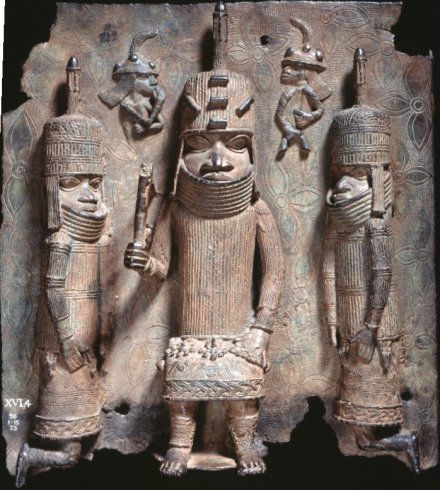
Great Britain’s punitive expedition also resulted in the capture of many hundreds of metal objects scattered to European museums and collections — collectively known as the Benin Bronzes. (It’s a misnomer: they’re actually brass.)

Hocked to defray the expense of their plundering, their diffusion around the empires’ continent helped broaden European appreciation for African art, and influenced modernist art movements. (Notably (pdf) German expressionism: tons of the bronzes ended up in Germany, and many can still be seen at Berlin’s Ethnological Museum.)

Nigeria, and the successor obas of Benin, have for decades besought their return in vain.


Cultural encounter: this Benin “bronze” shows the oba with two attendants, and the smaller floating heads of two European (Portuguese) traders.

More on this object, and its place in the story of Benin and Europe, in this episode of the BBC’s History of the World in 100 Objects; or, at the “bronze’s” page at the British Museum website.

On this day..