1894: Six anarchists in Barcelona

On this date in 1894, on the very day that anarchist terrorist par excellence Emile Henry was guillotined in Paris, six more anarchists were executed by firing squad outside Barcelona’s Montjuich Fortress.

Mariano Cerezuela, Bernat Siveval, Jaime Sogas, Jose Codina, Villarubbia, and Manuel Archs were condemned just weeks prior by a military court for complicity in the attempted assassination earlier that year of Spanish Marshal Arsenio Martinez Campos. Some had originally been rounded up in the general anti-anarchist crackdown after the bombing of the Liceu theater … although another man would be put to death for authoring that crime later in 1894.

Only one of their number, Sogas, died penitent.

In the report of the London Times (May 22, 1894),

[t]he condemned men were conveyed from the chapel, where they had spent the night, to the place of execution by an underground passage, the first two to appear being Sogas and Cerezuela. The former, who confessed last night, joined in the prayers offered by the priest, and he and Cerezuela walked quietly to their doom. The other prisoners, however, shouted all kinds of revolutionary cries. The convicts were placed in line, and at the first shot they all fell to the ground. It was found, however, that in the case of Sogas and Codina the bullets had not taken effect, and a second shot was necessary.

On this day..

1892: Two Georgian bandits, witnessed by Stalin

On this date in 1892, two outlaws were hanged (and a third spared at the last moment) in Gori, Georgia — part of the tsarist Russian Empire.

Josef Djughashvili, the future Stalin, was a teenager when he saw an 1892 public hanging in Gori.

The most noteworthy executioner present on this occasion was not on the scaffold, but in the audience: a 14-year-old student at an orthodox church school named Joseph Djugashvili. You know him by his later, steely revolutionist alias: Stalin.

This precocious, ferocious youth attended the public hanging with school mates to whom he was already a natural leader.

He and his friends sympathized with the doomed Caucasians, so insouciant at being strung up by the tsarist oppressor: conversing after the gruesome spectacle, Djugashvili would maintain that the men had not been consigned to hell, for they had suffered enough in the present.

But this boy was not made for theologizing; though he proceeded to seminary school in Tiflis — the best education prospect for an impoverished family — he disappeared thence into the life of professional revolutionary outlawry.

The recent (and well-received) biography Young Stalin recaptures this scene from Joseph Djugashvili’s youth.

The condemned men had stolen a cow and, in the ensuing pursuit, had killed a policeman. But the boys learned that the criminals were actually just three “peasants who had been so oppressed by landowners that they escaped into the forest,” petty Robin Hoods, attacking only local squires and helping other peasants …

The boys were fascinated. “Soso Djugashvili, me and four other schoolboys climbed a tree and watched the terrifying show from there,” remembers one of the group, Grigory Razmadze … Another spectator whom Stalin would later befriend and promote was Maxim Gorky, then a journalist, soon to be Russia’s most celebrated writer.

The Gorelis sympathized with these brave Caucasian bandits … The crowd became menacing; double ranks of Russian soldiers encircled the square. The drums began to beat. “The authorities in uniforms lingered around the scaffold,” wrote Gorky in his article. “Their dreary and severe faces looked strange and hostile.” They had reason to be nervous.

The three bandits in leg irons were marched onto the scaffold. One was separated from the others — he had been reprieved. The priest offered the two condemned men his blessings; one accepted and one refused. Both asked for a smoke and a sip of water. Sandro Khubuluri was silent, but the handsome and strong “ringleader,” Tato Jioshvili, smiled and joked valiantly before the admiring crowd. He leaned on the railings of the gallows and, noticed Gorky, “chatted to people who had come to see hi die.” The crowd threw stones at the hangman, who was masked and clad completely in scarlet. He placed the condemned on stools and tightened the nooses around their necks. Sandro just twirled his moustache and readjusted the noose. The time had come.

The hangman kicked away the stools. As so often with Tsarist repression, it was inept: Sandro’s rope broke. The crowd gasped. The scarlet hangman replaced him on the stool, placed a new noose round his neck and hanged him again. Tato also took a while to die.


Even Joseph Stalin was a child once.

One would have to really like the difficult-to-prove notion that executions have a brutalizing effect encouraging violence in others in order to see in this hanging the germ of the incomprehensible suffering young master Djugashvili would eventually unleash.

It’s not like this was Stalin’s only childhood exposure to brutality, and not too many of those buddies who watched this date’s hanging grew up to kill 20 million people.

Gori was one of the last towns to practise the ‘picturesque and savage custom’ of free-for-all town brawls with special rules but no-holds-barred violence. The boozing, praying and fighting were all interconnected, with drunken priests acting as referees… [At festivals during Stalin’s youth] the males in each family, from children upwards, also paraded, drinking wine and singing until night fell, when the real fun began. This ‘assault of free boxing’—the sport of krivi—was a ‘mass duel with rules’; boys of three wrestled other three-year-olds, then children fought together, then teenagers and finally the men threw themselves into ‘an incredible battle,’ by which time the town was completely out of control, a state that lasted into the following day—even at school, where classes fought classes.


This is Russia, not Georgia: festive Maslenitsa fisticuffs.

The small Georgian town that spawned the first name in Soviet terror actually maintained a public statue to its most famous son until 2010 — when it was finally removed in an apparent anti-Russian gesture in the wake of the South Ossetia war.

On this day..

1891: Ramon Lopez, a Spaniard, aged 38 years

“Escaped the Rope”

Los Angeles Time, Oct. 21, 1890

SANTA BARBARA, Oct. 20 — [By the Associated Press.] Mary Dezirello, aged 22 years, was shot and instantly killed this morning at 10 o’clock by Ramon Lopez, a Spaniard, aged 38 years. Lopez has been bothering the girl with his attentions for some time past, and had made threats of violence against her, declaring that if she did not marry him she should not marry anyone.

This morning he called at her father’s residence and called her out to the gate. He wanted to make up with her. She refused to have anything to do with him, when he pulled a big Colt’s revolver and shot her through the body. She died almost instantly. Lopez then shot twice at himself, without effect, and then walked away.

Shortly afterwards an officer came up and went toward Lopez’s house, which is in the same block. Lopez fired three shots at the officer without effect and was then arrested and locked up. Threats of lynching were so strongly made that this afternoon the murderer was taken to Ventura for safe keeping.


“Bound to Hang Him”

Los Angeles Times, Oct. 22, 1890

SANTA BARBARA, Oct. 21 — [By the Associated Press.] A vigilance committee was formed here yesterday to avenge the death of Mary Dezirello, the young girl who was murdered early yesterday morning by Ramon Lopez, because she refused to accept the latter’s attentions. The prisoner was taken to Ventura during the afternoon, but the committee did not believe this and last night over one hundred men visited the County Jail and demanded that Lopez be delivered to them.

The keys were given to the leader and the jail and courthouse searched, but the murdered [sic] was not found. The feeling against Lopez is at fever heat, and it is reported that members of the Vigilance Committee have sworn to hang him. The officers in Ventura feared that the crowd would go there to take the prisoner, and this morning Lopez and Edwardo Espinosa, another Santa Barbara murderer, were placed on a train at Ventura and taken to Los Angeles for safe-keeping.

It is reported here tonight that the mother of the murdered girl is dying on account of the tragedy, and that her father is nearly crazed.


“Last Day on Earth”

Los Angeles Times, Jan. 26, 1891

SANTA BARBARA (Cal.) Jan. 25 — [Special.] This was the last day for Ramon Lopez on this terrestrial sphere. Tomorrow, at some time between the hours of 10 and 3, he will be hanged in the jail-yard here for the murder of pretty Mary Dezirello in October last. Everything is in readiness and the rope has been thoroughly tested. He has spent much of the day in company with a priest.

Sheriff Broughton opened the gates to the jail-yard yesterday and today, and hundreds availed themselves of the opportunity to see a scaffold ready for the hangman. There is considerable suppressed excitement over the event. Lopez eats heartily and is cool and quiet. Several peace officers from adjoining counties are already in the city for the purpose of witnessing the execution.

“Only One Hitch; An Artistic Execution at the Channel City”

Los Angeles Times, Jan. 27, 1891

SANTA BARBARA, Jan. 26 — [Special.] Another life has been snuffed out in obedience to the mandates of the law. Ramon E. Lopez was executed on the gallows here today by the Sheriff of this county in a most expeditious and faultless manner. People who have witnessed a large number of executions say that they never saw anything of the kind so perfectly accomplished.

The sentence of Lopez said that he should be hanged by the neck until dead some time between the hours of 10 a.m. and 3 p.m. of today. Sheriff Broughton had not given out what would be the exact time of the hanging. By 10 o’clock, however, a large number of curious people, including a few women, were on the grounds, some of whom, of course, held permits which were to admit the bearers of the jail yard. About this time it was rumored around that the execution would be at 11 o’clock.

THE FAVORED FEW.

At 10:30 o’clock the gate to the jail inclosure was opened, and the ticket-holders were allowed to pass in one at a time, but before they were permitted to pass under the canvas where the scaffold was erected, each one was required to sign his name in a large blank book, which was kept near the entrance. About one hundred and fifty names were registered in this manner in this manner, which constituted probably three-fourths of those who witnessed the execution. At 10:57 o’clock Sheriff Broughton ascended the platform, and, addressing the crowd below, said: “Gentlemen, I think that a proper respect for the prisoner requires that you should all remove your hats and cease smoking when he comes upon the platform. Please do so from that time until the execution is over.”

THE PRISONER’S APPEARANCE.

The speaker then went down the steps and entered the jail, but reappeared almost immediately afterward, accompanied by the prisoner, two deputies and a Catholic priest. The condemned man was dressed in black, wore a plain black tie and carried aloft a large Roman cross. While crossing the yard to the scaffold the priest read aloud in Spanish an invocation from a small book. Lopez walked with a firm, deliberate tread across the grounds and up the steps. A general murmur went through the crowd of “How cool he is!” “What nerve!”

CONFESSED TO THE PRIEST.

The priest then stepped to the edge of the platform, and, looking down upon the heads below, said in broken English: “This man has confessed to me that he is guilty of the crime for which he is about to be hanged; he says that he deserves the punishment, and wishes me to ask all whom he may have offended, to forgive him; he is ready.”

Lopez’s arms and legs were then tied securely by the deputies. In about one minute the black cap was placed over his head, followed immediately by the fatal rope, and at 11:05 Sheriff Broughton pressed the pedal to the platform with his right foot, the trap door was free, and the condemned

SHOT LIKE AN ARROW

through the aperture beneath him, a distance of six and a half feet, and there he remained suspended for fifteen minutes, during which time not one tremor or convulsion of any kind was discernable. His neck had been dislocated by the fall, and he moved not a muscle.

The body vibrated very slightly but did not turn round, and remained exactly was when it dropped. This was considered very remarkable by the crowd. The knot, which had been placed under the left ear, by some means slipped around almost under the center of the chin.

THE BODY CUT DOWN.

At the end of the time mentioned the corpse was lowered into a coffin and was taken away by a local undertaker. Two physicians took turns testing the heart’s action and one of them reported to the Sheriff that “the prisoner is dead” at the end of the fifteenth minute.

The condemned man uttered not a word during the ordeal of the final preparations. Immediately after he ascended the platform the town clock struck eleven times. Lopez soon after turned his face to the south and upward, and seemed for a moment to

GAZE FULL UPON THE SUN,

which shone in uninterrupted rays upon him. This was his only voluntary act while on the platform, except kissing the cross, which the priest placed to his lips. The rest of the time he stood perfectly still with his eyes closed, and was apparently the most composed man on the platform.


“The Crime and Criminal”

Los Angeles Times, Jan. 27, 1891

SANTA BARBARA, Jan. 26 — [Special.] For days and days almost the sole topic of conversation here among all classes has been the forthcoming execution of Ramon E. Lopez. This was partly the result of the extraordinary nature of his crime, for which he has suffered death, and partly from the fact that it is the first legal execution ever held in the county. During these days of discussion the condemned man has occupied a small cell upstairs in the county jail, under the eyes of the “death watch,” pacing up and down in his small room or lying stretched out on his cot, conversing with the attendants or an occasional visitor, or playing on his favorite instrument — the guitar.

RESIGNED TO HIS FATE.

He was a small, compactly built Spaniard with a typical Castilian face and a very large head which required a 7 1/2 hat. When seen by your correspondent a few days ago he was perfectly calm and collected, and seemed everyway resigned to his impending fate. He was asked if he had any statement for the public, but answered in the negative and added: “The poor girl I loved so well, is gone to her long home; I shall soon go too. I am ready; there is nothing more to be said.”

I learn that Lopez was a man of considerable intellectual attainments, being especially well versed in the history of his own and contemporary nations. He was a natural mechanic of unusual skill. He had worked at the blacksmith’s trade, but of late years was principally engaged in repairing complicated machinery, including watches and clocks. He was born and raised in this city and was 38 years of age. He has relatives in Los Angeles, Ventura and San Jose.

LOPEZ’S CRIME.

The murder he committed was among the most atrocious and inexcusable known to the annals of crime. About 8 o’clock in the morning of October 20, last, he called at the home of his victim in one of the principal residence streets of this city, summoned her to his side, and without even the pretext of a personal quarrel, shot her down on the spot. She was his sweetheart, and they had been engaged to be married. Her parents were opposed to the match and she felt compelled to break off the engagement, and for this she lost her life! Her name was Mary Dezirello, and she was young, beautiful, and accomplished.

WANTED TO LYNCH HIM.

The reading public will probably remember the frantic attempts of a mob which came near lynching the murderer, and of his being spirited away by the officers to Ventura, and later to Los Angeles, in order to save his neck. He remained in the Los Angeles County Jail for a month and was then returned to this city. He was tried in December last and promptly convicted of murder in the first degree, the jury occupying only twenty minutes in finding a verdict.

ANOTHER VICTIM.

But this was not his only crime. He killed Henry Heldt in Los Angeles in 1883, in a row at a dance, and got three years at San Quentin for manslaughter, but was pardoned out a few years since by Gov. Stoneman. Lopez has not been guilty of any of the smaller vices so common to murderers. On the contrary, he has generally led a quiet, peaceable and industrious life, but has always been known to possess an ungovernable temper.

THE SOLACE OF RELIGION.

During the last few days of his life he was under the almost constant tutorage of his father confessor. His prison life has otherwise been quiet and uneventful. A few Christian ladies did, occasionally, visit him and pray and sing in his presence. He was always attentive and respectful to them, and generally asked them to return again. There has been a notable lack of that sickly sentimentality in his case so often displayed by the morbid and curious. It may be worth while to state that after the murder, and before he left the spot, Lopez fired two shots over his own head as if to take his own life; but he seems to have exercised considerable caution in doing so, since neither of the shots took effect.

A STRANGE ADVERTISEMENT.

A few days before the killing this extraordinary notice appeared over Lopez’s signature in one of the local papers:

All those desiring to marry a certain girl might be on the lookout, as their steps, manners and customs will be made known through the press next week in a historical point of view.

This was no doubt meant for a threat against any gentleman who might sue for the girl’s hand in marriage.

THE INSTRUMENT OF DEATH.

The scaffold, which was erected in a corner of the jail yard, has been ready since Friday last, and has been viewed by hundreds of people who were admitted to the premises by the Sheriff. The framework and platform of this scaffold was made in San Bernardino several years ago and its first service was in the case of the murderer McDowell, about the year 1883. Since that time it has done yeoman’s service in “removing” Silvas and Martinez in Los Angeles. It was also got in readiness to add dramatic effect to the taking off of one [Fritz] Anschlag, but that accomplished butcher chose his own method of quitting the earth, and cheated this useful instrument. It was shipped here from Los Angeles several days ago, and althrough it looks a little scarred and weather-beaten, seems sufficient for much substantial service in behalf of good society yet.

On this day..

1896: Fred Behme, evangelical Methodist

On this date in 1896, McLeansboro, Ill. hosted its only hanging.

German emigre Fred Behme was settled into married life when he converted from Catholicism to Methodism.

Unfortunately — so Behme saw it — his wife Mary didn’t hew to the old cuius region, eius religio principle where the man of the house was concerned, and stuck with the bishop of Rome for the salvation of her immortal soul.

And there’s just something about the zeal of a convert.

Fred Behme’s domestic missionary work grew more violent (pdf), and eventually his battered spouse moved out; when Fred coaxed her back, and found out that she’d baptized their infant son into idolatrous Catholicism while living apart from him, he chose Easter Sunday to commit what one newspaper called “one of the most hideous and blood-thirsty crimes that ever stained the good name and honor of McLeansboro”: Fred got the other kids out of the house, he attacked Mary with an axe,

drug her by the hair into the yard, and beat in the side of her head. He covered the body with corn fodder. He then took the little boy [whom Mary had baptized] to the barn and hanged him by the neck until he died. (Source)

Though the hanging was invitation-only, it was visible from McLeansboro’s public square and large crowds gathered to witness the hirsute Protestant check out with a short speech in German.

Wikipedia alleges (without a clear source indication) that one G. Phil Hanna was among this multitude, and that seeing Behme strangle to death on an inexpertly deployed rope launched a lifelong interest in the hangman’s craft that would culminate when Hanna pinch-hit on the execution team that carried out America’s last public hanging 40 years later. Others of less august accomplishment no less vividly recalled their (and their town’s) one-time walk through the valley of death.


The family that prays together … (The perp is the bearded man; the victims are the woman seated next to him, and the child in her lap.)

On this day..

1895: Not Almighty Voice

On October 22, 1895, Cree warrior Almighty Voice was arrested for the considerable crime of killing a cow without the right permit. When a white guard japed that workmen were “erecting a scaffold from which you will be hanged next morning” — actually, they were putting up a building — it set off one of the longest and bloodiest manhunts in Saskatchewan history.

Almighty Voice took the prospect of having his neck stretched this date seriously enough to break out of prison the night of October 22-23.

A week later, a Mountie tried to arrest Almighty Voice and was shot dead for his trouble. From a spurious criminal complaint that likely would not have been pursued, the specter of the gallows had sent Almighty Voice into wanted-outlaw status.

For a year and a half he mostly avoided detection, and if the other Cree on his reservation had knowledge of his whereabouts, the government’s $500 reward was not enough to induce them to supply it.

In May 1897, Almighty Voice and two fellow-travelers were finally caught in a shootout. The Cree did just fine in this exchange, but two more Mounties and (for some reason) a postmaster were not so lucky.

The next day, the Mounties turned cannon on the Indians’ position, finally killing the three of them in the bombardment — or else inducing them to kill themselves.

Nineteen months on, seven men were dead on account of our guard’s ill-chosen bit of gallows “humor.” Hardy-har-har. But Almighty Voice remains a legendary name in Saskatchewan.

On this day..

1896: Chief Chingaira Makoni, Rhodesian rebel

On this date in 1897, the British captured, then summarily tried and shot, one of the most persistent native rebels of the Second Matabele War — or (since that’s the colonial British designation), the Chimurenga, or revolutionary struggle of what would become present-day Zimbabwe.

At this point, it was “Rhodesia”, named for imperialist wizard Cecil Rhodes. It was his British South Africa Company, relentlessly pursuing mineral exploitation,* that had pushed the Union Jack into this land.

For natives, of course, that meant dispossession by white settlers, with all the attendant conflicts.

Chief Chingaira of the Makoni district was one of these: “what annoyed him most was the pegging-out of the whole of his territory for farms or gold claims.”

That’s the sort of thing to annoy a man right into outright hostility — resource conflicts, after all, would soon put British and Dutch settlers into their own war, with memorable results for death penalty history.

Not the less affronted, Makoni rose in the Ndebele-Shona chimurenga of 1896-97.** Though the revolt was defeated, its progress ultimately would claim the lives of 372 settlers — one-tenth of Rhodesia’s white settler population.

Chingaira Makoni and a few dozen of his supporters were besieged from the end of August 1896 in a cave, and forced out after several days by dynamite and pledges of safe conduct. Makoni emerged into capture in the dark of night September 3-4, but as described in this public-domain history of Rhodesia, initial plans for some regular trial were hastily discarded upon the escape of some of his fellows.

… [after capture] it was feared that if Makoni should escape … the whole district would be in a blaze, and that the safety of Umtali itself might be endangered. A court-martial was therefore convened to try him, one of the native commissioners being appointed to act as interpreter, and as his defender. In spite of his assertion that he was innocent, he was found guilty of being a rebel, and of having caused the murder of the three traders; he was therefore sentenced to be shot, and the sentence was carried out at once. He was placed with his back to a corn-bin, on the edge of the precipice on which his kraal stood, and died with a courage and dignity that extorted an unwilling admiration from all who were present. One of the best known men in Salisbury, when talking to me about it, said, “I know of nothing grander than Makoni’s death, than the quiet way in which he spoke to his people, and told them to abstain from further resistance; for himself he only begged that he might be buried decently. ‘And now,’ he said, ‘you shall see how a Makoni can die.'”

As with so many entrants in these dolorous pages, the end of the vital signs were not the end of the story. In consequence of Makoni’s martyrdom:

  • The officer who ordered his drumhead trial and execution was himself court-martialed — but acquitted
  • Makoni’s head was allegedly (pdf) hewed off as a trophy (legend has it being sent to Cecil Rhodes† himself)
  • Chingaira Makoni was elevated into the national mythology of (eventually) Zimbabwe

Though it does not deal in any great detail with our day’s principal, this narrative of the campaign by one of the white soldiers involved makes topical reading.

* Rhodes also founded the De Beers diamond mining colossus.

** Actually (and this is a scholarly pdf),

Academic historians have debated whether or not Chingaira Makoni was really a resister, or whether he did not merely stumble into confrontation with the whites, or whether, indeed, he did nothing at all and was merely a victim of white paranoia. These revisionist debates are very remote from the terms of the Chingaira myth in Makoni in the 1970s. In the myth Chingaira was unequivocally the embodiment of resistance; the hero ambiguously slain; buried, no-one was quite sure where; maybe to come again.

The source cited for this entry’s description of Makoni’s death actually upholds the “he didn’t actually rebel at all” position in its chapter on Makoni.

† Rhodes’s disastrous Jameson Raid on the neighboring Transvaal Republic had itself set the stage for the second Matabele Rebellion by depleting Rhodesian troop strength. It also got brother Frank Rhodes sentenced to death — a sentence later commuted.

On this day..

1892: Ruggles brothers lynched

On this date in 1892, highway robbers John and Charles Ruggles were shanghaied from a Redding, Calif. jail and lynched.


John and Charles Ruggles, lynched in Redding, Calif.

These two charmers knocked over the Redding & Weaverville stage on May 14, 1892, killing the coach’s guard when he fired back.

Charles Ruggles was wounded in the exchange and soon captured, but John Ruggles got away with the lockbox.

With a price on his head, John secreted the stolen loot somewhere and was not arrested until June 19.

Reunited in jail, the handsome outlaws were evidently a big hit with the ladies. As the Los Angeles Times reported on July 25, 1892,

The recent sentimental attitude of a number of women toward the prisoners as well as the line of defense adopted by their counsel, who has been evidently endeavoring to implicate Messenger [Amos “Buck”] Montgomery [the dead victim] as a party to the crime, had been denounced by a number of persons in the county and it is believed the lynching was due to those causes.

When the vigilantes came for him, John tried to buy the boys’ way out of trouble — or at least, buy Charley’s way out — by offering to reveal the location of his treasure.

The mob wasn’t interested, and the cache has never been found since. On the other hand …

The lynching of a brace of stage-robbers at Redding a few nights ago was not at all in accordance with law and order; but that it will have a discouraging effect on the “hold-up” industry, there is little question. It will be perfectly safe to indulge in stage rides in Shasta county, no doubt, for some time to come.

Los Angeles Times, July 27, 1892

On this day..

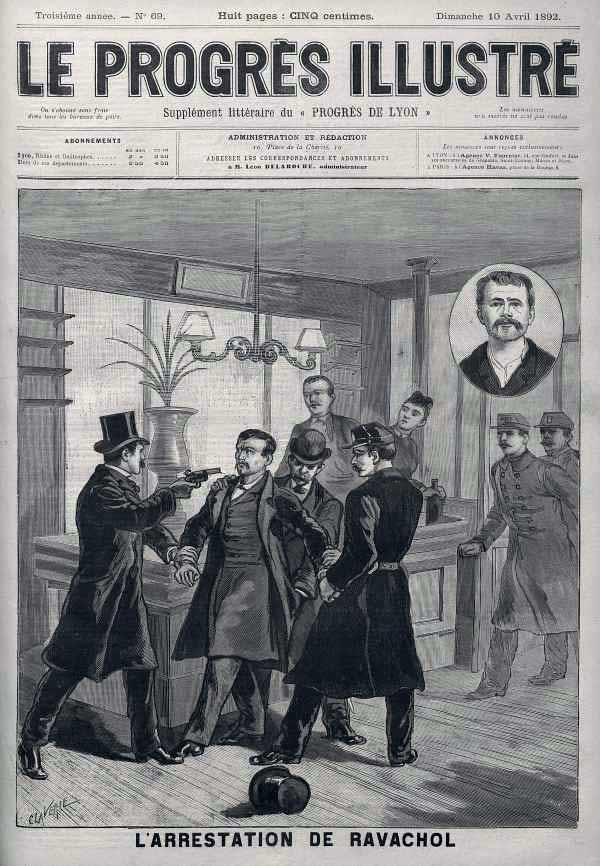
1892: Ravachol, anarchist terrorist

On this date in 1892, French anarchist François Claudius Koenigstein — better known as Ravachol — was guillotined at Montbrison for a series of bomb attacks on right-wing judges.

He took the name “Ravachol”, his mother’s, after his Dutch father ditched his mom, leaving the family in poverty.

Young Ravachol supported himself as best he could in proletarian labor and crime, as he attempted to observe* at his trial.

Ravachol, as painted by Charles Maurin.

There are many people who will feel sorry for the victims, but who’ll tell you they can’t do anything about it. Let everyone scrape by as he can! What can he who lacks the necessities when he’s working do when he loses his job? He has only to let himself die of hunger. Then they’ll throw a few pious words on his corpse. This is what I wanted to leave to others. I preferred to make of myself a trafficker in contraband, a counterfeiter, a murderer and assassin. I could have begged, but it’s degrading and cowardly and even punished by your laws, which make poverty a crime. If all those in need, instead of waiting took, wherever and by whatever means, the self-satisfied would understand perhaps a bit more quickly that it’s dangerous to want to consecrate the existing social state, where worry is permanent and life threatened at every moment.

Personal want segued into political conviction for Ravachol, whose crimes were justified by the principle of reprise individuelle.

And the political led him to reprisals of a less individual nature, when French state violence against radicals caused him to dynamite several magistrates’ homes.

He was caught in a restaurant,** brought to trial, and let off with penal servitude for life. Then another jury, intimidated by public outcry, reversed the decision and sent him to the guillotine.

The Banquet Years: The Origins of the Avant-Garde in France 1885 to World War I, which argues that anarchists “unsettle[d] the political smugness of the Third Republic … [and] challenge[d] any formulated aesthetic. The dynamism of prewar artistic activity ran a close parallel to anarchism; postwar Dada and surrealism look like its artistic parodies†.”

Anarchism, that revolutionary specter stalking fin-de-siecle Europe, burnt its fuse at both ends, but Ravachol’s falling head‡ left a legacy for his fellow-travelers. The next year, Auguste Vaillant tossed a bomb into the French Chamber of Deputies to avenge Ravachol. (Vaillant was himself guillotined, and himself avenged by Emile Henry and Sante Geronimo Caserio.)

Ravachol was also honored in a song, La Ravachole — set to the jauntily menacing tune of La Carmagnole, it cheers, “Long live the sound of the explosion!”

* This incendiary speech was cut off by the court.

** The table where the terrorist was nabbed got its own inscription: “Here ate Ravachol the day of his arrest.”

† e.g., Dadaist Marcel Janco‘s recollection:

We had lost confidence in our culture. Everything had to be demolished. We would begin again after the ‘tabula rasa’. At the Cabaret Voltaire we began by shocking common sense, public opinion, education, institutions, museums, good taste, in short, the whole prevailing order.

‡ Ravachol was guillotined midway through a parting exclamation, “Vive la Re-“. Initial newspaper reports implausibly rendered this as the patriotic classic “Vive la Republique!” rather than a much more in-character word like, oh, “Revolution”.

Weeks of controversy ensued over some witnesses’ claims that the head post-severing had actually completed the word “-publique”, a notion of a piece with the idea that the severed head survives decapitation by a few seconds. Scienticians countered that obviously excited witnesses were maybe hearing air escaping from the headless trunk and filling in the rest of the scene in their heads.

On this day..

1890: Major Panitza, by Stefan Stambolov

Sophia, June 28, 1890

With reference to my telegram of this day’s date, I have the honour to report that this morning Major Panitza was conducted from his place of confinement in town to the camp of Bali Effendi, close to Sophia, where the troops are quartered for the summer, and in presence of the whole brigade drawn up in military file he was shot by a peloton of twenty-four soldiers.

Major Panitza fell uttering the cry, “Long live Bulgaria.”

After the execution, Major Marinoff, the Commandant of the Sophia garrison, addressed a short speech to the troops, in which he said that Major Panitza had met his death in just punishment for treason against his Prince and country, and that a similar fate would be dealt out to whosoever should prove a traitor to the interests of the Fatherland.

The troops maintained a perfectly impassive attitude throughout the proceedings, and the execution of the condemned in the presence of the garrison shows that the Government wished to make an example which should be a warning to the officers to refrain from the political intrigues that had during the last few years become so prevalent, and that were dangerously undermining the discipline and loyalty of the army.

British and foreign state papers, vol. 83

Having recently gained independence by backing its Slavic brethren against its longtime Ottoman master in the Russo-Turkish War, Bulgaria was enjoying all the perquisites of being a minor power pressed between major powers.

The leading concern of its able, authoritarian, and justifiably paranoid leader* Stefan Stambolov — “the only Prime Minister in Europe who receives his visitors with a revolver lying next to the ink-stand on his desk,” in the New York Times’ description — was the interest of Bulgaria’s “benefactors” in St. Petersburg in turning this breakaway Ottoman province into an ever more pliant Russian instrument.

Whether it was the coreligionists or their coin who inspired it, many in Bulgaria felt sincere loyalty to Russia; in an age of empires, it wouldn’t have been unreasonable statecraft to opt for the security of dependency.

With that object in mind, Major Panitza hatched a dangerous plot to overturn the Bulgarian government. His plot conjured an equally dangerous reprisal from Stambolov — who was determined to keep as much independence as Bulgaria could sustain.

Despite fairly widespread sympathy in the army and the populace for Panitza’s plot, and of course in the face of entreaties of Russia, Stambolov had the execution carried out with impolitic dispatch just weeks after the court-martial did its work.**

Many outside of Bulgaria saw statesmanlike quality in Stambolov, but his severe rule exemplified by his unpopular ruthlessness towards Major Panitza made him many enemies at home. Stambolov was himself assassinated shortly after resigning from government in 1895, and his corpse abused en route to its resting place.

* Generally transliterated “Stambouloff” or “Stambuloff” during his own lifetime, this gentleman got control of the state by mounting a counter-coup against a Russian putsch. Since the Russians still succeeded in definitively dethroning the sitting Bulgarian king, Stambolov’s hand alone guided the unsteady Bulgarian ship of state for a time.

Stambolov eventually installed an Austro-Hungarian noble as Prince Ferdinand I (the two came to hate each other). Later titled “tsar”, Ferdinand was the grandfather of Simeon II, who achieved the unusual distinction of becoming Prime Minister of Bulgaria through democratic election in 2001.

** Panitza’s co-conspirators got various prison terms, including the former Commandant of the Sofia garrison, a gentleman sporting the Strangelovian moniker Lieutenant-Colonel Kissoff.

On this day..

1896: Bill Gay, prospector

This date in 1896 saw the Helena, Mont., hanging of frontiersman Bill Gay.


A ticket to Bill Gay’s hanging in December 1895 — which was, obviously, postponed.

As a prospector a generation earlier, Bill Gay had actually struck gold in the Black Hills, not far from Deadwood, S.D. The settlement that grew up around his claim, Gayville, was briefly in contention to be a key entrepot in the covered-wagon trade stripping Sioux land of precious metals.

Alas, Gayville burned down and became a ghost town, just like its founder became a ghost.

Maybe it was Bill Gay’s candle burning at both ends that caused the conflagration. The temporarily wealthy Gay (sporting furniture imported from the east coast!) had the pull to marry a dance-hall hottie … just, not so much pull that he had total impunity to ice a younger rival for his wife’s affections. After serving a turn in the clink for that murder — an abbreviated turn; the guy was rich, after all — Gay was back to square one as a prospecting plainsman, and moved on to Montana.

In Castle, Mont., where he settled (another mining camp later turned ghost town; see Ghost Towns of Montana), Gay fell into a mighty feud with local newspaperman John Benson.

When Benson’s establishment “mysteriously” burned down, a posse was detailed to bring in Gay, along with Gay’s brother-in-law. They killed a couple of deputies in the process of (successfully) blowing town; the in-law, Harry Gross, was never caught, but Gay was apprehended in California and returned to face the music.

Despite the Herculean efforts of his daughter, Maud — the wire report of the hanging (this one printed in the next day’s Omaha Morning World-Herald) complained that “never in the history of Montana have more efforts been made to save a criminal a neck” — he hanged this morning, still protesting that old Harry Gross had been the dead-eyed triggerman.

There’s a nice exposition of Bill Gay’s life from Wild West magazine reprinted at HistoryNet.com.

Bill Gay has no known connection to New York City piano lounge Bill’s Gay Nineties, which is an obvious oversight on someone’s part.

On this day..