1896: H. H. Holmes, America’s first serial killer

(Thanks for the public-domain “guest post” on prolific serial killer H.H. Holmes to Harry Brodribb Irving, from his A Book of Remarkable Criminals (Google Books | Project Gutenberg). Also enjoy The Holmes-Pitezel Case (1896).)

Honour Amongst Thieves

In the year 1894 Mr. Smith, a carpenter, of Philadelphia, had patented a new saw-set. Wishing to make some money out of his invention, Mr. Smith was attracted by the sign:

B. F. PERRY
PATENTS BOUGHT AND SOLD

which he saw stretched across the window of a two-storied house, 1,316 Callowhill Street. He entered the house and made the acquaintance of Mr. Perry, a tall, dark, bony man, to whom he explained the merits of his invention. Perry listened with interest, and asked for a model. In the meantime he suggested that Smith should do some carpenter’s work for him in the house. Smith agreed, and on August 22, while at work there saw a man enter the house and go up with Perry to a room on the second story.

A few days later Smith called at Callowhill Street to ask Perry about the sale of the patent. He waited half an hour in the shop below, called out to Perry who, he thought, might be in the rooms above, received no answer and went away. Next day, September 4, Smith returned, found the place just as he had left it the day before; called Perry again, but again got no answer. Surprised, he went upstairs, and in the back room of the second story the morning sunshine, streaming through the window, showed him the dead body of a man, his face charred beyond recognition, lying with his feet to the window and his head to the door. There was evidence of some sort of explosion: a broken bottle that had contained an inflammable substance, a broken pipe filled with tobacco, and a burnt match lay by the side of the body.

The general appearance of the dead man answered to that of B. F. Perry. A medical examination of the body showed that death had been sudden, that there had been paralysis of the involuntary muscles, and that the stomach, besides showing symptoms of alcoholic irritation, emitted a strong odour of chloroform. An inquest was held, and a verdict returned that B. F. Perry had died of congestion of the lungs caused by the inhalation of flame or chloroform. After lying in the mortuary for eleven days the body was buried.

In the meantime the Philadelphia branch of the Fidelity Mutual Life Association had received a letter from one Jephtha D. Howe, an attorney at St. Louis, stating that the deceased B. F. Perry was Benjamin F. Pitezel of that city, who had been insured in their office for a sum of ten thousand dollars. The insurance had been effected in Chicago in the November of 1893. Mr. Howe proposed to come to Philadelphia with some members of the Pitezel family to identify the remains. Referring to their Chicago branch, the insurance company found that the only person who would seem to have known Pitezel when in that city, was a certain H. H. Holmes, living at Wilmette, Illinois. They got into communication with Mr. Holmes, and forwarded to him a cutting from a newspaper, which stated erroneously that the death of B. F. Perry had taken place in Chicago.

On September 18 they received a letter from Mr. Holmes, in which he offered what assistance he could toward the identification of B. F. Perry as B. F. Pitezel. He gave the name of a dentist in Chicago who would be able to recognise teeth which he had made for Pitezel, and himself furnished a description of the man, especially of a malformation of the knee and a warty growth on the back of the neck by which he could be further identified. Mr. Holmes offered, if his expenses were paid, to come to Chicago to view the body. Two days later he wrote again saying that he had seen by other papers that Perry’s death had taken place in Philadelphia and not in Chicago, and that as he had to be in Baltimore in a day or two, he would run over to Philadelphia and visit the office of the Fidelity Life Association.

On September 20 the assiduous Mr. Holmes called at the office of the Association in Philadelphia, inquired anxiously about the nature and cause of Perry’s death, gave again a description of him and, on learning that Mr. Howe, the attorney from St. Louis, was about to come to Philadelphia to represent the widow, Mrs. Pitezel, and complete the identification, said that he would return to give the company any further help he could in the matter. The following day Mr. Jephtha D. Howe, attorney of St. Louis, arrived in Philadelphia, accompanied by Alice Pitezel, a daughter of the deceased. Howe explained that Pitezel had taken the name of Perry owing to financial difficulties. The company said that they accepted the fact that Perry and Pitezel were one and the same man, but were not convinced that the body was Pitezel’s body. The visit of Holmes was mentioned. Howe said that he did not know Mr. Holmes, but would be willing to meet him. At this moment Holmes arrived at the office. He was introduced to Howe as a stranger, and recognised as a friend by Alice Pitezel, a shy, awkward girl of fourteen or fifteen years of age. It was then arranged that all the parties should meet again next day to identify, if possible, the body, which had been disinterred for that purpose.

The unpleasant duty of identifying the rapidly decomposing remains was greatly curtailed by the readiness of Mr. Holmes. When the party met on the 22nd at the Potter’s Field, where the body had been disinterred and laid out, the doctor present was unable to find the distinctive marks which would show Perry and Pitezel to have been the same man. Holmes at once stepped into the breach, took off his coat, rolled up his sleeves, put on the rubber gloves, and taking a surgeon’s knife from his pocket, cut off the wart at the back of the neck, showed the injury to the leg, and revealed also a bruised thumb-nail which had been another distinctive mark of Pitezel. The body was then covered up all but the teeth; the girl Alice was brought in, and she said that the teeth appeared to be like those of her father. The insurance company declared themselves satisfied, and handed to Mr. Howe a cheque for 9,175 dollars, and to Mr. Holmes ten dollars for his expenses. Smith, the carpenter, had been present at the proceedings at the Potter’s Field. For a moment he thought he detected a likeness in Mr. Holmes to the man who had visited Perry at Callowhill Street on August 22 and gone upstairs with him, but he did not feel sure enough of the fact to make any mention of it.

In the prison at St. Louis there languished in the year 1894 one Marion Hedgspeth, serving a sentence of twenty years’ imprisonment for an audacious train robbery. On the night of November 30, 1891, the “‘Friscow express from St. Louis had been boarded by four ruffians, the express car blown open with dynamite, and 10,000 dollars carried off. Hedgspeth and another man were tried for the robbery, and sentenced to twenty years’ imprisonment. On October 9, 1894, Hegspeth{sic} made a statement to the Governor of the St. Louis prison, which he said he wished to be communicated to the Fidelity Mutual Life Association. In the previous July Hedgspeth said that he had met in the prison a man of the name of H. M. Howard, who was charged with fraud, but had been released on bail later in the month. While in prison Howard told Hedgspeth that he had devised a scheme for swindling an insurance company of 10,000 dollars, and promised Hedgspeth that, if he would recommend him a lawyer suitable for such an enterprise, he should have 500 dollars as his share of the proceeds. Hedgspeth recommended Jephtha D. Howe. The latter entered with enthusiasm into the scheme, and told Hedgspeth that he thought Mr. Howard “one of the smoothest and slickest” men he had ever known. A corpse was to be found answering to Pitezel’s description, and to be so treated as to appear to have been the victim of an accidental explosion, while Pitezel himself would disappear to Germany. From Howe Hedgspeth learnt that the swindle had been carried out successfully, but he had never received from Howard the 500 dollars promised him. Consequently, he had but little compunction in divulging the plot to the authorities.

It was realised at once that H. M. Howard and H. H. Holmes were the same person, and that Jephtha D. Howe and Mr. Holmes were not the strangers to each other that they had affected to be when they met in Philadelphia. Though somewhat doubtful of the truth of Hedgspeth’s statement, the insurance company decided to set Pinkerton’s detectives on the track of Mr. H. H. Holmes. After more than a month’s search he was traced to his father’s house at Gilmanton, N. H., and arrested in Boston on November 17.

Inquiry showed that, early in 1894, Holmes and Pitezel had acquired some real property at Fort Worth in Texas and commenced building operations, but had soon after left Texas under a cloud, arising from the theft of a horse and other dubious transactions.

Holmes had obtained the property at Fort Worth from a Miss Minnie Williams, and transferred it to Pitezel. Pitezel was a drunken “crook,” of mean intelligence, a mesmeric subject entirely under the influence of Holmes, who claimed to have considerable hypnotic powers. Pitezel had a wife living at St. Louis and five children, three girls–Dessie, Alice, and Nellie–a boy, Howard, and a baby in arms. At the time of Holmes’ arrest Mrs. Pitezel, with her eldest daughter, Dessie, and her little baby, was living at a house rented by Holmes at Burlington, Vermont. She also was arrested on a charge of complicity in the insurance fraud and brought to Boston.

Two days after his arrest Holmes, who dreaded being sent back to Texas on a charge of horse-stealing, for which in that State the punishment is apt to be rough and ready, made a statement to the police, in which he acknowledged the fraud practised by him and Pitezel on the insurance company. The body substituted for Pitezel had been obtained, said Holmes, from a doctor in New York, packed in a trunk and sent to Philadelphia, but he declined for the present to give the doctor’s name. Pitezel, he said, had gone with three of his children–Alice, Nellie and Howard–to South America. This fact, however, Holmes had not communicated to Mrs. Pitezel. When she arrived at Boston, the poor woman was in great distress of mind. Questioned by the officers, she attempted to deny any complicity in the fraud, but her real anxiety was to get news of her husband and her three children. Alice she had not seen since the girl had gone to Philadelphia to identify the supposed remains of her father. Shortly after this Holmes had come to Mrs. Pitezel at St. Louis, and taken away Nellie and Howard to join Alice, who, he said, was in the care of a widow lady at Ovington, Kentucky. Since then Mrs. Pitezel had seen nothing of the children or her husband. At Holmes’ direction she had gone to Detroit, Toronto, Ogdensberg and, lastly, to Burlington in the hope of meeting either Pitezel or the children, but in vain. She believed that her husband had deserted her; her only desire was to recover her children.

On November 20 Holmes and Mrs. Pitezel were transferred from Boston to Philadelphia, and there, along with Benjamin Pitezel and Jephtha D. Howe, were charged with defrauding the Fidelity Life Association of 10,000 dollars. Soon after his arrival in Philadelphia Holmes, who was never averse to talking, was asked by an inspector of the insurance company who it was that had helped him to double up the body sent from New York and pack it into the trunk. He replied that he had done it alone, having learned the trick when studying medicine in Michigan. The inspector recollected that the body when removed from Callowhill Street had been straight and rigid. He asked Holmes what trick he had learnt in the course of his medical studies by which it was possible to re-stiffen a body once the rigor mortis had been broken. To this Holmes made no reply. But he realised his mistake, and a few weeks later volunteered a second statement. He now said that Pitezel, in a fit of depression, aggravated by his drinking habits, had committed suicide on the third story of the house in Callowhill Street. There Holmes had found his body,carried it down on to the floor below, and arranged it in the manner agreed upon for deceiving the insurance company. Pitezel, he said, had taken his life by lying on the floor and allowing chloroform to run slowly into his mouth through a rubber tube placed on a chair. The three children, Holmes now stated, had gone to England with a friend of his, Miss Minnie Williams.

Miss Minnie Williams was the lady, from whom Holmes was said to have acquired the property in Texas which he and Pitezel had set about developing. There was quite a tragedy, according to Holmes, connected with the life of Miss Williams. She had come to Holmes in 1893, as secretary, at a drug store which he was then keeping in Chicago. Their relations had become more intimate, and later in the year Miss Williams wrote to her sister, Nannie, saying that she was going to be married, and inviting her to the wedding. Nannie arrived, but unfortunately a violent quarrel broke out between the two sisters, and Holmes came home to find that Minnie in her rage had killed her sister. He had helped her out of the trouble by dropping Nannie’s body into the Chicago lake. After such a distressing occurrence Miss Williams was only too glad of the opportunity of leaving America with the Pitezel children. In the meantime Holmes, under the name of Bond, and Pitezel, under that of Lyman, had proceeded to deal with Miss Williams’ property in Texas.

For women Holmes would always appear to have possessed some power of attraction, a power of which he availed himself generously. Holmes, whose real name was Herman W. Mudgett, was thirty-four years of age at the time of his arrest. As a boy he had spent his life farming in Vermont, after which he had taken up medicine and acquired some kind of medical degree. In the course of his training Holmes and a fellow student, finding a body that bore a striking resemblance to the latter; obtained 1,000 dollars from an insurance company by a fraud similar to that in which Holmes had engaged subsequently with Pitezel. After spending some time on the staff of a lunatic asylum in Pennsylvania, Holmes set up as a druggist in Chicago. His affairs in this city prospered, and he was enabled to erect, at the corner of Wallace and Sixty-Third Streets, the four-storied building known later as “Holmes Castle.” It was a singular structure. The lower part consisted of a shop and offices. Holmes occupied the second floor, and had a laboratory on the third. In his office was a vault, air proof and sound proof. In the bathroom a trap-door, covered by a rug, opened on to a secret staircase leading down to the cellar, and a similar staircase connected the cellar with the laboratory. In the cellar was a large grate. To this building Miss Minnie Williams had invited her sister to come for her wedding with Holmes, and it was in this building, according to Holmes, that the tragedy of Nannie’s untimely death occurred.


“Holmes Castle”

In hoping to become Holmes’ wife, Miss Minnie Williams was not to enjoy an exclusive privilege. At the time of his arrest Holmes had three wives, each ignorant of the others’ existence. He had married the first in 1878, under the name of Mudgett, and was visiting her at Burlington, Vermont, when the Pinkerton detectives first got on his track. The second he had married at Chicago, under the name of Howard, and the third at Denver as recently as January, 1894, under the name of Holmes. The third Mrs. Holmes had been with him when he came to Philadelphia to identify Pitezel’s body. The appearance of Holmes was commonplace, but he was a man of plausible and ingratiating address, apparent candour, and able in case of necessity to “let loose,” as he phrased it, “the fount of emotion.”

The year 1895 opened to find the much enduring Holmes still a prisoner in Philadelphia. The authorities seemed in no haste to indict him for fraud; their interest was concentrated rather in endeavouring to find the whereabouts of Miss Williams and her children, and of one Edward Hatch, whom Holmes had described as helping him in arranging for their departure. The “great humiliation” of being a prisoner was very distressing to Holmes.

“I only know the sky has lost its blue,
The days are weary and the night is drear.”

These struck him as two beautiful lines very appropriate to his situation. He made a New Year’s resolve to give up meat during his close confinement. The visits of his third wife brought him some comfort. He was “agreeably surprised” to find that, as an unconvicted prisoner, he could order in his own meals and receive newspapers and periodicals. But he was hurt at an unfriendly suggestion on the part of the authorities that Pitezel had not died by his own hand, and that Edward Hatch was but a figment of his rich imagination. He would like to have been released on bail, but in the same unfriendly spirit was informed that, if he were, he would be detained on a charge of murder. And so the months dragged on. Holmes, studious, patient, injured, the authorities puzzled, suspicions, baffled — still no news of Miss Williams or the three children. It was not until June 3 that Holmes was put on his trial for fraud, and the following day pleaded guilty. Sentence was postponed.

The same day Holmes was sent for to the office of the District Attorney, who thus addressed him: “It is strongly suspected, Holmes, that you have not only murdered Pitezel, but that you have killed the children. The best way to remove this suspicion is to produce the children at once. Now, where are they?” Unfriendly as was this approach, Holmes met it calmly, reiterated his previous statement that the children had gone with Miss Williams to England, and gave her address in London, 80 Veder or Vadar Street, where, he said, Miss Williams had opened a massage establishment. He offered to draw up and insert a cipher advertisement in the New York Herald, by means of which, he said, Miss Williams and he had agreed to communicate, and almost tearfully he added, “Why should I kill innocent children?”

Asked to give the name of any person who had seen Miss Williams and the children in the course of their journeyings in America, he resented the disbelief implied in such a question, and strong was his manly indignation when one of the gentlemen present expressed his opinion that the story was a lie from beginning to end. This rude estimate of Holmes’ veracity was, however, in some degree confirmed when a cipher advertisement published in the New York Herald according to Holmes’ directions, produced no reply from Miss Williams, and inquiry showed that no such street as Veder or Vadar Street was to be found in London.

In spite of these disappointments, Holmes’ quiet confidence in his own good faith continued unshaken. When the hapless Mrs. Pitezel was released, he wrote her a long letter. “Knowing me as you do,” he said, “can you imagine me killing little and innocent children, especially without any motive?” But even Mrs. Pitezel was not wholly reassured. She recollected how Holmes had taken her just before his arrest to a house he had rented at Burlington, Vermont, how he had written asking her to carry a package of nitro-glycerine from the bottom to the top of the house, and how one day she had found him busily removing the boards in the cellar.

The District Attorney and the Insurance Company were not in agreement as to the fate of the Pitezel children. The former still inclined to the hope and belief that they were in England with Miss Williams, but the insurance company took a more sinister view. No trace of them existed except a tin box found among Holmes’ effects, containing letters they had written to their mother and grandparents from Cincinnati, Indianapolis, and Detroit, which had been given to Holmes to dispatch but had never reached their destination. The box contained letters from Mrs. Pitezel to her children, which Holmes had presumably intercepted.

It was decided to make a final attempt to resolve all doubts by sending an experienced detective over the route taken by the children in America. He was to make exhaustive inquiries in each city with a view to tracing the visits of Holmes or the three children. For this purpose a detective of the name of Geyer was chosen. The record of his search is a remarkable story of patient and persistent investigation.

Alice Pitezel had not seen her mother since she had gone with Holmes to identify her father’s remains in Philadelphia. From there Holmes had taken her to Indianapolis. In the meantime he had visited Mrs. Pitezel at St. Louis, and taken away with him the girl, Nellie, and the boy, Howard, alleging as his reason for doing so that they and Alice were to join their father, whose temporary effacement was necessary to carry out successfully the fraud on the insurance company, to which Mrs. Pitezel had been from the first an unwilling party. Holmes, Nellie and Howard had joined Alice at Indianapolis, and from there all four were believed to have gone to Cincinnati. It was here, accordingly, on June 27, 1895, that Geyer commenced his search.

After calling at a number of hotels, Geyer found that on Friday, September 28, 1894, a man, giving the name of Alexander E. Cook, and three children had stayed at a hotel called the Atlantic House. Geyer recollected that Holmes, when later on he had sent Mrs. Pitezel to the house in Burlington, had described her as Mrs. A. E. Cook and, though not positive, the hotel clerk thought that he recognised in the photographs of Holmes and he three children, which Geyer showed him, the four visitors to the hotel.

They had left the Atlantic House the next day, and on that same day, the 29th, Geyer found that Mr. A. E. Cook and three children had registered at the Bristol Hotel, where they had stayed until Sunday the 30th.

Knowing Holmes’ habit of renting houses, Geyer did not confine his enquiries to the hotels. He visited a number of estate agents and learnt that a man and a boy, identified as Holmes and Howard Pitezel, had occupied a house No. 305 Poplar Street. The man had given the name of A. C. Hayes. He had taken the house on Friday the 28th, and on the 29th had driven up to it with the boy in a furniture wagon. A curious neighbour, interested in the advent of a newcomer, saw the wagon arrive, and was somewhat astonished to observe that the only furniture taken into the house was a large iron cylinder stove. She was still further surprised when, on the following day, Mr. Hayes told her that he was not going after all to occupy the house, and made her a present of the cylinder stove.

From Cincinnati Geyer went to Indianapolis. Here inquiry showed that on September 30 three children had been brought by a man identified as Holmes to the Hotel English, and registered in the name of Canning. This was the maiden name of Mrs. Pitezel. The children had stayed at the hotel one night. After that Geyer seemed to lose track of them until he was reminded of a hotel then closed, called the Circle House. With some difficulty he got a sight of the books of the hotel, and found that the three Canning children had arrived there on October 1 and stayed until the 10th. From the former proprietor of the hotel he learnt that Holmes had described himself as the children’s uncle, and had said that Howard was a bad boy, whom he was trying to place in some institution. The children seldom went out; they would sit in their room drawing or writing, often they were found crying; they seemed homesick and unhappy.

There are letters of the children written from Indianapolis to their mothers, letters found in Holmes’ possession, which had never reached her. In these letters they ask their mother why she does not write to them. She had written, but her letters were in Holmes’ possession. Alice writes that she is reading “Uncle Tom’s Cabin.” She has read so much that her eyes hurt; they have bought a crystal pen for five cents which gives them some amusement; they had been to the Zoo in Cincinnati the Sunday before: “I expect this Sunday will pass away slower than I don’t know–Howard is two (sic) dirty to be seen out on the street to-day.” Sometimes they go and watch a man who paints “genuine oil paintings” in a shoe store, which are given away with every dollar purchase of shoes–“he can paint a picture in one and a half minutes, ain’t that quick!” Howard was getting a little troublesome. “I don’t like to tell you,” writes Alice, “but you ask me, so I will have to. Howard won’t mind me at all. He wanted a book and I got `Life of General Sheridan,’ and it is awful nice, but now he don’t read it at all hardly.” Poor Howard! One morning, says Alice, Mr. Holmes told him to stay in and wait for him, as he was coming to take him out, but Howard was disobedient, and when Mr. Holmes arrived he had gone out. Better for Howard had he never returned! “We have written two or three letters to you,” Alice tells her mother, “and I guess you will begin to get them now. She will not get them. Mr. Holmes is so very particular that the insurance company shall get no clue to the whereabouts of any member of the Pitezel family.

Geyer knew that from Indianapolis Holmes had gone to Detroit. He ascertained that two girls, “Etta and Nellie Canning,” had registered on October 12 at the New Western Hotel in that city, and from there had moved on the 15th to a boarding-house in Congress Street. From Detroit Alice had written to her grandparents. It was cold and wet, she wrote; she and Etta had colds and chapped hands: “We have to stay in all the time. All that Nell and I can do is to draw, and I get so tired sitting that I could get up and fly almost. I wish I could see you all. I am getting so homesick that I don’t know what to do. I suppose Wharton (their baby brother) walks by this time, don’t he? I would like to have him here, he would pass away the time a good deal.” As a fact little Wharton, his mother and sister Dessie, were at this very moment in Detroit, within ten minutes’ walk of the hotel at which Holmes had registered “Etta and Nellie Canning.”

On October 14 there had arrived in that city a weary, anxious-looking woman, with a girl and a little baby. They took a room at Geis’s Hotel, registering as Mrs. Adams and daughter. Mrs. Adams seemed in great distress of mind, and never left her room.

The housekeeper, being shown their photographs, identified the woman and the girl as Mrs. Pitezel and her eldest daughter Dessie. As the same time there had been staying at another hotel in Detroit a Mr. and Mrs. Holmes, whose photographs showed them to be the Mr. Holmes in question and his third wife. These three parties–the two children, Mrs. Pitezel and her baby, and the third Mrs. Holmes–were all ignorant of each other’s presence in Detroit; and under the secret guidance of Mr. Holmes the three parties (still unaware of their proximity to each other, left Detroit for Canada, arriving in Toronto on or about October 18, and registering at three separate hotels. The only one who had not to all appearances reached Toronto was the boy Howard.

In Toronto “Alice and Nellie Canning” stayed at the Albion Hotel.

They arrived there on October 19, and left on the 25th. During their stay a man, identified as Holmes, had called every morning for the two children, and taken them out; but they had come back alone, usually in time for supper. On the 25th he had called and taken them out, but they had not returned to supper. After that date Geyer could find no trace of them. Bearing in mind Holmes’ custom of renting houses, he compiled a list of all the house agents in Toronto, and laboriously applied to each one for information. The process was a slow one, and the result seemed likely to be disappointing.

To aid his search Geyer decided to call in the assistance of the Press. The newspapers readily published long accounts of the case and portraits of Holmes and the children. At last, after eight days of patient and untiring investigation, after following up more than one false clue, Geyer received a report that there was a house–No. 16 St. Vincent Street–which had been rented in the previous October by a man answering to the description of Holmes. The information came from an old Scottish gentleman living next door. Geyer hastened to see him. The old gentleman said that the man who had occupied No. 16 in October had told him that he had taken the house for his widowed sister, and he recognised the photograph of Alice Pitezel as one of the two girls accompanying him. The only furniture the man had taken into the house was a bed, a mattress and a trunk. During his stay at No. 16 this man had called on his neighbour about four o’clock one afternoon and borrowed a spade, saying that he wanted to dig a place in the cellar where his widowed sister could keep potatoes; he had returned the spade the following morning. The lady to whom the house belonged recognised Holmes’ portrait as that of the man to whom she had let No. 16.

At last Geyer seemed to be on the right track. He hurried back to St. Vincent Street, borrowed from the old gentleman at No. 18 the very spade which he had lent to Holmes in the previous October, and got the permission of the present occupier of No. 16 to make a search. In the centre of the kitchen Geyer found a trap-door leading down into a small cellar. In one corner of the cellar he saw that the earth had been recently dug up. With the help of the spade the loose earth was removed, and at a depth of some three feet, in a state of advanced decomposition, lay the remains of what appeared to be two children. A little toy wooden egg with a snake inside it, belonging to the Pitezel children, had been found by the tenant who had taken the house after Holmes; a later tenant had found stuffed into the chimney, but not burnt, some clothing that answered the description of that worn by Alice and Etta Pitezel; and by the teeth and hair of the two corpses Mrs. Pitezel was able to identify them as those of her two daughters. The very day that Alice and Etta had met their deaths at St. Vincent Street, their mother had been staying near them at a hotel in the same city, and later on the same day Holmes had persuaded her to leave Toronto for Ogdensburg. He said that they were being watched by detectives, and so it would be impossible for her husband to come to see her there.

But the problem was not yet wholly solved. What had become of Howard? So far Geyer’s search had shown that Holmes had rented three houses, one in Cincinnati, one in Detroit, and one in Toronto. Howard had been with his sisters at the hotels in Indianapolis, and in Detroit the house agents had said that, when Holmes had rented a house there, he had been accompanied by a boy. Yet an exhaustive search of that house had revealed no trace of him. Geyer returned to Detroit and again questioned the house agents; on being pressed their recollection of the boy who had accompanied Holmes seemed very vague and uncertain. This served only to justify a conclusion at which Geyer had already arrived, that Howard had never reached Detroit, but had disappeared in Indianapolis. Alice’s letters, written from there, had described how Holmes had wanted to take Howard out one day and how the boy had refused to stay in and wait for him. In the same way Holmes had called for the two girls at the Albion Hotel in Toronto on October 25 and taken them out with him, after which they had never been seen alive except by the old gentleman at No. 18 St. Vincent Street.

If Geyer could discover that Holmes had not departed in Indianapolis from his usual custom of renting houses, he might be on the high way to solving the mystery of Howard’s fate. Accordingly he returned to Indianapolis.

In the meantime, Holmes, in his prison at Philadelphia, learnt of the discovery at Toronto. “On the morning of the 16th of July,” he writes in his journal, “my newspaper was delivered to me about 8.30 a.m., and I had hardly opened it before I saw in large headlines the announcement of the finding of the children in Toronto. For the moment it seemed so impossible that I was inclined to think it was one of the frequent newspaper excitements that had attended the earlier part of the case, but, in attempting to gain some accurate comprehension of what was stated in the article, I became convinced that at least certain bodies had been found there, and upon comparing the date when the house was hired I knew it to be the same as when the children had been in Toronto; and thus being forced to realise the awfulness of what had probably happened, I gave up trying to read the article, and saw instead the two little faces as they had looked when I hurriedly left them–felt the innocent child’s kiss so timidly given, and heard again their earnest words of farewell, and realised that I had received another burden to carry to my grave with me, equal, if not worse, than the horrors of Nannie Williams’ death.”

Questioned by the district attorney, Holmes met this fresh evidence by evoking once again the mythical Edward Hatch and suggesting that Miss Minnie Williams, in a “hellish wish for vengeance” because of Holmes’ fancied desertion, and in order to make it appear probable that he, and not she, had murdered her sister, had prompted Hatch to commit the horrid deed. Holmes asked to be allowed to go to Toronto that he might collect any evidence which he could find there in his favour. The district attorney refused his request; he had determined to try Holmes in Philadelphia. “What more could, be said?” writes Holmes. Indeed, under the circumstances, and in the unaccountable absence of Edward Hatch and Minnie Williams, there was little more to be said.

Detective Geyer reopened his search in Indianapolis by obtaining a list of advertisements of houses to let in the city in 1894. Nine hundred of these were followed up in vain. He then turned his attention to the small towns lying around Indianapolis with no happier result. Geyer wrote in something of despair to his superiors: “By Monday we will have searched every outlying town except Irvington. After Irvington, I scarcely know where we shall go.” Thither he went on August 27, exactly two months from the day on which his quest had begun. As he entered the town he noticed the advertisement of an estate agent. He called at the office and found a “pleasant-faced old gentleman,” who greeted him amiably. Once again Geyer opened his now soiled and ragged packet of photographs, and asked the gentleman if in October, 1894, he had let a house to a man who said that he wanted one for a widowed sister. He showed him the portrait of Holmes.

The old man put on his glasses and looked at the photograph for some time. Yes, he said, he did remember that he had given the keys of a cottage in October, 1894, to a man of Holmes’ appearance, and he recollected the man the more distinctly for the uncivil abruptness with which he had asked for the keys; “I felt,” he said, “he should have had more respect for my grey hairs.”

From the old gentleman’s office Geyer hastened to the cottage, and made at once for the cellar. There he could find no sign of recent disturbance. But beneath the floor of a piazza adjoining the house he found the remains of a trunk, answering to the description of that which the Pitezel children had had with them, and in an outhouse he discovered the inevitable stove, Holmes’ one indispensable piece of furniture. It was stained with blood on the top. A neighbour had seen Holmes in the same October drive up to the house in the furniture wagon accompanied by a boy, and later in the day Holmes had asked him to come over to the cottage and help him to put up a stove. The neighbour asked him why he did not use gas; Holmes replied that he did not think gas was healthy for children. While the two men were putting up the stove, the little boy stood by and watched them. After further search there were discovered in the cellar chimney some bones, teeth, a pelvis and the baked remains of a stomach, liver and spleen.

Medical examination showed them to be the remains of a child between seven and ten years of age. A spinning top, a scarf-pin, a pair of shoes and some articles of clothing that had belonged to the little Pitezels, had been found in the house at different times, and were handed over to Geyer.

His search was ended. On September 1 he returned to Philadelphia.

Holmes was put on his trial on October 28, 1895, before the Court of Oyer and Terminer in Philadelphia, charged with the murder of Benjamin Pitezel. In the course of the trial the district attorney offered to put in evidence showing that Holmes had also murdered the three children of Pitezel, contending that such evidence was admissible on the ground that the murders of the children and their father were parts of the same transaction. The judge refused to admit the evidence, though expressing a doubt as to its inadmissibility. The defence did not dispute the identity of the body found in Callowhill Street, but contended that Pitezel had committed suicide. The medical evidence negatived such a theory. The position of the body, its condition when discovered, were entirely inconsistent with self-destruction, and the absence of irritation in the stomach showed that the chloroform found there must have been poured into it after death. In all probability, Holmes had chloroformed Pitezel when he was drunk or asleep. He had taken the chloroform to Callowhill Street as a proposed ingredient in a solution for cleaning clothes, which he and Pitezel were to patent. It was no doubt with the help of the same drug that he had done to death the little children, and failing the nitro-glycerine, with that drug he had intended to put Mrs. Pitezel and her two remaining children out of the way at the house in Burlington; for after his trial there was found there, hidden away in the cellar, a bottle containing eight or ten ounces of chloroform.

Though assisted by counsel, Holmes took an active part in his defence. He betrayed no feeling at the sight of Mrs. Pitezel, the greater part of whose family he had destroyed, but the appearance of his third wife as a witness he made an opportunity for “letting loose the fount of emotion,” taking care to inform his counsel beforehand that he intended to perform this touching feat. He was convicted and sentenced to death on November 2.

Previous to the trial of Holmes the police had made an exhaustive investigation of the mysterious building in Chicago known as “Holmes’ Castle.” The result was sufficiently sinister. In the stove in the cellar charred human bones were found, and in the middle of the room stood a large dissecting table stained with blood. On digging up the cellar floor some human ribs, sections of vertebrae and teeth were discovered buried in quicklime, and in other parts of the “castle” the police found more charred bones, some metal buttons, a trunk, and a piece of a watch chain.

The trunk and piece of watch chain were identified as having belonged to Miss Minnie Williams.

Inquiry showed that Miss Williams had entered Holmes’ employment as a typist in 1893, and had lived with him at the castle. In the latter part of the year she had invited her sister, Nannie, to be present at her wedding with Holmes. Nannie had come to Chicago for that purpose, and since then the two sisters had never been seen alive. In February in the following year Pitezel, under the name of Lyman, had deposited at Fort Worth, Texas, a deed according to which a man named Bond had transferred to him property in that city which had belonged to Miss Williams, and shortly after, Holmes, under the name of Pratt, joined him at Fort Worth, whereupon the two commenced building on Miss Williams’ land.

Other mysterious cases besides those of the Williams sisters revealed the Bluebeard-like character of this latterday castle of Mr. Holmes. In 1887 a man of the name of Connor entered Holmes’ employment. He brought with him to the castle a handsome, intelligent wife and a little girl of eight or nine years of age.

After a short time Connor quarrelled with his wife and went away, leaving Mrs. Connor and the little girl with Holmes. After 1892 Mrs. Connor and her daughter had disappeared, but in August, 1895, the police found in the castle some clothes identified as theirs, and the janitor, Quinlan, admitted having seen the dead body of Mrs. Connor in the castle. Holmes, questioned in his prison in Philadelphia, said that Mrs. Connor had died under an operation, but that he did not know what had become of the little girl.

In the year of Mrs. Connor’s disappearance, a typist named Emily Cigrand, who had been employed in a hospital in which Benjamin Pitezel had been a patient, was recommended by the latter to Holmes. She entered his employment, and she and Holmes soon became intimate, passing as “Mr. and Mrs. Gordon.” Emily Cigrand had been in the habit of writing regularly to her parents in Indiana, but after December 6, 1892, they had never heard from her again, nor could any further trace of her be found.

A man who worked for Holmes as a handy man at the castle stated to the police that in 1892 Holmes had given him a skeleton of a man to mount, and in January, 1893, showed him in the laboratory another male skeleton with some flesh still on it, which also he asked him to mount. As there was a set of surgical instruments in the laboratory and also a tank filled with a fluid preparation for removing flesh, the handy man thought that Holmes was engaged in some kind of surgical work.

About a month before his execution, when Holmes’ appeals from his sentence had failed and death appeared imminent, he sold to the newspapers for 7,500 dollars a confession in which he claimed to have committed twenty-seven murders in the course of his career. The day after it appeared he declared the whole confession to be a “fake.” He was tired, he said, of being accused by the newspapers of having committed every mysterious murder that had occurred during the last ten years. When it was pointed out to him that the account given in his confession of the murder of the Pitezel children was clearly untrue, he replied, “Of course, it is not true, but the newspapers wanted a sensation and they have got it.” The confession was certainly sensational enough to satisfy the most exacting of penny-a-liners, and a lasting tribute to Holmes’ undoubted power of extravagant romancing.

According to his story, some of his twenty-seven victims had met their death by poison, some by more violent methods, some had died a lingering death in the air-tight and sound-proof vault of the castle. Most of these he mentioned by name, but some of these were proved afterwards to be alive. Holmes had actually perpetrated, in all probability, about ten murders. But, given further time and opportunity, there is no reason why this peripatetic assassin should not have attained to the considerable figure with which he credited himself in his bogus confession.

Holmes was executed in Philadelphia on May 7, 1896. He seemed to meet his fate with indifference.

The motive of Holmes in murdering Pitezel and three of his children and in planning to murder his wife and remaining children, originated in all probability in a quarrel that occurred between Pitezel and himself in the July of 1894. Pitezel had tired apparently of Holmes and his doings, and wanted to break off the connection. But he must have known enough of Holmes’ past to make him a dangerous enemy. It was Pitezel who had introduced to Holmes Emily Cigrand, the typist, who had disappeared so mysteriously in the castle; Pitezel had been his partner in the fraudulent appropriation of Miss Minnie Williams’ property in Texas; it is more than likely, therefore, that Pitezel knew something of the fate of Miss Williams and her sister. By reviving, with Pitezel’s help, his old plan for defrauding insurance companies, Holmes saw the opportunity of making 10,000 dollars, which he needed sorely, and at the same time removing his inconvenient and now lukewarm associate. Having killed Pitezel and received the insurance money, Holmes appropriated to his own use the greater part of the 10,000 dollars, giving Mrs. Pitezel in return for her share of the plunder a bogus bill for 5,000 dollars. Having robbed Mrs. Pitezel of both her husband and her money, to this thoroughgoing criminal there seemed only one satisfactory way of escaping detection, and that was to exterminate her and the whole of her family.

Had Holmes not confided his scheme of the insurance fraud to Hedgspeth in St. Louis prison and then broken faith with him, there is no reason why the fraud should ever have been discovered. The subsequent murders had been so cunningly contrived that, had the Insurance Company not put the Pinkerton detectives on his track, Holmes would in all probability have ended by successfully disposing of Mrs. Pitezel, Dessie, and the baby at the house in Burlington, Vermont, and the entire Pitezel family would have disappeared as completely as his other victims.

Holmes admitted afterwards that his one mistake had been his confiding to Hedgspeth his plans for defrauding an insurance company–a mistake, the unfortunate results of which might have been avoided, if he had kept faith with the train robber and given him the 500 dollars which he had promised.

The case of Holmes illustrates the practical as well as the purely ethical value of “honour among thieves,” and shows how a comparatively insignificant misdeed may ruin a great and comprehensive plan of crime. To dare to attempt the extermination of a family of seven persons, and to succeed so nearly in effecting it, could be the work of no tyro, no beginner like J. B. Troppmann. It was the act of one who having already succeeded in putting out of the way a number of other persons undetected, might well and justifiably believe that he was born for greater and more compendious achievements in robbery and murder than any who had gone before him. One can almost subscribe to America’s claim that Holmes is the “greatest criminal” of a century boasting no mean record in such persons.

In the remarkable character of his achievements as an assassin we are apt to lose sight of Holmes’ singular skill and daring as a liar and a bigamist. As an instance of the former may be cited his audacious explanation to his family, when they heard of his having married a second time. He said that he had met with a serious accident to his head, and that when he left the hospital, found that he had entirely lost his memory; that, while in this state of oblivion, he had married again and then, when his memory returned, realised to his horror his unfortunate position. Plausibility would seem to have been one of Holmes’ most useful gifts; men and women alike — particularly the latter — he seems to have deceived with ease. His appearance was commonplace, in no way suggesting the conventional criminal, his manner courteous, ingratiating and seemingly candid, and like so many scoundrels, he could play consummately the man of sentiment.

The weak spot in Holmes’ armour as an enemy of society was a dangerous tendency to loquacity, the defect no doubt of his qualities of plausible and insinuating address and ever ready mendacity.

Books about H.H. Holmes

On this day..

1897: Scott Jackson and Alonzo Walling, Pearl Bryan’s murderers

On this date in 1897, a remarkable scene unfolded at the double hanging of Scott Jackson and Alonzo Walling in Newport, Ky.

Jackson was described as standing erect and playing the part of an actor. Walling trembled with his eyes downcast. At that point, Jackson was again asked if he had anything to say. An eyewitness said, “Jackson hesitated fully two moments before he replied. Before he spoke, Walling turned expectantly evidently believing Jackson would speak the words that would save his life, even while he stood on the brink of death. Walling had half turned around and he stood in that position with an appealing expression on his face, while Jackson without looking at him, upturned his eyes and replied, ‘I have only this to say, that I am not guilty of the crime for which I am now compelled to pay the penalty of my life.”

Walling was then asked if he had any comments. He said, “Nothing, only that you are taking the life of an innocent man and I will call upon God to witness the truth of what I say.”

At 11:40am the trapdoors opened and Jackson and Walling were hanged.(Source)

Jackson and Walling had been convicted the previous year in separate trials — each defendant accusing the other — for the murder of Pearl Bryan, a naive Greencastle, Ind. farmgirl who had gone in search of an illegal abortion and turned up headless.

The notoriously grisly case — the decapitated body was only laboriously identified by tracing a manufacturers’ mark on her shoes back to her hometown — precipitated a nationwide media frenzy, ordinarily an ephemeral phenomenon.

But this story had more legs than your average whodunit. Years later, tourists were still seeking out Pearl Bryan sites to gawk, and paying local hucksters to eyeball murderabilia.

(As was the style at the time, the Pearl Bryan slaying also contributed a murder ballad recorded by the Library of Congress. Close-enough lyrics here.)

[audio:Ballad_of_Pearl_Bryan.mp3]

But for the last public hanging in Campbell County, the crime beat couldn’t even scratch the surface of the weirdness.

Poor Pearl Bryan’s head, you see, was never found, and the culprits adamantly refused to divulge its whereabouts, prompting rumors of satanic ritual.

This occult connection (and the unsettled nature of a case with a head still at large) attracted paranormal associations.

Bobby Mackey’s Music World, a Wilder, Ky., honky-tonk, that opened more than 80 years after Pearl Bryan’s murder, is reputed to be haunted by her spirit and those of the men hanged for her death. (The actual connection of this building/site to Pearl Bryan or her killers is speculative at best, but to judge by the stories they tell about it, Bobby Mackey’s seems to be a spectral Grand Central Station. Don’t take it from me: a “ghost counselor” and the “President of the United States Psychotronic Association” both vouch for its spooky bona fides!)

On this day..

1897: The Thirteen Martyrs of Bagumbayan

On this date in 1897, days after Philippine independence hero Jose Rizal was shot by the Spanish, 13 martyrs to the same cause suffered the same fate at the same execution grounds.

The 13 Martyrs of Bagumbayan (not to be confused with the 13 Martyrs of Cavite; it was a bakers’ dozen special on Filipino martyrs during the Philippine Revolution) consisted of:

They were casualties of Spanish pressure against the revolutionary Katipunan and/or its Rizal-rounded parent organization La Liga Filipina.

Not all this grab-bag of sacrificial patriots were really firebreathing revolutionaries. But the (serious) divisions among Filipino activists and revolutionaries were of small import to the Spanish, who (as the 13-strong martyr batches suggest) went in for the wholesale school of repression.

Perhaps most notable in this day’s batch was Francisco Roxas, one of the Philippines’ wealthiest men. Despite his liberal sympathies, he’d refused the more radical Katipunan’s shakedown for financing, only to have that organization vengefully place his name on a membership list the Spanish were sure to find. (Roxas maintained his innocence, but accepted his unsought martyr’s crown and never betrayed his fellows.)


Two photos of the 13 martyrs’ execution, from this page, with plenty of other undated executions.

On this day..

1899: Hilda Blake, poorhouse orphan

On this date in 1899, domestic servant Hilda Blake was hanged in Brandon, Manitoba for murdering the mistress of the house.

Book CoverThe only woman ever executed in Manitoba is the subject of Walk Towards the Gallows: The Tragedy of Hilda Blake, Hanged 1899 (U.S. Amazon link | Canadian), which charts her course from an English poorhouse to death on the Canadian frontier.

(A Norwich newspaper recently profiled its long-lost pauper daughter here and here.)

On the occasion of the 110th anniversary of Hilda’s hanging, Executed Today was able to sit down with Tom Mitchell, co-author (with his Brandon University colleague Reinhold Kramer) of Walk Towards the Gallows.

Here’s an excerpt from that book. And here are some reviews:

ET: How did you run across Hilda Blake?

TM: It’s a very simple story, really. The province of Manitoba tore an old jail down, and handed the property to the department of health for a senior citizens’ center. So, construction began, and an old jail guard named Bill Ryan showed up on the site and confronted the building superintendent and said, this is holy ground, and it is immoral for you to be constructing anything on this site without removing the human remains.

Hilda and two other victims of capital punishment were on the site, and the guard knew what was there. This made front-page news.

I was doing labor history at the time, so the possibility of finding out a lot of detail about domestic servants was compelling. And it turned out she was sort of a magnet for legal proceedings. When I went to find her court pocket, I found there were actually five court pockets.

As an orphan, she ran away from [her previous placement with] the Stewarts and took up residence with a family headed by a widow homesteader Mary Rex, A legal struggle ensued over who should have Hilda, and in the course of that, Hilda had to make a statement about who she was and where she wanted to be. When we read the letter, it’s clearly not Hilda’s voice, it’s somebody else writing for her. You’re almost always dealing with Hilda second-hand.

There is no other domestic servant probably in the British Empire for whom as much documentation exists, and it’s basically because of Hilda’s notoriety in the murder and these court cases previous. And of course you can track her right back to the British census and the records of the poorhouse and her old neighbourhood and community of Chedgrave, Norfolk England.

The only straightforward account Hilda gives is “My Downfall,” [see below -ed.] and if you read that, you get a pretty good sense of her sensibility. And if you read the press accounts of what she read in jail, you say, right, we’re dealing with a 21-year-old woman for whom literature -– Victorian novels — often times provided her with life strategies and notions of how a woman should conduct herself. Of course Victorian sensation novels were also filled with women who used guns for various ends.

Why was this isolated domestic crime such a big deal?

Western Canada in the 19th century was a frontier, and often times the leading edge of civilization in this frontier were white women and the sort of ideals and morality associated with white women — domestic environment, civility, gender relationships, social class and status involving men and women in terms of how they ought to account for themselves and so on.

So when you have an attack on this sort of basic notion of the social order that people are trying to build, the response is more visceral and more trenchant than it might have been in a more settled community. Here, it was almost akin to the Riel Rebellion: the lower orders are rising against us; every middle-class wife probably looked at her husband and said, “I hope you’re not misbehaving with the help, because we could have a problem.”

So what can we in the 21st century say about how British orphans shipped to Canada for domestic servitude experienced the world? And, of course, about how Hilda specifically experienced it?

Hilda was quite literary in her own way, and she obviously read and developed strategies for life from literature. She seemed to take her role models from literature, and we argue that in part that she can be understood through the books that she read, like Jane Eyre.

My colleague, Reinhold Kramer, whose contribution to Walk Towards the Gallows cannot be overstated, is an English professor. He developed this feature of the biography as well as other fundamental themes of the book.

My continuing frustration with the book is that nobody will see it as labor history. Everybody wants to see it as whodunit or something — but that’s okay; it’s been used for a lot of different courses, some on women, some on crime, some on women and the world of work.

How widespread and significant is this phenomenon of the domestic servant?

From 1870 to about 1930, there were something in the order of about 70 or so thousand children shipped from poorhouses (which were created by the 1830s poor law).

The whole idea of adoption is a 20th century thing. If you were a poor kid, an orphan, in the 19th century, you didn’t get adopted, you were put in a poorhouse and shipped off to Australia, Canada. On the western frontier of Canada, the labor of these children was a valuable commodity.

The British government recently apologized to the descendants of these children for the fact that they were sent out, often with sort of gratuitous statements from the organizations that sent them that they would follow them up. For many of them, it was tragic, and for Hilda and Mary Lane it was more than tragic.

As an economic sector, how important was this domestic service trade to Canada at the turn of the century?

Typically these were young women, and not all of them would be living within the residence of their employer, but most of them would be. The vast majority were young British women — Irish, English, what-not — and it was for women in the paid labor force, this was the main occupation. Young women coming off the farm or young immigrant women, this was one step above prostitution.

So, you could be a sex worker, or you could be a domestic worker. You didn’t get into this if there were options, and many young women would choose options that paid less, just to have social freedom.

So what would be a typical life path for a girl like Hilda?

The premise with Hilda was that she would work as a domestic servant and eventually marry, but the difficulty was that you always carried this badge of your social station.

You had basically no place to meet men in private, and the amount of time off you had was perhaps an afternoon per week. The possibility of you having some kind of independent social life was very very unlikely, so you were a captive of your place in the world of work.

For Hilda, she must have realized that her only escape was in moving up within this small world that she resided in. She kissed Mary Lane before she shot her, and I think was saying, this is nothing personal but it’s my only chance of moving up in the world.

You do a lot with how Hilda Blake played as a political issue, and the symbolism invoked by the press in handling her execution. Frankly, a lot of it seems very contemporary: “villains were bad because they were bad,” crime is “a platform upon which to preach the value of bourgeois order”. How did this crime work as a cultural narrative?

The big issue for Canada in the late 1890s was the quality of immigrant coming to Canada, because it was clear that if the West was going to develop, the country needed hundreds of thousands of people.

Clifford Sifton, who happened to be the MP for Brandon was the Minister for Immigration, and he was bringing Count Leo Tolstoy’s Doukhobors from Russia, Ukrainians from Austro-Hungary, and so on, and he considered these good-quality immigrants because they were agrarian, they could survive. He was being attacked bitterly by people whose ideas of adequate immigrants were shaped by Social Darwinism.

The other problem was that working class immigrants, paupers especially, from Britain were viewed as being marginally adequate because of their questionable morality. The notion of gender at the time was that women were, just by their nature, moral creatures, and if they weren’t, then she was more atavistic than even criminal men — they were moral imbeciles, they were dangerous.

When Hilda Blake murdered Mary Lane, it just happened that a federal election was in the offing, and the main issue that the Conservative party was going to use to try to defeat the Liberals and Clifford Sifton in his own district was immigration, so if the federal government didn’t execute Hilda Blake, they would be handing them an issue to run on.

The Melita Enterprise condemned Hilda early on with the line “we don’t want the Hilda Blakes of the world, they carry blood with the taint of Cain,” which is a great line I wanted to use for the title of our book.

So the federal government faced this dilemma, and our argument was that virtually all women who faced the death penalty had had their sentences commuted, but in the case of Blake, her social background made it impossible.

The one powerful person she had in her corner was the Governor General Lord Minto. The thing that made him susceptible in some senses to understanding the case was his own sense of guilt for the affair he was carrying on with a young woman in Ottawa. That wasn’t a secret; she was nicknamed “Minto’s Folly.”

How about the victim, Mary Lane?

Here was a woman who was murdered by someone she had taken in, been friends with, gunned down in the parlor of her own home. She was a very-well respected person in the community, she was an Anglican, and reportedly sympathetic to women in Hilda’s situation in life.

It’s amazing that Robert Lane manages to avoid coming in even for any kind of censure or public embarrassment.

There was nothing, not in terms of any juridical sense; apparently he wasn’t even interviewed.

The theory of the crime in domestic murders was always the love triangle: if the man of the house got gunned down, the hired man had better look out; in this case, when the woman got gunned down, it was a bit confusing about who would have done this. Ultimately Hilda confessed and protected Lane, but what protected him even more was his middle-class status within that community and the notion that men of that ilk were moral creatures who couldn’t possibly have connived to have had their wives gunned down. If he’d been a working class guy whose morals would have been more suspect, he probably would have been hanged with Hilda.

I think the authorities also couldn’t have been unaware of the implications: if they hanged Lane, his four kids would be orphans.

How widespread were these sexual relationships — or sexual exploitation — between masters of the house and domestics?

Domestic servants should have received danger pay, because they were victimized so often. Most of the women set up in these Magdalene Houses, these houses for single women who were pregnant, were domestic servants.

We talk about the amendments to the criminal code in the late 19th century, and there were some protections put in for women, but Charles Tupper, a Conservative, opposed these because he said they would arm domestic servants with terrific power to blackmail their employers. So the largest class of women in the paid economy were left outside the protection of the code, and any domestic servant who claimed that their employer impregnated them would face a court that would use every possible mechanism to get at their immorality.

It was almost akin to a feudal relationship within the home.

Why did Hilda plead guilty and ask for the maximum punishment?

This was, I think, Hilda’s sense of how a proper woman would behave. You have to think of Hilda growing up as an orphan, with no strong role models. So a lot of I think how she thought of herself and how she should behave came out of what she read.

Reviewers of the book weren’t always satisfied with that.

Sure. You write that “writing a history that did not ignore Blake’s subjectivity required a historical ‘reading’ of a wide range of sources,” and you build some ambitious speculative history on that basis. What kind of reception did that get?

Some reviewers saw that treatment as sort of postmodern, that we were satisfying ourselves with kind of a literary account of Hilda without too seriously thinking about the things we couldn’t talk about because we didn’t have the evidence.

We didn’t go that way without first being made aware by Hilda of her own great interest in novels and coon songs — the sort of Victorian era rap music; it’s a lower-class music, a sort of Victorian blues … you can see how Hilda would have identified.

We felt it was quite reasonable to argue as we did that often times her life strategies were rooted in Victorian novels.

Is there any sort of lasting public memory of these events, or were you resuscitating a completely cold case?

The Lane family still resents any discussion of this case. They still reside in Brandon, and it’s still a very live matter for them.

One descendant from outside Brandon called me after the book published and told me it wasn’t at all the version he had heard growing up. The story he’d been told is that Mary died when she was standing out in her front yard and she was hit by a bolt of lightning.

By the same token, after Hilda accused a tramp of the shooting, all the itinerant foreign born men in town making their way from one job to another were rounded up. There’s another family we found that who had a story in the family that grandpa had almost been hanged when “the maid fell in love with the master and murdered the mistress.”

It’s really fascinating how these echoes of the past persist through family oral tradition. These are the skeletons in the closet, and they show up in different guises.

In Brandon once a year, a local dramatic society go to the cemetery in Brandon and represent various well-known figures in the graveyard, and the public is invited to go and ask them questions about their lives. After the one year where Robert Lane was represented by one of the actors, his descendents objected and said that it was a serious incursion into their family privacy.

How about Hilda? Has she been portrayed?

Hilda hasn’t been represented because she’s not in the cemetery; she’s still under the senior citizens’ building. The superintendent told me he got a backhoe and an undertaker one Saturday and went exploring for human remains, and they couldn’t find any. So the building project went ahead and Hilda is now under the northeast corner of the Rideau Park Personal Care Home. Not exactly what the poorhouse guardians had promised Hilda’s older sister when they sought her permission to send Hilda and her brother Tommy to Canada in 1889.

Tom Mitchell and Reinhold Kramer are also co-authors of the forthcoming When the State Trembled: How A.J. Andrews & the Citizens Broke the Winnipeg General Strike.


“My Downfall”
by Hilda Blake

(From Walk Towards the Gallows, as published on the Western Sun, Dec. 14 1899)

One I was innocent, lighthearted and gay,
And sang while I worked through all the long day;
A stranger to sorrow, not a care had I,
A laugh on my lip, but never a sigh.

But one day the devil, in the form of a man,
Came smiling towards me; said he “You can
Know more, if you’ll take them,
Of joy and pleasure,” I heard him say,
“Than e’er you have dreamed of; I’ll show you the way.”

I followed the tempter, along the smooth track,
I’d gone a long distance, ‘fore e’er I looked back,
Or thought of returning —
When I turned, the way back seemed so lonely and dreary,
E’er I’d gone many steps I grew footsore and weary,
That down by the roadside, to rest and to weep,
My strength was exhausted, I soon fell asleep.

I awakened refreshed, my exhaustion all gone,
Saw the phantom of Pleasure, still beckoning me on;
Then I made up my mind
To leave Prudence behind,
And pursue my perilous way.

As I journeyed along my heart lost its song,
For the path grew stony and dark;
Each step that I took tore the flesh off my feet,
And the track was a blood-stained mark.

I looked at the tempter, in his eye was a gleam;
I saw he was standing beside a dark stream;
He cried, “Come along, take a few steps more
And your struggle is ended, your journey is o’er.”

As I stood on the brink of that river,
My heart grew faint and sick;
What I saw only made me shiver —
I thought Fortune had played me a trick.

“As I look across I see only the dead,
Neither joy, nor pleasure,” to Satan, I said:
“But pleasures there are, though hidden from view,
They only wait to be claimed by you.”

I thought as he spoke, he moved his hand
And I saw I was standing on sinking sand.
As I leaped across, a frantic yell
Reached my ear
When too late, I saw I had leaped into hell;
I tried to go back, but an awful wall
Loomed up, and separated me from all
My youth and innocence.

Forsaken by friendship, kith, and kin
I lie in my lonely cell;
It seems but a dream that I’ve crossed that dark stream
And descended from heaven to hell.

You hypocrites, pleading religion,
You inquisitive seekers of fame,
Ready now with your good advice
When I’ve drunk of the sorrow and shame;
You gave me no timely warning,
You held out no helping hand, —
Why didn’t you see me sinking
As I stepped on this treacherous sand?

Oh Friend of all Friends who rules earth and sea,
Look down with a pitying eye upon me;
Thou’ll forgive my transgressions, says the book that is best —
Come ye that are weary, and I’ll give you the rest.

On this day..

1895: Florence English and Amanda Cody

On this date in 1895, Amanda (Mandy) Cody became the first woman hanged in Georgia’s Warren County when she died with her (male) lover Florence English for murdering Cody’s husband, Cicero and dumping his body in a swamp.

According to The Penalty is Death: U.S. Newspaper Coverage of Women’s Executions (citing the Atlanta Constitution), they were all set to get away with it until English told his mother and “to the surprise of all, [she] told it to the white people living near.”

To credit the New York Times (Nov. 23), they went to the gallows in a rhapsodic religious transport.

SANG HYMNS WHILE BEING EXECUTED

A Negro Man and Woman Continued Their Melody Until the Drop fell.

WARRENTON, Ga., Nov. 22. — Florence English, twenty years old, and Mandy Cody, both colored, were executed here to-day for the murder of the latter’s husband. They died in the ecstacy of religious enthusiasm.

A trio of colored ministers held a prayer meeting in the corridor of the jail during the early morning. The prisoners at times mingled their supplications with those of the preachers, producing intense excitement. The culprits stood in the midst of the visitors, swaying their bodies to and fro, singing plaintive melodies characteristic of the black race.

Shortly before noon the prisoners marched from their cells to the scaffold. As they stepped on the platform both commenced singing an old negro camp meeting melody, “We’ll Soon Be on the Way to Heaven.” While their hands and feet were being pinioned, the murderers still continued the hymn.

They refused to make a statement. The black caps were then drawn over their faces, the hymn still being sung with renewed vigor. When the trap was sprung they were still singing.

On this day..

1896: Rainandriamampandry and Prince Ratsimamanga

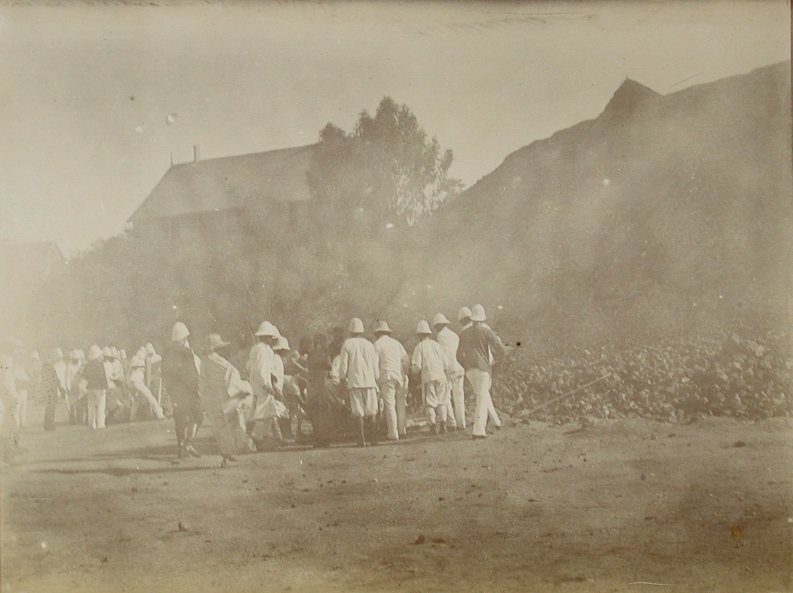
On this date in 1896, two Malagasy movers and shakers were shot to help cement French colonial control of Madagascar.

Interior Minister Rainandriamampandry

Having conquered the island militarily by 1895, France immediately faced indigenous resistance.

According to Stephen Ellis*

One of the most puzzling and fascinating of all resistance movements is that known as the revolt of the menalamba. It occurred over a wide area of central Madagascar, mostly in the kingdom of Imerina, in the two years following the French invasion of Madagascar in 1895. The most mysterious aspect of the rising has always been the question of who, if anyone, was its leader. The official version, that reported by the French government in Madagascar, was that the movement was inspired or directed by a number of magnates at the old Merina court. The published evidence is so ambiguous as to have obliged every subsequent author to accept this version, although there was considerable doubt expressed as to its truth at that time.

Managing this drumhead tribunal was just-arrived “Resident-General” Joseph Simon Gallieni, who seems to have alit (fresh from an assignment in Indochina) with the certain conviction that examples must be made.

While more wholesale bloodletting was deployed in the field, Gallieni selected some suitably high-profile exemplars from the supine state’s ruling elite — “Ratsimamanga, a nobleman who had been unpopular for many years because of his financial extortions,” says Ellis, and “Rainandriamampandry because … he had no close political friends and might therefore be considered dispensable.”

The convenient loss of the tribunal paperwork, which renders evaluation impossible and colonial motivation suspect, hardly would have been well beside the point. As one periodical in Paris (where Gallieni’s pacification project received enthusiastic greeting) approvingly put it,

As a lesson to the rebels, two great figures who had sided with them, Prince Ratsimamanga and Minister of the Interior Rainandriamampandry have both been tried, convicted and shot, all with such rapidity as to inspire their accomplices to salutary reflections.

Below: Selected photographs of the execution from the University of Southern California Digital Library. Click for larger images.

An aside: Madagascar was also the scene of intensely sectarian competition in the soul-saving business, resulting in an execution-day travesty reported in An Empire Divided: Religion, Republicanism, and the Making of French Colonialism, 1880-1914:

Gallieni gave permission to both the cure of the Antananarivo cathedral and a local French pastor to be with [Rainandriamampandry] during his last hours. But … the two started quarreling almost at once. Gallieni was deeply disturbed by the image of two religious men fighting during “the final minutes of a condemned man.”

* “The Political Elite of Imerina and the Revolt of the Menalamba. The Creation of a Colonial Myth in Madagascar, 1895-1898,” The Journal of African History, vol. 21, no. 2 (1980).

On this day..

1898: The Six Gentlemen of the Hundred Days’ Reform

This afternoon in 1898, six liberals got the chop for their hopeless attempt to give a tottering empire the reforms it desperately needed.

The Hundred Days’ Reform — actually 103 days, from June 11 to September 21 — marked the attempt by China’s Guangxu Emperor to implement a far-reaching modernization programme backed by forward-thinking officials with a mind to correct China’s supine position vis-a-vis the West, and even vis-a-vis its neighbors.

“Reform has never come about in any country without the flow of blood. No one in China in modern times has sacrificed himself for the cause of reform, and because of this China is still a poor and backward country. Therefore, I request that the sacrifices begin with myself.” –Tan Sitong

The Wuxu Constitutional Reform still stands as the great attempt made by Chinese progressives who tried to follow the example of the modern powers in order to save China from extinction. Represented by Kang Youwei and Liang Qichao, the bourgeois reformists were imbued with the spirit of national salvation; they carefully set about designing a blueprint for a constitutional monarchy based on the example of Western countries. They advocated the establishment of parliament and a national conference, and wanted to see honest and fair-minded people with the courage to criticize authority installed in a position of power. National policies should be discussed by the monarch and the people. They also wanted a constitution to stipulate the rights and obligations of the monarch, officials, and the people. The constitution was to be the highest code for all people in the country. They also wanted to establish a system featuring a tripartite balance of forces: parliament was to legislate, the magistracy to deal with issues of justice, the government with administration. All of these would be under the monarch.

The constitutional reform was to take place with radical intellectuals submitting their memoranda to Emperor Guang Xu, who alone had the power to promulgate them. The feudal diehards being in a position of strength and the national bourgeoisie being weak, however, the new politics survived no more than 100 days or so. When the forces of reaction inevitably clamped down on the movement, the six reformists who had inspired the movement for constitutional reform met their deaths like heroes.

Although sincere in its aspirations, the reform movement was bound to fail, as it depended on a reform “from top to bottom”, which ultimately had to be enacted by the emperor. The Hundred Days’ Constitutional Reform, however, remains a landmark event in the modern history of China, its failure notwithstanding. The Chinese bourgeoisie in fact succeeded in spreading democratic and constitutionalist ideas widely, and this had a significant effect on future generations. The political and legal theory of the Western bourgeoisie could now take root in the soil of China.*

The emperor’s Machiavellian conservative aunt, the Empress Dowager Cixi, who had been the power behind the Chinese throne since 1861, made the sure reform didn’t see two hundred days with a “coup” that didn’t formally overthrow the Emperor — just made him irrelevant.

Troublemakers further down the food chain didn’t get off so easily.

Kang Youwei, the reform movement’s chief exponent, escaped to Japan. Six others suffered the wrath of the Dowager Empress: Kang Guangren (Kang Youwei’s brother), Lin Xu, Yang Shenxiu, Yang Rui and Liu Guangdi … along with the young reformer Tan Sitong, who notably refused imprecations to flee arrest.

The sword’s blade across my neck,
I look toward heaven — laughing.
-Etched on a prison wall, allegedly by Tan Sitong


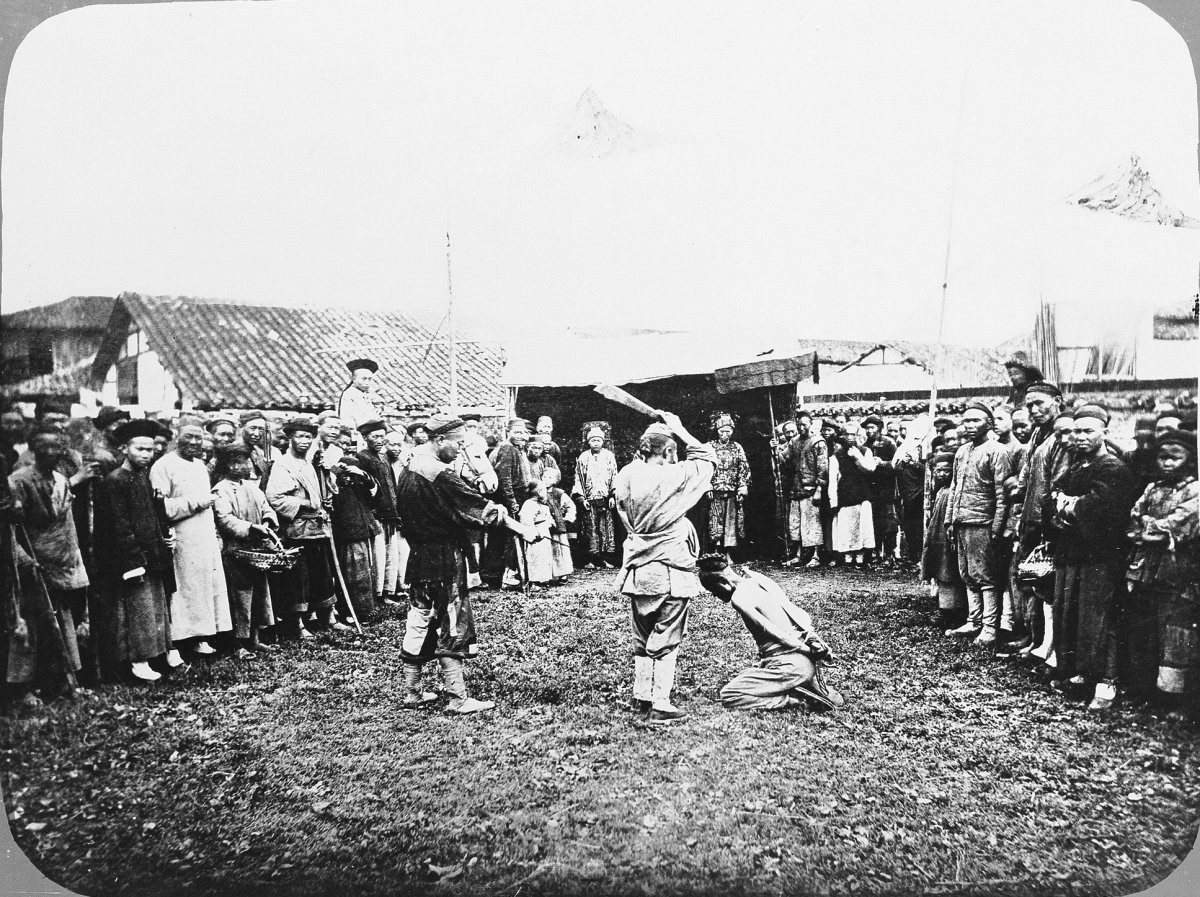
Photo of an unspecified 1867 Qing beheading in Canton.

* “The Chinese Legal Tradition and the European View of the Rule of Law” by Wu Shu-Chen in The Rule of Law History, Theory and Criticism, Part VI.

On this day..

1896: Charles Thomas Wooldridge, of The Ballad of Reading Gaol

On this date in 1896, Royal Horse Guard trooper Charles Thomas Wooldridge was hanged by the neck until dead at Reading Gaol, for the crime of murdering his wife.

Celebrated playwright and wit Oscar Wilde had been clapped in that same prison the previous November after his sensational conviction for “gross indecency” — that is, homosexuality.

Wilde’s immortal poetic rendering of the “Hell” of prison, “The Ballad of Reading Gaol”, is written to Wooldridge’s memory, and about his hanging. Its dedication frontispiece reads:

In memoriam
C.T.W.
Sometime Trooper of the Royal Horse Guards.
Obiit H.M. Prison, Reading, Berkshire,
July 7th, 1896.

Having no words to improve on Wilde’s, we offer his “Ballad” in its entirety for the savoring (the audio file is a reading of the text). Find it on Gutenberg or Google Books.

[audio:http://ia311533.us.archive.org/3/items/ballad_of_reading_gaol_jg_librivox/ballad_of_reading_gaol_wilde.mp3]

I.

He did not wear his scarlet coat,
For blood and wine are red,
And blood and wine were on his hands
When they found him with the dead,
The poor dead woman whom he loved,
And murdered in her bed.

He walked amongst the Trial Men
In a suit of shabby grey;
A cricket cap was on his head,
And his step seemed light and gay;
But I never saw a man who looked
So wistfully at the day.

I never saw a man who looked
With such a wistful eye
Upon that little tent of blue
Which prisoners call the sky,
And at every drifting cloud that went
With sails of silver by.

I walked, with other souls in pain,
Within another ring,
And was wondering if the man had done
A great or little thing,
When a voice behind me whispered low,
“That fellows got to swing.”

Dear Christ! the very prison walls
Suddenly seemed to reel,
And the sky above my head became
Like a casque of scorching steel;
And, though I was a soul in pain,
My pain I could not feel.

I only knew what hunted thought
Quickened his step, and why
He looked upon the garish day
With such a wistful eye;
The man had killed the thing he loved
And so he had to die.

Yet each man kills the thing he loves
By each let this be heard,
Some do it with a bitter look,
Some with a flattering word,
The coward does it with a kiss,
The brave man with a sword!

Some kill their love when they are young,
And some when they are old;
Some strangle with the hands of Lust,
Some with the hands of Gold:
The kindest use a knife, because
The dead so soon grow cold.

Some love too little, some too long,
Some sell, and others buy;
Some do the deed with many tears,
And some without a sigh:
For each man kills the thing he loves,
Yet each man does not die.

He does not die a death of shame
On a day of dark disgrace,
Nor have a noose about his neck,
Nor a cloth upon his face,
Nor drop feet foremost through the floor
Into an empty place

He does not sit with silent men
Who watch him night and day;
Who watch him when he tries to weep,
And when he tries to pray;
Who watch him lest himself should rob
The prison of its prey.

He does not wake at dawn to see
Dread figures throng his room,
The shivering Chaplain robed in white,
The Sheriff stern with gloom,
And the Governor all in shiny black,
With the yellow face of Doom.

He does not rise in piteous haste
To put on convict-clothes,
While some coarse-mouthed Doctor gloats, and notes
Each new and nerve-twitched pose,
Fingering a watch whose little ticks
Are like horrible hammer-blows.

He does not know that sickening thirst
That sands one’s throat, before
The hangman with his gardener’s gloves
Slips through the padded door,
And binds one with three leathern thongs,
That the throat may thirst no more.

He does not bend his head to hear
The Burial Office read,
Nor, while the terror of his soul
Tells him he is not dead,
Cross his own coffin, as he moves
Into the hideous shed.

He does not stare upon the air
Through a little roof of glass;
He does not pray with lips of clay
For his agony to pass;
Nor feel upon his shuddering cheek
The kiss of Caiaphas.

II.

Six weeks our guardsman walked the yard,
In a suit of shabby grey:
His cricket cap was on his head,
And his step seemed light and gay,
But I never saw a man who looked
So wistfully at the day.

I never saw a man who looked
With such a wistful eye
Upon that little tent of blue
Which prisoners call the sky,
And at every wandering cloud that trailed
Its raveled fleeces by.

He did not wring his hands, as do
Those witless men who dare
To try to rear the changeling Hope
In the cave of black Despair:
He only looked upon the sun,
And drank the morning air.

He did not wring his hands nor weep,
Nor did he peek or pine,
But he drank the air as though it held
Some healthful anodyne;
With open mouth he drank the sun
As though it had been wine!

And I and all the souls in pain,
Who tramped the other ring,
Forgot if we ourselves had done
A great or little thing,
And watched with gaze of dull amaze
The man who had to swing.

And strange it was to see him pass
With a step so light and gay,
And strange it was to see him look
So wistfully at the day,
And strange it was to think that he
Had such a debt to pay.

For oak and elm have pleasant leaves
That in the spring-time shoot:
But grim to see is the gallows-tree,
With its adder-bitten root,
And, green or dry, a man must die
Before it bears its fruit!

The loftiest place is that seat of grace
For which all worldlings try:
But who would stand in hempen band
Upon a scaffold high,
And through a murderer’s collar take
His last look at the sky?

It is sweet to dance to violins
When Love and Life are fair:
To dance to flutes, to dance to lutes
Is delicate and rare:
But it is not sweet with nimble feet
To dance upon the air!

So with curious eyes and sick surmise
We watched him day by day,
And wondered if each one of us
Would end the self-same way,
For none can tell to what red Hell
His sightless soul may stray.

At last the dead man walked no more
Amongst the Trial Men,
And I knew that he was standing up
In the black dock’s dreadful pen,
And that never would I see his face
In God’s sweet world again.

Like two doomed ships that pass in storm
We had crossed each other’s way:
But we made no sign, we said no word,
We had no word to say;
For we did not meet in the holy night,
But in the shameful day.

A prison wall was round us both,
Two outcast men were we:
The world had thrust us from its heart,
And God from out His care:
And the iron gin that waits for Sin
Had caught us in its snare.

In Debtors’ Yard the stones are hard,
And the dripping wall is high,
So it was there he took the air
Beneath the leaden sky,
And by each side a Warder walked,
For fear the man might die.

Or else he sat with those who watched
His anguish night and day;
Who watched him when he rose to weep,
And when he crouched to pray;
Who watched him lest himself should rob
Their scaffold of its prey.

The Governor was strong upon
The Regulations Act:
The Doctor said that Death was but
A scientific fact:
And twice a day the Chaplain called
And left a little tract.

And twice a day he smoked his pipe,
And drank his quart of beer:
His soul was resolute, and held
No hiding-place for fear;
He often said that he was glad
The hangman’s hands were near.

But why he said so strange a thing
No Warder dared to ask:
For he to whom a watcher’s doom
Is given as his task,
Must set a lock upon his lips,
And make his face a mask.

Or else he might be moved, and try
To comfort or console:
And what should Human Pity do
Pent up in Murderers’ Hole?
What word of grace in such a place
Could help a brother’s soul?

With slouch and swing around the ring
We trod the Fool’s Parade!
We did not care: we knew we were
The Devil’s Own Brigade:
And shaven head and feet of lead
Make a merry masquerade.

We tore the tarry rope to shreds
With blunt and bleeding nails;
We rubbed the doors, and scrubbed the floors,
And cleaned the shining rails:
And, rank by rank, we soaped the plank,
And clattered with the pails.

We sewed the sacks, we broke the stones,
We turned the dusty drill:
We banged the tins, and bawled the hymns,
And sweated on the mill:
But in the heart of every man
Terror was lying still.

So still it lay that every day
Crawled like a weed-clogged wave:
And we forgot the bitter lot
That waits for fool and knave,
Till once, as we tramped in from work,
We passed an open grave.

With yawning mouth the yellow hole
Gaped for a living thing;
The very mud cried out for blood
To the thirsty asphalte ring:
And we knew that ere one dawn grew fair
Some prisoner had to swing.

Right in we went, with soul intent
On Death and Dread and Doom:
The hangman, with his little bag,
Went shuffling through the gloom
And each man trembled as he crept
Into his numbered tomb.

That night the empty corridors
Were full of forms of Fear,
And up and down the iron town
Stole feet we could not hear,
And through the bars that hide the stars
White faces seemed to peer.

He lay as one who lies and dreams
In a pleasant meadow-land,
The watcher watched him as he slept,
And could not understand
How one could sleep so sweet a sleep
With a hangman close at hand?

But there is no sleep when men must weep
Who never yet have wept:
So we–the fool, the fraud, the knave–
That endless vigil kept,
And through each brain on hands of pain
Another’s terror crept.

Alas! it is a fearful thing
To feel another’s guilt!
For, right within, the sword of Sin
Pierced to its poisoned hilt,
And as molten lead were the tears we shed
For the blood we had not spilt.

The Warders with their shoes of felt
Crept by each padlocked door,
And peeped and saw, with eyes of awe,
Grey figures on the floor,
And wondered why men knelt to pray
Who never prayed before.

All through the night we knelt and prayed,
Mad mourners of a corpse!
The troubled plumes of midnight were
The plumes upon a hearse:
And bitter wine upon a sponge
Was the savior of Remorse.

The cock crew, the red cock crew,
But never came the day:
And crooked shape of Terror crouched,
In the corners where we lay:
And each evil sprite that walks by night
Before us seemed to play.

They glided past, they glided fast,
Like travelers through a mist:
They mocked the moon in a rigadoon
Of delicate turn and twist,
And with formal pace and loathsome grace
The phantoms kept their tryst.

With mop and mow, we saw them go,
Slim shadows hand in hand:
About, about, in ghostly rout
They trod a saraband:
And the damned grotesques made arabesques,
Like the wind upon the sand!

With the pirouettes of marionettes,
They tripped on pointed tread:
But with flutes of Fear they filled the ear,
As their grisly masque they led,
And loud they sang, and loud they sang,
For they sang to wake the dead.

“Oho!” they cried, “The world is wide,
But fettered limbs go lame!
And once, or twice, to throw the dice
Is a gentlemanly game,
But he does not win who plays with Sin
In the secret House of Shame.”
No things of air these antics were
That frolicked with such glee:
To men whose lives were held in gyves,
And whose feet might not go free,
Ah! wounds of Christ! they were living things,
Most terrible to see.
Around, around, they waltzed and wound;
Some wheeled in smirking pairs:
With the mincing step of demirep
Some sidled up the stairs:
And with subtle sneer, and fawning leer,
Each helped us at our prayers.

The morning wind began to moan,
But still the night went on:
Through its giant loom the web of gloom
Crept till each thread was spun:
And, as we prayed, we grew afraid
Of the Justice of the Sun.

The moaning wind went wandering round
The weeping prison-wall:
Till like a wheel of turning-steel
We felt the minutes crawl:
O moaning wind! what had we done
To have such a seneschal?

At last I saw the shadowed bars
Like a lattice wrought in lead,
Move right across the whitewashed wall
That faced my three-plank bed,
And I knew that somewhere in the world
God’s dreadful dawn was red.

At six o’clock we cleaned our cells,
At seven all was still,
But the sough and swing of a mighty wing
The prison seemed to fill,
For the Lord of Death with icy breath
Had entered in to kill.

He did not pass in purple pomp,
Nor ride a moon-white steed.
Three yards of cord and a sliding board
Are all the gallows’ need:
So with rope of shame the Herald came
To do the secret deed.

We were as men who through a fen
Of filthy darkness grope:
We did not dare to breathe a prayer,
Or give our anguish scope:
Something was dead in each of us,
And what was dead was Hope.

For Man’s grim Justice goes its way,
And will not swerve aside:
It slays the weak, it slays the strong,
It has a deadly stride:
With iron heel it slays the strong,
The monstrous parricide!

We waited for the stroke of eight:
Each tongue was thick with thirst:
For the stroke of eight is the stroke of Fate
That makes a man accursed,
And Fate will use a running noose
For the best man and the worst.

We had no other thing to do,
Save to wait for the sign to come:
So, like things of stone in a valley lone,
Quiet we sat and dumb:
But each man’s heart beat thick and quick
Like a madman on a drum!

With sudden shock the prison-clock
Smote on the shivering air,
And from all the gaol rose up a wail
Of impotent despair,
Like the sound that frightened marshes hear
From a leper in his lair.

And as one sees most fearful things
In the crystal of a dream,
We saw the greasy hempen rope
Hooked to the blackened beam,
And heard the prayer the hangman’s snare
Strangled into a scream.

And all the woe that moved him so
That he gave that bitter cry,
And the wild regrets, and the bloody sweats,
None knew so well as I:
For he who live more lives than one
More deaths than one must die.

IV.

There is no chapel on the day
On which they hang a man:
The Chaplain’s heart is far too sick,
Or his face is far to wan,
Or there is that written in his eyes
Which none should look upon.

So they kept us close till nigh on noon,
And then they rang the bell,
And the Warders with their jingling keys
Opened each listening cell,
And down the iron stair we tramped,
Each from his separate Hell.

Out into God’s sweet air we went,
But not in wonted way,
For this man’s face was white with fear,
And that man’s face was grey,
And I never saw sad men who looked
So wistfully at the day.

I never saw sad men who looked
With such a wistful eye
Upon that little tent of blue
We prisoners called the sky,
And at every careless cloud that passed
In happy freedom by.

But their were those amongst us all
Who walked with downcast head,
And knew that, had each go his due,
They should have died instead:
He had but killed a thing that lived
Whilst they had killed the dead.

For he who sins a second time
Wakes a dead soul to pain,
And draws it from its spotted shroud,
And makes it bleed again,
And makes it bleed great gouts of blood
And makes it bleed in vain!

Like ape or clown, in monstrous garb
With crooked arrows starred,
Silently we went round and round
The slippery asphalte yard;
Silently we went round and round,
And no man spoke a word.

Silently we went round and round,
And through each hollow mind
The memory of dreadful things
Rushed like a dreadful wind,
An Horror stalked before each man,
And terror crept behind.

The Warders strutted up and down,
And kept their herd of brutes,
Their uniforms were spick and span,
And they wore their Sunday suits,
But we knew the work they had been at
By the quicklime on their boots.

For where a grave had opened wide,
There was no grave at all:
Only a stretch of mud and sand
By the hideous prison-wall,
And a little heap of burning lime,
That the man should have his pall.

For he has a pall, this wretched man,
Such as few men can claim:
Deep down below a prison-yard,
Naked for greater shame,
He lies, with fetters on each foot,
Wrapt in a sheet of flame!

And all the while the burning lime
Eats flesh and bone away,
It eats the brittle bone by night,
And the soft flesh by the day,
It eats the flesh and bones by turns,
But it eats the heart alway.

For three long years they will not sow
Or root or seedling there:
For three long years the unblessed spot
Will sterile be and bare,
And look upon the wondering sky
With unreproachful stare.

They think a murderer’s heart would taint
Each simple seed they sow.
It is not true! God’s kindly earth
Is kindlier than men know,
And the red rose would but blow more red,
The white rose whiter blow.

Out of his mouth a red, red rose!
Out of his heart a white!
For who can say by what strange way,
Christ brings his will to light,
Since the barren staff the pilgrim bore
Bloomed in the great Pope’s sight?

But neither milk-white rose nor red
May bloom in prison air;
The shard, the pebble, and the flint,
Are what they give us there:
For flowers have been known to heal
A common man’s despair.

So never will wine-red rose or white,
Petal by petal, fall
On that stretch of mud and sand that lies
By the hideous prison-wall,
To tell the men who tramp the yard
That God’s Son died for all.

Yet though the hideous prison-wall
Still hems him round and round,
And a spirit man not walk by night
That is with fetters bound,
And a spirit may not weep that lies
In such unholy ground,

He is at peace–this wretched man–
At peace, or will be soon:
There is no thing to make him mad,
Nor does Terror walk at noon,
For the lampless Earth in which he lies
Has neither Sun nor Moon.

They hanged him as a beast is hanged:
They did not even toll
A requiem that might have brought
Rest to his startled soul,
But hurriedly they took him out,
And hid him in a hole.

They stripped him of his canvas clothes,
And gave him to the flies;
They mocked the swollen purple throat
And the stark and staring eyes:
And with laughter loud they heaped the shroud
In which their convict lies.

The Chaplain would not kneel to pray
By his dishonored grave:
Nor mark it with that blessed Cross
That Christ for sinners gave,
Because the man was one of those
Whom Christ came down to save.

Yet all is well; he has but passed
To Life’s appointed bourne:
And alien tears will fill for him
Pity’s long-broken urn,
For his mourner will be outcast men,
And outcasts always mourn.

V.

I know not whether Laws be right,
Or whether Laws be wrong;
All that we know who lie in goal
Is that the wall is strong;
And that each day is like a year,
A year whose days are long.

But this I know, that every Law
That men have made for Man,
Since first Man took his brother’s life,
And the sad world began,
But straws the wheat and saves the chaff
With a most evil fan.

This too I know–and wise it were
If each could know the same–
That every prison that men build
Is built with bricks of shame,
And bound with bars lest Christ should see
How men their brothers maim.

With bars they blur the gracious moon,
And blind the goodly sun:
And they do well to hide their Hell,
For in it things are done
That Son of God nor son of Man
Ever should look upon!

The vilest deeds like poison weeds
Bloom well in prison-air:
It is only what is good in Man
That wastes and withers there:
Pale Anguish keeps the heavy gate,
And the Warder is Despair

For they starve the little frightened child
Till it weeps both night and day:
And they scourge the weak, and flog the fool,
And gibe the old and grey,
And some grow mad, and all grow bad,
And none a word may say.

Each narrow cell in which we dwell
Is foul and dark latrine,
And the fetid breath of living Death
Chokes up each grated screen,
And all, but Lust, is turned to dust
In Humanity’s machine.

The brackish water that we drink
Creeps with a loathsome slime,
And the bitter bread they weigh in scales
Is full of chalk and lime,
And Sleep will not lie down, but walks
Wild-eyed and cries to Time.

But though lean Hunger and green Thirst
Like asp with adder fight,
We have little care of prison fare,
For what chills and kills outright
Is that every stone one lifts by day
Becomes one’s heart by night.

With midnight always in one’s heart,
And twilight in one’s cell,
We turn the crank, or tear the rope,
Each in his separate Hell,
And the silence is more awful far
Than the sound of a brazen bell.

And never a human voice comes near
To speak a gentle word:
And the eye that watches through the door
Is pitiless and hard:
And by all forgot, we rot and rot,
With soul and body marred.

And thus we rust Life’s iron chain
Degraded and alone:
And some men curse, and some men weep,
And some men make no moan:
But God’s eternal Laws are kind
And break the heart of stone.

And every human heart that breaks,
In prison-cell or yard,
Is as that broken box that gave
Its treasure to the Lord,
And filled the unclean leper’s house
With the scent of costliest nard.

Ah! happy day they whose hearts can break
And peace of pardon win!
How else may man make straight his plan
And cleanse his soul from Sin?
How else but through a broken heart
May Lord Christ enter in?

And he of the swollen purple throat.
And the stark and staring eyes,
Waits for the holy hands that took
The Thief to Paradise;
And a broken and a contrite heart
The Lord will not despise.

The man in red who reads the Law
Gave him three weeks of life,
Three little weeks in which to heal
His soul of his soul’s strife,
And cleanse from every blot of blood
The hand that held the knife.

And with tears of blood he cleansed the hand,
The hand that held the steel:
For only blood can wipe out blood,
And only tears can heal:
And the crimson stain that was of Cain
Became Christ’s snow-white seal.

VI.

In Reading gaol by Reading town
There is a pit of shame,
And in it lies a wretched man
Eaten by teeth of flame,
In burning winding-sheet he lies,
And his grave has got no name.

And there, till Christ call forth the dead,
In silence let him lie:
No need to waste the foolish tear,
Or heave the windy sigh:
The man had killed the thing he loved,
And so he had to die.

And all men kill the thing they love,
By all let this be heard,
Some do it with a bitter look,
Some with a flattering word,
The coward does it with a kiss,
The brave man with a sword!

“Each man kills the thing he loves” … words that must have originated in a fathomless depth in the soul of our renowned poet, who signed the poem only with his cell number and died penniless in 1900.

Part of the Themed Set: The Ballad.

On this day..

1894: Emile Henry, because there are no innocent bourgeois

On this date in 1894, Emile Henry was guillotined in Paris for bombing the Cafe Terminus three months before.

Yale history professor John Merriman (see him lecturing on the Paris Commune) explores how Henry’s bombing “ignited the age of modern terror.” (Review.) (Another.)

A bourgeois youth who, disgusted at the gross economic exploitation of the Gilded Age, had turned against his class with the fury only the apostate can command, Émile Henry had chucked a bomb into the chic cafe of the Parisian Gare Saint-Lazare a week after the execution of Auguste Vaillant.

Henry’s act killed only one, but electrified the country.

The Terminus bombing stood out in an era of violent anarchist ferment for its target selection: not a prince or president or parliamentarian, but the faceless multitudes of the bourgeoisie (formerly) secure in their metropolitan repose — who, in their indifference to the misery of workers assented to and profited from the more infamous repressions wrought by their plenipotentiaries.

Henry was completely explicit about his intent: “there are no innocent bourgeois.”

Recognizing the hopelessness of his legal position, he proudly admitted the charges against him and mounted an eloquent defense for the wider world of his version of anarchist terror.

I had returned to Paris at the time of the Vaillant affair, and I witnessed the frightful repression that followed the explosion at the Palais Bourbon. I saw the draconian measures which the government decided to take against the anarchists. Everywhere there were spies, and searches, and arrests. A crowd of individuals were indiscriminately rounded up, torn from their families, and thrown into prison. Nobody was concerned about what happened to the wives and children of these comrades while they remained in jail.

The anarchist was no longer regarded as a man, but as a wild beast to be hunted everywhere while the bourgeois Press, which is the vile slave of authority, loudly demands his extermination.

But, gentlemen of the bourgeoisie, you have reckoned a little too much without your host. You arrested hundreds of men and women, you violated scores of homes, but still outside the prison walls there were men unknown to you who watched from the shadows as you hunted the anarchists, and waited only for the moment that would be favourable for them in their turn to hunt the hunters.

… The bomb in the Cafe Terminus is the answer to all your violations of freedom, to your arrests, to your searches, to your laws against the Press, to your mass transportations, to your guillotinings. But why, you ask, attack these peaceful cafe guests, who sat listening to music and who, no doubt, were neither judges nor deputies nor bureaucrats? Why? It is very simple. The bourgeoisie did not distinguish among the anarchists. Vaillant, a man on his own, threw a bomb; nine-tenths of the comrades did not even know him. But that meant nothing; the persecution was a mass one, and anyone with the slightest anarchist links was hunted down. And since you hold a whole party responsible for the actions of a single man, and strike indiscriminately, we also strike indiscriminately.

Perhaps we should attack only the deputies who make laws against us, the judges who apply those laws, the police who arrest us? I do not agree. These men are only instruments. They do not act in their own name. Their functions were instituted by the bourgeoisie for its own defence. They are no more guilty than the rest of you. Those good bourgeois who hold no office but who reap their dividends and live idly on the profits of the workers’ toil, they also must take their share in the reprisals. And not only they, but all those who are satisfied with the existing order, who applaud the acts of the government and so become its accomplices, those clerks earning three or five hundred francs a month who hate the people even more violently than the rich, that stupid and pretentious mass of folk who always choose the strongest side — in other words, the daily clientele of Terminus and the other great cafés.

That is why I struck at random and did not choose my victims! The bourgeoisie must be brought to understand that those who have suffered are tired at last of their sufferings; they are showing their teeth and they will strike all the more brutally if you are brutal with them. …

We will not spare the women and children of the bourgeois, for the women and children of those we love have not been spared. Must we not count among the innocent victims those children who die slowly of anaemia in the slums because bread is scarce in their houses; those women who grow pale in your workshops, working to earn forty sous a day and fortunate when poverty does not force them into prostitution; those old men whom you have made production machines all their lives and whom you cast on to the waste heap or into the workhouse when their strength has worn away?

At least have the courage of your crimes, gentlemen of the bourgeoisie, and grant that our reprisals are completely legitimate.

In that pitiless war which we have declared on the bourgeoisie, we ask for no pity. We give death, and we know how to endure it. So it is with indifference that I await your verdict. I know that my head is not the last you will cut off; yet others will fall, for the starving are beginning to know the way to your great cafes and restaurants, to the Terminus and Foyot. You will add other names to the bloody list of our dead.

You have hanged in Chicago, decapitated in Germany, garotted in Jerez, shot in Barcelona, guillotined in Montbrison and Paris, but what you will never destroy is anarchy. Its roots are too deep. It is born in the heart of a society that is rotting and falling apart. It is a violent reaction against the established order. It represents all the egalitarian and libertarian aspirations that strike out against authority. It is everywhere, which makes it impossible to contain. It will end by killing you.

Clemenceau, who witnessed the beheading at the Place de la Roquette, saw in the ghastly white 21-year-old crying “long live anarchy!” in the predawn gloom this morning in 1894 “the face of a tormented Christ, terribly pale, implacable in expression, trying to impose his intellectual pride upon his child’s body … let those for the death penalty go, if they dare, to smell the blood of La Roquette.”

Five weeks later, the French president who had refused to spare Henry was himself assassinated by another anarchist.

The clip above uses an actual 1893 anarchist hymn to dynamite, that fruit of the chemical science whose pyrotechnics were held to catalyze social change. Henry, who probably hummed the song a few times in his life, must have approved the songwriter’s philosophy.

Tant mieux s’il éclate parfois en faisant beaucoup de victimes
Chez nos ennemis les bourgeois cela nous venge de leurs crimes

For more on Henry’s place in the era’s revolutionary ferment, enjoy this lecture by Dynamite Club author John Merriman as part of his course European Civilization, 1648-1945.

[audio:http://openmedia.yale.edu/projects/courses/fall08/hist202/mp3/hist202_14_102208.mp3]

On this day..

1891: The Namoa pirates

On this date in 1891, Chinese authorities beheaded 15 at Kowloon, including the leaders of the then-notorious Namoa pirates.

They were nicknamed for the steamer they had infamously commandeered six months before. The tale is related by an English maritime official’s orientalist (and now public-domain) memoir, The Mystic Flowery Land:

The most daring and disastrously successful piracy of late years … was the “Namoa” piracy in 1890. The startling news of this outrage created a general feeling of unsafety and consternation among the foreign communities in China, mingled with grief and just resentment for the cold-blooded murder of Captain Pocock and Mr. Petersen, both most popular and respected men, the latter being a member of the Customs Service.

On Sunday, the 3rd of December, 1890, the Douglas, Lapraik, and Co‘s coasting steamer, “Namoa,” commanded by my late most esteemed friend Capt. Pocock,* left Hongkong at noon, bound on her usual trip up the coast to Swatow, Amoy, and Foochow with several European and a large number of Chinese passengers, most of the latter being Fuhkien people returning to their native homes after many years absence in the United States and California, each with his little hoard of hard-earned dollars, gained by a small lifetime of frugal toil and self-denial in a distant land. These poor men were nearing their well-remembered haunts of earlier days, to once more spend among the relations and friends of their youth the fast-approaching New Year.

Several Chinese passengers [during the voyage] came up out of the main between-decks and walked about for some minutes in a seemingly aimless manner; then others emerged from the hatch, until there were between forty and fifty on deck — some forward near the hatchway leading down to the junior officers’ mess, others near the bridge ladder and entrance to engine-room and stokehole, and the rest at the main hatchway, saloon entrances and after skylight.

Suddenly, at a given signal, off came their loose outer garments, and these harmless-looking passengers were armed men; each with a cutlass and two revolvers in hand, and at their appointed stations.

The ship was now entirely in the hands of the pirates, whose leader placed one of the gang at the helm, with directions to steer a certain course.

The attack had been planned and carried out with consummate tact and forethought, for the pirates were old hands — desperate scoundrels … two or three ventured below … among their terror-stricken countrymen, and ransacked their luggage, robbing them of their treasured packets of dollars, saved during long and lonesome years of comparative exile and drudgery. Every cent was taken from these poor fellows, who wept in vain, and heart-rending scenes ensued. But the wretches took all.

Then [the European passengers] were all driven into the captain’s little berth, which was barely large enough to hold them all, where they were nearly suffocated.

At this point, the pirates steam off to rendezvous with their confederates, transfer their persons and their booty to the getaway ships, and — after debating whether to burn the Namoa — instead abandon the ship unsunk and the hostages unkilled.

These put the ship to rights and got it back to Hong Kong.

Public indignation was great, and considerable pressure was brought to bear on the Chinese Government to bring the pirates to justice. Skilled foreign and Chinese detectives were sent out on their track, doggedly determined to run these criminals to earth and make them pay the full penalty of their dastardly deeds.

… most, if not all, of these notorious crime-hardened criminals were eventually brought to justice, suffering decapitation outside Kowloon city, the majority of them being executed on Monday, April 17th, 1891, and the remaining nineteen on Thursday, 11th May, of the same year.**

The pirates were such big news that posed photos were taken of their public executions. (Both images are detail views; click for the full picture.)

For some time great precautions were taken by the captains and officers of coasting steamers to search the luggage of all native passengers, and thus guard against a similar catastrophe.

* Captain Thomas Guy Pocock was killed by the pirates, and has a private memorial in Hong Kong Cemetery (aka Happy Valley Cemetery). He left a one-year-old son who died in World War I.

** According to a tome on legal administration in Hong Kong, the pirates were beheaded in batches mixed in with other criminals.

A wholesale execution took place at Kowloon City on the 17th April, 1891, when nineteen pirates were decapitated, thirteen of them for participating in the Namoa and other piracies, and six others for various offences in Chinese territory … on the 11th May fifteen more prisoners were beheaded at Kowloon by the Chinese authorities, amongst the number being six Namoa pirates, including the three leaders of the gang, one of the men being the captain of the junks on board which the pirates put their plunder … One of the leaders decapitated, named Lai A Tsat, was a man whose boldness and cunning in carrying out piracies had long made him a terror both at sea and on shore.

On this day..