1894: John Cronin, by an automated gallows

From the Dec. 18, 1894 Atchison (Ks.) Daily:

HARTFORD, Conn., Dec. 18. — John Cronin was hanged here at 1:00 o’clock this morning.

The execution of Cronin was especially interesting, being the first hanging in this state under the law passed by the last general assembly and the first trial of an automatic gallows in the east.

This last is the idea of Warden Woodbridge. Aided by James H. Rabbett, a forger, now serving a two and one-half years’ sentence, the warden evolved what he considers an improvement on the hanging machine in use in Colorado.

Small shot has been substituted for water in the operation of the lever which releases the weight and an arrangement made whereby the execution may be stayed at any moment.

The compartment in which the shot are confined resembles an hour glass and the mechanism is thoroughly under the warden’s control. The shot was started in motion by the movement of a lever, and another lever would have enabled the warden to have stopped it at any time. The progress of the shot and the approaching moment when the weight would be released is indicated on a dial resembling a clock.

When Cronin had been seated in the chair and made fast, a signal from the executioner indicated to the man who had charge of the lever that he was ready. The machinery was then set in motion, there being no visible evidence of anything unusual.

The adjustment of the machine was made so perfect that the weight of 306 pounds made no perceptible noise as it was released and fell back to the ground beneath. Instantaneously the victim was jerked into the air, falling backward to within 2 feet of the floor.

One of the principal improvements over the Colorado appliance is the fact that the prisoner is not his own executioner. With the original machine,* when the prisoner was placed on the chair it released a lever which started the mechanism and in this way the man was practically forced to commit suicide.

John Cronin’s crime was the murder of Albert Skinner, at South Windsor, October 6, 1893. He was prompted by revenge for some fancied grievance. He had been boarding with Skinner for several months, but finally was ordered away. A fight ensued at the time and Cronin then went on a protracted debauch. The morning of the murder he went to Skinner’s house and meeting Skinner in the yard immediately shot him, inflicting a fatal wound.

* Developed to hang Dr. T. Thatcher Graves but to my knowledge never actually used.

On this day..

1893: Scuffletonians in Mt. Vernon, Georgia

From the Crittenden Press, Marion, Ky., Oct. 5, 1893, page 1 (pdf).

ON ONE SCAFFOLD.

Five Murderers Executed In Public at Mt. Vernon, Georgia

Three Killed a Merchant, the Fourth a Child and the Fifth a Companion.

Mt. Vernon, Ga., Sept. 29. — Five murderers were executed upon one scaffold at this place at 2:05 p.m. today. They were Hiram Jacobs, Hiram Brewington, Lucien Manuel, Purse Strickland and Weldon Gordon. All were commonly called negroes, but the first four named were descendants of the Crowatan Indians of North Carolina, and locally were known as “Scuffletonians,” from the name of the community from which they came. Three of them murdered Alexander Peterson, a rich merchant, last July, the fourth killed a five-year-old child and the fifth murdered a negro companion.

Over ten thousand people, white and black, witnessed the executions. Every incoming train deposited its load of human freight and steamboats on the Oconce and Attamba rivers ran a daily schedule. Thousands of women viewed the spectacle without a shudder.

The condemned men spent their last night on earth without any perceptible dread. This morning in the jail several colored ministers offered prayer for their spiritual salvation, exhorting them to be firm and courageous. At 1:30 p.m. the march to the scaffold was begun. The sheriff and prisoners were seated in a hack surrounded by a score of armed guards. They stood side by side on the scaffold. They were requested to make a statement if they desired.

Manuel said: “I have every reason to believe that I am going to meet the angels above. I fear nothing, my sins are forgiven and I shall go to heaven. I tell you my friends, to put your trust in God — good-bye.”

The others followed in the same strain. Strickland shed tears, while the vast throng sang, “A Charge to Keep I Have.” The Rev. Mr. Ross, a colored minister, prayed fervently. Then Sheriff Dunham adjusted the black caps and a photographer took their pictures.


Image from here, which appears to misdate the execution.

At this moment Sheriff Dunham bid them farewell, shaking each other by the hand, saying: “May God have mercy on your souls.”

At 2:05 p.m. the trap was sprung. There were no signs of a struggle, and the bodies hung straight and motionless. Half an hour later the bodies were cut down and deposited in pine coffins.

Update: Here’s a lovely wrap-up of the whole sordid affair.

On this day..

1896: Chief Uwini of the Maholi

This date in 1896 during the Second Matabele War saw the execution by field court-martial of the rebellious Chief Uwini.

This war, in present-day Zimbabwe, featured a revolt of the Matabele (Ndebele) people against Cecil Rhodes’s* British South African Company.

In the field, it was a short-lived affair.

Ndebele rebels slew over 200 white settlers in Matabeleland and Mashonaland during the first week of the surprising rising in March 1896. But most settlers were able to hunker down in he town of Bulawayo behind makeshift breastworks.

Up to 15,000 Ndebele warriors menaced this little citadel, but were deterred from storming it by the settlers’ modern weapons — artillery and the legendary Maxim gun** — until relieved in May. (Rhodes himself led one of the relief columns.) At that point, the rebels retreated to their strongholds, fragmented from one another, and generally got picked off or bought off group by group over the ensuing months.

One of the men arriving with Rhodes’s relief column was Robert Baden-Powell, an army scout who will bring us to this date’s feature execution.

Baden-Powell was dispatched with a squadron of cavalry to pacify the area northeast of Bulwayo. When he arrived there, one of the main rebel chiefs in the Somabula Forest, Chief Uwini, had just been taken prisoner.

“He was badly wounded in the shoulder, but, enraged at being a prisoner, he would allow nothing to be done for him; no sooner had the surgeon bandaged hi than he tore the dressings off again. He was a fine, truculent-looking savage, and boasted that he had always been able to hold his own against any enemies in this stronghold of his, but now that he was captured he only wished to die.”

-Baden-Powell (Source)

This prisoner put Baden-Powell in a conundrum. He had written orders to turn prisoners over to the Native Commission for civil handling (whether trial or otherwise).

Uwini had been induced to surrender by another officer’s promise to spare his life. However, this wounded chief could not be escorted five days back to Bulawayo by a force large enough to protect against the likely rescue attempt by his followers without abandoning his mission. Neither could Uwini be brought along on the patrol.

Something had to give.

Baden-Powell decided it would be the safe-conduct promise.

“I have taken another step, which I hope you will not disapprove of — viz. — trying Uweena by Court Martial,” Baden-Powell wrote his superiors on September 13. “He is the big chief of this part, we have lots of evidence that he instigated rebellion and murders of whites, he is badly wounded, we cannot send him to Buluwayo, and I must be leaving this with some of the senior officers tonight. So if the court find him guilty and sentence him to be shot I shall take on myself the responsibility of confirming it. The effect too should be very good for being carried out promptly and at his own stronghold — and we have a good number of rebels, prisoners and refugees, here to witness it & report it to the remainder.”

Another letter dated later that same day confirmed that the expected sentence had indeed been rendered, and Uwini had been ceremoniously shot that evening at sunset before the walls of the enemy fortress, in the presence of as many witnesses as Baden-Powell could find.

This quasi-juridical field execution put Baden-Powell in front of a court of inquiry after the fact. The court exonerated him, citing the circumstances and the purported effect of the execution in cowing the local insurgents.

Despite leaving the court of inquiry “without a stain on my character,” in Baden-Powell’s own words, this incident can’t help but throw a morally questionable shade for later observers. And this agent of empire does have later observers — because Lord Baden-Powell (as he eventually became styled) would go on to found the Scout Movement.† His 1907 boys scouting camp and subsequent book laid the foundation for the ensuing decades’ Anglo scouting tradition.

And this very Matabele War contributed crucial parts of the scouting backstory. It was in the course of this campaign that Baden-Powell became acquainted with the American scout and adventurer Frederick Russell Burnham. The two struck up a lifelong friendship, and Baden-Powell cribbed notes from the ranger’s guile (like wood “scoutcraft”) his counterpart had picked up on the dwindling American frontier. It was also in Rhodesia that Baden-Powell first wore the Stetson hat and neckerchief combination that would become a distinctive look both for Baden-Powell himself, and for the scout movement he launched.

* As of this story’s setting, the place in question had just begun to be called Rhodesia.

** It is in the context of Great Britain’s colonial adventures in Africa in this period (though not specifically just those of Matabeleland) that Hilaire Belloc published his 1898 poem “The Modern Traveller”. In it, a character named “Blood” gave this early machine gun its definitive literary tribute: it’s the couplet highlighted below, but the larger excerpt may be illuminating.

Blood understood the Native mind.
He said: “We must be firm but kind.”

A Mutiny resulted.
I never shall forget the way
That Blood upon this awful day
Preserved us all from death.
He stood upon a little mound,
Cast his lethargic eyes around,
And said beneath his breath:

“Whatever happens we have got
The Maxim Gun, and they have not.”

He marked them in their rude advance,
He hushed their rebel cheers ;
With one extremely vulgar glance
He broke the Mutineers.
(I have a picture in my book
Of how he quelled them with a look.)
We shot and hanged a few, and then
The rest became devoted men.

And here I wish to say a word
Upon the way my heart was stirred
By those pathetic faces.
Surely our simple duty here
Is both imperative and clear;
While they support us, we should lend
Our every effort to defend,
And from a higher point of view
To give the full direction due
To all the native races.
And I, throughout the expedition,
Insisted upon this position.

† Baden-Powell also counseled scouts to be unflinching should the “duty” arise to hang a man.

On this day..

1897: Harvey DeBerry, raving like a madman

(Thanks to Meaghan Good of the Charley Project for the guest post. -ed.)

On this date in 1897, a 23-year-old black man named Harvey DeBerry was hanged for sexually assaulting his employer’s daughter.

His offense, this sexual assault, was a new one under the Tennessee statutes, different from the crimes of rape and attempted rape, and DeBerry was the first person in Shelby County to be convicted of it.

DeBerry was a live-in laborer on the Eigiman farm in Frayser Station, Tennessee, and his wife was the farm’s cook. Mr. and Mrs. Eigiman had three children aged seven, five and two. It was the oldest child, Elenora, that DeBerry assaulted on October 8, 1896.

At the time of the crime, Mr. Eigiman was in the hospital in Memphis recuperating from a fractured skull and a broken leg. Mrs. Eigiman went to see him that day, leaving her children in the care of the DeBerrys. She left Elenora in bed in her nightgown, because the little girl said she wasn’t feeling well.

When Mrs. Eigiman returned at the end of the day, Elenora was still in bed, crying and acting as if she was in pain. She refused to tell her mother what was wrong, and cried and moaned all night.

The next morning, her mother stripped the bed and found blood on the sheets. Mrs. Eigiman confronted her daughter, and Elenora said Harvey DeBerry had come into her room, lain on top of her and hurt her. That same day, a doctor was called to examine the victim. His findings, according to court documents, were as follows:

He found the child highly excited, nervous, and trembling; that the person of the child was swollen, and very tender to the touch; that the parts showed acute inflammation and swelling; that he found a purulent discharge, and a slight rupture of the hymen; that penetration had been partial, but not complete; that the acute inflammation, purulent discharge, and swelling indicated that the injury was recent. During the course of the examination the physician asked the child who hurt her, and she replied that ‘Harvey hurt her.’ The mother was not present when the child made this statement.

Harvey DeBerry fled when Mrs. Eigiman and Elenora confronted him with their accusations.

He turned up soon enough, though, living in Arkansas under the alias Frank Berry, and was extradited to Tennessee for trial. He was represented by a father-and-son team of black lawyers and offered two witnesses in his defense: a washerwoman who said there was no blood on Elenora’s clothing, and someone who said he and DeBerry were harvesting corn together at the time of the crime.

However, the prosecution was able to prove that DeBerry’s alibi witness was mistaken about the date, and the washerwoman had laundered Elenora’ clothing a full month before she was attacked.

Elenora testified about her experience at the trial, saying the reason she hadn’t immediately told her mother about the attack was that Harvey had threatened to kill her if she breathed a word about what he had done. The defense tried to convince the court that another man had abused the little girl, but Elenora denied this on the stand.

A jury acquitted DeBerry of two counts of rape, but convicted him of “assault and battery upon a female under ten years of age, with intent to unlawfully and carnally know her.” What exactly constituted “rape” when there was scant to no penetration was a grey area in Anglo jurisprudence, but with the sexual assault law it was six of one and a half-dozen of the other: both rape and sexual assault were capital offenses.

On the scaffold DeBerry was sobbing and appeared terrified.

A newspaper said later that his last words were “the ravings of a madman. There was no connection of coherency in what he said.”

When he stood on the trap and the sheriff pulled the lever, nothing happened. After an agonizing moment, a deputy stepped forward and pulled it a second time. This time the trap worked and DeBerry fell, cleanly breaking his neck. He was pronounced dead within twelve minutes.

As to whether he confessed before he died, the sheriff and the minister refused to say.


For a bit of period context, the same date that DeBerry hung lawfully saw the summary lynching of an unknown tramp in Manheim, Illinois, outside Chicago. That man attempted to outrage a farmer’s wife but was fought off by the “muscular German woman,” then led a desperate chase through woods and cornfields for half an hour until one of the pursuing posse finally plunked him with a gunshot.

The wounded assailant was searched for identity papers (none turned up), then instantly strung up on the nearest sturdy tree. (Source: The News and Observer (Raleigh, NC), Aug. 20, 1897)

On this day..

1899: Three in the Klondike Gold Rush

On this date in 1899, the gallows of gold rush boom down Dawson City, Yukon strained for three murderers.

The 1896 gold strike in the Klondike triggered a huge rush of prospectors warming sub-Arctic climes with visions of sudden wealth. “When the world rang with the tale of Arctic gold, and the lure of the North gripped the heartstrings of men,” as put by that lure’s great muse Jack London, who himself had already come and gone from the Dawson City by this time, and struck his own variety of fortune in the process.

Miners pouring into the Yukon did not, of course, enter virgin territory. Native peoples had occupied it for thousands of years.

In May 1898, two prospectors, Christian Fox and William Meehan, camped near the mouth of McClintock Creek were only mildly uneasy about the arrival of the Nantucks, Tagish brothers who set up an adjacent camp. Relations were amicable for a while, but when returning one afternoon from the day’s work the prospectors were suddenly fired upon from ambush by their neighbors.

Meehan was slain in the fusillade. The injured Christian Fox managed to float away, get to land, and reach a miners’ settlement. He described the attack thus:

I was lying on the sacks against the side of the boat … and I saw Joe standing with his gun like this … and all the boys went into the brush, and I says to myself “Now they have shot us for our outfit, and are hurrying down to the next bend in the river to catch the boat … My only show is to get to the opposite side of the river and try to make for a white habitation” … I took the paddle in my hand and tried to paddle the boat but I was too weak, so I … used it as a pry … The boat ran up to a nice little level place where it was grassy and as I stepped out I stepped over the leg of my partner as he was stretched out over the boat with his head back and his mouth open and I saw that he was dead, and I said “Good by Billy old boy, I can do nothing for you here.”

By Fox’s report, the four Nantucks were soon taken into custody.


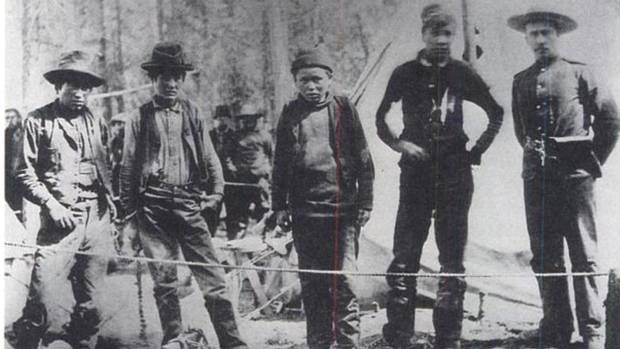
The four Nantuck brothers, shackled after arrest.

The trial unfolded in a court at the territorial capital of Dawson City. A compelling chapter in Strange Things Done: Murder in Yukon History does wonderful work with the cultural disconnections, including a two-page exchange between judge and interpreter (and, off-camera, Frank Nantuck) in which the court struggles to get the accused sworn “so help me God” since Frank’s cosmology has no idea of an afterlife. “He says, when he is dead he is dead — that is all I can get out of him,” the helpless middleman reports.

Q Has he any knowledge of God at all or any idea about a future state of rewards and punishments?

A No sir.

Q Or any clear belief in religion of any kind?

A No sir.

Q Will you say to him that we want him to tell us the truth and not to tell us anything that is not the truth; that he may be punished if he tells us anything that is not the truth; that we are going to ask him some questions and that he must tell us just the truth; ask him if he will agree to do that.

The outcome of the trial will not surprise and there was no question but that the Nantucks had done the shooting. What the Dawson court only barely noted was that brothers had been detailed to avenge two Tagish deaths. An old woman had previously been given or found some “baking powder” and proceeded to make bread with it: in fact, it was arsenic, which was used in mining. Here again is the cultural dislocation; the Nantucks living next to Fox and Meehan were trying to feel out whether those two prospectors were of the tribe that had provided this poison, and of equivalent social rank to the two men who died eating the arsenic-bread. Basically, neither side in this subarctic tragedy had any concept of what the other was on about.

There’s a play about this case, Justice. Peruse the play’s pdf companion study guide on the real historical case here.

In the end, all four Nantucks were condemned to die; Frank was probably still a minor, and he had cooperated with the investigation, so his sentence was commuted to life imprisonment … which did not turn out to be very long at all, since Frank and his condemned brother Joe both died in jail of tuberculosis during the 1898-99 winter.

Dawson Nantuck and Jim Nantuck remained to hang.

Momentarily sensational, the case was long forgotten among whites; it has, however, remained in the oral tradition of Yukon First Peoples. Both communities, however, saw the case brought to the fore when excavations accidentally turned up their remains — along with those of two other hanged men.

One of the other two was the third man to hang this date, a fellow by the name of Ed Henderson. Henderson was an American prospector whose fate might be a bit less instructive for posterity. He suffered from a horrible bladder infection that caused him to pass bloody water every 15 or 20 minutes. “The tortures of the damned,” he described it to court. Wincing yet?

The fact that Henderson suffered from it meant his two prospector-mates suffered from it as well — call it purgatory-level suffering; a member of their party had to relieve himself constantly and thrashed about in his sleeping bag all night for the agony it caused him.

Their empathy for his situation was overturned along with Ed Henderson’s inside-the-tent piss-bowl one night. The drenched and vengeful Tomberg Peterson started an immediate brawl, but Henderson’s leaky plumbing didn’t impair his ability to shoot Peterson dead. Henderson himself reported the incident when the prospectors reached their destination, possibly thinking that no jury would convict him.

The trio comprises the first men hanged by the Yukon Territory, which was only separated from the Northwest Territory in 1898. In fact, there was a bizarre procedural deficiency for the Nantucks (but not for Henderson): they were condemned by the court of the wrong, former territory since word of the territories’ separation had not reached Dawson City at the time of the trial. Nobody saw fit to remedy this blunder, however.

On this day..

1890: A quadruple hanging in Jim Crow America

(Thanks to Meaghan Good of the Charley Project for the guest post. -ed.)

Close to midnight on this date in 1890, four convicted murderers — three of them black and one white — were hanged on the gallows inside the Shelby County Jail in Tennessee. They were Edward Carr, 28, Parker Harris, 30, Hardy Ballard, 45, and Frank Brenish, 36.

Carr, who was half-black, had murdered his estranged wife Sallie in broad daylight on the street in Memphis on November 9, 1889. Edward Carr wanted to move to Mississippi and Sallie did not, and she had left him and moved in with a woman friend. When Edward saw his wife and her friend walking down the street, he said, “Sallie, I am going to kill you,” and then shot her.

She ran away, but he chased after her and shot her three more times. Sallie Carr died in her friend’s arms.

Edward surrendered to the police three days later, and his lawyer had to persuade him not to plead guilty to murder.

At his trial he said, “I do not know why I killed her. It was not because she offended me. We had lived happily together … I loved her so well, and she would not go with me.” Offering no defense, he was accordingly convicted on December 17, six weeks after his crime.

Harris had also killed his wife, Letha “Lettie” Harris, on the street in front of witnesses. Lettie was an “octoroon”, a now-outdated term for someone who is of mixed race and one-eighth black, seven-eighths white.

Like the Carrs, the Harrises were estranged and Lettie was living apart from her husband. On August 18, 1889, said husband encountered her riding in a buggy with several women and asked her to come home; Lettie replied that she never wanted to speak to him again.

In response, Parker Harris slashed her throat, then his own. He was able to run from the scene but collapsed several blocks away, weak from blood loss. He recovered sufficiently from his wounds to face trial; he too was easily convicted.

Hardy Ballard had killed a streetcar driver, G. Emmett Pinkston, on Christmas Day 1889 after an argument over the nickel fare. Ballard insisted he had paid; Pinkston said he hadn’t, and kicked him off the car. Both parties were armed in the ensuing fight, Ballard with a knife and Pinkston with an iron hook, and Ballard got the better of the streetcar driver and stabbed him to death.

His plea of self-defense at trial was not believed by the jury.

The sole white man, Frank Brenish, was a wife killer just like two of his co-condemned. Mary, his wife of two years, had left him because of his drinking and his failure to support her and his two stepchildren. Frank threatened to kill his wife if she didn’t come back to him, and Mary took these threats seriously enough to report them to the police. The cops had a talk with Frank and he promised to leave his wife alone.

Mary remained fearful, however, and when she went out she took her fourteen-year-old daughter, her sister and another man to protect her in case she encountered her husband. They were with her the night the murder was committed: they saw the whole thing.

Frank Brenish’s crime was so similar to Parker Harris’s that there was some speculation the two might have a joint trial: on July 5, 1889 he jumped out of a dark alley and slashed Mary’s throat, nearly decapitating her. Then he cut his own throat. Against the odds, a doctor was able to save Frank’s life, but Mary was beyond help: she had died almost instantly.

All four of the condemned were given copious amounts of alcohol while awaiting their execution, and Brenish got morphine as well. The wound on his throat hadn’t healed and it leaked from time to time. The night before his executed, he made a halfhearted attempt at suicide by slashing his wrist with a makeshift knife.

This was the era of racial apartheid in America, however, and even when men died together, they perhaps might not die together.

The gallows in this instance was built for two, so the natural idea was to hang the four men as two pairs.

Brenish, however, refused to suffer the indignity of being hanged alongside a Negro.

His jailers — and one hardly needs to mention their racial identity — honored his request for a segregated execution and modified the gallows so three people could be hanged at once.

The three black prisoners went first. Brenish died alone, fifteen minutes later. Harris, Ballard and Carr had “clean” hangings and died quickly, after making the usual final statements about their sins and their hope for redemption in Heaven.

When the time came for his racially unsullied death, Brenish was either so drunk or so scared he could barely stand, and he took several more swallows of whiskey while standing on the scaffold. He had severed his trachea when he slashed his throat and could only barely speak above a whisper. When he was asked for a final statement, the best he could come up with was, “They oughtn’t to hang a man when he ain’t in his right mind.”

It often happens that, when a person’s throat was previously cut, the wound will re-open during hanging. This didn’t happen to Harris, but it sure did during Brenish’s execution. Lewis Laska in Legal Executions in Tennessee: A Comprehensive Registry, 1782-2009 has a graphic description of what happened:

The officers had difficulty in placing the handcuffs because of his bandaged wrist. Blood trickled down his white gloves. With the noose and cap placed, he swayed to and fro and had to be held. When the lever was pulled and he dropped there was a pop (his neck was broken) and a hissing sound. The drop had opened the hole in his throat from the attempted suicide on the night of the killing. The hole was large enough to hold a cigar. As he hung, his wrist wound bled profusely.

Gruesome as his death may have appeared, though, Brenish didn’t suffer long. His heart stopped in less than a minute.

On this day..

1897: Choka Ebin, by his own relatives

(Thanks to Meaghan Good of the Charley Project for the guest post. -ed.)

On this day in 1897, Choka Ebin (Eben), a full-blooded Creek Indian, was executed in Perry, Oklahoma for the murder of Laura Anthony. He’d killed her just three weeks before, on May 23, and was arrested that same day. The law required Ebin’s own tribe to try and sentence him, and his own nearest kin to perform the execution — a precaution against the execution initiating a blood feud.

Ebin remained free between his conviction and his execution. He was supposed to die on June 4, but sent word that he was too sick to ride to town, and got a ten-day reprieve. On June 14 he dutifully appeared and turned himself in to the authorities.

He was placed on his knees on a chair, and his father and brother, Riley and Palko, took positions twelve paces back and fired their Winchester rifles.

The bullets hit the target dead center: shot in the heart, Ebin died within seconds. Riley and Palko then put his body in a coffin and took it home to bury. (Here’s a short contemporary newspaper blurb in a pdf)

On this day..

1891: Benjamin Harrison spares the Navassa rioters

On this date in 1891, U.S. President Benjamin Harrison settled a death penalty case from the remote Navassa Island by granting a commutation.

Back in the 19th century, islands stacked high with guano were worth their weight in bird crap. The phosphate-rich dung piled meters-deep in some places, and could be mined for agricultural fertilizer and for use in gunpowder and explosives.

In 1856, Congress even passed a Guano Islands Act empowering skippers to plant the stars and stripes on any of these lucrative little turd reefs they happened to run across. That’s how the U.S. came to possess, for instance, Midway Island … and more than 100 other islands as well. For audio product handling the guano binge, try this 99 Percent Invisible podcast.

Most of these claims have long since been ceded, but a few remain today. One of them is (still!) Navassa, a three-square-mile speck off the coast of Haiti, 100 miles south of Guantanamo Bay.

Today, Navassa is uninhabited and administered by the Department of the Interior on somewhat disputable footing. (Haiti, just two miles away, also claims Navassa.)

But in the late 19th century, its sweet, sweet guano was being extracted by a Baltimore-based firm known as the Navassa Phosphate Company. This operation employed 137 African-American laborers, moving groaning shitloads of product by raw muscle power under a blistering tropical sun … and under 11 white overseers.

The nature of the assignment — an island very far from the nearest American settlement, with no other industry, community or outpost to repair to — made taking a job on Navassa almost like hitching on somewhere as a sailor: you were off to a little floating dictatorship, with no way out until the end of the contract.

Navassa’s overseers turned out to have a taste for the cat o’nine tails, and worse.

“The conditions surrounding the prisoners and their fellows were of a most peculiar character,” Harrison noted in his eventual commutation order.

They were American citizens, under contracts to perform labor upon specified terms, within American territory, removed from any opportunity to appeal to any court or public officer for redress of any injury or the enforcement of any civil right. Their employers were, in fact, their masters. The bosses placed over them imposed fines and penalties without any semblance of trial. These penalties extended to imprisonment, and even to the cruel practice of tricing men up for a refusal to work. Escape was impossible, and the state of things generally such as might make men reckless and dangerous.

Or, as a naval inspection judged it, Navassa resembled “a convict establishment without its comforts and cleanliness”: people being worked brutally to the bone during their contract, eating rancid rations and living in filth.

Not surprisingly, Navassa’s “convict” laboring population rebelled in 1889, and in a vicious hour-long riot slew five overseers while maiming several others.

Warships calling on the island shipped 18 back to face murder charges; ultimately, three black guano-miners were sentenced to death for the affair.*

However, a huge clemency push spearheaded by the Baltimore-based black fraternal organization the Grand United Order of Galilean Fishermen raised the cry to spare the condemned men.

Guano harvesting resumed after the riot, but was aborted in 1898 by the Spanish-American War; the Navassa Phosphate Company fell into bankruptcy, and although the U.S. later threw up a lighthouse on Navassa to aid Panama Canal-bound vessels, it’s been effectively uninhabited ever since.

* The appeals arising from the Navassa conviction generated the 1890 Supreme Court case Jones v. United States, affirming Navassa’s American territoriality, and establishing Congressional jurisdiction over violations of U.S. law that didn’t take place in any particular state. This bit of jurisprudence has turned up all over the place in the century-plus since it was issued.

On this day..

1897: John Gibson, under Jim Crow

On this date in 1897, John Gibson was hanged for murder.

In its particulars, the case itself was as minute and forgettable as a homicide ever could be: Gibson got into a spat with a plantation overseer over the theft of 20 or 25 cents from his wages. Later that night, still steaming and now drunk, he called the boss out through the window. The overseer went out to the confrontation armed (Gibson wasn’t), and wound up shot dead by his own gun in the struggle.

This literal two-bit crime became national news, however, and went twice to the Mississippi Supreme Court and twice to the U.S. Supreme Court as a vehicle to challenge Mississippi’s new Jim Crow constitution.

After Reconstruction but especially in the 1890s, the dreadful regime of American apartheid reversed black civil rights gains.

Mississippi’s all-white* constitutional convention of 1890 was a signal event for this nadir of race relations — the first of a wave of new southern constitutions aimed at setting up a color bar. In addition to mandating segregated schools, that constitution imposed a few, ahem, reasonable requirements for voting, which lacked any overt racial language but just so happened to disenfranchise the black electorate almost to a man. (Don’t even get started about women.**)

  • every voter must pay “a uniform poll tax of two dollars”;
  • “every elector shall … be able to read any section of the constitution of this State.” Now, lest one miss the intent here, Mississippi added a clause permitting anyone descended from a legal voter pre-1867 to cast a ballot without passing the exam: if your grandfather could vote, you could vote too … too bad if your grandfather couldn’t vote on account of being property. This one-two punch throughout the South kept poor whites on the right team, and bequeathed to English the phrase “grandfather clause”.

Both these gratuitous hurdles to voting are now confined to the history books, but two other important techniques of disenfranchisement remain very much in use today.

  • a needlessly onerous voter registration process;
  • and, the franchise is reserved for upstanding voters who have “never been convicted of bribery, burglary, theft, arson, obtaining money or goods under false pretenses, perjury, forgery, embezzlement or bigamy.” In a context where wholesale incarceration of African Americans was a matter of policy.

Plus of course, brute force up to and including lynch law for political terrorism. “In those days,” one black Mississippian said, “it was ‘Kill a mule, buy another. Kill a nigger, hire another.’ They had to have a license to kill anything but a nigger. We was always in season.”

From 1901 to 1973, the South never once seated a black lawmaker in the U.S. Congress.

So it’s a grim scene for racial justice in the twilight of the 19th century. But we dwell on the voting-rights aspect because jurors were drawn from the voting rosters: all the filters that excluded African Americans from the ballot box likewise excluded them from the jury box. And here’s where we get back to John Gibson.

Gibson’s case was taken up by African-American attorneys† Cornelius Jones and Emanuel Hewlett, who argued it all the way to a Supreme Court. R. Volney Riser argues in Defying Disfranchisement: Black Voting Rights Activism in the Jim Crow South, 1890-1908 that they weren’t just trying to save their client — they were mounting a cagey attack on the Mississippi constitution and the pillars of Jim Crow law. If Jones and Hewlett

could show a racial motive in refusing potential black voters (and likewise potential black jurors), they would have a reasonably strong case.

The elements of a strong, jury-based anti-disfranchisement case were in place for Jones and Hewlett and all that they really wanted was to have his case remanded to a U.S. district court. That might seem anticlimactic, but it would have meant that southern judges, sheriffs, and voting registrars would find themselves standing before federal district judges to justify their administration of jury selection and voter registration. In the immediate short term, there would almost surely be some benefit for disfranchised African Americans.

They argued the cases on December 13, 1895, and the Supreme Court announced decisions in Gibson and [a companion case] Smith on April 13, 1896, little more than one month before [Jim Crow landmark] Plessy v. Ferguson. Justice John Marshall Harlan wrote both opinions and dismissed each case on jurisdictional grounds. The problem lay in the evidence, which was conspicuous by its paucity … Mississippi did not exclude blacks in terms … [and] in Gibson, Jones had not shown that Mississippi’s courts committed “any error of law of which this court may take cognizance” or that his client’s murder conviction “was due to prejudice of race.”

Washington Post, Oct. 27, 1895

In the real world, where rights need enforcement if they are to thrive, this ruling had the effect of giving a free hand to white power so long as it had the sense God gave a vegetable and didn’t directly declare that any of its universally all-white juries (or electorates) were constituted as a matter of explicit race prejudice. Just a marvelous coincidence! Nothing to see here, you federal judges.

As the Southwestern Christian Advocate editorialized after the ruling (Apr. 23, 1896)

Proof need hardly be asked that there was a deliberate purpose on the part of the persons charged with that responsibility [i.e., seating juries] to absolutely ignore the colored man as a juror. This is the cold truth, that the sheriffs and other court officers who have charge of the impanneling of juries will not select colored men. The persistency with which they deny such intent is one of the most gigantic mysteries of the age.

Of course, there is no constitutional enactment on the statute books of the State of Mississippi denying the right of jury service to Negroes, yet they do not serve, and for the simple reason that they are not chosen. It is the easiest matter in the world to keep Negroes out of the jury box in Mississippi. It is one of their sovereign rights.

There is no enactment against it, nothing for it, so there it is. And what is the Supreme Court or the Federal government going to do about it? Why, simply render its decisions upon what it does not permit. The fact is that the amendments to the Constitution, so far as the black man is concerned, are not worth the paper they are written upon without the moral sentiments of high minded and noble people behind it. And this will apply to State, Federal and Supreme Courts as well.

Meanwhile, the black man is expected to be an intelligent and a loyal citizen, notwithstanding the rights which he fought and bled for are now almost exclusively in the hands of those who at one time sought to pull the fair fabric of our Constitutional liberties to the ground.

It’s still to this day the case that defendants have very little scope to scrutinize potentially prejudicial jury composition. It’s still to this day the case that the Supreme Court has nothing but a toothless remedy. And it’s still to this day the case that some state’s attorneys can and do craft racially discriminatory juries more prone to convict by excluding blacks … so long as it’s “not in terms” and instead for literally any other pretext.

* Except for one black man.

** Representative sentiment of a Mississippian: “We are not afraid to maul a black man over the head if he dares to vote, but we can’t treat women, even black women, that way. No, we’ll allow no woman suffrage.” Mississippi only ratified female suffrage in 1984.

† There are some claims out there that the first black attorney to argue a case before the U.S. Supreme Court did so only in 1910; I may be overlooking a nuance in the manner these issues were presented to the high court, but so far as I can discern, Gibson was argued by black attorneys. This source suggests that it was hardly the first.

On this day..

1899: Not J.M. Olberman, spared by Oregon’s governor

This date in 1899 was the one appointed for the Roseburg, Ore. hanging of a miner named J.M. Olberman for murdering his partner-in-prospecting.

But as described in this April 28, 1899 story from the Portland Oregonian (transcribed in its entirety), a governor willing to “take a larger and less restricted view” of a case than the courts would do spared Olberman on the eve of his hanging.


SALEM, April 27. — The sentence of J.M. Olberman, who was to have been hanged in Roseburg tomorrow for the murder of J.N. Casteel, his mining partner, near Myrtle Creek, last year, has been commuted to life imprisonment. At 5 o’clock this afternoon Governor Geer sent a telegram to Sheriff Stephens, of Douglas county, advising him of the commutation. When asked tonight to give his reasons for extending clemency to Olberman, Governor Geer said:

I finally concluded to commute Olberman’s sentence to life imprisonment for the reason that there were many extenuating circumstances that remove his crime from the class of deliberately planned murders. His victim had not only viciously warned him the night before that he would kill him when he was least expecting it, but had refused to go to bed, lying on the lounge al lnight, and muttering his threats long after Olberman had retired. Reputable citizens of Mytle Creek have proven to me that Casteel had not only threatened Olberman’s life, but that of several other men, and that he was a ‘bully’ by natre, and a dangerous man. I have petitions signed by 62 citizens of Myrtle creek, where the tragedy occurred, stating that Casteel ‘frequently threatened to kill people, drove his son-in-law from home by threats to kill him; that he threatened to kill Olberman, and we believe he would have carried the threat into execution had he not himself been killed.’

To my mind, these facts, which are well established, make a wide distinction between Olberman’s crime and that which is committed by a highwayman, who deliberately murders for gain, or the brute who takes human life purely for revenge, and there should be a distinction between the degrees of punishment following their commission.

Courts are sometimes prohibited from going outside the forms of law and the record, although convinced, perhaps, that the equities of the case would warrant a different finding. It is to correct such conditions that the right to take a larger and less restricted view of the circumstances surrounding a case is given to the executive. It is great power to place in the hands of one man, and should be used very sparingly and rarely.

I have an abundance of testimony from Myrtle Creek and Portland, where he lived for four years, that Olberman is a man of steady habits, and of a peacable disposition, and has never associated with the criminal class. The commutation of his sentence was asked by most of the people in the vicinity where the murder was committed, and the same request was made by letter to me by both the daughters of the murdered man, one of his sons-in-law, and three of the trial jurors.

Olberman committed a great crime, but the provocation surrounding him makes him less guilty, in my judgment, than the other man who deliberately murders for either gain or revenge; and his crime being less his punishment should be less. I do not think I have erred in saving this man’s life, but if I have it has been on the side of mercy, and to do so is sometimes a positive virtue.

Among those who signed petitions and sent personal letters to the governor in Olberman’s behalf were Governor Bradley, of Kentucky; a member of congress from Kentucky; United States Senator Joseph Simon, H.M. Martin, William Flocks and George McDougall, three of the trial jurors, and Mrs. May Stewart and Mrs. June Reynolds, daughters of the murdered man.

On this day..