1606: Henry Garnet, Gunpowder Plot confessor

On this date in 1606, the English Jesuit Henry Garnet was hanged, drawn and quartered in the churchyard of Old St. Paul’s Cathedral.
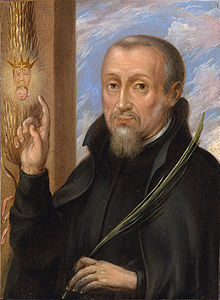
Garnet, “the prime scholar of Winchester College” as a gifted young student, left England to enter the Society of Jesus and study under Robert Bellarmine, a theologian so Catholic that he would later bring the hammer down on Galileo’s heliocentrism.

After eleven years in letters on the continent, the Society called Garnet to return to England in 1586 as the lead missionary to his native realm’s Catholic minority. It was a lonely burden for Garnet, especially after his opposite number Robert Southwell was arrested in 1592. (Southwell, too, went to the scaffold.) But Garnet carried it off as well as anyone. He remained free for nearly twenty years — creating an underground press and numerous illegal cells.

“Under his care the Jesuits in the English mission increased from one to forty, and that not a single letter of complaint, it is said, was sent to headquarters against him,” lauds the Catholic Encyclopedia.

Theologically, Garnet was noted for his defense of the doctrine of equivocation — that is (in the hostile reading of its Protestant interlocutors) of finding hair-splitting rationales for lying. It was an intellectual exercise of many centuries’ vintage, but for England’s beleaguered Catholics it was as urgent as life and death. Most specifically, this doctrine reckoned an oath insufficient to compel a truthful response to official inquiries as to the whereabouts and activities of fellow-Catholics who’d be liable with discovery to attain martyrdom. The liberal definition of “truth” to include an outright lie with a “secret meaning reserved in [one’s] mind” was obviously ripe for the scorn of persecutors for whom it was little but treason neatly clothed.

Knock, knock! Who’s there, in th’ other devil’s name?
Faith, here’s an equivocator that could swear in both
the scales against either scale, who committed
treason enough for God’s sake, yet could not
equivocate to heaven. O, come in, equivocator.

Macbeth (c. 1606), Act 2, Scene 3

Much of Garnet’s last weeks in custody ahead of his execution were spent in harrowing the doctrine of equivocation; indeed, this is even the very last exchange he had with doctors of the English church sent to accompany him.

One of those standing near him then asked him, “Whether he still held the same opinion as he had formerly expressed about equivocation, and whether he thought it lawful to equivocate at the point of death?” He refused to give an opinion at that time; and the Dean of St. Paul’s sharply inveighing against equivocation, and saying that seditious doctrine of that kind was the parent of all such impious treasons and designs as those for which he suffered, Garnet said, “that how equivocation was lawful, and when, he had shewn his mind elsewhere, and that he should, at any rate, use no equivocation now.”

There were nevertheless equivocations that Garnet would never countenance. His A Treatise of Christian Renunciation, compiling quotes from Church fathers detailing the things a good Catholic must be prepared to renounce for his faith, excoriated those who attended Anglican chuches. Their pretense, he said, was nothing but their own comfort.

Certaine private persons, who have wholly addicted them selves to make them Gods either of their belly and ease, or of the wicked mammon, setting God behind all things which may delight them … refuse also to beleeve that the do amisse …

Judas with a kisse dost thou betray me? amongst hereticks dost thou professe me? no other place to professe chastity, but in the bedd of a harlott?

Harried as they were, England’s Catholics greeted with anticipation the 1603 accession of King James: raised Protestant, but the son of the Catholic Mary, Queen of Scots. Garnet shared Catholics’ hope that James would ease off harassment of the Old Faith; he even authorized the betrayal of fellow-Catholics’ regicidal Bye Plot as a show of loyalty and to pre-empt a possible backlash. “Quiete et pacifice,” he begged.

But toleration was still not quickly forthcoming, and soon Catholics had reverted to “a stage of desperation.” James was only in his thirties: would the trials be neverending?

Garnet continued endeavouring to keep Catholics calm and give the new sovereign the political space necessary to relax persecution. But many of his flock soon tired of quiete et pacifice.

In 1605, there would be another try — one that is still remember, remembered to this day.

Here Garnet again gets into hot water with theological doctrine. Garnet caught indirect wind of Guy Fawkes’ terrorist plot — but he heard it kind-of-sort-of under the seal of the confessional: another priest who himself had heard the design under confession told it to Garnet in a more ambiguous circumstance.

Garnet’s excuses here might strike the reader as far too fine; certainly that is how his prosecutors viewed it. The circumstances of the plot’s revelation certainly appeared to give the priest enough leave to find a way to reveal it, especially since he knew about it for many months before that almost-fateful Fifth of November. Garnet seems to have wanted the resolution — or loathed to plant another Judas-kiss. Maybe he thought his exhortations could stop it without anyone winding up drawn on a hurdle. Maybe, after 19 furtive years knowing every morning that his next sleep might be in a dungeon, his heart of hearts wanted to see it to go ahead.

When the attempt to explosively decapitate the English state was discovered Garnet was hunted to ground; his last days of “liberty” were spent stuffed in a coffin-sized priest hole at Hindlip Hall before the “customs of nature which must of necessity be done” finally forced him to out into the sight of his captors.

His fate looks like a foregone conclusion in retrospect, but Garnet did fight it — for two months before his condemnation, and five more weeks after from trial until his execution during which he maneuvered to exculpate himself. (See Investigating Gunpowder Treason for an exploration of this.) Since Reformation English law of course did not recognize the seal of the confessional, the most charitable reading of Garnet’s own admissions start at misprision of treason. It is but a single step from there to the scaffold if one supposes his long silence shrouded any sort of approval of or aid to the plotters.

Garnet received the mercy of being hanged to death before he was cut down for the public butchery part of his sentence.

On this day..

1766: William Whittle

William Whittle, a Catholic, was executed at Lancaster on this date in 1766 for murdering his Protestant wife and their children in a religious frenzy.

For whatever reason, several years into his union, Whittle took deeply to heart a priestly warning that he was liable to damnation for marrying a heretic. He accordingly ended the marriage by “cleaving his Wife’s Head with an Axe, and ripping her Belly open, and afterwards cutting off the Heads of the two Children, one of whom he also ripped open and took out its Heart.” (St. James’s Chronicle, April 5, 1766)

(The children, Whittle said, had been imperiled in soul by their mother’s taking them to an Episcopal church; in murdering them their loving father had sent them to purgatory en route to heaven, saving them from eternal hellfire.)

Whittle was condemned to be hung in chains for the shocking crime, a demonstration that Catholics understood as aimed pointedly at them. At least of their number replied with like menace in an anonymous letter to the Rev. Mr. Oliver of Preston, the magistrate who committed Whittle to prison.

Sir, I make bold to acquaint you, that your house and every clergyman’s that is in the town, or any black son of a bitch like you, for you are nothing but hereticks and damned fouls. If William Whittle, that worthy man, hangs up ten days, you may fully expect to be blown to damnation. I have nothing more material, but I desire that you will make interest for him to be cut down, or else you may fully expect it at ten days end. My name is S.M. and W.G.

(Letter as quoted in the Leeds Intelligencer, April 22, 1766 — also the source of the newspaper screenshot above)

Mainstream suspicion of Catholics at this time — which was within living memory of the last great Jacobite restoration attempt — was quite deeply ingrained; as one can see from the riposte above, the sentiment was mutual. After all, these were matters of eternal salvation even if Whittle himself “appeared to be a stupid, bigotted, ignorant fellow.”

The shocking family butchery evoked a minor wave of fretting over insidious Catholic-Protestant intermarriages. I think the present-day reader will not have much difficulty recognizing contemporary analogues to this thrust of resulting commentary:

I am likewise persuaded that there are many lay-papists in the kingdom who abhor this fact of Whittle as much as any protestant can do. But if their religion does not give countenance to such doctrines as this alledged by this miserable man, why do they not by some public act disavow their approbation of them? why do they leave suspicions upon themselves and their religion by their silence, when such occasions call upon them so pressingly to explain themselves, and particularly when they are complaining of the severity of the penal laws[?]

On this day..

1612: Bishop Conor O’Devany and Father Patrick O’Loughran

On this date in 1612,* Bishop Conor O’Devan(e)y and Father Patrick O’Loughran were hanged, drawn, and quartered as traitors at George’s Hill outside of Dublin.

In the wake of the Gunpowder Plot, Ireland’s Catholics found things increasingly uncomfortable under King James.

In 1607, reacting to a squeeze on their incomes and prerogatives, two native noblemen fled to the continent hoping to make arrangements with the Spanish for a reconquest that would never come. This Flight of the Earls spelled the end of Ireland’s homegrown Gaelic aristocracy and set the stage for the Plantation of Ulster, the settler statelet that formed the germ of present-day Northern Ireland.

O’Loughran’s crime was very simple: already on the continent himself, he had administered the sacraments to those attainted fugitives, later having the boldness to return to Ireland.

There, the charge of collaborating with Bishop O’Devany was also laid to his shoulders.

While O’Loughran was in the summer of his natural life, O’Devany was around eighty years old. Consecrated a bishop in Rome in 1582, he had returned to the north of Ireland and been briefly detained in the post-Spanish Armada security scare.

In the 1600s, O’Devany’s protector had been Hugh O’Neill, Earl of Tyronne, and unfortunately this man was one of the earls in the aforementioned Flight.

He wasn’t a difficult man to target, but the somewhat gratuitous decision by England’s viceroy to do so was not widely supported even by the English and Protestant factions. O’Loughran’s conduct could perhaps be stretched to resemble treason; O’Devany was just an old man being persecuted for his faith. Going to his glory, the bishop did not fail to play that angle up under the eyes of a sympathetic Gaelic crowd.

Far from being cowed by the bishop’s butchery, those onlookers swarmed the gallows, touching the spilled blood and the quartered flesh as holy relics. “Some cut away all the hair from the head, which they preserved for a relic; some others gave practice to steal the head away … the body being dissevered into four quarters, they neither left finger or toe, but they cut them off and carried them away … with their knives they shaed off chips from the hallowed gallows; neither could they omit the halter with which he was hanged, but it was rescued for holy uses.” (Barnabe Rich)


This image counterposes O’Devany and O’Loughran (background) with the sufferings of 16th century martyr Archbishop Dermot O’Hurley (foreground).

Days after the executions, that aforementioned aggressive viceroy, Lord Chichester, reported to London how “a titular Bishop and a priest being lately executed for treason merely are notwithstanding thought martyrs and adored for saints.”

Thanks to the counterproductive outcome, the British laid off the policy of martyring Catholic priests thereafter (at least until Cromwell, but that’s another story).

Both men were beatified in 1992 among the Irish Catholic Martyrs.

* The date was February 1 according to the Julian calendar still in use by England at the time; it was February 12 according to the Gregorian calendar. England occupied Ireland through the period of the new Gregorian calendar’s initial 16th century adoption by Europe’s Catholic countries, so the official date in Ireland was February 1 … even though the padres’ boss in Rome would have considered it February 12.

On this day..

1757: Father Andreas Faulhaber, seal of the confessional martyr

On this date in 1757, Catholic priest Andreas Faulhaber was hanged at the order of Frederick the Great to defend the seal of the confessional.

Frederick had been appointed by the Heavenly Father, and a cruel earthly one, to a task far too monumental to tarry with theology: lifting the Kingdom of Prussia from the morass of German principalities and into the ranks of Europe’s great powers. Frederick was nominally a Protestant, as was the bulk of his domain, and der Alte Fritz once remarked that this profession pleasingly liberated his sovereignty from papal interference; his real doctrine was nothing but pragmatism.

Accordingly, the great enlightened absolutist sponsored Jesuit educators where schools were needed and Jewish merchants where trade was needed.

Disgusted at Frederick’s aggressive war on Austria, Voltaire scribbled to a friend,

I’ve seen his good intentions dropped
At the first trumpet blast.
They are nothing more than kings;
And live their lives with bloody things,
They take or rape a few provinces
To suit their ambitious ends
I give up, say goodbye princes
I want no one now but friends.

(Source)

But Voltaire did not in fact break with his royal admirer and correspondent over Silesia.

Frederick christened his new reign in 1740-42 by ripping the wealthy* province of Silesia away from the Habsburgs.

The Habsburgs were Prussia’s Catholic rivals for preeminence in central Europe and Silesia too was heavily Catholic, so Frederick extended over that province as liberal a grant of religious toleration as he might.

But the attachments of men for the kings of their forefathers are not always so easily displaced, and neither are those of kings for the most lucrative soil of their patrimony. Austria made two subsequent attempts to retrieve Silesia; together with Frederick’s initial invasion, these are the Silesian Wars.

The last of the three was itself just one theater of the gigantic Seven Years’ War. The conflict between Prussia and Austria over Silesia, and the complex continental diplomatic entanglements** each power effected in its pursuit, were among the root causes of that entire globe-spanning conflict.

Prussia won the first two Silesian Wars handily, but the third was a much more doubtful affair — indeed, Prussia was well on its way to defeat before the shock death of the Russian empress delivered that country into the hands of an unabashed Germanophile who pulled Russia out of the war.

But in view of Frederick the Great’s strained situation prior to this providential deliverance, some of his Silesian subjects made free to prefer their prospective Catholic/Austrian allegiance to that of their recent conqueror.

Desertions among Silesian conscripts, some of them even escaping to Austrian lines, called down the dark side of the religious toleration policy. Frederick let people pray as they liked so that he could rule as he liked; here, when he suspected the Silesian Catholic clergy of countenancing wartime disloyalty among their flock, those religious scruples had overstepped their proper sphere.

And so at last we come to our day’s execution.

One young man caught attempting to desert Frederick’s army was captured and interrogated by his commanders. He allowed that he had undertaken the sacrament of confession before escaping, and expressed to the priest his intention to abandon the army.

The priest, Father Andreas Faulhaber, was arrested on this basis, but between his calm defense of himself and the deserter’s shifting, unreliable story, the military court found little basis to proceed. The impression one gets is that the contemplated desertion was not the main thrust of the confession and that Father Faulhaber accordingly discouraged the sin in passing but didn’t bother to dwell on the point.

The impression is difficult to substantiate because the padre rigorously kept the seal of the confessional — another imposition demanded by faith that secular authorities who had armies to field preferred not to honor.

But evidently looking to serve notice that the monarch’s religious indifference could not be used to abrogate subjects’ responsibility to the state, Frederick himself ordered Faulhaber’s sudden execution for the morning of December 30.

The unfortunate priest only discovered his impending fate moments before it was enacted, but still refused under the makeshift gallows to give up anything incriminating about his parishioner. “Hang up the Jesuit Faulhaber, but let him not have a confessor,” read the order, according to this decidedly Catholic account, which adds that Faulhaber was not actually a Jesuit at all, and the word only added to invoke the going 18th century prejudice against that order.

Prussia won this war, too. It kept Silesia in Prussian hands, and then German hands, for two centuries. The bulk of Silesia was transferred to Poland after World War II.

* Silesia provided one-quarter of all the Habsburgs’ tax revenue, according to Frederick the Great: A Life in Deed and Letters.

** For the Seven Years’ War, Austria made common cause with its traditional foe, France: one consequence of this arrangement was the betrothal of the Austrian princess Marie Antoinette to the future French king Louis XVI.

On this day..

1591: Barnabe Brisson, at the hands of the Sixteen

On this date in 1591, the summary execution of Barnabe Brisson and two other French doctors of law signaled the beginning of the end of France’s Wars of Religion.

After the untimely death of Henri II in a freak jousting accident, his widow Catherine de’ Medici employed three frustrating decades shuttling the late monarch’s uninspiring offspring onto the throne only to see each in his turn die young and without issue. We are by these late years on to the last of Henri II’s sons — Henri III of France.

Actually, Henri wasn’t the last: just the last left alive. He had a younger brother, Francis, Duke of Anjou, who dropped dead in 1584 of malaria and left Henri III as the only Valois male. The heir presumptive after Henri III was his Calvinist brother-in-law Henri of Navarre. Spoiler alert: by the end of this post, Henri of Navarre is going to get there as King Henri IV.

The Catholic-vs.-Huguenot Wars of Religion had raged in France for many years but the last major installment of the bloody serial was the War of the Three Henrys: the two Henris aforesaid, plus the Duke of Guise, also named Henri — the standard-bearer of Catholic zealots.

Our present-day presumption of live-and-let-live spirituality was bequeathed from the Enlightenment only after it had been hard-won by centuries previous. In France of the 1500s, the most extreme (but by no means marginal) Catholic party saw the very existence of a Huguenot faction — and the fact that more moderate Catholic politiques were prepared to tolerate and treat with them — as an existential threat to the kingdom. Catholicism in the literal universal sense was intrinsic to France itself: if she should cease to be so, what would become of her? A 1589 pamphlet extolled what

an admirable thing [it is] to view the ardor and the devotion of everyone in France, the air resounding with prayer and processions of our youth who are purified by our prayers and by the common voice which is spread throughout this kingdom; we demonstrate that the benedictions and maledictions of a people have great effects.

With such great effects at stake, the pious ought not abide any fooling around with Providence. “If your brother, your friend, and your wife all of whom you hold dear wish to strip you of your faith,” wrote Louis D’Orleans in 1588, “kill them, cut their throats and sacrifice them to God.”*

This was a faction for whom Henri of Navarre’s prospective succession was absolutely intolerable, which makes it somewhat ironic that they themselves soon turned prospect into reality.

King Henri III was a Catholic himself, of course, and this irreconcilable Catholic League was part of what you might call his base. But though initially allied, the League’s attempts to dominate the young king led Henri III to execute a daring breakout: on December 23, 1588, he summoned the Duke of Guise to confer with him at the Chateau de Blois and there had his bodyguards murder Guise on the spot.


Just two Henries now …** (Executed Today’s court painter Paul Delaroche interprets that same scene here.)

The resulting fury of the Catholic League was so great that the king soon fled Paris and made common cause with Henri of Navarre. Now the civil war was the two Henris together — and the Catholic League opposing them. We come here to our date’s principal character, Barnabe Brisson (English Wikipedia entry | French), a distinguished jurist† in the Parlement of France. While most of this chamber followed the king out of Paris, Brisson chose to remain. “The Sixteen,”‡ the council of Catholic militants who now ruled Paris with the support of a populist militia, elevated Brisson to President of the Parlement.

In 1589 the Henris besieged staunchly Catholic Paris in an attempt to bring the civil war to a close. In a classic Pyrrhic victory, the League defeated this attempt by having a priest assassinate King Henri.


… and now we’re down to the last Henri.

While this action did break the siege, and avenge the murder of Guise, it made Henri of Navarre into King Henri IV. (Told you we’d get there.) The Catholic League’s attempt to recognize the new king’s uncle, a Cardinal, as the successor went nowhere at all, and at any rate this man himself died in 1590.

This succession greatly deepened the internal tension among Paris Catholics between the uncompromising men of the Sixteen and the moderate politiques, and the latter party’s interest in finding with the legitimate king a settlement that looked increasingly inevitable. After all, were these armed commoners really going to rule Paris indefinitely?


An armed march of the Holy League in Paris in 1590. (Anonymous painting)

The situation provoked the ultras among Paris’s ruling Sixteen to more desperate measures in a vain effort to maintain control. Their faction’s own post-Guise leader among the high nobility, the Duke of Mayenne, had refused inducements to seize the crown himself or to seat a sovereign provided by the League’s Hapsburg allies. He too was visibly sliding towards an accommodation with the heretic king. (He would reach one in 1596.) In much the same camp was an establishment figure like Brisson whose staying behind in Paris during the confused situation of 1588-1589 was scarcely intended to declare that his allegiance to creed surpassed all care for order. The man was a lawyer, after all.

During Mayenne’s absence from the capital in the autumn of 1591, the Sixteen mounted a radical internal coup and attempted to purge the city’s moderates. Brisson was arrested walking to work on the morning of the 15th and subjected along with two other jurists to a sham snap trial. All three were hung by lunchtime, and per a proposal floated among the council that afternoon were the next morning fitted with denunciatory placards and displayed on gibbets at the Place de Greve.

Barnabé Brisson, a chief traitor and heretic

Claude Larcher, an instigator of treacherous politiques

Jean Tardiff, an enemy of God and of Catholic princes

Their shocking exhibition was intended to incite a “St. Barthelemy des politiques” — a St. Bartholomew’s Day-esque pogrom against the politique moderates.

But the Sixteen had badly misjudged the mood of the city. The crowd beheld the mangled corpses silently, full of horror or pity — emblematic of the turning-point France was nearing in its interminable confessional strife. Despite the Catholic League’s strength in Paris, most Parisians were losing their appetite for bloodshed. The Duke of Mayenne was back in the capital by the end of the month and underscored the coming arrangements by seizing four of the Sixteen for summary execution themselves.

Two years later, Henri IV at last took Paris in hand by making a nominal conversion to Catholicism with the legendary (alleged) remark, “Paris is worth a Mass.”§

French speakers may enjoy this 19th century pdf biography of Brisson by Alfred Giraud.

* “Du Contemnement de la mort. Discours accomode a la miserable condition de ce temps” (blockquoted section) and Replique pour le Catholique Anglois, contre le Catolique associe des Huguenots (D’Orleans quote). Both via Dalia Leonardo in “Cut off This Rotten Member”: The Rhetoric of Heresy, Sin, and Disease in the Ideology of the French Catholic League,” The Catholic Historical Review, April 2002.

** Also of interest: this 1908 silent film of the assassination of the Duc de Guise, scored by Saint-Saens.

† Brisson’s dictionary of Justinian legal terminology remained in print until 1805. He also in 1587 produced a compilation of the laws of France as Le Code du Roy Henri III.

‡ The Sixteen were delegates of Paris’s quarters, assembled by the Duke of Mayenne. For detail on the composition and internal history of The Sixteen, see J.H.M. Salmon, “The Paris Sixteen, 1584-94: The Social Analysis of a Revolutionary Movement,” The Journal of Modern History, December 1972.

§ In the end, of course, an entirely unreconciled Catholic extremist assassinated Henri IV in 1610.

On this day..

1846: Andrew Kim Taegon, the first Korean priest

The first native Korean Catholic priest, Andrew Kim Taegon, was martyred for his faith on this date in 1846.

Catholicism had begun making inroads in Korea from the late 18th century, a development most unwelcome for the Confucian Joseon dynasty. Catholic adherents graduated over the decades of the 19th century to heavier and heavier degrees of persecution. By 1866, the peak of anti-Catholic sentiment, it’s thought that Korea’s Catholic community numbered about 20,000 living souls — and had lost about 10,000 others to martyrdom.

Andrew’s father was one of these 10,000.

The son, and the principal figure of this post, was baptized in his childhood. He trained for Holy Orders at overseas seminaries, in China and the Philippines (according to Wikipedia, he has a statue in the Philippines village where he once hung his hat), finally stealing illicitly into Korea to evangelize underground. Such missions were of ancient vintage for the Church; they have also proven a font of martyrs.

Kim managed about 13 months before he was captured and put to death in the 1846 “Pyong-o persecution”, one of several distinct crackdowns on the alien faith whose episodes punctuated the overall fearful climate for Korea’s Catholics.

Beheaded at the age of 25 among a group of 20 Catholic martyrs, the young man was eventually canonized as St. Andrew Kim Taegon by Pope John Paul II. He shares a common September 20 feast date with other Korean martyrs, including Paul Chong Hasang.

St. Andrew is the patron of the Korean clergy, and of the Pontifical Korean College in Rome. When in Seoul, stop at the Jeoldu-san museum and shrine to remember him.

On this day..

1948: Kiralyfalvi Miklos, Hungarian Catholic

London Times, June 9, 1948:

SCHOOLS DISPUTE IN HUNGARY
CARDINAL’S REPLY TO MINISTER
CATHOLICS’ CONCERN

BUDAPEST, June 8
The village priest and other persons held responsible for the murder of a policeman and the wounding of two others in a village in north-east Hungary last Sunday will be tried in Budapest on Thursday.

The letter of protest from the Minister of Education to the Primate, Cardinal Mindszenthy, says that the villagers had clearly been aroused to violence by the priest’s sermon, in which he spoke against the projected nationalization of the schools. They went straight from church to the mayor’s house and the municipal buildings, where the council had voted by a majority in favour of the nationalization, and the policeman was killed while trying to protect the mayor. The Minister asked the Cardinal to put an end “by central decree” to this pulpit agitation, adding: “If not, the responsibility will be shifted where it belongs, and the law will be evoked upon all who continue it or direct it.”

The Cardinal, in his reply, says that he knows no more of the incident than is contained in the Minister’s letter, and therefore can take no stand upon it. He adds that the idea of nationalization is still causing great excitement among Catholics all over the country, an that the only way to end the excitement is to abandon nationalization. He denies that the agitation is directed centrally (that is, by himself), and puts the responsibility on those who “insist on putting forward such provocative measures.”

Church’s Divine Right

The Primate has already refused to follow the example of the Protestant churches, which have agreed with the State that nationalization shall go through, but that their ancient seminaries shall be excluded and the teaching of religion in the schools continued, and that the State shall grant them a large annual payment, gradually decreasing, for 25 years. On the contrary, in his third pastoral letter, which was read in all Catholic churches on Sunday, the Cardinal said that nationalization violated natural law and the Church’s divine right.

People were saying, the pastoral letter continued, that it was now time for the State to take over; but certain principles, among them the ten Commandments, were timeless. It called upon the faithful “to pray for strength to resist with all their might this violation of the immortal soul.” Never had the shameful misleading of the people been so great in Hungary as now. The faithful must refuse to allow their families to read the newspapers of those who opposed their faith, and must offer a Novena to God that the “Satan prowling among us like a roving lion may be driven away.”

It is in this guise that the Cardinal sees the Communists. They see him as an inflexible survivor of the Middle Ages.

It was in the village of Pocspetri that all the trouble went down: a march to the local municipal building to protest school nationalization. For years after, Pocspetri would be shorthand (Hungarian link, as is the next) in the official press for any clerical backlash — something right out of the Middle Ages.

Kiralyfalvi, at his trial

At the end of this march, a policeman was dead. It’s alleged now — in anti-communist post-Cold War Hungary — that what really happened was that one of the policemen deployed for crowd control accidentally triggered his own gun and killed himself with it.

Whatever occurred in the march, it was a productive incident for Hungarian communists then executing their political takeover of Hungary. The resulting show trial (more Hungarian) is sometimes seen as one of the signal events in a concomitant crackdown on organized religion — a potential pole of opposition to the Soviet-backed state. The victim, of course, enjoyed the fallen cop’s prerogative, a fast-track beatification by the propaganda ministry. (No need for Hungarian to get the point of the pictures in this pdf.) Miklos Kiralyfalvi got the death sentence, but the prerogatives the church was focused on — those were the real prize.

London Times, June 12, 1948:

MURDERED HUNGARIAN POLICEMAN
PRIEST SENTENCED TO DEATH

BUDAPEST,June 11
Janos Astezlos, the priest whose trial on a charge of inciting his villagers to the murder of a policeman began here yesterday, was sentenced to death this afternoon. The villager who actually killed the policeman was also condemned to death, and of the other four who took part one received life imprisonment and the other three 12 years.

Such, five days after it happened, is the end of this affair, though not of the dispute that lies behind it. In this week’s edition of the Catholic weekly Hazank Mr. Barankovics, head of the Catholic Party in Parliament, which has at least 16 per cent of the country’s votes, writes that a true Christian is bound to defend the right of the Catholic Church to keep the schools, because once they were lost the Church would have nothing left to do but celebrate Mass, and its whole cultural influence would be gone. “Whoever is our leader,” he says, referring to rumours that he disagrees with the Cardinal, “we are bound to act in the same way.” Of the murder the newspaper writes that the Church never counselled violence and regrets deeply what happened.


BUDAPEST, June 11. — The villager accused of killing the policeman was hanged here tonight. -Reuter.

(The priest’s sentence was commuted to a prison term. Only Kiralyfalvi was executed for the Pocspetri murder.)

On St. Stephen‘s Day 1948, Cardinal Mindszenty himself was arrested for treason. This was old hat for the cardinal; he’d been arrested for opposing Bela Kun‘s interwar people’s republic, and arrested again by the Nazi collaborationist government in 1944.

This time, he copped a life sentence.

Briefly released during the 1956 Hungarian Revolution, Mindszenty fled to the American embassy as Soviet tanks subdued the country. He would live on the embassy grounds for the next 15 years, a potent symbol of living martyrdom against communism until he was finally released to Vienna.

If your Magyar is up to snuff, this documentary on the Pocspetri incident might be enjoyable.

On this day..

1857: Jean-Louis Verger, doctrinaire

On Saturday, January 3, 1857, the Archbishop of Paris Marie-Dominique-Auguste Sibour had just reached the church of Saint-Etienne-du-Mont when Jean-Loiuis Verger stepped out of a crowd — out of obscurity — and plunged a long Catalan knife fatally into Sibour’s chest.

The assassin Verger (English Wikipedia entry | French) was a 30-year-old ordained priest who had accumulated a quarrelsome reputation among his ecclesiastical peers. The previous year, he had been laid under an official interdiction for preaching against the Catholic Church’s controversial new doctrine of the Virgin Mary’s Immaculate Conception.

Some reports had Verger crying out “No goddesses!” as he daggered the archbishop. “It is nowise the person of the Archbishop of Paris whom I wished to strike, but, in his person, the dogma of the Immaculate Conception,” Verger told the magistrates who judged him within days. There wasn’t a whole lot of doubt about the trial, so why wait around? But Verger’s vendetta wasn’t only theological; his suspension meant he wasn’t getting paid, and as his fury mounted over it he went so far as to post himself at the door of a church with a placard proclaiming that he was starving.

Archbishop of Paris was a surprisingly dangerous job in the mid-19th century. Sibour got the post because his predecessor was shot dead negotiating at a barricade during the 1848 revolution; in 1871, Archbishop Georges Darboy was taken hostage by the Paris Commune and executed by his captors when the national government invaded the city.

On this day..

1567: Pietro Carnesecchi, Florentine humanist and heretic

On this date* in 1567, Florentine humanist Pietro Carnesecchi was burned after beheading at the Ponte Sant’Angelo in Rome.

Carnesecchi (English Wikipedia entry | Italian) was born to a wealthy Florentine merchant family allied with the Medici; as a child, Carnesecchi probably dandled the infant Cosimo, the future ruler of the city. His education was patronized by the Medici cardinal who went on to become Pope Clement VII.

All these friends in high places would prove in time to be a poisoned chalice.

But the young man was in his glory in his twenties at Clement’s papal court, as notary and protonotary, excelling in his lucrative sinecures on the curial cursus honorum.

To his grief and/or glory, he met along the way the Spanish reformer Juan de Valdes, who had taken refuge in Naples from the Spanish Inquisition, and the spellbinding pulpit orator Bernardino Ochino, who was by the late 1530s to trend towards outright apostasy.

Intellectual curiosity was a quality dangerous to its owners during the Reformation. Carnesecchi had his own insider’s view of the Church’s warts to add to the influences of these brilliant associates, and by the 1540s was obliged by his affinities to seek his safety in the more liberal religious environment of Venice … and later, after a close first brush with the Roman Inquisition, to leave Italy altogether.

He wasn’t on the run per se, but his was a contingent life: a few years in a place, with the ever-present peril that a shift in the political winds could see him or his friends to the scaffold. He returned from France to Venice in 1552, spurned a summons to justify himself once more to the Inquisition under the furiously anti-Protestant Pope Paul IV, and was even able to move back to the Eternal City with the accession to St. Peter’s Throne of another Medici cardinal as Pope Pius IV. The Inquisition, nevertheless, drug its feet when it came to acquitting Carnesecchi once again.

“Nothing progresses!” he cries in one of his letters, for the Inquisitors “will not judge as right and duty dictate, for they suggest scrupulous hesitancy where there is no ground for it, and interpret that prejudicially which, rightly apprehended, is good and praiseworthy.” In other words: prosecutors.

As Popes are said to alternate fat with thin, and old with young, here they traded zealot of the faith with mellow humanist. When Pius IV died, the pendulum swung back against Pietro and the relentlessly orthodox** Pius V took charge.

Carnesecchi took refuge in his native Florence, governed by that baby Cosimo de’ Medici, all grown up now into an authoritarian state-builder. Cosimo had welcomed him before, and interceded on his behalf in the last go-round with the Inquisition; Florence, moreover, had a long-running rivalry with Rome in peninsular politics. Carnesecchi would have supposed himself as safe there as ever he had been in his peregrinations.

“But how did Ghislieri’s [Pope Pius V’s given name] reckless energy paralyse others!” as this book puts it. “Cosimo, too, was destined to feel its influence.”

Carnesecchi was a guest at his sovereign’s table when the friar Tomaso Manrique, the Master of the Papal Palace, was announced, as sent on a special mission to Florence, and desiring an interview with the Duke. The Pope had furnished his messenger with a letter bearing date June 20th, 1566, in which, after greeting Cosimo with the Apostolic Benediction, ‘he was called upon, in an affair which nearly affected obedience to the Divine Majesty and to the Catholic Church, and which the Pope had greatly at heart, as being of the highest importance, to give to the bearer of this letter the same faith as though His Holiness were present conversing with him.” Manrique claimed in the Pope’s name the delivering over of Carnesecchi into the hands of the Inquisition. The Duke made his friend and guest rise from the table and surrender himself on the spot to the Papal messenger. And he abjectly added, that, “had His Holiness — which God forfend — called upon him to surrender his own son for the same motive, he would not have hesitated one moment to have him bound and surrendered.”

Thanks, buddy.

Hauled immediately to a Vatican dungeon, Carnesecchi spent his last 15 months in prison, under interrogation, and sometimes on the rack.

“They would fain have me say of the living and of the dead things which I do not know, and which they would so fain hear,” Carnesecchi pleaded in (futile, intercepted) letters to old associates from the Curia. He admirably refused to incriminate anyone, but was convicted in September 1567 on 34 counts of obstinate heresy. They can all be read here — headlined by that hallmark of rank Protestantism, justification by faith alone.

Carnesecchi was stripped of his ecclesiastical ranks and his property, and turned over to the secular arm — the latter hypocritically “beseech[ed] … to mitigate the severity of your sentence with respect to his body, that there may be no anger of death or of shedding of blood,” which was, of course, the very intent and the effect of turning him over. Carnesecchi met his fate sturdily; his Catholic confessor complained that he was more interested in bantering ideas than penitence for his wrong opinions, and showed no proper fear of death.

In 1569, Pius V bestowed the title of Grand Duke of Tuscany on Cosimo.

Carnesecchi, long obscure to posterity, was exhumed almost literally when the Napoleonic Wars gave anti-clerical factions the opportunity to ransack secret Roman Inquisition archives. His meter-long file passed into a succession of private hands and was finally published in the mid-19th century, and as a result there are several public-domain volumes about the heretic in addition to the one we have already cited. Some of the original documents, with English translation, can be read in this volume; Italian speakers might give this one a go.

* There are a few citations out there for October 3. I can’t find a definitive primary source, and it may be that the original records are themselves ambiguous, so I’m going with the bulk of the modern and academic citations in favor of October 1.

** Anglos may recognize Pius V as the pope whose bull explicitly releasing Catholics from their allegiance to Queen Elizabeth put English followers of the Old Faith in an untenable position, much to the grisly profit of this here blog.

On this day..

1480: The Martyrs of Otranto

On this date in 1480, Ottomans invading Otranto, Italy conducted a mass execution of prisoners.

Landing at the southern Italian city on July 28, the Ottoman force quickly overwhelmed Otranto. (Otranto rashly slew the messenger come to offer a merciful capitulation, only to find that its garrison began deserting within days.) On August 11, the Turks took the city by storm. Thousands died on that day’s bloodbath, including the Archbishop of Otranto.

Surviving women and children were sold into slavery. Men over age 15 had the choice of conversion — or death.

“Now it is time for us to fight to save our souls for the Lord!” a Christian shoemaker is said to have exhorted his 800 fellow prisoners. “And since he died on the cross for us, it is fitting that we should die for him.”

The acclaim greeting this call signaled inflammation ahead for the Turkish headsmen’s rotator cuffs. They had 800 faithful souls to dispatch to their eternal reward this date at the place still known as the Hill of Martyrs. (When in Otranto, visit it by taking the via Ottocento Martiri, just off via Antonio Primaldo — that’s the name of the militant shoemaker.)


The remains of the Otranto martyrs, arrayed as relics in the Otranto cathedral. (cc) image from Laurent Massoptier.

Historical novel set during these vents.

This, at least, is the most pious version of the story. The mass execution certainly did occur, but some latter-day historians like Francesco Tateo have argued that martyrdom is not attested by any of the contemporaneous sources, and the specifically religious understanding of events was only read in after the fact.

On whatever grounds one likes, Italy’s fractious city-states were deeply alarmed by the appearance on their shores of the all-conquering Turks. “It will always seem as if the funeral cross is borne before me while these barbarians remain in the boundaries of Italy,” wrote the Florentine humanist Poliziano.* (Source, a nonfiction book which covers Otranto in some detail.)

In the ensuing months, they rallied together vowing to expel the invaders.

Fortunately for this coalition, the Ottoman sultan Mehmed the Conqueror died in May 1481, and a brief period of internal conflict within the Ottoman empire over the succession perhaps led it to allow its Otranto outpost to wither on the vine. The Turks made peace and withdrew from their potential beachhead not long after, having held the city for just over a year. The bodies of the martyrs were said to have been found uncorrupted by decay.

The Catholic church beatified the 800 martyrs in 1771, but their final elevation to sainthood occurred only in 2013, just three months ago as I write this. They were in the very first group canonized by the new Pope Francis — although the canonization was approved by his predecessor Benedict XVI on the same day that Benedict resigned his pontificate. Considering current relations between the respective faiths, it was seen as a potentially impolitic move.

“By venerating the martyrs of Otranto, we ask God to protect the many Christians who in these times, and in many parts of the world, are still victims of violence,” Pope Francis said at the canonization Mass, diplomatically not naming any of those parts of the world.

* At the same time, Florence (in common with other Italian polities) had trade and diplomatic relations with the Ottomans.

On this day..