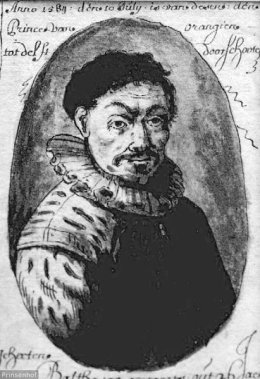
1578: Thee Bruges Minnenbroder

During the Dutch Revolt — a proto-nationalist conflict pitting the Low Countries against the Habsburg Empire, overlaid with a religious conflict pitting Calvinist against Catholic — the Low Countries principals came to an expedient arrangement to lay off fighting with one another in order to concentrate on controlling their respective internal revolts.

As we’ve previously discussed, this truce helped set up now-unmolested local religious majorities to do some internal purging.

Whereas Calvinist Ghent went after some Catholic monks on accusations of homosexuality, Catholic Bruges (today in Belgium) … went after some not-Catholic-enough monks on accusations of homosexuality.

The results, as described in Same-Sex Desire in the English Renaissance: A Sourcebook of Texts, 1470-1650, were depressingly similar.

In [illustrator Franz] Hogenberg‘s Scenes an engraving dated May 18, 1578, shows a lengthy procession of monks being marched out of a monastery in Bruges under armed guard. The title and verses explain that two Franciscans of Calvinist leanings were whipped and then interrogated (probably on account of their Protestantism). But they revealed that many in their order were tained by sodomy (Sodomi). The other monks admitted this (under torture?), and “they were all taken prisoners and led away to the gate for their godlessness.” Presumably depicting a result of this … [is] Execution for Sodomitical Godlessness in the City of Bruges … Three monks are about to be burned in a public square while two are being beaten. Underneath, the verses state, “in well-known Bruges in Flanders three Franciscans (Minnenbroder) have been burned. Also two others were well beaten with switches and two had to be banished. For they were young and inexperienced and had been seduced by the old ones, so that they unjustly practiced sodomy (unzuchtt) upon their bodies.” Though the circumstances of the monks’ trial are as yet unclear, such sentences were carried out by secular authorities. Minnenbroder (Franciscans) may be a satiric pun on the word minne (which had come to mean debauchery), suggesting “brothers in lust” as opposed to brotherly love. Hogenberg connects sodomy with “godlessness,” as was common.

… The investigations, convictions, and punitive displays in these monastic cases [in Bruges and in Ghent] had special topicality for inclusion because they not only afforded titillations of sexual scandal, censure, and public punishment, but also added alleged religious transgression and appealed to Protestant-Catholic rivalries of the time. Although Hogenberg’s sodomites are ecclesiastics, his engravings indicate how these public spectacles were managed, while also providing us one contemporary view of the attitudes attendant crowds displayed.

Detail view (click for the full images) of Hogenberg prints from this British Museum collection. Also see this slightly different version of the arrest print.

On this day..

1584: Balthasar Gerard, assassin of William the Silent

“If you succeed in your enterprise, the King will fulfill all his promises, and you will gain an immortal name besides.”

Christoffel d’Assonleville, to Balthasar Gérard

After 4 days of torture, on this date in 1584, Balthasar Gérard (Geeraerts) finally met his end by beheading on the wheel.

Gérard managed to be both historically important and wholly forgettable: an assassin working for Spain against the Netherlands, his regicide was met with a predictably stiff punishment. Then, no fault of his own, the subsequent course of history** pushed the assassin into obscurity while elevating his prey.
A lawyer by trade, Gérard was a fervent Catholic and supporter of the Spanish crown, which controlled the territory up the coast through the present-day Netherlands. At the peak of its power, Spain’s monarchy — led by King Philip II — had significant cause for concern at the rise in Protestantism.

The Spanish were Europe’s paladins of staunch Catholicism, and the sight of her troops did little to endear Spain to her colonized neighbors to the North.

For both religious reasons and political ones, the Dutch were looking for a way out from under the Spanish thumb, and a former noble named William, Duke of Orange, was a major instigator in the struggle. In his collected letters and addresses from the period, An apology or defence of William the First of Nassau, William states that, starting in 1559, he became increasingly concerned with plans against Protestants by the Spanish monarchy.

That also happens to be the year William was bestowed with stadtholdership of Holland, Zeeland, and Utrecht; in effect, he controlled the Dutch coast.

Though he was known as William the Silent, the Duke was endowed with both financial resources and widespread popularity, and he didn’t keep his mouth shut when it came to Inquisition courts in his realms.†

When the head enforcer of that policy, Cardinal Antoine Perrenot de Granvelle, left town, William got even noisier — declaring before the Council of State that Spanish policies were squelching religious freedom.

In 1566, the nobleman signed onto the Compromise of Nobles and began funding insurgencies across the northern provinces. As religious unrest grew, Calvinists and Protestants in the French and Germanic portions of Spain’s holdings quickly formed up behind William. An early attempt in 1568 to invade the Netherlands using German mercenaries and French Huguenots failed, but the resultant executions of Egmont and Hoorn put Spain on a long and winding road toward defeat.

The Dutch War was afoot, with William leading the way.

It would take and dozens of small-scale military victories over the next 15 years (during which William declared himself a Calvinist and fully broke his Spanish ties) for the Dutch to move to independence. The 1580 Union of Utrecht and 1581 Act of Abjuration officially ousted King Phillip II from the Netherlands and installed a new government.

Needless to say, Phillip reciprocated William’s love.

In 1580, Spain’s top man put a price on William’s head. Juan de Jáuregui tried to collect two years later by shooting the stadtholder, but the man holding the new title of Prince William I of Nassau recovered, while de Jáuregui was killed on the spot.

With 25,000 crowns at stake, there were bound to be other takers.

Our man Balthasar Gérard started looking for a close encounter with William the Target. At first, he joined the army in Luxembourg, which didn’t get him very far. It was time to gin up a real plot, which Gérard shopped to the Duke of Parma, Alessandro Farnese, in April 1584. Though the Duke offered no funding for the operation — Gérard ponied up the startup money he needed for the trip — and held out little hope that the lawyer would be successful, he gave Gérard assurances that his family would be taken care of in case of disaster.

Gérard first presented himself to William in June as the son of a martyred Calvinist from France. On 8 July, he returned and, badly in need of new clothes, managed to beg 50 crowns for a new set.

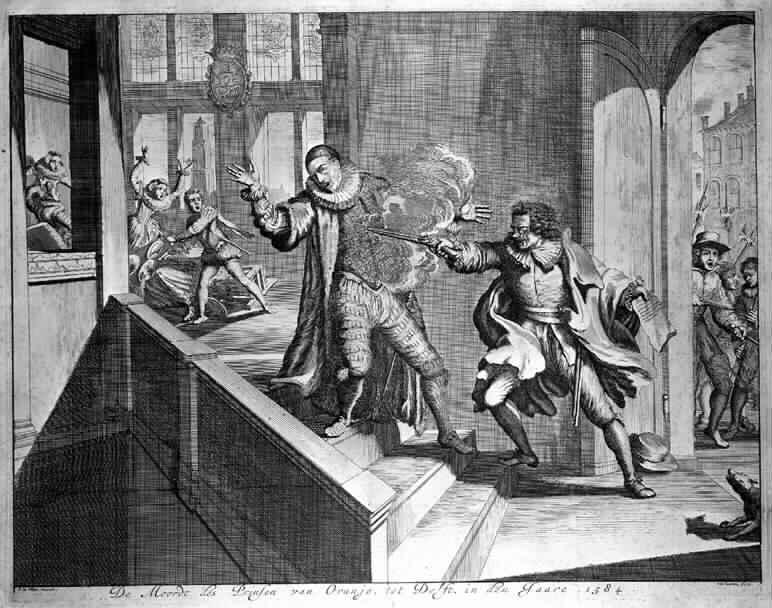
Instead, he bought a pair of pistols and, on 10 July, made history with a point-blank shot to William’s chest.


Detail view (click for the full image) of William the Silent’s 1585 assassination at the hands of Balthasar Gerard.

This assassination attempt didn’t fail. William became the second head of state to be killed by an assassin’s bullet,† — and his shooter the first such man to be juridically punished for the deed.

And, oh, how he was punished.

The regicide was beaten immediately after his capture, then subjected to a variety of cruelties, from wet leather boots which, when heated, both crushed and burned the feet, to daily floggings while hanging on a post outside the jail.

But on this day, his time of torture was up, and Gérard was finally put to death. You know, the usual:

It was decreed the right hand of Gerard should be burned off with a red-hot iron, that his flesh should be torn from his bones with pincers in six different places, that he should be quartered and disembowelled alive, that his heart should be torn from his bosom and flung in his face, and that, finally, his head should be taken off.


Gerard’s execution.

For all that he suffered as a regicide, Gérard left his family an impressive inheritance. Making good Parma’s assurances, King Phillip II gave them William’s former lands in three French provinces and took his siblings and their issue into his peerage.

Gérard’s cause carried on for another 60 years, until it was finally extinguished by the signing of the Peace of Münster by the Republic of the Seven United Netherlands and Spain.

* Foucault mistakenly identifies the torture as lasting 18 days, and the additional details he lays down for Gérard’s time on death row may be less-than-believable. However, all sources indicate that the tortures Gérard endured were quite spectacular, even by the standards of the day.

** See Dissident identities in the early modern Low Countries for a complete treatment of this period in The Netherlands and Belgium.

† For example, the city of Antwerp (Belgium), then under possession of the Spanish crown and considered the mercantile center of Europe for its vast sugar trade, featured over 100 executions for heresy from 1557-1562, twice as many as in all of Spain during that time.

‡ The first was James Stewart, 1st Earl of Moray, then Regent of Scotland. Stewart’s shooter, James Hamilton, escaped into exile, though others of the Hamilton clan answered for the murder.

On this day..

1923: Konstanty Romuald Budkiewicz, Catholic priest in the USSR

Late the night of March 31-April 1, which was in 1923 the dark between Holy Saturday and Easter Sunday, the Catholic priest Konstanty Budkiewicz (Konstantin Budkevich) was shot in the cellars of Lubyanka.

Born to a Polish family in present-day Latvia, Budkiewicz (English Wikipedia link | Polish) went to seminary in St. Petersburg. He was in that same city, now a 50-year-old vicar-general, when the Bolshevik Revolution shook Petrograd.

Given the Bolsheviks’ anti-clericalism, this was bound to be a trying position: Catholic clergy, especially of relative prominence, faced intermittent harassment. The outlander Latin rite and any Pole’s hypothetical association with Russia’s ancient geopolitical foe only exacerbated the situation.

Matters came to a head with the March 13, 1923 arrest (Polish link) of a number of Catholic clergy. In the ensuing days, most would be convicted and sentenced to death at a show trial on the grounds of “inciting rebellion by superstition.” To be charged with “inciting rebellion by superstition” is pretty much to stand condemned for it, one would think.

New York Herald correspondent Francis McCullagh, who was present in the courtroom, would later publish his observations of the proceedings in The Bolshevik Persecution of Christianity. The proseutor, McCullagh wrote,

launched into an attack on religion in general and the Catholic Church in particular. “The Catholic Church,” he declared, “has always exploited the working classes.” When he demanded the Archbishop’s death, he said, “All the Jesuitical duplicity with which you have defended yourself will not save you from the death penalty. No Pope in the Vatican can save you now.” …As the long oration proceeded, the Red Procurator worked himself into a fury of anti-religious hatred. “Your religion”, he yelled, “I spit on it, as I do on all religions, — on Orthodox, Jewish, Mohammedan, and the rest.” “There is not law here but Soviet Law,” he yelled at another stage, “and by that law you must die.”

Although information about anti-Christian hostility in the USSR tended to reach the wider world in fragmentary form only, there was an outcry in the western world over this trial’s condemnation of Budkiewicz’s boss, Archbishop Jan Cieplak, as well as that of Monsgnor Budkiewicz. International pressure would ultimately save one of those men … but only one.

Cieplak’s death sentence was commuted, and in 1924 he was even released and allowed to leave for Poland. He died in the United States in 1926.

Budkiewicz made do with grace of the celestial kind. He was whisked from his cell late on the 31st, and shot sometime overnight in the notorious Lubyanka prison in Moscow. Soviet authorities were so tight-lipped and obfuscatory about his situation that the pope prayed publicly in St. Peter’s later that same day for Budkiewicz’s life to be spared. Only several days later was the accomplished fact of Budkiewicz’s execution openly confirmed.

The Polish poet Kazimiera lllakowiczówna dedicated a verse to Budkiewicz, titled The story of the Moscow martyrdom.

Budkiewicz is being investigated by the present-day Catholic church for possible beatification. (Archbishop Cieplak is, too.)

On this day..

1586: Saint Margaret Clitherow, pressed Catholic

(Thanks to historian Courtney Thomas for the guest post. -ed.)

On March 25, 1586 Margaret Clitherow, the wife of a York-based butcher, was subjected to one of the more obscure forms of capital punishment in early modern England: she was pressed to death, the mandated form of punishment for those who refused to enter a plea to a legal charge.*

Margaret was a victim of increasingly stringent attitudes toward recusants in the second half of Elizabeth I’s reign (1558-1603): Margaret was pressed to death just a year before the execution of Mary Queen of Scots for her role in a Catholic plot to overthrow the Elizabethan regime and two years before the 1588 Spanish Armada.

The two officials who were tasked with carrying out the sentence allegedly employed several beggars to perform the job instead and Margaret was taken to the toll-both on the bridge that straddles the river Ouse where she was stripped and had a handkerchief tied over her eyes as a blindfold. She was then placed upon a rock roughly the size of a baseball or an adult’s fist and a large panel of wood (roughly the size of a door) was put on top of her and slowly loaded with 700-800 pounds of rocks and stones.

In theory the smaller rock beneath her would break her back when the heavy rocks were piled on.

Witnesses report that she expired within about fifteen minutes. Other victims of this punishment were not typically so lucky. For example, Giles Corey, executed in Salem in 1692, had weights slowly piled on him for a period of several days (being asked daily before more weight was added if he wished to enter a plea to the charge that he was a warlock) before he expired.

Margaret was born Margaret Middleton in 1552/3, the daughter of a wax-chandler named Thomas and his wife Jane, the daughter of Richard Turner, an innkeeper. One of four children, she was born during the reign of Mary I (who has gone down in history with the unfortunate (but not entirely undeserved) appellation “Bloody” attached to her).

A bit of background on the process of the various reformations in England is necessary to understand why Margaret’s Catholic beliefs were treated so harshly.

Having broken with the Roman Catholic Church and founded the Anglican Church in the 1530s through a legislative reformation designed to assist him in securing the dissolution of his marriage to Catherine of Aragon so that he could wed Anne Boleyn, Henry VIII saw many of his religious policies undone by his heirs.

He was succeeded on the throne in 1547 by his son (with his third wife, Jane Seymour), Edward VI, who made England into a more recognizably Protestant state than Henry appears to have intended (while Henry was interested in reforming stances, he appears to have identified most strongly with Catholic principles and geared his reformation toward abolishing the authority of the Pope in English ecclesiastical affairs, rather than changing beliefs and practices).

Edward was, however, a short-lived king, having died in 1553 after but six years on the throne. He was succeeded by his half-sister Mary (daughter of Henry’s first wife Catherine of Aragon) who was a devout Catholic and spent much of her reign steering England back into the port of Catholicism — a task which involved martyring approximately three hundred of her subjects for their Protestant sympathies.

Mary, in turn, was succeeded by Elizabeth, the daughter of Henry’s second wife, Anne Boleyn. Elizabeth was of a Protestant mindset and reinstituted the Anglican Church. Though initially reluctant to persecute people for their beliefs (she expressed herself as having no desire to “make windows into men’s souls”), political circumstances involving a plethora of plots on the part of Catholics (both real and perceived) against the Queen resulted in a hardening of attitudes.

While fines and penalties were in place for non-attendance at Church of England services, the regime also began to enforce strict penalties against those found guilty of sheltering priests and Jesuits. And it was to these laws that Margaret fell victim.


On July 1, 1571, when she was about eighteen years old, Margaret wed John Clitherow, a local York butcher and a widower with two sons. The number of children borne by Margaret to her husband is unknown; in addition to her stepsons William (1563-1636) and Thomas (d. 1604), she bore Henry (b. 1572) and Anne (1574-1622) and there is mention of other pregnancies but the details do not survive.

In 1574, when she was twenty one, Margaret experienced a spiritual awakening and converted to Catholicism.

While her husband did not join her in converting, members of his family also held Catholic sympathies and he was not unsupportive of her conversion, with the exception of one recorded incident when he railed against Catholics while drunk at a banquet.

Margaret soon became highly involved in northern England’s underground Catholic community. She regularly held masses in her home in the Shambles (where she assisted her husband with his business) and her son, Henry, traveled to Rheims (a Jesuit centre) to train for the priesthood. Inside her home, Margaret created a series of architectural features to facilitate the concealing of priests, including a priest hole and a hole which was cut between the attics of her house and the adjoining house which could be used by a priest to escape in the event that the house was searched.

Inevitably Margaret’s involvement with the local Catholic community drew official censure, and from 1576 onwards, John Clitherow incurred regular fines for her refusal to attend Church of England services with him. She was also imprisoned several times for her refusal to conform, serving three separate terms in York Castle as a recusant (August 1577 – February 1578; October 1580 – April 1581; March 1583 – winter 1584).

Once released, despite her efforts at concealment, on March 10, 1586 Margaret was arrested for harbouring priests (which, in 1585 had been made a capital offense). In a search of her house, a frightened child had revealed the location of a secret room containing Catholic paraphernalia and designed to shelter a priest.

After her arrest, Margaret was jailed and on March 14 she appeared at the assizes. Although she was repeatedly asked to plead, she refused a trial by jury and thereby incurred the penalty of peine forte et dure: being crushed or pressed to death. Margaret maintained that her refusal to plead was a measure to prevent her children and servants having to testify against her and also served to protect the souls of the jury which would find her guilty. It is very likely that she also wanted to protect other local recusants who had assisted her and desired to prevent the revealing of their identity, which a trial would have uncovered. However, many contemporaries simply thought her mad and wondered at her seeming indifference to her husband and children — and Margaret’s willingness to abandon them for martyrdom.

Yet, despite her imminent death, Margaret allegedly did not forget her family in her final days and reportedly sent her hat to her husband and her hose and shoes to her daughter, Anne. Some people, including her father-in-law, engaged in scurrilous mongering and postulated that Margaret’s willingness to die stemmed from guilt over an illicit encounter with her confessor, whose child she now carried. Such views, however, did not attain much popularity.

After her sentencing, she was visited by several local Protestant preachers and kin, who endeavoured in vain to persuade her to plead guilty and throw herself on the mercy of the assize justices. She also appears to have been pregnant at the time as many people urged her to publicly admit her condition and thereby obtain a stay of execution.

Margaret steadfastly refused to consider any of these things; she had embraced martyrdom. After her death, local family and friends (one of whom, John Mush, later authored a biography that remains the primary source for her life) found her corpse (buried anonymously as a criminal) and reinterred her in an unknown location in accordance with Catholic rites.

After his wife’s death, John Clitherow married for a third time and remained a convinced Protestant until his own death. The couple’s children, however, embraced their mother’s Catholic faith. Anne Clitherow was briefly imprisoned in 1593 for her refusal to attend Church of England services and eventually became a nun at the convent of St. Ursula’s in Louvain in 1598. Henry (the son who had traveled to Rheims) studied first to be a Capuchin (he joined that order in 1592) and then to become a Dominican. He died, possibly insane, without having firmly settled on an order. Margaret’s stepson, William, became a priest in 1608, and her other stepson, Thomas, a draper, was imprisoned for his recusancy. He died in Hull prison in 1604.

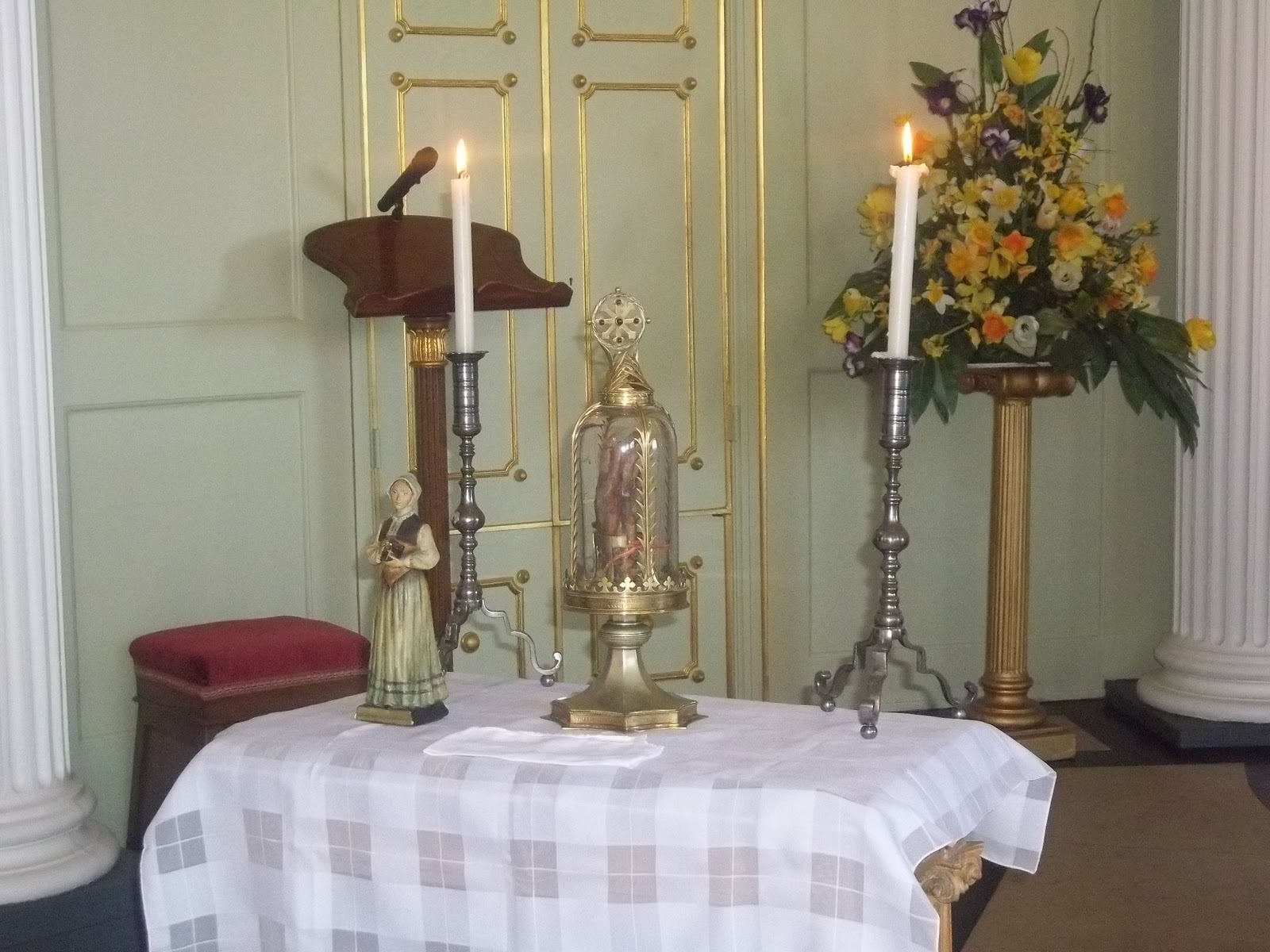
Margaret’s work for the English Catholic community and her martyrdom resulted in her canonization in the twentieth century. She was beatified in 1929 and canonized in October of 1970 — one of the Forty Martyrs of England and Wales. After her execution, somebody apparently chopped off her hand to preserve as a relic at the Bar Convent in York. Margaret’s feast day in the current Roman Catholic calendar, together with that of the other thirty-nine English martyrs, is May 4 — although in England it is celebrated on August 30.

A few books about Margaret Clitherow

* Editor’s note: the trial could not begin without a guilty/not-guilty plea, so pressing was a means of forcing a mum defendant to the bar. Brute force often succeeded in extracting the necessary plea; however, because death by pressing preceded trial or conviction, a defendant hardy enough to undergo that fate could use it as a means to skip to the “execution” without suffering the other pains of criminal conviction. In Margaret’s case, she avoided the potential implication of other furtive Catholics at trial; in Giles Corey’s case, he avoided forfeiting his property upon the inevitable witchcraft conviction, and passed his estate to his heirs instead.

On this day..

1421: The last Viennese Jews

On this date in 1421, a months-long campaign to purge Vienna of her Jews culminated with over 200 burned — and the rest of the once-thriving community either driven into exile or forced to convert.

Vienna had had a Jewish presence for centuries, centered on the Judenplatz.

The religious wars unleashed between Catholics and followers of the Czech reformer Jan Hus complicated the Jewish position. While not an unblemished relationship, Hussites were generally seen to be more sympathetic to Jews, and vice versa. Fellow-victims of Catholic persecution, Hussites recast the Biblical Antichrist with Papist rather than Jewish associations. Hussites openly looked to the Torah and Jewish divines like Rabbi Avigdor Kara for inspiration.*

That’s all well and good, but Vienna was emerging as one of the principal cities of the very Catholic Habsburg empire. (It was not yet the official seat: that would come later in the 15th century.)

To the perceived Hussite-Jewish alliance one must add consideration of Duke Albert V — later the Holy Roman Emperor Albert II — and his considerable debts, no small part of them held by Vienna’s Jewish moneylenders.

On Easter 1420, Albert pumped up a rumor that Jews had desecrated the Eucharist and ordered mass-arrests and -expulsions of Jews, complete with handy asset forfeiture. This was the onset of the Wiener Gesera, the Viennese persecution — as it was remembered later by remnants of the shattered Jewish community scattered abroad.

Pogroms attacking the Jews in Vienna (and elsewhere in Austria) ensued, culminating with the dramatic three-day siege of Vienna’s Or-Saura synagogue. That ended Masada-style when 300 trapped denizens committed suicide to escape forced baptism, and the last living among them torched the building from the inside. Its blasted remains were razed to the ground by the besiegers.**

Albert at that point finished off Vienna’s Jews by sending its final hardy (or foolhardy) members — 120 men and 92 women, it says here; different figures in the same neighborhood can be had elsewhere — to the stake.

“As the waters of the River Jordan cleansed the souls of the baptized, so did the flames which rose up in the year 1421 rid the city of all injustice,” read a Latin plaque erected on the site.

Jews were not permitted to return to Austria for centuries.

* “The Hussites pioneered a uniquely Czech form of philo-Semitism … the fascination, among a persecuted, dissident group, with the Jewish people and religion,” writes Eli Valley. “The Hussites were perhaps the first religious group in Christian European history to argue against the ban on Jews in craftsmaking and farming” and “unlike Martin Luther’s similar program in the sixteenth century, the Hussite movement did not predicate its kindness to Jews on the condition that they would be baptized.”

** The synagogue’s foundations have been only recently rediscovered, as part of the excavation for a Museum Judenplatz at the site. That museum has not necessarily been welcomed by the Viennese Jewish community it’s supposed to represent.

On this day..

1645: Conor Macguire, Lord Baron of Enniskillen

On this date in 1645, Conor Ma(c)guire, Lord Baron of Enniskillen, was drawn, hanged, and quartered at Tyburn.

Lord Macguire’s offense had occurred three-plus years earlier during the Irish Rebellion of 1641 — a bloody Catholic-Protestant civil war that would start the ball rolling towards Cromwell‘s depredations.

If the grievances of the latter are still well-remembered, English and Scottish Protestants had their own bill of particulars from the Irish Rebellion over Catholic-perpetrated slaughters like the Portadown Massacre. (Irish Catholics had their grievances from spending the preceding decade suffering land grabs for English settlers under the authoritarian rule of Thomas Wentworth. And on it goes.)

Actually, in the wake of the Irish Rebellion, there was a systematic project to collect witness testimony (not all of it reliable) about Catholic-on-Protestant violence. This codex would come in handy for Cromwell’s subsequent statecraft; it’s freely available online in an enormous searchable database.

Such beyond-the-pale doings took place literally beyond “the Pale” around Dublin, and outside similar fortified spots where the English holed themselves up.

These outposts gave the foreign heretics quite a bit of leverage, which Macguire and some other lords contrived to reverse via a plot to seize Dublin castle, kill its English lords, “and to put all the Protestants there likewise to the sword.” It was the lynchpin of an audacious coup that involved similar actions at English strongholds all around the island.

While some other fortresses did succumb, the plot against Dublin failed when Macguire’s co-conspirator Hugh “the Stereotype” MacMahon got drunk the night before and blabbed about it to his Presbyterian brother-in-law. Thus narrowly preserved, Dublin authorities arrested MacMahon and Macguire. (MacMahon was drawn and quartered in November 1644.)

The personal was very much political here, with the loss of lands and revenues under Wentworth stoking national and religious resentments against the English lords and settlers. Macguire described the recruiting pitch made by one of the rebellion’s leading spirits, Rory O’Mo(o)re: “[O’More] began to lay down to me the case that I was in then, overwhelmed in debt, the smallness of my estate, and the greatness of the estate my ancestors had, and how I should be sure to get it again, or at least a good part thereof.” (Source)

Whatever rank greed held in Conor Macguire’s motivations, however, he was constant to his horrific end. This interesting account of the scene on the scaffold will hardly fail to move the most ardent Orangeman to a bit of pity for the poor bastard enduring in his last moments on earth an endless badgering by the London sheriff to endorse a policy statement on intersectional strife.

On Thursday, February 20th, he was drawn on a sledge from the Tower, through London, and so to Tyburn; when being removed into a cart, he kneeled and prayed awhile; after which Sheriff Gibbs spake to him, representing the heinousness of his crime, and the vast numbers who had been murdered by that conspiracy, for which he was to suffer, and, therefore, exhorted him to express his sorrow for it: to which he answered, ‘I desire Almighty God to forgive me my sins.’

Sheriff Gibbs.—Do you believe you did well in those wicked actions?

Macg.—I have but a short time, do not trouble me.

Sher.—Sir, it is but just I should trouble you, that you may not be troubled for ever.

Macg.—I beseech you, Sir, trouble me not; I have but a little time to spend.

Sher.—I shall give you as much time after as you shall spend to give satisfaction to the people; I do require you, as an instrument set in God’s hands here, to make an acknowledgment to the people, whether you are sorry for what you have done or no; whether it be good or no.

Macg.—I beseech you do not trouble me; I am not disposed to give you an account. Pray give .me leave to pray.

Dr. Sibbald.—Give glory to God, that your soul may not be presented to God with the blood of so many thousand people.

Sher.—You are either to go to heaven or hell. If you make not an ingenuous confession your case is desperate. Had you any commission or not?

Macg.—I tell you there was no commission that ever I saw.

Sher.—Who were actors or plotters with you? or, who gave you any commission?

Macg.—For God’s sake give mo leave to depart in peace. They then asked him if he had not some pardon or bull from the Pope for what he did? to which he only answered, ‘I am not of the same religion with you.’ And being further urged about a bull, or pardon, said, ‘I saw none of it; all that I knew I delivered on my examinations; all that I said on my examinations are true; all that I said is right. I beseech you let me depart in peace.’ And so not returning them any answer to their question, he continued mumbling over a paper, which he had in his hand, as he had done from his first coming. The sheriffs commanded his pockets to be searched, whether ho had no bull or pardon about him, but they found in his pocket only some beads and a crucifix, which were taken from him. And then Dr. Sibbald said to him, ‘Come, my Lord, leave these, and acknowledge your fault to God and the world: one drop of the blood of Jesus Christ is able to purge you of all the heavy load that is upon you; it is not your Ave Marias nor these things will do you any good, but it is Agnus Dei qui tollit peccata Mundi.’ The Lord Macguire seemed not to regard his discourse, but read out of his paper to the people as followeth:

Since I am here to die, I desire to depart with a quiet mind, and with the marks of a good Christian; that is, asking forgiveness first of God, and next of the world. And I do forgive, from the bottom of my heart, all my enemies and offenders, even those that have a hand in my death. I die a Roman Catholick, and although I have been a great sinner, yet I am now, by God’s grace, heartily sorry for all my sins; and I do most confidently trust to be saved, not by my own works, but only by the passion, merits, and mercy of my dear Saviour Jesus Christ, into whose hand I commend my soul.

And then added, ‘I beseech you, gentlemen, let me have a little time to say my prayers.’

Sher.—Sir, if you answer ingenuously to those questions we shall ask you, you shall have time afterwards; whether do you account the shedding of Protestant blood to be a sin or not, and whether do you desire pardon of God for that sin?

Macg.—I do desire pardon of God for all my sins: I cannot resolve you in anything for my part.

Sher.—You can tell what your conscience dictates to you. Do you think it was a sin or not?

Macg.—For my part I cannot determine it.

Sher.—Then now it seems nothing to you to kill so many.

Macg.—How do you mean killing of them? to tell you my mind directly, for the killing, I do not know that, but I think, the Irish had a great cause for their wars.

Sher.—Was there any assault made upon you? Had you not entered into a covenant? Had you not engaged yourselves by oath to the king?

Macg.—For Jesus Christ’s sake, I beseech you, give me a little time to prepare myself.

Sher.—Have pity on your own soul.

Macg.—For God’s sake have pity on me, and let me say my prayers.

Sher.—I say the like to you, in relation to your own soul, whether do you think the massacre of so many thousand Protestants was a good act? For Jesus Christ’s sake have pity on your soul.

Macg.—Pray let me have a little time to say my prayers.

All this time his eye was mostly on his papers, mumbling something out of them to himself. Whereupon one of the sheriffs demanded these papers from him; he flung them down; they were taken up and given to the sheriff. They asked him further, whether they were not some agreement with the recusants in England? Whereunto he answered, ‘I take it upon my death, I do not know that any man knew of it;’ and after some other such like talk, the sheriff bidding him prepare for death, he said: ‘I beseech all the Catholics here to pray for me. I beseech God to have mercy on my soul:’ and so was executed.

On this day..

1859: Father Paul Loc, Vietnamese martyr

On this date in 1859, Paul Loc, a Catholic Vietnamese Martyr, was summarily beheaded at Saigon ahead of a French landing.

The orphaned child of a Catholic family from Cochinchina (southernmost Vietnam), Paul Loc was brought up by a pastor and went to seminary.

His ministry during the reign of a sovereign very hostile to the inroads of Christian missionaries, lasted less than two years. At that point, France went to war to conquer Cochinchina.

At that point, Father Loc was clapped in prison, but even then the earnest young man’s treatment seems to have been light. But on this date, French warships had been sighted ascending the Dong-Nai River towards Saigon itself, and the city’s panicking defenders martyred the priest almost without warning.

According to this French text, Paul Loc had his head cut off at the gates of Saigon’s citadel. Just a few days later, the French did indeed successfully take Saigon … the start of a beautiful friendship.

Pope Pius X elevated Paul Loc to “Blessed’ in 1909.

On this day..

1578: Blessed John Nelson, martyr

On this date in 1578, John Nelson was martyred at Tyburn.

A Catholic who had popped across to Flanders to train as a priest, Nelson was captured after about a year’s ministry in December 1577.

Matters with this minor martyr proceeded according to the usual script from that point. Interrogators put it to him whether Queen Elizabeth was the proper head of the Church of England — that old chestnut. The wrong answer would be treason.

[Nelson] was brought forth to be examined before the high commissioners. Here they tendered him the oath of the queen’s supremacy, which he refused to take; and being asked, why he would not swear, he answered, because he had never heard, or read, that any lay prince could have that pre-eminence. And being farther demanded, who then was the head of the church, he answered, sincerely and boldly, that the pope’s holiness was, to whom that supreme authority in earth was due, as being Christ’s vicar, and the lawful successor of St. Peter.

Secondly, [t]hey asked him his opinion of the religion now practised in England; to which he answered, without any hesitation, that it was both schismatical and heretical. Whereupon they bid him define what schism was; he told them, it was a voluntary departure from the unity of the catholic Roman faith. Then (seeking to ensnare him) they farther urged, what is the queen then, a schismatic or no? … he answered, conditionally, if she be the setter forth [of Anglicanism], said he, and defender of this religion, now practised in England, then she is a schismatic and a heretic.

After he was cut down alive from his hanging so that he could be disemboweled and quartered, Nelson’s last words were reportedly “I forgive the queen and all the authors of my death.”

On this day..

1678: William Staley, “the prologue to the bloody tragedy”

David’s mildness managed it so well,
The bad found no occasion to rebel.
But when to sin our biassed nature leans,
The careful devil is still at hand with means, [80]
And providently pimps for ill desires;
The good old cause, revived, a plot requires.
Plots, true or false, are necessary things,
To raise up commonwealths, and ruin kings.

-John Dryden’s Absalom and Achitophel, a Biblical allegory of the English political/religious scene in which the Popish Plot (“plots, true or false”) took place

On this date in 1678, a Catholic goldsmith was hanged and quartered for treason … a preposterous case that would preview the tragic main acts of the “Popish Plot”.

This 17th century anti-Catholic witch hunt traced to weird and unprincipled Anglican divine Titus Oates.

With his friend Israel Tonge, Oates in 1678 ginned up a fantastical Jesuit plot against the life of Charles II — which supposed conspiracy played insidiously to the realm’s age-old religious divisions, in a moment when a Catholic royal sibling stood next in line to the throne.

Indeed, Oates’s “revelations” would trigger the Exclusion Crisis, an unsuccessful parliamentary bid to balk the heir presumptive James (eventually James II) of his throne. Parliament, argued Henry Capell, “must quiet the minds of the people, as to their fears of Popery and the Succession.”

In Queen Elizabeth’s time there were conspiracies against her, when Mary Queen of Scots was taken off. In King James’s time, the Gunpowder-Treason. In the last King’s time, a horrid Rebellion, that ended in his murder; but here the Crown is under such a character as is more dangerous than all those; and from Popery came the notion of a standing Army and arbitrary power.

Oh, and London had just burned down within everyone’s living memory, an event popularly ascribed to a French Catholic conspiracy even into the 19th century.

There was an awful lot of latent (and not-so-latent) anti-Popery around for Oates to stir up, and he proved to have a gift for this demagoguery. (pdf) In late 1678, a magistrate investigating Oates’s claims, Edmund Berry Godfrey, was mysteriously murdered, and all hell broke loose: a political assassination could now be hung on the alleged Catholic conspiracy. In short order, alleged Catholic conspirators would themselves hang for it.

It was a full 9/12 mentality: people going about armed, loyalty oaths, rumors of French invasion or Guy Fawkes tunneling.

Oates, when feeling his, would have the juice to put peers of the realm on the scaffold … so what chance did poor William Staley have?

This patsy, no great ornament of the “plot”, was more an incidental (and expedient) casualty of the swelling paranoia. Overheard at a tavern chatting about the Protestant freak-out, in French (quelle horreur!), a couple of unscrupulous eavesdroppers shopped for treason when they couldn’t blackmail him.

The sovereign was supposed to have been characterized in this chat as “a great Persecutor or Tormentor of the people of God … And ([Staley] stretching forth his Arm, and then clapping his Hand on his Breast), speaking of His Sacred Majesty, said, I my self will kill him.” (Source) Whether a frustrated Catholic into his cups incautiously popping off, an innocent naif set up by reprobates, or a case of lost in translation, it seems safe to say that William Staley was no danger to the monarchy.

Staley, at any rate, denied having said anything of the sort all the few hours that remained to draw breath, which wasn’t many. It was a mere 12 days from the “treasonable” conversation on Nov. 14 to Staley’s execution.


Image from William Faithorne‘s 1681 (misdated) engraving depicting William Staley being drawn to execution.

With this hanging, and another (that of Edward Coleman) a week later, the Popish Plot persecutions were into full swing … three years of Stuart England McCarthyism that would claim at least 15 lives and end with Titus Oates imprisoned, whipped, and pilloried.

After the Orange Revolution chased the Catholic monarch out of England, Oates was released and pensioned: the incident long remained an ideological litmus test between proto-Whigs (pro-Oates, as he was a club wielded against the absolutist aspirations of Charles II and James II) and Tories (anti-Oates, for the same reason). Centuries later, one commenter could still remark, “There are three events in our history that may be regarded as the touchstone of party men: an English whig who asserts the reality of the Popish plot, an Irish Catholic who denies the massacre of 1641, a Scotch Jacobite who maintains the innocence of Queen Mary, must be considered as men beyond the reach of argument or reason.”

On this day..

1579: Thomas Sherwood, Catholic martyr

On this date in 1579, young Catholic layman Thomas Sherwood was hanged at Tyburn, cut down while still alive, disemboweled, and quartered.

This casualty of the Elizabethan era’s dangerous struggle for the soul of Britain had popped across to the continent to begin his studies under the church’s auspices.

He had not yet completed them when, on a return trip, a Protestant recognized him and got him locked up in the Tower, where Sherwood was tortured for information about the whereabouts of the underground Catholic Mass — but “he was brave beyond his years, no racking, no cross-examination could make him name any one.”

Sherwood had the distinction during his confinement of being one of the last earthly creatures to receive the (attempted) aid of octogenarian fellow-Catholic William Roper, Sir Thomas More‘s son-in-law and first biographer. (Roper’s attempts to send money to the imprisoned Sherwood were intercepted, however.)

Sherwood’s brother recalled of the martyr,

He was of small learning, scarcely understanding the Latin tongue, but had much read books of controversies and devotion, and had used much to converse among Catholic priests, and by reason thereof, having a good wit and judgment, and withal being very devout and religious, he was able to give good counsel, as he did to many of the more ignorant sort, being much esteemed for his virtuous life and humble and modest behaviour: besides God did give a special grace in his [conversation] , whereby together with his good example of life, he much moved and edified others. He was a man of little stature of body, yet of a healthful and good constitution, and very temperate in his diet.

After his first racking in the Tower (which was said to be rigorous), being visited by a Catholic gentlewoman, he showed himself of that joyful and comfortable spirit as she was astonished thereat. As also his keeper with compassion giving him warning that he was to be racked again, he was so little moved therewith, as merrily and with a cheerful countenance he said these words: ‘ I am very little, and you are very tall; you may hide me in your great hose and so they shall not find me; ‘ which the keeper did afterwards report to divers, much marvelling at his great fortitude and courage. He was about the age of twenty-seven years when he was martyred.

On this day..