1905: A.I. Volioshnikov, police spy

On this date in 1905,* the druzhinniki (militia) of Moscow’s insurrectionary Red Presnia district barged into the apartment of 37-year-old police detective A.I. Volioshnikov.

In front of his shrieking children, “they read the verdict of the Revolutionary Committee, according to which Volioshnikov had to be shot” — as a police spy surveilling rebels, according to Trotsky — then taken outside and executed directly at the Prokhorovka textile factory.**

The tsar’s artillery began barraging Red Presnia the very next day, and had overrun it — complete with summary executions of their own — before the calendar turned over to 1906.

* December 28 per the Gregorian calendar; it was December 15 per the Julian calendar still in use at the time in Russia.

** There’s a “Druzhinniki Street” in Moscow near the Krasnopresnenskaya metro station — and the Prokhorovka factory (dating to 1799) still stands nearby.

On this day..

1954: Eugen Turcanu, torturer

On this date in 1954, Eugen Turcanu and 16 other Romanian political prisoners were executed at Jilava prison.

Turcanu et al were noted as the truncheon arm of one of 20th century’s more blood-chilling torture programs, the Pitesti experiment. (Named for the facility where it began, Pitesti prison.)

As if taking Orwell’s 1984 as a paragon instead of a grim dystopian warning, the Pitesti experiment subjected several thousand political and religious dissidents to a savage course of ideological re-engineering. The object was to beat and brainwash undesirables into model Communists.

“Power is in inflicting pain and humiliation,” Orwell’s torturer-apparatchik O’Brien remarks in the novel. “Power is in tearing human minds to pieces and putting them together again in new shapes of your own choosing.”

Turcanu knew from the inside just what that sort of transformation entailed. He was by all appearances a proper Communist and a member of the right clubs thereto when, on the cusp of his 23rd birthday in 1948, he was arrested for a youthful prewar affiliation with the fascist Legionary movement.

He caught a harsh seven-year sentence but found his (short) life’s work in prison. His wheedling convinced wardens of his ideological suitability, and his Herculean physique suggested tasks that could only be entrusted to a co-founder of the Organization of Convinced Communist Detainees.

From late 1949 into 1952, Turcanu and a team of fellow goons were employed dishing out near-lethal thrashings on a wholesale scale to wrongthinkers. One thousand to five thousand souls are thought to have passed through the hands of Turcanu’s team; Soviet gulag survivor Aleksandr Solzhenitsyn called Pitesti “the most terrible act of barbarism in the contemporary world.”

As is customary with torturers, the ordeals extended far beyond brute force to invasive ritual debasement: people forced to eat shit, sexually humiliated, and manipulated into themselves turning torturer on their fellow prisoners and former friends. There’s a video documentary about this program (forcusing especially on its religious persecutions) embedded in its entirety here.

Obviously such practices, enacted on a nigh-industrial scale, were not the freelance initiatives of a few bad apples in the prison system. But no reader of the 21st century will be surprised that it was only the kapos like Turcanu who were punished for it once Stalin’s death relaxed the oppressive ideological terror in eastern Europe. While 22 prisoners were condemned (and 17 ultimately shot), the officers of Romania’s state police who had overseen them “suffered” things like reprimands and amnestied misdemeanor convictions.

On this day..

1947: Gyorgy Donath, Hungarian anti-communist

On this date in 1947, Hungarian politician Gyorgy Donath was executed for treason as the Hungarian state came into the hands of the Communists.


Gyorgy Donath awaits hanging in the courtyard of a Budapest prison on October 23, 1947. (Source)

Donath (Hungarian Wikipedia link) stood among the ranks of Eastern European politicians purged by Soviet-directed Communist parties behind the Iron Curtain in the first years of the Cold War — years when Stalin still called the shots for the Communist bloc.

Donath had been a wartime parliamentarian under the banner of Bela Imredy‘s right-wing Party of Hungarian Life.

Had Hungary’s postwar direction been determined by orderly ballot-boxing rather than great power machinations, Donath would have had a voice in it — for it was a conservative party, the Independent Smallholders Party, who won a big hold on government with 57% of the votes in the 1945 elections.

Though the Communists polled just 17% (with a similar tally for the Social Democrats), the General Secretary of the postwar party, Matyas Rakosi,* predicted that the putative defeat would “not play an important role in Communist plans.” And he was right.

Rakosi named his policy in response to the Smallholders “salami tactics” — as in slicing down the opposition piece by piece.

1947 was the knife’s edge.

From their post within the ensuing governing coalition — an outsized foothold relative to their electoral returns, as compelled by the presence of the still-occupying Red Army — the minority Communists in January 1947 announced the discovery of a conspiracy of “small agrarians,” and set about reducing the Smallholders and allies through a series of police raids and show trials.** Donath’s prominence in an irredentist fraternity, the Hungarian Community organization, was denounced the ringleader of the treasonable conspiracy.

He was hanged on October 23 — just eight weeks after a heavily rigged 1947 election put Hungary formally into the Communist camp.

Over the subsequent two years, independent and opposition parties were generally reduced to irrelevance, forced to take the Communist line, or dissolved entirely.

* Rakosi was the man whom Imre Nagy would eventually displace. The more moderate Nagy willingly swept himself up in Hungary’s abortive 1956 revolution against Communist domination. Soviet tanks crushed that revolution; Nagy hanged.

** In neighboring Romania and Bulgaria, similar tragedies were unfolding.

On this day..

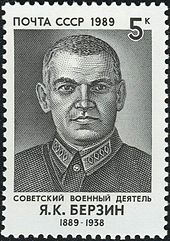
1938: Janis Berzins, Soviet military intelligence chief

On this date in 1938, the Soviet intelligence agent Janis Berzin(s) was shot in the basement of Moscow’s Lubyanka Prison.

A Latvian radical back to Riga’s chapter of the 1905 revolution,* Berzins became a trusted associate of Lenin in exile, and transitioned with the 1917 Revolution into a variety of political-security-military leadership positions in the new Soviet state.

For most of the 1924-1937 period, Berzins directed — indeed, practically createdSoviet military intelligence. He’s credited with personally recruiting the legendary World War II spy Richard Sorge; in 1936-1937 he was the chief Soviet military advisor in the Spanish Civil War under the nom de guerre “Grishin”. Russians fighting in Spain just referred to him as “the old man.” (Source)

Of course, no degree of seniority was sufficient safety during the frightful purging years of the Yezhovshchina. Once back in Moscow, Berzins fell instantly, almost randomly, over a spurious accusation of internal espionage.

His conviction was reversed after Stalin died.

* But not one of the Latvian revolutionaries who ended up in a shootout with London police.

On this day..

1962: Gottfried Strympe, purported terrorist

The novel East German polity was coming in the late 1950s to a crossroads that saw security paranoia ratchet up dramatically.

Emigration to West Germany accelerated considerably as the 1960s began, eventually giving rise to the infamous Berlin Wall.

In the countryside, forced collectivization implemented in 1960 produced resistance all its own. Agricultural output plummeted (the knock-on effects of a 1959 drought helped too); according to Patrick Major’s Behind the Berlin Wall: East Germany and the Frontiers of Power, groceries and everyday household items became markedly more difficult to procure in the early 1960s, sapping productivity throughout the economy as city workers queued for hours and black-market exchanges proliferated.

Following the Soviet Union’s great tradition of attributing economic trouble to running-dog wreckers, East Germany introduced the death penalty for politically motivated economic sabotage* — for example, the 206 cases of arson it attributed among 862 rural fires in 1960. (Figures as per Major.)

Our figure today, Gottfried Strympe, fell foul of these laws. In reality, he was no cackling secret agent but a disturbed loner.

He lurked about the eastern city of Bautzen opportunistically by turns the petty thief or the peeping tom.

Unfortunately for Strympe, who did some spells in psychiatric wards, his deviance extended past the titillation of spying a Hausfrau in her bustier to the much more menacing diversions of pyromania.

The poor man needed a social worker; what he got was the executioner. The charge sheet dramatically attributed his 28 acts of arson (crimes that each caused only minor property damage, and no human casualties) to the inspiration of “West German and American imperialists.”

Strympe, you see, had often visited a father (deceased in 1958) in West Berlin, back before the Wall sealed that city. Of course on those trips, Strympe picked over a Whitman’s sampler of western decadences, from pornography to Social Democracy. On this basis, the Stasi attributed his incendiarism to “terrorism” rooted in “an antisocial attitude strengthened by his stays in West Berlin.”

Strympe had a public show trial, the better that “the population of Bautzen will recognize the danger of communication and travel to West Berlin” (with props of said population — workers’ and civic groups — obligingly supplying the requisite demands for the traitor’s execution).

He was beheaded by Fallbeil at Leipzig on June 21, 1962.

* See Politische Strafjustiz in der Ära Ulbricht: Vom bekennenden Terror zur verdeckten Repression by Falco Werkentin.

On this day..

1948: Kiralyfalvi Miklos, Hungarian Catholic

London Times, June 9, 1948:

SCHOOLS DISPUTE IN HUNGARY
CARDINAL’S REPLY TO MINISTER
CATHOLICS’ CONCERN

BUDAPEST, June 8
The village priest and other persons held responsible for the murder of a policeman and the wounding of two others in a village in north-east Hungary last Sunday will be tried in Budapest on Thursday.

The letter of protest from the Minister of Education to the Primate, Cardinal Mindszenthy, says that the villagers had clearly been aroused to violence by the priest’s sermon, in which he spoke against the projected nationalization of the schools. They went straight from church to the mayor’s house and the municipal buildings, where the council had voted by a majority in favour of the nationalization, and the policeman was killed while trying to protect the mayor. The Minister asked the Cardinal to put an end “by central decree” to this pulpit agitation, adding: “If not, the responsibility will be shifted where it belongs, and the law will be evoked upon all who continue it or direct it.”

The Cardinal, in his reply, says that he knows no more of the incident than is contained in the Minister’s letter, and therefore can take no stand upon it. He adds that the idea of nationalization is still causing great excitement among Catholics all over the country, an that the only way to end the excitement is to abandon nationalization. He denies that the agitation is directed centrally (that is, by himself), and puts the responsibility on those who “insist on putting forward such provocative measures.”

Church’s Divine Right

The Primate has already refused to follow the example of the Protestant churches, which have agreed with the State that nationalization shall go through, but that their ancient seminaries shall be excluded and the teaching of religion in the schools continued, and that the State shall grant them a large annual payment, gradually decreasing, for 25 years. On the contrary, in his third pastoral letter, which was read in all Catholic churches on Sunday, the Cardinal said that nationalization violated natural law and the Church’s divine right.

People were saying, the pastoral letter continued, that it was now time for the State to take over; but certain principles, among them the ten Commandments, were timeless. It called upon the faithful “to pray for strength to resist with all their might this violation of the immortal soul.” Never had the shameful misleading of the people been so great in Hungary as now. The faithful must refuse to allow their families to read the newspapers of those who opposed their faith, and must offer a Novena to God that the “Satan prowling among us like a roving lion may be driven away.”

It is in this guise that the Cardinal sees the Communists. They see him as an inflexible survivor of the Middle Ages.

It was in the village of Pocspetri that all the trouble went down: a march to the local municipal building to protest school nationalization. For years after, Pocspetri would be shorthand (Hungarian link, as is the next) in the official press for any clerical backlash — something right out of the Middle Ages.

Kiralyfalvi, at his trial

At the end of this march, a policeman was dead. It’s alleged now — in anti-communist post-Cold War Hungary — that what really happened was that one of the policemen deployed for crowd control accidentally triggered his own gun and killed himself with it.

Whatever occurred in the march, it was a productive incident for Hungarian communists then executing their political takeover of Hungary. The resulting show trial (more Hungarian) is sometimes seen as one of the signal events in a concomitant crackdown on organized religion — a potential pole of opposition to the Soviet-backed state. The victim, of course, enjoyed the fallen cop’s prerogative, a fast-track beatification by the propaganda ministry. (No need for Hungarian to get the point of the pictures in this pdf.) Miklos Kiralyfalvi got the death sentence, but the prerogatives the church was focused on — those were the real prize.

London Times, June 12, 1948:

MURDERED HUNGARIAN POLICEMAN
PRIEST SENTENCED TO DEATH

BUDAPEST,June 11
Janos Astezlos, the priest whose trial on a charge of inciting his villagers to the murder of a policeman began here yesterday, was sentenced to death this afternoon. The villager who actually killed the policeman was also condemned to death, and of the other four who took part one received life imprisonment and the other three 12 years.

Such, five days after it happened, is the end of this affair, though not of the dispute that lies behind it. In this week’s edition of the Catholic weekly Hazank Mr. Barankovics, head of the Catholic Party in Parliament, which has at least 16 per cent of the country’s votes, writes that a true Christian is bound to defend the right of the Catholic Church to keep the schools, because once they were lost the Church would have nothing left to do but celebrate Mass, and its whole cultural influence would be gone. “Whoever is our leader,” he says, referring to rumours that he disagrees with the Cardinal, “we are bound to act in the same way.” Of the murder the newspaper writes that the Church never counselled violence and regrets deeply what happened.


BUDAPEST, June 11. — The villager accused of killing the policeman was hanged here tonight. -Reuter.

(The priest’s sentence was commuted to a prison term. Only Kiralyfalvi was executed for the Pocspetri murder.)

On St. Stephen‘s Day 1948, Cardinal Mindszenty himself was arrested for treason. This was old hat for the cardinal; he’d been arrested for opposing Bela Kun‘s interwar people’s republic, and arrested again by the Nazi collaborationist government in 1944.

This time, he copped a life sentence.

Briefly released during the 1956 Hungarian Revolution, Mindszenty fled to the American embassy as Soviet tanks subdued the country. He would live on the embassy grounds for the next 15 years, a potent symbol of living martyrdom against communism until he was finally released to Vienna.

If your Magyar is up to snuff, this documentary on the Pocspetri incident might be enjoyable.

On this day..

1919: Eugen Levine, Bavarian Soviet leader

On this date in 1919, Bavarian communist Eugen Levine (or Levien) was shot by the Freikorps for his role in the Munich Soviet.

Levine (English Wikipedia entry | German) was a St. Petersburg Jewish bourgeois whose early idealism led him to a Socialist Revolutionary (SR) terror cell. He did time in Siberia after Russia’s 1905 revolution was smashed.

Having moved to Germany to study, Levine became involved in World War I’s antiwar struggle, which in turn positioned him to be a key player in the communist movement in postwar Germany.

With the end of the Great War, Germany’s destiny was settled with bare knuckles. The now-communist Russian government, whose safety was imperiled from every direction, looked hopefully to a revolutionary proletariat in the more advanced neighboring economy of Germany to consolidate its own position as well as to meet the Marxist mandate for transnational revolution.

The Bolshevik Karl Radek urged an audience of Luxemburg and Liebknecht’s KPD that “without the socialist revolution in Germany the Russian workers’ revolution, dependent on itself, would not have sufficient strength to build a new house on the ruins left behind by capitalism.” (Source)

Others saw these revolutionaries in a less flattering light.

Nonetheless, Munich mounted a revolt breaking away an independent Bavarian state that would eventually usher in a Bavarian Soviet Republic. This state Eugen Levine seized control of on April 12, 1919, with a communist putsch against the expressionist playwright who had served as its first head of state.* Levine would be the second, and last, in that office.

In the end, the KPD in Munich — and not only there, but throughout Germany — simply lacked the organizational strength or the mass mobilization to sustain the attempted revolution(s) against its inevitable foes. By May of 1919, its threadbare forces had been overwhelmed by right-wing soldiers and paramilitaries.** Defenders of the city and actual or perceived revolutionaries were shot out of hand by the hundreds.


This obviously staged photo purports to depict a Freikorps execution of a (theatrically unfazed) Bolshevik in Munich in 1919. (Source)

Levine’s treatment was, if equally certain, at least marginally more ceremonial.

Captured in hiding a few days after the incursion, Levine was saved for a show trial† at the start of June.

He met it in impressively good cheer, despite a good idea what was coming.

We Communists are all dead men on leave. Of this I am fully aware. I do not know if you will extend my leave or whether I shall have to join [the late] Karl Liebknecht and Rosa Luxemburg. In any case I await your verdict with composure and inner serenity. For I know that, whatever your verdict, events cannot be stopped … Pronounce your verdict if you deem it proper. I have only striven to foil your attempt to stain my political activity, the name of the Soviet Republic with which I feel myself so closely bound up, and the good name of the workers of Munich. They — and I together with them — we have all of us tried to the best of our knowledge and conscience to do our duty towards the International, the Communist World Revolution.

Left and center parties raised a pan-Germanic outcry to stay the executioner’s hand, but Levine was shot two days after condemnation.‡

Munich transmuted, with this conquest, from an outpost of the revolutionary vanguard into a veritable far-right hothouse: just weeks after Levine’s execution, Adolf Hitler would make his fateful acquaintance with the NSDAP in Munich. Within a few years he and his germinated their own Bavarian revolution. Munich and its beer hall (which the Freikorps had used for summary executions in May 1919) were long hallowed of the Third Reich.§

* The deposed president, Ernst Toller, “hanged himself” in 1939. Auden paid him tribute in moving verse.

Dear Ernst, lie shadowless at last among
The other war-horses who existed till they’d done
Something that was an example to the young.

We are lived by powers we pretend to understand:
They arrange our loves; it is they who direct at the end
The enemy bullet, the sickness, or even our hand.

It is their tomorrow hangs over the earth of the living
And all that we wish for our friends; but existing is believing
We know for whom we mourn and who is grieving.

** The aide-de-camp of the Freikorps Epp that marched into Munich that first week of May was the future SA chief Ernst Röhm. Also participating in this sortie: early Nazi leaders (and eventual Hitler rivals) Gregor and Otto Strasser, and future Wannsee Conference participant Wilhelm Stuckart.

† The young lawyer Max Hirschberg drew first dibs on defending the doomed Levine before his drumhead court, but faint-heartedly passed the assignment off. Hirschberg would remember the moment with shame: “I was too insecure and too cowardly to confront the scornful sneer of the reactionaries,” he wrote.

Maybe Hirschberg’s harsh self-judgment steeled his soul, for soon the “orgy of brutality, bloodthirstiness, and injustice aroused in me a decisive transformation.” He began to aggressively seek out hated revolutionaries to represent in the teeth of the political winds. Hirschberg had a notable mano-a-mano courtroom confrontation with Adolf Hitler in 1930; he had to flee Nazi Germany in 1934, but built a career in New York where he blazed trails with his work on wrongful convictions. There’s a summation of his career in this pdf; or, see the 2005 biography Justice Imperiled.

‡ Primary newspaper coverage (e.g., London Times, June 9, 1919) confirms the date; the “July 5” widely cited in online articles is mistaken.

§ The Nazis erected a memorial to the Freikorps who crushed the Bavarian Soviet; its remains can still be seen today.

On this day..

1954: Lucretiu Patrascanu, purged Romanian

On this date in 1954, Lucretiu Patrascanu was shot in Jilava Prison outside Bucharest.

The widow’s-peaked longtime pol was one of the first inductees of the Romanian Communist Party (PCR) after its 1921 founding. Patrascanu (English Wikipedia entry | Romanian) was 21 years old then: the spirited politicking within the Communist movement would define the whole of his adult life.

By the 1930s, he held a position of national leadership. Patrascanu served in the Romanian legislature, and became a party representative to the Comintern.

It might have been at a Comintern road trip to Moscow in the 1930s that Patrascanu’s disillusionment with Stalin began. If so, it was beside the point: leftists in Romania (like everywhere else) had the more immediate threat of fascism to contend with.

After spending most of the war years under arrest, Patrascanu re-emerged as a state minister. He personally helped to author the August 23, 1944 coup that flipped Romania out of the Axis camp. But by the very next year he was under police surveillance.

He fell in the Soviet-driven late 1940s purge of Eastern European Titoists, for having such insufficiently internationalist notions as “before we are Communists, we are Romanians.” His time in prison was long enough for authorities to model his show trial on the 1952 Czechoslovakian Slansky trial, though Patrascanu himself disdained to denounce himself, or even to dignify the proceedings with a defense.

I have nothing to say, except [that I] spit on the charges brought against me.

He was posthumously rehabilitated in 1968 by Nicolae Ceausescu.

* Poignantly, Patrascanu was said to have read Koestler’s dystopian novel of the Soviet purges, Darkness at Noon, while an envoy to the 1946 Paris Peace Conference.

On this day..

1931: The Longhua Martyrs and the Five Martyrs of the League of Left-Wing Writers

On this date in 1931, the Chinese nationalists executed 23 Communists at Longhua, including five members of the League of Left-Wing Writers.

Early in what would prove to be the very long Chinese Civil War, the Koumintang government in 1930 mounted a suppression* of Communist outposts. That included military campaigns attempting to encircle communist-held regions, as well as an internal crackdown. It’s the latter that concerns us here.

A Communist-founded League of Left-Wing Writers operating in Shanghai was formally banned by the Koumintang in September 1930. Threatened with arrest, the writers struggled to stay underground but at a January 17 meeting in the British concession area,** British police arrested Li Weisen, Hu Yepin, Rou Shi, Yin Fu, and Feng Keng. They were handed over to the Chinese authorities.


The Five Martyrs: From left: Hu Yepin, Rou Shi, Feng Keng, Yin Fu, Li Weisen (Li Qiushi)

They became the Five Martyrs of the League when they were shot this date in 1931 along with 18 other Communist prisoners, one of them a pregnant woman.

Among the five martyrs, Rou Shi† was particularly close to the great writer Lu Xun, who was heartbroken when he received word of his young protege’s untimely end — “one of China’s best youths,” in his estimation. In hiding himself, Lu Xun composed a “Lament for Rou Shi”:

To long and sleepless nights I’ve grown
accustomed in the spring;
Fled with a wife and babe in arms,
my temples are graying.
‘Mid dream there comes an image faint —
a loving mother’s tear;
On city walls the overlords’
e’er-changing banners rear.
I can but stand by looking on
as friends become new ghosts,
In anger face bayonet thickets
and search for verse ripostes.
The poem intoned, my gaze turns low —
one cannot write such down.
Moonlight shimmers with watery sheen
upon my jet-black gown.

(as translated by The Lyrical Lu Xun: A Study of His Classical-Style Verse)

The discerning present-day visitor to Longhua can pay respects at the Longhua Revolutionary Martyrs Cemetery.

* The suppression claimed, among others, the life of Mao Zedong’s first wife.

** The extraterritorial British concession in Shanghai was a legacy of the opium wars.

† There’s an English translation of Rou Shi’s short story “A Slave Mother” here.

On this day..

1934: John and Betty Stam, China missionaries

On this date in 1934, Chinese Communists beheaded John and Betty Stam in the Anhui province town of Miaoshu.

The Stams had settled as China Inland Mission proselytizers in the town of Jingde (at their time generally rendered as “Tsingteh”). Betty Stam (nee Scott) had grown up in China, the daughter of a Presbyterian missionary. John was a New Jersey native who had graduated Moody Bible Institute in 1932. They had a three-month-old daughter named Helen Priscilla.

On December 6, 1934, Communist rebels in China’s long-running civil war entered Jingde and seized the foreign family. According to a tribute page kept by a great-nephew of the, John wrote a short note that evening.

Tsingteh, An.
Dec. 6, 1934

China Inland Mission, Shanghai

Dear Brethren,

My wife, baby and myself are today in the hands of the Communists in the city of Tsingteh. Their demand is twenty thousand dollars for our release.

All our possessions and stores are in their hands, but we praise God for peace in our hearts and a meal tonight. God grant you wisdom in what you do, and us fortitude, courage and peace of heart. He is able-and a wonderful Friend in such a time.

Things happened so quickly this a.m. They were in the city just a few hours after the ever-persistent rumors really became alarming, so that we could not prepare to leave in time. We were just too late.

The Lord bless and guide you, and as for us, may God be glorified whether by life or by death.

In Him,
John C. Stam

The author of John and Betty Stam: Missonary Martyr summarizes his subjects’ “inspiring and instructive story” in a blog post here.

A foreboding message, but Christian evangelizing in China had often proved dangerous to its practitioners.

The next day they were marched 12 miles to Miaoshu where they stopped for the night. Facing martyrdom, the couple stowed their daughter away like Moses, hidden in a sleeping bag with John’s last missive and ten dollars that might serve to care for her.

Miraculously, Helen Priscilla would be overlooked when the Stams’ captors came for them on December 8 and marched them through Miaoshu. It’s said that one Chinese vendor made bold to object, and was added to the doomed party for his trouble. At the end of the march, John was forced to his knees and beheaded before his companions’ eyes; Betty and the shopkeep followed him.

Little Helen survived her parents’ ordeal. A Chinese evangelist named Lo found the girl and carried her 100 miles to a mission hospital. She was taken in from there by Betty’s parents and eventually adopted by Betty’s sister and raised in the Philippines before returning to the United States.

Back in China, another missionary, Frank Houghton, was moved by the sacrifice of the Stams to compose a hymn, “Thou Who Wast Rich Beyond All Splendour” (set to an old French canticle, Quelle est cette odeur agréable?).

On this day..