1769: Two weavers, for the Spitalfield riots

On this date in 1769, two weavers hanged in East London in a bitter fight over wages and labor power.

Spitalfields, the East London district also known as the stomping-ground of legendary jailbreaker Jack Sheppard, was the capital of a thriving English silk-weaving industry. It had attained 18th century prosperity thanks in large measure to the decision of William and Mary to invite Lyons Huguenots being hard-pressed by the French crown to relocate their talents across the channel. This now-domestic industry* quickly began supplanting formerly dominant French imports.

In 1713 it was stated that silks, gold and silver stuffs and ribbon made here were as good as those from France, and that £300,000 worth of black silk for hoods and scarves was made annually. In 1721 the value of the silk manufactured in England amounted to £700,000 more than in 1688, when wrought silks were imported from France to the annual value of half a million sterling. (Source)

In this roaring and prestigious business, William Hogarth situated his 1747 Industry & Idleness plates: both the Industrious Prentice (eventually destined to become Lord Mayor of London) and the Idle Prentice (eventually executed at Tyburn) start off shoulder to shoulder at the Spitalfields looms.

But as the 18th century unfolded, even the most industrious Spitalfield weavers came under increasing competitive pressure especially from Chinese and Indian imports.

Although Parliament attempted to ban textile imports to preserve the domestic industries, Spitalfield workers were known to enforce their prerogatives directly by attacking people in the street thought to be wearing foreign prints. This simmering tension came to a rapid boil after settlement of the Seven Years’ War enabled England and France to resume trading — and a glut of French textiles to undermine weavers’ price controls.

Conflicts were no less fierce within the weavers’ community, between masters and laborers. Workers combined to maintain wages by attacking those thought to be undercutting prices.

In September 1769, one such action punished a wealthy anti-“combination” (for “combination”, read “labor union”) manufacturer named Lewis Chauvet, and cut the silk handkerchiefs right out of his looms.


From Season 3, Episode 2 of the BBC drama Garrow’s Law, which is directly based on this case. As of this writing, the entire episode can be found on YouTube.

Cutting silk from the loom was a rough method of enforcement by the labor combination. It had also been made a capital crime a few years before. And it turned out that Chauvet was ready to make his the test case.

Richly paying off a couple of independent artisan weavers for their questionable testimony, he secured the conviction of John Valloine or Valline (other alternate spellings are possible; the name clearly denotes the district’s Huguenot heritage) and John Doyle, two weavers allegedly part of the loom-smashing action. The accused denied it, Doyle reported to have fulminated at the gallows, “I am as innocent of the fact I am now to die for as the child unborn. Let my blood lie to that wicked man who has purchased it with gold, and them notorious wretches who swore it falsely away.”**

Manufacturers’ purposes were served just as well whether innocent or guilty. The point was labor discipline, not a few lost hankies.

Accordingly fixing “to strike Terror into the Rioters”, the crown ordered the execution to occur not at the Tyburn gallows, but right in the weavers’ backyard, adjacent Spitalfields at Bethnal Green.

This order actually delayed the sentence for the judiciary’s consideration of the minor point of whether this was allowed at all — since the actual boilerplate sentence read from the bench had specified “the usual place.” The wisest magistrates of the land considered the matter and in time agreed that “the time and place of execution was no part of the sentence” and therefore subject to His Majesty’s discretion. Bethnal Green it was.

They were therefore this morning taken in a cart from Newgate through the City to Whitechapel, and thence up the road to Bethnal Green, attended by the Sheriffs &c, with the gallows, made for the purpose, in another cart; it was fixed in the cross road, near the Salmon and Ball.


The Salmon and Ball pub, where the execution happened, today. (cc) image by Ewan Munro.

There was an inconceivable number of people assembled, and many bricks, tiles, stones &c thrown while the gallows was fixing, and a great apprehension of a general tumult, notwithstanding the persuasion and endeavours of several gentlemen to appease the same. The unhappy sufferers were therefore obliged to be turned off before the usual time allowed on such occasions, which was about 11 o’clock; when, after hanging about fifty minutes they were cut down and delivered to their friends. (cited here)

Vengeful weavers having their noses rubbed in their comrades’ executions smashed up Chauvet’s house in the riots on this date, and the powers that be decided that one hanging-day at Bethnal Green was plenty. A few other rioters convicted as confederates of Doyle and Valline were put to death at Tybun later in December 1769.

Years of violent labor conflict were finally quelled with the 1773 Spitalfield Weavers Act, a political compromise which protected the domestic industry from foreign competition and enabled magistrates to set wages.

Though this act stabilized a tense domestic situation, its effect over several decades was seriously problematic: a protected monopoly with wage-controlled workers maintained an increasingly obsolete system of labor-intensive manufacture that fell behind power looms coming online elsewhere.

As late as 1851 — mechanization wouldn’t fully take over until Britain’s trade liberalization of the 1860s — Charles Dickens visited Spitalfields, and saw a weaver

doing now, exactly what his grandfather did. Nothing would induce him to use a simple improvement (the ‘fly shuttle’) to prevent the contraction of the chest of which he complains. Nothing would turn him aside from his old ways. It is the old custom to work at home, in a crowded room, instead of in a factory.

Disallowed from taking lower wages even in bad times (or when cheaper cotton started displacing silk), many weavers sat completely unemployed instead — gradually sinking into a proletarianization they had fought to avoid. Spitalfield weavers eventually became one of the classic case studies in the laissez faire economics canon.

* Just to be clear, Huguenots weren’t the first silk weavers in Spitalfields; it’s just that their arrival let the industry take off.

** The hanged man’s comrades made good his gallows menace. Peter Linebaugh, whose The London Hanged is an outstanding resource on the economic pressures that brought these weavers and many others to the gallows, relates:

At noon upon a cold and snowy day, 16 April 1771, [Chauvet’s paid witness against the weavers] Daniel Clarke … went walking in Spitalfields. It had been sixteen months since the hangings of the cutters whom Clarke had sworn against, and he must have thought the people cowed or forgetful. He was recognized. ‘There goes Clarke, that blood-selling rascal,’ was the shout, and instantly a small crowd gathered to badger and pester him. He took to his heels and found temporary refuge in the house of Mary Snee. The currents of popular memory run deep; now they flooded to the surface. A hundred people beset the house hurling maledictions. ‘They would hang him, or burn him, or stone him,’ said Mary Snee. He was cornered, stripped and dragged by his feet into the street, where he was led by the neck on a parade of humiliation. The crowds grew. Widow Horsford [wife of one of the weavers hanged later in December 1769 at Tyburn] was seen to ‘jump out of the loom’ at the news Clarke was cursed and dragged to the brick-fields. Children pelted him with dirt. Bespattered with muck, he was thrown into a pond where he was ducked within a breath of drowning. He was removed to a sandheap, buried, dug up and returned to the freezing water. It was estimated that the crowd numbered 3,000. While he could speak, he taunted his tormentors, saying ‘he would take twenty of them’. Widow Horsford said, ‘Clarke, Clarke, I am left a widow, my children is fatherless on account of you.’ Clarke answered, ‘Chauvet is worse than me,’ and then he expired. A grim ending that would be remembered for generations.

On this day..

1867: The Manchester Martyrs

On this date in 1867, three Fenians hanged for the murder of a Manchester policeman.

They were the Manchester Martyrs — Michael O’Brien, William Philip Allen and Michael Larkin.

“Who were they?” an admiring James Connolly later asked, rhetorically.*

Two members of the Fenian organisation -– Kelly and Deasy –- were trapped in Manchester, and lay awaiting trial in an English prison. The Fenians in that city resolved to rescue them. [Manchester was a hotbed of Irish radicalism -ed.] This they did by stopping the prison van upon the road between Manchester and Salford, breaking open the van, shooting a policeman in the act, and carrying off their comrades under the very eyes of the English authorities.


Marker on the spot of the ambush that started all the trouble. (cc) image from Tom Jeffs.

Out of a number of men arrested for complicity in the deed, three were hanged. These three were ALLEN, LARKIN and O’BRIEN –- the three Manchester Martyrs whose memory we honour today.

There were actually five in all selected to stand trial for their lives for what the British dubbed the “Manchester Outrage”; although all five were condemned to swing, one received clemency and a second was pardoned outright since the evidence against him was soon proven to have been entirely perjured.

Indeed, all five of the men asserted their innocence in the shooting even when they acknowledged joining the crowd attempting to free their brethren.

But they, and especially their partisans, were still more energetic asserting the Fenian cause from the platform afforded by the legal antechambers to the scaffold. “God save Ireland!” they cried at several dramatic points in the trial — and these words titled a beloved patriotic tune in the martyrs’ honor.

The British, basically, freaked at the effrontery of an Irish mob hijacking a police wagon, making Fenian as dirty a word among the Anglo respectable as terrorist is today, and stampeded the case to judgment without dithering overmuch about fine points like meticulous investigation. While respectable liberals could (and did) make the clemency case on grounds of actual innocence, the right-thinking were scandalized by Irish marches in overt support of Fenianism.

“These Irish are really shocking, abominable people,” Queen Victoria wrote privately to one of the government’s Tory cabinet members. “Not like any other civilized nation.”

So it was a bloodthirsty rabble, baying and not a little drunk, that gathered outside the walls of Manchester’s New Bailey Prison to see Allen, Larkin, and O’Brien hang** for their abominableness. This lot also happened to witness the last public hanging in Manchester; England shifted to private executions the next year.

But these by no means represented everyone in Manchester.

The very week of the Fenian ambush, a philosopher had dropped in to Manchester to visit a local industrialist. These were, granted, not Englishmen but Germans. Still, Karl Marx and Friedrich Engels were keenly interested in the Fenian cause.

Marx exhorted English workers, now and over the years ahead, to make common cause with Fenianism; he apparently authored this clemency appeal for the Manchester Martyrs sent by the First International. The very day after the execution, Engels — our Manchester industrialist — compared the martyrs to John Brown and prophesied that the hangings “accomplished the final act of separation between England and Ireland.” (See Marx at the Margins: On Nationalism, Ethnicity, and Non-Western Societies)

These martyrs have stood the test of time, in part because Engels’ prediction (more or less) came to pass. But we think it’s their countryman Connolly whose epitaph rings truest — the summons three men in Manchester issued posterity to stand against monstrous edifices as “unyielding foes even to the dungeon and the scaffold.”

We honour them because of their heroic souls. Let us remember that by every test by which parties in Ireland to-day measure political wisdom, or personal prudence, the act of these men ought to be condemned. They were in a hostile city, surrounded by a hostile population; they were playing into the hands of the Government by bringing all the Fenians out in broad daylight to be spotted and remembered; they were discouraging the Irish people by giving them another failure to record; they had no hopes of foreign help even if their brothers in Ireland took the field spurred by their action; at the most their action would only be an Irish riot in an English city; and finally, they were imperilling the whole organisation for the sake of two men. These were all the sound sensible arguments of the prudent, practical politicians and theoretical revolutionists. But “how beggarly appear words before a defiant deed!”

* Connolly was observing the anniversary of the men’s death in 1915, which was the same anniversary a 13-year-old Kevin Barry began his own path to future martyrdom by attending a Manchester Martyrs memorial.

** Hanged badly. Notoriously erratic hangman William Calcraft only killed Allen on the drop; descended the gallows to help Larkin along; and was denied access by O’Brien’s confessor, who said he held that strangling man’s hand full 45 minutes until he finally succumbed.

On this day..

2011: Three Philippines drug mules in China

Today in China, overseas Filipino workers Ramon Credo, 42, Sally Villanueva, 32, and Elizabeth Batain, 38, were executed by lethal injection in China as drug smugglers — the first two in Xiamen, and the last in Shenzhen.

The three had been arrested in 2008 and convicted in 2009 for carrying heroin — they said unknowingly — into the People’s Republic.

The fate of these three aroused an outpouring of sympathy in their native land, where economics drives up to 10% of the population to work overseas, often at a hazard.

Vice President Jejomar Binay, who personally traveled to China to plead their case, called it “a sad day for all of us.” (Unusually, China actually granted a few weeks’ reprieve from the original February execution dates. This was viewed as a concession, and why not? China has rolled stronger countries in similar cases before without even that courtesy.)

While this case was in the headlines for weeks in the Philippines and around the world, the condemned at the heart of it seem not to have realized their deaths were imminent until relatives flew in from China to meet with them on this very day, just hours before execution.

These seem to be the first known Philippines nationals executed in China for drug trafficking, and if that’s a surprising milestone for the world’s most aggressive executioner to be setting with a regional neighbor noted for its many overseas workers … it bears remembering that it’s only China’s stupendous economic growth in the past generation or so that has made it such an especially attractive migrant worker destination.

This execution date also happens to be the 40th anniversary of another landmark event in Sino-Filipino relations, the hijacking of a Philippines airliner by six students, who diverted it to China. Those illicit airborne arrivals were greeted with considerably more leniency than our present-day drug couriers enjoy.

Seventy-two more Philippines nationals are reportedly under sentence of death in China for drug crimes(or not), and around 120 more for various offenses throughout the world.

On this day..

1922: C.C. Stassen, white miner

On this date in 1922, white miner Carel Christian Stassen was hanged in South Africa for murdering two blacks during the recent Rand Rising.

Also known as the Rand Rebellion or Rand Revolt, this rising saw a strike by white miners transmuted into outright insurrection … before being ruthlessly suppressed.

This seminal event in 20th century South Africa is also a classic study in the indeterminate solidarity of race and class, and would help set the stage for the apartheid system to come.

In the years preceding the Rand Revolt, an aristocracy of skilled white miners found itself, er, undermined by the sinking price of gold and the vast pool of underpaid black miners who had long been consigned to strictly unskilled jobs.

When white miners went on strike as the calendar turned to 1922, it was — self-consciously — in defense of white privilege: specifically, a color bar protecting white semi-skilled positions from black competition which white mine owners intended to breach.

In a context where the vast majority of mine workers overall were black, the strikers rallied under the banner,

“Workers of the world, unite and fight for a white South Africa!”


Note the sign in the lower left with the racialized twist that old labor slogan.

Inspiring stuff.

The strike’s peculiar dynamics bear all manner of historical inquiry. In its opening months, South Africa’s native black laborers were entirely left out, neither engaged as potential allies (obviously) nor targeted as “scabs” or enemies (more surprisingly).

But this just-among-whites dispute broke out of the family around March 7-9 when — on the very eve of military conflict with Jan Smuts‘ government — rumors swept the white strikers’ communities “that the natives were fighting the Whites … and that the Strikers and Police were working in conjunction to suppress the natives,” that “the kaffirs will kill us all.”

The quotes are actual period citations given in Jeremy Krikler’s 1999 article “The Inner Mechanics of a South African Racial Massacre,” in The History Journal, Dec. 1999. Krikler’s subsequent book, White Rising: The 1922 Insurrection and Racial Killing in South Africa, explores this topic in much greater detail.

In Richard Seymour’s summary,

they took their appeal to be part of the white community seriously, and in their murders dramatised their desire to be in solidarity with the institutions of white supremacy that were about to massacre them: it was as if to re-direct the fire onto the ‘real’ menace, as opposed to the respectable white workers who only wanted their fair share.

C.C. Stassen was one of those conducting dramatic murder — in his case, of two natives in what Stassen insisted was self-defense against an aggressive black mob.

As one can discern from his presence in these pages, however, Stassen’s homicides did not arouse a sentiment of solidarity among the country’s owners. Shortly after crushing the revolt in March (around 200 people died) they gave notice of their preference for class consciousness above race consciousness, hanging Stassen over the objections of labor unions in South Africa and abroad.

The legacy of the Rand Rising and the hangings of Stassen and others was the Pact Government, an alliance of white miners and Afrikaans farmers that ousted Smuts in a 1924 election.

Even though this new state arrangement proceeded to firm up race privilege in the mining sector with the piquantly named “Colour Bar Act”,* it did so on the basis of the victors’ terms established by the Rand Revolt.

The Pact Government … … ensure[d] that skilled work on the mines remained the preserve of whites, [but] it made no attempt to reverse what the mine owners had achieved: the expulsion of whites from a range of semi-skilled occupations … White wages fell markedly and labour militancy was terminated. The Rand — site of enormous battles in the early twentieth century — never again saw a significant white mineworkers’ strike. The curtain came down upon an epoch of white labour. Whatever revolutionary tradition it had had, was rooted out forever.

White Rising

* The National Party that enacted the Colour Bar Act would, when it next controlled the government in 1948, establish apartheid.

On this day..

1985: Mohammed Munir, Indonesian Communist

On this date in 1985, the onetime General Secretary of the Indonesian Communist Party (PKI) was suddenly executed for subversion.

Not to be confused with Egyptian pop singer Mohamed Mounir.

Though the date here says 1985, Munir was actually a very late casualty of the 1960s: specifically, the murky attempted “coup” of 1965 whose authorship the army quickly ascribed to the Communists and on that doubtful basis unleashed a ferocious bloodletting in 1965-66.*

Along with the hundreds of thousands of leftists slaughtered — many in Muslim sectarian violence, as distinct from being specifically hunted down by the army — some 200,000 wound up in prison.

According to a U.S. Department of Defense publication, Low-Intensity Conflict in the Third World (pdf),

the vast majority [of those 200,000 prisoners] were gradually released and rehabilitated during the first seven to 10 years of President Suharto’s New Order. By the mid-1970s, although Western sources could not agree on the remaining number, probably no more than 30,000 people remained in custody; but their living conditions and situations were often extremely bad. In the late 1970s, responding to the Carter administration, Vatican, The Hague, and Amnesty International remonstrances, the Suharto government implemented a series of staged, publicized releases of remaining PKI prisoners. All told, between 25,000 and 30,000 were released between 1977 and the early 1980s. In the early 1980s, most western sources estimated that no more than 5,000 hard-core PKI and other radical personnel remained in custody.

As the former head of the PKI-affiliated trade union SOBSI, Munir was “radical personnel” in the eyes of the Suharto dictatorship.

He’d been condemned on subversion charges in 1973, but the government had simply left that sort of people to rot in prison. (It had been five years between Munir’s arrest and his trial in the first place; clearly, nobody in Jakarta thought him a clear and present danger.)

According to this doctoral thesis,

On 14 May 1985 he was taken from his cell, and without explanation, shot. On 19 July 1985 there were further executions of Rustomo, Gatot, Lestario and Djoko Untung — all former senior members of the PKI in East Java. It was unclear whether the government had other agendas, or if the condemned had simply come to the end of a long, tedious and inhumane process … What the imprisonments and executions did, however, was to illustrate the continued power and convenience of state violence and anti-communism.

That “convenient” anti-communism helped clamp down on internal dissension.

The official campaigns made reformist sentiment in the civil service and the pro-democracy aspirations of students synonymous with communism. The fear generated served as a warning to progressive elements within the bureaucracy not to tamper … It was, in effect, a warning to all sections of society not to challenge the relationship between the ruler and the ruled.

* With the blessing of the West, naturally.

On this day..

1879: James McDonnell and Charles Sharpe

On this date in 1879, two Molly Maguires hanged in Mauch Chunk, Pa., while their reprieve waited for them just outside the door.

John Kehoe may have been the symbolic last chapter in the Mollies‘ suppression, but Pennsylvania didn’t intend to forego its mopping-up operation.

James McDonnell and Charles Sharpe (or Charles Sharp) had been convicted of murdering George Smith in 1863; like other Molly Maguire crimes, this one either (take your pick) languished for 13 years until the criminal enterprise that authored it was toppled, or was plucked from obscurity as a pretext on which to condemn the men on rather doubtful evidence.

It was on the strength of “snitch” testimony from admitted murderers that McDonnell and Sharpe were sentenced to die — McDonnell, a hirsute Irishman straight from barbarian central casting, even tried turning informer himself to save his own life, just as his accusers had done. (He continued to deny responsibility for the Smith murder, including on the gallows in his last statement.)

But as Maguire cases go, these were small fry … and it’s the sad circumstances of their end and the evocative description of the scene under the gallows that attracts our attention today.

An execution which it was thought would be one of the quietest hangings that ever took place in Mauch Chunk has proved the most exciting. A reprieve from Gov. Hartranft arrived here one-half minute after the drop fell — just 30 seconds too late to save the lives of the condemned men.

A scene of great excitement took place in the jail; but, although the condemned men had been hanging only a few minutes, there was no movement made toward cutting them down. The telegraph messenger reached the jail door before the drop fell; but no attention was paid to his knocking and ringing, the wife of one of the men having previously been extremely violent outside. When the drop fell the knocking and ringing continued, and the Sheriff sent out a man to arrest the persons whom he imagined to be creating a disturbance. It was then found to be the telegraph messenger with a reprieve. A brother of McDonnell, who had been kneeling by the scaffold, arose and excitedly charged the Sheriff and the bystanders with the murder of his brother. The excitement spread, and the Sheriff appealed to one of the priests, who exonerated him from blame. Amid this excitement and the reproaches of the maddened brother of McDonnell and the wailings of the bereaved families outside, the hanged men were forgotten, and their bodies remained suspended for 30 minutes after the drop fell. There is no reasonable doubt, however, that both were dead when the reprieve came.

It should be noted that the reprieve was not an outright commutation, only a stay of the sentence for a few more days. Nevertheless, the melodramatic affair led the Times to wax lyrical.

“The evil of this whole case,” it began, clearly not speaking from the point of view of McDonnell and Sharpe, “is that the gallows in Pennsylvania is invested with great uncertainty.”

[F]rom this time out the condemned man at the foot of the gallows may not only hope that a reprieve may arrive for him at any moment, but he may take off his thoughts from the certain doom before him and be agonized with the reflection that the boon which he waits for may come when his life has gone past recall. If a stay of proceedings is to be granted at all, it should be granted while the condemned man’s life may be said to keep the case open. It is a refinement of cruelty to keep hope alive and quivering at the foot of the gallows.

On this day..

1878: John Kehoe, king and last of the Molly Maguires

On this date in 1878, John “Black Jack” Kehoe was hanged in Pottsville — as Pennsylvania’s anthracite trusts took a victory lap around the corpses of the Molly Maguires.

Even to say what the Mollies were is to take a side in their life-and-death struggle. Irish immigrants fleeing the potato famine had poured into Pennsylvania’s coal mining country in the mid-19th century, where life in the mines was nasty, brutish and short, and the pay wasn’t anything to write home about either.

In a time when capital ruthlessly hunted any intimation of labor organizing and the Irish were a distinctly second-class people, the (apparent, or at least alleged) response of the Mollies was natural: form a secret society, and wring by threat of bodily harm the concessions it could not pursue by collective bargaining. For the recent Irish transplants, the tableau of a Catholic underclass working for a Protestant landlord who owned (and gouged on) everything in sight had a certain familiar feel.

Terrorists? They certainly used violence to achieve political objectives, at least if the testimony of their foes is credited. But they weren’t the only ones.

Mine owners turned public and private violence on Irish radicals pushing for things like the eight-hour day. The notorious strike-breaking Pinkerton Detective Agency was detailed to infiltrate the Mollies.

The main blow against the Mollies was struck over a period of (extrajudicial) vigilante justice in the mid-1870’s, culminating in “Pennsylvania’s Day of the Rope” in 1877, when ten supposed members were (judicially) hanged around the Keystone State.

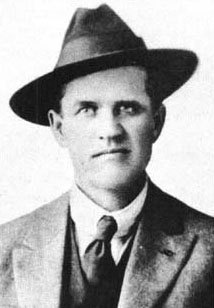
Kehoe, a power broker in mining country with some sway at the capital who was reputed to call the shots among the Maguires, faced the hangman singly a year later for an 1862 cold-case murder so doubtfully ascribed to Kehoe that the governor hesitated to sign the death warrant.

He signed it just the same, marking a sort of ceremonial “end to Molly-ism.” The New York Times exulted two days hence “that the widely-extended and long-continued tyranny and terror of this association is at an end,” and all because the resolute executive had gone and sent a hempen message to “the savage and benighted population of the coal region.”

The lesson taught by the punishment of the Molly Maguires would have been shorn of much of its terror and impressiveness if the energetic and persistent efforts made in behalf of KEHOE, the reputed king of that organization, had resulted in rescuing him from the gallows. If they had even so far succeeded as to have caused his punishment to be commuted to imprisonment for life, the admonitory influence of his fate upon the murderous clain of whom he was the last surviving chief would have been greatly lessened, and the snake of Molly Maguire-ism, of which he was the forked tongue and fangs, might haply have been only scotched, not killed. … The law has shown that it has subtlety enough to hunt [the Molly Maguires] through every possible labyrinth of refuge and strip from them every artifice of disguise, and power enough to wring them out of the desperate grasp of sympathizing constituencies and crush them.

Florid.

Like we said, violence wasn’t the exclusive resort of one side. But the monopoly of violence … that was held, as always, by the same hands that held the monopolies. Sean Connery as Kehoe reflects on the uneven contest while awaiting his fate in a (fictional) exchange with the Pinkerton mole who condemned him from the 1970 film The Molly Maguires.*

Pennsylvania Gov. John Hartranft left office a few weeks later, and reflected in his outgoing address on the lessons “the manufacturers and operators” ought to draw from the late unpleasantness.

The Mollie Maguire murders, like the agrarian murders in Ireland, and the trades-union outrages, arsons, and machine-breakings in England, were not the work of the so-called criminal classes. They were essentially class murders … If some of the leading spirits of the class had been members of a board of arbitration as representatives of labor, with some of the employers or their agents as representatives of capital, it is not unreasonable to suppose that most of the disagreements that have kept the coal regions in a state of turmoil might have been amicably adjusted, and many of those who were assassinated and of those who have been hanged living to-day.

101 years later, Kehoe received what was thought to be the first and only posthumous pardon in the state’s history. The Mollies’ true extent, purpose and actual actions — even their very existence as anything but a stalking-horse for the more thorough conquest of surplus labor — remain hotly debated to this day, since the public record of this tight-lipped society consists of little beyond the courtroom testimony of a handful of parties thoroughly prejudiced to hostility by class interest or payoffs.

* Written by Walter Bernstein, who had only recently emerged from the Hollywood blacklist for his Communist proclivities.

On this day..

1887: Parsons, Spies, Fischer and Engel, the Haymarket Martyrs

On this date in 1887, the Chicago political machine hanged four at Cook County Jail to defend civilization from the eight-hour day.

The Haymarket martyrs, as they would be remembered ere the hysterical atmosphere of their sentencing had passed, were four from a group of eight anarchist agitators rounded up when a never-identified person threw a bomb at Chicago police breaking up a peaceful rally. The bomb killed one cop; the indiscriminate police shooting that followed killed several more in friendly fire, plus an uncertain number of civilians.

The incident occurred just days after nationwide strikes began on May 1, 1886, in support of the eight-hour day. Nowhere were the tensions greater than Chicago, an epicenter of militant organizing. When tens of thousands poured into the streets on May 1, the Chicago Mail darkly said of high-profile radicals Albert Parsons and August Spies,

Mark them for today. Hold them responsible for any trouble that occurs. Make an example of them if trouble does occur.

Sure enough …

Most of the eight hadn’t even been present at the time the bomb was thrown, but the state put anarchism itself on trial under the capacious umbrella of “conspiracy,” in a proceeding so absurdly rigged that a relative of a slain cop was on the jury. Quoth the prosecutor,

Law is upon trial. Anarchy is on trial. These men have been selected, picked out by the grand jury and indicted because they were leaders. They are no more guilty than the thousand who follow them. Gentlemen of the jury; convict these men, make examples of them, hang them and save our institutions, our society.

That was the argument for hanging them. And right-thinking burghers applauded it.

Seven of the eight were condemned to die; two had their sentences commuted, but the other five refused to ask for clemency on the grounds that, innocent, they would “demand either liberty or death.” One of those five, Louis Lingg, painfully cheated the hangman by setting off a blasting cap in his mouth the night before his execution. (Lingg might have made, though seemingly not thrown, the mysterious bomb.)

The others — Parsons and Spies, along with Adolph Fischer and George Engel — hanged together, with their epitaphs upon their lips — literally so for Parsons, whose parting remark is at the base of the Haymarket Martyrs Monument*

“The time will come when our silence will be more powerful than the voices you are throttling today.”

“Throttle” was right, as the Chicago Tribune reported the next day, taking up when the trap was sprung:

Then begins a scene of horror that freezes the blood. The loosely-adjusted nooses remain behind the left ear and do not slip to the back of the neck. Not a single neck is broken, and the horrors of a death by strangulation begin.

Six years later, Illinois Gov. John Altgeld granted the free pardon the hanged men had demanded to the three surviving Haymarket anarchists. There is no institutional mechanism to determine erroneous executions in American jurisprudence — a fact that occasionally leads to smugly circular avowals that nobody recently executed has ever been “proven” innocent — and death penalty researchers Michael Radelet and Hugo Bedau believed as of this 1998 paper (pdf) that Altgeld’s executive statement flatly asserting the injustice of the Haymarket convictions was the most recent official acknowledgment of a wrongful execution in U.S. history. If true, its uniqueness would be understandable: the gesture cost Altgeld his political career.

Long gone as all these principals are, the legacy of Haymarket remains very much with us, and not just as a magnet for digital archives like this, this and this (don’t miss the brass gallows pin).

May 1, now rich with the symbolism of the Haymarket Passion, was soon selected by the international labor movement as the date to resume the eight-hour-day push — thus becoming the global workers’ holiday it remains to this day.

* Opposing interpretations of the Haymarket affair — which can be the “Haymarket riot” or the “Haymarket massacre,” depending on where you line up — were marked by opposing memorials. The police memorial was itself eventually bombed by the Weather Underground, and subsequently squirreled away from easy public view. Paradoxically, the Haymarket Martyrs Monument has been federally dignified as a National Historic Landmark.

On this day..

2005: Wang Binyu, desperate migrant laborer

On this date in 2005, a Chinese murderer who became the unlikely symbol of migrant laborers’ desperate plight was — quickly and quietly — put to death.

Binyu knifed four people to death, which isn’t the typical stuff to earn a public outpouring. In the course of things, he’d ordinarily have gone to his grave in the anonymity that attends most Chinese executions, perhaps not even a number to international monitors who struggle to ballpark China’s executions to the nearest thousand.

But the government news service published a surprisingly sympathetic interview of him, raising the case up for public comment that state authorities surely did not intend.

Jobbed

Wang earned his sentence during an altercation that occurred as he tried to collect years of unpaid back wages from his employer. It was the last of several encounters of escalating desperation driven by Wang’s father’s need for expensive medical treatment. Wang’s boss kept refusing to settle with his man, ultimately barring him from the factory premises.

In a China shaken by industrialization — proletarianization — Wang’s plight struck a chord. (Although there may have been a mistaken sense that he killed the nasty boss; in fact, the victims were the foreman and other factory employees who’d been detailed to force him out.) China has 200 million migrant workers like Wang, collectively owed billions in unpaid wages they have scant prospect of recovering.

I want to die. When I am dead, nobody can exploit me anymore. Right?

Exploitation at an end, Wang Binyu became the subject of a Pulitzer Prize-winning profile* in the New York Times; some additional coverage is here. The briefly vigorous conversation about his case in China, however, was forcibly shut down.

* The Pulitzer was actually awarded to the Times’ Joseph Kahn and Jim Yardley for a series of articles on the Chinese justice system; the linked story on Wang Binyu is one of eight.

On this day..

1917: Frank Little of the IWW lynched

On this date in 1917, Wobbly labor organizer Frank Little was abducted from his hotel and hanged from a railroad trestle in Butte, Montana.

An executive board member of the radical Industrial Workers of the World, the half-Cherokee Little had only rolled into Montana’s copper mining hub two weeks before. A roving agitator who had organized workers all around the west, he would be a signal martyr to America’s nascent Red Scare.

It was a fraught moment nationwide, and worldwide. After winning re-election on the slogan “He kept us out of war,” Woodrow Wilson upon his inauguration immediately (try to act surprised) got the United States into World War I. Just as it had in Europe, the question of war put American labor to the test: would it transfer opposition to war into resistance, or would it line up patriotically with its state?

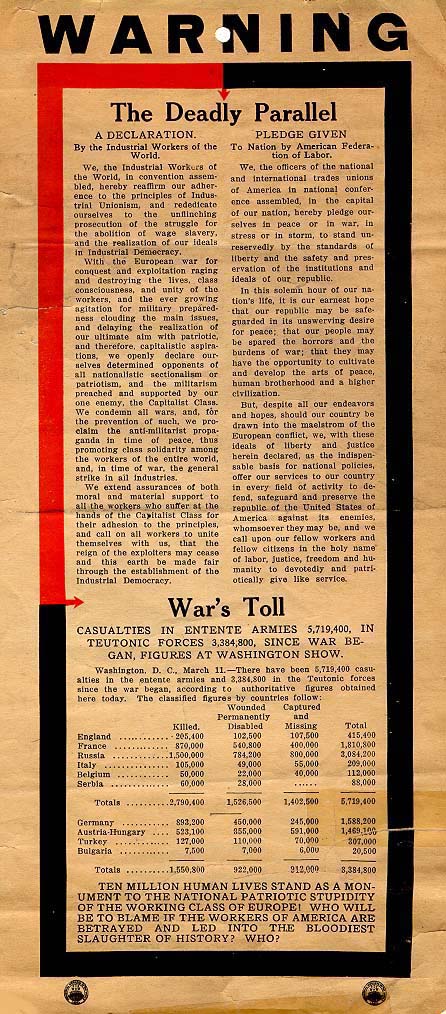
This outstanding IWW poster (via the University of Arizona’s web exhibit on the labor deportations that had expelled Frank Little from Arizona just days before he arrived in Butte) pits the militant Wobbly position against the nationalist American Federation of Labor.*

And Little was one of the most stridently anti-war in his movement.

Either we’re for their capitalist slaughter fest or against it. I’m ready to face a firing squad** rather than compromise. (Source)

Anaconda Copper could nowise welcome this character’s arrival, where he would organize already-striking miners and mix in militant anti-war rhetoric with incendiary potential in the cocktail of immigrant workers being asked (in many cases) to wage war on their homelands.

The local labor conflict, an exceptionally brutal instance of a pattern across the country and especially in western mining country, was probably savage enough on its own to make Little a marked man. Whether his anti-war activity or his union activity motivated his death is not sure, but the dilemma was probably a false one for his killers just as it was for Little himself: they were two heads of the coin. As American troops poured into Europe, and particularly as the Bolshevik Revolution later in 1917 spurred a worldwide Communist scare (and a separate American military expedition), both public and private power violently pursued left-wing elements.

Caption: Copper Trust to the Press: “It’s all right, pal; just tell them he was a traitor.” (Source.)

The film An Injury To One (review) deftly weaves those themes and others together into the tale of a crime which is also the tale of a time and place:

This note was found pinned to Little’s body. “3-7-77”, a Montana vigilante calling card, indicates the dimensions of a grave.

Officially (again, act surprised), it’s an unsolved crime. Even though the New York Times report the day after the hanging quoted a labor official claiming “certain” knowledge of five of the six men in the posse, and a prosecutor vowing, “it is a cold-blooded murder and every effort will be used to apprehend the men who did it,” nobody ever went on trial for lynching Little.

Company goons, likely aided by the infamous union-busting Pinkerton detective agency, are the presumed culprits. And it is the nature of lynchings to make extrajudicial the rough justice sought by a certain constituency, as expressed by Montana’s Helena Independent:

Good work! Let them continue to hang every I.W.W. in the state. The time has come. It is beyond the comprehension of the average citizen why the war department has not ordered certain leaders arrested and shot. The people will not stand for much more.

A massive funeral turnout brought federal troops to quash labor unrest in Butte … and in the years to come, the IWW would be hunted from pillar to post.

Pro-Wobbly sites give adoring biographical treatment and fairly extensive resource lists on Little here and here.

Little is buried in Butte. His grave marker reads:

Slain By Capitalist Interests For Organizing And Inspiring His Fellow Men.

* The AFL, now the AFL-CIO, remains the dominant institution in American labor today.

** Little undoubtedly had in mind the precedent of his fellow-martyr Joe Hill, executed judicially two years before in Utah.

On this day..