2005: Hastings Arthur Wise, workplace shooter

On this date in 2005, Hastings Arthur Wise was executed in South Carolina for a shooting rampage at his workplace.

Or rather — and this was the problem — his former workplace.

Canned from his machine-operator job of four years at the Aiken County R.E. Phelon engine manufacturing plant that July, Wise warned that he’d be back.

On September 15, 1997, he turned up packing a 9 mm pistol and exacted his revenge — just another of America’s endless cavalcade of mass shootings.

He shot a guard to get into the plant. The guard survived, but four others were not so fortunate as Wise stalked through his former employer’s halls screaming and firing. Police later recovered four empty eight-round magazines.

The human resources director who had fired him was the first Wise killed.

Two men in the tool and die area who had jobs that Wise had once sought unsuccessfully were the next.

A young woman in a job Wise had sought promotion to was wounded with shots to the back and leg, then finished off execution-style.

Wise took to firing almost indiscriminately and wounded a few others, but the body count still might have been higher. Some others Wise saw and could have murdered, but did not — some possibly saved by happenstance, others whom Wise said in court that he declined to shoot because he used to get along with them as coworkers. The whole rampage was calculated to such an extent that Wise took a 9,000-mile road trip to California and Texas to tick a few items off his bucket list first.

Wise always intended to check out at the end of his spree; the SWAT team found him on the floor suffering from a swallow of insecticide that turned out to be non-fatal. The judicial process was the slow train, but the destination remained the same.

“I don’t have much to say except that I did not wish to take advantage of the court as far as asking mercy,” Wise said to the court at his sentencing. “It’s a fair trial. I committed the crimes.”

As good as his word, Wise voluntarily dropped his appeals and went quickly from his 2001 conviction to execution, declining to make any final statement.

On this day..

1681: Leticia Wigington, apprentice-flogger

On this date in 1681, Leticia, Letitia, or Laetitia Wigington was hanged at Tyburn for beating her apprentice to death.

A case that would presage the next century’s better-remembered Brownrigg outrage, the Ratcliff Catholic coat-maker Wigington and her lodger John Sadler took five quid from one of Sadler’s fellow-sailors to apprentice their daughter.

On Christmas Eve 1680, Ms. Wigington took exception to the 13-year-old Elizabeth Houlton’s performance or caught her stealing from them or something, and set about thrashing her. After taking an hour to fashion a cruel cat o’ nine tails so they could really give it to her, these two

stript the poor Child barbarously and immodestly stark naked, and [Wigington] held her and ram’d an Apron down her Throat, to prevent her crying out, and the foresaid [Sadler] most inhumanely whipt her for 4 hours or more, with some short intervals of their Cruelty, and, having made her body raw, and all over bloody, sent for Salt, and salted her wounds, to render their Tortures more grievous. Of which Savage usage she dyed next morning [i.e., Christmas].

Salted her wounds?

Sadler fled, and was on the run for nearly a month; he was sentenced to die on February 25 and specifically prohibited from pleading for royal pardon before his March 4 execution.

Wigington got off a little “easier”, pleading her belly after a January conviction and delaying execution all the way to September 9. That’s quite a wait — a suggestive wait, one might think, though no actual record remains to confirm that Wigington left a little bundle of joy behind her to the world’s cat o’ nine tails.

For her part, Wigington went to her death asserting her innocence — “as the Child unborn” — and denouncing her enemies for inducing her “Apprentice Rebecca Clifford by name, who was not full 12 years of age, to swear against me” falsely.

On this day..

1771: Henry Stroud and Robert Campbell, for revenge

On this date in 1771, Henry Stroud and Robert Campbell were hanged at Bethnal Green Road — a pointed message to the Spitalfield working class.

Their hanging was tit for tat in an exchange of deadly violence between the state and laboring Londoners.

Two years before, an anti-union law making it a capital crime to cut silk out of looms had actually been put to use with the hanging of two as part of the suppression of a Spitalfields weavers riot.

This execution provoked in the following months a horrifying mob vengeance against the independent weaver who had testified — falsely, it was suspected — against those hanged men. When said informer, name of Daniel Clark, was recognized walking in the area one day, an angry crowd formed and “stript him, tied his hands behind him, took him to a pond, threw him in, and then threw stones and brickbats at him for some time; then took him out, tied a cord round his neck, and threw him in the pond again, and then threw stones and brickbats at him till they beat out his brains.”*

Snitches get … brickbats.

Justice David Wilmot** determined to hunt out some of this lynch mob he could make an example of, not disdaining to resort to arm-twisting and witness-buying.† Wilmot’s advertisement for leads drew anonymous threats, which the justice scornfully published in newspapers to up the ante.

The writers of these letters … [are] pursuing with insatiable & heart felt revenge, their designs against you should any one person suffer from your busy concern. & know farther that having such connections at all your haunts, and free access at most time to your person, ’til not the whole third regiment of guards that can protect you from the well concerted plan for your destruction.

The result was a chaotic five-day trial, at which witnesses openly flinched at the prospect of popular vengeance waiting outside the Old Bailey doors.

Henry Stroud, nevertheless, was identified by several witnesses as having taken a prominent part in visiting popular justice upon Clark, in the form of two or three hurled bricks that knocked the victim down — while Robert Campbell was reputed to have thrust the bloodied Clark’s head into the pool.

They were pointedly put to death behind a heavily armed cordon near the very spot of the homicide. Stroud, at least, went to his death still vigorously protesting his innocence.‡

“Thus did the alternating pageants of ritual murder come to an end,” writes Peter Linebaugh of this exclamatory execution in The London Hanged. “A hundred bayonets from the War Office protecting the hangman and the magistrates. The scapegoating of the class antagonism concluded with this powerful, official display of power in the streets, where usually the trill of [weaving] shuttles would fill the air.”

* Quoted in Norma Landau’s “Gauging crime in late Eighteenth Century London,” Social History, 35:4.

** Not to be confused with Justice Wilmot, then the sitting Chief Justice of the Common Pleas. Justice David Wilmot’s credentials from this affair and otherwise established him as a hated enemy of the London working class, and consequently his home was torched during the proletarian Gordon Riots.

† viz., testimony of one witness among the several in the Old Bailey transcript who openly discuss payola: “another gentleman offered me fourscore pounds; a gentleman that brought me the summons; he said, you know one Bob Campbell; I said, I did not by name; he said, he would give me fourscore pounds; I was frightened, he said, I see you are a stranger; if you will but swear to the man I will give you fourscore pounds.”

‡ After the days-long prosecution, Stroud’s entire defense case ran two sentences: “I am as innocent of the affair as ever was a child in the world. I neither handled brick, stone, tile, nor anything, so help me God.”

On this day..

2001: An adult actress stoned to death in Evin prison


(From the May 22, 2001 Eugene Register-Guard, which is also the source of the quoted text below.)

Sex workers face a struggle worldwide for labor rights and human rights. At the extreme end of the criminalization spectrum was the fate of the unidentified 35-year-old woman who, according to the Iranian newspaper Entekhab, “was partially buried in a hole at Tehran’s Evin prison and stoned to death Sunday.”

She had been arrested eight years before for acting in “obscene sex films,” which of course are as prevalent in Iran as everywhere else.

On this day..

1891: Benjamin Harrison spares the Navassa rioters

On this date in 1891, U.S. President Benjamin Harrison settled a death penalty case from the remote Navassa Island by granting a commutation.

Back in the 19th century, islands stacked high with guano were worth their weight in bird crap. The phosphate-rich dung piled meters-deep in some places, and could be mined for agricultural fertilizer and for use in gunpowder and explosives.

In 1856, Congress even passed a Guano Islands Act empowering skippers to plant the stars and stripes on any of these lucrative little turd reefs they happened to run across. That’s how the U.S. came to possess, for instance, Midway Island … and more than 100 other islands as well. For audio product handling the guano binge, try this 99 Percent Invisible podcast.

Most of these claims have long since been ceded, but a few remain today. One of them is (still!) Navassa, a three-square-mile speck off the coast of Haiti, 100 miles south of Guantanamo Bay.

Today, Navassa is uninhabited and administered by the Department of the Interior on somewhat disputable footing. (Haiti, just two miles away, also claims Navassa.)

But in the late 19th century, its sweet, sweet guano was being extracted by a Baltimore-based firm known as the Navassa Phosphate Company. This operation employed 137 African-American laborers, moving groaning shitloads of product by raw muscle power under a blistering tropical sun … and under 11 white overseers.

The nature of the assignment — an island very far from the nearest American settlement, with no other industry, community or outpost to repair to — made taking a job on Navassa almost like hitching on somewhere as a sailor: you were off to a little floating dictatorship, with no way out until the end of the contract.

Navassa’s overseers turned out to have a taste for the cat o’nine tails, and worse.

“The conditions surrounding the prisoners and their fellows were of a most peculiar character,” Harrison noted in his eventual commutation order.

They were American citizens, under contracts to perform labor upon specified terms, within American territory, removed from any opportunity to appeal to any court or public officer for redress of any injury or the enforcement of any civil right. Their employers were, in fact, their masters. The bosses placed over them imposed fines and penalties without any semblance of trial. These penalties extended to imprisonment, and even to the cruel practice of tricing men up for a refusal to work. Escape was impossible, and the state of things generally such as might make men reckless and dangerous.

Or, as a naval inspection judged it, Navassa resembled “a convict establishment without its comforts and cleanliness”: people being worked brutally to the bone during their contract, eating rancid rations and living in filth.

Not surprisingly, Navassa’s “convict” laboring population rebelled in 1889, and in a vicious hour-long riot slew five overseers while maiming several others.

Warships calling on the island shipped 18 back to face murder charges; ultimately, three black guano-miners were sentenced to death for the affair.*

However, a huge clemency push spearheaded by the Baltimore-based black fraternal organization the Grand United Order of Galilean Fishermen raised the cry to spare the condemned men.

Guano harvesting resumed after the riot, but was aborted in 1898 by the Spanish-American War; the Navassa Phosphate Company fell into bankruptcy, and although the U.S. later threw up a lighthouse on Navassa to aid Panama Canal-bound vessels, it’s been effectively uninhabited ever since.

* The appeals arising from the Navassa conviction generated the 1890 Supreme Court case Jones v. United States, affirming Navassa’s American territoriality, and establishing Congressional jurisdiction over violations of U.S. law that didn’t take place in any particular state. This bit of jurisprudence has turned up all over the place in the century-plus since it was issued.

On this day..

1813: 14 Luddites at York

On this date in 1813, the British intensified their war against machine-wrecking Luddites by executing 14 at York.

We touched last week on Mellor, Smith, and Thorpe, three Luddites hanged for assassinating a wool manufacturer during the dirty war that resulted from mechanizing formerly-artisanal textile production. The Luddite Bicentenary blog was prominently linked in that post; it’s been chronicling the real-time course of the Luddite rebellion from two hundred years’ remove, and is a recommended follow for anyone interested in this period.

Today, the Luddite Bicentenary marks the mass hangings of January 16, 1813, pursuant to sentences issued by that same special tribunal in York. Most had been convicted of an attack on nearby Rawfolds Mill; others, for taking part in two home-invasion robberies for the purpose of obtaining weapons.

Enjoy the full story at Luddite Bicentenary … but here’s a teaser excerpt from the January 23, 1813 Leeds Mercury‘s account of the “inexpressibly awful” sequential mass-hangings, seven upon seven, widowing 13 wives and leaving 56 children (and a 57th on the way) fatherless.

Execution.

After sentence of death had been passed upon the persons convicted of making the attack on Mr. Cartwright’s Mill, at Rawfolds, and of the Burglaries, fifteen in number, all of them except John Lumb, who was reprieved, were removed to the condemned-ward, and their behaviour in that place was very suitable to their unhappy situation…

if any of these unfortunate men possessed any secret that it might have been important to the public to know, they suffered it to die with them. Their discoveries were meagre in the extreme. Not one of them impeached any of their accomplices, nor did they state, as might reasonably have been expected, where the depot of arms, in the collection of which some of them had been personally engaged, was to be found. When interrogated on this point, some of them disclaimed all knowledge of the place, and others said, Benjamin Walker, the informer against Mellor, Thorpe, and Smith, could give the best information about the arms, as he had been present at most of the depredations. … The principal part of these ill-fated men were married and have left families. William Hartley, has left seven children, their mother, happily for herself, died about half a year ago. John Ogden, wife and two children; Nathan Hoyle, wife and seven children; Joseph Crowther, wife pregnant, and four children; John Hill, wife and two children; John Walker, wife and five children; Jonathan Dean, wife and seven children; Thomas Brook, wife and three children; John Swallow, wife and six children; John Batley, wife and one child; John Fisher, wife and three children; Job Hey, wife and seven children; James Hey, wife and two children; James Haigh, wife, but no children. On the morning before the execution, the eldest daughter of Hartley obtain permission to visit a wretched parent, when a scene took place which we will not attempt to describe. The heart-broken father wished to have been spared the anguish of this parting interval, but the importunate intreaties of his child a last prevailed, and they met to take a long farewell, never again to be repeated in this world. What must be the feelings of an affectionate father, (for such in this trying moment he appears to have shewn himself,) when, though standing on the brink of eternity, he declines to see a darling child; how great an aggravation of his punishment must those parting pangs of inflicted, and how loud an admonition does this melancholy incident suggest to the Fathers of families against entering into combinations that may place them in the same inexpressibly afflicted situations. It was Hartley’s particular request that the public should be informed of the number and unprovided situation of his orphan family.

At 11 o’clock on Saturday morning, the Under Sheriff went to demand the bodies of John Ogden, Nathan Hoyle, Joseph Crowther, John Hill, John Walker, Jonathan Dean, and Thomas Brook. They were all engaged in singing a hymn:

Behold the Saviour of Mankind,
Nail’d to the shameful tree;
How vast the love that him inclin’d
To bleed and for me, &c.

Which one of them [Luddite Bicentennary notes: John Walker, according to the Leeds Intelligencer] dictated in a firm tone of voice; and in this religious service they continued on their way to the platform, and some time after they had arrived at the fatal spot. They then join the ordinary with great fervency in the prayers appointed to be read on such occasions, and after that gentleman had taken his final leave of them, ejaculations to the throne of mercy rose from every part of the crowded platform.

Joseph Crowther addressing himself to the spectators said, “Farewell Lads;” another whose name we could not collect said, “I am prepared for the Lord,” and John Hill, advancing a step or two on the platform, said, “Friends! all take warning by my fate; for three years I followed the Lord, but about half a year since, I began to fall away; and fell by little and little, and at last I am come to this; persevere in the ways of godliness, and O! take warning by my fate!” The executioner then proceeded to the discharge of his duty, and the falling of the platform soon after, forced an involuntary shriek from the vast concourse of spectators assembled to witness this tremendous sacrifice to the injured laws of the country.

The bodies having remained suspended for the usual time [LB: 12.00 p.m.], they were removed, and while the place of execution was yet warm with the blood of the former victims, the remaining seven, namely, John Swallow, John Batley, Joseph Fisher, William Hartley, James Haigh, James Hey, and Job Hey, were led at half-past one o’clock from their cell to the fatal stage, their behaviour, like that of their deceased confederates, was contrite and becoming; James Haigh expressed deep contrition for his offences. John Swallow said he had been led away by wicked and unprincipled men, and hoped his fate would be a warning to all, and teach them to live a life of sobriety and uprightness. They all united in prayer with an earnestness that is seldom witnessed in the services of devotion, except in the immediate prospect of death [LB: the Leeds Intelligencer said they sung the same hymn as those executed earlier]. A few moments closed their mortal existence, and placed at the bar differing from all earthly tribunal’s [sic] in this infinitely important particular — here, owing to the imperfections of all human institutions, repentance though sincere, cannot procure forgiveness — there, we have the authority of God himself for saying, that the cries of the contrite and broken-hearted shall not be despised. Charity hopeth all things.

The criminal records of Yorkshire do not perhaps afford an instance of so many victims having been offered in one day to the injured laws of the country. The scene was inexpressibly awful, and the large body of soldiers, both horse and foot, who guarded the approach to the castle, and were planted in front of the fatal tree, gave to the scene of peculiar degree of terror, and exhibited the appearance of a military execution. The spectators, particularly in the morning, were unusually numerous, and their behaviour on both occasions, were strictly decorous and unbecoming. [sic]

Full post at Luddite Bicentennary. Also see LB on the mood of the town.

On this day..

1813: The Yorkshire Luddites, for murdering William Horsfall

This is the bicentennial of the hanging of three Luddites for the murder of manufacturer William Horsfall.

“Luddite” has come to refer imprecisely to a wide range of anti-mechanization machine-wrecking in early 19th century Britain; however, it’s most properly applied to a specific 1811-1816 movement.

While often understood casually as a sort of mindless technophobia, wreckers — Luddites and otherwise — actually had material labor grievances. New more efficient power looms reduced skilled workers to the ranks of unskilled subsistence labor, or to those of the superfluous unemployed.

With trade unionism illegal (and severely repressed), their means of resistance were of a desperate character. Lord Byron, almost alone in Parliament, rose to defend them: “These men were willing to dig, but the spade was in other hands; they were not ashamed to beg, but there was none to relieve them. Their own means of subsistence were cut off; all other employments pre-occupied; and their excesses, however to be deplored and condemned, can hardly be the subject of surprise.”

Hence, Byron sarcastically remarked, “new capital punishments must be devised, new snares of death must be spread, for the wretched mechanic who is famished into guilt.” Parliament did indeed extend its capital statutes to the protection of these new looms.

“Wrecking,” in the analysis of the late Eric Hobsbawm, “was simply a technique of trade unionism in the period before, and during the early phases of, the industrial revolution.”

Hobsbawm quotes a Nottingham town clerk describing the way textile manufacturers “acquire entire control of their workmen” by putting them to work on the owners’ power looms rather than hiring out workers who use their own looms. “Perhaps the most effectual manner in which the combination [read: proto-union] could coerce them was their former manner of carrying on war by destroying their frames.”

And the descriptor “war” was not far off.

The Luddites — so named for legendary loom-smasher Ned Ludd — proliferated in 1811-1812. Beginning in Nottingham with a protest against falling wages signed by General Ned Ludd and the Army of Redressers, they tapped a wellspring of discontent.

It was a time of war, of economic crisis, of spiking wheat prices whose rise to an 1812 record peak further immiserated those who scraped to earn a living by the sweat of their brow. A generation after the French Revolution, with Napoleon rampant on the continent, English elites had reason to fear their own legitimacy stood on unstable ground.* In 1811, the king even went mad.

And they thrive well who from the poor
Have snatched the bread of penury,
And heap the houseless wanderer’s store
On the rank pile of luxury.

-Percy Bysshe Shelly, “The Devil’s Walk” (1812)

From their birthplace in Nottingham, Luddite societies spread out through textile country, conspiring by moonlight to break into factories and smash up frames or commit other acts of industrial sabotage. (There’s a pdf timeline here) Byron, the Luddites’ defender, owned that the night before he departed a recent visit to Nottingham, “forty frames had been broken the preceding evening as usual, without resistance and without detection.”

Terrified manufacturers — some were known to have armored their establishments with what amount to siege fortifications; others, to outfit homes with early panic rooms as bolt-holes in the event of a Luddite attack — met this mob action violently. Westminster put 12,000 troops into Luddite country to fight the wreckers.

And the wreckers fought back.

William Horsfall, owner of a Marsden wool mill with 400 employees, had vowed to “ride up to his saddle in Luddite blood” … which promise gave a poetic twist to his actual fate: while riding on Huddersfield‘s Crosland Moor** in April 1812, a group of Luddites lying in wait opened fire on him and shot Horsfall through the groin.

“As soon as he fell after being wounded the inhuman populace surrounding him reproached him with having been the oppressor of the poor — they did not offer assistance,” an officer later reported. “Nor did any one attempt to pursue or secure the assassins who were seen to retire to an adjoining wood.” A fellow-manufacturer helped Horsfall to an inn, where he expired painfully 38 hours later.

It was several months before the powers that be were able to crack it.

Eventually, the energetic Huddersfield magistrate Joseph Radcliffe† was able to exploit the threat of hanging to force a Luddite cropper‡ into impeaching his confederates in the plot. This investigation is covered in marvelous detail at the Luddite Bicentenary blog, an outstanding resource on the period in general, but for our purposes we’ll sum up to say that the hunt for Horsfall’s killers wound up zeroing in on George Mellor, Thomas Smith, and William Thorpe.

They were tried over 11 hours on a single day, January 6, 1813 (summary: 1, 2, 3, 4).

That was a Wednesday.

That Friday, the three hanged in their manacles behind York Castle under heavy military guard to forestall any possible rescue, having never admitted any part in the murder. The authorities judiciously eschewed a more demonstrative (and potentially riot-inducing) execution at the scene of the crime.

“The number of people assembled was much greater than is usual in York, on those melancholy occasions; but not the slightest indication of tumult prevailed, and the greatest silence reigned during the whole of this solemn and painful scene,” the Leeds Mercury reported§ — and darkly explicated the intended lesson of the scene for other machine-wreckers.

all those who may have been so far infatuated as to become members of such societies should, from this moment, and by one common consent, desist from taking another step in furtherance of their objects. They must now see that they have stood on the brink of a frightful precipice, and that another step might have plunged them into that gulph which has overwhelmed their less fortunate associates.

The mailed fist deployed against wreckers in 1812-1813 did indeed smash the movement. Still, sporadic Luddite attacks would continue as late as 1816, and Luddite veterans went at the fore of the 1817 Pentrich Rising … just outside the place it all began, Nottingham.

* It was in just this period — in fact, only a few days after William Horsfall’s murder — that Prime Minister Spencer Perceval was assassinated. Given the conditions abroad in the land, many an elite feared upon first notice of this event a revolutionary rising … although Perceval’s killer turned out to be a deranged merchant whose confused private grievance had nothing to do with Britain’s social tensions.

** Not far from the spot of Horsfall’s murder — and a standard stop on every present-day Luddite commemorative walk — you’ll still find William Horsfall Street.

† Radcliffe’s exertions in the war against the Luddites secured for his family a still-extant baronetcy.

‡ Benjamin Walker, the Luddite informer who sent Mellor, Smith, and Thorpe to the gallows, was denied the advertised £2000 reward and wound up a beggar in London.

§ Leeds Mercury report via a reprint in the London Times of Jan. 12, 1813. (Also see this excerpt.)

On this day..

1767: Elizabeth Brownrigg

On this date in 1767, a jeering mob damning her to hell* saw Elizabeth Brownrigg hang at Tyburn.

“The long and excruciating torture in which this inhuman woman kept the innocent object of her remorseless cruelty, before she finished the long-premeditated murder,” says the Newgate Calendar, “more engaged the attention and roused the indignation of all ranks, than any criminal in the whole course of our melancholy narratives.” Hers is a very rich text.

As a middle-class midwife, Brownrigg mined the Foundling Hospital for young girls whom she would take on as apprentice domestic servants.

Brownrigg was far from the only one exploiting this ready pool of virtual slave labor, but it was her home’s marked sexualized sadism that really moved copy (pdf pamphlet). And Chateau Roissy it was not.

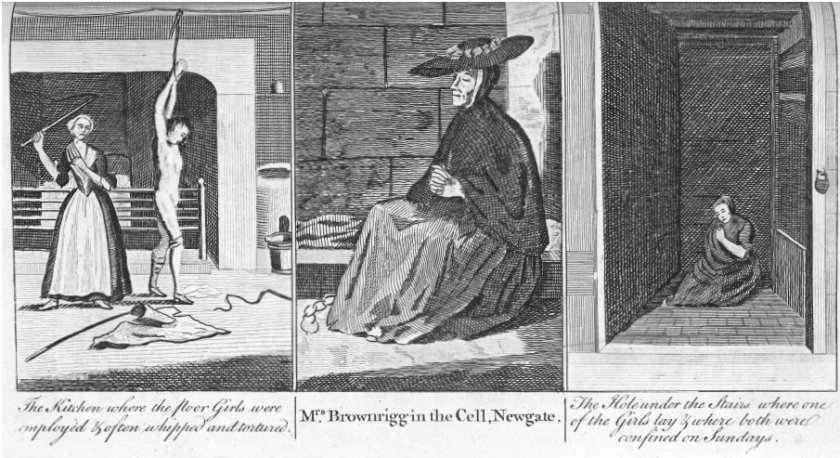
Elizabeth liked to keep the servants locked up, starving, usually naked, and would pinion their hands and inflict merciless corporal punishment for the least transgression against rules like “having any more bread”. The Old Bailey Online preserves one servant’s trial testimony:

Q. In what manner did she use to beat her?

M. Mitchel. She used to tie her up in the kitchen; when first she began to be at her, she used to tie her up to the water-pipe, with her two hands drawed up above her head.

Q. Describe that water-pipe.

M. Mitchel. That goes across the kitchen; the hooks that hold it are fastened into a beam.

Q. Had she used to have her clothes on when your mistress tied her up in this manner to beat her?

M. Mitchel. No, no clothes at all.

Q. How came that?

M. Mitchel. It was my mistress’s pleasure that she should take her clothes off.

Q. What had she used to beat her with?

M. Mitchel. She beat her most commonly with a horse-whip.

Q. How long did she use to beat her in this manner?

M. Mitchel. I cannot justly say, but she seldom left off till she had fetched blood.

This witness Mary Mitchel(l) was the lucky one of the Brownriggs’ last two Foundling Hospital charges: both girls had been stripped and horsewhipped so regularly that ulcerating, infectious sores — never able to heal before the next thrashing — pocked their bodies.

But Mary Mitchell at least survived. Her fellow-sufferer Mary Clifford was flat beaten to death, the body stuffed in the family coal-hole like so much rubbish. (In life, Mary Clifford was sometimes made to sleep there, too.)**


Detail view (click for a larger, three-panel image) of Elizabeth Brownrigg and her crimes illustrated in the Newgate Calendar.

For working-class Londoners struggling to navigate the dislocations of the Industrial Revolution, here was a villainess indeed. London was swelling, urbanizing, bustling with vulnerable orphans and abandoned children like our foundling Marys; all its working classes, for that matter, had reason to feel endangered in the face of fights for their lives against emerging commercial powers working hand in glove with the state — not excluding the ubiquitous threat of the gallows for pitiable property crimes.

And as Peter Linebaugh observes, “apprenticeship” by the 18th century “was less likely to involve the development of highly qualified, skilled labour power than to be the means of organizing the exploitation of young labour power.”† Like it’s not enough working your crappy dead-end unpaid internship; now, it comes with flogging?

Somehow, Brownrigg’s husband and son were convicted only of a misdemeanor and got off with a few months in prison, but Elizabeth bore all the hatred of Londoners more used to seeing apprentices swing than even the vilest master. The Murder Act which had appropriated even the corpses of London’s marginal people was applied to anatomize our former midwife; her skeletal remains were long displayed in a niche at the Royal College of Surgeons.

Oh, and the Foundling Hospital — which had cautioned the Brownriggs before about their excessive abuse of servants but not actually stopped sending them young girls to abuse — started finally instituting some oversight.


There’s a vicious and unsigned satire, “Elizabeth Brownrigge”, published in the September 1832 Fraser’s magazine. Over the years, it has occasioned a great deal of dispute among Thackeray scholars as to whether it might not have been an early creation of that master satirist’s pen. (Thackeray would have just turned 21 when it published.)

We’re not qualified to render judgment on the literary forensics, but the skewering of a murderess through the author’s mock-sympathy has a deliciously Thackerian flavor about it: the world was “incapable of understanding the height of her virtue.” It also underscores the continuing resonance of Elizabeth Brownrigg to Londoners 65 years after her execution.

The magnanimity of her soul, like Mr. Smeaton‘s pharos on the Eddystone, was firmly fixed upon the rock of the soundest principles, and diffused a light around it, for the guidance of those who were beating the waves upon the dark and troubled ocean of adversity, but was itself unshaken by the storm … [in prison] the fair and excellent Elizabeth adopted, as nearly as circumstances would allow, the same admirable disposition of her time to which she had been accustomed when inhabiting her own romantic bower in the village of Islington. She completed a large stock of baby-linen for the poor; she perused new publications of the day; and she composed an elaborate parallel between the characters of Socrates and Lady Jane Grey, after the manner of Plutarch. These are the two distinguished personages, in the whole range of authentic history, who in their strength of mind, purity of life, and extensive accomplishments, bore the strongest resemblance to herself; and to them, perchance, the attention of our heroine was more particularly directed in the quiet and retirement of her cell by the many points of similarity which subsisted between their destiny and her own.

Later, the fictional Elizabeth mounts a defense of such oblivious loathsomeness that it naturally impresses the judge:

“… punishment is a moral medicine. I may, perchance, actuated by too eager a desire for the rapid cure of my little and much-cherished patient, have dispensed my alternatives too liberally, and produced and untoward, an unexpected, and a most deeply-lamented consequence; but am I, therefore, to be condemned as guilty? In the analogous case of the physician, whose too-abundant anodynes may have lulled the sufferer to endless slumbers, or whose too copious phlebotomy may have let out the fever and the life at one and the same moment from the veins, would this most harsh and unmerciful measure be applied? … I demand from the justice of your lordship and a jury of my countrymen — as a matter not of mercy, but of right — the same impunity in my case which would be accorded, freely an unasked, under parallel circumstances, to the medical practitioner.”

Thackeray or whomever lay behind this pasquinade had a wider literary target in mind than simply Elizabeth Brownrigg(e)’s class. The short story is prefaced with a dedication to “the author of Eugene Aram“, meaning the popular novel published earlier in 1832 by Edward Bulwer-Lytton — a lifelong Thackeray bete noir. That novel concerned another renowned 18th century murderer, and it’s safe to say from the dedication that our satirist considered Bulwer-Lytton’s empathetic portrayal of the titular homicide a little, er, soft on crime.

I have been taught by Eugene Aram to mix vice and virtue up together in such an inextricable confusion as to render it impossible that any preference should be given to either, or that the one, indeed, should be at all distinguishable from the other … I had, indeed, in my dramatic piece, been guilty of an egregious and unpardonable error: I had attempted to excite the sympathies of the audience in favour of the murdered apprentices, but your novel has disabused me of so vulgar a prejudice, and, in my present version of her case, all the interest of the reader and all the pathetic powers of the author will be engaged on the side of the murderess.

* The Newgate Calendar: “On her way to the place of execution the people expressed their abhorrence of her crime in terms which, though not proper for the occasion, testified their astonishment that such a wretch could have existed: they even prayed for her damnation instead of her salvation: they doubted not but that ‘the devil would fetch her,’ and hoped that ‘she would go to hell.’ Such were the sentiments of the mob.”

** Elizabeth Brownrigg admitted to the Ordinary of Newgate the truth of Mary Mitchell’s horror testimony.

† Conversely, rogues who took to the highway and became working-class heroes were very often men who had absconded from their apprenticeship — for instance, Jack Sheppard and Dick Turpin.

On this day..

1768: Seven coal-heavers to crush the London port strike

On this date in 1768, a year of tremendous labor agitation in London, seven coal-heavers were hanged near the Shadwell dock.

With food prices surging,* the city’s hard-pressed urban proletariat was at peak militancy — which also lent violent energy the cause of hunted radical politician John Wilkes, who had returned from exile this year to stand for Parliament. Two principal loci of labor insurgency in 1768 were the Spitalfields weavers, whose struggle we have already observed, and the “coal heavers” — the men who did the grueling labor of offloading coal from Thames barges.

Coal-heaving was ill-paid and dangerous, and it was notoriously sensitive to fraud: workers (largely Irish: they’d been imported to hold down wages) being paid by the “sack” or the “vat” fought supervisors at riverside over just how fully loaded with coal such a sack or vat should be. Workers had their own recourse to “indirect Practises,” pilfering a few coals on the side to supplement pay up to within hailing distance of subsistence. The boss would call “theft” this grey-area practice harkening to labor traditions ancient and still-current. The rope would help him define it so.

Peter Linebaugh’s magisterial social history The London Hanged dramatically treats the fraught and violent months of the spring of 1768, when Irish workingmen were “bringing river traffic to a stand-still … [and] stopped the imperialist artery.”

Dockside taverns doubled as fraternal entities and regiments in the unfolding dock war. One John Green, keeper of a pub on New-Gravel Lane (not as scenic as the nearby Cutthroat Lane)

organized scab labour from [his] Roundabout Tavern. It was attacked in April with gunfire. A shoemaker bled to death on the pavement, a coal-heaver took a bullet in the head, ‘dropped down backwards, and never stirred’. The taverns were besieged, their furnishings destroyed. Gunfire was frequent. Green was acquitted of murder. Those testifying for him were mobbed and one witness had her jaw broken. The coal-heavers were as violent in word as in deed. ‘They would have Green’s Heart and Liver and Do for him’; ‘they would have him joint from joint’; ‘they would have his heart and liver, and cut him in pieces and hang him on his sign’; ‘they would hang him over his sign Post & cut him into Beef Stakes’.

Our seven — by name John Grainger, Daniel Clark, Richard Cornwall, Patrick Lynch, Thomas Murray, Peter Flaharty, and Nicholas McCabe — were indicted on grounds that they “with force and arms, with certain guns loaded with gunpowder and leaden bullets, feloniously, wilfully, and maliciously did shoot off at John Green.” Not quite cut into Beef Stakes, but it’ll get the job done.

Though the trials of Green, and then of Green’s assailants, were weeks apart, they concerned the very same disturbance on the night of April 20-21, when Green’s residence had been besieged by angry coal-heavers and Green with others had shot out the windows and killed at least two … but managed to hold his foes at bay during what must have been a harrowing night. Green wasn’t hurt, and gave evidence at the “shooting off” trial.

The London Irish had by 1768 an unparalleled knowledge of arms and armed struggle. They contributed to an insurrectionary impulse within the London working class. At the same time, as a consequence, the Irish had close knowledge of violent death. The intimacy of that knowledge was expressed in vivid euphemisms designed to reduce the terror of hanging. Seven coal-heavers received the ‘cramp jaw’ at the Old Bailey only after a new interpretation was placed upon the Waltham Black Act. The seven danced ‘a new jig without music’ on 26 July 1768. This particular ‘crack neck assembly’ was located in Sun Tavern fields, Shadwell … The move from Tyburn was designed to terrify the poor and working people of the river parishes. The ‘breath stopper’ was witnessed by 50,000 spectators, perhaps the largest crowd at such a scene since the hanging of the Earl of Ferrers eight years earlier. The Government anticipated disorders, if not rescue attempts, when these seven were to dance ‘tuxt de ert and de skies’. From 6 a.m. more than 600 soldiers patrolled the streets of Wapping and Shadwell. The Sheriff ordered all the constables of the Tower and Holborn divisions to assemble at the hanging site and to come armed with their staves. Thomas Turlis, the hangman, had stolen coal from a neighbour’s cellar five years earlier. But, that his work might not be interrupted, the Sheriff quickly obtained a pardon for him. He did his duty upon the coal-heavers, sent ‘a-spinning like a whirligig’. Once they had ‘peacably’ exited the world, many of the spectators may have gone for a drink as was customary:

Wid a facer we coddled our blood
For de wind id blows cold from de gibbett.

… The hanging at Sun Tavern Fields … taught a hard lesson about collective bargaining: attempts to counteract the rise in the price of provisions by improving wage rates would not be allowed. … the insurrectionary vanguard of the river proletariat was broken.

Or, as a more sanguine observer put it, after the hangings “the tumults immediately ceased, and peace and industry was happily restored.” And they all lived happily ever after.

* Bread prices doubled in 1768, leading to work stoppages, hoarding, and food riots throughout the city. Representative slogan shouted by desperate rioters: “We might as well be hanged as starve.” (George Rude, “The London ‘Mob’ of the Eighteenth Century,” The Historical Journal, Vol. II, no. 1 (1959))

On this day..

1995: Flor Contemplacion, OFW

On this date in 1995, Filipina maid Flor Contemplacion was hanged for murder in Singapore.

Contemplacion had, four years before, strangled a fellow-maid and drowned that maid’s four-year-old charge.

That’s what she confessed to, at least. Even though Contemplacion’s camp would eventually argue that the confession had been coerced, or that she’d been possessed by a strange epileptic, Contemplacion herself never really walked back that admission.

Still, Flor Contemplacion the cause celebre and Flor Contemplacion the cultural phenomenon was never only about the woman’s innocence, even if many do still believe she was framed.

By whatever happenstance of timing and circumstance, widespread publicity of her case in the Philippines during the months leading up to her hanging tapped a national discontent among her countrymen and -women about “OFWs” — overseas Filipino workers.

This economic sector — exported labor — had been intentionally nurtured (pdf) by Manila beginning with a 1974 labor code, and over the ensuing generation ballooned twentyfold into a positively enormous phenomenon.* By the time Flor Contemplacion hanged, everybody in the Philippines knew people who had worked overseas, and whose wage remittances were indispensable (pdf) for supporting their families in the Philippines. (And increasingly, the entire national economy.)


Boom of the overseas Filipino workers sector, 1975 – 2000 (1975 = 1). Source of figures; there are more official OFW stats here.

Ascendance of the OFW industry brought with it the discontents attendant with scattering wholesale quantities of the populace to unfamiliar corners of the globe, many of them to confront the timeless varieties of workplace abuse from positions of special vulnerability: “The dark reality,” one organization says this year, of “low wages, horrid working conditions, little protection for human rights, exploitation, harassment, threats, illegal arrests, imprisonment, criminalization, and deportation.”

To say nothing of the political discontents raised by such a discomfiting abdication of autarky, and the “domestic anxieties” (pdf) of developing “the embarrassing reputation that we are a country of DHs [domestic helpers], entertainers, and even prostitutes.” This is, truly, a rich and complex tapestry.

Flor Contemplacion is practically the patron saint of the indicted Filipino/a abroad, and her fruitless clemency appeal the political breakout of OFWs and their allies as a constituency to reckon with.

The effect was immediate. Contemplacion hadn’t had any great level of consular support early in her criminal process — the time when it might have made the most difference. (The Philippines embassy in Singapore later took considerable heat for this fact.)

But as the story made headlines and some sketchy witnesses accused the victim’s widower husband of being the real perpetrator, the case became a national sensation. Recently-elected president Fidel Ramos, who campaigned on restoring the previously-abolished death penalty in the Philippines, not only had to put on the full-court press for this condemned woman but incongruously declared her a “national hero”; his wife personally received Contemplacion’s remains at the airport. Leaders and ordinary people from Catholics to Communists rallied (sometimes rioted) in anger.

(Singapore was just at this time establishing its own reputation as the place that never gives diplomatically expedient clemencies. Never.)

Whatever the domestic controversies, the labor-export business has only continued to grow in the generation since Contemplacion’s hanging. To this day, the Filipino public has shown great sympathy with OFWs entangled in alien criminal justice systems, and demanded diplomatic support — regardless of particular individuals’ putative guilt.

Regrettably, it is often called to do so: from Saudi Arabia to China, the plight of Filipinos executed abroad remains a recurrent and emotionally charged theme in the country.

Flor Contemplacion’s name, well-known still anywhere in the archipelago, was back in the news last year … when her three sons all drew lifetime prison sentences for drug-smuggling.

On this day..