1829: The slaves of the Greenup revolt

On this date in 1829, the Kentucky town of Greenup strung up martyrs to the slave economy.

Our incident begins with a slaver by the name of Gordon who, with the aid of two assistants, was driving 60 blacks “including all sexes and ages” from the flesh markets of Maryland where he bought them west to the Mississippi — likely there to be “sold down the river” into barges bound for still harsher bondage deeper South. Melancholy slave coffles* like this one crisscrossed Kentucky’s highways routinely, columns of chattel lashed two by two to a long chain with a wagon train of provisions alongside. (Source) The awful migrations peaked in the summer months — timed to cotton plantations’ coming labor demands for the autumn harvest.

Despite the frequency and visibility of these transits, Kentucky remained an uneasy northern frontier of the Slave Power; in the coming Civil War it would become a literal battleground claimed by both North and South. Greenup was a river town, and just across the river lay Ohio, an abolitionist state. Kentucky’s proximity to free soil had invited bloody slave revolts in the past; here, the North-South nexus also helped to propagate the story of the Greenup incident.

An editor in nearby Portsmouth, Ohio, which was not merely free territory but a hub of the Underground Railroad, ran a story that soon volleyed around the Republic as newspaper after neighboring newspaper reprinted the remarkable bulletin copied ultimately from Portsmouth’s Western Tiller. This version of it (with line breaks added for readability) comes from the New-Hampshire Sentinel of Sept. 18, 1829. It’s verbatim from what the Western Tiller had reported almost a month before.

Affray and Murder!

A most shocking outrage was committed in Kentucky, about eight miles from this place, on the 14th inst. [14th of August, 1829] A negro driver, by the name of Gordon, who had purchased in Maryland about 60 negroes, including all sexes and ages, was taking them, assisted by an associated named Allen, and the wagoner who conveyed the baggage, to the Mississippi.

The men were handcuffed and chained together in the usual manner for driving those poor wretches, while the women and children were suffered to proceed without incumbrance.

It appears that, by means of a file, the negroes, unobserved, had succeeded in separating the irons which bound their hands, in such a way as to be able to throw them off at any moment. About eight o’clock in the morning, while proceeding on the state road leading from Greenup to Vanceburg, two of them dropped their shackles and commenced a fight, when the wagoner, Petit, rushed in with his whip to compel them to desist. At this moment every negro was found perfectly at liberty; and one of them seizing a club, gave Petit a violent blow on the head, and laid him dead at his feet; and Allen, who had come to his assistance, met a similar fate, from the contents of a pistol fired by another of the gang.

Gordon was then attacked, seized and held by one of the negroes, whilst another fired twice at him with a pistol, the ball of which each time grazed his head, but not proving effectual, he was beaten with clubs and left for dead.

They then commenced pillaging the wagon, and with an axe split open the trunk of Gordon, rifled it of the money, about $2,400, sixteen of the negroes then took to the woods.

Gordon in the mean time, not being materially injured, was enabled by the assistance of one of the [slave] women, to mount his horse and flee; pursued however, by one of the gang, on another horse, with a drawn pistol. Fortunately he escaped with his life, barely arriving at a plantation as the negro came in sight; who then turned about and retreated.

The neighborhood was immediately rallied, and a hot pursuit given — which we understand has resulted in the capture of the whole gang, and the recovery of the greater part of the money.

Seven of the negro men and women, it is said, were engaged in the murders, and will be brought to trial at the next court in Greenupsburg.

There are various reports afoot of the precise number of hangings effected on this date. The Espy file offers five names, but the newspapers of the time give it as four — as in this version from the Essex Gazette of Haverhill, Mass. (Jan. 2, 1830), which is likewise an nth-generation copy of the Western Times‘s initial reportage. The doomed men, that paper remarked, “all maintained to the last, the utmost firmness and resignation to their fate”; in spite of the predictably harsh punishment, it is interesting that they were allowed that traditional privilege of the condemned to expostulate under their hanging-nooses, even here to the point of vindicating the justice of their rebellion which would really have been tantamount to inciting other slaves to follow their example too.**

They severally addressed the assembled multitude, in which they attempted to justify the deed they had committed, on the principle acknowledged by all wise men,

That it is lawful in the sight of God and a principle implanted in the breast of every man by nature, to fight for freedom, and slay the tyrant who dares to deprive them of it.

This only they had done, and having failed to accomplish the sole object for which they slew their merciless oppressors, traffickers in human flesh, it remained for them to pay the forfeit of that failure with their lives.

One of them while standing upon the cart, just ready to be launched into eternity, exclaimed, several times — “Death! — Death, any time, in preference to slavery!”

During the whole time they stood under the gallows, not a joint was seen to tremble, nor a sigh heard to escape from them.


David Walker, a free-born North Carolina black man who moved to Boston and became a prominent abolitionist, dwells at some length on the story in his magnum opus, Walker’s Appeal. Directed at his African-American fellows, the Appeal here does not pause to justify the self-evident righteousness of slaves revolting against their captors — instead, it addresses the putatively “humane” action of the enslaved woman, who in Walker’s estimation in effect props up slavery as a whole when she rescues the near-murdered slaver Gordon. Indeed, while the sketchy information that survives about this failed revolt does not offer us the particulars of what unfolded in the hours immediately following the slaves’ breakout, the proximity of potential refuge across the sectional border invites one to wonder whether that ounce of compassion was not the difference preventing the slaves from reaching the Ohio River. Walker, at any rate, has no patience for sentiment in this instance.

Here a notorious wretch, with two other confederates had SIXTY of them in a gang, driving them like brutes … [until] by the help of God [the slaves] got their chains and hand-cuffs thrown off, and caught two of the wretches and put them to death, and beat the other until they thought he was dead, and left him for dead; however, he deceived them, and rising from the ground, this servile woman helped him upon his horse, and he made his escape.

Brethren, what do you think of this? Was it the natural fine feelings of this woman, to save such a wretch alive? I know that the blacks, take them half enlightened and ignorant, are more humane and merciful than the most enlightened and refined European that can be found in all the earth … there is a solemn awe in the hearts of the blacks, as it respects murdering men: whereas the whites, (though they are great cowards) where they have the advantage, or think that there are any prospects of getting it, they murder all before them, in order to subject men to wretchedness and degradation under them. This is the natural result of pride and avarice.

But I declare, the actions of this black woman are really insupportable. For my own part, I cannot think it was any thing but servile deceit, combined with the most gross ignorance: for we must remember that humanity, kindness and the fear of the Lord, does not consist in protecting devils. Here is a set of wretches, who had SIXTY of them in a gang, driving them around the country like brutes, to dig up gold and silver for them, (which they will get enough of yet.) Should the lives of such creatures be spared? Are God and Mammon in league? … Any person who will save such wretches from destruction, is fighting against the Lord, and will receive his just recompense. The black men acted like blockheads. Why did they not make sure of the wretch? He would have made sure of them, if he could.

Walker died suddenly of tuberculosis a few months after his Appeal hit print. As he forecast elsewhere in that same document, his widow received scant indulgence on her mortgage debt once the husband was out of the picture and the white real estate mogul George Parkman soon compounded the woman’s grief by throwing her out of the house. It was one of the countless little coldnesses Parkman inflicted en route to stacking up his own fortune … and to his years-later star turn as the victim of one of Harvard University’s most sensational murder trials.

* The witness who described this earlier 1822 scene of a 40-strong slave coffle marching perversely under the stars and stripes quotes an apt stanza from popular 18th century poet William Cowper, an ardent hater of slavery:

Ah! me, what wish can prosper, or what prayer,
For merchants rich in cargoes of despair?
Who drive a loathsome traffic, gauge and span,
And buy the muscles and the bones of man!

** Perhaps matters would have been handled differently a couple of years later, after Nat Turner‘s rebellion scared the pantaloons off slaveowners.

On this day..

1773: Four convict labor escapees in Maryland

We owe this date’s post, as with a number of others on this site, to Anthony Vaver, proprietor of the superb (albeit recently dormant) Early American Crime blog.

Vaver wrote the book on pre-Revolutionary War convict transportation to the Americas, and we were directed to the men featured today in a post Vaver ran on one of the most common resistance strategies — running away.

Being shipped out of Britain to the American colonies where they faced years of involuntary labor and the prospect of being bought and sold like slaves, convicts could hardly fail to ponder the advantages of escape.

Many did more than ponder: colonial newspapers are rife with adverts for absconded convict laborers, whose descriptions of the fugitives also make for a rich source on the everyday accoutrements of the 18th century working class. Pictured here are a very few arbitrarily chosen samples of the genre:

Such self-liberation did not always entail slipping away in an unsupervised moment: more direct means were occasionally employed, a fantasy that many surely entertained counterpoised by the threat of violent state reprisal. The four men who hanged together at Frederick, Maryland, made bold to put the dream into bloody actuality.

These men had been purchased by a merchant specializing in the convict labor trade — part of “a parcel of convicts” as the New York Gazetteer matter-of-factly described it (Aug. 5, 1773) which Archibald Moffman obtained “in order to dispose of them again to advantage.”

Instead it was Moffman who was disposed of. As Moffman and his nonplussed workingman retinue traveled through Maryland,

about two or three miles on the other side of Frederick-Town, one of the servants told his master that he was too much fatigued to go any further; they therefore all rested themselves on an old tree by the side of the main road. After some time, Moffman told them they must proceed on their journey, but they refused and immediately threw him backwards over the tree, dragged him about five steps into the woods, and then cut his throat from ear to ear; took his pocket book and then went over the mountain, calling at every tavern on the road.

But while the proximity of wilderness and the mutability of identity in the 18th century potentially facilitated escape, the colonies’ sparse habitation also made it harder to disappear into the obscurity of plain sight. Maryland was one of the most populous of the New World jurisdictions with barely 200,000 souls in 1770. It wasn’t that everybody knew everybody, but at such scales one could only go so long without engaging by chance the recognition of some acquaintance or busybody.

Seen in this light, the decision of our murderous fellows to call at every tavern on the road looks a mightily ill-considered course of action for men who ought to have felt the scourge of desperation at their backs. At one of these watering-holes, someone who had noticed these convict laborers on the road recently as they accompanied the yet-unkilled Moffman now ran into them sans oversight, and made inquiries — justifiably skeptical of the “parcel’s” story that their owner was following a few leisurely clicks behind. Failing to find Moffman on his way down the road, he sent up an alarm and the cutthroat tipplers were soon detained. Confession, conviction, and execution all followed within a matter of weeks.

The newspaper stories about this quartet do not so much as mention their names.

On this day..

1923: Jesus Saleta and Pascal Aguirre, Terrassa anarchists

On this date in 1923, two anarchists were garroted in the Catalan city of Terrassa.

Terrassa was unwillingly under new management, having been occupied by the Captain-General of Catalonia Miguel Primo de Rivera* upon the latter’s coup just days prior to the events in this post.

In historical periodization, Primo de Rivera’s six-year dictatorship marks a last stage of the Restoration, a decades-long social struggle bridging the span between Spain’s twilight years in the imperial-powers club and the onset of the Spanish Civil War.

Spain and especially the notoriously insurrectionary Catalonia had been riven by conflict in the first years of the 1920s. One of our principals for this day’s execution, Jesus Saleta, had been a leader of the intermittently outlawed anarchist trade union CNT,* whose gunmen fought ferocious street battles with police and company enforcers.

He was not averse to dirtying his own hands. In 1922, Saleta had stood trial (he was acquitted both times) for running a bomb factory and for orchestrating an attack on businessman Joan Bayes. After the murder of CNT executive Salvador Segui early in 1923, Saleta helped organize the reprisals. Tension and bloodshed rose throughout the year.

On September 18, he committed the crime for which he would die less than a week later: together with Pascual Aguirre and several other anarchists, he robbed a bank to finance his underground operations; a man was shot dead in the process. Saleta, Aguirre, and a third collaborator, Joaquin Marco, were arrested in the ensuing chase.

Marco was acquitted — he had not been identified clearly enough — but both Saleta and Aguirre were condemned to the firing squad, a sentence the military unilaterally amended to the garrote on the grounds that shooting was too honorable a death for these terrorists.

Both went boldly to the scaffold on this date. (There’s a full narration of proceedings in a Spanish newspaper (pdf) here, and a plain-text equivalent here) “This is the way anarchists die!” a proud Saleta exclaimed to the executioner as he was seated.**

The cry “Viva anarchy!” was the last thing each man uttered as the metal ring wrung the life from his throat.

* We’ve already met Primo de Rivera’s Falangist son in these pages.

** The two were garroted by longtime executioner Gregorio Mayoral Sendino, assisted by Rogelio Perez Vicario [or Cicario]. The latter was assassinated in revenge by Barcelona anarchists on May 7, 1924.

On this day..

1762: Sarah Metyard and Sally Metyard, mother and daughter

(Thanks to Meaghan Good of the Charley Project for the guest post. -ed.)

On this date in 1762, Sarah Metyard and her daughter, Sarah Morgan “Sally” Metyard, were hanged at Tyburn for the horrible murder of their apprentice girl.

Sarah, a milliner, and Sally, her assistant, had taken on several female apprentices. One of those, a thirteen-year-old workhouse orphan named Anne Naylor or Nailor, was cruelly treated by the Metyards, who beat her, confined her to the attic and fed her nothing but bread and water. Twice she escaped and asked for help and twice she was dragged back by her mistresses to be tortured all over again.

After the second escape attempt, according to the entry in the Newgate Calendar, the Metyards

…put [Anne] into a back room on the second storey, tied a cord round her waist, and her hands behind her, and fastened her to the door in such a manner that it was impossible for her either to sit or lie down. She was compelled to remain in this situation for three successive days; but they permitted her to go to bed at the usual hours at night. Having received no kind of nutriment for three days and two nights, her strength was so exhausted that, being unable to walk upstairs, she crept to the garret, where she lay on her hands and feet.

While she remained tied up on the second floor the other apprentices were ordered to work in an adjoining apartment, that they might be deterred from disobedience by being witnesses to the unhappy girl’s sufferings; but they were enjoined, on the penalty of being subjected to equal severity, against affording her any kind of relief.

On the fourth day she faltered in speech, and presently afterwards expired. The other girls, seeing the whole weight of her body supported by the strings which confined her to the door, were greatly alarmed, and called out: “Miss Sally! Miss Sally! Nanny does not move.” The daughter then came upstairs, saying: “If she does not move, I will make her move”; and then beat the deceased on the head with the heel of a shoe.

This is a sad epitome of what will appear at large in too many dreadful examples on the great day of account, when all those who have counteracted, or ill discharged their relative duties of parent and child, ruler and subject, pastor and people, or any other of the superior and inferior relations in this state of trial, will look aghast at each other, in frantic despair, charging the neglect of duty, of relaxed discipline, of disobedience, and evil example to each other’s account; when all that seduce and betray each other into sin, will fill up the dire and dreadful number.

Learn hence ye parents and children of every rank, the force and importance of that admonition, preparative to a general reformation of life and manners, the neglect of which is a sure presage of a general corruption and impending destruction.

the Newgate Ordinary

Anne died a short time afterwards, and Sarah and Sally hid this fact and told everyone she had run away. They hid her body in a box in the garret for two months until the smell became too offensive, then dismembered the corpse and dumped it in a gully-hole in Chick Lane. Two watchmen found the remains on December 5, 1758.

The crime went undiscovered for years, and Sally eventually moved out of the house and in with a Mr. Rooker. Sarah, however, was afraid her daughter might tell someone what happened, and began stalking her and threatening her life. Her attempts to frighten Sally into silence backfired when Sally confronted her and alluded to the murder in front of Mr. Rooker.

Once Sarah was gone, Rooker demanded to know what they’d been talking about, and Sally spilled the beans. He went straight to the cops. (Or more precisely, to “the officers of the parish of Tottenham High Cross.”)

Sally backed up everything he told them.

Cate Ludlow and Graham Jackson record in their Grim Almanac of Georgian London,

the Metyards had to be separated in prison lest they attack each other, and would always blame the other if asked about the crimes. Unbeknownst to the gaolers, the mother had been starving herself (a fitting fate) in an attempt to cheat the gallows; a few days before the due date she fell into a fit and swooned away. She never spoke again. On 19 July 1762, before 9:00 a.m., the women were put into the cart. The ordinary had to fight to get them through the enormous crowds, and found the mother stretched out like a statue, not even seeming to breathe, though her chest twitched convulsively now and then. The daughter begged for prayers from the crowd (over the jeers and boos*), and looked about for Mr. Rooker. She added that ‘she died a martyr to her innocence.’

After they were hanged, their bodies were displayed before the public at the Surgeons’ Hall, then dissected.

* The populace reserved a special hatred for mistresses who abused their serving-girls.

On this day..

1948: Hans Karl Möser, for rocketry

In 1943, punishing Allied bombing had chased Germany’s brilliant rocket scientist Wernher von Braun and his team away from the Baltic port of Peenemünde where their pioneering work on the V-2 rocket had taken such a heavy toll on London.

Casting about the Third Reich for a suitable spot to base the missile team, the rocketeers settled on the Kohnstein, a hill in Thuringia already hollowed out by gypsum mines. This tunnel network was readily adapted into a subterranean munitions factory called Mittelwerk — difficult for the Allies to find, and once they found it, difficult to bomb.


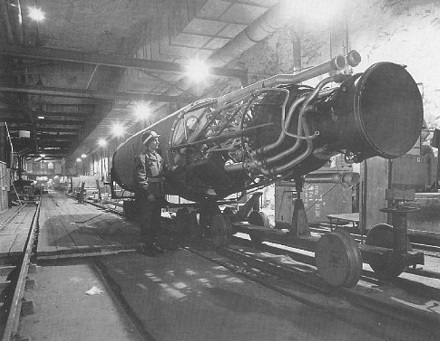
A U.S. Army soldier poses with a half-assembled V-2, one of about 250 such rockets found in the Mittelwerk labyrinth when the facility was captured.

With the facilities and the big brains in place, only one thing was missing: millions of man-hours of labor.

Nazi Germany had that in plentiful supply.

Beginning in late 1943, concentration camp inmates at Buchenwald began to be funneled out to a new facility, Mittelbau-Dora. Initially just a Buchenwald sub-camp, Dora grew over the course of 1944 into an immense facility holding 50,000 prisoners — a handful of German undesirables, but mostly captured foreign nationals: French, Dutch, Polish, Czech, and Russian. Short of food, sleep, and clothing for the 1944-1945 German winter, they were systematically worked to death in the Mittelwerk shafts to build a better bomb.

Our day’s principal, Hans Möser/Moeser (English Wikipedia entry | German) was an SS-Obersturmführer who made a living throughout the war years pulling guard detail in a number of concentration camps.

On May 1, 1944, Möser was transferred from Auschwitz to Mittelbau-Dora. It was the last job he would ever hold, but were Möser on the market today his C.V. would laud his team-player orientation and project management skills on a high-priority initiative. No doubt he was just the sort of reliable agent who understands how things are done that the world’s mad bombers need at their back.

“Ninety percent of the prisoners lived and worked in the tunnel of the mine,” testified one German who worked at Dora as a secretary and doctor’s aide.

As a result of the uninterrupted work in the mines and the absence of any installation for forced draft and ventilation, there prevailed a stuffy cold atmosphere, which made breathing difficult. The prisoners also slept in the subterranean tunnel in big chambers hewed out of the rocks, in five beds on top of each other. Already in 1944 3,500 prisoners used to sleep in such a room. In the tunnel of the mine there was no ater, the prisoners got absolutely insufficient quantities of tea for drinking purposes. But for weeks they were not able to wash themselves. As a result of the heavy work in the mines and of the bad food numerous prisoners died from exhaustion during their work.

According to that same testimony, the camp received a frightful order on Good Friday, which fell on March 30 in 1945: drive every last prisoner into those tunnels and bring down the caves around them. “No prisoner should be allowed to fall into Allied hands alive.”

The speedy arrival of the American 3rd Armored Division and 104th Infantry Division just days later prevented that order from taking effect.

The facilities themselves, too, were to be destroyed as part of Hitler’s scorched-earth “Nero Decree” intended to deny the benefit of German industry and infrastructure to the arriving conquerors. But Hitler’s War Production Minister Albert Speer was intentionally ignoring that order, a decision that might well have helped him avoid hanging at the Nuremberg trials.

Mittelwerk was a valuable capture indeed for the Allies. The Americans who first occupied it, and then the Russians who took it over a few months later, ransacked it for parts and technical specifications. The V-2 was the first man-made object to reach space, blasting at the speed of sound to the edge of orbit before plummeting back with its payload into the heart of London or wherever. It’s the ancestor of the long-range, intercontinental ballistic missiles that would come later, as well as the space programs of the countries who could build such missiles.

And of course, it wasn’t just the parts.

Wernher von Braun himself was the top prize of all — the young genius (he was just 33 when World War II ended) with the weapons of the future in his skull. As Germany collapsed in 1945, von Braun and his team of engineers had resolved to surrender themselves to the Americans rather than the Russians, but they too were subject to an order given the SS to execute the scientists if their capture appeared imminent. The Fuhrerbunker knew as well as the Allies how valuable this asset was.

In the event, von Braun managed to give himself up to a surprised American private. He disappeared into American custody, the crown jewel of “Operation Paperclip” that grabbed some 1,500 scientists from Germany and helpfully whitewashed their past misdeeds — misdeeds like Nazi party affiliation, and participating in slave labor camps.

Firing guided rockets into space was one thing. Unfortunately for our man Möser, his own skill set of bullying subordinates was not in short supply for either of the Cold War antagonists.

Möser was the one defendant (among 15) condemned to death at the resulting trial of Dora camp personnel. Rocket scientists, naturally, were not present for the occasion; Wernher von Braun and his team were hard at work at this time at Fort Bliss, Texas adapting the V-2 to the American Hermes program.

But at Dora, it had been Möser’s job to oversee camp discipline and labor strength for the slaves doing the grunt work manufacturing von Braun’s brainchild. Testimony convinced the court that the SS man had done this far too brutally, and perhaps with sadistic pleasure.

Several witnesses testified Möser frequently beat prisoners and participated in executions, often shooting at the men who were hanged for camp infractions — while they were hanging, or after they were taken off the gallows. (And of the latter, some already dead and some still alive.) “The accused told the twelfth witness that it was a pleasure to give the mercy shots, like shooting a deer.”

Möser for his part countered that he took no joy himself in the beatings and killings that he had to conduct as part of his job — and that the camp commandant had early on reprimanded him for leniency, threatening that “in view of the importance of the V-weapons operation, this could be interpreted as sabotage because it reduced the work efficiency.” How’s that for a hostile work environment?

(There’s a large .pdf of the entire trial summary here. Möser’s section begins on page 36 of the pdf (page 68 per the numbering in the scanned book pages).)

His presence on this here site betrays the outcome. On this date in 1948, Hans Möser was hanged at Landsberg Prison along with several other (unrelated) convicted war criminals.

On this day..

1780: John Gamble, anti-Wilmot

On this date in 1780, three men were executed in London — John Gamble was hanged at Bethnal-Green, Samuel Solomons in Whitechapel, and James Jackson in the Old-Bailey — for that summer’s working-class Gordon Riots.

These three all died for pulling down houses during the riots. Our focus today is on Mr. Gamble, who helped haul down the house of Justice David Wilmot, Esq.

Crying “Let’s go to Justice Wilmot’s!” rioters on the east end of London that night of June 7 headed straight for the residence of their notorious foe, a magistrate who had made himself infamous in workers’ eyes by his zeal to bring working-class economic resistance to heel.

Gamble, a hard-drinking journeyman cabinet-maker, was among the pillagers, and by dint of recognition was designated to pay the penalty for it.

“There might be a thousand” people who mobbed the Wilmot house, one witness at Gamble’s trial estimated. “When I left the place they were pulling down the house. They had thrown down part of the lead, and were throwing down the rest.”

This one was among three witnesses who testified to seeing Gamble on the scene, hauling out wood for a merry bonfire and “chuck[ing] tiles off two or three times” from the roof.

The penniless artisan defended himself as well as he could, cross-examining witnesses in an attempt to show conflicting reports of his dress that night. He himself claimed to have simply been out for a walk while drunk. Evidently it made a favorable impression on many in the courtroom.

“The prisoner being but a lodger had no friend to appear for him, nor any counsel; he was too poor,” reported the Gazetteer and New Daily Advertiser (July 6, 1780). “It was hoped by many, as he was a very hard-working, ignorant man, that he would have been recommended to mercy, and several of the Jury were certainly for it, but others, with the Foreman, seemed to be of a different opinion.”

London authorities were all about making a point with these Gordon Riots cases, and Gamble’s execution was arranged on a “gallows at Bethnal-green … fixed immediately opposite to Justice Wilmot’s house.” That’s as per the General Evening Post, July 20, 1780 – July 22, 1780, which affords us this affecting description of the actual hanging:

the Ordinary got up into the cart, and prayed with him upwards of 20 minutes, in which he joined with the greatest devotion; he was then tied up, and his brother and another friend got up into the cart, and took an everlasting farewell, and kissing each other, they retired. Here the prisoner desired the Ordinary to pray some minutes longer with him, which he readily complied with; having finished, and gone to his coach, the executioner pulled his cap over his face, and at the request of the prisoner a handkerchief was tied over his cap. He put his hands together, and lifting them towards Heaven, cried out “Lord Jesus receive me,” when the cart drew away, and he was launched into eternity about half past eight o’clock, amidst a numerous crowd of spectators. After hanging upwards of an hour his body was cut down, and delivered for interment. The prisoner was about 36 years of age, a cabinet-maker, and has left a wife and three children. ‘Twas observed, that all the time he was under the gallows, he never but once turned his face towards Mr. Wilmot’s house. His time was taken up so much in prayer, that he made no speech to the populace of any kind.

Just as Gamble was turned off, two pick-pockets, dressed tolerably decent, were detected, and delivered over to the custody of the civil officers.

(After this ceremonial procession-to-hanging-site, the penal party returned to Newgate to repeat the same with Samuel Solomons, then returned to Newgate again to repeat it with James Jackson. Additional executions for other pullers-down of houses took place around London on both July 21 and July 22.)

On this day..

1740: Elizabeth and Mary Branch, tyrannical mistresses

From the Newgate Calendar:

These cruel women were born at Philips Norton, in Somersetshire. The mother was distinguished from her childhood by the cruelty of her disposition. She married a farmer, named Branch, but the husband soon found what an unfortunate choice he had made; for his wife no sooner came into possession of her matrimonial power than she began to exercise her tyranny on her servants, whom she treated with undeserved and unaccountable cruelty, frequently denying them the common necessaries of life, and sometimes turning them out of doors at night in the midst of winter; but their wages in these cases were sent them by Mr Branch, who was as remarkable for his humanity and justice as his wife for the opposite qualities. Mary Branch, the daughter, was an exact resemblance of her mother in every part of her diabolical temper.

Mr Branch dying, and leaving an estate of about three hundred pounds a year, he was no sooner buried than all the servants quitted the family, determined not to live with so tyrannical a mistress; and her character became so notorious that she could obtain no servants but poor creatures who were put out by the parish, or casual vagrants who strolled the country.

It is needless to mention the particulars of the cruelties of this inhuman mother and daughter to their other servants, at whom they used to throw plates, knives and forks on any offence, real or supposed; we shall therefore proceed to an account of their trial and execution for the murder of Jane Buttersworth, a poor girl, who had been placed with them by the parish officers.

At the assizes held at Taunton, in Somersetshire, in March, 1740, Elizabeth Branch and Mary, her daughter, were indicted for the wilful murder of Jane Buttersworth; when the principal evidence against them was in substance as follows: Ann Somers, the dairymaid, deposed that the deceased, having been sent for some yeast, and staying longer than was necessary, excused herself to her old mistress on her return by telling a lie; on which the daughter struck her violently on the head with her fist, and pinched her ears. Then both of them threw her on the ground, and the daughter knelt on her neck, while the mother whipped her with twigs till the blood ran on the ground, and the daughter, taking off one of the girl’s shoes, beat her with it in a cruel manner. The deceased cried for mercy, and after some struggle ran into the parlour, where they followed her and beat her with broomsticks till she fell down senseless; after which the daughter threw a pail of water on her, and used her with other circumstances of cruelty too gross to mention. Somers now went out to milk her cows, and on her return, at the expiration of half-an-hour, found her mistress sitting by the fire and the girl lying dead on the floor; but she observed that a clean cap had been put on her head since she went out, and that the blood had run through it. At night the body was privately buried.

This transaction, added to the character of the mistress, having raised a suspicion in the neighbourhood, a warrant was issued by the coroner to take up the body, and an inquest being made into the cause of the girl’s death, Mr Salmon, a surgeon, declared that she had received several wounds, almost any one of which would have proved mortal. The jury found both prisoners guilty, and they were sentenced to die. As the country people were violently enraged against them, they were conducted to the place of execution between three and four in the morning, attended only by the jailer and about half-a-dozen people, lest they should have been torn in pieces.

When they came to the spot, it was found that the gibbet had been cut down; on which a carpenter was sent for, who immediately put up another, and mother and daughter were executed before six o’clock, to the disappointment of the country to witness the death of two such unworthy wretches.

On this day..

1522: Vicent Peris, of the Revolt of the Brotherhood

On this date in 1522, the leader of the Revolt of the Brotherhood came to his grief in Valencia.

Spain circa 1519-1520 was a powder keg. The rival kingdoms Aragon and Castille had of late been joined by a personal union of Ferdinand and Isabella, but now that couple was several years dead, and the scepter held by an irritating Flemish youth who had just popped in to hike everyone’s taxes so he could fund the bribe campaign necessary to become the Holy Roman Emperor Charles V.

These tensions triggered the Revolt of the Comuneros in Castile, whose consequent executions we have already dealt with; in Aragon, they launched the Revolt of the Brotherhoods. The “brotherhoods” in question were the germanias, urban artisan guilds. Those guilds stepped into a power vaccuum in Valencia when a 1519 plague triggered anti-Moslem riots and sent the nobles scurrying for the safety of their country estates. (Charles was busy in Germany being crowned Holy Roman Emperor.)

This was more than fine by the salty Valencia townsfolk, who much detested the overweening aristocracy.

[G]entlemen (caballeros) were regarded with the greatest hostility by the masses of the people. Argensola and Sandoval relate a story which places this hostility in a conspicuous light. One day, as a gentleman passed through a certain street, a woman called upon her son to look at him, and mark his appearance carefully. The child inquired the reason. The mother replied, “In order that when you become a man you may be able to say that you had seen a gentleman; for long before that time the whole race shall have disappeared, and been as completedly destroyed as the Templars were. (Source)

A “Council of Thirteen” — one representative from each of Valencia’s principal guilds — took over the city’s government.


La pau de les Germanies (The Peace of the Germanias) by Marcelino de Unceta.

Vicente Peris (English Wikipedia entry | Spanish), a firebrand weaver, soon came to be the first among this leading baker’s dozen. He enjoyed some military successes in 1521, and took advantage of them wherever possible to impose forced conversions, property expropriation, or summary execution on any Muslims he could lay hands upon.

No surprise but this alarming situation drove the hated caballeros into organized counterattack, just as the Valencian factions started breaking apart over how far to push the revolution. After they were thrashed at the Battle of Oriola in August 1521, they didn’t have to worry about that question any more.

Peris was caught slipping back into now-royalist-controlled Valencia on February 18, 1522, apparently hoping to stir up his old comrades in arms once more, and caught only after a running street battle that night that ended with him being smoked out of his house as it was burned around him.

As addenda to his execution this date, that house was entirely razed and the ground salted over, with a decree that nothing should ever be built there again. Peris’s descendants were anathematized as traitors to the fourth generation.

* The island of Mallorca followed Valencia’s lead in revolt, and by 1523, followed its unhappy fate as well.

On this day..

2013: Rizana Nafeek, Sri Lankan maid

A year ago today, a blindfolded, white-clad Rizana Nafeek had her head chopped off in public in Dawadmy, near the Saudi capital of Riyadh.

Rizana Nafeek, a Sri Lankan, was among the numerous foreign laborers routinely imported to Saudi Arabia for domestic work. There are an estimated 1.5 million migrant domestic workers in Saudi Arabia from South Asia (especially Sri Lanka), Nepal, Indonesia, East Africa, and the Philippines. Most are employed via the kafala (“sponsorship”) system that places their host in an almost lord-like position of authority.

Such workers are excluded from Saudi Arabia’s labor protections, and as a result stand vulnerable to horrifying abuse.* Household heads often confiscate these workers’ passports, and in some cases have subjected their domestic employees to rape, beatings, wage confiscation, and work weeks of 100-plus hours. One Sri Lankan woman had nails driven into her hands when she complained about overwork.

Rizana Nafeek hardly had time to find out whether any of these perquisites were in store for her. Not long after she arrived in Saudi Arabia in 2005 hoping to make enough money as a domestic drudge to move her impoverished family into a house, she had bottle-feeding duties for her host family’s infant foisted upon her. Nafeek had no training in caring for infants.

In May 2005, that child began choking while in Rizana’s care, and her panicked shouts summoned the mother. By the time the mother arrived, the infant had fallen unconscious, and the upset family immediately handed over their maid to the police, accusing her of strangling the baby.

This was the victim for whom Nafeek was decapitated, and also perhaps an illustration of tunnel vision in law enforcement. It’s quite doubtful whether there was ever any objective basis for supposing a homicide, but the fact that this was the color the family gave to events in the horror of the moment set in motion all the ensuing events.

During the investigation leading up to her 2007 trial and condemnation, Nafeek confessed to smothering the child — but she would later claim this confession was tortured out of her, and that the baby simply started choking on its bottle. (There was never a post-mortem on the dead baby.)

Opaque as the Saudi Arabian criminal justice system is, it’s got ample reputation for obtaining confessions by violence, and for mistreating migrant workers. And the accused had scant legal representation and no translator when she was tried for her life in a Saudi court.

After her conviction, it would also emerge that, order to land her the gig, Nafeek’s Sri Lankan recruiting agency falsified her papers to bump her age up past the legal minimum of 21. Rizana Nafeek arrived in Saudi Arabia carrying a passport that said she was born in 1982, making her 23 years old when she committed the supposed murder … but her birth certificate said that she was born in 1988, and was still a minor when the “murder” took place.

As an international clemency push developed for the potentially-innocent underaged migrant worker, the Saudi government strongly rejected its critics’ charges.

Noting that the dead infant’s family refused repeated blandishments of “blood money” to exercise its right to grant clemency, Riyadh officially “deplore[d] the statements made” by Rizana’s supporters “over the execution of a Sri Lankan maid who had plotted and killed an infant by suffocating him to death, one week after she arrived in the kingdom.”

More sympathetic Saudis, undoubtedly meaning well, offered Rizana Nafeek’s family cash compensation after the young woman was beheaded. That money, too, was angrily refused.

“I will not accept any gifts from the Saudis or the Saudi government which murdered my daughter,” mother Saiyadu Farina told a Sri Lankan newspaper. That anger was widely shared in Sri Lanka; Colombo even recalled its Saudi ambassador in protest.

That’s as may be, but money is sure to carry the argument at the end of the day. Wage remittances by overseas laborers are a massive boon to the island nation, amounting to $6.3 billion in 2012 — 8.8% of the Sri Lankan economy. And Saudi Arabia remains the single largest employer (pdf) of Sri Lankans abroad.

As of the time of Rizana Nafeek’s execution, at least 45 other foreign domestics, most of them Indonesians, were also awaiting execution on Saudi Arabia’s death row.

* Ill treatment of migrant domestic workers is a phenomenon elsewhere in the Middle East, and elsewhere around the world.

On this day..

1922: Taffy Long, Herbert Hull, and David Lewis, Rand rebels

RAND MINING RECOVERY.

LOWER WORKING COSTS.

(From our correspondent.)

JOHANNESBURG, Oct. 28. The Rand Daily Mail, in an article dealing with the economic situation of the Union, gives striking figures illustrating the steady advance of the gold industry on the march towards prosperity.

Profits for the July-September quarter show an increase of £1,136,000 over the previous quarter. This has been accomplihed not only by lowering wages, but by all-round improvement in efficiency per unit, mining costs having fallen from 25s. 8d. in 1921 to 20s. 5d. in September, 1922 …

[T]he Rand Daily Mail says that these facts “represent unmistakable omens of coming prosperity which should steel the downhearted farmer to greater effort and encourage the suffering industrialist throughout the Union, and transform the pessimism of the merchant into healthy confident and hope.” (London Times, Oct. 30, 1922)


THREE RAND EXECUTIONS.

ANTI-GOVERNMENT RIOT.

(From our correspondent.)

JOHANNESBURG, Nov. 17. The bitterest feeling prevails among the workers over the refusal to reprieve the three men, Long, Hull, and Lewis, who were condemned to death for murder in connexion with the Rand revolt, and were executed at Pretoria to-day.

Appeals for mercy poured in till almost the last moment, and an open-air mass meeting was held, in which prominent Communists took part. At this meeting angry and threatening speeches were made; the names of General Smuts and Sir Lionel Phillips were boohed, and the crowd attempted to break into the Town Hall, severely injured a detective, and was finally dispersed by armed police. The public generally approves the Government’s firmness. The condemned men sang the Red Flag on the scaffold. (London Times, Nov. 18, 1922)


“Come dungeons dark or gallows grim the sun will be our parting hymn.”

FUNERAL OF RAND MURDERERS.

COMMUNIST APPEAL TO CHILDREN.

(From our correspondent.)

JOHANNESBURG, Nov. 19. Remarkable scenes recalling the funeral of the victims of the great strike of 1913 were witnessed at the burial of the remains of Long, Lewis, and Hull, who were executed on Friday. The coffins, in separate hearses, were followed by thousands of workers, with banners and regalia, representing every trade union. “The Red Flag” was sung at the graveside and addresses were delivered, in which members of Parliament, of the Provincial Council, and Town Councils participated.

The latest development of Communist propaganda in Johannesburg is the distribution broadcast among children and students as they are leaving their schools and colleges of a pamphlet denouncing as “legalized murder and a blot on history” the execution of the men convicted of murder at special treason courts. (London Times, Nov. 20, 1922)

On this day..