1660: Major-General Thomas Harrison, the first of the regicides

On this date in 1660, the restored House of Stuart began a week of bloody justice against Charles I‘s regicides by hanging, drawing and quartering Thomas Harrison at Charing Cross.

Stuart Little

Charles’ son and heir Charles II had been stuck on the continent during the 1650’s, until the Commonwealth came apart from its own internal contradictions after the death of Oliver Cromwell.

With anarchy looming, suddenly monarchy didn’t look so bad — and Charles II had a way back into the saddle.

Beheads I Win …

The first thing on everyone’s mind was what to do about the little matter of having lopped off his dad’s head.

Political reality drove the settlement: nearly everyone in the English gentry had in some manner acquiesced to the Commonwealth during its decade-plus turn steering the ship of state; an expansive line on treason would be a nonstarter. At the same time, His Soon-To-Be-Royal-Again Majesty expected a few examples made to do right by the old man and keep king-killing well off his future subjects’ agenda.

Result: the Indemnity and Oblivion Act, granting a free pardon to all supporters of the Commonwealth save a handful of those most directly implicated in Charles I’s execution.

Weeks of frantic negotiating between the parties and private settlements of borderline cases with the royalist camp preceded the action. But Thomas Harrison wasn’t part of any of it.

… Entrails you Lose.

The rigid Puritan, one of 59 who signed the last king’s death warrant and at one time the commander of England’s armies, had been on the outs with everyone since Cromwell set up the Protectorate in 1653. Godly Tom was a “Fifth Monarchist,” anticipating the imminent return of Christ perhaps in conjunction with the imminent year 1666 … and no government felt safe about these millenarians. He’d been imprisoned several times by the Protectorate, too.

Though many attainted regicides fled for Europe or America, Harrison (possibly motivated by age and infirmity) hung out, waited for arrest, and took his punishment stolidly.

God hath covered my head many times in the day of Battle. By God I have leaped over a wall, by God I have runned through a Troop, and by my God I will go through this death.

Specifically meaning, drawn on a hurdle from Newgate to Charing Cross (with a fine vantage for the doomed on Whitehall, where Charles I had met his end), hanged but revived, his genitalia cut off and bowels carved out and burned while still conscious, and finally beheaded and his body divided into quarters for gruesome public display around town.

You have selected regicide.

Harrison died on a Saturday, and his was the opening act of a busy week in the bowel-burning business; nine other fellow regicides condemned with him would share that fate during the week ahead:

  • John Carew, on Monday the 15th;
  • John Cook and Hugh Peters, on Tuesday the 16th;
  • Thomas Scot, Gregory Clemen, Adrian Scroop and John Jones, on Wednesday the 17th;
  • Francis Hacker and Daniel Axtel, on Friday the 19th.

Harrison was chosen as the first partly, perhaps, because the Fifth Monarchists were (justifiably) considered a still-extant menace, and partly because, as one account had it,

[h]e was a fierce and bloody enthusiast. And it was believed, that, while the army was in doubt, whether it was fitter to kill the king privately, or to bring him to an open trial, that he offered, if a private way was settled on, to be the man that should do it. So he was begun with. But, however reasonable this might be in itself, it had a very ill effect: for he was a man of great heat and resolution, fixed in his principles, and so persuaded of them, that he never looked after any interests of his own, but had opposed Cromwell when he set up for himself. He went through all the indignities and severities of his execution, in which the letter of the law in cases of treason was punctually observed, with a calmness or rather a cheerfulness that astonished the spectators.

“As cheerful as any man could do in that condition”

And this coda is attested by the age’s famous diarist, Samuel Pepys, whose neat and oft-quoted summation of Harrison’s fate runs thus:

I went out to Charing Cross, to see Major-General Harrison hanged, drawn, and quartered; which was done there, he looking as cheerful as any man could do in that condition … Thus it was my chance to see the King beheaded at White Hall, and to see the first blood shed in revenge for the blood of the King at Charing Cross.

Who overcomes by force hath overcome but half his foe

As might be expected, vindicated royalists sought more blood than the handful of exemplars could furnish. What compromise could expiate the sin of regicide?

Poet and polemicist John Milton, having been propagandist-in-chief for the now-abortive revolution, endured the jeers of his enemies for the conspicuously apolitical stuff (a grammar book!) by which he would set his table in the years ahead.

Upon John Milton’s not suffering for his traiterous Book when the Tryers were executed, 1660.

That thou escaped’st that vengeance, which o’ertook,
Milton, thy regicides, and thy own book,
Was clemency in Charles beyond compare:
And yet thy doom doth prove more grievous far.
Old, sickly, poor, stark blind, thou writest for bread:
So for to live thoud’st call Salmasius from the dead.

(Claudius Salmasius was a French intellectual whose defense of the Stuart royal rights had been savaged by Milton during the Protectorate.)

It’s thanks to the Indemnity and Oblivion Act’s not sending Milton the way of General Harrison that we have Paradise Lost.

On this day..

1652: Captain James Hind, royalist highwayman

On this date in 1652, James Hind, a highwayman who preyed on Roundheads, was drawn and quartered for treason.

Famed throughout the realm for his dashing heists on the roads, Hind was the subject of no less than 16 printed pamphlets of the nascent popular press in the early 1650’s, which magnified brigand’s feats, oratory and persona into a sort of populist Cavalier superhero: Marvel Comics for the woodcut age.

The highlights of Hind’s adventures receive rapturous attention from the Newgate Chronicles:

  • Setting upon Oliver Cromwell shortly after the execution of Charles I, his partner Thomas Allen being taken in the affray;
  • An amusing duel of Biblical citations while robbing regicide Hugh Peters, resolved in the characteristic manner of such impasses by reference to which disputant holds the gun.

    “Pray, sir, make no reflections on my profession; for Solomon plainly says, ‘Do not despise a thief’; but it is to little purpose for us to dispute. The substance of what I have to say is this: deliver thy money presently, or else I shall send thee out of the world to thy master in an instant.”

  • Any number of pleasing episodes with lesser personages suitable for the gallant highwayman — ladies charmed but un-pillaged, paupers subsidized, and always, wicked Parliamentarians chastened. Several excellent Hind anecdotes are gathered by Gillian Spraggs here.

As to the veracity of this stuff, the Captain himself suggests a pinch of caution.

A Gentleman or two, desired so much favour of [the gaoler], as to aske Mr. Hind a civil question; which was granted. So pulling two books out of his pocket, the one entituled, Hind’s Ramble, The other Hind’s Exploits, asked him whether he had ever seen them or not: He answered, yes; And said upon the word of a Christian, they were fictions: But some merry Pranks and Revels I have plaid, that I deny not.

But Hind’s adherence to the Stuart cause was real enough, or at any rate something he had the 17th century media savvy to play up. At his execution, he professed pleasure in having targeted Roundheads for most of his crimes, and it was not theft that saw him to the scaffold, but treason. He made free royalist talk upon his arrest, proposing a toast to the exiled king that otherwise sympathetic guests were too cautious to take up.

Hind fits symbolically into the tradition of the romantic outlaw of Robin Hood stock, and anticipates the 18th century rogues’ gallery of noble brigands fighting a doomed rearguard against capitalism. Hind’s acts, criminal by any standard, are justified by the illegitimacy of the society he preys upon; he embodies at once a social and political rejection of the nascent mercantile England, and a biographical realization of its actuating mythos — personal aptitude and acquisition,* with a cover story for why his victims had it coming.

Neither did I ever wrong any poor man of the worth of a penny: but I must confess, I have (when I have been necessitated thereto) made bold with a rich Bompkin, or a lying Lawyer, whose full-fed fees from the rich Farmer, doth too too much impoverish the poor cottage-keeper: And truly I could wish, that thing were as little used in England amongst Lawyers, as the eating of Swines-flesh was amongst the Jews.

A dead-end position — just like James Hind himself.

* In a supposed rhapsody over gold forced from the hand of John Bradshaw — yet another regicide; Hind seemingly met them at every turn — our robber rather has his cake and eats it too in extolling and condemning lucre.

Ay, marry, sir, this is the metal that wins my heart for ever. Oh! precious gold, I admire thee as much as Bradshaw, Prynne or other such villains, who would for the sake of it sell our Redeemer again, were He now upon earth.

On this day..

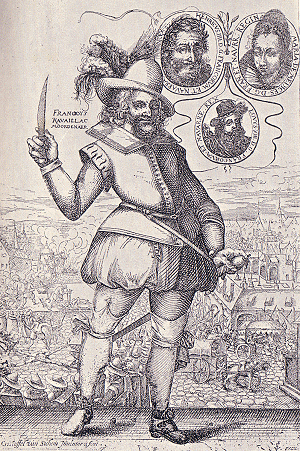
1610: Francois Ravaillac, because Paris was worth more than a mass

On this date in 1610, the fanatical Catholic who assassinated Henri IV of France was ripped apart on the Place de Greve.

The road to this man’s calvary begins long before his infamous crime, even long before the birth of his illustrious victim.

The Protestant Reformation — so richly represented in the executioner’s annals — had fractured France in the 16th century.

After decades of voluptuously indecisive Catholic-versus-Hugeunot slaughter, matters had finally been settled by the man upon whom French absolutism would erect its (ill-fated) edifice.

Henri IV, the first Bourbon monarch and a Huguenot, had unified the country by the sword, capped by his memorably politic conversion to Catholicism in 1593 to win over the holdout capital of Paris — the occasion of his understated declaration that “Paris is worth a mass”.

Let us tarry here to appreciate “the good king Henri” in a kaleidoscope of flattering artwork to the tune of Vive Henri IV, the monarchy’s unofficial anthem after its subject’s passing:

Did you catch that last image?

Henri’s fine gesture of sectarian triangulation and the reign of relative calm it inaugurated were naturally resented by godly partisans of both camps who either considered his conversion a betrayal or considered the king a closet Protestant.

At the crazed end of this latter spectrum, we meet our day’s principal, Francois Ravaillac.

Readers unconstrained by time may enjoy this Tolstoyan trek into the regicide’s mind and milieu, but it will suffice us to say that the modern shotgun-wielding postal clerk who just seemed like a quiet, harmless type to all his coworkers might like the cut of Ravaillac’s jib. A bit of a loner, a bit of a professional washout, with a penchant for religious visions and a passel of ill-arranged grievances … by this point in the movie, that’s about what you expect the police profiler to be reciting.*

It is only right that such a contemporary-sounding lone nut story ought to have a vigorous conspiratorial counternarrative.

There has always been a strong suspicion that behind Ravaillac’s hand was the work of the scheming Catholic Duc d’Epernon, perhaps even with the complicity of Henri’s wife Marie de’ Medici, who had conveniently been crowned as queen the day before the murder** and promptly teamed up with Epernon to cement an alliance with a traditional French rival, the ultra-Catholic Habsburgs.

Balzac, for one, had no doubt about it:

all of [her] actions were prejudicial to France … Marie de’ Medici wasted the wealth amassed by Henri IV.; she never purged herself of the charge of having known of the king’s assassination; her ‘intimate’ was d’Epernon, who did not ward off Ravaillac’s blow, and who was proved to have known the murderer personally for a long time. … [T]he victory Richelieu at last won over her (on the Day of the Dupes) was due solely to the discovery the cardinal made, and imparted to Louis XIII, of secret documents relating to the death of Henri IV.

The historical jury is out on that question, presumably for good.

If Ravaillac was a conspirator, he proved to be a damned good one, denying under repeated torture that he had any accomplices. On this date, the tortures reached their crescendo and conclusion — to the horrible delight of the Parisian mob, as reported by Alistair Horne (via The Corner):

On 27 May, still protesting that he had acted as a free agent on a divinely inspired mission, Ravaillac was put to death. Before being drawn and quartered, the lot of the regicide, on the Place de Grève scaffold he was scalded with burning sulphur, molten lead and boiling oil and resin, his flesh then torn by pincers. Then his arms and legs were attached to horses which pulled in opposite directions. One of the horses “foundered,” so a zealous chevalier offered his mount; “the animal was full of vigour and pulled away a thigh.” After an hour and a half of this horrendous cruelty, Ravaillac died, as the mob tried to prevent him receiving last rites. When he finally expired,

“…the entire populace, no matter what their rank, hurled themselves on the body with their swords, knives, sticks or anything else to hand and began beating, hacking and tearing at it. They snatched the limbs from the executioner, savagely chopping them up and dragging the pieces through the streets.”

Children made a bonfire and flung remains of Ravaillac’s body on it. According to one witness, Nicholas Pasquier, one woman actually ate some of the flesh. The executioner, supposed to have the body of the regicide reduced to ashes to complete the ritual demanded by the law, could find nothing but his shirt.

Ravaillac was the last Frenchman drawn and quartered for a century and a half — but his punishment as a regicide formed the precedent for that handed down in 1757 to Damiens.

* No need, though, as Francois wasn’t hard to catch: he stepped up to Henri’s carriage when it was caught in a traffic jam on May 14, 1610, and stabbed the king to death plain as can be. He was lucky (sort of) to avoid a lynching.

** Rubens later painted a gaudy celebration of this event.

On this day..

1649: Charles I

On this date in 1649, the struggle between parliament and crown cost the Stuart monarch Charles I his head.

Charles‘ political clumsiness and unreconstructed authoritarianism had seen the realm whose unitary sovereignty he insisted upon blunder from disaster to disaster: into bankruptcy, military defeat, religious conflict and the English Civil War.

The assignation of cause and consequence in that war’s genesis has much exercised historians.

What is beyond dispute is that the confrontation between monarch and subject, pitting against each other political and economic epochs, theories of state and power, rates as one of history’s most captivating courtroom dramas.

Charles refused to answer the court’s charge of treason, occasioned most particularly by the king’s fomenting the Second Civil War while already a defeated prisoner of parliament following the first Civil War. He rested firmly on royal prerogatives against what some interlocutors take to be an almost desperate plea by his judges for some hint of acknowledgment that could open the door to compromise:

[A] King cannot be tried by any superior jurisdiction on earth. But it is not my case alone — it is the freedom and the liberty of the people of England. And do you pretend what you will, I stand more for their liberties — for if the power without law may make laws, may alter the fundamental laws of the kingdom, I do not know what subject he is in England that can be sure of his life or anything that he calls his own. Therefore, when that I came here I did expect particular reasons to know by what law, what authority, you did proceed against me here.

It must be borne in mind that the trial of a king was a completely unprecedented event. Charles might be forgiven his attitude, even if it smacked of the impolitic high-handedness that had forced this deadly test of powers.

Parliament’s position — here in the words of its President — is distinctly in the stream of political discourse (if not always actual practice) ascendant in the West to this day.

Sir, as the law is your superior, so truly, sir, there is something that is superior to the law and that is indeed the parent or author of the law — and that is the people of England.

And therefore, sir, for this breach of trust when you are called to account, you are called to account by your superiors — “when a king is summoned to judgment by the people, the lesser is summoned by the greater.”

The modern and the medieval, facing each other at the bar.


A fragment from a World War II bomb-damaged and only-recently-rediscovered Hippolyte Delaroche painting situating Charles in the Christlike pose of enduring the mockery of his captors.

Charles played his lordly disdain to the end, refusing to admit parliament’s jurisdiction by making any sort of plea.

The line between heroic defiance and pig-headed obstinacy being very much in the eye of the beholder, the confrontation is typically played straight-up for its arresting clash of principles — as in the 1970 biopic Cromwell, with Alec Guinness as the monarch:Probably more troubling for the parliamentary party than the regicide taboo was consideration that the execution would transfer royalist loyalties from a man safely imprisoned to an heir beyond their power, who could be expected to (as in fact he did) resume the civil war.

Competing philosophies expounded for the competing interests; the dispute involved the era’s intellectual titans, in conflict over the most fundamental concepts of the state. Thomas Hobbes wrote his magnum opus The Leviathan as a royalist exile in Paris, and its abhorrence for rebellion and divided sovereignty unmistakably reflects the English Civil War experience. John Milton earned his bread as a republican polemicist; his poetic celebration of Satan’s failed rebellion in Paradise Lost, written after the Stuart restoration, can be read as a political critique.

Separated at the block? Charles I and Hobbes’ Leviathan

It’s conventionally thought that the beheading was conducted by a radical minority, though that supposition is debatable, colored as it is by the ultimate restoration of the crown. But although England would have a king again, the weight of political authority would steadily, permanently, gravitate towards parliament, organ of the merchant classes who would steer England henceforward.

Did it have the right? Two implacable powers each claimed an indivisible object; “between equal rights, force decides.” So on this cold winter’s afternoon — Charles wore thick undergarments, so he would not shiver with the appearance of fright — the deposed king was marched to a scaffold erected at Whitehall. He gave a short final address, with the famous words for his principle of martyrdom — “a sovereign and a subject are clean different things” — then laid his head on a low block, where a masked executioner (never definitively identified) cleanly chopped it off.

After the monarchy’s restoration, Charles was canonized as a saint by the Church of England: he’s still the last person so venerated, an odd salute to a mortal career of unalloyed arrogance and incompetence. Observance of the cult was toned down in the 19th century, although a Society of King Charles the Martyr dedicated to its preservation still exists; monarchists of a more secular inclination also continue to mark his martyrdom on this anniversary.

Less reverent by far was Monty Python’s homage:

“The most interesting thing about King Charles the First is that he was five foot six inches tall at the start of his reign, but only four foot eight inches tall at the end of it.”

Part of the Themed Set: The English Reformation.

On this day..