1776: Neptune, as witnessed by John Gabriel Stedman

On or around this date in 1776,* a couple of blacks in Suriname (both slave and free) were executed for unrelated crimes … notably a free man named Neptune whose coolness under horrific torture is related by John Gabriel Stedman in The Narrative of a Five Years Expedition against the Revolted Negroes of Surinam.

Dutch-born and of Scottish descent, Stedman was a soldier who volunteered to serve in the West Indies and found himself in Suriname fighting those “revolted negroes” — Maroons fled from slavery who had established independent communities and episodically (most of the 1770s were one such episode) fought the white colonies.

Maroon settlements in Suriname still pesist to this day.

Though that was Stedman’s business on the Caribbean coast of South America, the culprits whose deaths he witnessed today were not among the “revolted”, but more prosaic criminal fare. Prosaic, that is, until Neptune’s insouciantly comedic discourse in the midst of the most appalling torture.

Stedman sets the scene for us with the more everyday depravities prevailing in the colonial capital, Paramaribo

If, as I have just mentioned, cruelties were become less common in the rivers by the rebels, barbarities still continued in a shocking degree in the metropolis; where my ears were deafened with the clang of the whip, and the shrieks of the negroes. Among the most eminent of these tyrants was a Miss Sp—n,who lived next door to Mr. de Graav, and who I saw with horror from my window give orders that a young black woman should be flogged principally across the breasts, at which she seemed to enjoy peculiar satisfaction. To dissipate the impression this scene had left on my mind, I got into a whiskey, and rode out; when the first thing I saw was a negro girl fall naked from a garret window on a heap of broken bottles: this was indeed an accident, but she was so mangled, though not dead, that she exhibited a spectacle nearly as wretched as the other.—Cursing my unlucky fate, I turned the horses, and drove to the beach, as the only place to avoid every scene of cruelty and misery; but here I had the mortification to see two Philadelphia sailors (while they were fighting on the forecastle of their vessel) both fall over the ship’s bow into the stream, where they sunk, and were no more seen. On board another American brig, I discovered a little tar defending himself from the cross-trees with a hatchet, against a serjeant and four armed men, for a considerable time; till they threatening to shoot him out of the rigging, he at last surrendered, and being brought ashore, was dragged to Fort Zelandia, in company with two others, by a file of musketeers, where, for having been drunk on duty, they received a fire-cant each, at the captain’s request; that is, they were bastinadoed or beaten on the shoulders by two corporals with bamboo canes, till their backs were black, and swelled like a cushion. However arbitrary this mode of correction, the captain endeavoured to explain the necessity of it; the private American sailors being of a turbulent spirit indeed when drunk, although when sober they may be fairly classed among the best seamen in the world.

But the narrator is just getting warmed up, and after a good night’s sleep …

Early the next morning, while musing on all the different dangers and chastisements to which the lower class of people are exposed, I heard a crowd pass under my window. Curiosity made me start up, dress in a hurry, and follow them: when I discovered three negroes in chains, surrounded by a guard, going to be executed in the savannah. Their undaunted look, however averse I may be to the sight of cruelties, so attracted my attention, as to determine me to see the result, which was thus:— The sentence being read in Low Dutch (which they did not understand) one was condemned to be flogged below the gallows, and his accomplice to have his head struck off with an axe, for having shot a slave who had come to steal plantains on the estate of his mistress. The truth however was, that this had been done by that lady’s absolute command; but the murder being discovered, she, in the hopes of saving her character, besides the expence of paying the penalties, gave up her valuable slave, and permitted the unhappy man to be thus sacrificed. He laid his head upon the block with great indifference, stretching out his neck; when, with one blow of the axe, it was severed from his body.

The third negro, whose name was Neptune, was no slave, but his own master, and a carpenter by trade; he was young and handsome, but having killed the overseer of the estate Altona, in the Para Creek, in consequence of some dispute, he justly forfeited his life. The particulars, however, are worth relating: This man having stolen a sheep, to entertain a favourite young woman, the overseer, who burnt with jealousy, had determined to see him hanged; to prevent which, the negro shot him dead among the sugar canes; for these offences of course he was sentenced to be broken alive upon the rack, without the benefit of the coup de grace or mercy-stroke. Informed of the dreadful sentence, he composedly laid himself down on his back on a strong cross, on which, with arms and legs expanded, he was fastened by ropes: the executioner, also a black man, having now with a hatchet chopped off his left hand, next took up a heavy iron bar, with which, by repeated blows, he broke his bones to shivers, till the marrow, blood, and splinters flew about the field; but the prisoner never uttered a groan nor a sigh. The ropes being next unlashed, I imagined him dead, and felt happy; till the magistrates stirring to depart, he writhed himself from the cross, when he fell on the grass, and damned them all, as a set of barbarous rascals; at the same time removing his right hand by the help of his” teeth, he rested his head on part of the timber, and asked the by-standers for a pipe of tobacco, which was infamously answered by kicking and spitting on him; till I, with some American seamen, thought proper to prevent it. He then begged that his head might be chopped off; but to no purpose. At last, seeing no end to his misery, he declared, “that though he had deserved death, he had “not expected to die so many deaths: however, (said he) you christians have missed your aim at last, and I now care not, were I to remain thus one month longer.” After which he sung two extempore songs (with a clear voice) the subjects of which were, to bid adieu to his living friends, and to acquaint his deceased relations that in a very little time he should be with them, to enjoy their company for ever in a better place. This done, he calmly entered into conversation with some gentlemen concerning his trial; relating every particular with uncommon tranquillity—”But,” said he abruptly, “by the sun it must be eight o’clock; and by any longer discourse I should be sorry to be the cause of your losing your breakfast.” Then, casting his eyes on a Jew, whose name was De Vries, “A-propos, sir,” said he, “won’t you please to pay me the ten shillings you owe me ?” — “For what to do ?” — “To buy meat and drink, to be sure—don’t you perceive I am to be kept alive?” Which speech, on seeing the Jew stare like a fool, this mangled wretch accompanied with a loud and hearty laugh. Next, observing the soldier that stood sentinel over him biting occasionally on a piece of dry bread, he asked him ” how it came to pass, that he, a white man, should have no meat to eat along with it ?” — ” Because I am not so rich,” answered the soldier. — “Then I will make you a present, sir,” said the negro; “first, pick my hand that was chopped off clean to the bones, next begin to devour my body, till you are glutted; when you will have both bread and meat, as best becomes you;” which piece of humour was followed by a second laugh; and thus he continued, until I left him, which was about three hours after the dreadful execution.

Wonderful it is indeed, that human nature should be able to endure so much torture, which assuredly could only be supported by a mixture of rage, contempt, pride, and the glory of braving his tormentors, from whom he was so soon to escape. [ here a footnote is marked in the original text, whose content is: “At Demerary, so late as October, 1789, thirty-two wretches were executed in three days, sixteen of whom suffered in the manner just described, with no less fortitude, and without uttering one single complaint.” -ed. ]

Though I never recal to my remembrance, without the most painful sensation, this horrid scene, which must revolt the feelings of all who have one spark of humanity, I cannot forbear exhibiting to the public the dreadful spectacle in the annexed drawing.


Detail view of William Blake‘s illustration of Neptune’s breaking on the rack. (Click for full image.)

If the reader, however, should be offended with this shocking exhibition, and my dwelling so long on this unpleasant subject, let it be some relief to his reflection, to consider this punishment not inflicted as a wanton and unprovoked act of cruelty, but as the extreme severity of the Surinam laws, on a desperate wretch, suffering as an example to others for complicated crimes; while at the same time it cannot but give me, and I hope many others, some consolation to reflect that the above barbarous mode of punishment was hitherto never put in practice in the British colonies.

I must now relate an incident, which, as it had a momentary effect on my imagination, might have had a lasting one on some who had not investigated the real cause of it, and which it gave me no small satisfaction to discover. About three in the afternoon, walking towards the place of execution, with my thoughts full of the affecting scene, and the image of the sufferer fresh in my mind, the first object I saw was his head at some distance, placed on a stake, nodding to me backwards and forwards, as if he had really been alive. I instantly stopped short, and seeing no person in the savannah, nor a breath of wind sufficient to move a leaf or a feather, I acknowledge that I was rivetted to the ground, where I stood without having the resolution of advancing one step for some time; till reflecting that I must be weak indeed not to approach this dead skull, and find out the wonderful phenomenon, if possible, I boldly walked up, and instantly discovered the natural cause, by the return of a vulture to the gallows, who perched upon it, as if he meant to dispute with me for this feast of carrion ; which bird, having already picked out one of the eyes, had fled at my first approach, and striking the skull with his talons, as he took his sudden flight, occasioned the motion already described. I shall now only add, that this poor wretch, after living near six hours, had been knocked on the head by the commiserating sentinel, the marks of whose musket were perfectly visible by a large open fracture in the skull.

Stedman’s work details a number of other atrocities against Suriname’s African (primarily slave) population, many of them powerfully illustrated by William Blake with near pornographic effect. These sorts of things were of ancient vintage in the realm.

The Narrative itself became both an important anti-slavery text, and an invaluable historical reference. (Where I have clipped the text, Stedman is about to segue into a discourse on the local vulture population, just the sort of detail that present-day researchers might have a hard time sourcing for 18th century Suriname.)

But even though contemporary abolitionists made use of the Narrative, Stedman’s 18th century publisher actually played down the author’s tone on the subject. A version much more overtly critical of slavery and the savage corporal punishments that upheld it has recently been published from the original manuscripts. (An abridged version of that original is also available.)

* Stedman’s narrative mingles chronological journal-style entries with general observations about his environs. The text is slightly ambiguous as to the date, but the chapter in question begins by situating the action on Aug. 12, digresses into a description of the regional landscape, then returns to the narrative where this blog entry picks it up. It’s not completely explicit that the metropolitan atrocities he witnesses also occur on the 12th, but the text invites that inference — with the execution taking place the next morning after.

The next date explicitly named is Aug. 24, the birthday of the Prince of Orange, so if Neptune did not die on Aug. 13, it was within only a very few days after.

On this day..

1795: Pomp, a Negro

On this date in 1795, an African-American near-slave (slavery’s official 1783 abolition in the state seems not to have constituted a completely bright line) was hanged in Ipswich, Mass. for murdering his master-slash-employer.

Thanks to Laura James at CLEWS, we are drawn to this story reproduced here at the University of North Carolina-Chapel Hill’s Documenting the American South site. Pomp was perhaps mentally “touched”; he was certainly physically “touched” for any perceived inadequacy at his labors, and eventually chopped off his master’s head while the latter slept beside his wife. (The wife summoned the police, without molestation from Pomp.)

The victim, Captain Charles Furbush, was a minuteman who fought at Lexington, one of the opening skirmishes of the Revolutionary War.

Reprinted in full below (complete with breaks in the text where the original document is damaged) is the “Dying Confession of Pomp,” a broadsheet produced by a local merchant — who does not scruple to append some classified ads to the end of the text.*


I POMP now under sentence of death in Ipswich Jail, was born in [illegible], and brought from that place, so soon after I began my existence, that together with my Parents, I arrived at Boston when I was about three months old. My Father died soon after and my Mother has since had two husbands, and is now a widow. I have three sisters and three brothers now living in Boston, for whom a well as for my Mother I have a great regard.

My Mother soon after our arrival in this Country gave me away to Mr. Abbot of Andover. With this Gentleman I lived till I was sixteen years of age, but he being then on the point of moving back into the country some distance, told me if I chose it that I might then live with one of his sons, who was still to reside in Andover. I took up with his offer: choosing rather to continue in Andover, than to accompany my old master, to his new abode.

With young Mr. Abbot I lived not long, before I grew uneasy with the place. I told him that I meant to leave him soon, but he informed me that I was not free. About this time I was seized with convulsion fits which continued to oppress me at times ever after, to the fatal night that I murdered Capt. Furbush. Continuing still unreconciled to the new place, I went to the Select men of Andover to know whether I had not a right to leave it, and by their advice continued there a considerable time longer. But after a while it came to pass that Capt. Furbush took a notion to have a black man; and applying to the Select men, obtained their consent that I should be his servant. In compliance with the wishes [illegible] him; but soon found that I did not like him any better than the man with whom I had last lived. Furbush had a considerable farm and when I first began to live with him did some work himself, but I did not like the way he carried on his business, and after a while he left off work entirely, and by my desire left the whole management of the farm to me. I performed nearly all the work that was done on the place, cut all the hay, and with a trifle of help from the boy, whom my master desired to asist me a few days in a season, raised an hundred and seventy bushels of corn in a year. But my master still continued unkind to me, never letting me go to meeting on Sundays, and forcing me to clear out the cattle on those sacred days. When I asked him for money, he commonly gave me no more than four pence half peny, at a time: and even on Election day he gave me no more, nor would he suffer me on those days to go to frolicing till after one o’clock in the afternoon.

Though I did the best that I was able to do on the farm, my master was so far from seconding my endeavors, that he often brought whole droves of horses home with him in the night, and turned them in among the standing corn, that I had taken so much pains to plant, and hoe, and on the succeeding mornings he would charge me with the guilt of turning these horses into the corn field. In this way he often caused corn enough to be broken down in one night to fat a hog, and keep him fat a whole winter. I thought I found that he was a bad man, and a cheating horse jockey, and finally being unable to like him, I ran away from him, but was pursued, found, brought back, and severely flogged, by him for my pains. I afterwards ran off again but again met with the same fate. In this manner I went on ten or a dozen years, not liking my place, and not able to get away from it. I was frequently troubled with convulsion fits and sometimes crazy in such a degree, that I was generally bolted in to a chamber every night, in order to hinder me from getting into the chamber where my masters daughters slept. I worked very hard all the time. My master had one weakle son who was unable to work, and who often shed tears while he saw me labor and told me that he wished he was able to help me. I told him that perhaps I should contrive something after a while but did not explain myself. Continuing still uneasy I thought I would try once more the benefit of my legs. I accordingly ran off, but after a weeks absence, I was again brought back by my master, stripped naked, tied up by both hands, and unmercifully flogged. This was in the evening, and though it was late in the fall, and cold, frosty, icy weather, my master left me thus naked, and tied up, till the morning. My sufferings during the tedious hours of this lengthy night, by reason of cold and nakedness, a sore back and wounded spirits, were extremely great, and while under this torture, I thought it likely that my master would sometime or other feell the effect of his cruelty. My conjectures were so far right that it was the last time, that Furbush ever struck me.

My master used to tell me I might stay as long as I pleased at his house, adding that he should not stay in the world forever. From this I entertained an idea that Mrs. Furbush and the farm would be mine, after the death of my master. The hopes of being master, husband and owner, on one hand, and the cruel treatment I had received from Furbush on the other, prompted me to wish for his death and produced an idea of hastening [illegible] by [illegible] him myself.

In this state of mind the morning of the fatal day arrived. I arose considerably disordered having a great singing noise in the ears, and something whispering strange things to me I however went about my work as usual, cut up bushes all the day, near where there was another man to work but revealed nothing concerning my designs to him, at night went home, eat a beef steak for supper, and went to bed. Soon after I was seized with a fit, bit my tongue almost through, and after coming out of the fit, was delirious. I continued not long after this in bed, being impressed with an idea that I must get up and kill Capt. Furbush. The Lord a massy! said I to myself what is a going to take place now! The door of my chamber not being bolted as usual, I left my apartment and went down to the fire place. I was struck with horror by my reflections; but something still kept whispering in my ear, that now is your time! kill him now! now or never! now! now! I took an axe and went softly into the bed room of my master, and the moon shining bright, distinguished him from my mistress, I raised the ax before he awaked and at two blows, I so effectually did the job for him, that he never after even stretched himself.

My mistress being roused from sleep by the sound of the blows, said are you dead you? But receiving no answer she immediately left the bed, and called in a near neighbor. I did not try to escape not knowing that there was any necessity of it. I was told that I had but to go up to my chamber, I went there and perceived that somebody had bolted the door after me. Company soon began to croud into the house, and I was soon told that I should certainly be hanged. I was now very much frighted, nnd expected to be hung immediately, but my grief wore off considerably w [illegible] found that I was not to be hung there. I [illegible] soon brought to this Jail, and here enjoy mys [illegible] considerable well, though at Court time I [illegible] ry unhappy, and now some times, the idea [illegible] I have no friends, makes me dull.

The Ministers have been kind to me here, and I believe they are clever people: Mr. Stanniford too the Ja [illegible] keeper is kind and humane, and his wife and daughters clever people and pretty women. ([illegible] ndantly amiable ladies he ought to have said [illegible] whole family are clever folks.) The Ministers have told me to pray to God, and to the blood of Christ, for a new heart. I approve of [illegible] advice, and spend great part of my time in prayer, even ten or twenty times in a day I pray though I find it hard work, I do not however find fault with the hardness of the task, for [illegible] ieve it has been attended with great success. I have good hopes that I have got a new hear [illegible] the one that I used to have, used to ache [illegible] d, but the one I now have feels easy. I never [illegible] so well and hearty in my life as I now am, [illegible] fits and lunacy have left me entirely [illegible] hope to behave cleverly and graciously in this world.

I have prayed so much, that I have got all the minister’s [illegible] of praying and am not afraid to pray with [illegible] black coated man on the Continent. I [illegible] d make a very extraordinary priest, and inde [illegible] am turning very fast into one. When I [illegible] here, I was as black as any negro in the country, but now I have scarcely a drop of negro blood left in me, my blood having so far [illegible] ed into the blood of a Minister, that I am a [illegible] y nearly as white as a Mulatto. Minist [illegible] people and they can turn [illegible]

Some acc [illegible] the hapless POMP with some reflections [illegible] fate by J. PLUMMER, Jun.

Illustration of Pomp's hanging from the broadsheet

POOR POMP was a well made, considerable large, likely looking Negro. [illegible] e was very capable of contriving business on a farm, and such was his strength and industry, that besides the [illegible] which he received for his labour, Capt. Furbush could very well have afforded him 50 dollars per year–With such wages, or even with half that salary he might soon have acquired money enough to purchase 50 acres of excellent [illegible] land, and to have enabled him to clear and improve the same–In that situation some unfortunate white woman might possibly have sought [illegible] assylum in his arms, or at least the likelie [illegible] to girl that fell within the line of his ac [illegible] nce would have sprung like nimble doe [illegible] his marriage bed–The animating sweets of freedom, and of domestic life, had then been all his own–He would neither have sullied his hands with innocent blood, nor have been forced with unutterable woe, to breathe his last in a h [illegible] . But alas! instead of running this happy course, for want of understanding, and skill [illegible] him, to wife and laudable pursuits, we have seen him experience the sad reverse.

I ha [illegible] endeavored to preserve the ideas of poor Pomp, in the above speech, though I have taken the liberty to arrange the matter in my own way, [illegible] to word his thoughts more elegantly and [illegible] than he was able to express them. As to [illegible] said of something telling him to kill his [illegible] er, I believe it to be a falsehood of his ow [illegible] hing contrived by him to excuse his conduct, but as to the rest of his speech, I fancy that he believed it himself; though in several particulars he was pretty much mistaken. His [illegible] capacity was below the common pitch, and his understanding was undoubtedly considerably injured by convulsion fits, though his parts were vastly superior to those of an ideot. But for a rational being his mental improvements were extremely small; though when we consider the situation that he has lived in, this is not so very strange as we at first should think it. He lived either alone in the field, in bed, or in the kitchen of some people, who were too much above him to be his associates: and probably was never learned to read–There were few Negroes in Andover or any where near him, and all there was were unlearned people. From whom then or in what manner was it in his power to gain knowledge? ‘Tis true that he had some intercourse with his white neighbours, but very little that was profitable for instruction;– the discourse generally turning on domestic business, the raising country produce, the age, and strength, of oxen, and horses, the bulling of cows, or the lambing of sheep.– Of knowledge like this Pomp had a large stock. He knew all his master’s cattle, sheep, and hogs, and pretty exactly the age of each creature: and likewise the horses and oxen of many of his neighbours: could tell when such a particular cow of a certain neighbour had been bulled, and when his sow had pigged; but no man thought it worth his while to talk much upon other matters with him, nor would he have been much pleased with the discourse had it been otherwise. He knew not the names of the Seven Sciences, nor even that there were such things or names–knew nothing of ancient or modern history, nor even the late revolution in France, or the consequences of it so often rung through the universe–So little [illegible] ears–Of philosophy [illegible] , geography, good breeding, honor, politics, [illegible] he never heard, or heard with little attention, and less improvement– To crown his ignorance he lost his life by not knowing that murder was a sin: he expecting that he should immediately rise to a good estate and great felicity whenever he should be fortunate enough to kill his master. He knew nothing of the Laws of the United States or of this Commonwealth; and after the murder when he was told that he would be hung, he dreamed nothing of any previous imprisonment or trial: when he heard the sentence of death in Court, he expected to be hung the same hour but finding he was not to be executed that day, he conceived hopes that he never should be. He had seen others and been himself corrected in anger. He had observed that whenever his master was angry with him he either flogged immediately, or he for that time escaped correction, and that after the wrath of his master had subsided there was no danger. He thought the People of Andover and the Court at Ipswich would hang him in the same angry frame of mind, that his master used to flog him in, or that they would not hang him at all: he having no idea of the calm, but irrefutable ire, the deliberate, but vindictive, vengeance of the offended Justice, and of Heaven.

N. B. The reader will take notice that I do not attest to the truth of Pomp’s dying speech, but I affirm that he related to me as matters of fact the particulars [illegible] ted in this speech– Unfortunately for me [illegible] Jail keeper was absent when I visited the prisoner, [illegible] on his name does not appear a [illegible] tness: his lady was present, but perceiving that she was rather timorous, I did not trouble her with a request to be a witness; though I believe she will readly, orally attest to the truth of it.

Printed for and sold by JONATHAN PLUMMER, JUN. price 6d, who still continues to [illegible] various branches of trifling business–Underbeds filled with straw and wheeled to the ladies doors — Any person wanting a few dollars at any time may be supplied by leaving a proper adequate in pawn–Wanted 1000 junk bottles.

A certain secret disorder cured privately and expeditiously– Love-letters in prose and verse furnished on the shortest notice–The art of gaining the object beloved reasonably taught–

Nymphs and swains bow’d down with care
By cupid wounded to the heart,
Quick, O quick to me repair
For soon I ease the dreadful smart.


To Tell a Free Story: The First Century of Afro-American Autobiography, 1760-1865 characterizes the dueling interpretations of Pomp and his white interlocutor as “[pitting] two explanations of black criminal behavior against each other for the first time in Afro-American autobiography. Plummer’s argument is based on the notion of the Negro as absence. His lack of remorse for murder shows that he has no moral sense, and in justifying his crime with the “whispering” voices, he proves that he lacks truthfulness. Pomp’s narrative, on the other hand, insists that there was something at work in the black man’s psyche, a dynamic whose manifestations in the actions and language of Pomp resisted Furbush’s methods of control and Plummer’s system of reference.”

* By the way, click on my sidebar ads, why don’t you?

On this day..

1734: Marie-Joseph Angélique, for burning Montreal

On this date in 1734, a Portuguese-born slave known as Marie-Joseph Angélique was publicly hanged before the burned ruins of old Montreal on an accusation of having set the blaze.

Having recently been caught attempting to abscond with her lover, a white servant named Claude Thibault, Angelique was the instant consensus community suspect when Montreal caught fire on April 10. Forty-six buildings in the still-small frontier town burned; Angelique was arrested the very next morning.

(Thibault fled town, his fate unknown but presumptively no worse than what befell his paramour.)

Nobody died in the fire, but conflagrations were deadly serious back in the bucket brigade era.

The sentence

calls for the said Marie Joseph Angelique in reparation for the Fire caused by Her and other issues brought forward at the trial, to be condemned to make honourable amends Disrobed, a Rope around her Neck, holding in her hands a flaming torch weighing two Pounds before the door and main entrance of the parish Church of the said City of Montreal, where She will be led by the Executor of the high Court And there on her knees state and declare in a loud and intelligible voice that she maliciously and defiantly and wrongly set the Said fire for which She is repentant, [and] ask Forgiveness from God, the King and the Court; this done she is to be taken to the public square of the said City of Montreal to be Hanged until dead at the gallows erected for this Purpose at the said square, and then her dead Body is to be placed on a flaming pyre and burned and her Ashes Cast to the wind, her belongings taken and confiscated by the King; prior to this the said Marie Joseph Angelique is to be subjected to torture in the ordinary and extraordinary ways in order to have her reveal her accomplices …

And so she was.

Although the torture broke Angelique’s now-useless denial of her own guilt, she maintained her defense of Claude Thibault, insisting that she acted alone. It’s up for debate whether she did, in fact, act alone, or act at all — and if Angelique was guilty, what meaning or intent one can ascribe to her action.

There’s a fascinating exploration of this case, including the available primary documents, available in English or French.

On this day..

71 B.C.E.: The followers of Spartacus

… a Thracian of Nomadic stock, possessed not only of great courage and strength, but also in sagacity and culture superior to his fortune, and more Hellenic than Thracian. It is said that when he was first brought to Rome to be sold, a serpent was seen coiled about his face as he slept, and his wife, who was of the same tribe as Spartacus, a prophetess, and subject to visitations of the Dionysiac frenzy, declared it the sign of a great and formidable power which would attend him to a fortunate issue.

-Plutarch, The Life of Crassus

On an uncertain date roughly around this time in 71 B.C.E., some 6,000 survivors of the shattered rebel slave army of Spartacus in Rome’s Third Servile War were crucified along the Appian Way.

The specific chronology of this legendary warrior, leader of the last major slave revolt against Rome, is necessarily foggy, but in fine, he broke out of a gladiators’ camp in 73 B.C.E. and went on to lead a slave army some 100,000 strong up and down the Italian peninsula for two solid years, repeatedly stomping Roman forces sent to suppress him.

His motivations remain mysterious; if one likes, one can project back on him an anachronistic anti-slavery project, but it’s more likely he was just trying to get by day by day as the greatest empire* on the planet harried his every move and internal divisions tore at the rebel camp.

Nevertheless, Spartacus and army prospered, and plundered, in the very heart of that empire, and gave Senators reason to fret the security of their capital even as their legions carried Roman arms from Spain to Palestine.

The army (for the gladiators organized it with military discipline, realizing a mob would be easy prey for Rome) was trapped, at last, at the toe of the Italian boot by Roman plutocrat Crassus, later to become a patron of, and fellow triumvir with, Julius Caesar. Abandoned by pirates with whom the slave army attempted to negotiate passage, it was a desperate situation. Spartacus, writes Appian, “crucified a Roman prisoner in no-man’s land to demonstrate to his own troops the fate awaiting them if they were defeated.”

Duly inspired, Spartacus and his army broke out of the Roman circumvallation around February of 71 B.C.E. Hemmed in by a second Roman force, the slaves turned to fight their pursuer, Spartacus dramatically sticking a blade into his own warhorse before the fight as another one of those conquer-or-die pregame speeches.

In The Spartacus War, Barry Strauss estimates April of 71 B.C.E. for that decisive battle. The slaves lost it; Spartacus died in combat, and his ancient calumniators vied to sing his heroism on the field.

But 6,000 survivors did not go down fighting to the death. These, Crassus staked out along one of Rome’s principal highways, the carcasses left to disintegrate there for months or years.

He’s easy to admire now,** but slave revolts scare the bejeezus out of slave societies, and the Spartacus rising would keep generations — centuries — of Romans sweating about a potential repeat. (At least, elite Romans, the ones whose voices remain for us.)

Their pejorative take on Spartacus (aside from his personal valor and martial excellence, for which even hostile writers gave him credit) was long the received wisdom on this upsetter of divinely established social order. “From a small and contemptible band of robbers,” sniffed Saint Augustine of the gladiators, “they attained to a kingdom.” They “enjoyed whatever pleasures they wished, and did what their lust suggested.”

The present-day reader’s readiest association is likely the much more admiring — and famously homoerotic, which is now yet another connotation for the gladiator’s name — Stanley Kubrick classic Spartacus, which turns 50 this year and gave to the cinematic canon the stirring “I’m Spartacus!” scene as the captured slave army defiantly embraces death.

This episode is completely ahistorical, but so what? One of the wildest things about this sword-and-sandal production is how much of it isn’t made-up. Like the premise: in the lifetime of Julius Caesar, a few guys busting out of gladiator school using nothing but kitchen utensils threatened for two years to turn the Eternal City and its far-flung realms upside-down.

* Okay, still a republic, if you like. But those days were fast coming to a close.

** Especially for modern leftist radicals; Marx and Che Guevara were both big fans; German communists Rosa Luxemburg and Karl Liebknecht named their movement for Spartacus, and it was during Berlin’s “Spartacus Week” that they were murdered.

A number of sports clubs in the former Soviet bloc also carry the Spartacus name, including Russian football power Spartak Moscow as well as several clubs in Bulgaria, which currently governs most of the rebel slave’s ancestral homeland of Thrace.

A few books about Spartacus

On this day..

1781: The slaves of the Zong, for the insurance

Beginning this day in 1781, the captain of the slave ship Zong began throwing his cargo overboard in a still-notorious case combining the horrors of the Middle Passage with the cruel rapacity of capital.

The Liverpool-based ship was en route from Africa to Jamaica, there to exchange its human chattel for New World produce bound for the European market.

Characteristically for slave ships, it was inhumanly packed: more economical for a slaver to overcrowd its captives and write off the ones who died than to maximize slaves’ chances of survival. And on this particular ship, malnutrition and disease claimed more than 60 slaves (as well as seven crew members).


Underwater sculpture off Grenada commemorating slaves thrown overboard during the Middle Passage.

With many more in danger of expiring, Captain Luke Collingwood reasoned that the cargo would be a loss if it succumbed, but that shippers’ insurance would reimburse the firm “when slaves are killed, or thrown into thrown into the sea in order to quell an insurrection.” Over a three-day span beginning Nov. 29, 1781, Collingwood had 133 still-living but sick slaves cast overboard;* “the last ten victims sprang disdainfully from the grasp of their executioners, and leaped into the sea triumphantly embracing death.” (Source)

This gave the ship’s owners — the good captain himself was not among them — the chance to attempt an insurance scam.

This historical-philosophical book (review, a pdf) analyzes the Zong affair as the emblematic “inauguration of a long twentieth century underwritten by the development of an Atlantic cycle of capital accumulation.”

When the Zong landed having lost in total more than half of its original 440 slaves (and Collingwood himself, that fastidious servant of his shareholders), its owners did indeed attempt to recoup the many who had been intentionally killed. Smelling fraud, the insurer refused to pay.

There followed the signal case of Gregson v. Gilbert, a dry insurance trial that also became a beacon of the slave system’s blood-chilling jurisprudential logic.

After a jury sided with the claimant shippers against the insurers, the matter hit a wide public on appeal before Lord Chief Justice Mansfield when abolitionist activists Granville Sharp and Olaudah Equiano seized upon its conscience-shocking quality.

While Sharp and Equiano agitated unavailingly for a homicide investigation, the insurer — which was itself in the very same business of human bondage as the shipper — self-righteously posed “as counsel for millions of mankind, and the cause of humanity in general.” (Source) Its interests, after all, would be served by the least possible indemnity for slaves murdered in passage.

Solicitor-General John Lee — “the learned advocate for Liverpool iniquity,” in Sharp’s estimation — successfully insisted upon limiting the case to its commercial considerations.

What is this claim that human people have been thrown overboard? This is a case of chattels or goods. Blacks are goods and property; it is madness to accuse these well serving honourable men of murder. They acted out of necessity and in the most appropriate manner for the cause. The late Captain Collingwood acted in the interest of his ship to protect the safety of his crew. To question the judgment of an experienced, well-travelled captain held in the highest regard is one of folly, especially when talking of slaves. The case is the same as if horses had been thrown overboard. (Quoted here; Wikipedia has it “as if wood had been thrown overboard.”)

Lord Mansfield agreed, “(though it shocks one very much) that the case of slaves was the same as … horses,” and simply found with the insurers that no liability attached them since the killings were voluntary rather than necessary.

Nobody was ever prosecuted.


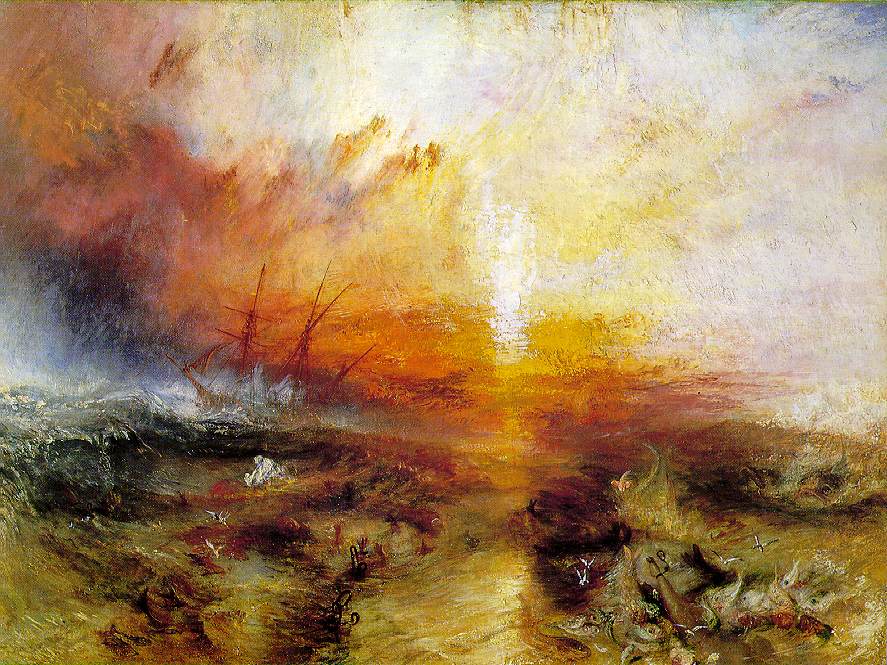
The disturbing 1840 Turner seascape “Slavers throwing overboard the Dead and Dying – Typon [sic] coming on”, also known simply as “The Slave Ship”, is widely thought to have been inspired by the Zong episode. The allusion would have been well-known to his contemporaries.

* One of the 133 survived by climbing back aboard the ship.

On this day..

1780: Corregidor Antonio de Arriaga, by his slave

On this date in 1780, Incan-Peruvian indigenous leader Tupac Amaru launched his insurrection against the Spanish with the public execution of a Spanish corregidor.

Antonio de Arriaga, as Spain’s man in Tungasuca, had as part of his job description forcing curacas to extract the crown’s tribute from the natives. This put some tension between him and the likes of the strong-willed Tupac Amaru, who advocated fiercely enough for his people’s rights that Arriaga threatened him with death.

It also made Arriaga’s death an invitingly emblematic scene to open the indigenous revolt.

On Nov. 4, 1780, Tupac Amaru kidnapped Arriaga returning from a dinner party, then forced him to sign letters summoning Spaniards and curacas alike to Tungasuca.

There, he mustered his own force of armed natives and performed for them a “carefully staged public ceremony.”

According to a primary source excerpted in The Tupac Amaru and Catarista Rebellions

Account of the Most Horrible Crime Committed by Jose Gabriel Tupac Amaru, Cacique of Pampamarca

On the morning of Friday, November 10th, Tupac Amaru ordered that three columns … be organized from all the people from his Province that were already there. Two were composed of Spaniards and Mestizos armed with muskets, sabers, and sticks; and one of Indians with slings. In the middle of this, he brought out the Corregidor, dressed in his military uniform, and publicly started taking his uniform off, stripping him of his rank following the rituals he had understood and seen in other occasions, until he was left in his shirt. He then put a shroud on him … that had the title of La Caridad on it. He then gave the order to take him to the gallows, accompanied by the Priest and two other clergymen, where he went with a resignation and patience worthy of somebody who was already touching the portals of eternity.

Once on the gallows the Corregidor was forced by the tyrant to publicly declare that he deserved to die in that way. A black slave of the Corregidor [named Antonio Oblitas -ed.] served as his executioner, but the ropes snapped and both fell to the ground. But they suspended them again with a lariat around their necks, and thus they completed the execution in clear sight and tolerance of all his Province. [“they” is as rendered in the book; I have no indication that more than one person was executed. -ed.] Not one voice was raised that would disturb the operation. And most surprising of all was that those same Collectors and those close to the Corregidor were the ones who (oh, what an awful spectacle of perfidy!) sped his way to the ignominious place of execution, and who pulled on his feet so he could die even more violently.

The rebellion, needless to say, was on.

On this day..

1852: John and Jane Williams, slaves

On this date in 1852, John and Jane Williams hung in Richmond for the hatchet-murder of the wife and infant child of their master.

This one was a sensation for the antebellum crime beat, the “deep brain-cuts” to the heads of Joseph Winston (who survived) and Virginia Winston and nine-month-old child (who, obviously, did not) administered in the small hours July 19th was just the sort of thing to tap white slaveholders’ fears. (Reportedly, they were cruel masters and had recently threatened to sell Jane without also selling her child.)

That the crime was authored by urban slaves assimilated to the money economy connected it directly with broader anxieties about social transformations, as explored by Midori Takagi in Rearing Wolves to Our Own Destruction:

[U]rban slaves who enjoyed a variety of privileges including hiring out, living apart, socializing without supervision, and cash bonuses. White Richmonders believed these privileges encouraged the slaves to be rebellious …

Although John belonged to the Winston household, he worked at the docks for John Enders during the day. Like most hired slave workers, John could move about the city before and after working hours with no supervision. He also probably received cash from his earnings and could earn extra by performing overtime work. John was not required to live in the Winstons’ house but chose to in order to be with his wife. Janes, on the other hand, was directly owned by the Winstons and most likely did not enjoy the same privileges as her husband. But she was able to move about in the city making trips to the market, did socialize with other slaves and possibly free blacks, and was well aware of the privileges and expectations of hired slaves including her husband.

White residents came to believe that these factors encouraged slaves to act violently by planting within them “the germ of rebellion.” One influential Richmonder, Joseph Mayo (who later became mayor), attributed the “glaring evils” of the slave population to “the system of board money … [and] the assumptions of equality exhibited by the blacks in riding in carriages contrary to law, and in dress and deportment.” Increasingly, white city dwellers began to wonder if they had been — in the words of one resident — “rearing wolves to our own destruction.”

These anxieties, piqued by crimes such as the Williamses’, would lead to a welter of new restrictions on the movement, behavior, and even attire of urban slaves in Richmond in the ensuing years.

But that was for the future. While Richmond had real-life master-murdering miscreants in its clutches, it gave vent to all its opprobrium.

Papers described the crimes as “hardly paralleled in history,” anticipated for Jane (who eventually copped to the crime and unsuccessfully tried to exculpate John) “the fires of her eternal doom,” and her execution “without the smallest particle of sympathy from any human being possessed of the ordinary feelings of justice.” The exhortations of her pastor, the Richmond Daily Dispatch opined, fell upon “unwilling ears. The thick-crowding thoughts of the diabolical murder of two innocent, guileless beings, committed by Janes with the coolness and deliberation of a fiend, rendered unimpressive, cold, and tedious, those ceremonies.”

It is to be hoped [the Dispatch concluded] that her merited and summary execution will operate as a warning to the fractious portion of our negro population.*

In a show of scrupulous regard for the inalienable rights endowed by the Creator, the state of Virginia compensated the convalescing Joseph Winston to the tune of $500 for expropriating and executing his property.

* (Second-hand) sources for the newspaper excerpts: The Penalty is Death: U.S. Newspaper Coverage of Women’s Executions by Marlin Shipman; and, “Black Female Executions in Historical Context” by David V. Baker, Criminal Justice Review, vol. 33, no. 1 (March 2008).

On this day..

1832: Samuel Sharpe, “I would rather die upon yonder gallows than live in slavery”

On this date in 1832, Jamaican national hero Samuel Sharpe died upon the gallows for instigating the slave revolt that would (help to) end slavery.

Samuel Sharpe, an educated slave who was also a Baptist deacon, was the moving spirit behind the attempted general strike that became the Christmas Rebellion.

That time of year was less than festive for Jamaica’s enormous slave population, for Saint Nick opened the short window for harvesting the island’s sugar cane.

Samuel Sharpe and collaborators had the wit to realize that being depended upon to bring in the cash crop that made life comfortable for their owners put the slaves’ hands upon a potent economic lever. In the last few days of 1831, they pressed it.

The “passive resistance” thing didn’t last long, however, and the “strike” transmuted into a rebellion — the cause swiftly taken up by thousands of slaves around the island who torched crops. Given the small (less than 20) white body count,* the “violence” appears to have been directed against the instruments, rather than the perpetrators, of their enslavement.

Not so the reprisals.

The rebellion was suppressed within days, and over 300 put to death for it (in addition to 200 slave casualties during the pacification itself). There’s an absorbing BBC Witness episode about this affair available as a podcast here.

Sharpe was the last of those executed.

But his revolt is widely thought to have given impetus to the British parliament’s deliberations over the ensuing months that ultimately led to the Slavery Abolition Act (1833).

What [abolitionist MP William] Wilberforce was endeavoring to win from the British senate by his magic eloquence the slaves themselves were endeavoring to gain by outbreaks and violence. The combined action of one and the other wrought out the final result. While one showed that slavery was wrong, the other showed that it was dangerous as well as wrong. Mr. Wilberforce, peace man though he was, and a model of piety, availed himself of this element to strengthen his case before the British Parliament, and warned the British government of the danger of continuing slavery in the West Indies. There is no doubt that the fear of the consequences, acting with a sense of the moral evil of slavery, led to its abolition. The spirit of freedom was abroad in the Islands. Insurrection for freedom kept the planters in a constant state of alarm and trepidation. A standing army was necessary to keep the slaves in their chains. This state of facts could not be without weight in deciding the question of freedom in these countries … I am aware that the insurrectionary movements of the slaves were held by many to be prejudicial to their cause. This is said now of such movements at the South. The answer is that abolition followed close on the heels of insurrection in the West Indies, and Virginia was never nearer emancipation than when General Turner kindled the fires of insurrection at Southampton.

Frederick Douglass

Sharpe, today, is an official national hero of Jamaica. The place in Montego Bay that he hanged is known as Sam Sharpe Square, and his face adorns the currency.

* Contrast with the much smaller, much bloodier rebellion of Nat Turner in the U.S., which preceded the Christmas Rebellion by a few months.

On this day..

1814: Six slaves in Guyana

An alarming rumour, meanwhile, … spread throughout the Colonies; a rumour which, whatever of truth or fact, little or none, might be at the foundation, gathering, as it went, size and gloom, and dust of slander, was calculated to make them all feel very unhappy. The report was that a slave insurrection had been discovered, having its centre on the Berbice West Coast, but extending right and left so as to include all the shore from the Corentyne Coast to Mahaica, about eighty miles; that the negroes had chosen a governor and other officers; that it was their intention to murder all the white men, and take possession of all the rest; that some of the Demerara East Coast negroes were leaders in the rebellion, especially Philip, a member of the church on Le Resouvenir; and that instruction of the negroes was to blame.

the account which the negroes gave of the matter was, that there had been formed a society in imitation of the Freemasons, they wishing to have, as well as their buckras or masters, a society of that nature; and that the money collected was to support the poor and defray the expense of their dances, &c.; just as it had been formerly very common for them to assume the names of their masters, or of the Governor or Fiscal, and send invitations to friends to supper or a dance, and appoint a captain of their own as president of the feast; sometimes to put feathers in their hats at holiday time and parade the streets. “No one,” as far as Mr. Wray could learn, “had been injured by them, neither was any property destroyed,” yet on 12th April six of the unhappy people apprehended on the West Coast were executed in New Amsterdam as ringleaders, their heads cut off and fixed upon poles on the different estates to which they belonged; one of them white with age, whose master, Mr. Rader, told Mr. Wray that he denied to the last having any bad intentions. Several others were flogged under the gallows, and some were transported.

A proclamation was subsequently issued to the effect that as “the privilege allowed the slaves of the Colony, of publicly or privately dancing on estates and other places at stated periods, had been perverted by them to purposes of the most dangerous nature, all dancing was forbidden until next year, 1815, or the further pleasure of the Court;” … This was followed, late in the year, by another calling upon the colonists to pay their quota of the expenses incurred in crushing the plot and indemnifying the proprietors of the slaves capitally punished … Better still, the law concerning Sunday labour was amended in favour of the slave, forbidding field-work on that day, except in sudden emergencies; and further enactments were issued limiting and regulating the excessive use of the whip, and forbidding the burial of any slave dying suddenly or by suicide, or in consequence of punishment or hurt, without previously acquainting the authorities …

From The Life and Labours of John Wray, Pioneer Missionary in British Guiana.

On this day..

1758: Francois Macandal, forgotten black messiah

(Thanks to Mark Davis of macandal.org for the guest post on a remarkable historical parallel to today’s inauguration of Barack Obama. -ed.)

The world was astounded when Barack Obama was elected to the Presidency in 2008 knowing the cultural barriers minorities have faced for hundreds of years. The date of inauguration, January 20, also happens to be the anniversary of the burning at the stake of a virtually unknown man, Francois Macandal,* whose epic war against cultural barriers has been buried for centuries.

Read some of his story and judge if the historic election of Barack Obama could have occurred without the man they called “Macandal.”

The parallels with Barack Obama’s journey are numerous, but the life of Macandal was perhaps even more remarkable, reaching great heights and falling into the darkest chasms of despair, yet succeeding in spite of staggering odds. Macandal’s travails may be about finding one’s purpose and dreaming of victory even when condemned by a majority, as he was relentlessly pursued by soldiers and hounded by countless naysayers.

251 years ago on January 20, 1758, Macandal was chained to a post on a platform before thousands of slaves brought together to witness his brutal torture and execution. Because of his importance, the French gathered slaves from hundreds of plantations throughout the colony of St. Domingue (now Haiti and the Dominican Republic). They believed such a horrific spectacle would quash Macandal’s Revolution, which he began to end French rule and abolish slavery, 12 years before.

Around 1746 Macandal escaped his plantation, united thousands of escaped slaves along with many still enslaved, and proclaimed that he would lead them all to independence and freedom. This declaration, from someone who had only six years before been taken from his home in the Congo, was unprecedented, since no slave colony had ever defeated a European nation. Then Macandal mobilized tens of thousands and may have inspired millions to end slavery and defeat colonial hegemony in the Haitian Revolution consummated decades after his death.

But ironically even the famous, black Marxist writer C.L.R. James, attributed one of the greatest revolutions in history to something akin to ‘spontaneous rioting’ by 500,000 black slaves in 1791. Since 1791 almost every historian has reduced the “Haitian Revolution,” the only successful overthrow of a colonial power by black slaves, to a ‘collective rage,’ inspired by the whites of the “French Revolution.” Yet it may have been Macandal’s Revolution, not the starving peasants of France, that inspired their uprising in 1789.

The true story of Macandal represents obscure but recorded testimonies about his life and explains why the slave revolt of 1791 was in fact, “Macandal’s Revolution,” almost 50 years in the making. Macandal foretold the end of slavery, then planned it, plotted it and began it. His story shatters a myth that has gone unchallenged for over 200 years: that the Haitian Revolution of 1791 was a spontaneous slave uprising inspired by the French peasants who had charged the Bastille Prison in Paris two years earlier.

The Haitian Revolution ultimately ousted the French, defeating Napoleon and numerous French generals. It also succeeded against the vaunted British army and established a new government run by former slaves. It was the first domino in a series of colonial defeats and changes in law that led to the end of institutional slavery; and Macandal started it all.

Correcting the Historical Record

Macandal is rarely the focus of historians and when mentioned only his insignificance is noted. But the popular version of his story was immortalized by the original French writers themselves, in the interest of bolstering a self-image of innate superiority as a nation and a race. To have recognized Macandal’s brilliance would have acknowledged slavery’s illegitimacy, so Macandal’s real story had to be trivialized and buried.

This telling of Macandal’s journey from a free child in Africa to slavery and then revolution, relies less on popular writings and more on a review of all of the records in context. For example French writers claimed Macandal broke free because he was tied with ropes and the post was made of rotted wood that fell apart when he was set ablaze. Historians have repeated this without scrutiny. The French on St. Domingue regularly burned slaves to death at the town square of the capital, “Cap Francais.” At Macandal’s execution they gathered thousands of slaves as witnesses, to insure a humiliating defeat and halt his widely supported rebellion. Yet, despite this grandiose staging, we are supposed to believe Macandal was insignificant. And we must accept that the French military was so inept they forgot how to execute and did not know that ropes burn and untreated, rotted wood is flammable. Many such dubious “facts,” are still repeated blithely about Macandal and few Westerners grant him his bravery, genius or impact.

Interestingly, the U.S. Bill of Rights guaranteeing equality for all was also adopted in 1791, but it would be more than seven decades before slavery was outlawed in the U.S. and almost two centuries before equal opportunity laws were passed and enforced. For one tiny nation, Macandal enabled this to occur over 200 years ago.

Background

I began researching the life of Macandal 20 years ago, startled and inspired by one chapter in Wade Davis’ popular book The Serpent and the Rainbow, which focused on secret societies, Voodoo and Zombification. His version of Macandal’s story was dictated to him by Rachel Bouvoir-Dominique, a Haitian Anthropologist I interviewed in 1997, at her office in Cap Haitien. Working under the tutelage of well-known author and expert on Haitian history Michel Laguerre, a professor at U.C. Berkeley, I received grants for a field study and documentary on the subject of Macandal.

Anthropologists often allocate greater weight to oral history, informal observer accounts, burial remains, maps and gravures, re-evaluating more accepted published works historians rely on, and so this account reflects my perspective and research as an Anthropologist. I examined European gravures (illustrations) and colonial records cited commonly more skeptically, because they were clearly burdened by religious, sexist and racial paradigms of the day. For example illustrations portrayed slaves with happy smiles and sanguine facades, enjoying their lives in idyllic settings on the plantations. Yet slaves faced torture, rape, separation of family and death from over-work, every day. Blacks were often drawn with monkey features (toes, ears etc.) and other demeaning caricatures.

Western writers were fiercely loyal to provincial rhetoric, including the gender and racial bias then considered crucial foundations of Christian theology. Western scholars dehumanized natives and women to rationalize slavery, prejudice and justify the infamous “hierarchy of being,” which granted “white men” a closeness to God that no one else could approach. This endowed them with the right to use others as they saw fit.

There were many reasons colonial authorities destroyed or buried the noteworthy exploits of slaves. Few accounts of courageous acts from among the ranks of millions of Africans during 400 years of slavery were recorded and preserved, primarily to maintain the perception that slavery was justified, necessary and Nubian Africans were not truly human but beasts of burden. There are literally thousands of articles, books and films about individuals among the six million Jews who died during the holocaust but only a scant few from among the 100-200 million indigenous peoples killed during the colonial expansion; all the more reason to re-evaluate slaves like Macandal.

A Brief History of Macandal

During the early 18th century, around the age of 12, Macandal was taken from the west coast of Africa, probably the Loango Kingdom in the Congo. I claim the date of his birth was 1728 primarily because oral historians in Haiti I interviewed believed him to be 30 when he was fastened to a post before thousands and set on fire in 1758.

The French called him Macandal which may derive from a city in the Congo called “Makanda.” The town of Makanda no longer exists due to civil war but could have ancient roots and slaves were often named after the places they came from. His name may have been taken from the term makanda (plural form of “kanda”) referring to African societal groups. Some written accounts report that Macandal claimed to be descended from a ranking societal group and the son of a Chief or King.

Amazingly, Macandal could speak, read and write Arabic fluently. Some believe this is because he was raised Muslim, yet the Congo was Christianized long before Macandal was born. Portuguese mercenaries, missionaries and armies had combed every square inch of the Congo beginning in the late 1400’s, searching for gold, diamonds and slaves, forcing conversion to Christianity. However Macandal’s words and actions reveal a unique knowledge of both Christianity and Islam. His ancestors may have emigrated from the east coast where Muslims and Asians had allied with Swahilis to build beautiful cities and schools before the Portuguese invasion. His family may have then hidden themselves for centuries.

Conversion to Christianity was also a requirement for slaves on colony plantations but Macandal defied the French by learning the underpinnings of Christianity, to understand the roots of slavery and challenge newly acquired doctrines. Despite many influences the adult Macandal claimed no affiliation with Christianity, Islam, Voodoo or Animism.

As a child Macandal was educated and known to be accomplished in both music and art, including painting and sculpture. His dedication to learning was apparent throughout his life. He displayed a vast knowledge of plants, became a doctor on the plantation he was taken to and was sought by even the French themselves for treatment of diseases and ailments. Yet the vegetation on St. Domingue was completely different from that of the Congo; therefore, Macandal had to study his new environment and learn the properties of perhaps hundreds of plants. He secretly taught himself French and became so eloquent that the French aristocrats remarked that he could speak it better than they themselves, though education was strictly forbidden for slaves.

Based on historical records and interviews, it appears that Macandal was first sentenced to death on his plantation, around 1746 at the age of 18, for falling in love with the plantation owner’s favorite lover, a young and beautiful house slave. He underwent a scene of heinous torture intended to culminate in his death in front of many witnesses, but escaped mysteriously and fled into the hills. The French replaced this account with a tale about Macandal becoming handicapped from losing a hand in a sugar mill and then being left unguarded. His escapes were always attributed to poor guard oversight.

Though Macandal probably began his new life of freedom with the intention of bringing vengeance to his former owner Lenormand de Mezy and rescuing his true love, for some reason his objective evolved. Perhaps because of the totality of his traumatic experiences or because of the influence of Maroons (ex-slaves already living in the distant mountains) Macandal met after escaping, he began working for a new goal of freedom for all.

Macandal led a sweeping and unwavering revolution during the 12 years after his escape from the plantation. Unlike other escaped slaves, Macandal actually made the end of slavery his stated mission. He became the first to unite thousands of disparate Maroons who were living free but divided by tribal affiliation and known to be ardently dedicated to the destruction of each other. His uniting of these groups was an extraordinary accomplishment and he is the first known black leader and ex-slave to do so.

He began calling himself the “Black Messiah” and gave rousing speeches in secret locations to recruit slaves. He made dangerous and daring appearances on plantations during the night to urge loyalty and inspire hope. The name “Black Messiah” had great meaning to Macandal as evidenced by one of his famous speeches at a secret recruitment meeting. The words exposed Macandal’s understanding of Islam and Christianity and their link to institutional slavery. The term was a powerful catalyst he used to preempt religious and ethical indoctrination of blacks and free them from the ideological bonds of slavery. He had to usurp the authority of the Church and French government to convince slaves they deserved equality, freedom, family sanctity, education and self-government.

Macandal became a brilliant strategist and had a large, organized camp with lieutenants, captains and other ranks. He led countless attacks and escaped capture mysteriously many times. His tactics were unique and devastating. They were known to be carried on after his disappearance despite the brutal efforts of the French to extinguish illegal grassroots activity. During his reign as a Maroon leader he may have recruited half or more of the 100,000 slaves living on the plantations as secret agents of his revolution.

Maroons and slaves apparently employed his tactics for decades after his disappearance in 1758. During the decade before the final thrust for overthrow in 1791, and despite harsh measures to thwart rebellion, Maroon activity greatly increased. This activity was so secret that virtually nothing is known about this period and is one reason historians assume the war for independence was unplanned, even though the first massive attack was led by Boukman Dutty, formerly a cruel black overseer who was a contemporary of Macandal. His gathering, which launched the war, was convened at a hidden location where Macandal formerly gave his speeches, the symbolism of which cannot be denied.

Generals that followed Boukman used ingenuity and unique strategies to win the 13-year war and Toussaint L’Ouverture is given most of the credit for the victory. But Toussaint refused to support the war until after it had begun; its inevitability certain. He was 13 when Macandal was sentenced to death in 1758. A voracious reader and student of warfare he was well aware of Macandal but content as a slave under a liberal planter.

It is my thesis the “Macandal Revolution” continued through the three decades preceding the Haitian Revolution. No other slave is known to have prophesied and promised the end of slavery yet Macandal predicted that blacks would defeat the French, become free and independent of colonial rule and control the colony of St. Domingue. His rally cry and pronouncement repeatedly rang throughout the colony despite opposition and betrayal from many slaves who greatly feared the French and did not believe victory was possible.

The Haitian Revolution remains the only successful movement by black slaves to defeat a colonial power and achieve complete independence. It stands alone as a towering victory against incalculable odds. Though it is characterized as a ‘riot’ that generated its own momentum, 500,000 slaves and free blacks mysteriously rose up in unison, using sticks and stones, against over 50,000 heavily armed soldiers, landowners and henchmen.

The Fall of Colonialism

As Macandal’s victories mounted I propose that word of his revolution spread to Europe and bolstered many anti-colonial movements. For example one of his closest secret allies was a French Jesuit priest and the Jesuits along with other religious leaders in Europe began fomenting rebellion during this period. Before news of Macandal’s revolt spread, many in Europe believed the slave trade was not only profitable but philanthropic. It had long been heard in the churches that slaves were heathens being brought to Christ and treated well in the process. His uprising no doubt made many Europeans aware that slaves were not being treated well and were desperate. Macandal’s shocking victories may have provoked Europeans to finally condemn colonialism and slavery. His fearless attacks and disregard for colonial might may have also seeded the French Revolution.

What really happened on January 20, 1758? Macandal endured great agony during an intense and excruciating punishment. He did this so that slaves everywhere might become free. The French claim Macandal was burned alive at the town square in Cap Francais.** Admitting he broke free and leaped out of the fire, they wrote that soldiers reclaimed Macandal and threw him back in. However some observers claimed Macandal broke his chains and fled, never to be seen again. How he broke free during any of his escapes despite being surrounded by guards and soldiers, is not known. It is interesting to note that his remains were never found and there is no burial site. Given the French proclivity for making examples of slaves to increase fear and enforce discipline, a successful execution should have been commemorated by another French monument.

For most historians, January 20, 1758, came and went with barely a mention in official memorandums. Yet a detailed search of documents reveals a massive cover-up, confusion and consternation. Macandal’s Revolution was not quashed or even slowed; instead it was impelled and sent wildly rumbling down a path of manifest destiny. Plantation owners later discovered their most trusted slaves were working for the revolution. New restrictions were put on all blacks throughout the colony and 4-5 rebels were burned at the town square every month to strike fear into the rest. Intense interrogation and torture revealed ever more depth to the conspiracy. Macandal’s execution day inflamed slaves and intensified their commitment to him and they became more united and fervently bent on winning freedom. Jesuits were banned from St. Domingue five years later.

As the first U.S. President with African roots is inaugurated on January 20, no one will speak of Macandal or Macandal’s Revolution, which led to equal rights in 1804 for one small nation. January 20, 1758, the day the French sought to secure colonialism and slavery in perpetuity, became a day of victory for Macandal and a watershed event which brought colonialism down. Though Macandal has been denied his place, his actions may have ended slavery and paved the way for people like Barack Obama to make history.

Mark Davis received his Bachelor of Arts degree in Anthropology from U.C. Berkeley and a Master’s in Anthropology from the University of Hawaii. He is the foremost authority on Macandal and his one hour documentary The Black Messiah was broadcast on PBS in 1997. He publishes information through his website at www.macandal.org.

* The man’s true name is lost to us; the one he was given by the French can be alternately spelled “Mackandal” or “Makandal” or “Mackendal”.

** Renamed Cap Haitien after Haiti won its independence.

On this day..