1691: Jack Collet, sacrilegious burglar

On this date in 1691, Jack Collet was hanged for “sacrilegious burglary.”

This little-known highwayman ditched an apprenticeship with a Cheapside upholsterer to take the road, and carved a niche as the guy what robbed while dressed up as a bishop. (Once having lost his ecclesiastical garb at dice, he re-robed by sticking up a churchman on the road and forcing his victim to dis-.)

“As if he had been determined to live by the Church,” clucks the Newgate calndar, “he was at last apprehended for sacrilege and burglary, in breaking open the vestry of Great St Bartholomew’s, in London, in company with one Christopher Ashley, alias Brown, and stealing from thence the pulpit cloth and all the communion plate.”

For this bid to render un-from God, Caesar rendered Collet unto Tyburn.

On this day..

1686: Paskah Rose, Jack Ketch interregnum

On this date in 1686, the English executioner Paskah (or Pascha) Rose was hanged at Tyburn for burglary — by his predecessor and his successor, the famed hangman Jack Ketch.

(c) image from Peter Herring, used with permission. Also see this illustration

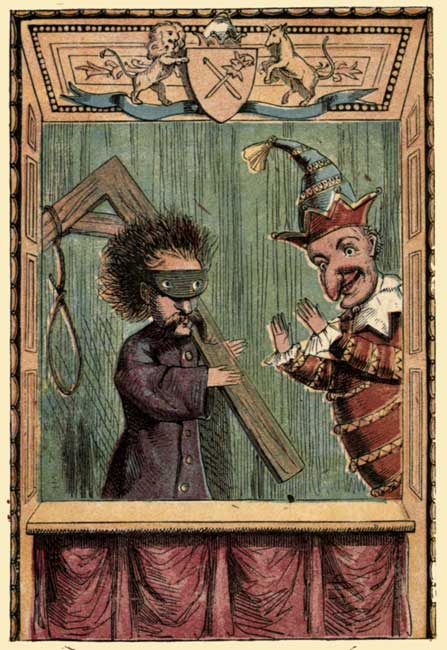
The “Jack Ketch” character from a Punch and Judy puppet show: traditionally, Punch gets the better of their meeting and hangs Jack Ketch.

The Irish immigrant Ketch is the first name in English executioners. Indeed, you can call any of his successors right down to Pierrepoint a “Jack Ketch” and be perfectly understood.

The immediate successor, however, was Ketch’s own assistant — who inherited top billing after Ketch went to jail for “affronting” a sheriff.

Jack Ketch had been trodding the scaffold-boards, hanging, beheading, and drawing-and-quartering for two-plus decades at that point: he’s thought to have been appointed in 1663, and he’d inserted himself into those performances rather more prominently than an executioner ought by botching some of Restoration England’s most high-profile executions.

There’s little reliable information about these early executioners, but it seems Ketch’s reputation for clumsiness had forced him to issue an “Apologie” justifying himself.

But the man unquestionably had longevity in his favor, which is more than Paskah Rose could say.

Within months of becoming the chief London executioner, Rose and another man were chased down in the act of burgling clothes from a house, “the Goods found in Rose’s Breeches.”

Rose and his co-defendant Edward Smith accordingly hanged along with three others at Tyburn this date — by Jack Ketch, now returned from his carceral retirement for one last tour.

Ketch died late that same year of 1686, but has lived on in any number of ballads, doggerels and broadsides immortalizing the name. He was surely aided in this by the less impressive caliber of many who succeeded him: it wasn’t long after Ketch dispatched Pascha Rose that another “Jack Ketch” — an ignoble profession that wouldn’t until centuries hence be drawn from the country’s respectable classes — also met Pascha Rose’s same fate.

There’s a now-public-domain Autobiography of Jack Ketch by 19th century English writer Charles Whitehead.

On this day..

1776: Benjamin Harley and Thomas Henman, Smugglerius?

On this date in 1776, smugglers Benjamin Harley and Thomas Henman were hanged at Tyburn for murdering a customs-house officer who had intercepted them trafficking tea on the Deptford turnpike.

One of these two gentleman might well be the flesh-and-bones person behind the ghoulish ecorche sculpture known as “Smugglerius”.

This beautifully ghastly item was commissioned of sculptor Agostino Carlini by the anatomist William Hunter: it is the cast of a hanged man, meticulously flayed of his skin to reveal the musculature for the convenience of future students’ sketches. Those students gave their subject the jocular nickname, since in life it was thought to be a smuggler.

For good measure, Carlini posed the corpse in the manner of the Hellenistic marble Dying Gaul.


Dying Gaul (known in the 18th century as Dying Gladiator), one of the world’s best-known classical sculptures. (cc) image from Tom Magliery.

Of the “Dying Gladiator”, Byron wrote:

He recked not of the life he lost, nor prize,
But where his rude hut by the Danube lay,
There were his young barbarians all at play,
There was their Dacian mother, — he their sire,
Butchered to make a Roman holiday; —
All this rushed with his blood; — Shall he expire,
And unavenged? — Arise! ye Goths, and glut your ire!


A copy of Agostino Carlini‘s bronze cast of “Smugglerius”, displayed in Edinburgh. (cc) image from Chris Hill.

So that is Smugglerius, an astonishing artifact. For decades, it (actually a copy of Carlini’s original, which is long lost) has been parked at the Edinburgh College of Art, translating thence into countless students’ anatomical sketch pads.


William Linnell‘s 1840 drawing of Smugglerius.

To trace the ecorche‘s origin, we have, to start with, this letter from John Deare … not the tractor guy, but a noteworthy Liverpool sculptor. At time of writing in 1776, he was a 15-year-old matriculating art student:

One of the men bid me tell you, that Mr. Carter would give me half-a-guinea, at least, a week, for the first part of my time, and fifteen shillings for the latter part; but you will write to him, and ask him what he proposes: he is, just as they say, a blustering fellow, but a good man. I have seen two men hanged, and one with his breast cut open at Surgeons’ Hall. The other being a fine subject, they took him to the Royal Academy, and covered him with plaster of Paris, after they had put him in the position of the Dying Gladiator. In this Hall there are some casts from Nature that are cut from the middle of the forehead down to the lower part of the body, one part excoriated, and the other whole.

With the direct reference to the Dying Gladiator/Dying Gaul pose, we seem very clearly to have a bead on the creation of Smugglerius, and the letter suggests that it was one man taken from a pair of hanging subjects. Conveniently (or inconveniently) there were just two such pairs of executions at Tyburn in the spring of 1776: those of Benjamin Harley and Thomas Henman on May 27; and, those of Samuel Whitlow and James Langar on April 12.

Now, artist Joan Smith and anthropologist Jeanne Cannizzo have recently, and very publicly, argued that Smugglerius is not Harley or Henman, but James Langar — a man from the earlier hanging pair. This claim even teased an exhibition carrying the perhaps unfortunate title Smugglerius Unveiled.

The case for Langar basically has two components:

  1. Deare dated his letter about the “Dying Gladiator” on May 1, so the executions must precede that date — which means that it’s one of Langar or Whitlow.
  2. It’s more likely that Langar, a soldier, would have had the outstanding physique to attract Hunter’s interest. (Whitlow was a domestic servant who robbed his master in an unrelated crime.)

Headlines aside, this sleuthing obviously falls well shot of airtightness.

Historian Tim Hitchcock, incidentally a moving spirit behind the creation of the invaluable Old Bailey Online database, doesn’t find James Langar a persuasive candidate. In private communication with this site (4 April 2012), he remained “still very much of the opinion that [Smugglerius] is either Thomas Henman or Benjamin Harley … I am even more convinced now than before.” Here’s the case for one of the Harley/Henman pair:

  1. Harley and Henman were smugglers. You know … like Smugglerius?
  2. Trial records indicate death-sentenced prisoners also condemned to anatomization, and they do not say that about Whitlow and Langar, who were merely thieves
  3. Harley and Henman, by contrast, had killed; they were therefore subject to the Murder Act, and accordingly sentenced “to be afterwards dissected and anatomized; which sentence was executed upon them”*

All things equal outside of the date on Deare’s letter, Harley and Henman look much the likelier source of Smugglerius. (If so, we seem to lack any good reason to prefer Harley as the Smugglerius model as against Henman, or vice versa. Flip a coin.)

The historiography for Langar depends inordinately upon the present-day interlocutor’s confidence in the “1 May” date a Georgian-era teenager slapped onto a bit of personal correspondence with, one can be sure, nothing resembling academic gravity. May 1 could be mistaken outright (maybe it was June 1, and he wrote “May” out of the previous 31 days’ habit); or, it could be only a reference to when Deare began a letter that he might have composed over several weeks; or, it could be that the author had some trivial reason of personal expediency to backdate.

Maybe so, maybe not. But who would have thought anyone would be interested in Harley or Henman (or Langar) going on two and a half centuries after their deaths.

Executed Today had occasion to discuss this fascinating object d’art and its discomfiting origin with one of Hitchcock’s collaborators, IUPUI Professor of British History Jason M. Kelly.

ET: What’s the background? Why is Smugglerius being produced at all in 1770s Britain?

JK: Well, 1768 marked the establishment of the Royal Academy of Arts. It took over 20 years to create.

The idea was to give Britain a school of art — of painting, sculpture, and architecture — to rival its continental peers. The French had established art academies in the previous century; they were among the premier art schools in Europe, if not the premier schools.

The British didn’t have anything comparable. And, in an age of rivalries, both political and cultural, artists and patrons alike saw the Royal Academy as central to British national identity.

The Academy hired William Hunter to be the professor of anatomy. He was an anatomist — a doctor — by training, not an artist, so he was very interested in teaching things like musculature, skeletal structure, and the circulatory system.

Smugglerius was not William Hunter’s only ecorche. He had made at least one other as a teaching aid, and he was proud to associate himself with it. He even poses for a portrait with a miniature version of it.


Miniature portrait of William Hunter holding a miniature bronze from Michael Henry Spang‘s reduction of an earlier ecorched figure. (The full-sized figure can be seen in the background of this sketch.)

What actually goes into producing an ecorche?

They had to get the body from the gallows to the art academy. Then they flayed it. In this case, somebody decided to pose the corpse as the Dying Gladiator.

They had some time prior to rigor mortis to get everything situated. in this case, they flayed him, posed him, then let him dry out, possibly overnight, so that they could make a mold of his body.

Beyond its immediate use as a teaching device, it’s also an art object for appreciation in its own right. How do you read that phenomenon?

This is very much a representation of the power of the state, the unrestrained power.

The execution itself is a display of power, but the government went further when in 1752 it passed the Murder Act allowing the College of Surgeons to get six bodies a year to dissect.

Ordinary people had no desire to have their remains used in this way. In the example of Smugglerius, the criminal was executed. Then, the body was desecrated — transformed into an art object for elite connoisseurs.

The sculpture was meant to represent ideal beauty as well as the terrifying strength of the state. The very people who were meant to appreciate the model of the Dying Gaul were the same people holding the reigns of power. In a sense, this image reinforced the elites’ view of the world, both aesthetically and politically.

Why pose the figure in this way, as the Dying Gaul or Dying Gladiator?

There’s one reading of Smugglerius to the effect that it was very subversive because the Dying Gladiator was seen as emblematic of the decline of Rome: the sculpture represented Rome’s decadence and corruption.

an inveterate abuse, which degraded a civilised nation below the condition of savage cannibals. Several hundred, perhaps several thousand, victims were annually slaughtered in the great cities of the empire; and the month of December, more peculiarly devoted to the combats of gladiators, still [in the early 5th century] exhibited to the eyes of the Roman people a grateful spectacle of blood and cruelty … which had so long resisted the voice of humanity and religion.

-Edward Gibbon in The Decline and Fall of the Roman Empire

So, you could speculate that this pose slyly represented contemporary executions under the Bloody Code in the same critical way.

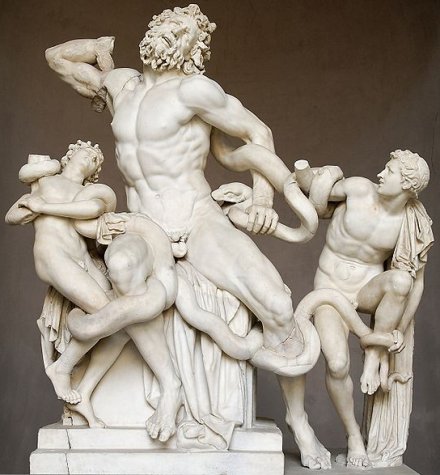
The Gladiator was also one of the best-known and -admired classical sculptures in all of Europe, along with the Laocoön.

In the 18th century they were compared as two examples of dignified dying. Contemporaries saw a certain stoicism in the sculptures — even though Virgil wrote that Laocoön cried out.

Ultimately, Smugglerius reminds us what happens when power is unrestrained. In a world where most people don’t have a voice, the state can ignore the rights and dignity of individuals. The real story here is the story of arbitrary authority and the importance of an enfranchised citizenry with the ability to put limits on those wielding power.

* Hanged felons not sentenced to anatomization could still wind up being taken apart in an operating theater, either as a result of their striking a direct bargain with the surgeons, or involuntarily via London’s growing trade in illicit corpses.

On this day..

1760: Laurence Shirley, 4th Earl Ferrers

On this date in 1760, Laurence Shirley, 4th Earl Ferrers became the last member of the House of Lords to hang.

A violent-tempered man — madness was said to run in the family, and this was in fact the Earl’s defense at this trial — Ferrers’ nastiness ran his wife right out of the house. Consider this was the 18th century, he must have been some kind of intolerable.

Though it was directed at another member of the household, this anecdote from the Newgate Calendar may prove illustrative of the sort of fellow we’re dealing with:

Some oysters had been sent from London, which not proving good, his lordship directed one of the servants to swear that the carrier had changed them; but the servant declining to take such an oath, the earl flew on him in a rage, stabbed him in the breast with a knife, cut his head with a candlestick and kicked him on the groin with such severity, that he was incapable of a retention of urine for several years afterwards.

Right.

We’ve seen in these pages how a certain sort of ill-humored man would sooner go to the scaffold than subsidize his ex. Ferrers was this sort.

The arrangement for the Ferrers spouses (they weren’t divorced, just separated) was that Ferrers would pay her support via his old household steward. Chafing at the payments and resenting the middleman, Ferrers one day in January summoned him to his, theatrically accused him of breaking faith, and shot him through the chest.

The Earl was tried before the House of Lords (a jury of his peers, and Peers!),* but his sentence was straight from the Old Bailey: not just hanging, but anatomization.

However, his exalted rank did draw a few odd perquisites.

Most noticeably, perhaps, was the fact that Ferrers was allegedly hanged with a rope of silk, rather than hemp. For only the softest coiling around noble throats, you see.

The other, and in hindsight more consequential, was that he didn’t get the low-rent treatment of being shoved off a cart. Instead, the scaffold was surmounted with a small platform supporting a set of trap doors whose opening would suspend the malefactor for his asphyxiatory journey to the hereafter.

This, one of many illustrations of the hanging, suggests this novel feature:

This innovation presents us an obvious forebear of the now-familiar “drop” method of hanging which evolved over the subsequent centuries. Though the drop was not repeated at Tyburn, it became wholesale practice when hangings moved to Newgate Gaol; the drop itself thereafter became the very art of the hanging when it was lengthened and scientifically measured to snap the neck of the condemned on the fall instead of strangling him or her.

And you could trace it all back to May 5, 1760.

To judge from other engravings, this red-letter day did not want for witnesses.

Perhaps stage-frightened by all these eyeballs on their noteworthy prey, the executioners put on an amateur-hour show. They openly fought over the £5 tip Ferrers gave (he accidentally handed it to an assistant), and likewise again over the rope that conducted the sentence.

When next in London, wet your whistle at Streatham’s The Earl Ferrers, a local pub.

* Ferrers defended himself: a norm for the time, but to latter-day eyes rather hard to square with his insanity defense. You’ve got a lucid defendant relying upon his wits to save him in a juridical proceeding inquiring of his own witnesses, “Was I generally reputed a Madman?” (Ferrers’s defense, specifically, was “I’m periodically insane.” But when the wind is southerly, he knows a hawk from a handsaw.)

On this day..

1652: Joan Peterson, the Witch of Wapping

“Let the sceptical read the ‘Country Justice’ to see what subtle threads were strong enough for a witch-halter!” (Source)

On this date in 1652, Joan Peterson was hanged at Tyburn for witchcraft.

Joan is a long time in the ground, and her dying refusal to be cowed by the officious prelate ordained to badger her into self-incrimination would alone stand her in very worthy stead in these pages. Even the hangman got annoyed when Joan, at the gallows,

was by the Ordinary nine on ten times earnestly pressed to confesse something against the said Mrs. Levingstone: Whereupon the Executioner told the Ordinary, he might be ashamed to trouble a dying woman so much, to which he replyed, he was commanded so to doe, and durst doe no otherwise. And afterwards the said Ordinary still insisting in his discourse, and very often pressing the said Peterson to confesse and discharge her conscience before God and the world; she answered that she had already confessed before the Bench, all she had to confesse; that she had made her peace with God; and therefore desired to dye in quiet, for now she was to appeare before God who presently would Judge her, and that God was witnes, that she dyed Innocently, and was in no wise guilty of what was laid to her charge.

Go, Joan.

This account comes to us from one of the surviving pamphlets (pdf) about her case, a document that, were it produced today, would probably draw a severe sanction under Britain’s nasty libel laws for its scandalous indictment of Joan’s persecutors.

It lays out an unscrupulous conspiracy of local grandees scrabbling after inheritance money, in which the “Witch of Wapping” swung for being the only honest broker in the room. Sure, we can’t prove it. But the rival, anti-Joan pamphlet (also at that same pdf link) has a lot of rot about our woman damningly chattering with a diabolical familiar in the cunning guise of a squirrel.


Satan’s minion. (cc) image from alphakilo2bravo.

According to the pro-Joan pamphleteer, the trouble started when an elderly woman named Lady Powell died, leaving her wealth to a particular relative — the “Mrs. [Anne] Levingstone” mentioned in the excerpt above — and stiffing several others.

These others contrived a scheme to charge Anne Livingston with witchery in order to separate her from her windfall and get their own hands on it. Though witch-hunting never really reached the epidemic dimensions in England that it often achieved on the continent — the English ban on torture helped prevent self-sustaining cycles of forced denunciations — it did have its moments, and the characters in question may have been encouraged by the recent exploits of notorious witch-diviner Matthew Hopkins in preposterous judicial homicide.

But they weren’t targeting Joan Peterson at all. They just wanted to use her to get at Livingston.

When Peterson, a local healer with a knack for fixing migraines, refused a bribe to accuse Livingston of sorcering, the plotters made it an offer she couldn’t refuse (and protected themselves from exposure) by accusing Joan herself.

Our pamphlet presents a riveting and revolting story of the conspirators essentially being one with the local judicial officials — in fact, when it comes to trial, they’re literally Joan Peterson’s judges — but even as they groped her for witches’ teats and the like, they endeavored “to perswade the said Peterson to confess [since] she needed not fear what she confessed, for it was not her life they aimed at, but to have matter whereby to accuse one Mrs. Levingston, who had gotten the said Lady Powels estate, and thereby had undone 36 Persons of the said Ladyes Kindred.”

Playboy parliamentarian (and, recently, regicide) John Danvers* made a rare appearance in the neighborhood to help orchestrate events. Danvers was a sound man to have for an expedient financial racket; he was famous for acquiring his fortune by marrying an older widow. She’d since died, and he’d since squandered it.

Even with the fix in, however, Joan’s ability to produce physician testimony and a written post-mortem ascribing Lady Powell’s death to natural causes — the doctors were impressed she’d managed to make it to age 80 what with the “the Dropsie, the Scurvey, and the yellow Jaundies” — ran that whole case aground.

Considering the incriminating threats and blandishments Joan had heard, however, they just got her on a second, simultaneous indictment — for bewitching one Christopher Wilson, on the grounds that he’d gone to her for a cure, gotten a little better, and then relapsed. If you think modern libel law is harsh, you should see Protectorate malpractice law.

Wilson, one should add, did not make this complaint himself: others were induced to level the charge on his behalf, while the court itself barred most defense testimony with threats to imprison the witnesses as probable witches themselves. (Nevertheless, some did appear for Joan.) Somehow, this was enough for conviction.

Even after her condemnation,

the said confederates and their agents went very often to her promising her a Repreive or Pardon if she would confesse that Mrs. Levingstone had Imployed her to make away the life of the Lady Powell, to which she replyed she could not, because it was altogether false. But one of the said confederates urging her againe to say something against Mrs. Levingstone, she told him he was a rogue, and gave him a blow on the face, which made his nose bleed: Where it is to be noted, that what for love of money they could not tempt her to, they resolved at last for love of her life to force her to, by necessitating her either unjustly to confesse a notorious falsehood against the said Mrs. Levingstone or else to dye without mercy or Repreive, which otherwise was proffered her by the said Confederates, to make her unjust in doing the same.

Go, Joan.

* There’s a street named for him in Chelsea. His family name (though not selected specifically for John Danvers) also adorns the town of Danvers, Massachusetts … which was renamed in the 18th century to help bury its notoriety as Salem Village, an epicenter of the Salem witch trials.

On this day..

1677: Thomas Sadler and William Johnson, mace thieves

On this date in 1677, Thomas Sadler and William Johnson were hanged at Tyburn for one of the most impudent burglaries in English history.

Thomas Sadler alias Clarke, William Johnson alias Trueman and Thomas Reneger … broke burglariously into the dwelling house of Heneage Lord Finch the Lord Chancellor of the said Lord the King and then and there stole and carried off a silver mace gilt gold worth one hundred pounds and two velvet purses imbroydered with gold and and silver and sett with pearles, worth forty pounds, of the goods and chattels of the said Lord the King.”

That’s right. They robbed the Lord Chancellor of his ceremonial mace while he slept, and a couple of embroidered ceremonial purses. (Representative pictures here.) The only reason they didn’t make off with the Great Seal of the Realm too was that the Chancellor had it under his pillow while he slept, for safekeeping. That’s some security.

The robbers, to their misfortune, were little better conscious of this crucial precaution.

They paraded through the darkened streets with mace poised on shoulder, a glorious revelry of knaves celebrating what they surely anticipated was the signal achievement of their lives — and the knell of their deaths.

Upon return to their lodging-house, and having no particular place to stash this hottest of loot, they just stuck it in a cabinet. There, the landlady ran across it while cleaning, and raised the alarum.

So Sadler and Johnson died for the astounding crime — Reneger, who didn’t, hadn’t been involved in a previous robbery that Sadler and Johnson committed, which might have helped mitigate his guilt — along with three distinctly undercard common criminals whom even the Newgate Ordinary scarcely noticed.

Johnson left a mournful little self-eulogy, many centuries since lost but preserved for us in that Ordinary’s evocative text.

Before his Tryal, having an excellent fancie, and a hand no less happy at Limning, he had drawn most lively on the wall of his Chamber in Newgate, a pair of Scales, and in one balance the Mace, and in the other Tyburn; the last much over weighing the first: But since his Condemnation, he drew in one Scale the Gallows, in the other a Crucifix; the first mounted up by the greater weight of the last, and these lines under-written, as I have been informed.

My Precious Lord, from all Transgressions free, Was pleas’d, in tender pity unto me, To undergo the Ignominious Tree.

I Suffer justly; but his Sacrifice, I trust, shall make my groveling Spirit rise, And from the Gibbet mount the glorious Skies.

On this day..

1579: Thomas Sherwood, Catholic martyr

On this date in 1579, young Catholic layman Thomas Sherwood was hanged at Tyburn, cut down while still alive, disemboweled, and quartered.

This casualty of the Elizabethan era’s dangerous struggle for the soul of Britain had popped across to the continent to begin his studies under the church’s auspices.

He had not yet completed them when, on a return trip, a Protestant recognized him and got him locked up in the Tower, where Sherwood was tortured for information about the whereabouts of the underground Catholic Mass — but “he was brave beyond his years, no racking, no cross-examination could make him name any one.”

Sherwood had the distinction during his confinement of being one of the last earthly creatures to receive the (attempted) aid of octogenarian fellow-Catholic William Roper, Sir Thomas More‘s son-in-law and first biographer. (Roper’s attempts to send money to the imprisoned Sherwood were intercepted, however.)

Sherwood’s brother recalled of the martyr,

He was of small learning, scarcely understanding the Latin tongue, but had much read books of controversies and devotion, and had used much to converse among Catholic priests, and by reason thereof, having a good wit and judgment, and withal being very devout and religious, he was able to give good counsel, as he did to many of the more ignorant sort, being much esteemed for his virtuous life and humble and modest behaviour: besides God did give a special grace in his [conversation] , whereby together with his good example of life, he much moved and edified others. He was a man of little stature of body, yet of a healthful and good constitution, and very temperate in his diet.

After his first racking in the Tower (which was said to be rigorous), being visited by a Catholic gentlewoman, he showed himself of that joyful and comfortable spirit as she was astonished thereat. As also his keeper with compassion giving him warning that he was to be racked again, he was so little moved therewith, as merrily and with a cheerful countenance he said these words: ‘ I am very little, and you are very tall; you may hide me in your great hose and so they shall not find me; ‘ which the keeper did afterwards report to divers, much marvelling at his great fortitude and courage. He was about the age of twenty-seven years when he was martyred.

On this day..

1330: Roger Mortimer, usurper

The prince I rule, the queen do I command,
And with a lowly congé to the ground
The proudest lords salute me as I pass;
I seal, I cancel, I do what I will.
Fear’d am I more than lov’d;—let me be fear’d,
And, when I frown, make all the court look pale.

-Roger Mortimer in Christopher Marlowe’s Edward II

On this date in 1330, Roger Mortimer’s three-year run as de facto ruler of England ended with a rope at Tyburn.

Mortimer was a key figure in the Despenser War — a revolt of nobles against King Edward II and the king’s hated-by-nobles right hand Hugh Despenser.

That war failed and landed Mortimer in the Tower. Then, things really got interesting.

Mortimer escaped his cell in 1323 and fled to France. There he took up with King Edward’s own wife, Queen Isabella, when the latter came to court on some state business.

This was, needless to say, quite a scandalous arrangement — but hey, Isabella had seen royal cuckolding right in her own family before.

So the adulterous lovebirds settled in to canoodle and set about planning some serious homewrecking.

Both Isabella and Mortimer are by every appearance among the most outstanding personalities of their day, and they had ambition to match their considerable personal gifts.

In the autumn of 1326, they invaded England and won a swift victory as those disaffected nobles from the recent wars declared for the usurpers. This time, Hugh Despenser was put to death.

Edward didn’t fare that much better. By the next January, he had been forced to abdicate in favor of his 14-year-old son, which in reality meant ceding power to his ex and her lover. And you thought your divorce settlement was bad.

In the long tradition of rival heads of state being disposed of, Edward II was, well, disposed of: strangled in captivity later that same year (allegedly! there is some doubt as to whether he really died in 1327), and given a state funeral that put Roger Mortimer into a bogus public display of mourning

(Mortimer’s kinsman and historical-fiction-biographer Ian Mortimer thinks Edward actually survived, which is neither here nor there as pertains the fate of Mortimer.)

Once he got to the top of the heap, Mortimer too had rocky aristocratic relationships. He irked the lords of the realm with his tendency to behead them. He lost the First War of Scottish Independence. Oh, and he was a regicide. All this frayed his popularity. (This just in: governance is hard.)

More than that, since he and Isabella ruled in the minority of the titular king, Edward III, they were rearing a wolf to their own destruction — a wolf with a built-in personal grudge about his father’s overthrow and murder. All young Edward needed was a plan to disencumber his fangs.

As is so often the case, the most direct solution proved to be the best. In one of the more dramatic family moments in the English royal annals, Edward joined his close friend and a small band of trusted armed men, and burst in on Mortimer at Nottingham Castle, arresting him while his mother plaintively implored Edward to “have pity on gentle Mortimer.”

But Mortimer got as much mercy as he’d given the late Edward II. A mere six weeks removed from mastery of England, Mortimer was presented bound and gagged for the formality of a condemnation by Parliament on grounds of assuming royal authority. Then he was hustled off to Tyburn dressed pointedly in the same black tunic he had once worn to mourn Edward II. It was the first documented case of a nobleman being hanged at that grim destination.

First Lord. My lord, here is the head of Mortimer.
K. Edw. Third. Go fetch my father’s hearse, where it shall lie;
And bring my funeral robes.
Accursed head,
Could I have rul’d thee then, as I do now,
Thou hadst not hatch’d this monstrous treachery!

-Marlowe’s Edward II

The French could say the same thing of Edward.

We’ve previously recommended Lady Despenser’s Scribery for its coverage of this period; true to form, it has a detailed series on Roger Mortimer: 1, 2, 3, 4

On this day..

1724: Jack Sheppard, celebrity escape artist

“Yes sir, I am The Sheppard, and all the gaolers in the town are my flocks, and I cannot stir into the country but they are at my heels baaing after me.”

Jack Sheppard

On this date in 1724, the hangman finally got Jack Sheppard.

Sheppard was a thief, a romantic hero, a highwayman of the urban proletariat, a Houdini whom no prison could hold.

It had become possible in his time to ride criminal notoriety into celebrity: Jack Sheppard, a mere 22 at his death, proved as adept with that quicksilver element during his personal annus mirabilis of 1724 as he was with a lockpick.

Sheppard’s world had him fitted to wield a hammer better than thieves’ tools — but at about age 20, a young man awash in the illicit liberty of London’s underbelly, he ditched the square carpenter to whom he was apprenticed to live free by his wits.

Peter Linebaug’s The London Hanged finds in Jack Sheppard’s career and his runaway popularity an important marker of the capital city’s “refusal of subordination: — contra Foucaultian discipline, which “makes the rulers of government and society seem all-powerful.”

An important meaning of liberation … [consisted of] the growing propensity, skill and success of London working people in escaping from the newly created institutions that were designed to discipline people by closing them in. This tendency I have dubbed ‘excarceration’ because I wish to draw attention to the activity of freedom in contrast to its ideological or theoretical expressions…

This lithe youth is most famous for his literal talent for freedom: four times in 1724 he escaped from custody in ever more dramatic fashion.

He busted out through the ceiling of St. Giles Roundhouse. He rappelled with a bedsheet rope down the 20-foot wall of Clerkenwell Prison with his lover.

This sort of thing won the enterprising rogue growing folk hero status. The vaunted Sheppard “made such a noise in the town, that it was thought the common people would have gone mad about him, there being not a porter to be had for love nor money, nor getting into an ale-house, for butchers, shoemakers and barbers, all engaged in controversies and wagers about Sheppard.”*

It also drew the unwanted attention of 1720s London’s Jabba the Hutt: “thief-taker” Jonathan Wild, who managed a vast thieving cartel enforced by Wild’s willingness to turn in non-participants in his ingenious cover role as the city’ preeminent lawman. That’s some protection racket.

Sheppard, to the fame of his memory, scorned obeisance to the crime lord as much as to any guild carpenter and worked for no man but himself. A vengeful Wild shopped him to the authorities.

This time, Sheppard was actually condemned to death for burglary but broke prison again, using yet another classic ruse: the “disguised in smuggled women’s clothes.”

Back on the lam, he posted a cocky letter to his executioner “Jack Ketch” giving his regrets at not having joined two fellow-sufferers on the scheduled hanging date. (September 4.)

I thank you for the favour you intended me this day: I am a Gentleman, and allow you to be the same, and I hope can forgive injuries; fond Nature pointed, I follow’d, Oh, propitious minute! and to show that I am in charity, I am now drinking your health, and a Bon Repo to poor Joseph and Anthony. I am gone a few days for the air, but design speedily to embark, and this night I am going upon a mansion for a supply; its a stout fortification, but what difficulties can’t I encounter, when, dear Jack, you find that bars and chains are but trifling obstacles in the way of your Friend and Servant

JOHN SHEPPARD

London’s finest were determined to put an end to this character’s preposterous run of prison breaks, so when they caught him the fourth time Sheppard found himself loaded with manacles and chained to the floor of a special strongroom in Newgate Prison. Get out of that, Jack.

Somehow, Jack got out of it.

On the night of Oct. 14, Sheppard authored the sublimest breakout in Newgate’s voluminous annals. Picking the locks of his fetters with a small nail, our acrobat scurried up a chimney, picked, prised, or otherwise passed a succession of locked doors in the dead of night, paused to rest on the condemned pew of the gaol chapel, forced a grille, reached the roof, and threw another homemade rope over the wall to scamper down to safety.

And then “he promptly went forth and robbed a pawnbroker’s shop in Drury Lane of a sword, a suit of apparel, snuff boxes, rings, &c., and suddenly made a startling appearance among his friends, rigged out as a gentleman from top to toe.”

There’s no doubt but that Jack had showmanship, but at a certain point he could have done with just the tiniest measure of discretion. But then, this was a man writing his own legend. Sure, he could have put his head down and tried to disappear into some nameless Puritan settlement in the New World. (His distraught mother kept telling him to get out of the country.) He traded those dull and toilsome years for the fame of generations: his candle burned at both ends.

When next Sheppard was detained, it was towards his apotheosis. It was the only time he would be arrested and fail to escape.

A throng of thousands mobbed London’s route to execution this date, almost universally supporting the ace escapologist. And Sheppard very nearly had for them the piece de resistance in his career of magical disappearances: it was only at the last moment before boarding the fatal tumbril that Sheppard’s executioners found the penknife their prey had secreted on his person, evidently intending to cut his cords and spring from the cart into the safety of the surging crowd. What an exploit that would have been.


Detail view (click for full image) of George Cruikshank‘s illustration of Sheppard’s death for William Ainsworth‘s Victorian novel about the legendary criminal. More of these illustrations here.

This indomitable soul has enjoyed a long afterlife as a subversive hero.

A celebrity in his own time, his execution-eve portrait was taken by the Hanover court painter himself, James Thornhill. Sheppard is a very likely candidate as an inspiration for the criminal Macheath in The Beggar’s Opera completed just a few years after his death; likewise, his abandoned apprenticeship makes him the most apparent model for Hogarth‘s “idle prentice” plates.

A century later, prolific historical novelist William Ainsworth** claimed the convict-martyr for an 1839 retelling. This popular potboiler — read it free online here — came in for a spate of 19th century social panic when it was learned that a notorious servant-on-master murder had been carried out by a young man who had recently read it. A two-decade ban on public plays based on the Jack Sheppard novel ensued.

For as much as Jack Sheppard is romanticized in his remarkable individual characteristics, his story has always had a class undertow that raises the hackles of the powerful — and is celebrated by the people who menace that power. Linebaugh, again:

Jack Sheppard, housebreaker and gaol-breaker, was once the single most well-known name from eighteenth-century England. His fame spread across oceans and the centuries. When the bandit Ned Kelly was alive, the Australian press was full of comparisons between him and Sheppard. At the same time on the other side of the globe in Missouri, Frank and Jesse James wrote letters to the Kansas City Star signed ‘Jack Sheppard’. In England his name cut deep into the landscape of popular consciousness. Henry Mayhew noted that Cambridgeshire gypsies accepted Sheppard stories as the archetype of ‘blackguard tales’. Among English sailors anyone with the surname of ‘Sheppard’ was automatically called ‘Jack’. Within the Manchester proletariat of the 1840s his name was more widely known than that of the Queen herself. One of these lads said, ‘I was employed in a warehouse at 6s. 6d. a week, and was allowed 6d. of it for myself, and with that I went regularly to the play. I saw Jack Sheppard four times in one week.’

The oral history of Sheppard has maintained his memory within human contexts where books were scarce and working-class resources for an independent historiography were non-existent. Moreover, that memory was kept in contexts of social struggle in which a continuity, if not a development, with earlier moral and political conflicts was suggested.

* cited in Andrea McKenzie, “The Real Macheath: Social Satire, Appropriation, and Eighteenth-Century Criminal Biography,” Huntington Library Quarterly, December 2006

** Ainsworth is also known for a novel about Sheppard’s near-contemporary, highwayman Dick Turpin.

On this day..

1767: William Guest, coin shaver

On this date in 1767, a larcenous bank clerk was hanged at Tyburn for robbing the till.

Sleigh ride: Detail of a studious William Guest being drawn to Tyburn (click for full print).

In this case, it wasn’t anything so gross as grabbing the money and running. No, our malefactor William Guest — the “son of a clergyman of unblemished character” whose “constant handling of gold [for the Bank of England] shook his integrity” — started milling the edges of the guineas he handled and innocuously returning them to the bank’s stock whilst piling up his own supply of gold filings.

It’s sort of the pre-digital version of the Office Space scheme: “I’m just talking about fractions of a penny here, but we do it from a much bigger tray. A couple of million times. So what’s wrong with that?” Literal profit on the margin: perfect for the FIRE sector.

Though 18th century London’s perpetual necktie party was obviously focused on the lowest classes, its busy gallows had room enough for the occasional white-collar crime.

And by England’s lights, debasing the currency was as serious a crime as there was: Guest’s conviction wasn’t for larceny or fraud, but for treason.

Because of that, he didn’t get the plain-old cart ride to the gallows, but was drawn on a sledge — the “drawn” bit of “hanged, drawn, and quartered,” although for this penny-shaver the execution itself didn’t entail the horrible quartering.

After enduring this archaic ignominy, the minister’s son “was indulged to pray on his knees” before being noosed and “his whole deportment was so pious, grave, manly and solemn, as to draw tears from the greatest part of the numerous spectators.”

On this day..