1950: The Martyred, at the outset of the Korean War

On this date in 1950, the opening salvos of the Korean War were fired … and behind North Korea’s lines, in Richard E. Kim‘s novel The Martyred, 12 imprisoned Christian pastors were on that same day executed.

This psychologically complex novel takes place months later, when United States/United Nations forces backing South Korea have surged northward, capturing Pyongyang. Here the narrator, a South Korean intelligence officer named Captain Lee, is detailed to investigate how it came to pass that these 12 were killed … and that two others with them were spared.

One of those two has gone mad from the experience. The other is suspected of abandoning God to save his life.

We discover otherwise: that in fact, Rev. Shin was spared by his jailers because they admired his firmness whereas the executed men were the ones who turned coward. Even so, Rev. Shin refuses to publicize his innocence, preferring to embrace the unjust suspicion of his faithlessness in order to elevate the so-called martyrs — in turn giving heart and faith to his congregants.

We followed the chaplain up the aisle, flanked by the congregation that still sang, standing. Only a few of the chandeliers were lighted. A cold draft chilled my bare head, though I felt the warmth of human bodies surrounding me. Halfway up the aisle, I looked up toward the altar, behind which stood the elders, Park and a few others, and Mr. Shin. Soon Colonel Chang and I were with them, facing the congregation. Mr. Shin stepped forward. The candles on the lectern flickered. The congregation sat, hushed.

“Dear brethren,” he began quietly. “You all know who I am, and I know you. I know you, yes, I know you so well that I do not hesitate to say that I belong to you and you belong to me. I am you, you are me, and we are one. And I stand here in the shadow of my inglorious past, and say to you, welcome to the house of our Lord. This house of our Lord is filled tonight, and I am out there with you and you are up here with me. We are here together as one to worship our God and praise Him. Amen.”

Scattered voices in the congregation said, “Amen.”

“I know you well, so well that I know you did not come tonight to this house of our Lord to worship Him. You came to hear me. And I shall speak to you and you shall hear me. I am you and you are me. But who am I?” He paused. “I am a sinner.”

He paused again for a long moment; then, suddenly, his powerful voice boomed. “You came to hear me, a sinner, and you shall hear me, a sinner! Open your eyes! Bare your hearts! And hear! It was I who betrayed our martyrs!” He stopped, his hands clutching the lectern, his body bent slightly forward. He had stressed “I” so strongly that the high-ceilinged interior of the church rang with a vibrating “I” in a tremulous echoing that pervaded the dim, cold air — “… I … I … ” Not a soul stirred.

He said quietly, “On the eighteenth day of June, as you all know, the Communists imprisoned fourteen ministers, and I was one of them. On the twenty-fifth day, twelve ministers were murdered. For seven days and nights, they tortured our martyrs. My dear brethren, I say to you that they tormented the flesh of your martyrs for seven days and nights. I say, ‘flesh of your martyrs,’ for they could not harm their spirits. But how did they torture your martyrs?”

To my surprise — and uneasiness — Mr. Shin, for the next twenty minutes or so, described to the congregation in the minutest detail how each ministers was tortured, one after another, all twelve of them. Mr. Hann, said Mr. Shin, collapsed after three ays and nights of torture and becme ill. At first it seemed that the silent congregation was spellbound by the blood-smeared description, but gradually it began to bestir itself, the rustling of clothes, coughing, and concentrated heavy breathing disturbed the cold air.

Suddenly a woman shrieked. Cries went up. The entire congregation stirred with agitation. Some of the elders rose to their feet. Chaplain Koh hurried over to Mr. Shin, who stood unmoved, rigidly facing the crowd.

A voice from the back shouted, “Away with you!” and another voice, “We don’t want to hear from you!”

Then a woman hissed, “You — a sinner! How dare you defile our martyrs!”

On this day..

1958: Raymond John Bailey, for the Sundown Murders

On this date in 1958, itinerant carpenter Raymond John Bailey was hanged for one of Australia’s most sensational crimes.

This case derives its gloomy appellation, the Sundown Murders, from the same crepuscular handle dignifying the abandoned South Australia station where the bodies of Sally (Thyra) Bowman (43), her daughter Wendy Bowman (14), and family friend Thomas Whelan (22) were discovered in their Vanguard. All three had been bludgeoned and shot, as had the Bowman’s two dogs — an utterly shocking outrage.

The Outback dirt retained sign of the killer’s own conveyance with its telltale trailer; reported sightings pursuing this clue led a gigantic manhunt to the Queensland hospital where Bailey had gone to work … having driven there with a caravan in tow on a northbound course suitable to cross paths with the victims. He owned an unlicensed rifle; the theory of the case, supported eventually by a confession which Bailey repudiated as given under duress,* was that Bailey set upon the vehicle to rob it and even took the trouble to siphon the petrol — which was “dear up in that neck of the woods and Bailey’s old car and caravan would not be doing more than 10 or 12 miles to the gallon.” (Crown prosecutor E.B. Scarfe)

In the 21st century, investigative journalist Stephen Bishop has notably pitched a case for Bailey’s outright innocence. Bishop’s The Most Dangerous Detective: The Outrageous Glen Patrick Hallahan contends that the titular lawman — he’s the leftmost fella on the picture above, taken at Bailey’s arrest — railroaded the suspect, forcing him into a confession that “does not tally with other evidence” and ignoring potentially exculpatory details like footprints at the murder scene too large to be Raymond Bailey’s.

Bishop’s appeals for an official exoneration have thus far gone nowhere.

* Not his own torture, but the threat — in fact the nearby sound — of his sobbing wife being interrogated.

On this day..

1939: Toribio Martinez Cabrera

Spanish officer Toribio Martinez Cabrera was executed on this date in 1939 by Franco’s Spain.

An army lifer who had cut his teeth fighting in Cuba against Spain’s imperial dispossession, Martinez Cabrera (English Wikipedia entry | Spanish was one of the few brigadier generals to remain loyal to the Spanish Republic when his brethren launched the Spanish Civil War.

Despite entrusting him with command responsibility, his upper brass demographic profiled as a probable rebel and the Republic remained wary of his act; he was interrogated as a possible double agent after the fascists took Malaga, and defeated an outright treason charge after Franco occupied Gijon in 1937. It seems like he was destined to be shot by someone.

Having the honor of returning to an official capacity in the collapsing remains of the Republic, he supported Segismundo Casado‘s March 1939 coup against the Communist-allied Juan Negrin. The latter could get no negotiated terms from the fascists and so resigned himself, as he later remembered from exile, “to fight on because there was no other choice, even if winning was not possible, then to salvage what we could — and at the very end our self respect … Why go on resisting? Quite simply because we knew what capitulation would mean.” Unfortunately for Martinez Cabrera, Casado’s short-lived junta also got a cold shoulder from Franco and submitted to unconditional surrender.

Although most of its members evacuated abroad as the fascists triumphed, Martinez Cabrera declined to flee. He was shot at Paterna on June 23, 1939.

On this day..

1918: Captain Alexey Schastny

On this date in 1918, Captain Alexey Schastny received the cold thanks of the Bolshevik government for saving its Baltic fleet.

Icebound in the city of Helsingfors (Helsinki) across the Gulf of Finland from his Red homeland, Schastny (English Wikipedia entry | the more substantial Russian) orchestrated an emergency speedy breakout just ahead of a German incursion that seized the city in April and could have grabbed the Soviet Baltic fleet.

Schastny’s decisive action brought 236 vessels, including six battleships, across the frozen sea and safely home to Kronstadt.

The heroism of this operation at a moment of such low ebb for Russian prestige made Schastny a potentially dangerous element, should the onetime tsarist sailor choose to exercise his great prestige in the navy to the detriment of the Bolsheviks. This was the winter of the Russian Civil War, when White insurgents tore at the nascent Revolution.

Leon Trotsky, at this same moment scrambling to organize the Red Army to stabilize the situation, had Schastny arrested as a counterrevolutionary barely a month after the celebrated ice voyage. So grave a threat did this sea dog present that the Soviet state, having briefly abolished the death penalty, restored it in June 1918 specifically so that Schastny could be shot.

Schastny makes his appearance in the slick 2017 serial Trotsky, where he’s played by Anton Khabarov; the first half of episode 7 focuses heavily on Schastny’s arrest, court-martial, and execution.

On this day..

1786: Phoebe Harris, coiner

(Thanks to Richard Clark of Capital Punishment U.K. for the guest post, a reprint of an article originally published on that site with some explanatory links added by Executed Today. CapitalPunishmentUK.org features a trove of research and feature articles on the death penalty in England and elsewhere. -ed.)

Up to 1790, women convicted of High Treason and Petty Treason were burned at the stake. Although I am sure you have a perception of what High Treason is, as a crime in those days, it also encompassed several other offences, notably coining. Coining covered several individual offences relating only to gold and silver coins, e.g. clipping coins to provide coin metal for forgeries, colouring coins to make them appear of higher value, making counterfeit coins and having the equipment to do any of the above. Coining was considered treasonable because it directly affected the State and confidence in the currency.

The crime.

Under the name of Mrs. Brown, Phoebe Harris had rented a room from one Joel Sparkes at a house in Drury Lane, London (No. 19, in Swan-yard) before Christmas 1785. A friend of hers, Francis Hardy, had recommended her to Sparkes, describing her as a captain’s widow with a private income. In reality, it seems that Phoebe had been separated from her husband for two or three years. Whilst Phoebe lived at this address she was regularly engaged in filing and clipping coins and then using the metal to make new counterfeit coins in sand moulds. Francis Hardy was the person who was later to inform the police of the goings on at No. 19. There was a suggestion, flatly denied by him in court, that Francis Hardy had had a relationship with Phoebe. He did, however, take her teenage daughter in as a servant on the day of her mother’s arrest.

Arrest.

At about 5 o’clock in the afternoon of Saturday, the 11th of February 1786, John Clarke (a constable) went to No. 19 in consequence of the information he had received and found Phoebe Harris and Elizabeth Yelland in the first floor room. He and his assistants, George Meecham, Patrick Macmanus, and William Andrews, broke down the locked door and arrested the two female occupants. They then searched the room in which they found some counterfeit coins and the necessary equipment for coining in an adjoining closet.

When John Clarke compared the counterfeit shillings to genuine ones, it was clear that they had been cast from a mould made from a genuine shilling. In all, some 12 counterfeit coins were discovered, both shillings and sixpences. One of the genuine sixpences had a hole in it and this was evident in the counterfeits.

A little later, after the rooms had been searched, Elizabeth’s brother, Joseph Yelland, returned home and was also arrested. All three were taken to Bow Street to appear before a magistrate. They were remanded in custody at Newgate to stand trial at the next Sessions of the Old Bailey.

The trial.

Capital trials at this period took up very little time with a number being conducted during a single day. The April Sessions of the Old Bailey in 1786 were held on Wednesday, the 26th of that month, before Mr. Baron Eyre. Among those indicted were Joseph Yelland, otherwise known as Holman, Phebe Harris (spelling of Phoebe as given in the original indictment) and Elizabeth Yelland, who were jointly charged with two specimen counts, as follows: “for that they, on the 11th of February last, one piece of false, feigned, and counterfeit money and coin, to the likeness and similitude of the good, legal, and silver coin of this realm, called a shilling, falsely, deceitfully, feloniously, and traiterously did counterfeit and coin, against the duty of their allegiance, and against the statute.” There was also a second count of coining a sixpence. The shilling is the equivalent of the current 5p coin, whilst a sixpence is the equivalent of 2.5p. Although in 1786, these two coins had much greater purchasing power they were still coins of small denomination.

The prosecution was opened by Mr. Silvester, assisted by Mr. Wilson and Mr. Garrow led the defence. [Silvester and Garrow were famous combatants at the bar. See this post for another instance. -ed.]

The case was heard before the 2nd Middlesex jury, consisting of twelve men. Both sides were able to call witnesses and cross examine those for the other side. In this case, the Crown called the constables involved in the raid, together with the landlord and his son. They also called Francis Hardy, who gave direct eyewitness evidence of the manufacture and colouring of the counterfeit coins. The coining equipment found in the rooms was produced in court as evidence. Hardy also suggested that the group had bought forged coins from other criminals to pass off as good — also a capital crime then, known as uttering. He stated in his testimony that she continued with the coining business even though she knew that Hardy was fully aware of what she was doing. It appears that there had been some disagreement between Hardy and Phoebe and this may have led to him informing on her.

The defence was principally based upon the testimony of character witnesses for each of the defendants who averred them to be people of good character. Phoebe addressed the court as follows: “My Lord and Gentlemen of the Jury, I am an unhappy woman; I was desired by a young man of the name of John Brown, to take the room, which I did, and he brought the things found in the room; and desired me to secrete them, and I not knowing the nature of them, or for what purpose they were intended, did do so, and so I told the gentleman when they came and took me: as to my sister-in-law, I being very ill, she came to clean the room for me, and the gentleman found her cleaning it on her knees: and my brother-in-law came some time after the gentlemen had been in the room.”

She also called two character witnesses.

The jury took some time in their deliberations before finding Phoebe guilty and, despite Francis Hardy’s evidence against them, acquitting Elizabeth and Joseph Yelland. As was normal sentencing of all those convicted, took place at the end of the Sessions. Nine prisoners were condemned to death, these being: Hannah Mullins, William Smith, Edward Griffiths, James May, George Woodward, Daniel Keefe, Jonathan Harwood and William Watts, who were sentenced to be hanged while Phoebe was condemned to be burned at the stake. Many other prisoners were sentenced to transportation or imprisonment. Hannah Mullins and James May were subsequently reprieved to transportation. The condemned were returned to Newgate prison to await their fates.

Execution.

Phoebe Harris was to be the first woman burnt at Newgate, as distinct from Tyburn or Smithfield, and her execution was carried out just after 8.00 a.m. on the morning of Wednesday the 21st of June 1786. A huge crowd, estimated at some 20,000 people, had turned out to watch this gruesome spectacle.

At 7.30 a.m. six men, Edward Griffiths, George Woodward, William Watts, Daniel Keefe, Jonathan Harwood and William Smith were brought out through Newgate’s Debtor’s Door and led up onto the “New Drop” gallows. They were prepared in the usual way and the drop reportedly fell around 8.00 a.m.

After they were suspended, Phoebe was led from the Debtor’s Door of Newgate by two sheriff’s officers to a stake that had been erected halfway between the gallows and Newgate Street. The stake was some 11 feet high and had a metal bracket at the top from which a noose dangled. Phoebe was described as, “a well made little woman of something more than thirty years of age, with a pale complexion and not disagreeable features.” She was reported to be terrified and trembling as she was led out. She mounted a stool and the noose was placed around her neck and was allowed a few moments to pray with the Ordinary before her support was removed and she was left suspended. According to V. A. C. Gatrell’s book The Hanging Tree she died hard, he reported that she choked noisily to death over several minutes.

After hanging for half an hour, the executioner put an iron chain around her upper body and fastened it to the stake with nails. Two cart loads of faggots were now piled around the stake and then lit. It is reasonable to assume that she would have been quite dead by this time. After a while, the fire burnt through the rope and Phoebe’s body dropped, remaining attached to the stake by the chain. It took over two hours to be completely consumed by the fire, which continued to burn until midday.

Comment.

Only two more women were to suffer Phoebe’s fate. These were Margaret Sullivan on the 25th of June 1788 and Catherine Murphy on the 18th of March 1789, both for coining. At the April Sessions of 1790, Sophia Girton was also convicted of this offence but her execution was delayed until after Parliament had passed an Act (Act 30 Geo. III, c.48) substituting ordinary hanging for coining offences on the 5th of June 1790. In fact, Sophia was ultimately pardoned, on condition of transportation for life to New South Wales, on the 12th of June 1790.

Executions by burning at Newgate were distinctly unpopular with the local residents of what was a respectable business area of the City. They had sent a petition to the Lord Mayor requesting that Phoebe’s execution be carried out elsewhere. This was an early version of “not in my back yard” rather than a protest against the severity of her punishment. It was later reported that some locals became ill from the smoke from her body. There were similar protests over the Sullivan and Murphy executions and a great feeling of relief when Sophia Girton was reprieved, and the whole ghastly business passed into history in 1790.

The Sheriffs were also becoming increasingly unhappy about attending burnings, and it was they who brought forward the Bill to end this practice. Even though by this time the condemned woman was dead before the faggots were lit, it must have still been a gruesome and revolting spectacle and one which conveyed a feeling of injustice. Men convicted of coining offences were hanged in the same way as other condemned males. The Times newspaper took up this theme after Phoebe’s burning and printed the following article: “The execution of a woman for coining on Wednesday morning, reflects a scandal upon the law and was not only inhuman, but shamefully indelicate and shocking. Why should the law in this species of offence inflict a severer punishment upon a woman, than a man. It is not an offence which she can perpetrate alone — in every such case the insistence of a man has been found the operating motive upon the woman; yet the man is but hanged, and the woman burned.” One can only agree with the “Thunderer’s” sentiments as the Times came to be known. Other London newspapers carried similar articles. Again similar outrage was expressed two years later at the burning of Margaret Sullivan, although strangely there was little media interest at the burning of Catherine Murphy.

On this day..

1679: Five Jesuits, for the Popish Plot

Five Jesuits were hanged at Tyburn on this date in 1679, in the largest single mass execution of England’s “Popish Plot” hysteria.

This club of five is the five of clubs in a Popish Plot-themed deck of cards. Here are more images from the same series.

During this 1678-1681 outbreak of anti-Catholic paranoia, according to the French priest Claude La Colombiere, “the name of the Jesuit [became] hated above all else, even by priests both secular and regular, and by the Catholic laity as well, because it is said that the Jesuits have caused this raging storm, which is likely to overthrow the whole Catholic religion.”

This clique of course had a long tradition on the Isles of positioning as treasonable foreign agents dating to the Elizabethan age.

The five Jesuits of concern to us today, Thomas White aka Thomas Whitebread, John Fenwick, William Harcourt aka William Harrison, John Gavan, and Anthony Turner, were accused by Popish Plot confabulator Titus Oates of having “consulted together and agreed to put the said Lord the King [i.e., the reigning king, Charles II] to death and final destruction, and to change the lawful established religion of this kingdom to the superstition of the Roman Church.”

The prisoners made a deft and eloquent defense, impugning the credibility of the embittered ex-priest Oates who could produce no evidence to support his conspiratorial charges — all the stuff that would become the common perception a few years later when a disgraced Oates stood in the pillory for the bloodbath unleashed by his fabulisms.

But in 1679 — what with being hated above all else — the trial was a foregone conclusion. They were hanged to death, then quartered posthumously.

In common with almost all the victims of the Popish Plot persecutions, all five denied their guilt at their executions.

I am come now to the last scene of mortality, to the hour of my death, an hour which is the horizon between time and eternity, an hour which must either make me a star to shine for ever in the empire above, or a firebrand to burn everlastingly amongst the damned souls in hell below; an hour in which, if I deal sincerely, and with a hearty sorrow acknowledge my crimes, I may hope for mercy; but if I falsely deny them, I must expect nothing but eternal damnation; and therefore, what I shall say in this great hour, I hope you will believe. And now in this hour, I do solemnly swear, protest and vow, by all that is sacred in heaven and on earth, and as I hope to see the face of God in glory, that I am as innocent as the child unborn of those treasonable crimes, which Mr. Oates, and Mr. Dugdale have sworn against me in my trial … [if I] palliate or hide the truth, I wish with all my soul that God may exclude me from his heavenly glory, and condemn me to the lowest place of hell-fire.

On this day..

2014: Mahmoud Al Issawi, murderer of Laila Ghofran’s daughter


Hiba Al Akkad (standing) embracing her famous mother.

Mahmoud Al Issawi was hanged at Wadi el-Natrun prison outside Cairo on this date in 2014.

In 2008, he stabbed to death Hiba Al Akkad, the 23-year-old daughter of Moroccan star singer Laila Ghofran, along with Heba’s friend Nadine Gamal, in the course of a botched burglary in Cairo’s affluent Sheikh Zayed suburb.

On this day..

1485: William de La Marck, the Wild Boar of the Ardennes

On this date in 1485, the German warrior William de La Marck was beheaded at Maastricht.

“There is, moreover, in the land, a nobleman of good descent, and fame in warlike affairs, but otherwise, so to speak, Lapis offensionis et petra scandali — and a stumbling block of offence to the countries of Burgundy and Flanders. His name is William de la Marck.”

“Called William with the Beard,” said the young Scot, “or the Wild Boar of Ardennes?”

“And rightly so called, my son,” said the Prior, “because he is as the wild boar of the forest, which treadeth down with his hoofs and rendeth with his tusks. And he hath formed to himself a band of more than a thousand men, all, like himself, contemners of civil and ecclesiastical authority, and holds himself independent of the Duke of Burgundy, and maintains himself and his followers by rapine and wrong, wrought without distinction upon churchmen and laymen.”

Sir Walter Scott, Quentin Durward. The boar is a major antagonist in this novel, but Scott has him killed, ahistorically, in melee.

Le Sanglier des ArdennesThe Wild Boar of the Ardennes, so christened for his resemblance to that ferocious beast; “he affected to delight in this surname, and endeavoured to deserve it by the unvarying cruelty and ferocity of his life” — tusked his way onto history’s stage in the power vacuum following the collapse of Burgundy as an independent power.

Among other effects, Burgundy’s fall greatly widened the local autonomy of the city of Liege, in present-day Belgium — a city that Burgundy in its recent heyday had violently brought to heel.

And not merely the city, but the entire Prince-Bishopric of Liege.

A tasty truffle for the snuffling, to porcine eyes.

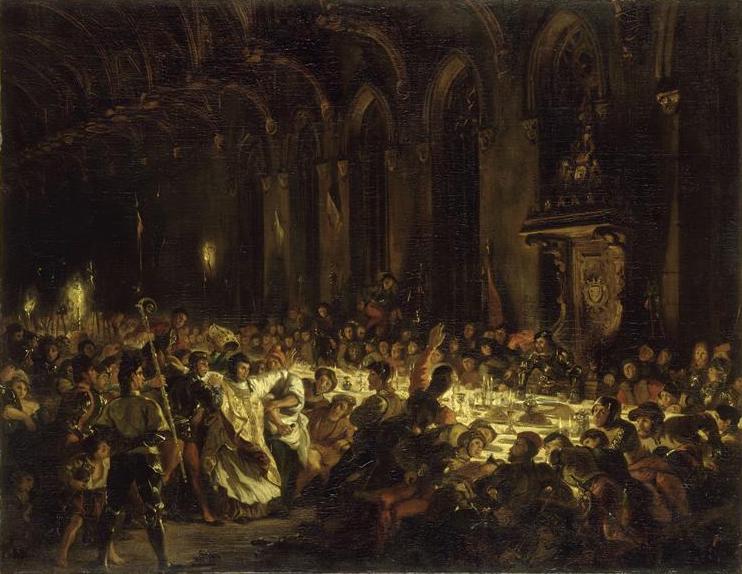
In 1482, the Wild Boar assassinated the sitting Prince-Bishop of Liege, Louis de Bourbon. It’s a scene captured in dark melodrama by Executed Today‘s court painter Eugene Delacroix.

He intended by this stroke to set up his son Jean de La Marck as the Prince-Bishop. Instead he kicked off a civil war and in lieu of the mitre he obtained a payoff from the Prince-Bishopric as Liege turned to resisting the inroads of the Austrian Empire. The Boar now allying with Liege in this endeavor, he was ingloriously ambushed by imperial forces and brought in for butchering.

On this day..

1751: Thomas Quin, Joseph Dowdell, Thomas Talbot, and five others at Tyburn

From the Newgate Calendar:

THOMAS QUIN, JOSEPH DOWDELL, AND THOMAS TALBOT

A Gang of Notorious Thieves, executed at Tyburn, June 17, 1751, for robbery.

At length these miserable robbers see,
Unhappy fruit, suspended on the tree;
They teach, sad lesson! in their wretched state,
That shame and ruin are the villain’s fate;
And that too late each guilty man will find,
Justice, though sometimes slow, is never blind.

The villains disclosed in this narrative, will shew the necessity of the act of parliament for inflicting punishment on masters and mistresses giving a false character. of a servant.

A corrupt servant is the most dangerous inmate of a house; and therefore too much caution cannot be used in admitting such domestics.

Quin, a murderer in his own country, Ireland, was recommended to London as a youth of good morals; while his disposition was base to a great degree.

Dowdell, who in his apprenticeship had injured his first master, procured a recommendation to another, to whom he also proved a villain.

The Case of the unhappy WILLIAM GIBBS, now under Sentence of Death.

On the 13th of March I went to the House of John Duncombe, at Nine at Night, to get a Pint of Beer. I lived five Doors from him. I sat down to drink my Beer, and in came Litchfield, Corbet, Smith, Jackson, and one Gordon; Litchfield went away, and left the rest; Smith and Corbet went to Cards, and Wine came in plentifully. I being a Neighbour, was desired to take Part, which I did. About Two o’Clock Mrs. Duncombs took her Purse, and dropt it over the Bar, I believe, in the Sight of all, except Jackson, who was drunk, and asleep on the Ground, notwithstanding he took upon him to swear hard against me, and was scarce able to stand or sit upon a Chair. I seeing Mrs. Duncombe so careless, and for no other Reason than to make her careful another Time, took the Purse, thinking it was Silver, (and not imagining a Sum of that Consequence would be so heedlessly handled) took it, and went and laid it on a Bulk, (which, by the bye, was his own Wife’s Green-Stall) a few Yards from Duncombe’s Door. Mrs. Duncombe missing the Purse, cried out, I have lost twenty-three Guineas; which frightened me almost out of my Senses, and she called her Husband. I denied the taking of it, and desired the Servant to call my Wife, thinking to get her to bring the Purse, and drop it in the Bar, or thereabouts; for, when I heard of the Sum, my Heart melted within me. Mr. Duncombe said, There’s no Occasion to call any Body, it is a Joke, and I will give a Bottle of Wine, and a free Pardon, and Thanks to him that will give an Account of it. I was very glad to hear that, and called him Backwards into the Yard, and said, Mr. Duncombe, I am sorry I should jest with such edged Tools, I little thought the Contents, but as I am a Neighbour, and live in Credit, pray let it go no farther; he said it should not; I told him where it was, and sent him for it. The Purse he had intire, and brought in a Bottle of Wine; and shook Hands; and, to all Appearance, were good Friends, as formerly, I having used his House ever since he kept it. And when he went to take Ship to go to Scotland, and carried a great Charge of Money, he chose me to conduct him, at Midnight, from Hyde-Park Corner to Hermitage Stairs. I really loved him, and would have done him any Service, as soon as I would have done it for myself; but a Person in Company, Corbet by Name, said we could not make the Matter up without going before a Justice. We agreed to go, Mr. Duncombe, myself, and another, privately. We did so, and Mr. Duncombe told the Justice, who lives near Golden Square, St. James’s, that it was a Jest, but that he wanted to be safe, and we were recommended to give general Releases. While my Wife was gone to get Releases drawn, an inveterate Enemy of mine came into the publick House where we were waiting, who called Mr. Duncombe out, and persuaded him to go to another Justice, and take out a Warrant for me, and before my Wife came back with the Releases, they had served a Warrant on me; and although we were within five or six Doors of the aforesaid Justice, they were ashamed to take me there, but took me about a Mile to another, by whom I was committed, although before recommended for Releases by the other. It plainly appears I had no Intent to keep the Purse or Contents for several Reasons: As first, No Person could lay it on me more than another, for there were four Persons in the House besides myself, and, as I am a dying Man, I never had a Thought of defrauding him of a Shilling. Secondly, I, as a Friend and Neighbour, have been Night and Day entrusted in his House, all the same as his Brother, and he never lost any thing as I ever heard of. Lastly, My Circumstances were not so bad as to cause me to do an ill Action, for I kept two Shops, one at Hammersmith, where my aged Father and Mother lives, and the other at Hyde-Park Corner; and when I came into Trouble I had two Apprentices, one of whom I have turned over since I have been in Newgate. I have a Wife and three Children, a Father and Mother, the one 80, the other 85 Years of Age, whose grey Heirs, without God’s great Mercy, will be brought with Sorrow to the Grave. When this great Misfortune happened to me, I worked for a great many noble Families, and I praise God, wherever I worked there was nothing lost. That unhappy Day, the 13th of March, I had been part of it at work at a worthy Gentleman’s, and was weary, and wanting a Pint of Beer before I went to Bed, could not be content to have it at Home with my Family, but must unfortunately go to the House, whereby I put myself in the Way of this great Misfortune, and if it be the Will of Divine Providence that I must suffer, I am content and resigned.

William Gibbs.
May, 1751.

Letter of one of the five other men hanged with Quinn, Dowdell, and Talbot

Talbot, the third of this dangerous gang, after having robbed on the highway; and being afraid of apprehension; applied to be restored to honest servitude, and was refused; but his master, in pity to his distresses, recommended, him to a nobleman.

Talbot, on the first opportunity, robbing his noble employer, we would ask whether the late master, knowing the servant to have been a thief, was not, in recommending him to an honest employ, virtually, the greater villain of the two? In fine, they were all from early youth, delinquents; and each had been imposed on honest people by those who knew them to be such. No wonder, then, that they will be found thereof the greatest rascals in this calendar of crimes.

Quin was a native of Dublin, the son of honest, but poor parents; and his father dying while he was a child, his uncle put him to school, and afterwards placed him apprentice to a buckle-maker, with whom be served three years faithfully; but his friends supplying him with clothes too genteel for his rank in life, he began to associate with gay company, and was guilty of many irregularities.

These thoughtless youths were frequently concerned in riots, and Quin was considered as the head of the party. In one of these nocturnal insurrections, Quin murdered a man, whose friends, watching him to his master’s house, desired that he might be delivered up to justice; but some of the journeymen sallying forth with offensive weapons, drove off the people; on which a warrant was issued for apprehending the murderer, when his master advised him to depart for England.

A subscription for his use being raised by his friends, he came to London, having recommendations to some gentlemen in that city; but of these he made no use, for, frequenting the purlieus of St. Giles’s, he spent his money among the lowest of his countrymen, and then entered on board a man of war.

After a service of six months, he quitted the ship at Leghorn, and sailed in another vessel to Jamaica, where he received his wages, which he soon spent. He now agreed to work his passage to England, and the ship arriving in the port of London, he took lodgings in St. Giles’s, and soon afterwards became acquainted with Dowdell and Talbot, of whom we are now to give an account.

Dowdell was the son of a bookbinder in Dublin, who being in low circumstances was unable to educate his children as he could have wished. His son Joseph, who was remarkable for the badness of his disposition, he ‘prenticed to a breeches-maker, but the graceless youth grew weary of his place before he had served two years of his time.

Dowdell being ordered by his master to take proper care of some green leather, particularly to defend it from the snow; instead thereof, he heaped such quantities of snow and ice on it, that it was greatly reduced in value. This circumstance so exasperated his master, that he was glad to get rid of him by delivering up his indentures of apprenticeship.

Thus at large, and the father ill able to support him, he was recommended to the service of a gentleman in the country, with whom he might have lived happily: but he behaved badly in his place, and running away to Dublin, commenced pickpocket.

After some practice in this way, he became connected with a gang of housebreakers, in company with whom he committed several depredations in Dublin. Having broke open a gentleman’s house, he was opposed by the servants, and effected his escape only by the use he made of a hanger; soon after which he was taken by the watchmen, and being carried before a magistrate, he was committed to prison till the next morning, His person was advertised, and he was brought to trial, but none of the servants being able to swear to him, he was acquitted for want of evidence.

He now renewed his dangerous practices, and committed a variety of robberies. The following is one of the most singular of his exploits. Going to the house of a farmer, near Dublin, he pretended to be a citizen who wanted a lodging, for the benefit of his health, and he would pay a liberal price.

The unsuspecting farmer put his lodger into the best chamber, and supplied his table in the most ample manner. After a residence of ten days, he asked the farmer’s company to the town of Finglass, where he wanted to purchase some necessaries. The farmer attending him; Dowdell purchased some articles at different shops, till seeing a quantity of gold in a till, he formed a resolution of appropriating it to his own use.

Having returned home with the farmer, Dowdell pretended to recollect that he had omitted to purchase some medicines, which he must take that night, and which had occasioned his going to Finglass. Hereupon the farmer ordered a horse to be saddled, and Dowdell set forwards, on a promise to return before night. On his arrival at Finglass he put up his horse, and stealing stealing unperceived into the shop above-mentioned, he stole the till with the money, and immediately set out for Dublin.

In the interim, the farmer missing his lodger, went to Finglass, and not finding him there, proceeded to Dublin, where he chanced to put up his horse at the same inn where Dowdell had taken up his quarters.

In a short time he saw our adventurer with some dealers, to whom he would have sold the horse; on which the farmer procured a constable, seized the offender, and lodged him in prison.

For this presumed robbery (a real one, doubtless, in the intention) he was brought to trial; but it appearing that the farmer had intrusted him with the horse, he could be convicted of nothing more than a fraud, for which he received sentence of transportation.

The vessel in which he sailed being overtaken by a storm, was dashed on the rocks of Cumberland, and many lives were lost, but several, among whom was Dowdell, swam on shore, and went to Whitehaven, where the inhabitants contributed liberally to their relief. Dowdell travelling to Liverpool, entered on board a privateer, which soon took several prizes, for which he received 60l. to his share, which he soon squandered in the most thoughtless extravagance. Being reduced to poverty, he robbed a Portuguese gentleman; for which he was apprehended, but afterwards released on the intercession of the gentlemen of the English factory; on which he sailed for England, and arrived at London.

He had not been long in the metropolis, before he associated with a gang of pickpockets and street-robbers (among whom was one Carter), whose practice it was to commit depredations at the doors of the theatres. Dowdell had not long entered into this association, before he and Carter went under the piazzas in Covent-garden, where the latter demanded a gentleman’s money, while Dowdell watched at a little distance, to give notice in case of a surprise. While Carter was examining the gentleman’s pockets, he drew his sword and killed the robber on the spot, and a mob gathering at the instant, it was with great difficulty that Dowdell effected his escape.

He now went to the lodgings of a woman of ill fame, who having been heretofore kept by a man of rank, he had given her a gold watch and some trifling jewels, which Dowdell advised her to pawn, to raise him ready money.

The girl hesitating to comply, he beat her in a most violent manner, on which she swore the peace against him; whereupon he was lodged in Newgate, but discharged at the next sessions, no prosecution being commenced against him.

He was no sooner at large, than he made a connexion with a woman of the town, whom an officer had taken to Gibraltar, and during her residence with him she had saved a hundred moidores. Dowdell having possessed himself of this sum, soon spent it extravagantly, and then prevailed on her to pawn her clothes for his support.

Talbot was the son of poor parents, who lived in Wapping, and having received a common education, he engaged himself as the driver of a post-chaise, in the service of a stable-keeper in Piccadilly. While he was driving two gentlemen on the Bath road, a highwayman stopped the carriage, and robbed them of their watches and money.

This circumstance gave Talbot an idea of acquiring money by illicit means; wherefore, on his return to London, he made himself acquainted with some highwaymen, assuring them that he was properly qualified to give them the intelligence necessary for the successful management of their business.

His proposal met with a ready acceptance; and a company having soon afterwards hired a coach and six of his master to go to Bath, Talbot gave one of the highwaymen notice of the affair; and it was resolved that the robbery should be committed on Hounslow-heath.

The highwaymen meeting the carriage on the appointed spot, robbed the parties of all they had, so that they were obliged to return to London for money before they could pursue their journey. Talbot’s share of this ill-gotten booty amounted to fifty pounds, which gave him such spirits that he resolved to pursue the same iniquitous mode of living.

In consequence of this resolution, Talbot informed the highwayman of some company going to Bath, and he attempted to rob them, but a gentleman in the carriage shot him dead on the spot.

Mortified at this accident which had befel his friend, Talbot no sooner arrived in London than he determined to resign his employment, and commence robber on his own account; but previous to engaging in this business, he spent his ready money in the worst company.

After several attempts to commit robberies, and having narrowly escaped the hands of justice, he grew sick of his employment, and requested his former master to take him into his service. This he declined, but in pity to his distress, recommended him to a nobleman, in whose family he was engaged.

Talbot had been but a short time in his new place, before he robbed the house of several articles of value, which he sold to the Jews, to supply the extravagance of one of the maid servants, with whom he had an amour.

This theft was not discovered at the time; but Talbot was soon discharged from his place, in consequence of the badness of his temper, which rendered him insupportable to his fellow servants.

On his dismission he spent his ready money with the most abandoned company, and then commencing housebreaker, committed a variety of depredations in the neighbourhood of London; for one of which he was apprehended and brought to trial at the Old Bailey, but acquitted for want of evidence.

On the very evening he was acquitted, he stopped a carriage in Drury-lane, and robbed a gentleman of his money, which he soon spent among the most dissolute of both sexes; and within a week afterwards, he broke into a house in Westminster, where he obtained plate and cash to a large amount, but was not apprehended for this offence.

In a few days he was taken into custody for picking a gentleman’s pocket, brought to trial, at the Old Bailey, sentenced to be transported for seven years, shipped to America, and sold to slavery.

He had not been long in this situation, when he embarked at Boston, in New England, on board a privateer; but when at sea he entered into a conspiracy with some of the sailors, to murder the officers, and seize the vessel; but the confederacy being discovered in time, a severe punishment was inflicted on Talbot and the other villains.

Talbot, quitting the privateer, sailed to England in a man of war, and engaging with some street-robbers in London, was apprehended, convicted, and sentenced to die: but he found interest to obtain a pardon on condition of transportation.

However, he had not been long abroad before he returned, in company with an abandoned woman, who had been transported at the same time; and this woman introduced him to the acquaintance of Quin and Dowdell, in company with whom he committed a considerable number of robberies.

These accomplices robbed six coaches one evening, and obtained considerable plunder; but this being soon spent in extravagance, they at length embarked in a robbery which cost them their lives.

Having made a connexion with one Cullen, they all joined in a street-robbery, and stopping a coach near Long Acre, robbed a gentleman of his watch and money. Some people being informed of the affair, immediately pursued them; and Cullen, being taken into custody, was admitted an evidence against his accomplices, who were apprehended on the following day.

Being brought to trial at the next sessions at the Old Bailey, they received sentence of death; but, after conviction, seemed as little sensible of the enormity of their crimes, as almost any offenders whose cases we have had occasion to record.

Dowdell and Quin were Roman Catholics; and Talbot refusing to join in devotion with the ordinary of Newgate, at the place of execution, we can say nothing of the disposition of mind in which they left this world.

We would have wished the following exclamation the mouths of these miserable sinners, at the time they made their dying atonements

O omnipotent Creator! Such hellish deeds
My soul abhors. O Lord! behold my frame,
My inmost frame, and cleanse my sinful thoughts
Then ever guide me in thy perfect way,
The way established to eternal bliss?

These men died, we fear, unrepenting sinners.

On this day..

1863: William Lynch, suppressed mutineer

(Thanks to Edward Waldo Emerson, the son of transcendentalist chin-wagger Ralph Waldo Emerson, for the guest post. His account of the beloved Massachusetts cavalryman Charles Russell Lowell’s lethal suppression of a mutiny in his civil war regiment, as related to him by Lowell’s widow for his, Emerson’s, 1907 biography Life and Letters of Charles Russell Lowell. Lowell can’t speak for himself on this account because he was killed the next year at the Battle of Cedar Creek, after which he was posthumously promoted to Brigadier General.

Emerson does not directly narrate a death penalty story, but the image in the coda records the fate of one of the rebellious enlisted men. There were two others in legal jeopardy from this affair: Sylvester Riley died while awaiting his court-martial in Fort Independence in Boston Harbor; and, 16-year-old Francis Dew drew a death sentence which was commuted by President Abraham Lincoln on account of Dew’s youth. -ed.)

Mrs. Lowell, anxious that the exact facts be known, wrote for me this account of the

MUTINY IN BOSTON.

A very painful incident took place while Colonel Lowell was recruiting for the Second Cavalry, which impressed him very much.

Stopping as usual, at eight o’clock one morning, at the recruiting station, he found the small squad of new recruits who were to be transferred that day to the camp at Readville, in a state of mutiny. Hearing the noise on his arrival, he descended at once to the basement, and the Sergeant in command explained that he had ordered a man to be handcuffed, that the others had said it was unjust and should not be done, and had resisted. Colonel Lowell at once said: ‘The order must be obeyed.’ ‘No! No!’ shouted the men. He continued: ‘After it is obeyed, I will hear what you have to say, and will decide the case on its merits, but it must be obeyed first. God knows, my men, I don’t want to kill any of you; but I shall shoot the first man who resists. Sergeant, iron your man.’ As the Sergeant stepped forward with the irons, the men made a rush, and Colonel Lowell shot the leader, who fell at once. The men succumbed immediately, some bursting into tears, such was their excitement.

The whole incident was very painful to Colonel Lowell, especially because he had always regarded it as one of the privileges of an officer that he did not have to kill with his own hand.

The circumstances, however, turned out as fortunately as was possible in such a case. The man had no relatives, so far as could be discovered, and his record showed that he was a very bad man, and had previously been in the Regular Army, so that he knew very well what he was doing in resisting an order.

One of Governor Andrew‘s staff, who was present when Colonel Lowell reported his action, gave the following account, which I copy from Professor Peirce’s life of Lowell in the Harvard Memorial Biographies:

Entering his Excellency’s room, he made a military salute and said, ‘I have to report to you, sir, that in the discharge of my duty I have shot a man’; then saluted again, and immediately withdrew. ‘I need nothing more,’ said the Governor to a bystander, ‘Colonel Lowell is as humane as he is brave.’

On this day..