1726: Étienne-Benjamin Deschauffours

Etienne-Benjamin Deschauffours (or Duchauffour) was burned at Paris’s Place de Greve on this date in 1726.

Although executed on a sodomy conviction, it wasn’t mere same-sex indulgence but a monstrous, Jeffrey Epstein-like project of elite sexual depravity that cinched his fate, at least if the trial records are to be believed.

“Under a variety of pseudonyms, and in various lodgings, Deschauffours earned a living by spotting ‘likely lads’ and supplying them on payment of commission to wealthy clients, both French and foreign (perhaps some 200 in all),” quoth Who’s Who in Gay and Lesbian History: From Antiquity to World War II.

Deschaffours frequently tried out his finds (young and very young), and found his pleasure in their pain (it is difficult not to think forward to the Marquise de Sade, or backward to Gilles de Rais). He castrated a young Italian whose admirer hoped this might render him more compliant.

Reportedly, he procured these semi- or unwilling charges for overmighty magnates who were — as with the previous century’s Affair of the Poisons — far too powerful and numerous to bring to book without inviting systemic crisis. Their vices thus remain mere rumors even down to our remove of posterity, for whom shadowy and redacted documentation yet conceals god knows what monstrosities.

Jim Chevallier, in The Old Regime Police Blotter II: Sodomites, Tribads and “Crimes Against Nature”, notes a 1734 doggerel capturing the scandal-mongering that became as the popular impression of the affair.

Du Chauffour and d’Oswal
are two unparalleled buggers,

There’s the resemblance.

One burned for his crime,
The other was made cardinal,

There’s the difference.

On this day..

1701: Captain Kidd

On this date in 1701, the pirate William Kidd hanged at London’s Execution Dock; his body was afterwards gibbeted at Tilbury Port.

Alhough his famous buried treasure and its subsequent literary afterlife has helped make Kidd one of history’s best-known buccaneers, the man more closely resembles a startup entrepreneur … just a monumentally unlucky one.

The Scotsman had done well enough as a relatively legitimate privateer raiding enemy French ships to settle down in colonial Manhattan in the 1690s. He made a prosperous marriage to a wealthy widow, and for several years he dwelt as a respectable burgher who helped underwrite construction of the still-extant landmark Trinity Church.

Induced by whatever reason of restlessness or cupidity, Kidd in 1696 came to captain the venture that would be his undoing: the voyage of the aptly if unimaginatively christened Adventure Galley. Backed by a who’s who of Whig worthies up to and including the king himself, Kidd set out for the Indian Ocean bearing letters of marque that authorized him not only to prey on the French, but to attack “Pirates, Freebooters, and Sea Rovers,” which is like when Willie Sutton explained that he robbed banks because that’s where the money is.

The adventure flopped owing to the galley’s singular infelicity with locating suitable prizes. As 1697 stretched into 1698, there grew the prospect of ruin and the discontent of the crew — who, like Kidd’s investors, would only be paid out of such loot as their ship could capture. Desperation drove Kidd to increasingly reckless attacks against unauthorized targets, most notoriously an Armenian-owned merchantman called the Quedagh Merchant, heavy with trade goods owned by an Indian nobleman well-connected to London through the Mughal court. Kidd would argue that French passes purchased by that ship’s English captain made this a legal prize, but you can’t muddle high statecraft and big business on legal chicaneries. In English eyes he had by this and several other incidents gone the full pirate himself; on top of that, he also fatally bashed a truculent gunner about the head, which added charges of murder to his eventual indictment.

Kidd’s career ended in the New World where his reputation as a criminal hunted by the English Navy precluded protection — everywhere from the Caribbean to his own former haunts in the North American colonies. Eventually it was the Earl of Bellomont (who was also governor of New York) who clapped Kidd in irons, possibly concerned to display a profligacy of zeal lest his own early sponsorship of Kidd’s disastrous mission redound against Bellomont himself. Kidd’s unsuccessful attempt to bargain with his patron turned jailer using the promise of hidden pirate booty is one source of the legends that have followed his name down the years.

Another source is the public and greatly protracted nature of the proceedings against Captain Kidd. It was nearly two years from his arrest to his execution, an age that saw him returned to England and examined personally by Parliament — product of an attempt by Tories to tar their political rivals with the association.

Kidd for his own part pleaded innocence and wrote plaintive letters to the king from his stinking cell in Newgate, to no avail. “It is a very hard Sentence,” he reproached the judge upon hearing his fate. “For my part, I am the innocentest Person of them all, only I have been sworn against by perjured Persons.”

On this day..

1559: Spanish Protestants at Valladolid

On this date in 1559, an auto de fe in Valladolid marked the onset of an Inquisition purge of nascent Lutheranism in Spain.

Now you’d expect to find the Spanish Inquisition policing spiritual disloyalties of the realm’s backsliding Jewish and Muslim conversos

… but of course the Tribunal of the Holy Office of the Inquisition had a broad remit to defend orthodoxy and considering that Spain is still a predominantly Catholic country they’d be entitled to point at the scoreboard.

In 1558, it caught wind of an actual Lutheran movements, heretofore rarely seen on the peninsula — and as Joseph Perez notes, it alarmingly penetrated clerical and aristocratic circles. “A blast of hysteria struck Castile. Suspects filled the prisons, where there was soon no room for newcomers. Nor were there enough inquisitors to conduct the trials. Others had to be brought in from Cuenca and Murcia … It proved necessary to provide special protection for the detainees, to prevent them being lynched by the infuriated populace.”

A series of autos collectively comprising scores of defendants unfolded over 1559-1560, beginning in Valladolid — where the Lutheran cadre seemingly numbered close to 100 literate and influential souls.

Underscoring how deeply this heretical sect reached into the Spanish state’s heart, the star attraction among the 14 Protestants burned that day was Augustino de Cazalla, a chaplain to Emperor Charles V. Others joining him included:

  • Two siblings of Augustino de Cazalla: Francisco de Buiero [Vivero], a priest, and Beatriz de Buiero
  • Alfonso Perez, another priest
  • Juan Garcia, a goldsmith
  • Antonio Herrezuelo,** a lawyer
  • Christoforo de Ocampo de Zamoza
  • Christoforo de Padilla de Zamoza
  • Caterina Roman
  • Doña Caterina de Ortega, daughter of the Treasurer
  • Francisco de Herrera
  • Isabella de Strada de Pedrosa
  • Juana Velasquez de Pedrosa
  • Gonzalo Vaiz

The Lutheran crackdown was only getting started. As our chronicler Joseph Perez observes, “On 24 September, over 100 individuals were sentenced in Seville; twenty-one received the death penalty. Among them was a son of the count of Bailen, first cousin to the duke of Arcos. Here too, one man was burnt alive for having remained true to his convictions to the end. On 8 October, Philip II presided over the second auto da fe of Valladolid in the course of which fourteen individuals were sentenced to death, among them Carlos de Seso, who was burnt alive for persisting in his errors. Then, on 22 December 1560, another auto da fe took place in Seville: seventeen of the accused were sent to the stake, three of them in effigy, one of whom was Doctor Constantino Ponce de la Fuente.”

* The whole family received the fury of the Inquisition: two other siblings caught non-capital sentences, an the already-deceased mother Doña Leonora de Buiero was exhumed for burning along with the living heretics. Not only that, the family house was razed and a marker disgracing the family was erected in its place.

** Herrezuelo’s wife, Leonor de Cisneros, recanted to avoid the stake but the resulting reproach from her martyr-husband stung her so deeply that she followed his fate in 1568. Herrezuelo was the militant of the crowd: all of the other 13 disavowed their errors to obtain the mercy of strangulation prior to incineration; Herrezuelo died gloriously obstinate, suffering burning alive to spite his persecutors.

On this day..

1527: Hans Hergot, immovable type

Nuremberg printer Hans Hergot was beheaded in Leipzig on this date in 1527.*

He’d previously published work of revolutionary Thomas Müntzer and he proved his simpatico with that fellow’s millenarian vision by publishing his own tract, Von der newen Wandlung Eynes Christlichen (The New Transformation of Christian Living). It was for this utopian sedition that Hergot lost his life, and no wonder.

The vision is of an egalitarian, agrarian society organized on a parochial basis in which goods are held in common for the use of all, habitation is after the Carthusian pattern, farming and crafts operate harmoniously, and every invidious ground and sign of social distinction has disappeared …

The enemies of Hergot’s revelation on whom he pronounces God’s imminent wrath are the ruling nobility and the Lutheran “scripture wizards” who theologically collude with them, the unjust acquitting the unjust …

It is precisely the eclecticism of Hergot’s prophetic voice that underlies its importance. For it suggests how a far-flung outburst of enthusiasm for divine or evangelical law, as opposed to corrupt and compromised human ordinances, was a connecting thread among myriad reforming orientations int he early sixteenth century — humanist, Lutheran, mystical, and apocalyptic — all of which intersected with the German Peasants’ War and the development of Anabaptism and other strands of Christian social radicalism.

From Irenaeus to Grotius: A Sourcebook in Christian Political Thought

There’s a “Hans Hergot Tower” in the Saxon town of Uelzen.

* Overshadowed, on the Reformation martyrology, by Anabaptist Michael Sattler, who burned at Rottenburg on the same date.

On this day..

1876: Hjert and Tector, the last public beheadings in Sweden

Augusta, you are now so big that the world’s temptations begin to surround you. Pay close attention to your own heart, for in the human heart lies a seed of evil and when it has the opportunity to take root it grows very fast …

From the last letter of Gustav Hjert to his family

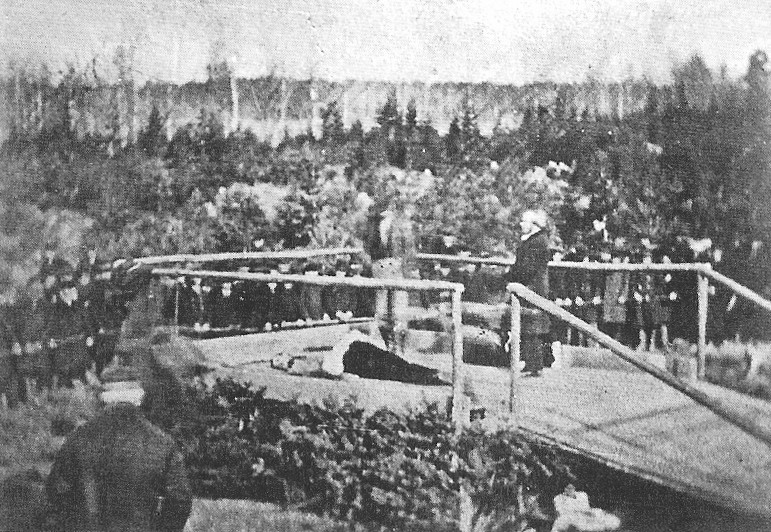
Below is a photo of the May 18, 1876 beheading of Gustav Adolf Eriksson Hjert, who with his accomplice in murder Konrad Petterson Lundqvist Tector/Tektor comprised the last public beheadings in Sweden. In the shocking image at hand, the fatal blow has been inflicted by the practiced arm of executioner Johan Fredrik Hort.

Hjert and Tector committed their capital crime together — it was a badly botched* armed robbery of a carriage that resulted in two people shot dead and no booty heisted — but they were separately separated from their heads: Hjert in Lilla Malma, and Tector in Stenkumla, both on the same Thursday morning.

* Botched as in, they were waiting to ambush the mail coach but in their eagerness they waylaid the wrong vehicle.

On this day..

1865: George Baker and George Beal, Salem murderers

A 1938 Oregon Magazine retrospective on the May 17, 1865 Salem, Ore. hanging of George Baker and George Beal(e) comes from a compilation of research on the wonderful site Oregon Pioneers.

These were very much pioneer days. The Pacific Northwest Oregon Territory started drawing large scale white settlement from the 1830s, with the onset of the Oregon Trail, the means by which both the offenders and the victim in this case arrived at this distant land.

The state of Oregon (only a subset of the Oregon Territory, which also comprised the present-day states of Washington and Idaho) attained statehood in 1859 with the census population weighing in at 52,000 the following year. Its first judicial executions only occurred in 1850 — so this punishment was very much a novelty, as the piece below indicates. (I’ve added some line breaks for readability.) There’s a great deal more at the Oregon Pioneers site.

SEVENTY-THREE Years is a long time, yet there are people now living who witnessed the execution of Beal and Baker on May l7th, 1865. The writer was a boy of 10 years at that time. Well do I remember the trial and execution of the men, for the murder of Daniel Delaney for his money.

Daniel Delaney was a wealthy stock raiser living about two miles southwest of Turner. He was a southerner and brought slaves with him to Oregon. He was a good citizen and a clean man, and his stock roamed over the hills and the valleys around Turner Station.

At that time he settled here there were no fences and the stock roamed over the whole country. There were no banks in this part of the state and whoever had money must hide it about his premises.

Delaney was supposed to have a lot of money. Beal was keeping a saloon in Salem in a building now occupied by the Marion Hotel. He lived across the street in a house south of the old Rector Hotel with his wife and mother. Beal had a partner in the crime, George Baker, who drove cattle for the early day butchers of Salem. He was a weak minded man, and lived on the block south of Beal’s saloon with his wife and three or four children.

On the night of the murder, Beal met Baker at a point on Mill Creek, formerly agreed upon. Beal was walking and Baker was riding a black mare hereafter mentioned in this article. At this point they obtained some charcoal which they used on their faces to disguise themselves, as Beal was well acquainted with Delaney, and often would stay all night with him while off on hunting trips when in that part of the country. He also crossed the plains in the same train with Delaney in 1843.

Delaney lived alone except for a colored boy, 12 years of age, and his dog. They called the old man out of the house and shot him and also the dog. The colored boy hid in the wood pile near the house. Delaney, who was wounded, recognized Beal and said to him, “Spare my life, Beal, and you can have all the money I have got.” Beal drew a revolver from his pocket and said to him, “Dead men do not talk,” and fired a shot that finished Delaney, who was wounded.

The colored boy remained in hiding until daylight next morning, then taking the dog, which was badly wounded, carried him over to one of Delaney’s sons about a mile away, giving the alarm.

Beal and Baker were soon arrested for the crime on suspicion. One of the suspicious circumstances was that the black mare which Baker was riding on the night of the murder had lost one shoe. Another was the finding of a hat band which had been lost off Beal’s hat.

The trial was very interesting and so many people wanted to hear the trial that there was not room in the old wooden court house which occupied the same ground as the present one, so the trial was held in the Holman block, used by the legislature before the state capitol was built.

The prisoners were defended by Caton & Curl with David Logan, prominent attorney in Oregon at that time. Rufus Mallory was prosecuting attorney. The colored boy proved to be a very good witness for the state; also the hat band which fitted Beal’s hat was found in his bed room after his arrest; also the black mare had one shoe missing.

The prisoners were found guilty after a long and tedious trial and were sentenced to be executed on the 17th day of May, 1865. For this purpose the county of Marion erected a wooden scaffold on the block on South Church street, bounded by Church, Mill, Winter and Leslie streets.

The prisoners were confined in a small brick jail on the northwest corner of the court house block, until the day of the execution, when they were taken from the jail by the then Sheriff of Marion County, Samuel Hedrick, and placed in a hotel bus and taken to the place of execution, where they paid the penalty of their crime.

The death march was impressive. At that time Marion county had a militia company known as the Marion Rifles. They were dressed in gaudy uniforms as on dress parade and formed around the bus in a hollow square with fixed bayonets. Marching east on Court to Church street, thence south on Church street to the place of execution. The procession was followed by a vast crowd of people.

The military unit then formed about the scaffold until after the execution. People came to witness this execution from all parts of the state, even some Indians from Grand Ronde and the Siletz reservations. In fact, it was considered a public holiday. My old school teacher, Pearson, a law and order man, dismissed school so his pupils could witness the execution of these men as an object lesson.

The high grounds about the mill race formed a natural amphitheater for the occasion. Beal walked up the steps to the platform on the scaffold with a firm step. He then produced a small bible and read from it a short chapter, and then said in a firm voice, “Now take this book and read it and follow its teachings and you will never come to what I have.” He then tossed the book to the people in the crowd.

Baker was very weak and had to be assisted up the steps.

Soon the rope was placed about the necks of the prisoners and it was soon over. Public sentiment was strong against these men, especially Beal, who was considered the master mind in this sad affair; even so much so that objections were made to them being buried in our local cemetery. But Daniel Waldo, a good old pioneer, granted space for them on his farm on what is known as the Waldo Hills. He said every man, good or bad, should be entitled to six feet of earth.

The public sentiment against the murderers was so far reaching it even extended to the attorneys for the defense, in the loss of practice. However, it sent Rufus Mallory, who prosecuted the case, to the lower house of congress from Oregon.

And it must have had some good effect in a moral way, for it was twenty years before another man was executed for murder in Marion County.

I wrote this story as I remember it as a boy of ten years of age. I had a chum like most boys, and we were interested very much in the trial and excitement. Sometimes we could not get a seat. One time we secured good seats but the sheriff, Samuel Hedrick, made us give them up to older people. We did not like it very much, but had to do it with a smile. But twenty-three years later the ten-year old boy had taken over his office.

On this day..

1920: Four denunciators of Laon

(Thanks to Alphonse Lemonon for the guest post, which originally appeared under the title “Civilization’s Thin Veneer: War Shows the Seamy Side of Human Nature” in The Overland Monthly (July 1920). As noted in the foreword paragraph, it’s substantially an English translation of reporting from May 16, 1920 edition of Le Petit Journal. These were the unlucky half of eight people convicted in a trial touching 44 Frenchmen and -women from the northern regions occupied by Germany at some point during the late war, who were accused of collaborating with those Germans and denouncing their patriotic countrymen. There’s much more about this case (in French) including more pictures (in grainy black and white) in this police magazine. -ed.)

[Almost at the moment when Joan of Arc was being canonized with all the clerical ceremonies at Rome [this occurred on May 16, 1920 -ed.], four political prisoners — one a woman — were tied to stakes and shot according to military and civic ceremony near Paris. The tragic and instructive narrative is here told in a translation from the most popular Paris Newspaper — Le Petit Journal, May 16, 1920.]

FOUR of the condemned informers of Laon, of which affair one has not forgotten the dolorous echo, Georges Toque, Moise Lemoine, Leander Herbert and the woman Alice Aubert were shot yesterday morning, at Vincennes, and if it were an affecting execution, it assuredly was to them. Two of them fell while swearing to their innocence and crying “Viva la France!”

The Last Awakening.

All four were awakened at 4 a.m. Some instants before the officers charged with the transfer of the condemned to execution had presented themselves at several prisons; some at the prison de la Sante where Toque and Lemoine were confined, others at Cherchi-Midi where Herbert was detained, and a third group at the prison de Saint-Lazare, where one other, Alice Aubert, condemned of the same affair, was held. She occupied a cell with Helen Favre, who had been reprieved.

The lawyers of the four condemned were on hand to assist their clients until the last moment. Maitres Delmont and Campinchi arrives at the prison La Sante about the same time as lieutenant-colonel Beyle, commissioner of the government. All were shown together to the cells and Toque was called. He was seated and dressing himself. The usual words on such occasions having been pronounced by the commissioner of the government, the condemned man moved towards the foot of his bed and finished his dressing — never ceasing meantime to protest his innocence.

Maitre Delmont handed the prisoner his shoes which he took with a gesture of indifference and while putting them on remarked: “I go to make the journey to eternity and have no need.” Having completed his dressing he wrote two letters, which he intrusted to Maitre Delmont for delivery. One he addressed to his wife, the other to the minister of Justice. It follows:

Monsieur le Ministre de la Justice.

At the moment of dying, I affirm solemnly my innocence and of you demand vengeance.

I swear that i have never belonged to the spy service of Germany. I swear to have never rendered them any service, nor to have informed on anybody. I swear that Waegele has odiously lied.

Georges Toque.

At that moment the prisoner Lemoine who had been awakened about the same time as Toque passed in the corridor of the prison, and seeing his associate, called out to him:

“Let us go Toque, have courage.”

After the formal entry on the prison register, the two condemned men appeared in the court of the prison, their heads bare but their demeanor calm.

They were placed in the same automobile, seated opposite each other, the prison abbe and a gendarme accompanying them. The journey to the execution grounds began for them. Meantime painful scenes were being enacted at the prisons containing the two other doomed persons, Leandre Herbert the soldier and Alice Aubert. The soldier appeared demented. His lawyer could not calm him and called the prisoner’s attention to the automobile in company with two religienotice of the civilian doctor, Socquet, demanding a reprieve.

The doctor refused declaring that the wards Vincennes. prisoner enjoyed all his faculties.

“You are going to shoot an insane man. I leave the responsibility with you” concluded the lawyer.

Herbert was placed in a voiture and arrived at the scene of execution at Vincennes some minutes after Toque and Lemoine.

The three condemned men were subjected to an atrocious delay of three-quarters of an hour till the third voiture containing Alice Aubert appeared.

To allay the mental sufferings of the delay, when minutes seemed hours, it was proposed to the prisoners to alight from the voitures and walk in the court of the donjon at Vincennes, but Lemoine refused, as being too cold.

At Saint-Lazare.

While the three condemned men awaited death at Vincennes, a touching scene took place at the prison Saint-Lazare, where the condemned woman Aubert shared a cell with Helene Favre, condemned at the same time but commuted. The Favre woman thought she was the one about to be taken to execution and fell in a terrible nervous crisis.

On the contrary Alice Aubert had good control of herself, listened to the official orders without evincing any emotion; but her eyes filled and she cried silently some minutes. Then she began to dress herself, a figure sad and resigned. She said to her lawyer who tried to comfort her:

“If I am sad — if I cry — it is not for me, it is for my sister, it is for my child. It is also for the others condemned.”

She put on her yellow silk hose and patent-leather shoes which contrasted with her simple petticoat and mantle, and all the time she repeated: “Providing that I can go to heaven”; “Providing that I can go to heaven”; “Providing that I can go to heaven.” These words she used till she alighted at the execution ground at Vincennes.

Before quitting the prison Saint-Lazare the condemned woman wished to hear mass, and it was not until she had received communion that she mounted the automobile in company with two religieuses who assisted her until the last moments. The automobile then sped towards Vincennes.

At La Caponniere.

At five hours and a half (5:30 a.m.) an order rang out upon the ground of la Caponniere: “Garde a vous!” (Attention). The voitures containing the condemned advanced upon the road. The soldiers of the 13th artillery, the 23rd dragoons, and the 26th chasseurs, who formed the square, presented arms; the trumpets sounded “Aux champs!” the firing squads rectified their position before the four stakes placed in line at a distance of ten metres from one another.

Slowly the autos came to a a [sic] stop, and from the one at the head descended Toque and Lemoine, absolutely livid but calm.

The abbe Geispitz embraced the two condemned men and they in turn embraced their lawyers, and then Toque addressed his lawyer:

You have seen my memoranda and you know that I am innocent. Preserve well all the pieces show that I am not culpable. After my death — long time after — when calm will be returned to the consciences, make clear my innocence. Rehabillitate my memory, I pray you.

He directed again the attention of his lawyer to certain leaves of his memoranda that were not in their order, nor did he forget any detail.

And that man who came to die insisted again that in the future he be not misrepresented, that he be not disparagingly spoken of as “Toque the traitor”.

The painful and prolonged scene wore out the patience of Lemoine who tugged impatiently on the lapel of his companion’s overcoat and said “Let us go,” and took a step forward. The two condemned men escorted by the gendarmes then began to direct their steps towards the stakes where they were to stand before the firing squads, but were halted as the other two condemned prisoners, had not yet descended from their automobiles.

Turning about, Toque and Lemoine saw Herbert the soldier wearing his blue uniform, his cap turned the wrong way and advancing with long strides. He continued to speak incoherently: “Me also, I wish to say something — say something”. He did not cease to repeat these words and addressing the gendarmes he said: “Do not hold me — do not hold me — You will see — you will see — Ah! ah!”

Behind him came Alice Aubert, without coiffure like Toque and Lemoine and like those marching with firm step.

One moment where she entered the square, by one gesture instinctive of feminine coquetrie, she drew over her light colored dress her manteau of sombre hue.

Toque and Lemoine, who were advancing towards the stakes, turned again to speak the last word to their lawyers, the hands — a dernier au revoir — accompanied by a sign of the hands. And then the four condemned marched in Indian file traversing the square and directing their steps to the stakes at which the gendarmes tied them.

The Execution.

Toque was at the extreme right. Lemoine was at the second stake. Herbert was attached to the third. The fourth stake on the left propped Alice Aubert.

Lemoine and Toque refused the bandage intended to mask the view of the firing squad. Herbert remained mute and let things proceed.

The clerk of the Council of War at this moment appeared between the two firing squads in the centre and read the sentence of death.

All the official details in full had been finished and in the silence impressive the clear and strong voice of Toque elevated itself once more: “I swear that I am innocent; vive la France!”

Also Lemoine, elevating his right hand took the same oath and also cried: “Vive la France!”

As for Herbert, he articulated again the same phrase: “Me also I wish to say something.”

With hand raised Toque again avowed his innocence, until the soldiers of the front rank knelt to fire. All put their pieces to the shoulder. Again Toque cried: “Vive la France!” The officer lowered his sword and the fusil[l]ade crackled. But a frightful rattle, like an appeal for help escaped from the gorge of Toque. He was not dead. The guns had trembled in the hands of the firers.

Maitre Delmont, the lawyer of Toque, cried to an under-officer: “Dispatch him, dispatch him”! The soldier approached the palpitating body, from which escaped continually the heart-rending cries and discharged his revolver twice in the head of the condemned. The rattle ceased but the man still stirred and a third ball found the brain.

Alice Aubert, with her hands clasped upon her breast, and holding in her fingers a crucifix rested upright against the stake. She too received in her turn the coup de grace. Her head fell. Then she became completely erect and sank for the last time to move no more.

The two others also received their coup de grace; but it was unnecessary for Lemoine who had his skull stove in. It was not so with Herbert whose pulse continued to beat and his lips to move at the moment when a doctor examined him.

The civilian doctor Socquet, declared that he was dead, and the body of which one of the legs had been broken by a bullet was placed in a coffin.

After examining the two other cadavers, the doctor Socquet came to certify the death of Alice Aubert. He wished to examine the heart, but the chemise of the woman obstructed. A soldier, by the aid of a knife, cut the shoulder-strap and the doctor plunged his hand which trembled in the gorge of the woman streaming with blood. He drew forth a photograph equally blood-stained — the picture of the child of Alice Aubert. She had placed the photograph on her heart before going to die. It was piteously replaced upon the breast of the dead.

A sonnerie guerriere, resounded then, and to those notes of the trumpets the troops defiled.

All the assistants were paler than the dead.

Some minutes after two wagons, surrounded by dragoons, quitted the scene of execution and proceeded to the cemetery of Vincennes four kilometers distant. In the wagons were four wooden coffins. They contained the stripped bodies of the four executed prisoners.

The bodies not having been reclaimed they have been, after a mock burial, delivered to the faculty of medicine.

On this day..

1731: Two murderers and three crooks at Tyburn

The Ordinary of Newgate (in this case, James Guthrie) furnishes us the following “ACCOUNT, of the Behaviour, Confessions, and Dying Words, OF THE MALEFACTORS, Who were EXECUTED at TYBURN, On FRIDAY the 14th of this Instant May, 1731″:


BEING THE Third EXECUTION in the MAYORALTY OF THE Rt. Hon. HUMPHREY PARSONS, Esq;

Number III. For the said YEAR.

LONDON:

Printed and Sold by JOHN APPLEBEE, in Bolt-Court, near the Leg-Tavern, Fleet-street. M.DCC.XXXI.

[Price Three-Pence.]

THE ORDINARY of NEWGATE, His ACCOUNT of the Behaviour, Confession, &c.

AT the King’s Commission of Oyer and Terminer, and Gaol-Delivery of Newgate, held (before the Rt. Hon. HUMPHREY PARSONS, Esq; Lord Mayor of the City of London; the Rt. Hon. the Lord Chief Justice Raymond; the Hon. Mr. Baron Cummins; the Hon. Mr. Baron Thompson; the Hon. Mr. Justice Denton, and others of His Majesty’s Justices of Oyer and Terminer, and Gaol Delivery for the City of London, and Gaol-Delivery of Newgate, holden for the said City and County of Middlesex) at Justice-Hall in the Old-Bailey, on Wednesday, Thursday, Friday, Saturday, and Monday, being the 28th, 29th, and 30th, of April, and the 1st and 3d of May, 1731, in the Fourth Year of his Majesty’s Reign.

Nine Men, viz. James Berry, Richard Cooper, Francis Woodmarsh, Richard Trap, alias Blue Dick, John Peaverly, John Butler, Francis Lynn, alias Glynn, James Owen, and Ambrose Newport, were by the Jury found guilty of capital Crimes, and receiv’d Sentence of Death accordingly.

After Sentence, they were instructed in the chief Articles of our most Holy Christian Faith: That it is necessary to know that there is one God, the Sovereign Lord of Heaven and Earth; who made all Things by the Word of his Power, and who preserves every Thing in its Being; “For in him we Live, and Move, and have our Being, as certain also of your own Poets have said, for we are also his Off-spring:” As saith the Apostle St. Paul, Acts. xvii. 28.

And as from the omnipotent Word of God, we have our first Existence, and by his powerful Providence we are preserv’d in our Being; so we ought to believe, that there are three Persons in this one God; the Father, who creates and preserves us; the Son of God, who redeems us by his Death and Sufferings, and thus purchases us to be an holy, peculiar, chosen People unto God, zealous of good Works; and God the Holy Ghost, who sanctifies the elect People of God, and who preserves them by the mighty Power of God, through Faith unto Salvation.

And as we ought to believe in the Divine Unity, and that there is a Trinity of Persons in the Godhead; so are we to believe, that there is one Mediator or Intercessor between God and Man, according to the Holy Apostles Doctrine, 1 Tim. ii. 5, 6. For there is one God and one Mediator between God and Men, the Man Christ Jesus, who gave himself a Ransom for all, to be Testified in due Time. I exhorted them to believe in Christ, the Son of God, and only Saviour of Sinners, with an operative and lively Faith, moving us to Holiness in all manner of Life and Conversation, for Faith without Works is Dead being alone; as St. James says, Holiness is that which makes us like unto and resemble God, the Archetype of all Perfection, Purity and Virtue. And therefore, since they had been young Men void of Holiness and the Fear of God, which was the occasion of Gods forsaking them, since they had forsaken him, and knew nothing of his Ways, and giving them up to themselves, to their own Hearts Lust, to commit all Uncleanness and all manner of Wickedness with Greediness, I took occasion to offer them a serious Exhortation to Holiness in Heart and Life, to redeem their Time, because the Days are Evil, to improve the few Moments allow’d them upon Earth, in fearing and loving God, and endeavouring to keep his Commandments according to the Apostles Advice. “See then that ye walk Circumspectly, not as Fools, but as wise Men; redeeming the Time, because the Days are Evil.” Eph. v. 15, 16. And I desir’d ’em, to resolve, by the Grace of God, that if they had done Iniquity and Sin, they would do so no more: That whereas formerly they had been the Servants of Unrighteousness unto Sin, henceforth they would become the obedient Servants of rigteousness unto holiness; as the same Apostle adviseth us, “Neither yield ye your members as Instruments of unrighteousness unto Sin; but yield your selves unto God, as those that are alive from the Dead, and your members as instruments of righteousness unto God.” Rom. 6, 13. And I prest upon them to endeavour after habitual Holiness, because of the great Danger and Destruction ensuing upon a wicked Course of Life. As the Apostle also acquaints us, “For the Wages of Sin is Death: But the Gift of God is eternal Life through Jesus Christ our Lord.” Rom. vi. 23.

Two of them having been Convicted of Murder, I us’d many Motives and Arguments to convince them of the greatness of their Guilt. I show’d them that this was one of the blackest and most atrocious Crimes, Man was capable of committing, and that therefore, by all Laws Divine and Humane, the Punishment annext to this Sin is Death by the Sword of publick Justice. The History Moses gives us of the Creation and the antediluvian World, is Compendious, and the Account of the Flood itself, and the Times immediately following is but very short; yet that holy Man, inspir’d by the Spirit of God, in an extraordinary Manner, not making mention of other Laws and Customs proper to those very antient Times, takes particular Notice, no doubt as well knowing how prone Mankind is to prosecute Malice and Revenge, by extending their Resentment of suppos’d or real Injuries or Affronts too great a Length of Gods express Command, that the Murderer should by no Means pass unpunished, but that he should die a violent Death by the Hand of Justice. “And surely your Blood of your Lives will I require: At the Hand of every Beast will I require it; and at the Hand of Man, at the Hand of every Mans Brother will I require the Life of Man. Whosoe sheddeth Mans Blood, by Man shall his Blood be shed: For in the Image of God made he Man.” Gen, ix. 5, 6. Yet notwithstanding the greatness of their Sins, I desired them to throw themselves upon the Mercy of God which is Infinite, and if with David and Manasseh, who were true Penitents for the same Sin and Crime, they truly and sincerely repented, even of this henious Sin of Murder, then God would receive them into Favour, and Pardon that Sin, as he did remit the same to others; for Pardon is promis’d in general to a true Repentance for all his Sins without exception.

I instructed them also in the most important Affair of the Lords Supper, as a special Means to avert their Thoughts from all sinful Appetites, to dispose their Minds for receiving the Grace of God, and to prepare them for the Glories of a future State.

While these and many other good Instructions were given, all of them attended in Chapel; only James Berry was indispos’d for some Days, but behav’d Christianly, and show’d a great Desire to take the Sacrament, as did also some of the rest, and in general they behav’d with a better outward Decorum, than these unhappy Creatures use to do. Peaverly the poor Boy was also Sick for some Time, and carried himself always very decently. When I ask’d him, why he robb’d his Master of so great a Sum of Money as 48 Guineas, and what he intended to do with it, or if any Body advis’d him to such a Crime? He said he could not tell why he did it, that he knew not what to do with it, but to cram his Belly with good Victuals, and that no Body advis’d him, but that it was a Motion of his own wicked Heart. All of them made regular Responses; Butler and Lynn, although they declar’d themselves Romans, yet they gave close Attendance in Chapel, excepting one Afternoon, made Responces and comply’d with the Worship, as did the rest in time of Worship; they read a little too loud upon some Romish Manuals they had; but when I reprov’d them for it, and told them our Worship was such as no Christian could in Reason refuse to comply with, although there might be some other Differences, they did so no more, but were attentive with the rest.

Upon Tuesday, the 11th Instant, the Report was made to his Majesty in Council, of the nine Malefactors under Sentence of Death in Newgate: When John Butler and Francis Lynn, alias Glynn, of St. Giles’s in the Fields, for assaulting Edward Dyer on the King’s Highway, putting him in Fear, and taking from him a Hat, val. 5 s. and a Muslin Stock, val. 6 d. the 23d of August last; John Peaverley, of St. George’s Hanover-square, for feloniously stealing a Purse, val 2d. and 48 Guineas, in the Dwelling House of Robert Dickenson, the 25th of April last; and James Owen, of St. Bartholomew’s-Exchange, for feloniously stealing a Bank-Note, value 100 l. the Property of Thomas Butler, the 4th of February last, receiv’d his Majesty’s most gracious Reprieve.

The other Five, viz. James Berry, Ambrose Newport, Richard Cooper, Richard Trap and Francis Woodmarsh were order’d for Execution.

Francis Woodmarsh, of St. George Hanover-Square, was indicted for the Murder of Robert Ormes, giving him one mortal Wound with a Sword, on the left Part of the Body, near the left Pap, the Length of half an Inch, and the Depth of six Inches, of which he instantly died, the 19th of April last.

He was likewise indicted a second Time, upon the Coroners Inquest, for the Murder of the said Robert Ormes.

1. Francis Woodmarsh, 33 Years of Age, born in North-, of honest respected Parents, who liv’d much in Y-, and gave him good Education at School, in reading, writing, Latin, and Accompts, to fit him for the World, and instructed him carefully in the Principles of our holy Christian Faith. He did not go to any particular Business, when of Age, but acted the Gentleman more than any Thing else; he serv’d some Time in the Army, and was advanc’d (as he said) to be an Ensign in a marching Regiment, but soon left that Business; and afterwards not following any particular Trade of Life, ’tis to be feared he was too much addicted to Iddleness. He was married to a Wife, who appear’d to be a good, discreet Woman, whom he commended as such, and recommended to the Care and Kindness of his Friends, who were People of Respect. He had some Children, but they had all the good Fortune to Die before him. He said, he serv’d a Person of Prime Quality, till he went Abroad some Years ago, but without Hopes of returning in haste; and that some of his Friends serv’d that noble Family for some Generations past. He was a Kind of Dealer in Wigs; when any great Man, whom he knew, wanted a Wig, he us’d to make or provide him One, and by that he sometimes made 2 or 3 Guineas, which was the mot he had to Live upon for some Time past. He said, that about the Time of the late Rebellion, he did several good Services, kept some Gentlemen from joyning in that unnatural Rebellion, and travail’d over best Part of England and Scotland upon that Occasion.

His Father had an Estate and a good Farm in the Country, bestow’d very liberally upon him, and gave him several Sums of Money, of which he never made any good Account, and for that Reason, he had not much left him by his Father, and was he less esteem’d by his Relations. He said, that he was a sober Man, kept the Church, hated Cursing and Swearing, and other Vices, that he read his Book much, shunn’d idle Company, and lov’d a quiet, peaceable Life.

The Account he gave of the Murder of Robert Ormes, for which he died, was to this Purpose.

On the 19th Day of April last, which was Easter-Monday, he walk’d out alone, as far as Chelsea, for his Diversion: When he was upon his Return to Town, the Sun was pretty hot, and he being thirsty, went into on Ale house in Chelsea-Fields, where there was a Company of People, altogether Strangers to him, who Swore and Blasphem’d very much; he was impatient at the hearing of this, and gently reprov’d them, saying that there could be no Profit in using such execrable Oaths, and that it would be much better to be more Smooth in their Conversation, and not to provoke God, by such vain and very sinful Repetitions. They did not think him a proper Person to administer Reproof, but gave him Names, which he took to be opprobrious, and call’d them Scrubs; but insisted that he was a Gentleman and a Scholar, and repeated Si Deus est animas, &c. They bid him pay his Reckoning and begone, and said, they doubted if he had any Money in his Pocket, &c. several satyrical Expressions having past, he was weary of their Company, paid his Three-half-pence, for a Pint of Beer, and went off. The Deceas’d Mr. Ormes, his Wife, and the rest of the Company went out after him, and some of them swore, and cried out to dash out the I-n’s Brains. Upon which they beat him unmercifully, with their Canes and Sticks, upon the Head and other Parts of the Body. He was confounded and knew not what to do, but thought upon nothing but his being murther’d: To save himself, he retir’d a good Way, till he came to the Garden hedge, then he drew his Sword to defend himself, and call’d out to hold off and beware of him, being upon his own Defence. At this Time, Mr. Ormes, (as he suppos’d) rush’d upon his Sword and was kill’d, which was the easier done, because his Breast was naked, as he said. And more than this he knew nothing of the Matter: Only to extenuate the Affair, he said, he was very short-sighted, and never saw Ormes, nor none of the Company.

This is an Account, which contradicts the Evidence of the Prosecutor, and all who were against him, who swore possitively, that he stabb’d Mr. Ormes, without any Provocation, and that they did not see him receive any Stroaks with a Cane. I told him it was not probable, so many People would witness any Thing but Truth, without varying; but after all the Reasons could be us’d for an ingenious Confession, he never alter’d in his Narrative to me, nor to all those who visited him in the Prison, under Sentence, to whom he always repeated the same Thing, with abundance of Tears trickling down his Cheeks. He said he commonly walk’d out with a Sword, (which was very unfortunate to him, on that unhappy Day); although contrary to the Advice of his nearest Friends.

The Reason he gave for dressing like a Gentleman, was, because he had once been an Officer in the Army, and he also expected to get into the Service of some great Man, to whom his fine Dress would be one Recommendation. He made no Reflections, but only said, he heard Mr. Ormes was Quarrelsome.

He was Pusillanimous and of a mean Spirit, always wept and cried like a Child, when he told his Case to any Body, the Tears gush’d out in a very strange Manner, so that he could scarce speak because of his deep Sighs and Groans. I comforted him against the Fears of Death, but he remain’d inconsolable. I often told him, that his undiscretion, in medling with Strangers, of whom he knew nothing off, and with whom he had nothing to do, was the occasion of the unhappy Misfortune that happened; and therefore, laying aside all Pretences of Excuse, seeing he was legally Convicted, it was his Duty to repent of that grievous Sin of Murder: He said he did so, but it’s to be fear’d, he had some Reserve; and it’s certain, there could not be a Man more unwilling, and more afraid of Death than he was.

He had been of a careless and idle Disposition, which exposed him to Temptations, and brought him to a violent and shameful Death. He behav’d well, and appear’d very penitent. He declar’d that he hop’d for Salvation thro’ Christ, that he sincerely repented of all his Sins, and forgave all Injuries, as he expected Forgiveness from God.

On Wednesday Evening, the second Day before their Execution, One in a Lay-Habit, whom they supposs’d to be a R-sh P-st, came to him and spoke silently in his Ear, That it was necessary for him to Turn, for that there was no Salvation out of their Church. Woodmarsh was but a weak Man in his Intellectuals, and he said this Assertion of that Stranger, put him into the greatest Agony and Perplexity immaginable, all the next Night. I told him, he need not be afraid to trust his Salvation upon the Mercy of God, through the Merits of Jesus Christ; and that their Way of Instruction was, to teach Men to confide in their own Merits, and the intercession of the Saints, which was an uncertain Way of obtaining the Favour of God, and contrary to Scripture-Revelation. He was content, and said he did not believe him; but that being so near Death, it put him in no little Confusion, to hear himself upbraided, as if he had liv’d in so gross an Error all his Life.

This is a Freedom, which those of our Communion dare not take in some neighbouring Countries.

The following ACCOUNT of the Killing of Mr. Ormes, was delivered by Francis Woodmarsh, to a Gentleman in the Press-Yard, in Newgate, the Morning before his Execution, (in the Sight of a great Number of People there present,) and by him requested to be delivered to Mr. Applebee, to be publish’d to the World.-

As it is customary for Persons under my unhappy Circumstances to declare the Truth at their last Moments concerning the Fact for which they Suffer: I hope by this to satisfie the World as to the real Truth; tho’ things have been much misrepresented, which have done me no small harm.

ON Easter-Monday last, towards the Evening, calling at the Three Moor-Cocks in Chelsea-Fields (by my self) for a pint of Beer, I unluckily happen’d to go into the Room where Mr Ormes the Deceas’d was with his Friends, all Strangers to me, and all of them seem’d to be much in Liquor; and some of them talking very Profanely, I took the Liberty to Reprove them. At which the Wife of the Deceas’d was very Angry, and used me with a great deal of Ill manners, and gave me very abusive Language, and prompted Mr. Ormes her Husband to Quarrel with me; and her Expression was to knock my Brains out, with several other indecent Expressions, unbecoming her Sex; upon which I paid my Reckoning, and was going out of their Company; but to my great Surprize, Mr. Ormes push’d me out of Doors, and pursued me seven or eight Yards, giving me several Blows with his Cane, which at last obliged me to Draw my Sword in my own Defence, not with any Intention to Kill the Deceased, but only to make him desist from abusing me; but the Deceased-still pursuing me with his Blows, the unlucky Accident happened, for which I am immediately going to suffer Death.

I had no premeditated Design against the Deceased, he being an utter Stranger to me, having never seen him before.

Mrs. Middleton, the Landlady of the House, was in the Celler when I went out of the House, and so could not possibly see whether Mr. Ormes struck me or not, though she swore to the contrary; and likewise gave a false Description of the Ground, to discredit the Evidence of Mr. Bell, who appear’d as an Evidence for me: For which I pray God Almighty to Forgive her, as I do the rest of the Evidences that were then in Company, who I think aggravated Matters to the Court.

As for Mr. Bell, he was an utter Stranger to me, I never having seen him to my Knowledge, till the Time of my Trial, he coming voluntarily to declare the Truth, which was to the same Effect as I have already related, as to the Deceased’s following and striking me; for which I have been inform’d, he has been reflected on: But to do him Justice, I have, by the Assistance of my Friends, obtain’d a Certificate, under the Hands of his Officers, in regard to his Character, which I have hereunto annex’d, and which if I had produc’d on my Trial, I believe might have been of Service to me; but my Trial coming on so soon after my Commitment, prevented me from making so proper a Defence for myself, as otherwise I might have done.

I hope I have made my Peace with God Almighty, through the Merits of my Saviour Jesus Christ, for this and all other my past Offences.

I die an unworthy Member of the Church of England, and beg the Prayers of all good Christians.

May 14, 1731.

Francis Woodmarsh.

A Copy of a Certificate of Mr. Edmond Bells Character, who was an Evidence for the Prisoner; (Sign’d by his Officers)

WE whose Names are hereunto Subscribed, do Certifie, That we have known some Years Edmond Bell, now a Corporal in Lieutenant Col. Henry Wingfields Company in his Majesty’s First Regiment of FootGuards, Commanded by the Right Hon. Sir Charles Wills, and that we have always found him to be a Person of Integrity and Honesty; and that we do believe he wou’d not Swear or Depose any thing but the Truth, upon any Account whatsoever.

As Witness our Hands this 6th, day of May, 1731.

H. Wingfield, Col.

M. Rawlins, Capt.

R. Walter, Ensign & Adjutant.

Richard Cooper, of St. Catherine Creed-church, was indicted for the Murder of Margaret Harle, alias Hall, by giving her one mortal Wound with a Pistol and leaden Bullet upon the right Part of the Bck, of the depth of five Inches, of which she instantly died, the 16th of April last.

He was likewise indicted a 2d Time on the Coroners Inquest for the same.

2. Richard Cooper, 28 Years of Age, Born of honest Parents in the Strand, who gave him good Education at School, in Reading, Writing, casting Accompts, &c. and instructed him in religious Principles. His Father, who was a Maker of Gold and Silver Lace, Died and left him Young; and when he was of Age, his Mother put him to a Shoe-maker, and his Master dying in two or three Years, and he not liking that Employment, would not be turn’d over, but follow’d after that, (as he call’d it) publick Business in Taverns and Shops, by way of a Servant or Porter.

In this Station he serv’d an Apothecary near Covent-Garden upwards of six Years; during which Time he was in Love with a young Woman, and was in Terms of Marriage with her: But after he had Spent all his Money in attending and treating her upon all Occasions, she gave him the Slip and married another young Man, with whom (as he observ’d) she liv’d but a miserable and comfortless Life.

But this Disappointment prov’d still a greater Misfortune to him, for he being naturally inclin’d to Melancholy, and his Mother, who was left in pretty good Circumstances by his Father, having lost her Money by supporting a naughty Brother, who is gone beyond Seas, and an unlucky Sister, and he having advanc’d some Money upon their Account, he turn’d altogether discontented, and would not serve the Gentleman, who had been a very kind Master to him any longer, but came and engag’d in the Service of Mr. Day a Gentleman of the same Business in Leaden-Hall-Street, where he had the Misfortune to Murther the poor Girl Margaret Hall, for which he died.

At first he own’d that he kill’d the Maid, but said, it was only by Accident, by Reason of the Pistol being cock’d, and its going off as he took it out of his Pocket he knew not how; but before he died, he own’d that he did it purposely, and being ask’d Why? He said he knew no Reason, but the violent Temptation of the D-l. He denied that he had any premeditated Design, and that there ever was any Difference between them excepting some hasty Words, which may happen in any House, when Persons live together any considerable Time, as he liv’d with her seven Months. As to the cutting or hurting her Arm, he said it was only accidentally.

His Master said, he lost two good Servants, he having been with him nine or ten, and she seven Months. He said, he was always very honest and obliging to his Masters, and that by Serving seven Years about. Apothecaries Shops, he had acquir’d some knowledge of the Business, could make up Drugs and understood Receipts. He had of a long Time thought upon doing away with himself, and some Years ago he threw himself into the Thames but was drag’d out alive; and some Time ago he bought a pocket Pistol for the same Purpose, and (as he said) he intended to shoot himself with it in the back Room, at the same Time he murdered the Maid, but his Master coming in interrupted him, and then he going to the Kitchen, he was tempted to Discharge it in the poor Maids Back, as she was throwing up Coals into the Fire, of which Wound she immediately died, only having gone some Steps into the Shop, she said, Richard had shot, kill’d or murther’d me.

He was so indifferent about Life that he made no Application for saveing it, as all of them commonly do. He said, there was no Reason for alledging that he Shot the Maid, because She would not allow off to great Familiarities, for he never intended, nor proposed any such Thing. He had been of a Peevish, Surly and melancholy Disposition; he spoke much and fast, and was of a Hasty passionate Temper; but was not Mad or out of his Senses as they represented him to have been. I represented to him the evil of Murder, especially, Self-murder, and desir’d him to Repent of those Sins particularly. He said he did so, and beg’d Grace of God to assist him. He was never much guilty of Cursing, Swearing, Drinking or Whoring, tho’ not altogether free of those Vices. He had some good and virtuous Inclinations, and when he was not necessarily detain’d, he went to Church. He declar’d himself Penitent for all his Sins, that he hop’d for Salvation through the Merits of Jesus Christ his only Saviour, and that he died in Peace with all the World.

James Berry, of St. Peter’s-Poor, was Indicted for Burglariously breaking the House of John Mendez de Costa, and feloniously taking 6 Silver Spoons value 40 Shillings, a Silver Tankard, value 7 l. the 29th of March last.

3. James Berry, Sixty-five years of Age, born in Lancashire of honest Parents, who gave him Education at School according to their Ability, and had him instructed in religious Principles. They bred him to House-painting, at which Trade he serv’d out his Time, and afterwards liv’d in a creditable, honest way; married a Wife, and had several Children, some of whom, both Sons and Daughters, are now married and following business in an honest way in the Country. He was a Soldier in the Wars of Flanders seven Years, and serv’d there to the satisfaction of his Officers; and afterwards he went to Sea, and was Cook of a Ship two or three Years. In all the different Stations of Life he had been in (as he said) he behav’d himself well, and had still a good Character and Reputation. For a great many Years past he liv’d in or about London, and his late Wife Nurss’d a Son to Mr. De Costa whom he robb’d twenty Years ago, and liv’d after that for the most part in his House as a Servant, and both he and she were very much oblig’d to that Family, for both of them had much of their Bread to eat. Him they employ’d to wash and Paint their House, and about other little Affairs, and her they kept as a Servant, so that he was very ungrateful in robbing his Benefactor. About a Year ago his Wife died, and in a very short Time, though he was pretty well advanc’d in Years, yet he ventur’d upon a second Wife; and not having to support her and keep up a Family, and his old Friend upon some Misbehaviour, having Discharg’d him his House, and he not being capable to Discharge some old Debts, his Creditors thought fit to take out an Execution upon his Goods. The poor old Man could not tell what to do in this Extremity, but knowing perfectly the Situation of De Costa’s House, without imparting his Mind to any Body whatsoever, he thought fit, by breaking softly with his Hand a Pane or Two of Glass, to open the KitchenWindows in the Night-time, and to take the Silver Tankard and six Silver Spoons, mention’d in the Indictment. He declar’d his Wife knew nothing of all this, but afterwards the Goods being once in their Possession, his Wife and he went in Company to Pawn the Plate, that they might have Money advanc’d to pay off a 4 l. Debt, for which he was then distress’d by the Landlord, who seiz’d his Goods. But the Pawn-Broker, and a Goldsmith employ’d to weigh the Plate finding them to be advertis’d, as stollen Goods from a certain Person, stopt them, and then Berry was taken up, imprison’d, convicted and Executed for the said Crime. He was always very Penitent while under Sentence, and behav’d with a deal of christian Submission, having never been guilty of any Dishonesty in his Life, as he said, excepting the Crime for which he died. He lov’d to keep the Church and follow’d a regular Life; only upon his Travels and the rambling Part of his Life, he had been sometimes Irregular, but not much as he told me. Two or three Days before he died, he was in a little Passion, but when I represented to him the unseasonableness of being so, he declar’d he was very Sorry and Penitent for it. He declar’d, that he firmly believ’d, that he should be Saved by the Mercy of God through Christ, that he sincerely Repented of all his Sins, in Evidence whereof he often shed Tears, and that, he forgave all injuries done him, as he expected forgiveness from God.

Ambrose Newport, of Thistleworth, was Indicted for feloniously Stealing a black-brown Mare, value six Pound, the Property of Charles Clinch, the 26th Day of April last.

4. Ambrose Newport, Twenty-one Years of Age, born in a Country Town in Wiltshire, of honest Parents, who educated him at School, so as to fit him for Business, suitable to their Station, and got him instructed in religious Principles.

When of Age, his Father educated him to his own Business, which was that of a Gardiner; this Trade he followed for some Time, but being soon weary of constant Employment, he betook himself to an idle Life, going about the Country, and keeping wicked Company, which in the End prov’d his Ruin.

But all this, (as he said) happen’d after his Father’s Death, who by his paternal Authority, kept him in some Order; but when his Parents were once dead, being left without any Restraint, he gave himself up to all Manner of Wickedness, and could not be holden in, by any of his Relations or Acquaintances. His Brother’s Admonitions, (who often told him, that he would certainly be hang’d,) were of no Manner of Effect, but he still continu’d an abandon’d Wretch, forsaking every Thing that’s Good or Virtuous.

He continu’d in this Course of Life, and refuss’d the Advice of all those who endeavour’d to Reclaim him.

About Michaelmas last, he met with a Company of common Thieves, House-breakers, Highway-men, and Horse-stealers, who did his Business at once, and brought him to his fatal End.

They advised him to engage in their Gang, and all gave him fair Promises, that he should never Want, while he had Success in their laudable Enterprizes. He being of a perverse Disposition, too readily concurr’d with them, and succeeded in the stealing of five or six Horses, till at length the unlucky Mare, for which he died, was his final Overthrow.

He confess’d that he Stole the Mare, which he sold at Brentford; and that his Sentence was just, according to Law, that he had Stollen several other Horses, and had been guilty of many other Crimes, such as Housebreaking, Highway, Robbing, Picking, Stealing, Whoring, Drinking to Excess, Swearing and Blaspheming, and that he knew no Kind of Sin he had not committed, excepting Murder, or some such atrocious Sins.

He acknowledg’d that he suffer’d most justly, for his Contempt of God and Transgression of his Laws, and for his neglecting the good Admonitions of his Instructors and Well-wishers.

He always behav’d very well, both in Publick and Private, and made regular Responses to the Prayers. He declar’d that he believ’d in Jesus Christ, repented of all his Sins, and died in Peace with all Mankind.

Richard Trap, alias Blue Dick, of Paddington, was Indicted for assaulting John Monk, on the Highway, putting him in Fear, and taking from him two Cloth Coats, Value thirty Shillings, a Wastcoat, a Pair of Boots and Spurs, a Guinea, a half Guinea, and twelve Shillings in Money, the 19th of March last.

5. Richard Trap, about 26 Years of Age, of mean Parents in Dorsetshire, who gave him no Education at School, having a numerous Family of Children, for whom they could not provide.

When of Age, he learn’d to be a Bricklayer, and a Pavier; and by following those Employments, he gain’d his Bread. Business not being very brisk in the Country at some Times, he us’d to came up to London about Harvest Time for some Years past, and Wrought at Country Work, Brick-laying, or Paving of the Streets as he could be Employed.

He fell in Love with, and lately Married a young Woman at Harrow on the Hill, which occasion’d his coming oftner to, and staying longer in or about London than he intended.

As for the Highway-Robbery Sworn against him, he said he knew nothing of it, and that Humphreys who swore himself an Accomplice, knew as little of it as he; but that he was induc’d to do it upon some other Motive. After all the Arguments could be us’d for an ingenious Confession; he still said, he did not do the Robbery, but that he was at Home all the Night it was committed, in Company with his Wife at Harrow on the Hill; and that Humphreys the Evidence was all that Night in the same House with them.

He own’d, he had been a great Sinner in several Respects, but that he was never Guilty of Thieving or Robbery in his Life. Under his Misfortunes he behav’d very Decently and Christianly; and though he was no Scholar yet he was very attentive to Prayers and Exhortations, and appear’d to have some Sense of Religion upon his Spirits. He hop’d for Salvation through the Merits of Jesus Christ our Lord, Repented of all his Sins, and died in perfect Peace with all Mankind.

At the Place of EXECUTION.

Francis Woodmarsh and Richard Cooper, had another Divine, who came that Morning they died, and gave them the Sacrament privately in the Cells.

Cooper came up to Prayers, but Woodmarsh staid below with some of his Friends. Under the Tree, he was in great Confusion and Disorder and a mighty Terrour of Death: He seem’d to be a little Stupid, and call’d aloud two or three Times in Time of Prayer, wanting to speak with Some-body. Some of his fellow Sufferers bid him be quiet. He was impatient to know when they would be turn’d off. He had no further Confessions, but insisted too much upon his Innocence, saying, he had no ill Intention, and knew nothing of any Body being Kill’d, that he only defended himself, &c. When he had hung a little, he was stript naked to the Skin, (by the Executioner) a very undecent Spectacle; and likewise Berry was strip’d naked at the same Time by the Executioner, only leaving his Breeches on.

Cooper had no more to say.

Richard Trap adher’d to his former Confessions, going to Death with a positive Denial of the Fact he died for, or that he was ever guilty either of Theft or Robbery in his Life.

Newport said he was griev’d for his most sinful and wicked Life, but that he hop’d God out of his infinite Mercy would Pardon him.

James Berry earnestly desir’d hearty Prayers to be offer’d up to God for them. They were all serious at Prayers and Singing of Psalms, and ment off the Stage, crying to God, to have Mercy upon them, and the Lord Jesus would receive their Spirits. &c.

This is all the Account given by me,

JAMES GUTHRIE,

Ordinary of Newgate.

ADVERTISEMENTS.

Just publish’d,

A Rational and Useful ACCOUNT of the VENERAL DISEASE: with Observations on the Nature, Symptoms, and Cure, and the bad Consequences that attend by ill Management; with proper Admonitions; recommended as a Friendly Instruction to all Persons who do, or may, labour under this Misfortune.

ALSO

A short Enquiry into Old GLEETS, and other Weaknesses; whether from Veneral Embraces, Self Pollution, or Natural Imbecillity, and the Reason why they are so seldom cur’d: With the Author’s Method of Cure.

To which is added,

Some Hints of the Practical Scheme, the Methods and and Medicines therein expos’d, and the gross Impositions justly detected. With an Account of Specificks, the Use and Abuse of the Name, and how it covers Ignorance and a Cheat.

The Eighth Edition, corrected, with Additons.

By JOSEPH CAM, M. D.

Evasti? credo metues, doctusque cavebis.

Quares quando it erum paveas, iterumque perire

Possis o toties servus! -Horat.

Principiis obsta. -Ovid.

LONDON: Printed for the Author, and Sold at his House in Bow Church Yard in Cheapside; and by E. Midwinter, in St. Paul’s-Church-Yard, Price stitch’d, one Shilling.

Soap sold by Retale.

THE best Cuttings at Four-Pence

Half Penny a Pound; and very good Green Soap, at Four Pence a Pound; which is very sweet, will wash as well, and go as far as the best Crown Soap, and is a Penny a Pound cheaper, by William Cowpland, Soap Maker at the 3 Pidgeons and Crown in the Old Bailey, near Ludgate Hill. He also Makes and Sells, fine hard Soap, white Barrel Soap, and all his other sorts of Soap Wholesale as well as Retale, for Ready Money, at the very lowest Prices, even tho’ a Child be sent for them.

He likewise makes and sells, his admirable new invented Liquid Soap, at one shilling a Pint, which is as clear as Canary, and smells more pleasant than any Perfume, it being the only Soap yet known for washing the finest Laces, Muslins, Cambricks, Silks, Callicoes, &c. even in cold Water as well as hot, and is highly esteemed by most of the best Quality in England, for washing and beautifying the Hands and Face, as also by Gentlemen for shaving. Only to be had as above directed of William Cowpland, who having petitioned his Majesty to grant him his Royal Letters Patents for the sole making thereof, hath obtained the Honourable Attorney General’s Report in his Favour.

THE ROYAL COSMETICK;

To beautify and cleanse the Face, Neck, and Hands, and to preserve the Complection of Ladies and Others: Devised by several learned Physicians, and used by Queens; Princesses, and other Ladies of Quality, in Italy, Germany, France, and England.

Which, for its excellent Virtues, exceeds all others, and beautifies the Face, Neck, and Hands, to the utmost Perfection, giving a charming Lustre and fine Air to the Features, rendering the Face delicately fair, plump, and smooth, though before ever so ordinary; instantly causing a youthful Fairnes, to Admiration, making a Person look young though old; it makes rough and red Hands exceeding white and smooth, infallibly taking away Redness, Wrinkles, Pimples, Spots, Worms, Morphews, Sun-Burns, Heats, or any other Discolourings of the Skin. It nourishes, plumps, smooths, clears and softens the Skin to the last Degree. It likewise heals Chops of the Lips, Hands, and Arms to Admiration.

The Use of it is so clean, and it hath so pleasant a Flavour, that nothing can exceed it; and is therefore a most excellent Thing to preserve or regain a fine Skin and Complection.

Prepared and Sold by the Author, a Chymist, at his House, the second Door on the Right Hand in Bride-lane, near Fleetstreet; ’tis also Sold at Robotham’s Toy-shop without Whitechappel Bars; at Mr. Neal’s Toy-shop opposite the Whiteheart Inn in the Borough of South- ark; and at Mr. Greg’s, Bookseller, next Northumber-land-house, Charing cross.

Price 3 s. 6 d. a Bottle.

Where is also Sold,

FOR a certain CURE of the SCURVEY, and all SCORBUTICK HUMOURS, is recommended the Tincture Magnum, Anti-Scorbuticum: Or, The Grand Anti-Scorbutick Purging-Tincture of Scurvy Grass; prepared after a new compendious Method, whereby is, made much more beneficial in purging the Blood of all salt brinish, and watery Humours, thn any Preparation heretofore prepared of that Sovereign Herb; to be taken any Time of the Year, but more especially Spring and Fall.

At One Shilling a Battle.

An ADDRESS to the GENTLEMEN, By Dr. GREGORIUS, (Noted for his Skill in Surgery and Anatomy, as well as Physick and Chymistry.)

Who having observ’d the frequent Advertisements in the News Papers, of one and another Single Medicine, said to cure all Sorts of Gleets, and Seminal Weaknesses, which their Authors confound together, as if there were no Difference between them, has been prevail’d upon, by his Friends, in this Publick Manner, to inform, and undeceive those who have unwarily been brought into either, (or both together, as it sometimes happens) of these perplexing, draining Imbecilities.

That where the Gleeting is only from a Laxity of the Glands in the Urethra, what leaks and drills away insensibly from them, through the Urinary Passage, and spots or smears the Linnen, though it be yellowish, yet being without Pain, or any ill-condition’d Disorder, is no more than Mucus, and must be cured one Way.

And where it is a Seminal Weakness, that which slips away involuntarily, though it be thin, watery, and unelaborate, either by itself, in the Day-time, or a Nights too frequently, or profusely in the Sleep, or with the Upine, or upon Stool, whether from an Acrimony, or Deravity of the Juices, or by over straining the Spermatick Vessels, or both, is Seed, and is to be remedied another, inasmuch, as that Medicine which will cure the one, will not cure the other, and (vice versa) as every Practitioner that knows the Nature, Make, and different Situation of the Parts ministring to Generation, will allow; and that for want of this due Distinction, and right Application, it is, that so many People are disappointed of Cure; and by Continuance of the Gleetings are drain’d, as they are, into Impotencies, or Infertili, ties, which as it hinders their Marrying, gives them great Anxiety, and the more, when attended, as in some, with Pain and Weakness in the Back and Reins; or as, in others, with Difficulty, or Dribblings of the Urine in, or after making it, which at Length comes away either foul, sharp, slimy, or of an ill Smell.

As this is so in Fact, and the Doctor well known to have experienc’d, in numberless Instances, the noble and neverfailing Effects of Two particular Balsamick Electuaries, which he spared no Pains or Expence to find out, the one to restrain the Mucus, and the other, the involuntary shedding of the Seed, by their respectively bracing up the Fibres, and restoring the Tone and Springiness of the relaxed Glands and Seminals, invigorating the Genitals, and fertilizing the Seed, was also perswaded to recommend their Use, that those, who, for a long while together, had tried other Medicines for the same Weaknesses, and by their not succeeding, concluded themselves incurable, might be convinc’d by their speedy Amendment and Recovery by these, that it was not the Incurability of their Malady, but the wrong Method they had been in for Cure,

But yet, in either of the said Two Weaknesss, or where it happens that they are complicated, and have proceeded, either from Self-Abuses, excessive, or over straining Coitions, or from over Purgations in Venereal Cures, or any other Cause, as a Flux of Humours generally falls down and settles upon all weakened Parts, rendering them still the weaker, and these tender nervous Parts more especially: The first Step to be taken in order to make way for a regular and substantial Cure, (and without which it is not to be accomplished) must, in a pecular Manner, be to correct, and gently divert those Humours; and the only Medicine he could ever rely upon to do this effectually, that is to overcome the Cause, and introduce the Cure of the most difficult of these Weakness, (even where the Vessels had been obstructed, Manhood greatly enfeebl’d, and in some, well nigh extinct, or at least not able to touch a Woman, but ad primum labiorum contactum, semen emittunt;) has been his Preparing Pills, of which when the Patient has taken only three Doses, at due Distances he is to begin (and not before) with one or t’other (or both together, as the Case may chance to be) of the said Two Electuaries, which how to distinguish in, and how to proceed with, the printed Directions, wrap’d up with the Pills, do so plainly shew, that no Persons, even of the meanest Capacities, can be any Loss to understand them; but will, by their observing the easy Rules therein laid down, have their Blood and whole Body, well cleans’d and purified, the debilated Parts strengthened, and by Degrees, compleatly, and lastingly invigorated and restored, so as to be enabled quickly, and safely to Marry, without the least Need of any further, or other Advice or Medicine.

They are to be had, Price 7 s. 6 d. the Box, sealed up-ready to be deliver’d to any Messenger, upon only asking for, A Box of Pills, at Mr. Payne’s, a Bookseller, at the Crown, facing the Chapter Coffee-house, in PaternosterRow.

Note, The said Two Electuaries, viz, Numb, 1, for Gleets, and Numb. 2, for Seminal and Genital Weaknesses, are to be had there also, Price 7 s. 6 d. each Pot, and are likewise sealed up, and to be asked for by Electuary Number 1, or Electuary Number 2.

On this day..

1826: Francis Irvin, the first hanging in Ohio County, Kentucky

This chapter titled “The First Hanging in Ohio County, KY” comes from the public-domain 1926 volume Ohio County Kentucky in the Olden Days. The footnote appears in the original text.

Francis Irvin, who was raised in the Adams Fork settlement, had become involved In a lawsuit with an old gentleman named William Maxwell in which Irvin’s character and purse were involved. Maxwell gave a deposition and, after he had testified, mounted his horse to go home. That was the last seen of Maxwell alive. At a late hour in the evening his riderless horse reached the farm and whinnied for his master. The animal was found by a member of the family who at once saw that the empty saddle was covered with blood, indicating that the rider had been seriously hurt or killed.

Several days were spent in hunting the body, in which hunt Irvin joined. Being suspected of the crime he was constantly watched. It was afterwards observed that he always proposed searching in different localities from that in which the body was eventually found. It had been thrown into a slight pool or basin worn by the water of a small branch where it poured over the roots that partially obstructed the channel. It was there found covered with loose stones, logs, dirt, and leaves. A heavy fall of rain had washed away all the lighter covering, and after the high water subsided, the body was left exposed to sight.

Cowardly sneaks, although the most disposed, should never commit crime. Had Irvin been a man of iron nerve and will and boldly protested his innocence, he could never have been lawfully convicted, but his craven heart gave evidence as soon as the body was discovered. He trembled and turned pale, and although his confession might have been made under sufficient threats and persuasions to have excluded it as evidence on the trial, yet he gave facts which fastened the guilt on him, such as telling where he had hidden Maxwell’s hat and shoes and where they could find another bullet hole in the body, one which, up to then, had not been noticed.

Irvin was arrested and committed to the old log jail in Hartford. The old house was so weak that it had to be guarded at a great expense until he was removed to the Hardinsburg jail for safe-keeping.

His case lingered in court for nearly two years and at one time resulted in a hung jury. A final trial was had and the jury brought in a verdict of murder.

Joseph Allen, of Hardinsburg, had been a practitioner at the Hartford bar from perhaps the first circuit court held in the county. He was Irvin’s lawyer, and was able, untiring, and devoted to his client. Great reliance was placed on the selection of juries in desperate cases. Next to the hardened villain who feared punishment himself, the mild, tender-hearted man who abhorred a murder and shrank from taking life, even by due process of law, was sought as a juryman. The panel was at last completed save one, and the defendant still had one or more peremptory challenges in reserve. Timothy Condit was called. There perhaps never lived a purer Christian or more tender-hearted man. He seldom listened to a tale of suffering or misery without tears.

Mr. Allen viewed him sternly and critically and took him without challenge, and during the trial and in his argument always aimed to excite the old man’s sympathy. This he no doubt succeeded in doing for tears were seen coursing down his cheeks during the trial, also when a verdict of guilt was announced. The able counsel for the defendant looked surprised, but no doubt still clung to the hope that Timothy Condit would “give down,” so he called for a poll of the jury.

This was done by each juryman being called by name and asked whether he agreed to the verdict. Condit’s name was the last on the list. When his name was called, Mr. Allen assumed a grave and solemn tone of voice, and, pausing on each word, said: “Mister Condit, do you agree to that verdict?” — with an emphasis on “you,” “agree,” and “verdict.”

During all this time the courthouse was thronged with spectators. The interest felt seemed painfully intense. Every eye was turned on the meek, simple-hearted old man. Every ear was strained to hear his words. The good old man raised his eyes to heaven; tears trickled down his cheeks. His words were feeble, yet thrilling. Slowly he said: “In the name of the Lord, I do.” A murmur of applause burst from the crowd. This was followed by a titter of laughter at an ill-natured remark by Allen about the old man and his Lord. Allen then threw down his papers and books and left the courthouse.

Judge Alney McLean, whose heart was always overflowing with human kindness, could not pass sentence with anything like due composure. He solemnly set the day of execution — May 13, 1826 — but when he spoke the words “that you be hanged by the neck until you are dead, dead, dead!” — his voice became husky and almost inaudible as he wiped tears from his eyes.*

A hanging had never before occurred in Ohio County. Men, women, and children of every age and condition came not only from this county but also from Daviess, Breckinridge, Grayson, Butler, and Muhlenberg. Taverns, private houses in town, and even homes for miles in the country were crowded with visitors. Even the courthouse was filled over night with campers. The whole of the four acres of the public square was then unoccupied, except as a common, and was almost as green as a meadow, but the morning after the hanging it resembled a battlefield.

The erection of a gallows in the center of the town was unusual, but the reason was this: Shortly after the sentence was passed, remonstrances came in from every neighborhood to the sheriff, John Rogers, against erecting a gallows on the road they traveled to town. No man would give leave for its erection on his property. The sheriff did not wish to incur the ill will of the whole community, so, upon the advice of the county attorney, he built the scaffold in Washington Street, a short distance below the crossing of Market Street.

The night previous to the execution the poor wife of the condemned man brought him a new suit of snow white home-made linen and a very large twist of home-grown tobacco.

Dressed in his suit of white, with his big twist of tobacco protruding largely from his pantaloon pocket, he was driven to the gallows in a one-horse cart by the sheriff. He seemed determined to take the tobacco with him to another world, for, just before the rope was adjusted around his neck, he pulled out his twist, took an enormous chew, and then put the twist back in his pocket and buttoned the flap over it, apparently with anxious care.

Irvin’s conduct upon the scaffold seemed to excite only pity and contempt. He showed nothing but a weak, cowardly fear of death — no courage, no stoicism to excite admiration, certainly nothing to stimulate the most depraved spectator to emulate his example. Whilst the sheriff was adjusting the cap over his face and the rope around his neck, he clung to him like a drowning man, and the sheriff had to pull from him. The cart moved suddenly away. A few convulsive struggles, a quiver of muscles, and the melon-stealing, orchard-robbing boy who had culminated into a vile murderer in middle age was no more.

* In a subsequent article Mr. Taylor makes a correction to the effect that upon further reflection he found “the scene with Timothy Condit and Joseph Allen” took place at the first trial of Irvin and not the last. He attended all the trials and admits that “after a lapse of these many years these trials became blended together in the writer’s memory.” Judge John B. Wilson, in a memorandum (1926) citing Order Book No. 7, pages 10 and 44, says that the last trial ended on Tuesday, April 4, 1826, and that the jury consisted of: George Oldham, Job Malin, Joseph D. McFarland, Ezekiel Kennedy, Cornelius Roach, Joseph Paxton, Stephen Rowan, Churchill Jones, Michael Myers, Nicholas Taylor, Allan May, and Ansel Watson, foreman.

On this day..

1682: Four at a Lisbon auto de fe

(Thanks to Scottish Church of England clergyman Michael Geddes for the guest post. Geddes had occasion to witness the May 10, 1682 auto de fe in Lisbon on account of serving as the chaplain to the factory there, and left this account of it in volume I of his 1709 page-turner, Miscellaneous Tracts. Geddes’s detailed account of the Inquisition’s operation in chapter V forms the bulk of our text here, and it’s no surprise from what he writes that the Inquisition’s protests forced him out of Portugal a few years afterward. In Chapter VI, he provides brief vignettes enumerating the offenses of the dozens of subjects of our May 10 auto, from which we have highlighted only the executions — all four of them “New Christians” condemned for continuing to practice Judaism. -ed.)

A View of the Court of Inquisition in Portugal:

With a List of the Prisoners that came forth in an Act of the Faith celebrated at Lisbon, in the Year 1682.

The Court of Inquisition, which in Portugal is commonly called, The Holy Office, and The Holy House, consists of an Inquisitor General, the Supreme Council, Inquisitors, Assessors, Qualificators, a Secretary, an Advocate Fiscal, a Treasurer, Familiars, and Goalers.

The Inquisitor General, who is commonly called the Inquisidor Mor, is named by the King, but confirmed and authorized by the Pope, to act as his Delegate. He lives constantly at Lisbon, in an House in the Inquisition, which belongs to his Office. It is a Place of so great Dignity and Profit, that the Cardinal Infante Don Henry, and Albert Cardinal, Archduke of Austria, were in it, and Don Verissimo Alencastro left the Primacy of Braga for it.

The Counsellors of the Supreme Court are al named by the Inquisitor Major, but must before they act have the King’s approbation. The Council sits constantly twice at Lisbon.

The Inquisitors, who are commonly Secular Priests, do belong either to the Supreme Court which is fixed at Lisbon, or to the Inquisitions of Conimbra, Ebora, or Goa in the East Indies, which Courts have all the same inferiour Officers, and Stiles, and have all their Acts of the Faith.

The Assessors are Divines, Civilians, and Canonists, which are consulted by the Inquisitors in all difficult Cases.

The Qualificators are employed in correcting and amending of Books, and are commonly Dominican Fryars.

It [is] to be hoped, the Heresy of Doctrines is better understood by these Qualificators, than the Etymology of the word Heretick was by the Writer of their Repertorium, printed at Venice in the Year 1588, who to shew his Critical Learnings, faith, the word Hereticus, according to some, is compounded of Erro, and Recto; because an Heretick errs from what is right. According to others it is derived from Eristor, which signifies to divide; and according to some it comes from Adhereo, because it is one’s adhering obstinately to an Error, that makes him an Heretick. And with the same stocks of Learning it was, that another Inquisitor proved from St. Paul’s Words, Hereticum devita, that Christians were commanded to deprive Hereticks of their Lives.

The Secretary writes down whatever is said judicially in the Inquisition.

The Advocate Fiscal prosecutes the Prisoner with his utmost skill and diligence to convict him of Heresy.

The Treasurer has the Estate and all the Goods of the Prisoner put into his hands, when the Prisoner is apprehended.

The Familiars are the Bayliffs of the Inquisition; which tho it is a vile Office in all other Criminal Courts, is esteemed so honourable in this of the Inquisition, that there is not a Nobleman in the Kingdom that is not in it, and such are commonly employ’d by the Inquisitors to apprehend People; Neither is it any wonder, that Persons of the highest Quality do desire to be thus employ’d, since the same plenary Indulgence is by the Pope granted to every single Exercise of this Office, as was granted by the Lateran Council to those that succoured the Holy Land.

The Goalers are directed by the Inquisitors, how to dispose of, and how to treat their Prisoners, and are straitly charged not to give, nor to suffer them to have any manner of Intelligence.

The Inquisitors, and all their Officers do take an Oath, not to discover any thing that is said or done within the Walls of the Inquisition to any Person whatsoever, neither is there any thing more severely punished by this Court, than the Violation of that Oath.

And whereas the Pope’s having thus appointed Inquisitors to be the Judges of Heresie, was a great Incroachment on the Episcopal Jurisdiction, which the Papal eyes since it pretended to be Monarchical, has sought by a thousand ways to lessen; the Popes, to make this Encroachment go down the easier, allowed two Privileges to the Bishops; the one was, that the Inquisitors should not have Authority to Imprison a Bishop: And the other was, that before they condemned any Person as a Heretick, they should send to the Bishop of the Place, to concur with them in that Sentence; which two Constitutions, though they are still in force, are of little benefit to the Bishops; who tho they may not be imprisoned upon suspicion of Heresy by the Inquisitors, may be confined to their Houses by them, until they have inform’d the Pope, as the Archbishop of Toledo was in the Reign of Philip II. And if the Bishop, when he is acquainted with the Process of the Prisoner, should refuse to agree to his being condemned, the Inquisitors may pass Sentence notwithstanding; for in this, as in all other Cases, the Divine Authority of Bishops, when it happens to clash as they term it, with the Papal, must still give way to it.

The Court of Inquisition proceeds summarily, and most commonly upon a Denuntiation, as they term it, which does not, like an Accusation, disable the Person that makes it to be a Witness. The Inquisition forceth all to inform that can do it, by Edicts in the Form following.

To all, and singular Christians, as well Ecclesiasticks as Laicks of both Sexes, of whatsoever Degree, Order, Condition, Preeminence, Dignity, or Authority, the highest not excerpted. Know ye, That we by the Series and Tenor of these Presents, and by our Authority, and by that of the Office we execute here, do Charge and Command, That within twelve Days after the Publication hereof, (the first four of which are to be as the first, and the next four as the second and the last four as a peremptory and third Canonical Admonition) all that do know or suspect any of Heresy, do come and inform against them, upon Pain of the greater Excommunication latae Sententiae, which shall be ipso facto incurred, and from which they cannot be absolved by any, but by our Lord the Pope, or by us. And we do further Certify, That whosoever, despising the Penalty of this Excommunication, shall forbear to inform us, shall moreover be proceeded against as a Favourer of Hereticks.

If the Informer, when he comes in, names any Witnesses besides himself, they are sent for privately, and before they are examined, do take an Oath, not to discover to any Person their having been with the Inquisitors, nor to speak of any thing they said, saw, or heard within that Court.

All People, tho never so infamous, and tho they stand convicted of Perjury, are in favour of the Faith, and in detestation of Hereticks, admitted by the Inquisition to be Witnesses, Mortal Enemies only excepted.

This Exception is of little Benefit to the Prisoner, by reason of his not knowing who they are that have informed and witnessed against him.

The Depositions of the Informer, and Witnesses, if there be any, being thus privately taken, a Familiar is sent for, and being come, he has the following Order put into his Hand.

By the Command of the Reverend Father N. an Inquisitor of Heretical Pravity, let N. be apprehended and committed to the Prisons of this Holy Office, and not be released out of them but by the express Order of the said Reverend Inquisitor.

If several Persons are to be taken up at the same time, the Familiars are commanded so to order things, that they may know nothing of one another’s being apprehended; and at this the Familiars are so expert, that a Father and his three Sons, and three Daughters, who lived together in the same House, were all carried Prisoners to the Inquisition, without knowing any thing of one another’s being there, until seven Years afterwards, when they that were alive, came forth in an Act of the Faith.

The Prisoner being apprehended and carried with all possible Secrecy to the Inquisition, is delivered to the Goaler.

The Prisons of the Inquisition are little dark Rooms, and have no other Furniture but a hard Quilt, and an useful Pot. The Prisoners are not suffered to see any Body but their Keeper, who brings them their Diet, and with it a lighted Lamp, which burns about half an Hour; neither must their Keeper, without Leave from the Inquisitors, entertain any Discourse with them.

After the Prisoner has spent two or three Days and Nights, perhaps Weeks or Months, in his melancholy Apartment, he is carried by his Keeper before the Inquisitors; who, before they ask him a Question, do make him take an Oath to return true Answers to all their Interrogatories; and if he has ever been guilty of any Heresy to confess it to them.

The first Question the Prisoner is asked, is, Whether he knows why he was taken up by the Inquisition? And if he answers, That he does not know; he is then asked, Whether he knows for what Crimes the Inquisition useth to imprison People? If he answers, For Heresy; he is admonished, upon the Oath he has taken, to confess all his Heresies, and to discover all his Teachers and Complices. If the Prisoner denies that he ever held any Heresies, or had ever Communication with any Hereticks, he is gravely told, That the Holy Office does not use to imprison People rashly, or without having good Grounds for what they do, and that therefore he would do well to confess his Guilt; and that the rather, because the Holy Office, contrary to the Custom of all other Courts, is severe to those that deny, but merciful to all that confess their Guilt.

If the Prisoner persists in denying that he ever held any Heresies, his Goaler is called in, and commanded to carry him back to the Place from whence he came, and the Prisoner is admonished strictly to examine his own Conscience, that the next time they send for him, he may be prepared to make a true and full Confession of all his Heresies, Teachers, and Complices. The Prisoner having been allowed two or three Days, perhaps Weeks or Months, more to do this in, is brought before the Inquisitors a second time, and is asked, Whether he comes prepared to confess? And if he answers, That he cannot without accusing himself or others falsly, make any such Confession as they desire of him; they do then ask him, Where he was born, and what his Parents were, and where he went to School, and who were his School-masters, and where he has lived all his time, and with whom he has conversed most, and who has been his Confessor, and when he was last at Confession, and at the Sacrament? with twenty more such Questions: And being told, That they have sufficient Proof of his being an Heretick; they command him, since he cannot repent of his Heresies, unless he confesseth them all, to go back to his Prison, and there pray to God for Grace to dispose him to make a true and full Confession to the saving of his Soul, which is all they seek after. And being again allowed a considerable time to pray, and consider on what the Inquisitors have said to him, he is brought before them a third time; and in case he persists in pleading, Not guilty, he is then asked some Questions concerning divers Heretical Doctrines, but without acquainting him with the Particulars he is charged withal, for fear of leading him thereby to the Knowledge of the Informers or Witnesses: For Example, Whether he believes Christ to be bodily present in the Sacrament, and that it is lawful to adore Images, and to pray to Saints and Angels? And if he affirms, That he did always firmly believe these, and all the other Doctrines of the Roman Church; he is asked, If he always believed these Doctrines, how he came to speak against them? and if he denies that he ever did, he is then told, That since he is so obstinate in his Heresies, of which they have a sufficient Proof before them, they will order their Advocate Fiscal to form his Process, and to convict him of them. But in case the Inquisitors have not sufficient Evidence, notwithstanding that, to draw a Confession from the Prisoner, they have told him oftner than once, That they had, they do then fall a Note lower, and tell the Prisoner, That though they may not have sufficient Proof of his Heretical Words and Actions to convict him of them, that yet they have sufficient to put him on the Rack to make him confess them. And having fixed the Day when he is to undergo the Tortures, when that dismal Day comes, if he does not prevent it by such a Confession as is expected from him, he is led to the Place where the Rack is, attended by an Inquisitor, and a Publick Notary, who is to write down the Answers the Prisoner returns to the Questions which shall be put to him by the Inquisitor, whilst he is upon the Rack. During the time the Executioner is preparing that Engine of unspeakable Cruelty, and is taking off the Prisoner’s Clothes to his Shirt and Drawers the Inquisitor is still exhorting the Prisoner to have Compassion both on his Body and Soul, and by making a true and full Confession of all his Heresies, to prevent his being tortured. But if the Prisoner saith, That he will suffer any thing rather than accuse himself or others falsly, the Inquisitor commands the Executioner to do his Duty, and to begin the Torture; which in the Inquisition is given by twisting a small Cord hard about the Prisoners naked Arms, brought behind his Back, and hoisting him up from the Ground by an Engine to which the Cord is fastned: And as if the miserable Prisoner’s hanging in the Air by his Arms, were not torment enough, he has several Quassations or shakes given him; which is done by screwing his body up higher, and letting it down again with a jerk, which disjoints his arms, and after that the torture is much more exquisite than it was before.

When the prisoner is first hoisted from the Ground, an Hour-glass is turned up, and, which, (if he does not prevent it by making such a Confession of his Heresies as the Inquisitor that is present all the while, and is continually asking him Questions, expects from him,) must run out before he is taken down; To promise to make such a confession, if they will take him off the Rack, not being sufficient to procure him that Mercy, no more than his crying out that he shall expire immediately if they do not give him some Ease; that, as the Inquisitors tell us, being no more than all that are upon their Rack do think they are ready to do.

If the Prisoner endures the Rack without confessing any thing, which few, or none, though never so innocent, are able to so do; so soon as the Hour-glass is out, he is taken down, and carried back to his Prison, where there is a Surgeon ready to put his Bones in joint. And though in all other Courts, the Prisoners having endured the Rack without Confessing the Crimes for which they were tortured, clears ’em and makes void all the Evidence that was against them, yet in the Inquisition, where whatsoever Humanity and right Reason have established in favour of the Prisoner, is left to the Discretion of the Judge, it is commonly otherwise; the Prisoners that will not confess any thing, being usually racked twice; and if they stand it out, tho few of them can do that, thrice.

But if the Prisoner makes the Confession the Inquisitor expects he should on the Rack, it is writ down word for word by the Notary, and is, after the Prisoner has had a day or two’s Rest, carry’d to the Prisoner, to set his hand to it, which if the Prisoner does, it puts an end to his Process, the want of sufficient Evidence to have convicted him, being abundantly supply’d by this extorted Confession, being thus signed by him. But in case the Prisoner, when it is brought to him, refuseth to sign it, affirming it to be false, and to have been extorted from him by the Extremity of the Torture, he is then carried to the Rack a second time to oblige him to repeat and sign the same Confession.

It is a very hard matter for any one that is a Prisoner in the Inquisition for Heresy, to escape the Rack, since neither the professing and maintaining the Doctrines to be true wherewith he is charged, nor the denying of them, can secure him from it, the first being commonly Racked, to make them discover their Teachers and Accomplices; and the second, to oblige them to confess their own Guilt. And if a Prisoner does confess his having spoke some Heretical Words, but to save his Estate, stands in his having spoke them rashly, and in a Passion, without an Heretical Mind, he is racked to make him discover whether it was so or not, or whether his Thoughts were not the same with his Words. If a Prisoner either makes no Confession at all, or does not confess the particular Heretical Words or Facts wherewith he stands charged, and with which the Inquisitors will never acquaint him; he is asked whether he has any thing besides his Denial to offer in his own Defence, and if he has to make use of it: For now the Advocate Fiscal, upon their having Evidence enough against him, is ordered to form his Process. Here, if the Prisoner alledgeth, that unless they will be pleased to let him know the particular Heretical Words, or Facts, he stands charged withal, and who the Persons are that have informed and witnessed against him, it will not be possible for him to make any Defence; he is told, that cannot be done, because, to let him know the particular Heretical Words or Facts, might lead him to the Knowledge of the Informers and Witnesses; who by the fundamental Law of the Inquisition, must never either directly or indirectly be discovered to him.

Now for this singular and inhuman Custom of not letting their Prisoners know the particular Facts they stand charged withal, nor who they are that have informed and witnessed against them, the Inquisitors have nothing to say, but that it is necessary to the Security of the Lives of the Accusers and Witnesses, who if they were known, would be in so great danger; that none would dare to venture to inform or bear Witness against Hereticks in their Court. Which Pretence, tho it might have some Ground when Courts of Inquisition where first erected, no Cty, no not Rome itself, having submitted quietly to them when they were first introduced; it is now notorious to all the World, and to none more than to the Inquisitors themselves, that it is altogether groundless, and especially in Spain and Portugal, where the Inquisition is not only established by Law, but by a wonderful Fascination, is so fixed in the Hearts and Affections of the People, that one that should offer the least Affront to another, for having been an Informer or Witness in the Inquisition, would be torn in a thousand Pieces: And did the Prisoners that have been in the Inquisition but know certainly, who the Persons were, that had informed and witnessed against them, they durst not for their ives speak one word against them, or shew them the less Respect on that account.

Now for a Court to continue a Custom so singularly unjust and cruel, and upon a Pretence all the World knows to be altogether groundless, is a Confidence not to be matched any where, that I know of.

The Prisoner being thus deny’d the knowledge of the Things and Persons, without which it is scarce possible for him, tho never so innocent, to make any Defence, he is notwithstanding that, graciously asked by the Inquisitors whether he desires to have an Advocate and Proctor to help him to make it. If the Prisoner saith he would, he is not to name them, but must take those the Inquisitors shall appoint, who before they have seen their Client, must take the following Oath.

J.N. Doctor of both Laws, do in the Presence of the Lord’s Inquisitors of this Place against Heretical Pravity, having my Hand on the Holy Gospel of God, promise and swear sncerely and faithfully to defend and maintain the Cause of N. a Prisoner in the Prisons of this holy Office, who stands accused and impeached for Causes mentioned in its Acts; but so, as not to use any Trick or Cavil, or to instruct my said Client how to conceal the Truth in Judgment. And I do farther promise and swear, That if I shall by any way discover my said Client to be guilty of the Crime or Crimes wherewith he stands charged, I will thereupon immediately dismiss his Cause. And if by having searched narrowly into his Case, I shall discover that he has had Complices in his Heresies, I will give Information against them to this holy Office: All which I do promise upon Pain of Perjury, and of an Excommunication, from which I cannot be absolved by any but by this holy Office. So help me God, and these holy Gospels.

The same Oath is taken by the Prisoner’s Proctor, as the Inquisitors call him, tho in Truth, both he and the Advocate are the Inquisitors Engines, made use of to fish what they can out of the Prisoner against himself and his Friends, rather than any thing else.

The Prisoner being thus fitted with an Advocate and Proctor, who are not suffered to know any thing more of his Accusers, and of the Witnesses against him, than he himself knows; he is asked by them whether he would have any Questions put by the Inquisitors to those that have informed and witnessed against him, or would have them examined upon any Points: And in case the Prisoner furnisheth his Advocate with any such Questions or Points, they are put by him into Form, and delivered to the Inquisitors.

The Prisoner is asked also whether he has any Witnesses of his Orthodoxy; and if he names any, they are sent for, and heard by the Inquisitors. And as these Witnesses do go to the Inquisition with trembling Hearts, so they are extremely cautious, not to say any thing concerning the Prisoner, that shall imply their having lived in any intimacy with him, for fear of bringing themselves under a Suspicion of Heresy. And by the Laws of the Inquisition, no Relation of the Prisoners within the fourth Degree can be a Witness for him. When the Prisoners Advocate and Proctor are dismissed, they take an Oath that they have no Copy of the Defence the Prisoner made for himself, and that they will never speak of it to any Person whatever, neither is the Prisoner ever suffered to see the Depositions of his own fearful Witnesses, no more than the Depositions of those that are against him.

Beside the fore mentioned, there is another common Process in the Inquisition, which is against those that have murder’d themselves, or died a natural Death in their Prisons. The Process against the first is short; A Prisoner’s having murdered himself being judged such an Evidence of his Guilt, as is sufficient to convict him of the Heresies wherewith he was charged. The Process against the second is carry’d on by the Advocate Fiscal in the same manner as it would have been, had the Prisoner been alive, and the Prisoner’s Relations and Friends, or any other that have any thing to offer in Defence of the Deceased, are by a publick Edict summon’d to appear before the Inquisitors within forty Days, to give their Evidence; and if upon this Summons none do appear to offer any thing in Vindication of the Deceased, as I believe few are ever so hardy as to do that, the Deceased, after the Expiration of that Term of Days, is acquitted, or condemned, in the same manner that he would have been had he been alive. And if he is condemned, his whole Estate is forfeited, and his Body and Effigies are burnt at the next Act of the Faith, as are the Bodies and Effigies of those that have murdered themselves.

But the Power of the Inquisition extends not only to those that died in its Prisons, but to the Bodies, Estates and good Names of all, that, after their Decease, shall be convicted of having died Hereticks. And tho as to the Estates of those that are convicted of having dy’d Hereticks, they can go no farther than forty Years, as to the taking of their Bones out of their Graves and burning them, and the depriving them of their good Name, there is no Limitation of Time.

When a competent number of Prisoners are convicted of Heresy, either by their own voluntary, or extorted Confession, or upon the Evidence of certain Witnesses, a Day is fix’d by the chief Inquisitor for a Jayl-delivery, which is called by them, an Act of the Faith, and which is always upon a Sunday. In the Morning of the Day the Prisoners are all brought into a great Hall, where they have the Habits put on they are to wear in the Procession, which begins to come out of the Inquisition about 9 of the Clock in the Morning.

The first in the Procession are the Dominican Fryars, who carry the Standard of the Inquisition, which on the one side hath their Founder, Dominic’s Picture, and on the other side the Cross, betwixt an Olive Tree and a Sword, with this Motto, Justicia & Misericordia: Next after the Dominicans come the Penitents, some with Benitoes, and some without, according to the nature of their Crimes. They are all in black Coats without Sleeves, and barefooted, with a Wax Candle in their hands. Next come the Penitents who have narrowly escap’d being Burnt, who over their black Coat have Flames painted, with their Points turned downward, to signify their having been saved, but so as by Fire. This Habit is call’d by the Portugueze, Feugo [sic] revolto, or Flames turned up side down. Next come the Negative or Relapsed that are to be Burnt, with Flames upon their Habit, pointing upwards, and next come those who profess Doctrines contrary to the Faith of the Roman Church, and who besides Flames on their Habit pointing upward, have their Picture, which is drawn two or three days before upon their Breasts, with Dogs, Serpents, and Devils, all with open Mouths painted about it.

Pegna, a Famous Spanish Inquisitor, calls this Procession, Horrendum ac tremendium Spetaculum, and so it is in truth, there being something in the Looks of all the Prisoners, besides those that are to be Burnt, that is ghastly and disconsolate, beyond what can be imagined; and in the Eyes and Countenance of those that are to be Burnt, there is something that looks fierce and eager.

The Prisoners that are to be Burnt alive, besides a Familiar, which ll the rest have, have a Jesuit on each hand of them, who are continually preaching to them, to abjure their Heresies; but if they offer to speak any thing in defence of the Doctrines they are going to suffer Death for professing, they are immediately gagg’d, and not suffer’d to speak a Word more.

This I saw done to a Prisoner, presently after he came out of the Gates of the Inquisition, upon his having look’d up to the Sun, which he had not seen before in several Years, and cry’d out in a Rapture; How is it possible for People that behold that glorious Body, to worship any Being but him that created it? After the Prisoners comes a Troop of Familiars on Horseback, and after them the Inquisitors, and other Officers of the Court upon Mules; and last of all comes the Inquisitor General upon a White Horse, led by 2 Men, with a black Hat, and a green Hatband, and attended by all the Nobles, that are not employ’d as Familiars in the Procession.

In the Terreiro de Paco (which may be as far from the Inquisition as White-hall is from Temple-bar) there is a Scaffold erected, which may hold two or three thousand People; at the one end sit the Inquisitors, and at the other end the Prisoners, and in the same order as they walked in the Procession, those that are to be burnt, being seated on the highest Benches behind the rest, which may be ten Foot above the Floor of the Scaffold.

After some Prayers, and a Sermon, which is made up of Encomiums of the Inquisition, and Invectives against Hereticks, a Secular Priest ascends a Desk, which stands near the middle of the Scaffold, who having first taken all the Abjurations of the Penitents who kneel before him, one by one in the same Order they walked in the Procession, at last recites the final Sentence of the Inquisition upon those that are to be put to Death, in the Words following:

We, the Inquisitors of Heretical Pravity, having, with the Concurrence of the most Illustrations N. Lord Archbishop of Lisbon, or of his Deputy, N. called on the Name of the Lord Jesus Christ, and of his Glorious Mother, the Virgin Mary, and sitting on our Tribunal, and Judging, with the Holy Gospels lying before us, that in our Judgment may be, is the sight of God, and our Eyes may behold what is just in all Matters betwixt the Magnifick Doctor N. Advocate Fiscal on the one part, and you, N. now before us on the other, we have Ordained, that is this place, and on this day you should receive your definitive Sentence;

We do therefore by this our Sentence put in Writing, define, pronounce, declare, and sentence thee, N. of the City of Lisbon, to be a Convicted, Confessing, Affirmative, and Professed Heretick, and so be deliver’d, and left by us as such, to the Secular Arm: and we by this our Sentence, do cast thee out of the Ecclesiastical Court, as a Convicted, Confessing, Affirmative and Professed Heretick, and we do leave and deliver thee to the Secular Arm, and to the Power of the Secular Court; but at the same time do most earnestly beseech that Court so to moderate its Sentence, as not to touch thy Blood, or to put thy Life in any danger.

Is there in all History, an Instance of so gross and confident a Mockery of God, and the World, as this of the Inquisitors earnestly beseeching the Civil Magistrates not to put the Hereticks they have condemned, and delivered to them, to death? For were they in earnest when they make this Solemn Petition to the Secular Magistrates, why do they bring their Prisoners out of the Inquisition, and deliver them to those Magistrates, in Coats painted over with Flames? why do they teach, that Hereticks, above all other Malefactors, ought to be punished with Death? And why do they never resent the Secular Magistrates having so little regard to their earnest and joynt Petition, as never to fail to Burn all the Hereticks which are delivered to ’em by the Inquisition, within an Hour or two after they have them in their hands? And why in Rome, where the Supreme, Civil, and Ecclesiastical Authority are lodged in the same Person, is this Petition of the Inquisition, which is made there as well as in other places, never granted? Certainly, not to take any notice of the old Canon, which forbids the Clergy to have any hand in the Blood of any Person whatsoever, would be a much less Dishonour to the Inquisition, than to pretend to go on, observing that Canon, by making a Petition which is known to be so contrary to their Principles and Desires.

The Prisoners are no sooner in the hands of the Civil Magistrate, than they are loaded with Chains, before the Eyes of the Inquisitors, and being carried first to the Secular Goal, are within an Hour or two brought from thence before the Lord Chief Justice, who, without knowing any thing of their particular Crimes, or of the Evidence that was against them, asks ’em one by one, In what Religion they do intend to die? If they answer, that they will die in the Communion of the Roman Church, they are condemned by him, To be carried forthwith to the place of Execution, and there to be first strangled, and afterwards burnt to Ashes. But if they say, They will die in the Protestant, or in any other Faith that is contrary to the Roman, they are then sentenced by him, To be carry’d forthwith to the place of Execution, and there to be burnt alive.

At the place of Execution, which at Lisbon is the Ribera, there are so many Stakes set up as there are Prisoners to be burnt, with a good quantity of dry Furz about them. The Stakes of the Profess’d, as the Inquisitors call them, may be about four Yards high, and have a small Board [whereupon] the Prisoner is to be seated, within half a Yard of their top. The Negative and Relapsed being first strangled and burnt, the Profess’d go up a Ladder betwixt the two Jesuits which have attended them all Day; and when they are come even with the forementioned Board, they turn about to the People, and the Jesuits spend near a Quarters of an Hour, exhorting the Profess’d to be reconciled to the church of Rome; which if they refuse to be, the Jesuits come down, and the Executioner ascends, who, having turned the Profess’d off the Ladder upon the Seat, and chained their Bodies close to the Stakes, he leaves them, and the Jesuits go up to them a second time, to renew their Exhortation to them, and at parting tell them, That they leave them to the Devil, who is standing at their Elbow to receive their Souls and carry them with him into the Flames of Hell-Fire, so soon as they are out of their Bodies. Upon this a great Shout is raised, and as soon as the Jesuits are off the Ladders, the cry is, Let the Dog’s Beards, Let the Dog’s Beards be made; which is done by thrusting flaming Furzes fastened to a long Pole against their Faces. And this Inhumanity is commonly continued until their Faces are burnt to a Coal, and is always accompanied with such loud Acclamations of Joy as are not to be heard upon any other occasion; a Bull-Feast, or a Farce being dull Entertainments to the using of a profess’d Heretick thus inhumanely.

The Professt’s Beards having been thus made, or trim’d, as they call it in jollity, Fire is set to the Furz which are at the bottom of the Stake, and above which the Professt are chained so high, that the top of the Flame seldom reacheth higher than the Seat they sit upon; and if there happen to be a Wind (to which that Place is much exposed) it seldom reacheth so high as their Knees: So that though if there be a Calm, the Professt are commonly dead in about half an hour after the Furz is set on fire; yet if the Weather prove windy, they are not after that dead in an hour and a half, or 2 Hours, and so are really roasted, and not burnt to Death. But tho out of Hell there cannot possibly be a more lamentable Spectacle than this, being joined with the Sufferers (so long as they are able to speak) crying out, Misericordia por amor de Dios, Mercy for the love of God; yet it is beheld by People of both Sexes, and of all Ages, with such Transports of Joy and Satisfaction, as are not on any other occasion to be met with.

And that the Reader may not think that this inhumane Joy may be the Effect of a natural Cruelty that is in those Peoples disposition, and not of the Spirit of their Religion, he may rest assured, that all publick Malefactors, besides Hereticks, have their violent Deaths no where more tenderly lamented, than among the same People, and even when there is nothing in the manner of their Deaths that appears inhumane or cruel.

Within a few Days after the Execution, the Pictures of all that have been burnt, and which were taken off their Breasts when they were brought to the Stake, are hung up in St. Domingo’s Church, whose West End, tho very high, is all covered over with these Trophies of the Inquisition hung up there in honour to Dominic, who, to fulfil his Mother’s Dream, was the first Inventor of that Court; Dominic’s Mother, when she was ready to be brought to Bed of him, having dream’d that she was delivered not of a humane Creature, but of a fierce Dog, with a burning Torch in his Mouth.


A List of the Persons who received their Sentences n the Act of the Faith, celebrated in the City of Lisbon, on the 10th of May, 1682.

[We omit numerous people whom Geddes itemizes having died in prison or sentenced sub-capitally, e.g., flogging, imprisonment, deportation to colonial Brazil, the galleys, and so forth. -ed.]

The Persons delivered to the Secular Arm.

[Age] 43, Gaspar Lopez Pereire, a New Christian, a Merchant, a Batchelor, the Son of Francisco Lopez Pereire, a Native of the Town of Mogadouro, an Inhabitant of Madrid, and Resident in this City of Lisbon, convicted, confessing, affirmative, professing the Law of Moses, Obstinate, and Impenitent.

[Age] 33, Antonio de Aguiar, a New Christian, a Merchant, a Native of Lamilunilla, near to Madrid, an Inhabitant of Sevil, and Resident in this City of Lisbon, convicted, confessing, affirmative, professing the Law of Moses, Obstinate, Impenitent.

[Age] 42, Miguel Henriques da Fonseca, a New Christian, an Advocate, Native of the Town of Avios, an Inhabitant in this City of Lisbon, convicted, confessing, affirmative, professing the Law of Moses, Obstinate, Impenitent.

These three were burnt alive, within two Hours after the Inquisition had delivered them to the Secular Arm.

[Age] 32, Pero Serraon, more than half a New Christian, a Batchelor the Son of Antonio Serraon, an Apothecary, who is in the List, a Native, and Inhabitant of this City, convicted, Negative, and Obstinate.

This last was first strangled, and afterwards burnt to Ashes with the other Three.

On this day..