1933: Thomas Thurmond and John Holmes lynched in St. James Park


This still-notorious lynching — America’s seminal lynching for the broadcast media era — has been portrayed several times on the silver screen.

On this day..

1939: Six assassins of Armand Calinescu

On this date in 1939, Romanian Prime Minister Armand Calinescu was gunned down on a Bucharest street in an ambush by the Iron Guard. (Romanian link)

Before the day was out, six of members of the hit squad were lined up and machine-gunned on the very same spot.

Armand Calinescu

Calinescu was a conservative politician trying to fight off the rising fascist movement in his country — that aforesaid Iron Guard — and preferred to keep Romania in politic neutrality and friendly with England and France rather than hitching its fate to Nazi Germany.

This entailed an increasingly acrimonious struggle throughout the 1930s against the fascists. Calinescu once called the Guard “an association of assassins,” and the prospect of taking a bullet from them can’t have been far from his mind. Calinescu’s fingerprints were all over press closures, pre-emptive arrests, and still worse offenses to outrage the far right. After years in the cabinet working hand-in-glove with the hated-by-fascists King Carol II, Calinescu finally became Prime Minister in March of 1939. Carol hoped he could be the bulwark against a Legionary takeover.

If by his enemies ye may know a man, know that Calinescu was taken seriously enough for a multilateral meeting between representatives of the Iron Guard, fascist Italy, and Nazi Germany in order to make the arrangements for his murder. But Calinescu would probably have just as soon have preferred his life to this tribute of his foes.

Upon news of the assassination, Calinescu’s place was immediately filled by Gen. Gheorghe Argesanu, whose one week as head of government was distinguished by a ruthless crackdown on his country’s homegrown terrorists.* The very next day’s British papers, in the same stories reporting the assassination, carried news “of an exemplary punishment” delivered within hours: “Last night, under the glare of powerful arc lamps, the murderers were publicly executed by machine-gun on the spot where the crime had been committed.” (London Times, September 22, 1939)

Nor was that the last exemplar.

The Times reported on September 25th that the ensuing days had seen “more than 300 former Iron Guards were shot” all around the country, including many “in the open street as a public example, on the pattern of the machine-gun executions in public at the scene of the crime.”

The “example” did not have the intended effect: in the span of another year, a fascist-aligned government had control of Bucharest and King Carol had hightailed it to Mexico, never to return.

* The Iron Guard would pay back Argesanu a year later by killing him during the Jilava massacre of its political prisoners.

On this day..

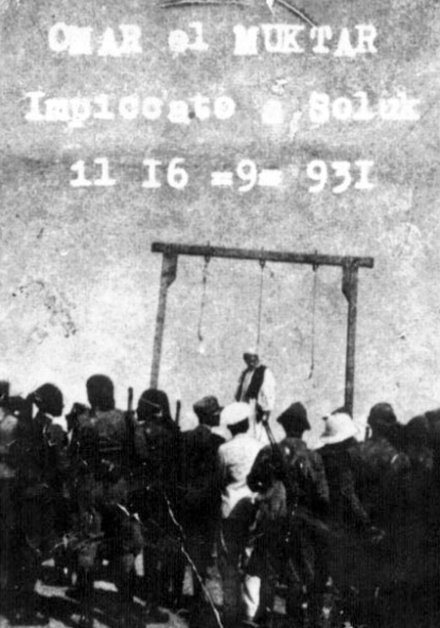
1931: Omar Mukhtar, Libyan revolutionary

On this date in 1931, Libyan independence martyr Omar [al-]Mukhtar was publicly hanged by the Italians at their concentration camp in Suluq.

Mukhtar (English Wikipedia entry | Italian) was born an Ottoman subject back in 1858 and had lived long enough to see his native Libya seized in the 1911-12 Italo-Turkish War.

Mukhtar, a religious teacher and follower of the Senussi movement, became the leader of the Libyan resistance that dogged the Italian occupation. Mukhtar proved an energetic and successful desert guerrilla fighter, and he had to be given the Italians’ mechanized military.

The Italians executed an estimated 4,000 Libyans in the 1920s, and drove hundreds of thousands into concentration camps, and gradually, only gradually, gained the upper hand on their adversaries.

Captured in battle after he abandoned a 1929 truce, Mukhtar was denied prisoner-of-war status and subjected to a snap military tribunal in one of the small coastal enclaves actually controlled by Italy — “a regular trial and consequent sentence, which will surely be death,” as the Italian general directed. It surely was.

He’s played by Anthony Quinn in the 1981 film Lion of the Desert — a better movie than you might think given that it was bankrolled by Muammar Gaddafi.

A national hero for contemporary Libyans across any social divide you’d care to name, Omar Mukhtar was valorized by the rebels who recently overthrew the aforementioned Gaddafi (here’s Mukhtar on a billboard in rebel-held Benghazi). “The whole world knows what Omar al-Mukhtar did,” Mukhtar’s 90-year-old son told media during the civil war. “That’s where they get their energy from. Ask the youth, they’ll tell you they are all the grandsons of Omar al-Mukhtar.”

His steely profile can be seen on Libya’s 10 10 dinar note.

On this day..

1939: Charles McLachlan

(Thanks to Meaghan Good of the Charley Project for the guest post. -ed.)

On this date in 1939, 57-year-old Charles Augustine McLachlan was gassed at San Quentin State Prison in California. He’d murdered a six-year-old neighbor girl at his home in Downey, California the previous year.

McLachlan was a widower who was half Irish-American and half Mexican by descent but described as white. A master painter and decorator, he owned a plot of land with a few houses he’d built himself.


Mugshot of perp; newspaper sketch of victim.

McLachlan lived alone in the smallest of the houses, an eight-by-twelve-foot shack; the largest building was occupied by his son and daughter-in-law, Joe and Carmen, and their child. The parents of the victim, Jennie Moreno (her name is spelled “Jenny” in many accounts), had known McLachlan for about thirty years. Although he was occasionally seen drunk, he had a reputation as a kind, likeable man.

That is, until April 14, 1938.

At 10:00 that morning, Jennie Moreno and her younger sister went to give a magazine to Carmen McLachlan.

Jennie’s parents last saw her at 11:00 a.m., while she was getting ready to go to church. When she didn’t return home at noon as expected, her parents began searching for her. At some point a neighbor smelled a strange odor and noticed smoke pouring out the windows of McLachlan’s shack, which had no chimney or flue.

The police were summoned. They arrived at his house at midnight and found bloodstained, partially burned clothing belonging to both Jennie and McLachlan lying on a sheet of metal on the floor of the shack. The floor had been washed and was still sopping wet.

A search of the premises turned up Jennie’s shoes and a bloodstained hammer. McLachlan’s mattress was saturated with blood and there was blood on the floor beneath the bed as well. He was arrested on the spot.

At the same time the sheriff’s deputies were arresting McLachlan, a search party that included Jennie’s father and uncle found her partially nude body concealed among the weeds in the vacant lot next to McLachlan’s property.

When they saw McLachlan being led away in handcuffs, they guessed he must be the murderer. Jennie’s uncle struck McLachlan in the face and several others in the crowd called out, “Lynch him!” But the police were able to disperse these aspiring vigilantes without too much difficulty.

McLachlan, who had been drinking wine and whiskey since 9:00 a.m., was quite drunk at the time of his arrest and at first said he had no memory of what happened. He ultimately made a confession to murder. McLachlan stated he’d been lying in bed resting with the door open when little Jennie wandered inside. He took her into the bed and began to fondle her, then struck her in the head with a hammer after she screamed. He waited until after dark, and then carried her body to where it was later found.

Jennie’s body showed evidence that she had in fact been violently raped, something McLachlan never admitted to.

He would go on to repudiate his entire statement, saying the police had kept him in jail without sleep or food and coerced the confession. He pleaded both not guilty and not guilty by reason of insanity, waived his right to a jury trial and was heard by a judge.

McLachlan claimed he heard “witches” speaking to him and said the voices “say most anything.” While in jail he would refuse to eat or speak for days at a time, and he refused to cooperate with his defense. A psychiatrist hired to examine him found “evidence of pre-senility and psychic pain” but believed he was feigning mental illness.

Found both guilty and sane, he was condemned to death. The judge to whom McLachlan had entrusted his fate called Jennie Moreno’s murder “one of the most brutal and horrible ever perpetrated in Los Angeles County.”

Charles McLachlan walked into the gas chamber at 10:10 a.m., eighteen months after his crime. “Twisting and straining against the straps that bound him,” he took seven minutes to die.

On this day..

1936: Manuel Goded Llopis

On this date in 1936, the Spanish Republic executed Gen. Manuel Goded Llopis, who mounted an unsuccessful nationalist attack in the heart of Republican Spain, Barcelona.

Goded (English Wikipedia entry | Spanish) was born of Catalan ancestry in Puerto Rico. His family moved back to the mother country when the United States stripped that territory away in the Spanish-American War.

Goded advanced rapidly through the armed forces, becoming dictator Miguel Primo de Rivera‘s chief of staff by 1927. He was dismissed from this post for intriguing against the government, but soon found his way back to command and became (Spanish link) one of the circle of officers conspiring to check the advance of the left.

When the anti-Republican military mounted the revolt that became the Spanish Civil War, Goded was in Catalonia — freshly arrived on a mission to snatch Barcelona for the fascists at the revolt’s outset. Forces loyal to the Republican government, however, defeated Goded in the streets of Barcelona on 19 July. The general himself was captured on 11 August. A Republican court had him shot at Montjuic the very next day, along with another officer, Alvaro Fernandez Burriel.

His defeat, in the long run, might have been a gift by the Republicans to their conquerors: Goded was a partner but also a rival of Francisco Franco’s, and Goded’s presence in the postwar settlement among the nationalist victors might have introduced a fault line into the Franco regime.

On this day..

1936: Josep Sunyol, FC Barcelona President

FC Barcelona is many a sportive leftist’s major European football side of choice, thanks to the club’s longtime identification with its city’s Catalan anti-Francoism.

That identification, stretching all the way back to the club’s formative early-20th century years (“History of FC Barcelona” enjoys its own voluminous Wikipedia page) put the Barca president at the end of fascist guns on this date in 1936.

Josep Sunyol was born into the Catalan elite, and had a varied career in the public eye: left activist, parliamentary deputy, newspaper founder, and, come 1935, president of FC Barcelona. He’d been serving on the Barca board of directors since 1928. There’s a lengthy Sunyol biography here.


At the center of the rail, Sunyol (left) chats with Catalan president Lluis Companys. (Source)

It was in his political, rather than his footballing, capacity that in August 1936 — just days into the Spanish Civil War — Sunyol traveled from Barcelona to Madrid to meet with fellow Republicans.

He never made it back.

On the return trip from Madrid, Sunyol’s chauffeured car flying the Catalan senyera was stopped by pro-Franco Falangist forces in the Sierra de Guadarrama north of Madrid. It may have been only inadvertently that Sunyol crossed this checkpoint of nationalists, who were already gathering for an attack on Madrid that would eventually inspire For Whom The Bell Tolls. (Indeed, this novel is set in the Sierra de Guadarrama.)

Whatever Sunyol’s intention, he was quickly recognized and detained by his foes on the evening of August 6. Shortly thereafter, they decided to shoot him out of hand.

The civil war and the era of Franco are still sensitive topic in Spain, but FC Barcelona’s politically engaged supporters have pushed the present-day club (with partial success) to more overtly embrace its anti-fascist “martyr president”.

On this day..

1934: William Cody Kelley, the first in Colorado’s gas chamber

On this date in 1934, “the most successful and painless [execution] ever conducted at the penitentiary” claimed the life of William Cody Kelley in Colorado’s brand-new gas chamber.

Nevada had debuted this American contribution to the art of killing 10 years before. Colorado was the second state to gas a prisoner, and stood on the leading edge of gas chamber adoption during the 1930s by a half-dozen states in the American West. (… plus North Carolina.)

Kelley was condemned for bludgeoning pig-rancher Russell Browning to death with a pipe, and his otherwise forgettable case was a milestone for a reason besides the method: Kelley was the first executed in the state of Colorado without review by the state supreme court.

The reason? Dead broke, Kelley couldn’t scrape together $200 required for the appeal.

Journalist Lorena Hickok heard of Kelley’s plight and was about to front the cash when she was talked off it, on the grounds that her sticking up for a condemned murderer might throw a politically difficult light on her close friend Eleanor Roosevelt.

Hickok swallowed her principles but a later letter to the First Lady — the two had a voluminous correspondence; they may well have had a romantic relationship, too — drips with Hickok’s regret.

The thing has nearly driven me crazy. How can you have any faith or hope in us if we do things like that in this supposedly enlightened age? … I feel as though we were living in the Dark Ages, and I loathe myself for not having more courage and trying to stop it, no matter what the consequences were. You would have done it. Well — I guess I’d better not think about it any more.

-From One Third Of A Nation, quoted here

While an inconceivable fortune stood between Kelley and his life, the execution materiel — a dozen acid capsules — set Colorado back just 90 cents. Such a pittance bought a killing method so reliable that “there was no cutting out of the victim’s heart, as was done after executions under the State’s old system of hanging, to make sure of death,” a gross if wellfounded precaution.

Kelley’s partner in the murder, Lloyd Frady, testified against Kelley (both men claimed the other had committed the murder), and had his own death sentence commuted for his trouble. Frady was eventually released in 1949, but not before he made his fortune behind prison walls selling artsy “curio goods”. Those without the capital, as they say, get the punishment — and in this case, vice versa.

Colorado used the gas chamber for all its executions until 1967.

On this day..

1937: Helmut Hirsch, secret bomber

On this date in 1937, the German-American Jewish terrorist Helmut “Helle” Hirsch was decapitated at Plotzensee Prison.

Hirsch (English Wikipedia entry | German) was an architecture student who had been driven from Germany by anti-Semitic laws and studied, therefore, in Prague. (Before the Reich gobbled up Czechoslovakia, of course.)

There he became involved in the Strasserite anti-Hitler “Black Front”. To Hirsch’s grief, this organization had been thoroughly penetrated by pro-Hitler spies.

In December 1936, Hirsch embarked on a train. His mission was to bomb something in Germany. The details of the plan remain murky to this day; Hirsch’s subsequent trial was held in secret and his worried family only learned the whereabouts of their son three months missing when they heard a radio broadcast in March announcing his condemnation for “preparation of high treason and criminal use of explosives endangering the public.”

It seems that Hirsch was supposed to have disembarked in Nuremberg and there picked up some left luggage deposited by a fellow conspirator; he may have been meant to deliver this payload Nazi party headquarters in Nuremberg, or perhaps to the offices of Julius Streicher’s propaganda sheet Der Stürmer.

The young would-be terrorist would tell his family in prison letters that he had instead bypassed Nuremberg and kept going all the way to Stuttgart to meet a friend, hoping the latter would talk him out of his wavering commitment to the plot. Instead, he was arrested that night by the Gestapo.

This case made news in the United States during the spring of ’37 because Hirsch’s father, Siegfried, was a naturalized American. That made Helmut a U.S. citizen, too, even though the son had never set foot in the United States.* U.S. Secretary of State Cordell Hull and the American ambassador to Germany William Dodd lobbied the Nazi government to spare Hirsch** — but to no avail.

Hirsch’s sister Kaete Hirsch Sugarman later donated her brother’s papers — letters, photos, architectural drawings — to Brandeis University, which maintains them as the Helmut Hirsch Collection. They include this touching final letter the young man wrote to his family on the eve of his execution.

Dear Mother, dear Father,

I have just been told that my appeal for clemency was turned down. I must die then.

We need not say anything any more to each other. You know that in these last months I have really found the way to myself and to life. Real beauty must stand before unswerving honesty. You know that I have lived every moment fervently and that I have remained true to myself until the end. You must live on. There can be no giving up for you. No becoming soft or sentimental. In these days I have learned to say “yes” to life. Not only to endure it but to love life as it is. It is our own inner gravity, the force by which we have entered life.

It must help you in some way that I know I have finally reached my own inner image and feel complete. And in this feeling is much of our time and our world.

The only way I know how to thank you is by showing you until the last moment that I have used all your love and goodness towards becoming a whole being of my time and my heritage. Do not think of the unused possibilities, but take my life as a whole. A great search, a foolish error, but on its path to finding of final truth, final peace.

Please care for Vally [his girlfriend, Valerie Petrova] as for a child. I embrace you, dear mother and you, my father, once more for a long, long time. Only now have I realized how much I love you.

Yours forever,

Helmut.

* Siegfried Hirsch was a naturalized American who had lived in the U.S. for a decade prior to World War I. Siegfried’s U.S. citizenship had been revoked in 1926 because he had left to live abroad, but when the matter came to prominence in 1937 it was reinstated and Helmut Hirsch explicitly acknowledged as a U.S. national.

** The shoe has been on the other foot for death-sentenced German nationals in the present-day U.S.

On this day..

1936: Arnold Sodeman, Schoolgirl Strangler

(Thanks to Meaghan Good of the Charley Project for the guest post. -ed.)

On this date in 1936, Australia’s Arnold Karl Sodeman was hanged at Pentridge Prison in Coburg, Victoria.

The “Schoolgirl Strangler” used the same modus operandi on all of his four victims: strangled, gagged with their own clothing, the arms and legs tied after death, and their bodies dumped with little effort at concealment.

Born in 1899, Sodeman was raised in an unhappy home with a violently abusive father. He ran away at the first chance he got.

He went on to get in trouble with the law, for theft-related offenses and prison escape, and the authorities deemed him an “incorrigible rogue” — which was less charming than it sounds.

By his late twenties, Sodeman seemed to have settled down. He worked various laboring jobs, married in 1926 and had a daughter two years later. When sober he was a mild enough man, but under the influence of drink — which was often — he changed into a different person altogether.

However, his marriage was loving and happy, and he adored his little girl and his dog. Whatever else Sodeman might have done, he never mistreated his family.

His law-abiding life, however, didn’t last.

His first victim was twelve-year-old Mena Alexandra Griffiths, whom Sodeman kidnapped, raped and strangled on November 9, 1930. Her body wasn’t found for two days. She was the only victim who was sexually assaulted.

A month later the police arrested a suspect, a truck driver named Robert McMahon. Mena’s younger sister identified him, and he was committed for trial. Ultimately, after two and a half months in custody, he was released for lack of evidence.

But on January 10, 1931, while McMahon was still in jail, Sodeman struck again, abducting and strangling Hazel Wilson, a sixteen-year-old who suffered from tuberculosis. Hazel was last seen standing near her home, smoking a cigarette and horsing around with an unidentified young man. Her body turned up in a nearby vacant lot the next day.

The police put out appeals for the young man to come forward and “assist with their inquiries,” and even offered a reward for information leading to his identification, but their efforts came to nothing.

Hazel’s father, who reportedly had a violent temper, was looked at as a possible suspect in his daughter’s death, but he was cleared.

Although the police recognized the similarities in the Griffiths and Wilson crimes and realized it was probably the same perp in both cases, they had nothing concrete to go on. Both homicide investigations stagnated.

On January 1, 1935, after a four-year dry spell, Sodeman abducted Ethel Belshaw while she was out buying ice cream, and strangled her. She was twelve. He was her next-door neighbor and sometimes had tea with her family.

Sodeman was actually questioned by the police and admitted he had spoken to Ethel on the day she disappeared, but he said he’d left her alive, and nobody pressed him about it.

Instead, investigators focused on a teenage boy who had given contradictory statements about his movements on the day of the murder. He was arrested and charged with killing Ethel, but there was no evidence against him and the case was dismissed after a couple of days.

Left to right: Mena Griffiths, Ethel Belshaw, and June Rushmer. (Not pictured: Hazel Wilson.)

Exactly eleven months later, on December 1, he killed his last and youngest victim, six-year-old June Rushmer.

This victim he also knew slightly: she was a co-worker’s daughter, and Sodeman took it in his mind to kill her after she asked him for a ride on his bicycle.

(The Belshaws and the Rushmers couldn’t afford tombstones for their daughters. It wasn’t until more than seventy-five years later that the Australian Funeral Directors Association donated bronze plaques to mark their graves.)

It should be noted that Sodeman was drunk at the time of all four murders. “When in this state,” he reflected later, “thoughts would go through my mind concerning men, women and children whom I disliked … I would feel the desire to even it up, not caring what happened to them, but I would shake it off. As soon as the liquor wore off I could reason properly and would wipe it all off.”

At the time of the Rushmer homicide, Sodeman was part of a laboring crew repairing roadways.

Shortly after June’s murder, one of his coworkers joked that he’d seen Sodeman near the crime scene. Sodeman became so angry and defensive that the others got suspicious and went to the police. The cops hauled him away from his work site for questioning.

This time the police had finally got the right man. After twelve hours of interrogation, Sodeman confessed to everything in great detail, describing how he would link his thumbs together to get a better grip on the throats of his victims. He correctly identified the exact type of candy he’d used to lure the girls. He also admitted to the attempted murders of two other children.

At trial, Sodeman’s attorney had little choice but to go with an insanity defense. Sodeman certainly had the genetic background for it:

  • His great-grandfather died of “inflammation of the brain.”
  • His grandfather died in a mental hospital.
  • So did his father.
  • Annnnnd his mother suffered from serious short-term memory loss.

Sodeman himself had bouts of depression throughout his life, and he sustained a serious brain injury years before the murders started when he fell off a horse.

According to author Ivan Chapman, at Sodeman’s trial,

Three doctors — two of them Government medical officers — examined Sodeman and gave their individual opinions. One thought he had a brain disorder that flared when he drank alcohol; another decided he was neither conscious of, nor understood, what he was doing; the third believed Sodeman was not responsible for what he did. All three doctors backed down, however, when Sodeman’s confession was produced in court. They agreed that if it accurately described the facts of the crime, then Sodeman must have appreciated the nature and quality of his acts; none of them was prepared to declare him certifiably insane.

The verdict was, inevitably, sane and guilty as charged.

Although he did appeal his conviction, that went nowhere and Sodeman himself seems to have welcomed death. He said he felt it was necessary for him to die, because if he lived he believed he would kill again.

Sodeman spent the last afternoon of his life playing draughts with another condemned man, then slept soundly during the night. On the scaffold the next morning, when asked if he had anything to say for himself, Sodeman replied simply, “No, sir.” He died without any fuss.

His widow reverted to her maiden name after his death, hoping to escape the notoriety, and raised their daughter alone. She never remarried, and died in the 1980s.

The autopsy did uncover something interesting: it turned out Sodeman had suffered from leptomeningitis, a degenerative disease of the brain. When a person with this condition abuses alcohol, their brain can become seriously inflamed, which can cause irrational behavior among other symptoms.

Needless to say, the finding casts serious doubts on Sodeman’s ability to control his actions at the time of the murders. In fact, according to one criminal psychologist, Sodeman wouldn’t have even been found fit to stand trial if his crimes had occurred today.

But it was too late to do anything about it.

On this day..

1936: Buck Ruxton, red stains

(Thanks to Meaghan Good of the Charley Project for the guest post. -ed.)

On this date in 1936, Buktyar Rustomji Ratanji Hakim, also known as Buck Ruxton, was hanged in Strangeways Prison for the murder of his common-law wife, Isabella, and their maid, Mary Jane Rogerson.

A general practitioner of Persian descent, Ruxton was born in India and moved to the United Kingdom in 1930 to set up practice in Lancaster.

He met a married Englishwoman, Isabella Van Ess, and took up with her after her divorce. Although they never legally married and Ruxton actually already had a wife he’d left behind in India, they lived as man and wife and had three children, and she took his last name.

Ruxton had a reputation as a good doctor and a compassionate one who waived his fees for indigent. He wasn’t nearly as good a husband as he was a physician, however: he was extremely jealous of his charming, sociable wife and continually accused her of infidelity with little actual evidence of it.

The neighbors overheard violent arguments, and Isabella would occasionally take the children and leave, seeking refuge at her sister’s home. At one point she reported her husband to the police for domestic violence, but they paid little attention to her complaints.

On September 15, 1935, Ruxton flew into one of his rages, stabbed his wife five times in the chest, beat her and strangled her with his bare hands. He battered the maid to death as well, since she had been unlucky enough to witness it. A clever little rhyme memorialized the story, one of its various versions is printed below:

Red stains on the carpet, red stains on the knife
For Dr. Buck Ruxton had murdered his wife
The maid servant saw it and threatened to tell
So Dr. Buck Ruxton, he’s killed her as well

Ruxton dismembered both bodies in the bathtub and dumped the parts in a stream near the Scottish border, over a hundred miles from Lancaster. There were thirty pieces in all, leading the press to call the case the “Jigsaw Murders.”

In an effort to hinder identification, Ruxton removed the victims’ teeth and skinned their faces. This turned out to be too clever by half: once the bodies were found in late September, the precision of the cuts told authorities that the killer was someone with anatomical knowledge and surgical skill, which narrowed the suspect pool considerably.

This filter, combined with the realization that one of the newspapers Ruxton used to wrap up some dismembered bit was a special edition copy sold only in Lancaster and Morecambe, led the cops to Ruxton and not many others. It wasn’t long before the pieces — sorry — fell into place.

Meanwhile, exciting new forensic techniques, helped firm up identification of the corpses: authorities superimposed a photograph of Isabella over one of the skulls and found a dramatically jury-friendly visible match.

Isabella Ruxton, in life and death.

Forensic entomology (in this case, the gross but useful technique of checking the age of the maggots infesting the corpses) helped pinpoint the date of death.

Ruxton was arrested on October 13, nearly a month after the double murder.

The Ruxtons’ charlady told the police that on the day Isabella and the maid disappeared, Ruxton came to her house early and told her not to come in to work. The next day, when she arrived at the Ruxtons’ house, she found it in a state of disarray with the carpets removed and a pile of burnt material in the backyard. A neighbor couple also had helpful recollections: Ruxton had persuaded them to come and help out at his house, saying he’d cut his hand while opening a can of peaches and he needed to clean up quickly because decorators were coming over. They scrubbed his walls and he gave them some bloodstained carpets and clothing.

Given all this evidence, there was little Ruxton’s defense attorney could say for him.

The defense tried to challenge the identification of the bodies, but the superimposed skull picture was quite convincing. Ruxton admitted his guilt prior to his execution and signed a short confession. He was hanged in spite of a petition with 10,000 signatures asking for mercy.

The Ruxton case, a smashing tabloid hit in its day, has been the subject of its own book, T.F. Potter’s The Deadly Dr. Ruxton: How They Caught a Lancashire Double Killer. It’s also featured in many general true crime books, including Colin Wilson and Damon Wilson’s Crimes of Passion: The Thin Line Between Love and Hate, Colin Evans’s The Casebook of Forensic Detection: How Science Solved 100 of the World’s Most Baffling Crimes, and Harold Schechter’s A to Z Encyclopedia of Serial Killers.

On this day..