1942: Helmuth Huebener, Mormon anti-Nazi


Poster announces Helmut Hubener’s execution.

On this date in 1942, 17-year-old Helmuth Hübener was executed at Plotzensee Prison for listening to the BBC.

Huebener was a Mormon youth with the political perspicacity to abhor fascism from a very young age: the former Boy Scout (Mormons really take to scouting) ditched the Hitler Youth after Kristallnacht, which happened when Huebener was only 10 years old.

As Germany forged ahead towards worse horrors in the years, conscientious people of all ages had moral dilemmas to resolve. Mormons in Nazi Germany weren’t persecuted per se and to keep it that way that small community generally kept its head judiciously down.

Not Huebener.

Horrified by the privations of their Jewish neighbors, Huebener with fellow Mormon teens Karl-Heinz Schnibbe and Rudi Wobbe began illegally listening to foreign radio broadcasts and using the material to compose anti-fascist pamphlets for distribution around Hamburg.

Themes like Germany’s coming defeat (a Huebener circle favorite) never went over well with the authorities; a 1939 law decreed that “Whoever willfully distributes the broadcasts of foreign stations which are designed to endanger the strength of resistance of the German people will, in particularly severe cases, be punished with death.”

Huebener’s friends, aged 18 and 16, were judged only sufficiently severe for hard labor sentences; both survived the war but have since died. Huebener as the ringleader got the death penalty. (The local Mormon congregation expediently excommunicated him, a judgment later reversed from church headquarters in Salt Lake City.) And clearly Huebener was failing to “support the troops”, in the present-day parlance: his own older brother Gerhard had been drafted into the Wehrmacht and was away at the front.

“My Father in heaven knows that I have done nothing wrong,” young Helmuth wrote shortly before his beheading. “I know that God lives and He will be the proper judge of this matter.”

The Latter-Day Saints church, not usually thought of as a hive of anti-authority activity, has only gradually warmed up to celebrating its appealing young resistance martyr.

In addition to a number of books, Huebener is the subject of the documentary Truth & Conviction as well as the forthcoming feature film Truth & Treason.

A few books about Helmuth Huebener

Three Against Hitler and When Truth Was Treason were written by Huebener’s un-executed confederates.

Novels inspired by Helmuth Huebener

On this day..

2000: Yopougon Massacre

This date in 2000 saw the most notorious incident in a dreadful wave of election violence in the West African nation of Ivory Coast.

The context was the aftermath of a contentious 2000 presidential election summoned by a coup government that had overthrown the previous regime the year before.

Ivorian politics pitted the more prosperous coastal Christian south against the more rural Muslim inlands, but the 2000 election did not: Alassane Ouattara, the northern/Muslim standard-bearer was eliminated from the election by a conveniently-introduced summer 2000 law disqualifying candidates with a foreign parent. Ouattara was a former Ivorian Prime Minister, but for this election, he wasn’t Ivorian enough to stand.

Political bad blood became political bloodsport with the Oct. 22 election.

On Thursday, Oct. 26, 2000 — which was also the day that election’s winner Laurent Gbagbo was officially sworn in, despite thousands protesting — pro-Gbagbo militias went to town on Ouattara supporters, Muslims, immigrants.

In pro-Gbagbo sections of Abidjan like the suburbs of Abobo and Yopougon, ethnic Dyula or Dioula were rounded up en masse, mosques attacked by mobs, and people menaced, beaten, or worse.

The Human Rights Watch report “The New Racism: The Political Manipulation of Ethnicity in Côte d’Ivoire” gathers a number of these eyewitness accounts, including the summary execution/mass murder of 57 that would make global headlines (French link):

In the late afternoon of October 27, the bullet-ridden bodies of fifty-seven young men were found dumped in two piles in a forest clearing on the outskirts of Yopougon. After speaking with two survivors of and several witnesses to events surrounding the massacre, Human Rights Watch researchers established that paramilitary gendarmes based at the Gendarme Camp of Abobo were directly responsible for the killings. This incident was the single worst atrocity of the election period.

The massacre took place on October 26, 2000 in two stages. The first involved the shooting of detainees at the Gendarme Camp of Abobo, where young men rounded up from Abobo neighborhood were taken during the morning and early afternoon of October 26, 2000. Prior to the shooting detainees were subject to … brutality and torture … At approximately 3:00 p.m…. at least two gendarmes opened fire on the detainees held there, killing some thirty to forty.

The second stage showed the signs of being a well-planned operation. Well-armed gendarmes deployed intoa neighborhood bordering the Gendarme Camp of Abobo and rounded up between eight and thirteen young men who were used as porters to load the dead onto a truck and later dispose of the bodies in the forest. The porters and all other survivors were then gunned down, though some were not killed. These survivors described the presence of one truck, two jeeps, and the involvement of some thirty gendarmes in this operation.

Two men (they’re both directly quoted in the Human Rights Watch report) survived the second stage of the massacre by playing dead.

This unpunished incident — eight gendarmes were tried, but all acquitted — has blended into the rich tapestry of grievances stoking Ivory Coast tensions down to the present day.

Laurent Gbagbo … under arrest. (Not for this massacre.)

When outright civil war erupted in 2002, anti-Gbagbo rebels reportedly yelled “This is for Yopougon!” when gunning down policemen.

In 2010 Ouattara beat Gbagbo in yet another presidential election. That led to a fresh round of nasty civil war.

That war’s upshot was to seat Ouattara — he’s President of the Ivory Coast as of this writing — and to extradite Gbagbo for war crimes proceedings at the Hague. But in the course of that more recent bloodletting, Yopougon once again became a massacre site, and its football pitch “an open-air cemetery”.

On this day..

2006: Danny Rolling, the Gainesville Ripper

During the first week of classes in August 1990 at the University of Florida’s city of Gainesville, five college students were brutally murdered during a terrifying burglary-rape-murder spree.

On this date in 2006, serial killer Danny Rolling finally paid for the murders.

The face of evil in our community” and Florida college towns’ most infamous serial killer since Ted Bundy made the FSU Chi Omega sorority his last port of call, Rolling was a 26-year-old with sociopathy born of an abusive home life. (Here’s a pdf profile of the guy.)

After shooting his hated father in the face — the Shreveport, La., policeman lost an eye but lived — Rolling headed east to Florida. He would later say that he aspired to become a “superstar” criminal — just like Bundy.*

Little did anyone know that Rolling was already a murderer. Only after his grisly turn in Gainesville was he linked back to a theretofore unsolved 1989 Shreveport triple homicide that saw a man, his daughter, and his son stabbed to death. Rolling had posed young Julie Grissom for investigators.

It was a signature behavior the Gainesville police were about to know all too well.

Out of nowhere, the horror murders leaped onto Florida front pages: 18-year-old Sonja Larson and 17-year-old Christina Powell, stabbed to death on August 24, 1990 (Larson was raped, too): both girls’ bodies theatrically posed.

The very next day, 18-year-old Christina Hoyt raped, stabbed to death, and decapitated — the severed head positioned as if scrutinizing its former torso.

Terrified students began taking what protective measures they could against the hunter in their midst, but just two days later 23-year-old Tracy Paules was raped, knifed, and posed … after Rolling also killed the boyfriend that she had staying over for safety.

Arrested soon thereafter on an unrelated burglary, Rolling’s campsite turned up the evidence linking him to the Gainesville Ripper’s predations. Superstardom was on the way: Rolling’s murders helped inspire the Wes Craven slasher classic Scream.**

When the much-delayed case finally came to trial in 1994, Rolling unexpectedly pleaded guilty without any deal to avoid the death penalty. Why dilute his infamy by denying it? “There are some things you just can’t run from, this being one of those,” Rolling told the judge in his singsong drawl.

Maybe had he come of age just a few years later, the Gainesville Ripper might have scratched that itch for notoriety holding forth on the coming age of new media channels instead of butchering humans.

Certainly Danny Rolling, arranger of mutilated corpses, had the character of a performer; recordings of his own renditions of folk songs were among the artifacts police recovered from the killer’s campsite. Later, in prison, Rolling became a prolific death row artist and his “murderabilia” art can be found for sale on the Internet.

He also personally illustrated The Making of a Serial Killer, a book about his crime spree that Rolling co-authored with Sondra London — a true crime author who fell in love with her subject.

A few books about (and by) Danny Rolling

Whatever charms people perceived in Danny Rolling have understandably been lost on those who survived the victims. And Rolling’s wicked “superstardom” remains yet a sensitive subject in Gainesville, where many residents still remember those days of panic the Gainesville Ripper sowed in 1990.


Memorial to Danny Rolling’s victims painted on Gainesville’s 34th Street Wall. Image (c) hecht 801 and used with permission.

* There was a more direct link between Bundy and Rolling as well: (non-death-row) murderer Bobby Lewis, who became Bundy’s friend while the latter was in prison, later also befriended Danny Rolling, even acting as a go-between for Rolling’s dealings with investigators.

** There’s also a 2007 (posthumous to Danny) horror film directly about the Gainesville murders.

On this day..

1865: Paul Bogle

On this date in 1865, Baptist deacon Paul Bogle was hanged at the Morant Bay courthouse for his part in that locale’s eponymous rebellion.


Third World’s “1865 (96 degrees in the shade)” celebrates Paul Bogle: “Today I stand here a victim the truth is I’ll never die”

Bogle helped lead of the protests-cum-riots that became that rebellion.

Baptists played an essential role in the affair, which has led some to call it the “Native Baptist War”. And indeed, Baptism had long intertwined with underclass resistance: Jamaica’s most famous slave rebel, Samuel Sharpe, was also a Baptist deacon. A previous royal governor in Jamaica had once warned that “the worst evil which hangs with a menacing aspect over the destinies of this island is the influence exercised with baneful effect by the majority of Baptist missionaries.”

From the standpoint of the powerful in Jamaica and Britain, 1865 would vindicate that warning.

A (white) Baptist missionary named Edward Underhill had penned a January 1865 letter bemoaning the miserable condition of most Jamaicans and starkly disputing received wisdom that blacks were just too lazy to work: “The simple fact is, there is not sufficient employment for the people; there is neither work for them, nor the capital to employ them.” (Underhill later wrote a book on the events, The tragedy of Morant Bay, a narrative of the distrubances in the Island of Jamaica in 1865.)

Underhill’s letter got into public circulation and as a result there were a number of “Underhill meetings” perhaps comprising an “Underhill movement” on the island in 1865 — essentially a going social campaign that rooted deeply in Jamaica’s native Baptist communities. Though “native Baptists” is a vague term, it distinguishes not only black from white but, in the words of Mary Turner, a whole “proliferation of sects in which the slaves developed religious forms, more or less Christian in content that reflected their needs more closely than the orthodox churches, black or white.”

William Gordon had switched his religious allegiance to native Baptist and was known to speak at Underhill meetings: that’s part of what got him hanged.

Likewise, our day’s focus, Paul Bogle, was a native Baptist minister, in the St. Thomas-in-the-East parish — and it was the protest of Bogle and his supporters against an unjust prosecution that started the whole rebellion off.


Statue of a militant Paul Bogle (that’s a sword in his hands) outside the Morant Bay courthouse where all the trouble started. (cc) image from dubdem sound systems.

There was, accordingly, an immediate reward out on Bogle’s head, and an immediate demonization in the respectable English press. There, he was “the notorious Paul Bogle,” in the words of one letter to the editor (London Times, Nov. 18 1865), in whose Baptist chapel rebellious “panthers” wantonly “drank rum mixed with gunpowder and the brains of their victims.”

By the time that letter had been dispatched, Bogle’s purported orgies had long since been interrupted: captured by Maroons, he was delivered to custody, instantly tried, an hanged that very day in a batch of 18 rebels.

A horror to Victorian planters, Bogle has won the reverence of posterity as a freedom fighter and national hero.


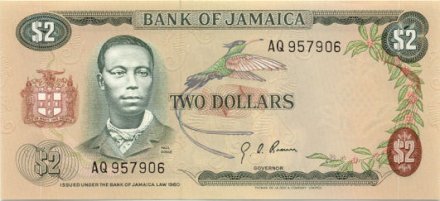
Paul Bogle on the (now out-of-circulation) Jamaican two-dollar bill.

On this day..

1865: George William Gordon, Jamaican politician

“No incident of the dreadful story” of Morant Bay, wrote Edward Underhill, “produced a more painful impression than the arrest, trial, and execution of Mr. G.W. Gordon” this date in 1865.

The son of a white planter and a mulatto slave, George William Gordon was an able businessman and became a Jamaican assemblyman.

In that capacity, he was a vocal critic of British colonial maladministration, an advocate for blacks, and a political foe of Jamaica’s governor, Edward John Eyre. He’d already had government commissions canceled because of his politics.

Gordon had nothing to do with the Morant Bay outbreak. He was away from the disturbance altogether, in Kingston, when it broke out.

But he was regarded by many white elites as a class enemy, and Eyre did not intend to miss this opportunity to eliminate him. A few years later, a French tribunal would express the rationale as it cracked down on the Paris Commune: guilty or no, “a prudent and wise Government must rid itself [of troublemakers] when it finds a legitimate occasion to do so.”

Accordingly, Gordon was arrested by civil authorities in Kingston — he actually turned himself in when he heard there was a warrant out on him — and then transferred into the hands of the drumhead military tribunals that were operating in the conflict zone, obviously with the intent of terminating a gadfly.

This extra-legal act is discussed in greater detail here, but the long and short of it was tartly summarized by no less than the sitting Lord Chief Justice:

[Kingston authorities] were not the ministers or apparitors of the martial authority, and did not possess the power to take up Mr. Gordon for the purpose of handing him over to the martial law. Nevertheless, they did it. They did it by the exercise of the strong hand of power, because it was thought that a conviction could not be got at Kingston. It was altogether unlawful and unjustifiable. To Mr. Gordon it made the difference of life or death.

Gordon, in his last letter to his wife, took it all in an understandably contemptuous stride:

General Nelson has just been kind enough to inform me that the court-martial on Saturday last has ordered me to be hung, and that the sentence is to be expected in a hour hence, so that I shall be gone from this world of sin and sorrow.

I regret that my worldly affairs are so derranged: but it cannot be helped … I never advised or took part in any insurrection. All I ever did was to recommend the people who complained to seek redress in a legitimate way … It is however the will of my heavenly Father that I should thus suffer in obeying His command, to relieve the poor and needy, and to protect, as far as I was able, the oppressed …

do not be ashamed of the death your poor husband will have suffered. The judges seemed against me; and from the rigid manner of the Court, I could not get in all the explanations I intended. … It seemed that I was to be sacrificed.

Much of what Governor Eyre did in those desperate days skirted, at best, the edges of what might be legally colorable. But at least those instances, in the main, were directed at people alleged to have been actual rebels or rioters. Eyre could safely expect wide latitude where the security of the realm was at stake.

In Gordon, however, there was a man whose crime was nothing other than to have sympathized with the real and crushing plight of the lower orders and advanced their cause politically. Eyre’s magistrates made that fact alone into sedition, and twisted the rules of their own courts-martial to pin it on Gordon.

Given the exceptionally lawless nature of this scenario — and Gordon’s own visibility as a colonial elite — his became the lightning-rod case for English liberals incensed at Eyre’s behavior. John Stuart Mill, Charles Darwin, Herbert Spencer, and others demanded Eyre’s prosecution for the affair, Thomas Huxley writing for the faction,

the killing of Mr. Gordon can only be defended on the ground that he was a bad and troublesome man; in short, that although he might not be guilty, it served him right.

I entertain so deeply-rooted an objection to this method of killing people — the act itself appears to me to be so frightful a precedent, that I desire to see it stigmatised by the highest authority as a crime.

It can hardly surprise the reader, versed as we are by this late date in official impunity, that not Eyre nor any lieutenant was ever thus stigmatised.

While Eyre evaded due punishment, Gordon could not escape the plaudits of posterity. He’s been honored as a Jamaican National Hero, and the very building where the present-day parliament sits is called the Gordon House in his honor.

On this day..

1865: Johnson Speed, arson bystander

The line between a snap military tribunal with a preordained outcome, a summary execution in the field, and simple murder blurs over in this affair where the word of any armed man in a British uniform had virtual color of law.

This account of one poor sod flogged within an inch of his life and then summarily shot when his captor soldiers took it into his heads that he might have had something to do with some fire comes from Illustrations of Martial Law in Jamaica: Compiled from the Report of the Royal Commissioners, and Other Blue Books Laid Before Parliament.


On [October] the 22nd four white soldiers were taken by Mr. Christopher Codrington to his house at Rose Garden, where they had dinner. When they returned in the evening to David Mayne’s shop, at Long Bay, two constables were there with two prisoners, James Sparkes and Johnson Speed.

They tied the former to a tree, and gave him 100 lashes.

They then tied up Johnson Speed, and gave him eighty-five lashes, when the cat broke.

One of the soldiers ran into the shop and brought a horsewhip, but another one interfered as it was not a thing to beat a man with. Another looker-on was here asked whether Johnson Speed had done anything during the disturbance, and he replied that when Mr. Hinchelwood’s house was burning Speed was there. Then the soldier said, “Where is my rifle?”

The man cried out, “Lord, I don’t do nothing, and I am going to dead.”

The soldier fired, but his rifle had no ball in it, or he had missed. He loaded the gun afresh, and hit the man in the middle of the back as he was tied to the tree. Another one went up, as he dropped writhing to the ground, and put a rifle to his ear and blew out his brains. These were soldiers of the 2nd Battalion of H. M. 6th Regiment of Foot. Mr. Christopher Codrington, a Justice of the Peace, was present.


The above is one of the very last accounts in a tome heavy with atrocities destined never to be punished in this world.

It seems apt both for the subject matter of this site and for laying bare the biases of the source to include the very last few paragraphs that follow.


David Burke was shot at Manchioneal. The soldiers ordered him to go before and point out rebels. “He was a big stout young man,” said a witness, ” and he walked quite lumber-like, and they said he was a rebel too, and shot him dead”.

Andrew Clarke was shot in his own house, at Manchioneal, under the following circumstances, as described by his widow :—

I was sitting with the baby, and I saw a black soldier, and he asked Andrew Clark, “Where are all the men’s goods you have ? Please bring them out.” Clarke said, “I have been sick three months, and I did not interfere.” The soldiers searched and found nothing. Then I was sitting down, and three soldiers came in, and a man named Saunders came in with them, and I explained that it was John Murray’s house, and the soldier dropped him, and he dropped on his side and bawled for mercy. The soldier told me, “Take yourself right out,” and I came out, and another soldier said, “Put another bullet into that fellow’s head,” and they blew out his brains. They burnt the house with fire from the kitchen.

These are samples of the scenes enacted in the beautiful island of Jamaica under pretence of repressing disturbances. My task has not been undertaken in vain if it tends to deepen the resolve of my countrymen to resist at all hazards, the preposterous pretensions of Colonial Governors and military officers, to deal with human life and property as they please, without responsibility to the laws which bind society together, or to the nation which places the sword in their hands for the purposes of justice and mercy.

On this day..

1865: An unnamed Obeah man

From William James Gardner’s (public domain) A History of Jamaica:

On the 21st a circumstance occurred which created much controversy. A reputed Obeah-man was tried by court-martial and convicted. One of the favourite assertions of these people has been that “Buckra can’t hurt them.” Colonel Hobbs directed him to be placed on a hill-side, about four hundred yards from the firing party. The bullets caused almost instantaneous death, and it is stated that the effect on the minds of the prisoners was so great, that the colonel felt at liberty to release a considerable number then in his camp, many of whom were heard to say they never would believe in Obeah again.

On this day..

1865: William Grant, evidently a ringleader, a persuader, and adviser

The account below of a forgotten saddler hastily attainted a participant “in the background” in the Morant Bay rebellion comes from Illustrations of Martial Law in Jamaica: Compiled from the Report of the Royal Commissioners, and Other Blue Books Laid Before Parliament.


Another victim was William Grant, saddler, of Morant Bay. The following record of the proceedings in his case is probably unique in the history of judicial or quasi-judicial investigations :—

October 20th, 1865.
Drum-head Court Martial.

President:—Lieut. H. Brand, E.N.
Members:—Lieut. Errington, K.N., Ensign Kelly, 4th W.I.R.

William Grant, charged with being one of the ringleaders and originators of this rebellion.

The Provost sworn states :—

About four or five days ago I was informed that this man was the originator and founder of the party who raised the rebellion, that he was not likely to be seen himself, but makes the others. He keeps a saddler’s shop, where the secret meetings took place. On the road from St. Thomas-in-the-East to the Guinness (Ginnep) tree, where placards had been posted, calling secret meetings, I searched the house of Chisholm, also a confederate, and in the presence of Mr. Jones, E.A., I took a blue card, as an admission ticket to a Society of Friends, printed William Grant, Founder. That card I sent to the Governor.

The prisoner Duncan Stuart, in his defence, when called upon by Captain Astwood, voluntarily made this statement. He had previously made it in the presence of Mr. Miller, J.P., whose signatures I here produce. “Grant called Bogle at Dr Alveranga’s, and said, ‘Don’t pull this down, wait a little, don’t join with the Volunteers, when you see what they do, run in.’ Grant said, ‘Now is the time to vindicate.’ ”

Mr. Miller, Justice of Peace, for St. Thomas-in-the-East, sworn:—

That statement was voluntarily given and sworn to before me.

Geo. F. Judah, Sergeant-Major of Volunteers:—

I gave the prisoner my rifle to repair on the morning of the riot, and he has kept it, and I have never seen it since.

The prisoner in his defence merely states that he never knew anything about the riot before it actually broke out. He has acknowledged to having corresponded with Mr. Gordon, but that, he states, was quite private, about some land.

This man was evidently a ringleader, a persuader, and adviser, and did his utmost to keep in the background and push the ignorant on to rebel.

Found Guilty, October 20th, 1865. Sentence, Death.

H. Brand, President,
Lieutenant E.N.
Approved and confirmed,

A. A. Nelson,
Brig. Genl. Commanding Field Force.

[The proceedings of the Courts-martial were retained by the Commissioners, and they refused to exhibit them to the Counsel for the parties complaining of the measures of suppression. General Nelson and others were therefore not cross-examined in reference to these trials.]

The first witness, Ramsay, the Provost-Marshal, told the Court only of what he had been informed — the great crime of the prisoner apparently being that he was the founder of a Society of Friends, and had actually a blue card of membership in his house.

The witness, Duncan Stewart, was not called. He had already been tried and was under sentence of death, and was duly hanged the same evening along with Grant. (See List). A so-called statement of this man was produced in writing. It will be noticed he spoke only of “Grant” having used certain words. Three Grants were hung at Morant Bay, and a William Grant was convicted by a Special Commission at Kingston, while the Royal Commissioners were sitting, and sentenced to penal servitude for life. It is clear from the evidence then given that the William Grant alluded to by Duncan Stewart was the one who was then sentenced. John Dickenson, on being examined by the living William Grant at that trial said:— “There was a William Grant, a saddler, who is hung. You are left. You are the man.” (No. 355 of Papers laid before the Royal Commissioners by Mr. Eyre).

Ramsay had evidently a strong interest in the conviction of this prisoner. He sent the following letter to Captain Luke, on 16th October, 1865:— “I also personally apprehended William Grant, the founder of the Society of Friends. I hope I may not be thought seeking for pecuniary benefit alone in claiming the rewards for information against G. W. Gordon at large, seizure of Chisholm, Grant, and Miles.”

Brand, the President of the Court-Martial, seems to have felt the evidence was weak, and he supplemented it by the following statement of his own. “This man was evidently a ringleader, a persuader, and adviser, and did his utmost to keep in the back ground and push the ignorant on to rebel.” The Judge having thus convinced himself, by his own conclusive testimony, adds “Found guilty. Sentence, death,” and, as a matter of course, the experienced officer of Her Majesty’s Service, who was the revising officer, adds:—”Approved and confirmed. A. A. Nelson, Brig.-Genl., Commanding Field Force, Morant Bay, 20th October, 1865.”

It is unnecessary to add that in the list of the executed is to be found the name “William Grant, under date of the 20th October. Charge, ringleader of rebellion!”

On this day..

Daily Quintuple: The Morant Bay rebellion

In 1865, British-controlled Jamaica faced an economically-driven revolt that altered its history.

Though slavery had been abolished in the British empire during the 1830s, emancipation had not come with land reform. Ex-slaves and their descendants remained desperately poor. Indeed, Britain’s near-simultaneous liberalization of the sugar trade had cratered prices for Jamaica’s top export — and with it, cratered most of the Caribbean economy.

To a petition early in 1865 for access to crown lands to relieve these dire conditions, Queen Victoria had extended a familiar classic of cruel and condescending economic catechism: shut up and work.

“The prosperity of the Labouring Classes, as well as of all other Classes,” quoth the piece that would be published as “The Queen’s Advice”,

depends, in Jamaica, and in other Countries, upon their working for Wages, not uncertainly, or capriciously, but steadily and continuously, at the times when their labour is wanted, and for so long as it is wanted; and if they would use his industry, and thereby render the Plantations productive, they would enable the Planters to pay them higher Wages for the same hours of work than are received by the best Field Labourers in this country; and as the cost of the necessaries of life is much less on Jamaica than it is here, they would be enabled, by adding prudence to industry, to lay by an ample provision for seasons of drought and dearth; and they may be assured, that it is from their own industry and prudence, in availing themselves of the means of prospering that are before them, and not from any such schemes as have been suggested to them, that the must look for an improvement in their condition; and that her Majesty will regard with interest and satisfaction their advancement through their own merits and efforts.

So your average Jamaican fieldhand’s “merits and efforts” became so much dry tinder accumulating, just waiting for the spark. (Note: Princeton has an album of photographs from this period here.)

In October 1865, flint struck steel with the prosecution of a poor black laborer for trespassing onto unused land.

The ensuing protest mushroomed into the Morant Bay rebellion: a scuffle with police, leading to proscriptions, leading to a more confrontational mob, an outnumbered and trigger-happy militia, and a full-fledged riot that seized the town of Morant Bay and proceeded to attack nearby plantations.

Dreadful reports, more terrifying for their scantiness and uncertainty, went abroad in those days, of “atrocities revolting to human nature.” That’s the New York Daily News, which ran a letter from Kingston, Jamaica, reporting “the whites who have fallen into the hands of these savages have been doomed to slaughter without distinction of age or sex. They tear out the tongues of their victims, cut off the breasts of women, strangle and mutilate little children.”*

Fearing a Haiti-like general revolution, Jamaican Governor Edward John Eyre — once an Australian explorer, which is why you can find his name on a New South Wales wine label — bloodily crushed the uprising.

Hundreds were put to death, either summarily in the field or after proceedings that would have wanted twice the deliberation to rise to the level of perfunctory. Hundreds more, including pregnant women, were flogged. Being in the wrong place at the wrong time without a demonstrable alibi ready to hand was liable to be worth a body’s life.

We note over the next five days two famous cases and three obscurities that may give a sense of how things were in those days — though Morant Bay depredations could in fact sustain several numbing weeks in these pages. For instance, a missive dated October 19 reports in passing the capture of “a number of prisoners from the rebel camp. Finding their guilt clear, and being unable either to take or leave them, I had them all shot. The constables then hung them upon trees, eleven in number.”

One officer** who showed excessive (read: any) exactitude for process was ordered in writing to emulate a comrade “doing splendid service … shooting every black man who cannot account for himself.”

Nelson at Port Antonio hanging like fun by court martial. I hope you will not send any black prisoners.

All this “fun” would put Governor Eyre in the eyre of a storm back in the home country.

These executions — but most especially that of colonial assemblyman George William Gordon — had little or no color of law, and spurred many English liberals to demand Eyre himself be prosecuted for murder. Nor was this merely an elite predilection: English working classes then in the midst of their own push for representation rallied in support of the Jamaicans, even burning Gov. Eyre in effigy. British Tories and propertied Jamaicans called Eyre a hero.

Ultimately, this furious “Eyre Controversy” proved insufficient to generate an actual criminal procedure against an agent of the empire, which would have entailed clearing a very high bar indeed. Recourse to the civil courts produced a landmark 1870 decision, Phillips v. Eyre whose upshot was to validate a law Eyre had the Jamaican assembly hastily enact retroactively legalizing his behavior and thereby rule out the prospect of a tort claim.

That Jamaican assembly was spooked enough that in 1866 it renounced its own power and made Jamaica into a Crown Colony directly governed by its British executive.

But if the need of the moment was to suppress the uprising, the need of history was to celebrate it — and the hero for posterity would not be Governor Eyre. The Morant Bay insurgents, a bare few of whom we will meet over the next days, have been valorized as slave rebels even if they weren’t quite literally slaves, and generally occupy an honored place in Jamaica.

* Cited in London Times, Nov. 13, 1865 — by which time the actual revolt was well over.

** That reluctant officer complied with his orders, but threw himself into the sea when recalled to England for subsequent the parliamentary inquiry.

On this day..

1489: Domenico Gentile and Francesco Maldente, Bull-shitters

From Pope Alexander VI and his court: extracts from the Latin diary of Johannes Burchardus (line breaks added for readability):


On the Sunday night, 15th September, 1489, Signor Domenico Gentile of Viterbo, apostolic writer, Francesco Maldente, canon of Forli and Conrado, also Battista of Spell, notary of the Apostolic Camera, Lorenzo Signoretto, writer in the Register of Bulls, and Bartolommeo Budello, procurator of the Penitentiary, were successively taken and detained in the Castle of San Angelo on a charge of forging apostolic letters.

The Lord Domenico aforesaid confessed that he had forged about fifty apostolic letters or bulls, containing various matters, in the following way: The Lord Francesco would discover matters to be despatched and agree with the parties upon the sum which they were to pay after the despatch of letters. When the agreement had been made and a bank named by the party for paying the sum agreed upon to be paid when the letters were presented to the bank, then he would despatch one that was expected, or some matter that would pass easily through all the offices by the royal way.

When this was done, the Lord Domenico aforementioned washed out all the writing of the bull, or that part which he did not want, with a certain fluid, restored the paper with flour and stiffened it again. Afterward he wrote on it the matter concerning which Francesco had agreed with the party, leaving in the bull the names of the rescribendary, computators, and other officials.

More often he changed the stamp, and put on another, according to the nature of the matter. He also used different inks. That with which he wrote the first matter to be despatched in the proper way was made of gum or some other material, but was certainly indelible. But the other, which he used to write over the bull that had been erased, was ordinary ink. In this way they gave forged bulls to the parties.

Within about two years they had despatched divers matters, for example, dispensations to one or two benefices for Friars of the Orders of Mendicants, unions of many benefices to the incomes of certain abbots with permission to rule these in an order changeable at pleasure, a dispensation for a certain priest of the Diocese of Rouen, who had married a wife, to the effect that he might lawfully keep her and many others for which they had received sometimes a hundred, two hundred, two hundred and fifty, and two thousand ducats, as is related in the process instituted against them.

The said Francesco also made confession, and on Sunday, the 18th of October, at about nine in the evening, they both were led from the castle aforementioned to the Castle of Soldano, and before they reached that place they believed they were condemned to death. For the auditor of the Camera, the Bishop of Cesena, and the Lord Bartolommeo Deolpito, first apostolic notary and governor of the city, who in their official capacity had prosecuted them, told the said Francesco that if he named his fellow accomplices our Most Holy Lord would be pleased to bestow the office of abbreviator upon him and set him at liberty, and he believing that he would do this accused the above named and several others.

On behalf of the Lord Domenico, his father who had attended our Most Holy Lord in the first illness of his pontificate, and his two brothers interceded most earnestly with the cardinals and other influential men in the city for his life. But no one could prevail upon our Most Holy Lord. So, after they had been established in the said castle, they were told that they were to die on the morrow; and therefore were bidden to take heed to the salvation of their souls, and priests were sent to them to hear their confession and strengthen them in the faith.

On Monday, the 19th of October, 1489, there was a consistory and the auditor of the Camera aforesaid with the governor came to the Castle of Soldano where they passed definite sentence against the said Domenico and Francesco, degraded them, deprived them of office and emoluments, and handed them over to the secular court.

Then mass was celebrated in the said castle, at which the said Domenico and Francesco were present, and at the close they received the holy communion from the hands of the celebrant; after this they were led to the Piazza di San Pietro, where a platform had been erected in a space not far from the lowest step, four rods long, three wide, and one high, or thereabouts.

There the said Francesco who was a priest was robed in full vestments in the usual way. Then the summary of the case was read by the notary, Antonio of Paimpol. After the reading of it, Francesco was degraded and given over to the secular court into the hands of Ambrosino, the apparitor.

After he had been given over, Domenico who had only the first tonsure was robed in a surplice and degraded from that rank by the Father Pietro Paolo, Lord Bishop of Santa Agata, who vested himself in stole and cope upon the platform, and put on in front a plain alb over the rochet. After his degradation Domenico was given over to the court and the said apparitor.

Their heads were not shaved otherwise than they had been before, nor were they stripped of the clothes in which they came from the castle, because of their office and because such was the pleasure of the Bishop of Cesena, the auditor.
After this the aforesaid having been degraded were placed upon a chariot which stood ready there, Domenico on the right and Francesco on the left.

In front of them were seated a friar of the Order of Minors, their confessor, in accordance with the observance in parts of France, and another of the society of the Misericordia who held a crucifix and was robed in the garb of that society with his face covered. Behind the degraded ones were erected two rods, and to the top of them cords were fastened, on which were hung four of the bulls despatched and forged by them.

In this way they were conducted by the Bridge of San Angelo past the Castle of Soldano and hard by the house of the Cardinal of Ascanio, past the Hospital of the Germans, close to the house of the Lord Falco by the Pario straight to another street, thence by the bridge to the Campo dei Fiori, where near the corner by the steps and the Taberna Vacca, so-called, the place of execution had been prepared in the form of a hut, having a wooden pillar erected in the center, and surrounded by piled-up faggots. To the upper part of the column had been fixed two ropes. Below the ropes two stools were placed upon the ground for the accused and another on the other side of the column for the lictor, and around the shed outside many piles of logs.

When the aforementioned degraded persons reached the said place of execution, they got down from the cart, and entered the hut, where in the guise and clothes in which they were brought there, they ascended the two stools prepared for them.

The lictor put ropes upon their neck of which they were scarcely conscious, for the confessor and the other friar who bore the crucifix were continually strengthening them in Christ. When the ropes had been placed in position, the lictor’s assistants drew away the stools from beneath their feet and thus they were hanged and gave up the ghost.

After they were dead they were taken down from the pillar, stripped to their shirts and placed in a sitting position upon the said stools, propped against the pillar, and bound to the column with the chain beneath their arms. Then the fire was kindled and their bodies burned. The lictor heaped up the logs many times until after the hour of vespers, that the bodies might be entirely consumed, and thus the fire lasted until the following morning.

On the following day, about the hour of vespers, ashes, in which many of the bones were still found, were collected by certain of the society of Misericordia with a broom, placed in a sack in a new chest, and with the cross and the usual procession was borne by the said society to the church appointed for the purpose and buried.


As shockingly impious as the forgery of papal bulls sounds (and was), this sort of fraud was very much a thing. Papal bulls were never confined to only grand matters, but issued for all sorts of everyday reasons. In a world where nobody could shoot an email to the Holy See to confirm this or that declaration, a document blazoned with the papal keys which asserted some local monastic prerogative or personal perquisite could be law for a good long time.

(In maybe the most notorious case, the penultimate Count of Armagnac obtained a forged papal dispensation permitting an incestuous marriage to his sister.)

Innocent VIII, born Giovanni Battista Cibo, is scarcely the most egregiously disreputable cleric* of the age — the guy after him was a Borgia, after all — and as may be seen from today’s entry had a care for at least the public relations debacle of particularly flagrant abuses.

But as a Renaissance pontiff, Innocent had a brood of illegitimate children and a view of St. Peter’s Throne as a seat for nakedly worldly ambition — marrying, for instance, one son to the daughter of Lorenzo de’ Medici in a deal that also obtained a cardinal’s hat for a Medici relation who in time would become Pope Leo X. Wholesale ecclesiastical corruption, including the market in bulls-to-order, was simply part of this world; Domenico and Francesco notwithstanding, Innocent did little to tame it.

The Florentine priest Savonarola first rose to prominence thundering against (and supposedly predicting the death of) this guilty Innocent. But that later Medici pope Leo X would in a few decades’ time meet the more serious challenge to ecclesiastical corruption. When that day came, Martin Luther initially suspected that the papal bull Leo X issued denouncing Luther’s theses might be … a forgery. (The reformer even published a short 1520 manifesto to that effect, “Against the New Bull forged by Eck“.)

* Innocent may be best known as the guy who fired up the coming age of wholesale witch persecutions.

On this day..