1749: Bosavern Penlez, whorehouse expropriator

To the memory of the unfortunate
BOSAVERN PEN LEZ
Who finished a Life, generall well reported of,
By a violent and ignominious Death.
He was the Son of a Clergyman,
To whom he was indebted for an Education, which he so wisely improv’d
As to merit the Love and Esteem of all that knew him.
But actuated by Principles, in themselves truly laudable
(When rightly directed, and properly restrain’d)
He was hurried by a Zeal for his countrymen,
And an honest Detestation of Public Stews
(The most certain Bane of Youth, and the Disgrace of Government)
To engage in an Undertaking, which the most Partial cannot defend,
And yet the least Candid must excuse.
For thus indeliberately mixing with Rioters, whom he accidentally met with,
He was condemn’d to die:
And of 400 Persons concerned in the same Attempt, he only suffer’d,
Tho’ neither Principal, nor Contriver.

How well he deserved Life, appears
From his generous Contempt of it, in forbidding a Rescue of himself;
And what Returns he would have made to Royal Clemency,
Had it been extended to him, may fairly be presumed
From his noble Endeavours to prevent the least Affront to that Power,
Which, tho greatly importun’d, refused to save him.

What was denied to his Person, was paid to his Ashes,
By the Inhabitants of St. Clement Danes,
Who order’d him to be interr’d among their Brethren,
Defray’d the Charges of his Funeral,
And thought no Mark of Pity or Respect too much
For this Unhappy Youth,
Whose Death was occasioned by no other Fault
But a too warm Indignation for their Sufferings.

By his sad Example, Reader be admonish’d
Of the many ill Consequences that attend an intemperate Zeal.
Learn hence to respect the Laws — even the most oppressive;
And think thyself happy under that Government
‘That doth truly and indifferently administer Justice,
‘To the Punishment of Wickedness and Vice,
‘And to the Maintenance of God’s True Religion and Virtue.’

On this date in 1749, Bosavern Penlez — surely one of the all-time great names to hang on a gibbet — was put to death to the sorrow of all of England. You know how they say that horse thieves are not hanged for stealing horses, but that horses might not be stolen? Bosavern Penlez was hanged that whorehouses might not be torn down by mobs of angry sailors.

(Fourteen other less remarkable folk were hanged for less remarkable crimes at the same time. Just another mass execution day at Tyburn.)

A petition of over 300 St. Clement Danes residents for sparing the two men condemned in the riots. (From the General Advertiser, Oct. 11, 1749.) John Wilson received the solicited pardon; Bosavern Penlez did not.

On the first three days of July in 1749, the Strand in London saw a running series of riots after a mob of angry sailors descended on a whorehouse where some of their brethren had been robbed and abused. Those sailors pulled down that bordello and then moved on to the nearby bawdy-houses, eventually also ransacking the Star Tavern owned by a character named Peter Wood.

Gendarmes had to be called out to control the situation (and this done without proper legal authorization), but somehow not the mob’s ringleaders nor its inciters nor its most enthusiastic wreckers wound up in legal jeopardy.

Only two faced death: John Wilson, a journeyman shoemaker. And Bosavern Penlez, a young wig-maker who’d been out drinking in the neighborhood. And both of these seemed to have just been caught up accidentally or opportunistically in events.

They were comprehensively damned by the testimony of Peter Wood, the aggrieved procurer of Star Tavern, and his wife — disreputable people of whom a neighbor remarked, “I would not hang a dog or a cat upon their evidence.” But then, besides the eyewitness testimony, Bosavern Penlez was also apprehended with a bundle of linens he had evidently liberated from the Wood’s devastated cathouse, linens whose source he unconvincingly claimed not to remember. So the picture one has is that Wilson was perhaps little more than a passerby … but Penlez was a distinct, if minor, participant who could more or less be shown to have got himself tanked and treated the mayhem like it was a gift certificate to Bed, Bath & Beyond.

Not exactly saintly but also not a cardinal sin. Public sentiment for these fellows’ clemency was intense, starting right with the jury that convicted them but also recommended mercy.

Only Wilson was spared, however.

According to the Newgate Calendar, George II was mightily disposed to pardon both, but justice John Willes, who heard the case personally, vigorously opposed the royal mercy for “no regard would be paid to the laws except one of them was made an example of.”

Penlez, in the end, was the one made example of.

His hanging this date in 1749 would bleed into an election held later that same autumn, almost dealing a serious setback to the sitting Pelham government. Those events are detailed in Malvin Zirker’s introduction to this out-of-print volume.

And the resultant fusillade of pamphlets and public protests asserting a maximalist take on Penlez’s purity induced novelist Henry Fielding to enter the fray with a manifesto of his own strongly supporting the young man’s execution.

Readers of Fielding’s fiction might start at the rigidity of his editorial line.

Penlez’s defenders couldn’t really argue that he was completely innocent. Still, they contested the justice of the death penalty for such a character whose involvement in the whole thing was so tertiary and happenstance, not to mention influenced by drink. Doubly so that it was attested by the word of such a villain as Peter Wood. In the words of one pro-Penlez polemic, Wood would “run at every one, like a mad Dog, … indifferent who it was he hang’d by his Oath.”

Fanny Hill author John Cleland entered the fray on the side of the accused; his The Case of the Unfortunate Bosavern Penlez is aghast at “shedding the Blood of this young Man for the Example-sake … such a Severity being too much for the Nature of the Guilt actually chargeable on him, [and] will serve rather to confound and destroy all Ideas of Right and Wrong.”

Penlez was convicted not as a thief — which charge would have given the jury leave to find that the value of his linens amounted to less than the threshold necessary to hang him — but under the Riot Act which directly mandated death for “unlawfully, riotously, and tumultuously assembled together, to the disturbance of the publick peace.” Wood’s eyewitness testimony to the effect that Penlez (and Wilson, too) smashed up windows and furniture in his house and threatened him was essential to establishing a part in the tumultuous assembly.*

As this level of guilt was popularly doubted, our friend Henry Fielding — himself the very magistrate** who had engineered the suppression of the disturbance, having returned on the third day of it from a weekend away from London — took up his pen post-hanging to support the government’s handling of Penlez from arrest all the way to the scaffold. His A True State of the Case of Bosavern Penlez produces the witness accounts sworn before him as magistrate during the riots themselves, and reproves those Penlez supporters whose anger at his execution made the “malefactor” into “an object of sedition, when he is transformed into a hero, and the most merciful prince who ever sat on any throne is arraigned of blameable severity, if not of downright cruelty, for suffering justice to take place.”

If, after perusing the evidence which I have here produced, there should remain any private compassion in the breast of the reader, far be it from me to endeavour to remove it. I hope I have said enough to prove that this was such a riot as called for some example, and that the man [Penlez] who was made that example deserved his fate. Which, if he did, I think it will follow, that more hath been said and done in his favour than ought to have been; and that the clamour of severity against the government hath been in the highest degree unjustifiable.

* The Ordinary of Newgate reported that Penlez, who long remained cagey on the point, admitted in the end entering the bawdy-house during the riot, but disavowed any attack upon its owner. Wilson, for what it’s worth, always denied having entered the house and insisted Wood had misidentified him.

** Henry Fielding was the half-brother of magistrate and policing pioneer John Fielding. The Fieldings’ mutual roles in the creation of London’s first professional investigators to supplant the problematic “thief-taking” system of private, rewards-driven prosecution, is the subject of The First English Detectives: The Bow Street Runners and the Policing of London, 1750-1840.

On this day..

1934: Harry Pierpont, Dillinger mentor

At 12:09 a.m. this date in 1934, Harry Pierpont — a partner of notorious gangster John Dillinger — was electrocuted at the Columbus, Ohio penitentiary.

This Indiana-born criminal helped Dillinger transition from local malcontent to FBI’s Most Wanted* in prison in Michigan City, Indiana. Pierpont was a professional armed robber and the leader of a gang that knocked over several Indiana banks in the mid-1920s before his capture.

That was right about the time that fellow Hoosier Dillinger was catching an absurdly harsh 10-to-20-year sentence for robbing a local grocer in Mooresville — a sentence Dillinger helped bring on himself when he took his father’s advice to plead guilty and take responsibility and blah blah blah.

The court threw the book at him.

“I will be the meanest bastard you ever saw when I get out of here,” 21-year-old Dillinger is supposed to have said. He’d prove infamously true to his word … with the help of Harry Pierpont.

The two crossed paths in the penitentiary system in 1925. Pierpont was only eight months older, but was a much more seasoned criminal and mentored the young Dillinger in the arts of bank robbery. Both also cribbed from two former associates of the German robber Hermann Lamm, who broke new ground in the larceny game with his disciplined, systematic approach to the job: casing the bank, organizing the crime, plotting and practicing the getaway route.

Dillinger finally made parole after nine long years in the stir on May 22, 1933. The years-long show of rehabilitation that won him his liberty immediately proved to have been a facade: in a pre-arranged plan, Dillinger committed several bank robberies that summer to raise funds to orchestrate a prison break for Pierpont et al.

Pierpont and seven others, who would form the first Dillinger gang (Pierpont reportedly encouraged the branding fronting his charismatic former apprentice), and their escape conveniently occurred just after Dillinger himself had been arrested. His once-and-future associates returned the favor by liberating Dillinger from the Lima, Ohio jail — gunning down Sheriff Jess Sarber in the process.

That was Oct. 12, 1933. (Here’s a Dillinger gang timeline.)

Dillinger would be dead within the year and Pierpont not much outlive him. But in those months pillaging banks (wildly unpopular at this moment, the very pits of the Great Depression) from the open-road freedom of zooming Terraplanes that could outrace police cars, wielding spectacular Tommy guns that could outgun police, the Dillinger gang staked its social bandit bona fides.**

They robbed several more banks with the discipline and precision that would make them famous; notably, Dillinger and company rarely drank and never when planning heists, evaluating targets with all the businesslike sobriety of corporate raiders.

They weren’t caught in the act, but while trying to lay low in Arizona.

Dillinger and had one more escape in his bag, and that a spectacular one: brandishing a fake wooden “gun”,† Dillinger busted out of the allegedly “escape-proof” Lake County Jail in Crown Point, Ind. and joined up with another gangster.

Dillinger had four months and change yet to go, a cavalcade of Midwestern robberies, an alleged appearance-altering plastic surgery, and a running battle with the young HerbertJ. Edgar Hoover and his star agent Melvin Purvis. Dillinger was finally shot dead in Chicago that summer of 1934. His robbery spree had lasted only 15 months, but it made him a worldwide celebrity.

Three others arrested with Dillinger in Arizona, however, were not with Dillinger when he escaped Crown Point.

Instead, they were destined for Ohio to answer for that sheriff they’d murdered freeing Dillinger the year before. Harry Pierpont and a fellow gang member, Charles Makley, caught capital sentences.

It’s more than likely that they were anticipating another rescue from their famous confederate, but Dillinger’s end in Chicago sealed Pierpont’s and Makley’s fate, too.

On September 22, with death dates looming, those two attempted to replicate Dillinger’s “fake gun” escape gambit with bars of soap carved like pistols and painted with bootblack. (Woody Allen paid it homage.) It was a desperate try, and it ended in a fusillade from an un-bluffed squad of prison guards as Pierpont and Makley tried to spring the gate to their prison block.

Makley, perhaps the luckier of the two, died of his injuries. The hobbled Pierpont lived long enough to make it to the electric chair.

A few books about John Dillinger

* Dillinger was the first person designated as the fledgling Federal Bureau of Investigation’s Most Wanted.

** Anecdote: the Dillinger gang wouldn’t steal from bank customers, telling them “we only want the bank’s money.”

† Or maybe a real gun subsequently replaced with a fake gun, maybe with the connivance of bribed guards or the like … there’s a good deal of unresolved speculation about this escape.

On this day..

1891: William Rose

On this date in 1891, William Rose was hanged — and, when the rope snapped, hauled back up and hanged again — for murdering his feuding neighbor Moses Lufkin in Redwood County, Minn.

The scaffold botch was an apt conclusion to a deeply controversial case. Two juries hung (both leaning towards acquittal) before a third trial finally convicted Rose with the help of new eyewitness testimony that wouldn’t inspire much confidence now — and didn’t even back then.

Lufkin had been shot through a window at night — this is according to that questionable eyewitness testimony — by an unknown assailant who then fled. Connecting Rose to the murder required stitching together circumstances: Rose’s known hatred for Lufkin; the want of an alibi; the fact that he’d recently bought some ammunition. Rose protested his innocence from start to finish, and many people believed him.

In a letter published by the St. Paul Weekly Pioneer Press on Oct. 15, Rose accused that very witness of the murder: Lufkin, who was loathed by many besides Rose, had been living with the witness; said witness also knew Lufkin had cash on hand from a pension payment and the sale of his farm. Rose even repeated this accusation at the gallows.

The contentious proceeding — “one of the most remarkable cases known in the history of the State of Minnesota,” in the words of one contemporaneous report* — has been revived for a present-day audience in Patricia Lubeck’s new book, Murder in Gales: A Rose Hanged Twice. Lubeck and her friend and research assistant Michelle Gatz combed through original trial transcripts and newspaper coverage, and it left the author “pretty sure that William Rose didn’t do.”

Lubeck (author website) is the curator of Redwood County Museum, which still preserves the jail cell where Rose spent his last night on earth. She was gracious enough to share her research with Executed Today. (Other interviews with Ms. Lubeck are here and here.)


Patricia Lubeck. (Photo courtesy of Ms. Lubeck.)

Murder in Gales: A Rose Hanged Twice book coverET: First off, how did you come by this story and what made you decide to devote a whole book to it?

PL: Kind of by a fluke. I came across it at the Minnesota History Center; I was helping my friend research.

When I worked at Yellow Medicine County, I researched the first man hanged in that county and became interested in early crime in southwestern Minnesota. At one point, the archivist at the Minnesota History Center brought out several boxes of court transcripts from trials. I was perusing through several cases when I came across the Lufkin vs. Rose case, and it looked very interesting.

So, William Rose and Moses Lufkin were neighbors and foes. What was the nature of their enmity — how did it get started?

They were two families who settled in southwest part of Minnesota in the late 1800s and they were friendly neighbors in the beginning. But soon petty differences arose, and the quarreling increased in bitterness from year to year.

Then a new element came into the picture when William Rose fell in love with Lufkin’s beautiful daughter Grace, and her father put a stop to the romance. This sparked the feud and lawsuits.

I think because of that feud, when Lufkin was murdered, the community kind of thought that maybe Rose did it.

The problem of the dicey sufficiency of the evidence was at the heart of the case at the time — in trial, on appeal, in the court of public opinion. Does this case have any lessons for thinking about the wrongful-conviction phenomenon here in the 21st century? Or what else do you hope the reader will take away from your book?

I guess I was just really outraged by what William Rose went through, and I felt like I was the voice for Rose. This is a story that not many people know about; it was not just a cut-and-dried case and there were a lot of factors involved. I just want people to know that there were many other possible suspects that could have done it, but that he, Rose, was the one who paid for the crime.

And I still feel that somebody has the missing piece, and somebody may come forward to exonerate Rose. I would like anyone who has information about this case to contact me by mail at: Box 52, Belview, MN 56214.

They had to try him three times to get the conviction, and the case was unusually protracted and controversial. Was there any legal chicanery involved in accomplishing the guilty verdict? By the standards of the time were there any areas where the courts clearly dropped the ball legally?

Another man who lingered alone [after Rose’s funeral] was ol’ man Slover … [who] proclaimed to those still standing at the gravesite, “Gentlemen, this is awful.”

“It certainly is,” replied [Rose’s friend] John [Averill]. “Are you sure you’ve got the right man?”

Slover replied, “I don’t know, John, but I hope so.”

-from Murder in Gales

The difference in the third trial was that Eli Slover came forward and said he was sure that it was William Rose who shot the gun. He had testified at the previous two trials that he wasn’t sure at all … and the shooter was someone he supposedly saw from the back, in the dark, so how would he be sure?

The prosecutor, Michael Madigan, was suspected of meeting with certain witnesses prior to their testimony; coaxing them and possibly even bribing them to give the testimony he wanted in order to bring in a conviction against Rose. I think that the prosecutor wanted to bring in a guilty verdict, and he persuaded Eli Slover to say that William Rose was the one that he saw that night, running away. Later on, this prosecutor got in trouble himself. He went to prison and got disbarred for perjury in 1893.

William Rose on the gallows accused Slover by name as the murderer; Lufkin had moved in with the Slovers and recently sold his farm, so the Slovers knew he had cash on him. He [Slover] is one of a number of other possible suspects I list in the book. This Lufkin guy was a bad man; he himself always stated he would die a violent death.

But at the time that William Rose was facing his trials, there was another murder that happened around the same time period in Redwood County — Clifton Holden, who killed Frank Dodge. People were shocked to have two murders in their midst, after having had a couple of other homicides in the recent past,** and there was a danger that Holden and Rose could have been lynched. At the time, the press and public sentiment cried out for a conviction, and the county was becoming burdened by the costs of trials and so a guilty verdict was found. Holden was also sentenced to hang, but at the 11th hour, Gov. Merriam reduced the sentence to life in prison.


Although memory of these sad events have faded, they were talked-about in the area for years after William Rose’s hanging. “Time and again,” said one newspaper account Lubeck quoted, “has some cute individual started the story that Will Rose was innocent.” There were even confused local rumors that Slover had made a deathbed confession from his later residence in Oregon.

“These events brought home to the people of Minnesota the the truth that the prevailing system during the 1800s, of executing criminals, was radically, morally, and terribly wrong,” Lubeck argues.

William Rose was the only person ever executed in Redwood County. Minnesota abolished the death penalty full stop in 1911.

* St. Paul (Minn.) Daily News, Oct. 15, 1891

** The Marshall (Minn.) News Messenger harrumphed on Nov. 30, 1888, shortly after Rose’s avoided conviction in his first trial, “Redwood County had its fourth murder in two years, and we know of no other county where a murderer may so easily escape, even by going through the court system of Redwood.

“The Alexander murder, premeditated, easily escaped. The Gorres murder only got 6 years for manslaughter, about what a small thief would receive; the Rose murder resulted in acquittal. And now Clifton Holden has murdered a fourth victim.

“Meanwhile the taxpayers are being grieveously burdened with taxation for all these murder trials.”

On this day..

2012: Eric Robert, determined volunteer

Tonight at 10 p.m. local (U.S. Central) time* in Sioux Falls, South Dakota will administer a toxic lethal injection to Eric Robert … with Robert’s complete consent. (Update: Robert has indeed been executed as scheduled.)

Robert will reach the gurney on the greased-lightning legal path, thanks to his own willingness to die.
It’s a mere 18 months since Robert (then serving a prison term for kidnapping) and another convict murdered guard Ronald “RJ” Johnson for his uniform during an unsuccessful escape attempt.

Robert pled guilty, requested the death penalty, and waived his appeals. This phenomenon is surprisingly common; the Death Penalty Information Center’s invaluable executions database classifies over 10% of modern U.S. executions as voluntary. (138 volunteers out of 1,308 total executions as of this writing: Robert will be the 139th and 1,309th)

While many of those abandoned their appeals in despair once they’d been on death row for a while, Robert has shown uncommon clarity of purpose from the very first, and his firm and intelligent resistance to any attempt to intervene against his death sentence has undermined any possible argument that the guy isn’t in his right mind. So far as anyone can tell, he sincerely believes in a retributive criminal justice ethos.

It might help that the man has followed an atypical criminal arc. He has a biology degree and was a law-abiding wastewater treatment supervisor and Little League coach until he weirdly posed as a police officer and kidnapped a teenager in 2005.** (He says he was drunk.)

Robert even complained publicly when South Dakota nixed a spring 2012 execution date to conduct the mandatory appellate review all capital cases receive; he wrote a letter to the Associated Press saying that he would kill again.

“Victims of non-capital offenses receive their justice when the perpetrator is placed in custody,” Robert wrote. “Victims in capital cases receive their justice when the perpetrator is executed.” That might indeed constitute a persuasive reason to execute Eric Robert, though the same logic would just as readily dispute the suitability of the death penalty as public policy. It’s invariably justice delayed, after all.

I am free to admit my guilt, as well as acknowledge and accept society’s punishment just as I am free to proclaim innocence in defiance of a verdict. I believe that the sentence of death is justly deserved in any murder and should be carried out … Give the Ron Johnson family their justice, they have been forced to wait too long. I finish where I started — I deserve to die.

The court soon obliged him. With legal interventions seemingly at an end and no reason to expect a change of heart from Robert (who could stop the proceeding at any time by announcing his intent to file additional appeals) his execution tonight appears to be inevitable.

And if legal maneuvering has been light, South Dakota — whose 2007 execution of Elijah Page, another volunteer, was the first in that state since the Truman administration — has not been spared the lethal injection misadventures that have bedeviled American death chambers the country over.

Sodium thiopental, one of the drugs used in the classic three-drug lethal injection cocktail, has become very hard to come by for executions. In 2011, South Dakota was exposed for having purchased a supply of unlicensed thiopental from the India company Kayem Pharamaceuticals.

That led South Dakota to switch its lethal injection process to instead use pentobarbital, again following a nationwide trend. Pentobarbital executions have been subject to their own legal challenges, and in South Dakota such suits have been pushed by advocates for Donald Moeller.

Moeller is the next man scheduled to die at Sioux Falls; like Robert, he’s a volunteer, and he’s successfully rejected the “assistance” of the pentobarbital appeal. If all goes to plan Moeller will die during the week of Halloween: two executions in three weeks for a state where the death chamber went unused for a lifetime.

* See this handy list of the times of day each U.S. jurisdiction conducts its executions. The time is rather unusual; many states have moved away from the stereotypical “midnight assassination” late-night execution in favor of something more proximate to business hours.

** The available public evidence suggests Robert perhaps (and understandably) loathes incarceration; rather than shibboleths about society’s punishment, Robert fought to reduce his kidnapping sentence to bring a potential parole opportunity within his grasp. The escape attempt and bluster about killing people happened after those kidnapping appeals foundered.

On this day..

1772: John Jones, John Sunderland, John Chapman, and John Creamer

The Old Bailey Online site — “A fully searchable edition of the largest body of texts detailing the lives of non-elite people ever published, containing 197,745 criminal trials held at London’s central criminal court” — is one of the scaffold-chaser’s most outstanding resources and well worth perusing by anyone whose interests even remotely touch English crime and law from the Bloody Code to the eve of World War I.

Today’s post touches four such men, very distinctly non-elite fellows all sharing the same common Christian name, all hanged together at Tyburn for burglary. (Technically, John Creamer was hanged for returning from transportation, but he was transported in the first place for burglary.)

We begin as is our wont at the unhappy end. Here the Ordinary of Newgate — that “great Bishop of the Cells”, whose business was salvaging the souls of men whose flesh was forfeit — details the last hours of the doomed. Theirs is typical, even forgettable among scores of such accounts.

The condemned array themselves in various cuts of pathos, contrition, resignation. (Only Creamer somewhat objects to his sentence; this is almost beside the point.)

The clock ticks inexorably.

They’re turned off in the passive voice — who turned them? — crying out to God.

The prisoners were brought down from their cells about a quarter before seven. Their behaviour was every way becoming their unhappy situation.

The appearance of Sunderland and Jones was really moving and affecting by reason of their late illness of a bad fever, of which Sunderland was never expected to have recovered: He was so weak and low that he could scarcely support himself.

Chapman, while his irons were unloosing, said, ‘Ah! these will soon fall to the lot of some poor unhappy fellow!’ Sunderland and Jones were not fettered, the low and sickly condition they were in not requiring it.

Being now ready they went up to chapel, except Creamer, who was of the Catholic persuasion: Sunderland went up first: it was a few minutes before Jones and Chapman followed. In this short interval of time Sunderland said, ‘O how cold am I! I am now as cold as I have been lately hot and distracted with a fever, when I was so light-headed, that nothing run in my mind but a respite was come down, and wondered at their keeping me in my cells. Once upon a time little did I think of coming to this untimely end!’

When Jones came up (who had occasion to wait a little behind) he, with a very decent and christian-like behaviour, fell on his knees to ask God’s blessing.

After being severalty spoken to and prayed with, they were admitted to the Lord’s table, of which they partook, ’tis hoped, to their everlasting comfort.

They were then again recommended in prayer to the mercy of Christ; desiring them stedfastly to look to him as crucified for them, and to be sensible that their sentence was just, but that he, the innocent and immaculate Lamb of God, suffered, the Just for the unjust, and was treated with the greatest shame and ignominy, to take away their curse. They were once more reminded to look unto him, and to let nothing, that might pass on their way, divert their attention from him.

The clock striking eight, Sunderland listed up his hands and said, “We have not three hours more to live in this world.”

Service being ended, they went down from chapel to be made ready. Creamer, while the halter was fixing about him, wrung his hands and wept bitterly, and said, at going out, “God forgive them that have taken away my life for returning back to my own country!”

They arrived at the place of execution at half past ten; and when tied up, I went to perform the last office to them. They behaved with decency. And having again acknowledged that their sentence was just, except Creamer, who thought it rather hard, as he had committed no robbery since his return; but he was told to remember, that he had deserved to die before, and had received mercy: “True, says he, it is so; well, God forgive every one.”

They were once more recommended in prayer to the mercy of God, and then soon were turned off, crying out, Lord, receive our spirits.

Four burglars gone to the Tyburn tree.

In the period after the Seven Years’ War, housebreaking was a boom industry — there was a jaw-dropping eightfold increase in documented burglaries in London from 1766 to 1770. “The material civilization of the urban bourgeoisie became more refined, its belongings — ever increasing in variety and number — became arranged with a view to display and security.” (Linebaugh) Said period also corresponded to the demobilization of some 100,000 soldiers, blithely dumped from the late global war into an economy destitute of social welfare buttressing.

Each veteran “must return to some vocation which he has forgot, or which is engrossed by others in his absence,” lamented The Gentleman’s Magazine. “He must sue for hard labour, or he may starve. If human nature cannot submit to that, cannot he lie down in a ditch and die. If this disbanded brave man should vainly think he has some right to share in the wealth of his country which he defended, secured, or increased, he may seize a small portion of it by force — and to be hanged.”

For the enterprising criminal, the growing quantities of plunder available from a domestic raid exceeded by orders of magnitude the coppers one might riskily expropriate in the streets by main force or dextrous digits.

Entrepreneurial thieves accordingly developed an astonishing felicity for breaking and entering, often (as was the case with all this day’s hanged Johns) penetrating occupied domiciles where the soon-to-be-dispossessed owners dozed.

The blind magistrate and police reformer Sir John Fielding was at this time leading the uphill struggle to control the breaking-and-entering epidemic. (His testimony to Parliament is the source of those “octupling burglary rate” figures.)

Fielding’s anti-burglary agenda included strengthening the city’s embryonic policing, as well as killjoy social measures like shuttering taverns and suppressing the Beggar’s Opera; that very year of 1772, he debuted a (still-extant) magazine to circulate the descriptions of wanted fugitives. And trying to force pawnbrokers and other potential fences into monitoring their inventory sources, Fielding successfully prevailed on Parliament to expose the receivers of stolen goods to the same criminal sanctions as the thieves themselves. (See The First English Detectives: The Bow Street Runners and the Policing of London, 1750-1840)

All these would have limited effect against London’s ingenious burglars. But our four Johns were the kind of men Fielding meant to put out of business.

John Jones and John Sunderland were a team. Six weeks before their hanging, they broke into a home and bent their backs under an entire wardrobe’s worth of booty: “one silver saucepan, value 10 s. one pair of silver knee buckles, value 4 s. and one pair of silver-garter buckles, value 2 s. the property of the said Aaron Franks, Esq; one gold watch-chain, value 20 s. two seals set in gold, value 10 s. six linen stocks, value 3 s. eight pair of silk stockings, value 30 s. two silk pocket handkerchiefs, value 4 s. five other pocket handkerchiefs, value 5 s. five linen-shirts, value 40 s. one pair of pocket pistols, value 40 s. one flannel waistcoat, value 5 s. and one pair of laced ruffles, value 40 s. the property of Jacob Franks, Esq; one cloth coat, value 20 s. one cloth waistcoat, value 5 s. two other linen shirts, value 4 s. one cornelian seal set in silver, value 2 s. one pair of silk stockings, value 1 s. and one pair of thread stockings, value 6 d. the property of Joseph Grover; four other shirts, value 16 s. two pair of worsted stockings, value 3 s. the property of Phineas Ghent, and one thickset frock, value 15 s. the property of Richard Varley , in the dwelling house of the said Aaron Franks, Esq.” (Grover and Ghent were servants. Everyone got cleaned out … and nobody woke up.)

The tricky and essential part of the burglary business, as Sir John Fielding recognized, was getting rid of the loot. Jones and Sunderland were shopped by a suspicious man to whom they attempted to sell some of the clothes.

John Chapman jimmied open the shuttered and barred window of a St. George in the East residence while its owner slept upstairs and emptying the place of “a silk handkerchief, and two linen handkerchiefs, value 2 s. four China bowls, value 20 s. one earthen bowl, value 6 d. one pair of gold weights and scales, value 1 s. one leather box, value 1 s. and thirty-six half-pence.” The theft was only discovered in the morning when a neighbor noticed the broken window and raised the alarm; Chapman was traced when one of the China bowls later turned up, but by that time he’d already notched another successful midnight home invasion. He drew death sentences in both cases.

His 17-year-old accomplice turned crown’s evidence, and described the method in that latter instance:

John Chapman had a chissel in his pocket, a long chissel, a rusly one; he bid me look out that no-body came by; I stood within a yard or two of him; he put his shoulder to the bolt, and pulled very hard, and broke it open; after we had broke it open, the watchman came by to call the hour, past one; we put the shutters to and went a little further down a turning, till he went to his box again. When the watchman went to his box we got in; John Chapman struck a light; we both went in, and shoved the window up; we pulled the window shutter to again, and he had a key that he pulled out of his pocket, or was in the bureau; he pulled the door open; he had a candle in his pocket, wrapped up in a bit of paper, and a tinder box and matches, and pulled the drawers open, one at a time, and took out what was in them; there was a blackish gown, and some cotton to make shirts of, some striped cotton, and a great large table cloth flowered; there were a great many more things I cannot justly mention.

Bonanza.

we went on three or four steps the same side of the room, where there was a good deal of china; we saw the pepper castor with some pepper in it, and a silver spoon; one spoon bigger than a tea spoon; there were two bottles with liquor, one wine I believe; Chapman drank, and then said to me drink; I did; we laid the things upon the ground. I went backwards and searched where the coppers were, there I found half a dozen of tea spoons, in a cupboard where was victuals; the handles of the spoons did not turn up, they went downwards.

We looked down upon the ground, there was a great deal of copper saucepans and some shoes; I took some of the buckles of …

We tied them up in bundles, and brought them over the fields; he carried me down Old Gravel-lane, to (I believe the place is) Broad-street where Mrs. Nimmy lives; he carried them up stairs, and I lay with him all night … Chapman carried the things away in the morning; I got the cotton to make some shirts of; I brought it to Mrs. Nimmy; I knew her very well; she asked me whose they were; I said my brother bought them for me; I said I was going apprentice, and my mother would pay her, when they were made; I cannot tell where any of the other things were carried; Chapman gave me 12 s. for my share; he sold the things.

John Creamer‘s hanging crime was returning from transportation, but that transportation had been imposed in 1769 for yet another burglary.

Creamer’s was the least impressive heist of the bunch, perhaps little more than a crime of opportunity. Short on cash to pay for a pot of beer late one night at his lodging-house, he went upstairs, broke into a fellow-lodger’s room while the fellow-lodger slept, and absconded with 8 3/4 guineas. He not only paid for the beer, he went right out that night carousing and spending freely in the sight of many witnesses. He was traced because one of the coins he parted with had a distinctive “white spot like silver”; the victim, who suspected Creamer to begin with, was able the next day to track down that coin where it had been spent and tie it back to the miscreant.

On this day..

1933: Morris Cohen, medicine-taker

(Thanks to Robert Elder of Last Words of the Executed — the blog, and the book — for the guest post. This post originally appeared on the Last Words blog. Fans of this here site are highly likely to enjoy following Elder’s own pithy, almanac-style collection of last words on the scaffold. -ed.)

“It looks pretty dark, but if I have to, I guess I can take my medicine.”

-Morris Cohen, convicted of murder, Illinois. Executed October 13, 1933

A thirty-eight-year-old barber, Cohen got the electric chair for the murder of Officer Joseph Hastings during a robbery attempt at Chicago’s Navy Pier. A secondary headline in the Chicago Daily Tribune read “Record for Speedy Justice Is Set.” He had been executed less than two months after the crime.

On this day..

1901: Johannes Lotter, Boer War “rebel”

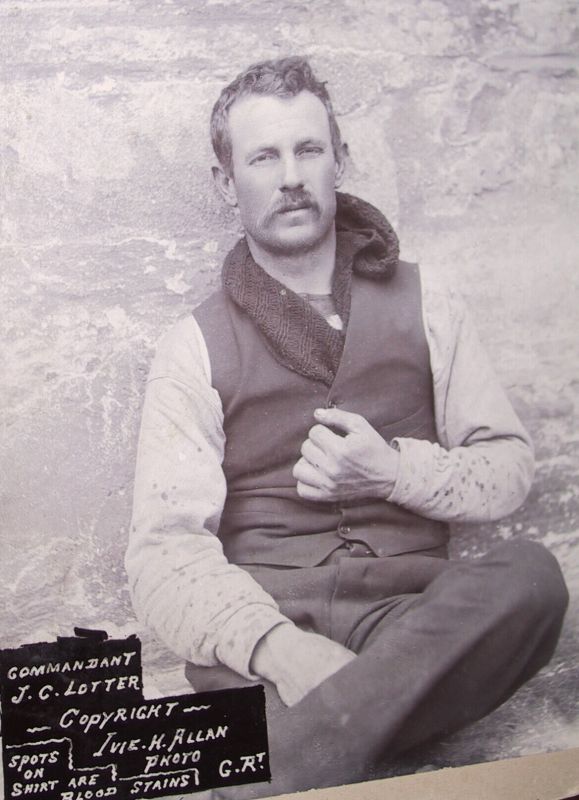
On this date in 1901, Commandant Johannes Lotter was shot at Middelburg.

Along with Gideon Scheepers, Lotter is one of the most famed Boer guerrillas from the Second Boer War.

Regarded by the British as one of their most nettlesome adversaries in that dirty guerrilla war, Lotter was captured in a bloody early September ambush when matters were well into an unpleasant scorched-earth endgame.

This was cause for much slapping of backs among the Union Jack set, and earned for his captor an immediate promotion.


Lotter’s captured men being jubilantly escorted into Graaff-Reinet.

Lotter almost immediately found himself in the dock for — well, all the things one does in a dirty guerrilla war.*

And one other thing: sedition.

The British charged Lotter as a rebellious subject of the British Cape Colony — rather than a resident of one of the independent neighboring Boer states — who owed allegiance to the British crown; upon this premise things like “killing troopers in war” became “murdering troopers”.

Lotter’s trial hung on his papers.** The defendant “pleaded that he was a Free State burgher, and, as such, entitled to the usage of civilised warfare and a legal combatant’s privileges.”

But he was in a bit of a pickle when it came to proving that the “Commandant Lotter” the British discovered on voting rolls for the Cape Colony city of Colesburg was a different guy. Innocent Blood: Executions During the Anglo-Boer War (its title telegraphs its Boer sympathies) summarizes:

his Free State citizen document was in a small case, which was lost or destroyed theday of surrender. Witnesses for the defence gave evidence that they had seen these papers. British intelligence stated that it could find no proof of his Free State citizenship in Bloemfontein. Lotter responded by asking how he could prove his citizenship when all his witnesses were still on commando and that he had been granted no time to call upon them.

Hey, the guy had six whole weeks from capture to execution to sort it all out.

A “Chair Monument” — there’s a picture of it on this page — commemorates Lotter and his fellow commando Pieter Wolfaardt at the place outside Middelburg where they were shot together on Oct. 12, 1901.

A number of additional prisoners from Lotter’s command taken with him in that same ambush were also eventually executed.

* Specifically: murdering two native spies; killing three British soldiers; blowing up railway lines; and sjamboking loyalist civilians.

** When the British later captured Scheepers, who was unquestionably not a Cape rebel, they simply charged his similar conduct as war crimes to the same capital effect.

On this day..

1817: Gertrudis Bocanegra, Mexican independence heroine

On this date in 1817, Mexican War of Independence heroine Gertrudis Bocanegra was publicly shot in her native town of Pátzcuaro for treason.

Bocanegra (English Wikipedia entry | Spanish), a literate Enlightenment woman was already 45 years old when the rebellion against the Spanish empire broke out.

Her husband and son joined Hidalgo‘s forces, in which service they would lay down their own lives.

Gertrudis Bocanegra kept a safe house, gathered supplies and money, shuttled messages … until Spanish authorities arrested her in 1817 and tortured her for information. (Need one even ask if the noble Bocanegra informed on her compatriots?)

She’s known as La Heroína de Pátzcuaro and is the namesake for, among other things, a plaza in that city and the striking Biblioteca Gertrudis Bocanegra, where one can find this:


(cc) image from eperales depicts Juan O’Gorman‘s monumental Historia de Michoacan. We’ve seen this monument before, as it depicts the Spanish burning to death the last native Tarasco ruler.

Bocanegra’s own execution is also shown in the mural — in the lower right, obscured by the bookshelves in the photograph above, but captured in detail in this Spanish blog post.

On this day..

1987: Eshan Nayeck, the last executed in Mauritius

On this date in 1987, Eshan Nayeck was hanged in Port Louis — capital of the Indian Ocean island nation Mauritius, a former Dutch, French, and British colony near Reunion Island.

It was just the second execution (French link) since Mauritius attained its independence in 1968, and it remains to this day the last.*

Nayeck sensationally stabbed to death a man named Abdool Rashid Atchia in Port Louis’s Central Market in 1983.


Scene of the crime: Central Market in Port Louis, circa 2006. (cc) image from erwinkarim.

* Mauritius abolished the death penalty in 1995, but its current Prime Minister Navin Ramgoolam has publicly mooted (pdf) restoring capital punishment “for crimes such as drug trafficking.”

On this day..

1569: Vladimir of Staritsa, royal cousin

On this date in 1569, Vladimir of Staritsa was forced by Ivan the Terrible’s goons to drink poison.

Vladimir was Ivan’s (barely) younger cousin, both of them grandsons of Russia’s state-building Ivan the Great.

Ivan the Terrible, of course, was the heir to the throne, an inheritance he received at the tender age of three when his father died unexpectedly — leading to Ivan’s famously miserable childhood of being kicked around by the boyars.

The dreadful relationship thereby fostered between throne and nobles came to a crossroads in 1553, when Ivan the Terrible appeared to be on his deathbed. The fading tsar tried to get those boyars to swear loyalty to Ivan’s infant son. Most of the boyars openly preferred the adult Vladimir of Staritsa.

This dramatic encounter is a pivotal episode in Sergei Eisenstein’s classic film Ivan the Terrible.

Instead of dying, Ivan surprisingly recovered. Awkward!

Vladimir actually survived this episode, and he himself may not even have been actively trying to claim the throne: the boyars hated Ivan plenty without his seditious assistance.

And for a while it looked as if any ill feelings were water under the bridge. Vladimir swore loyalty to Ivan upon the latter’s recovery, fought military campaigns alongside Ivan, and was even depended upon by Ivan as a guarantor of peace among Ivan’s own several potentially rivalrous sons.*

But that was the 1550s.

As the 1560s unfolded, Ivan grew increasingly mistrustful of his boyars’ loyalty.** According to this volume, an elevation of Vladimir to the throne was the object of at least one plot during those years. As Ivan’s only male cousin, he was a natural successor should Ivan be deposed, and therefore a natural focal point for Ivan’s enemies.

When Ivan eventually gave rein to his paranoia and unleashed the bloody purges of the oprichnina, Vladimir inevitably succumbed. Ivan decreed his death and forced him to administer the sentence by his own hand with a draught of poison, even going so far as to extirpate Vladimir’s wife and children, too.†

In a twist of the cruel irony Russian history is so susceptible to, Ivan the Terrible’s homicidal suspicion of his relations helped to doom Ivan’s own Rurik dynasty: after Ivan accidentally killed his own son and heir in a fit of pique, the succession which might have found a backup option in Vladimir and his offspring instead utterly collapsed — plunging Russia into the “Time of Troubles” out of which one of those former boyar families, the Romanovs, emerged with the throne after all.

* See Sergei Bogatyrev, “Reinventing the Russian Monarchy in the 1550s: Ivan the Terrible, the Dynasty, and the Church”, The Slavonic and East European Review, Apr. 2007. (pdf here)

** Ivan’s nasty turn after 1560 might trace to the untimely death of his wife Anastasia Romanovna, whom Ivan suspected might have been poisoned by those hated boyars.

† One daughter Maria Vladimirovna of Staritsa, survived.

On this day..