1743: John Breads, Rye killer

On this day in 1743, John Breads met his fate on the gallows in the small Sussex town of Rye, on the south coast of England. The spectacle of his hanging was compounded by the subsequent use of the gibbet, a cage in which Breads’s body was left exposed to the elements in Gibbets Marsh for more than 20 years.

On the face of it, this was just another hanging in the dustbin of history, but author Paul Kleber Monod uses it as the focal point of a book, The Murder of Mr. Grebell: Madness and Civility in an English Town (review | another), in which he wraps Rye, the murder and the execution into the social structures of England (especially small-town England) of the 18th century.

Although the murder itself is a small part of Monod’s book, he nonetheless outlines two aspects of the Breads story which make it worth a look by readers of Executed Today:

  1. the issue of fairness in the handling of the trial and execution; and
  2. the killer’s attempt to assert “mental distraction”

The facts of the murder itself seem fairly straightforward, although a little quirky, since the whole affair was apparently a case of mistaken identity: James Lamb, the then-mayor of Rye, was invited to dinner on March 16, 1743, to celebrate the appointment of his son John to the customs service. Lamb was feeling ill that day and asked his brother-in- law, Allen Grebell, to attend the dinner in his place. As Grebell was returning home after the event, he was attacked and stabbed in the churchyard by John Breads; although Grebell was able to make it back to his home, he died that night from his wounds.

When Breads was arrested for the murder, he claimed he had intended to kill Lamb, not Grebell. Monod points out that, since Lamb was related (albeit by marriage) to the victim, normal procedure would have been to move any hearing or trial to another jurisdiction, or at least allow an independent jurist to preside over the case. Breads’s assertion that Lamb was the intended victim should have given the Mayor even more reason not to be involved.

Instead, he insisted on keeping the trial in Rye and compounded the irregularity by acting as both prosecutor for the grand jury and as judge for the trial, thus ignoring judicial standards relating to conflict of interest. Additionally, one description of the trial claims that Lamb testified during the trial itself; if this is true, Monod says, such testimony was a breach of common law, which dictated that judges could not testify in cases over which they were presiding.

Monod introduces a commentary by Rye resident and lawyer Henry Dodson, who questioned whether Breads had received a fair trial in light of Lamb’s actions:

How fair a Tryal, the Prisoner had, I leave the Reader, to determine after he is informed, the above Mr. Lamb, was Mayor, Coroner, Party Prosecuting, Judge, Witness and Sheriff, in Presenting, Trying and Executing the said John Breads.

I suppose, he was Mayor, Coroner, and Sheriff, as essentiall, to the office of Mayoralty; Party and prosecutor, as Brother in Law to the Unfortunate good Gentleman, that was Killed; and Judge, and Witness out of Zeal, in getting the Prisoner proved Sane …

Dodson seemed to feel that Lambs involvement in the case was just a little too personal, and the fact that Breads was gibbeted after his execution might lend some credence to that idea. Gibbeting, Monod points out, was not usually a punishment imposed by a judge, but rather by royal order, and it was generally reserved for the most serious of killers.

But Monod puts the trial into a larger social context, suggesting that

the trial of John Breads bears a message about how the law operated in the 18th century [and] stands as an example of how authority might assert itself aggressively and unrestrainedly. The last word belonged to the judge … a kind of paternalism based on the social (and hence moral) inequality between defendant and judge. It was the opinion of the magistrate that counted.

[This] system reflected a social and political structure in which authority had been concentrated in a few hands, usually by inheritance … Breads had little chance of escaping the most extreme form of retribution.

The second point of interest in the Breads trial was that it stood at the cusp of a new understanding of insanity in the commission of crimes.

This is a mere replica of the Breads gibbet on display at the Rye Museum, but the town council still has possession of the original, skull and all. It’s reported to be a highly sought gawk, but it can only be seen by special arrangement.

Although Breads originally claimed his plan was to kill the mayor, he changed his tune at the trial, where he was reported as having said that “if he had committed the Fact, he knew nothing of it, for it was done when he was in Distraction … In short, he affected Madness …” (Kentish Post, June 1-4, 1743)

Or, in today’s parlance that would fitfully develop, “Not guilty by reason of insanity.”

Insanity had been a legitimate defense for years, but the definition of insanity was very much in flux at this time. Doctors suggested that madness was due to a mental defect rather than possession by an evil spirit and lawyers were pushing the idea that homicide required “malice aforethought,” while many average citizens still believed that those who were mad were in the grip of the devil.

Monod proposes yet another possibility by putting the question into a sociological context: “Insanity does not operate randomly,” he writes. “It cannot separate a sufferer from the social context in which he or she exists.”

For Breads, whose upbringing had been closely tied to his church, that context included unsuccessful attempts in the late 1600s by religious purists to wrest control of Rye’s government and economy from the wealthy secular class, and the antagonistic feelings that remained from the abject failure of that effort and the perceived religious persecution that followed it. Breads was no doubt influenced by that antagonism, Monod suggests, and those feelings “may have alienated him from the way the town was governed … [He] wanted to vent his rage on the oligarchs.” As a result, “Even in his madness, Breads was trapped by his own history and that of his native town.”

Whatever the source of Breads’ “distraction,” it did him no good. But it did become one piece of a serious conversation about the issue — a conversation which has continued for centuries.

On this day..

1945: Mile Budak, Ustasha ideologue

On this date in 1945, seven former members of Croatia’s World War II Ustasha regime were hanged in Zagreb by Tito‘s postwar Yugoslav government — the morning after they had all been death-sentenced at a one-day military trial.*

Despite the presence of wartime Prime Minister Nikola Mandic (English Wikipedia entry | Croatian) in the batch, the marquee name was writer Mile Budak
(English Wikipedia entry | the far more detailed Croatian and German).

The “minister of culture with a machine gun” in the branding of his leftist literary contemporary Miroslav Krleza, Budak spent the interwar years writing hit novels valorizing the Croatian peasantry (The 1,000-page OgnjišteHearth — is the magnum opus) and also voluminous copy for far-right periodicals. Thanks to the latter activity, Budak endured an arrest, an attempted assassination, several years’ self-imposed exile to Italy, and (after his return) the murder of his wife.

Small wonder that when Germany broke off from the post-imperial Kingdom of Yugoslavia an “independent” Croatian puppet state, Budak signed up as its chief propagandist. Initially Minister of Education in 1941, he subsequently became its ambassador to Germany, and in 1943 its Foreign Minister.

He’s most notorious for the alleged aphorism “One third of the Serbs we will kill, one third expel, and the last third convert to Catholicism” — and though adherents widely dispute his authorship of any such phrase, Budak’s racial cosmology elevating Croatians (“an intersection of Slav and Gothic blood”) over their South Slav brethren was part of the intellectual scaffolding for his state’s wartime campaign of ethnic cleansing against Serbs. (It goes without saying that Jews and Roma were even more screwed.)

Judgments on the literary merit of Budak’s output appear to be driven heavily by the critic’s sympathy level with Budak’s politics. Post-independence Croatia has a robust far right that has often shown keen to rehabilitate the Ustasha, so it’s no surprise that Budak has been rediscovered as a writer and his name stapled to numerous streets in Croatia** and even to one in the Bosnian city Mostar — strictly in honor of his artistry and not the war business, mind you.

* Indeed, several — Mandic included — were only yielded up from British captivity in mid-May. (Link goes to a Croatian pdf)

** There’s one, for instance, in present-day nationalist enclave Knin — formerly the capital of the Serbian Krajina during the internecine 1990s wars. Knin’s capture and, er, ethnic reordering is the occasion celebrated on Croatia’s Victory Day holiday (August 5). It was for this operation that Croatian general Ante Gotovina was prosecuted by the International Criminal Tribunal for the former Yugoslavia; Gotovina’s eventual shock acquittal and release to a great nationalist orgy in Zagreb led Serbia to quit cooperation with the ICTY’s “selective justice”.

On this day..

1971: Sean Flynn and Dana Stone, Vietnam War photojournalists

On an unknown date thought to be approximately June of 1971, American photojournalists Sean Flynn and Dana Stone were executed by Communist captors in Southeast Asia.

Flynn is the big name of the pair,* literally: a former actor, he wasn’t in like his superstar father Errol Flynn. After trading on his prestigious name for a few silver screen credits, Sean grew bored of Hollywood and pivoted into a career in wanderlust — trying his hand as a safari guide and a singer before washing up in Vietnam where the action was in January 1966.

He made his name there as a man who would find a way to snatch an indelible image out of war’s hurricane, even at the risk of his own life.


One of Flynn’s photos: A captured Viet Cong being tortured. (1966)

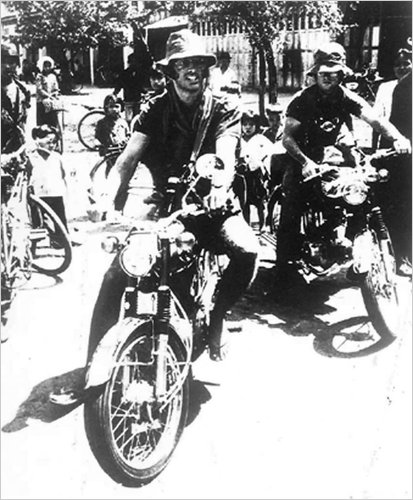
On April 6, 1970, Flynn and fellow risk-seeking photojournalist Dana Stone hopped on rented motorbikes bound for the front lines in Cambodia. It was a last mission born of their characteristic bravado — all but bursting out of the frame astride their crotch rockets in the last photo that would become their epitaph. They were never seen again; having apparently been detained at a Viet Cong checkpoint, it’s thought that they ended up in the hands of Cambodian Khmer Rouge guerrillas and were held for over a year before they were slain by their jailers.


Flynn (left) and Stone mount the bikes for their lethal assignment. This is the last picture ever taken of them.

Sean’s mother, actress Lili Damita, spent years seeking definitive information about his fate, without success. Dana’s brother, John Thomas Stone, joined the army in 1971 reportedly with a similar end in mind; he was killed by friendly fire in Afghanistan in 2006. The prevailing conclusion about their fate arrives via the investigation of their colleague and friend, Australian journalist Tim Page — a man for whom memorializing the journalists who lost their lives during the Vietnam War has been a lifelong mission.

Though Flynn’s and Stone’s guts are undeniable, not everyone appreciated their methods. “Dana Stone and Sean Flynn [son of the Hollywood actor, Errol Flynn] were straight out of Easy Rider, riding around on motorcycles carrying pearl-handled pistols. Cowboys, really,” said fellow photog Don McCullin. “I think they did more harm than good to our profession.”

* He’s not to be confused with present-day actor Sean Flynn — that’s our Sean Flynn’s nephew. (Sean the nephew was named for Sean the uncle.)

On this day..

1891: Christian Fuerst and Charles Sheppard

OMAHA, Neb., June 5. — Charles Sheppard and Christian Fuerst, who murdered Carl Pulsifer Dec. 10, 1889, and then robbed the body of $20, were hanged at Frement [sic] at 10:30 this morning. Sheppard nearly fainted on the gallows, but Fuerst acted entirely unconcerned. When the men were asked if they had anything to say Fuerst replied, “nothin,” but Sheppard said, “We are the men who did the deed and therefore no one else can be accused of it.” Both of the men’s necks were broken.

Dallas Morning News, June 6, 1891

On this day..

1867: Gottlieb Williams, eyeballed

From the very first volume of the Transactions of the American Ophthalmological Society, spanning 1864 to 1871. The society, and the journal, are still going strong.

The ellipses omit three other hangings investigated by Dr. Dyer.

FRACTURE OF THE CRYSTALLINE LENS IN PERSONS EXECUTED BY HANGING.
By E. Dyer, M.D., of Philadelphia, Pa.

Three years ago I presented to the Society the result of the examination of the eyes of a man who was hanged, also some experiments on the effects of hanging on the crystalline lens of the dog. In the case of the man the anterior capsule and the lens of the right eye were fractured. The direction of the fracture was horizontal and a line below the centre, extending as far back as the middle of the lens. In the left eye the anterior capsule only as involved. In one dog the same conditions were found, in another only one lens was fractured, and in a third no lesion was detected.

Since then I have experimented on rabbits. Two were hanged and four were strangulated. The trachea in two of the latter were laid bare and tied, but no fracture was detected in any case. Drs. S.W. Mitchell and W.W. Keen, who assisted me at the experiments on the dogs, were present.

The following are the notes of several executions at which I have been present since my report of the case already mentioned. I have been able to examine the eyes of the criminals both before and after death.

Gottlieb Williams, aet. 34, was executed in Philadelphia, June 4, 1867. Drop four and one-half feet; the knot slipped so as to be under the occiput; suspended thirty minutes; convulsive movements lasted five minutes; neck not dislocated.

Examination at 11.54 A.M., five minutes after the body was cut down. Appearance of eyes natural; no protrustion; no injection of conjunctival vessels, corneae clear.

Right eye, pupil well dilated; media clear. Small point seen on the anterior capsule of the lens in the median line, just above the margin of the pupil. At 12, M., spot more distinct; at 12.26 P.M., spot still present, somewhat elongated. Optic nerve normal; retinal vessels small.

Left eye, pupil smaller than the right; cornea clear; lens in normal condition; optic nerve normal; arteries small. I was not allowed to remove the eyes.

Drs. H. Yale Smith, physician to the prison, W.W. Keen and J. Ewing Mears assisted me in the examination.

This unpleasant series of investigations has been pursued ith the hope of throwing some light on the vexed question of the mechanism of the accommodation, but as yet without any satisfactory result.

On this day..

1898: James Fleming Parker

This morning in 1898 — allegedly after enjoying the company of an obliging prostitute during the preceding night as a favor from the sheriff, a childhood friend* — James Fleming Parker hanged on Courthouse Square in Prescott, Arizona.

An effective tort lawyer would have saved Parker from his untimely end, for his path to the gallows began when he lost a prized horse struck by an Atlantic and Pacific train and the railroad — spiraling towards bankruptcy in the wake of the Panic of 1893 — came up with only the most niggardly award.

Incensed, Parker went and got his the old-fashioned way: by sticking up an A&P train.

A few things went wrong.

For one, Parker botched the heist and had to flee the iron horse with an underwhelming haul, a dead confederate in his wake.

For another, he’d been recognized and was arrested a week later after a chase through the Arizona wilderness.

And finally, he decided to double his bad bet by leading a jailbreak while awaiting trial — in the course of which he fatally shotgunned a deputy district attorney who had responded to the hue and cry. Parker was lucky to end up in the clutches of that friendly sheriff instead of lynched to the nearest trestle or telegraph pole by an angry posse, but the upshot was the same.

Last sentiment, according to the Tombstone Epitaph** (June 5, 1898):

I have not much to say; I claim I am getting something that ain’t due me; but everyone who is going to be hung says the same thing, so that cuts no figure. Whenever people say I have to go, I am one that can go.

And then he went.

* If so, this last communion followed hours after Parker’s conversion to Catholicism.

** Really.

On this day..

1882: Sandy Mathews, in Memphis

From the June 3, 1882 Chicago Tribune:

Six Thousand People Present at the Execution of Sandy Mathews.

MEMPHIS, Tenn., June 2 — Sandy Mathews, colored, who murdered Essick Polk, colored, twele miles north of this city last October, was hanged in the county-jail yard this afternoon at 1 o’clock. The execution was witnessed by fully 6,000 people, a majority of whom were colored. The condemned man made a speech from the gallows, in which he confessed the killing, and implored his hearers to repent of their sins and go with him to Heaven. His neck was broken by the fall.

THE GALLOWS

had been erected in the southern portion of the jail-yard and was built high enough to give a full view to the ccrowd that jammed the streets running parallel with the jail. Matthews [sic] slept well last night, and partook of a hearty breakfast this morning. He bade farewell to his wife about 11 o’clock, and began making preparations for the hanging. A few weeks ago he embraced Catholicism, and was attended in his cell by the Rev. Father Lucius, of St. Mary’s Catholic Church. He called for his dinner at noon, and ate heartily, and afterwards smoked a cigar. At half-past 12 o’clock he was brought from his cell and conveyed to the scaffold, where he addressed the crowd for twenty minutes in

A DISCONNECTED SPEECH,

confessing to having killed Polk, and at the same time imploring his hearers to repent of their sins ere too late, and be forgiven, as he had done. He then knelt and repeated the Lord’s Prayer, after which the Rev. Father Lucius said the prayers for the dying. The condemned man was handcuffed, and his arms, and legs, and ankles strapped. The black cap was adjusted, and, as he uttered the words

“FAREWELL FRIENDS, FAREWELL WORLD,”

the drop was sprung, and his body shot down. His neck was broken by the fall, and ther was but very slight convulsions of the body. During the speech many of the colored people responded to his implorations by shouting, “Bless the Lord, Amen.” Sandy Mathews killed Essick Polk for having enticed his wife from him. He struck him three blows with an ax. Several hours afterwards he took the dead remains and buried them in a field near his house. The hole not being large enough, he chopped the dead body in pieces, and thus buried them. The crime was kept concealed for five months, but revealed by a stepdaughter of Mathews, who was the only witness to the killing, and upon whose testimony he was convicted. Gov. Hawkins was appealed to, but declined to interfere with the sentence of the lower court, which was afterwards confirmed by the Supreme Court.

On this day..

1970: Pedro Eugenio Aramburu, by the Montoneros

On this date in 1970, Argentine general and former dictator Pedro Eugenio Aramburu was shot by a band of Peronist student guerrillas.

Aramburu (English Wikipedia entry | Spanish) was one of the major figures behind the 1955 Revolución Libertadora that sent populist president Juan Peron fleeing to Spain. Peron was initially succeeded in the presidency by another general named Eduardo Lonardi, but before 1955 was out Aramburu had overthrown and replaced him, too; Aramburu ran the ruling junta until elections in 1958, maintaining a sharp ban on any vestige of Peronism — including even the mere mention of the exiled ex-president. He also had General Juan Jose Valle shot for plotting a Peronist coup in 1956.

The next two decades saw Argentina’s political institutions grow ever more painfully brittle, as shaky civilian governments were toppled in turn by equally shaky military rulers, every turn of the wheel eroding the country’s norms of orderly governance without attaining a stable political coalition. The charismatic Aramburu remained throughout a pole of anti-Peronism, which mattered as Peron’s long shadow grew and his return to Argentina began to seem likely.*

The faltering legitimacy of the government in turn spawned leftist guerrilla movements like the Peronist Montoneros, who entered Argentina’s political fray in gobsmacking style by abducting Aramburu in an affair the guerrillas called “Operation Pindapoy”.

On May 29, 1970 — Argentina’s Army Day and also the one-year anniversary of a suppressed popular uprising against the military government — two of the Montoneros terrorists disguised themselves as junior officers and presented themselves at Aramburu’s unguarded Buenos Aires apartment, claiming that the army had assigned them as his escort. The ruse worked like a charm.

With their prey in hand, the “officers” and their confederates stuffed him in a Peugeot and followed clattering dirt roads to evade police checkpoints, arriving that evening to a safehouse they had readied in the hamlet of Timote. There, a trio of young radicals constituted themselves a revolutionary tribunal and put Aramburu on “trial” for the murder of Gen. Valle and his fellow Peronist rebels fourteen years before.

Mario Firmenich, one of the dozen young Montoneros kidnappers, would later describe the three days they spent with their celebrated prisoner for a magazine: “His attitude was calm. If he was nervous, he controlled it.” Firmenich, who is still alive, has always insisted as he said then that their action evinced the popular will. “For the first time the people could sit on the bench and judge and condemn. That is what the Montoneros performed in Timote: to show the populace, that, beyond the pitfalls, legal chicanery and repression, there was a path to true justice, which stems from the will of a people.”

True justice was executed in the basement of their hideout. Having announced the inevitable verdict to Gen. Aramburu half an hour before, the leader of the cell shot him in the chest and then the head. The Montoneros then buried him, still bound and gagged, right there in the cellar — slathered with quicklime in an effort to hide the evidence.

It was a shocking blow to a fragile polity, and would help speed the (probably inevitable) fall of Gen. Juan Carlos Ongania, who was ousted from the presidency just a week after Aramburu’s murder.**

To grasp the profound effect of the kidnapping and murder of Aramburu it is necessary only to consult any Argentine periodical issued after May 29, 1970. Shortly after the kidnapping, Ongania announced in a televised speech that the death penalty would be imposed for crimes against public order. This decree was insufficient, however, to alleviate the feeling that order and authority had collapsed for good. (Source)

During Argentina’s subsequent dictatorship (and its escalating “Dirty War” against, amongst other subversives, the Montoneros), the town square of Timote was named for its unwilling guest Aramburu. That name has been changed in recent years.

* Peron did in fact return in 1973, amid bloodshed.

** Aramburu was probably involved in a plot to get rid of Ongania, whose credibility had gone to pieces in early 1970 quite independent of the Montoneros. Firmenich suspects this might account for the ex-president’s compliance with the purported junior officers who abducted him.

On this day..

1509: Four Dominicans for the Jetzer affair

(Thanks for today’s guest post to anti-clerical Enlightenment polemicist Voltaire, whose intervention in (and caustic commentary upon) death penalty cases in his own day we have several times featured. The events described arise from the Dominican order‘s Aquinas-derived dissent from the view, predominant theologically as well as popularly, of the Virgin Mary’s Immaculate Conception. The Immaculate Conception would later become settled doctrine in the Church. -ed.)

It is well known that the Cordeliers or Franciscans and the Jacobins or Dominicans have detested each other ever since they were founded. They were divided on several points of theology as well as being financial rivals. Their chief quarrel turned on the state of Mary before her birth. The Franciscans argued that Mary had not sinned in her mother’s womb, while the Dominicans were of the opposite opinion. There never was, perhaps, a more ridiculous question, and yet it was this very matter which made these two religious orders quite irreconcilable.

A Franciscan, preaching at Frankfurt in 1503 on the immaculate conception of Mary, happened to see a Dominican called Vigan come into his church. “I thank the Holy Virgin,” he exclaimed “for not having permitted me to belong to a sect which dishonours her and her son.” Vigan eplied that this was a falsehood. The Franciscan then came down from the pulpit, carrying an iron crucifix, and struck the Dominican such a violent blow that he almost killed him, after which he went on to finish his sermon on the Virgin.*

The Dominicans held a meeting to plan their revenge, and, in the hope of heaping greater humiliation on the Franciscans, they resolved to perform miracles. After several fruitless attempts they finally found a favourable opportunity in Berne.

One of their monks was confessor to a simple-minded young tailor named Jetzer, who was particularly devoted to the Virgin Mary and to Saint Barbara. This imbecile seemed to them to be an excellent subject for miracles. His confessor convinced him that the Virgin and Saint Barbara expressly commanded him to become a Dominican and to give all his money to the order. Jetzer obeyed and too the habit. When his vocation had been well tested, four Dominicans, whose names appear in the subsequent trial, disguised themselves on several occasions as best they could, one as an angel, another as a soul in purgatory, a third as the Virgin Mary and the fourth as Saint Barbara. At the end of these apparitions, which it would be too tedious to describe in detail, the Virgin finally revealed to Jetzer that she was born in original sin; that she would have been damned if her son, who was not yet on this earth, had not taken care to regenerate her immediately after she was born; that the Franciscans were impious and had grievously offended her son by claiming that his mother had been conceived without mortal sin, and that she charged him to announce this to all the servants of God and Mary in Berne.

Jetzer did not fail to do this. Mary appeared again, accompanied by two robust and vigorous angels. She thanked him and said that she had come to imprint upon him the holy stigmata of her son as proof of his mission and as a reward. The two angels tied Jetzer up and the Virgin drove nails into his hands and feet. The next day Brother Jetzer was exhibited on the altar for all to see, freshly bleeding from the heavenly favours he had received. The devout flocked to kiss his wounds. He performed as many miracles as he wanted, but the apparitions still continued. Finally Jetzer recognised the voice of the sub-prior beneath the mask he wore. He cried out and threatened to reveal everything. He followed the sub-prior into his cell, where he found his confessor and the two angels, who were entertaining some girls.

The monks, now that they were unmasked, had only one course open to them, which was to poison Jetzer. They sprinkled a communion wafer with some corrosive which had such a foul taste that Jetzer could not swallow it. He fled from the church crying out against the sacrilegious poisoners. The trial lasted for two years and came before the bishop of Lausanne because at that time laymen were not allowed to judge monks. The bishop sided with the Dominicans. He decided that the apparitions were real and that Jetzer was an imposter; he was even so cruel as to sentence the poor man to torture. But later the Dominicans imprudently degraded Jetzer, stripping him of his monk’s habit. This meant that Jetzer was now a layman again and his case could therefore be heard by the Council of Berne. As a consequence of his testimony the long catalogue of crimes was confirmed. When the ecclesiastical judges were called in from Rome, they were compelled to deliver up the criminals to the secular authorities. The guilty were burnt at the Marsilly gate on 31 May 1509. Records of the trial are now in the archives of Berne and have been printed on several occasions.


The fourteenth panel (click for the full glorious graphic novel) of a woodcut series illustrating the progress of the hoax. (Via).

* The Dominican Wigand Wirt, who denounced the Immaculate Conception so vociferously that he was summoned to Rome in 1507 to answer for it.

On this day..

1741: Cuffee and Quack, “chained to a stake, and burnt to death”

This date in 1741 marked the first official execution for the alleged New York slave conspiracy of 1741.

Nineteen days before, two slaves named Caesar and Prince had hanged, nominally for theft but believed by the populace (and the court) primary instigators of a staggering plot to put New York to the torch, murder the city’s whites, and reign as kings on the ashes of their masters’ city.

Cuffee was, alongside those already-executed Caesar and Prince, part of a trio of slaves known to hang about together at the house of barkeep and fence John Hughson. Already notorious about town for a gin-robbing incident that had seen all three publicly whipped in 1738, they had again burgled a linen store that February. (That’s the crime for which Caesar and Prince were executed.)

The evidentiary chain linking these commonplace prowlers to a spate of fires whose intent must be the annihilation of the city leaves quite a bit to be desired, but the burning spring of 1741 helped solder them together in part thanks to a white New Yorker spying Cuffee in what he thought was a suspicious position during a fire and raising the alarm. Cuffee fled, back to the home of Adolph Philipse — his owner, and also the uncle of one of the judges who would eventually condemn him — where a crowd of incited freemen chased him down and hauled him to gaol, “borne upon the People’s Shoulders.” His skulking seemed to confirm a widening suspicion, spiced by the mother country’s going war against dusky Spaniards, that the city’s Negroes must surely lurk behind a fortnight’s infernos. From this point on it appears as if New Yorkers — or at least the city’s elites — determined by consensus that they “must necessarily conclude, that [the fires] were occasioned and set on Foot by some villainous Confederacy of latent Enemies amongst us.”

Now, this appearance of consensus is an impression nearly three centuries distant, and is heavily shaped by the circumstance that there’s one predominant voice surviving the ravages of years to document for us the official proceedings: Daniel Horsmanden, who both judged and investigated the case and is thus heavily invested in its outcome. His A Journal of the Proceedings in the Detection of the Conspiracy Formed by Some White People, in Conjunction With Negro and Other Slaves, for Burning the City of New-York in America and Murdering the Inhabitants is Horsmanden’s record of how the plot or “plot” was uncovered; it was assembled in 1742 and presents trial and deposition records curated by Horsmanden with a view to persuading “such as have a Disposition to be convinc’d, and have in Reality doubted, whether any particular Convicts had Justice done them or not” — for by this time such doubts were dogging Horsmanden’s court, having hounded 30-odd people to death on evidence that was already viewed as highly impeachable.

There had been some wanton, wrong-headed Persons amongst us, who took the Liberty to arraign the Justice of the Proceedings, and set up their private Opinions in Superiority to the Court and Grand Jury; tho’ God knows (and all Men of Sense know) they could not be Judges of such Matters; but nevertheless, they declared with no small Assurance (notwithstanding what we saw with our Eyes, and heard with our Ears, and every one might have judg’d of by his Intellects, that had any) That there was no Plot at all!

Whether the entire slave conspiracy to burn New York was a phantom, or whether it did indeed reflect in whatever distorted way a some real mode of resistance, is a factual question that is permanently unanswerable.* But the cases certainly took on a witch hunt quality, and they bore many hallmarks of wrongful conviction that are familiar even today.

Our first two hangings, Caesar and Prince, were doomed by the decision of John Hughson’s teenage serving-girl to turn state’s evidence and denounce them. As Cuffee and Quack would be the first people formally tried for the arson wave, her evidence was buttressed in this case by another common prosecutor’s cheat: the prison snitch.

A (white) petty thief named Arthur Price, who was being held in New York’s dungeon along with the growing ranks of suspected terrorists, helpfully began informing on the people around him. It’s likely he was a longstanding underclass crony of the purported plotters.

At any rate, the civic-minded Price, “having been found by experience to be very adroit at pumping out the Secrets of the Conspirators … was ordered to put Cuffee (Mr. PHILIPSE’s Negro) into the same Cell with him, and to give them a Tankard of Punch now and then, in order to chear up their Spirits, and make them more sociable.” What do you know but the next morning, Price was ready to report that his inebriated cellmate had admitted the conspiracy to him, and had implicated Quack as the man who actually fired the fort.

Quack was promptly arrested. Arthur Price would give evidence against both at their trial, but having made himself an obvious stool pigeon his use as an informant was at an end since nobody would go near him any longer.

More key information against Cuffee and Quack came from two other slaves, whose “Negro evidence” — a distinct class of (significantly derogated) proof in New York courts — would also have been controversial. The crown’s attorney prosecuting the case felt obliged to go out of his way to justify to the jury the unsworn testimony of “Pagan Negroes” on the grounds that without such, “the greatest Villanies would often pass with Impunity.” But pagan or no, both Sandy (a minor) and Fortune were also men who were suspect in the plot. Perhaps as black slaves their king’s evidence could not be as strong as that of the white servant Mary Burton — but it might still be strong enough to save their lives. Sandy spent a week in the dungeon amid his alleged confederates, after which he was hauled before the grand jury and leaned upon until he cracked.

They told him, if he would speak the Truth, the Governor would pardon him, though he had been concerned in them; and this was the Time for him to save his Life by making a free and ingenuous Confession; or in Words to this Purpose. He answered, That the Time before after that the Negroes told all they knew, then the white People hanged them. The Grand Jury assured him, that it was false; for that the Negroes which confessed the Truth and made a Discovery, were certainly pardoned, and shipped off: [which was the Truth] And upon this Assurance he began to open, and gave the following Evidence.

Quack, Sandy said, had solicited Sandy to help him burn down Fort George — and Cuffee “said, D–m him, that hang him or burn him, he would set fire to the Town.” Fortune was among the numerous other names he named — whose “Design was to kill all the Gentlemen, and take their Wives, and that Quack and Cuffee were particular Persons that talked so.”

Strangely, before they suffered at the stake Cuffee and Quack were suffered to conduct a hopeless defense of their own — “indulged with the same Kind of Trial as is due to Freemen, though they might have been proceeded against in a more summary and less favourable Way,” in the crown’s summing-up. This was more than they were entitled to as slaves, and they used the court’s liberality to summon ten witnesses in an attempt to establish good character and alibi; notably, Quack’s owner John Roosevelt avowed that “Quack was employed most Part of that Morning the Fort was fired, from the Time they got up, in cutting away the Ice out of the Yard; that he was hardly ever out of their Sight all that Morning, but a small Time while they were at Breakfast; and that they could not think he could that Morning have been [from] their House so far as the Fort.” But even from a white property owner, these words were far too little against a consensus that had been shaped seemingly from the belly of the conspiracy — from Mary Burton’s evidence and Arthur Price’s evidence and Sandy’s and Fortune’s evidence: that Quack’s were the hands that set the most damaging fire in the arson campaign, and that Cuffee’s, along with Caesar’s and Prince’s, were the hands that directed him.

Their condemnation was a mere formality, albeit one whose rhetorical opportunities the court did not mean to neglect.

You both now stand convicted of one of the most horrid and detestable pieces of villainy, that ever satan instilled into the heart of human creatures to put in practice; ye, and the rest of your colour, though you are called slaves in this country; yet you are all far, very far, from the condition of other slaves in other countries; nay, your lot is superior to that of thousands of white people. You are furnished with all the necessaries of life, meat, drink, and clothing, without care, in a much better manner than you could provide for yourselves, were you at liberty; as the miserable condition of many free people here of your complexion might abundantly convince you. What then could prompt you to undertake so vile, so wicked, so monstrous, so execrable and hellish a scheme, as to murder and destroy your own masters and benefactors? nay, to destroy root and branch, all the white people of this place, and to lay the whole town in ashes.

I know not which is the more astonishing, the extreme folly, or wickedness, of so base and shocking a conspiracy; for as to any view of liberty or government you could propose to yourselves, upon the success of burning the city, robbing, butchering, and destroying the inhabitants; what could it be expected to end in, in the account of any rational and considerate person among you, but your own destruction? And as the wickedness of it, you might well have reflected, you that have sense, that there is a God above, who has always a clear view of all your actions, who sees into the utmost recesses of the heart, and knoweth all your thoughts; shall he not, do ye think, for all this bring you into judgment, at that final and great day of account, the day of judgment, when the most secret treachery will be disclosed, and laid open to the view, and everyone will be rewarded according to their deeds, and their use of that degree of reason which God Almighty has entrusted them with.

Ye that were for destroying us without mercy, ye abject wretches, the outcasts of the nations of the earth, are treated here with tenderness and humanity; and, I wish I could not say, with too great indulgence also; for you have grown wanton with excess of liberty, and your idleness has proved your ruin, having given you the opportunities of forming this villainous and detestable conspiracy; a scheme compounded of the blackest and foulest vices, treachery, blood-thirstiness, and ingratitude. But be not deceived, God Almighty only can and will proportion punishments to men’s offences; ye that have shewn no mercy here, and have been for destroying all about ye, and involving them in one general massacre and ruin, what hopes can ye have of mercy in the other world? For shall not the judge of all the earth do right? Let me in compassion advise ye then; there are but a few moments between ye and eternity; ye ought therefore seriously to lay to heart these things; earnestly and sorrowfully to bewail your monstrous and crying sins, in this your extremity; and if ye would reasonably entertain any hopes of mercy at the hands of God, ye must shew mercy here yourselves, and make what amends ye can before ye leave us, for the mischief you have already done, by preventing any more being done. Do not flatter yourselves, for the same measure which you give us here, will be measured to you again in the other world; ye must confess your whole guilt, as to the offences of which ye stand convicted, and for which ye will presently receive judgment; ye must discover the whole scene of iniquity which has been contrived in this monstrous confederacy, the chief authors and actors, and all and every the parties concerned, aiding and assisting therein, that by your means a full stop may be put to this horrible and devilish undertaking. And these are the only means left ye to shew mercy; and the only rea­sonable ground ye can go upon, to entertain any hopes of mercy at the hands of God, before whose judgment seat ye are so soon to appear.

Ye cannot be so stupid, surely, as to imagine, that when ye leave this world, when your souls put off these bodies of clay, ye shall become like the beasts that perish, that your spirits shall only vanish into the soft air and cease to be. No, your souls are immortal, they will live forever, either to be eternally happy, or eternally miserable in the other world, where you are now going.

If ye sincerely and in earnest repent you of your abominable sins, and implore the divine assistance at this critical juncture, in working out the great and momentous article of the salvation of your souls; upon your making all the amends, and giving all the satisfaction which is in each of your powers, by a full and complete discovery of the conspiracy, and of the several persons concerned in it, as I have observed to ye before, then and only upon these conditions can ye reasonably expect mercy at the hands of God Almighty for your poor, wretched and miserable souls.

Here ye must have justice, for the justice of human laws has at length overtaken ye, and we ought to be very thankful, and esteem it a most merciful and wondrous act of Providence, that your treacheries and villainies have been discovered; that your plot and contrivances, your hidden works of darkness have been brought to light, and stopped in their career; that in the same net which you have hid so privly for others your own feet are taken: that the same mischief which you have contrived for others, and have in part executed, is at length fallen upon your own pates, whereby the sentence which I am now to pronounce will be justified against ye; which is,

That you and each of you be carried from hence to the place from whence you came, and from thence to the place of execution, where you and each of you shall be chained to a stake, and burnt to death; and the lord have mercy upon your poor, wretched souls.

That sentence came down on May 29.

It was implemented the very next day, amid a mob scene.

With Quack and Cuffee staked to their pyres, they were harried to admit the plot with the promise of a reprieve from their horrible sentence. Even if mercy would only amount to moderating death by burning into death by hanging, it would be well worth having — and the frightened slaves grasped at the small succor left them.

The spectators at this execution were very numerous; about three o’clock the criminals were brought to the stake, surrounded with piles of wood ready for setting fire to, which the people were very impatient to have done, their resentment being raised to the utmost pitch against them, and no wonder. The criminals shewed great terror in their countenances, and looked as if they would gladly have discovered all they knew of this accursed scheme, could they have had any encouragement to hope for a reprieve. But as the case was, they might flatter themselves with hopes: they both seemed inclinable to make some confession; the only difficulty between them at last being, who should speak first. Mr. Moore, the deputy secretary, undertook singly to examine them both, endeavoring to persuade them to confess their guilt, and all they knew of the matter, without effect; till at length Mr. Roosevelt [Quack’s owner, who testified for his alibi -ed.] came up to him, and said he would undertake Quack, whilst Mr. Moore examined Cuffee; but before they could proceed to the purpose, each of them was obliged to flatter his respective criminal that his fellow sufferer had begun, which stratagem prevailed: Mr. Roosevelt stuck to Quack altogether, and Mr. Moore took Cuff’s confession, and sometimes also minutes of what each said; and afterwards upon drawing up their confessions in form from their minutes, they therefore intermixed what came from each.

Thus induced by prevaricating confessors amid a mob baying for their blood, both Quack and Cuffee implicated Hughson as the originator of the plot, and themselves as early principals, and named a good many others besides. (Quack also at last claimed responsibility for firing Fort George, as the court had found.)

But the quid for their quo was not the promised abatement of their sufferings. As Sandy had worried to the grand jury in a different context, white men’s reassurances to slave rebels whom they meant to destroy could prove … unreliable.

After the confessions were minuted down (which were taken in the midst of great noise and confusion) Mr. Moore desired the sheriff to delay the execution until the governor be acquainted therewith, and his pleasure known touching their reprieve; which, could it have been effected, it was thought might have been means of producing great discoveries; but from the disposition observed in the spectators, it was much to be apprehended, there would have been great difficulty, if not danger in an attempt to take the criminals back. All this was represented to his honour; and before Mr. Moore could return from him to the place of execution, he met the sheriff upon the common, who declared his opinion, that the carrying the negroes back would be impracticable; and if that was his honour’s order it could not be attempted without a strong guard, which could not be got time enough; and his honour’s directions for the reprieve being conditional and discretionary, for these reasons the execution proceeded.

* For contrasting perspectives, Peter Linebaugh and Marcus Rediker present this as a real instance of working-class rebellion in The Many-Headed Hydra, while Jill LePore’s New York Burning approaches it as mostly a concoction.

On this day..