1732: Petrus Vuyst, governor of Dutch Ceylon

On this date in 1732, the deposed Dutch governor of Ceylon was executed by throat-slashing in Batavia (present-day Jakarta, Indonesia) for abuse of power.

Petrus Vuyst (English Wikipedia entry | Dutch) was a Batavia-born son of a Dutch mercantile empire already well upon its decline phase.

Following a loop back to the mother country for espousing and legal training, Vuyst returned to the East Indies and soon advanced in the colonial bureaucracy — governing Dutch Bengal before being appointed the Low Countries’ proconsul in Dutch Ceylon.

The scant information about Vuyst is mostly in Dutch; this public domain document details the proceeding slating him with corruption and wholesale cruelty.

On this day..

1917: Otilio Montaño, Zapatista

One hundred years ago today, Otilio Montaño Sánchez was shot as a traitor to the Mexican Revolution.

Montaño was a rural schoolteacher who came to mentor Emiliano Zapata via Zapata’s cousin.

Montaño had the distinction of helping Zapata draw up his movement’s “sacred scripture,” the egalitarian Plan of Ayala, and rose with his protege to become Secretary of Public Instructions in the Zapatista governing junta.

This association was destined to be displaced by a different (ex-)revolutionary, Venustiano Carranza, who would break with Zapata and emerge from the Revolution as Mexico’s president. Montaño suffered the fate Carranza’s former allies would have wished to impose upon him: being accused of supporting a pro-Carranza revolt, a revolutionary tribunal had him shot (dishonorably, shot in the back) wearing a defamatory sign reading “So die all traitors to the fatherland.”

A small town in Morelos is named for Montaño.

On this day..

1723: Christopher Layer, for the Atterbury Plot

On this date in 1723, Christopher Layer was hanged and quartered at Tyburn for the Jacobite Atterbury Plot

In the wake of the hegemonic Whigs’ political legitimacy crisis following the 1720 financial implosion of the South Sea bubble, supporters of the exiled Stuart dynasty rekindled* hopes of resuming the English throne.

The “Atterbury Plot” — so named for its sponsor and most prominent adherent, the Tory Anglican bishop Francis Atterbury — proposed to orchestrate a coup that would seize the persons of the usurping Hanovers and key points in London and Westminster, coordinated with both an internal Catholic/Tory rising and a landing by forces loyal to James Stuart. (He’s known as “the Pretender” or as King James III, depending on where the speaker’s treasons lie.) So particularly were the Tory ambitions developed that lists of expected supporters for each of England’s counties had been drawn up, the framework of a hypothetical replacement state.

This plot was broken up by 1722 and has been ridiculed as fanciful by outcome-oriented observers, but the government at the time took a plan by disaffected elites to kidnap the royal family — a plot which had only been betrayed to them by one of the conspirators’ French contacts — very seriously indeed. Paul Kleber Monod characterizes the 1714-1723 period (which compasses more than just the Atterbury scheme) as “the most widespread and the most dangerous” of “three great waves of Jacobite activity.”

Responding vigorously, the newly ascendant Prime Minister** Robert Walpole used anti-Jacobite security measures to lay his firm hand on the helm of state. A Dutch envoy in 1723 wrote that one of its progenitors, Sir Henry Goring, “had formed a company out of the Waltham Blacks for the Pretender’s service” and that this perceived Jacobite association of skulking soot-faced poachers and potential guerrillas “led to the bringing of the Waltham Black Act into Parliament.”†

In a conspiracy of disaffected nobles, Layer might have been the least august participant — and perhaps this explains why he was the one to pay the highest price.

A successful Middle Temper barrister of strictly commoner stock, Layer’s successful practice earned him the confidence of Lord North and Grey, one of the other chief Jacobite conspirators.

Himself a ready adherent of same, Layer communicated directly with the Pretender, even traveling to Rome in 1721 to brief him personally on the plot. The volume of incriminating correspondence thereby produced, some of it in the hands of a mistress who would shop him, brought Layer his death sentence — albeit only after dramatically attempting an escape. His severed head would cast a rotted warning mounted atop Temple Bar.

Many died for the Stuart cause down the years but in the present affair only Layer would quaff the cup of martyrdom.

For others involved, who had been more circumspect about their paper trails and associates, treason would meet with less lethal revenge. Held in the Tower of London for two years, Atterbury himself proved elusive for a proper prosecution despite having corresponded directly with the Pretender with suggestive but discreet language (e.g., “the time is now come when, with a very little assistance from your friends abroad, your way to your friends at home is become safe and easy” in April 1721); instead, the Commons voted a bill of pains and penalties depriving him of his office and exiling him. Lord North and Grey followed him to the continent; like combinations of dispossession and disgrace befell all the other conspirators too.


Plaque to Christopher Layer in Aylsham, where he once practiced.

Poet Alexander Pope,‡ a Catholic, was close with Bishop Atterbury and wrote him an epitaph upon his passing.

For Dr. Francis Atterbury,
Bishop of Rochester,
Who died in Exile at Paris, in 1732.

[His only Daughter having expired in his arms, immediately after she arrived in France to see him.]

DIALOGUE.

SHE.

Yes, we have liv’d — one pang, and then we part!
May Heav’n, dear Father! now have all thy Heart.
Yet ah! how once we lov’d, remember still,
Till you are Dust like me.

HE.

               Dear Shade! I will:
Then mix this Dust with thine — O Spotless Ghost!
O more than Fortune, Friends, or Country lost!
Is there on earth one Care, one Wish beside?
Yes — Save my Country, Heavn’,
               — He said, and dy’d.

* Jacobites had only recently been defeated in a 1715 rising; they retained enough vim to try again in 1745.

** Walpole is often regarded retrospectively as the first Prime Minister, but this was not an official rank in his time: indeed, it was a defamation used against him and which Walpole rejected. (“I unequivocally deny that I am sole or Prime Minister and that to my influence and direction all the affairs of government must be attributed.”)

† Quote from Katherine West Scheil in Shapeskeare Survey 51.

‡ In other Atterbury-related celebrity litterateur brushes, Edward Gibbon’s Stuart-sympathizing grandfather was obliged by the Jacobite scandal to retire to his estate, “disqualified from all public trust.” The erudite historian would recall that “in the daily devotions of the family the name of the king for whom they prayed was prudently omitted.”

On this day..

1946: Bruno Tesch and Karl Weinbacher, Zyklon-B manufacturers

On this date in 1946, British hangman Albert Pierrepoint hanged seven German war criminals at Hameln Prison.

These seven comprised two distinct groups charged in two very different misdeeds:

Karl Eberhard Schöngarth and four others hanged for executing a downed Allied pilot in 1944.

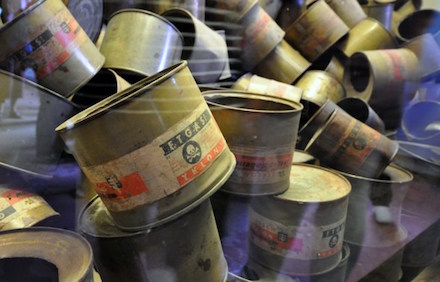
Bruno Tesch and Karl Weinbacher were executed for a critical support role in the Holocust: they were principles of the chemical manufacturer Testa, which sold Zyklon-B to the Reich for use in the gas chambers.


Zyklon was just a brand hame (“Cyclone”)

Hydrogen cyanide had been employed as a legitimate pesticide and de-lousing agent for many years before World War II. Because of its danger, the odorless deadly gas was sold spiced with an odorant to alert humans accidentally exposed to it.

Tesch and Weinbacher had their necks stretched because they were shown to have knowingly sold this product sans odor, reflecting Testa’s complicity in its intended use upon humans. (A third Testa employee was acquitted, having inadequate knowledge of the firm’s operations.)

On this day..

Daily Double: Hameln after the war

Famous for its Pied Piper, the Saxon town of Hameln (Hamelin) after World War II had the honor or burden of sending off 150+ of the war criminals whose volkische enchantments had so devastated Europe. (Plus a number of others for more ordinary crimes under military jurisdiction.)

Taking over a prison where the Nazis had murdered leftists, Jews, and homosexuals, the British made it Albert Pierrepoint‘s home away from home, the gallows-clearinghouse for war crimes trials throughout the western Reich. In Hameln the suave hangman noosed many of the World War II convicts that have featured on this here site down the years, including those of

Great Britain maintained a military presence in Hameln throughout the Cold War, which it is only now winding down. However, she handed the prison back to the West German government in 1950, and German authorities responded by controversially reburying 91 hanged war criminals in a consecrated cemetery.

The prison buildings still stand today, but they’ve been since converted into a four-star hotel which doesn’t advertise the many frightful ghosts who haunt its suites.

For the next two days, we’ll resurrect a few of them from consecutive mass hangings in 1946. For more about Hameln and a thorough roster of its postwar executions, see this page on the invaluable Capital Punishment UK site.

On this day..

1946: Ten at Hameln for killing Allied POWs

On this date in 1946, the British hanged 10 convicted war criminals at Hameln Prison, notably including seven for the “Dreierwalde Airfield murders” of four Allied prisoners of war.

Picture from this book about RAF POWs in wartime Germany, which also supplies the unknown names: A.W. Armstrong and R.F. Gunn of the RAF; B.F. Greenwood and J.E. Paradise of the RAAF.

In that case, two British and three Australian airmen had been captured after bailing out during a March 21 raid. Taken to the nearby aerodrome between Dreierwalde and Hopsten in Westphalia, they were marched out the next day ostensibly for transport to a POW compound. Instead, they all ended up shot by their guards — although Australian Flight-Lieutenant Berick was able to escape, wounded, and survive the war.

The nub of the case was whether the guards cold-bloodedly murdered their prisoners (prosecutors’ version), or whether there was an escape attempt by the airmen that caused the guards to start shooting (defense version).

Berick’s affidavit to the effect that no escape had been attempted weighed very heavily here — that nothing was afoot until he suddenly perceived the guards cocking their weapons. Karl Amberger would testify on behalf of himself and his men that the five had been suspiciously taking their bearings as they marched and suddenly broke off running in different directions.

The defense counsel’s attempt to reconcile these accounts in the haze of war was not fantastical — “saying that the cocking of the action of a weapon by one guard was not unnatural given the fact that five prisoners had to be guarded in a lane in the growing dusk … [while] Berick and the other prisoners probably regarded it as likely that they were to be shot, as others in their position had been, and began to run when it was not necessary.” But it did not carry the day.

Three other Germans joined this bunch on the scaffold, for similar but unrelated POW abuses.

  • Erich Hoffmanm, condemned by a joint British-Norwegian court in Oslo for the murder of Allied POWs in occupied Norway.
  • Friedrich Uhrig, for murdering a downed Royal Air Force pilot at Langlingen.
  • Franz Kircher, for killing three airmen at Essen-West.

On this day..

Feast Day of St. Victor and St. Corona

May 14 is the feast date of St. Victor, a Christian Roman soldier and his co-religionist and possible spouse Corona. Both the city and the century (and therefore the reality) of their passion are uncertain.

For the believer, what these martyrs lack in firm historicity they make up for in practical effect.

Corona chanced to become associated by medieval times with money — possibly the coincidence of her name, meaning crown,* with the sigils on coins — and thus she got wrapped up into a variety of pecuniary prayers and incantations. Strictly unofficial stuff from Rome’s standpoint, you understand: treasure-hunting, lotteries, wagering, and other fond fantasies of unearned windfalls.

The solemn devout might laugh, but “dear god, give me some stuff” comprises an underrated share of popular theology. J. Dillinger cites this charmer in Magical Treasure Hunting in Europe and North America: A History, dating to 1794 Austria:

Virgin and martyr Corona, I, a poor sinner, ask you to remember your great mercy and honour and your control over the treasures of the world and whoever asks you in the name of Jesus Christ your dear bridegroom, in his name you have power to give worldly goods to me, a poor and needy person, so I beg you with all of my humble heart, oh virgin and martyr Corona relief [sic] me from my needs and my poverty by giving me 50000 florins of good gold for the salvation of my soul through the redemption of my need body.

This enchantment needs to be added to the web’s supply of money-drawing rituals.

Because engaging such supernatural entities was a frightful venture for the petitioner, be he ever so humble, the prayer amusingly contains an equally elaborate chant for dismissing Saint Moneybags after she has paid up.

Now go away in the peace of God, which shall be between you and me, go back to the place where you came from, the eternal peace of God shall be and shall stay forever between you and me, and you will come again, when I wish to see you. Now go away and be blessed, through God and his holy five wounds, and go away in the peace of God, and the blessing be between you and me and the mine. Amen.

* Her legend can be found attributed to St. Stephanie: like “Corona”, the name Stephanie means “crown”.

On this day..

1920: Rickey Harrison, Hudson Duster

On this date in 1920, Rickey Harrison of the Greenwich Village “Hudson Dusters” went to the electric chair for a murder committed in the course of an armed robbery.

As befits a gaggle of old time New York hoodlums this crowd was rife with colorful nicknames — Goo Goo Knox, Circular Jack, Ding Dong — and hired out its thrashings in service of Tammany Hall‘s rude electoral manipulations. Their signal achievement was earning a popular doggerel tribute that rang in the streets in its day, by beating senseless a beat cop who’d had the temerity to arrest some of their number.

Says Dinny [patrolman Dennis Sullivan], “Here’s me only chance
To gain meself a name;
I’ll clean up the Hudson Dusters,
And reach the hall of fame.”*
He lost his stick and cannon,
and his shield they took away.
It was then he remembered,
Every dog had his day.

At their peak the Hudson Dusters could rank as one of the brighter stars in the dizzying constellation of Big Apple crooks. Herbert Asbury’s classic The Gangs of New York notes that “perhaps fifty small groups … operated south of Forty-second street [and] owed allegiance to the Gophers, Eastmans, Five Pointers, Gas Housers, and Hudson Dusters … Each of these small gangs was supreme in its own territory, which other gangs under the same sovereighty might not invade, but its leader was always responsible to the chieftain of the larger gang, just as a prince is responsible to his king.” Allegedly future Catholic social justice activist Dorothy Day, then a teenage radical journalist just moved to New York City, enjoyed carousing with the Dusters in the 1910s.

Despite political pull through Tammany (and heavenly pull through Dorothy) arrests and gang wars dusted the Dusters over the first two decades of the 20th century.

Our man Rickey Harrison, a pipsqueak Irishman with a substandard nickname (“Greenwich Village Terror” … lame), led a gangland raid on a high-stakes poker game at the Knickerbocker Waiters Club on September 7, 1918, and shot dead a Canadian soldier who refused to give up his boodle. Harrison would go to his grave insisting that it was not he who fired the fatal shot, although he was markedly less scrupulous about accounting the undetected and unprosecuted crimes of his career.

As a last indignity, Harrison and another murderer named Chester Cantine — who preceded the gangster to the electric chair — had to brace themselves for eternity within earshot of a raucous Sing Sing vandeville show where prisoners and 800 visitors were “applauding and roaring with laughter in an improvised theatre a few feet away … comic sketches [and] jazz music resounded throughout the prison.” (New York Times, May 14, 1920)

Harrison’s last sentiment — “Let us hope and pray they will never do this thing to another man, innocent or guilty” — still awaits fulfillment a century later.

* The apparent allusion is to the Hall of Fame for Great Americas, a civic pantheon opened in 1900 that is now part of Bronx Community College. This outdoor colonnade, still extant but largely forgotten, imported its busts-of-great-men concept from Bavaria; the Hall’s popularity in its time makes it the ancestor of the innumerable Halls of Fame that have since come to litter the North American civic landscape.

On this day..

1775: William Pitman, for murdering his slave

(Thanks to Meaghan Good of the Charley Project for the guest post. -ed.)

On this date in 1775,* plantation owner William Pitman was hanged for murder in King George County, Virginia.

Pitman had a reputation as a brutal man and was no stranger to the Virginia courts; he had been making appearances since the 1750s. So perhaps it was not surprising that he got strung up eventually.

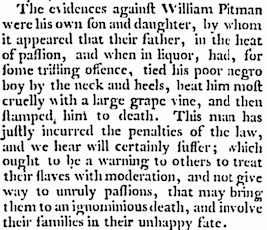
Virginia Gazette, Apr. 21, 1775

What is surprising, indeed perhaps unprecedented, is that the murder victim was one of his own slaves.

The Virginia Gazette, which published the sole surviving account of the incident, says that Pitman, “in liquor” and “in the heat of passion” lost his temper, “tied his poor negro boy by his neck and heels,” and beat him with a large grapevine before stomping him to death.

Pitman can hardly have been the first, or the last, slaveowner to slaughter his own “property” but it was usually impossible to get a conviction because blacks were not allowed to testify against whites in court. In this case, however, two white people — Pitman’s own son and daughter — sealed the case by giving evidence against their father.

The Gazette, writing on April 21, said Pitman had “justly incurred the penalties of the law” and said hopefully that the story might be “a warning to others to treat their slaves with moderation, and not give way to unruly passions, that my bring them to an ignominious death, and involve their families in their unhappy fate.”

* Pitman’s hanging “yesterday” is reported in the Saturday, May 13 issue of the Virginia Gazette — a different Virginia Gazette from the one quoted in this post, as it happens: three competing papers used this same branding; the report in this post’s body on the circumstances of Pitman’s conviction comes from Dixon and Hunter’s Gazette, while the May 13 item establishing the hanging date is from Alexander Purdie’s Gazette.

Purdie’s May 13 edition further adds that when the sheriff came to fetch him on the fatal day, “Pitman made some resistance, but was soon overpowered; he behaved with decency at the place of execution, and attributed his unhappy fate to the effect of intemperate drinking.”

On this day..

1528: Eitelhans Langenmantel, Thomas Jefferson ancestor

On this date in 1528, the Augsburg Anabaptist Eitelhans Langenmantel was executed as a heretic, along with a servant and a maid. Langenmantel had used his own fortune to print several dissident tracts.

His infant grandson, Daniel Hoechstetter, would eventually emigrate to Cumberland where he did honorable business for England’s Royal Mines as part of a community of German miners.

Through this Anglicized descendant, Langenmantel is the maternal great great great great great great great grandfather of U.S. President and Founding Father Thomas Jefferson.

On this day..