1730: A Natchez woman tortured to death at New Orleans

On this date in 1730, French-allied Tunica Indians put a captured Natchez woman to grisly public death under the walls of New Orleans.

This is the English translation of Marc-Antoine Caillot’s Relation du voyage de la Louisianne ou Nouvelle France fait par le Sr. Caillot en l’année 1730, a key firsthand source for the incident in this post.

Months earlier the Natchez had risen in rebellion against the colonists in Louisiana — a bloody settling of accounts the that answered a French push to colonize more land with an attack meant to drive them out of Louisiana altogether. The initial, surprise attacks slew 237 French subjects, many in stomach-turning fashion. Friend of the site Dr. Beachcombing details a particularly atrocious murder in his post on the affair at Beachcombing’s Bizarre History Blog.

So the French were in a state of rage and fright on April 10 — the day after Easter — when an allied tribe, the Tunica, showed up at the Big Easy with six Natchez captives in tow, three women and three children. Chief among them was a woman readily recognized by the French as the wife of a once-friendly Natchez chief now “known for being an enemy of the French.” Indeed, escapees from Natchez captivity slated her with having given the go-ahead for the torture-murder of three of their countrymen.

And this hated foe the Tunica proceeded to offer to the French, as a gesture of goodwill.

As Sophie White explains in her “Massacre, Mardi Gras, and Torture in Early New Orleans” (The William and Mary Quarterly, July 2013),* Louisiana territory governor Etienne Perier in slyly declining the prisoner intentionally condemned her to a speedy and spectacular death. Rather than taking her into official custody for disposal by the French judiciary or diplomatic organs, Perier put her up for a night in the French jail while her captors prepared a performance for the morrow calculated to slake the bloodlust of French and native alike.

White’s narrative is worth excerpting at length here; all the parentheticals come from White’s original text.

Officially, Governor Perier could claim that he had maintained French notions of justice by rejecting the Tunica offer of the prisoner of war (even though at a later date he would openly write of another four male and two female Natchez having “been burnt here”). Yet he allotted a space for the Tunica to torture her and arranged for her to be kept in jail overnight while the Tunica danced the black “calumet of death” in preparation for her execution. In the morning, after gathering firewood, erecting a frame, and painting their faces and bodies, the Tunica “began to run as if possessed by the devil and, while yelling (it is their custom), they ran to the jail where she was in chains”; she was engaged in a final assertion of sartorial self-preservation, “fixing a ribbon to her braided hair,” hair that she knew would soon be scalped.

Like Perier, the colonial populace also became involved in exacting revenge on this member of the Natchez nation. Not only were “all the Sauvages who were in New Orleans” present at the torture ritual but colonists also attended the performance as spectators, as they might in France attend a public execution. They watched as the Tunica tied her to a frame and as a Natchez man who had abandoned his kin and been adopted by the Tunica stepped forward to burn her, starting with “the hair [poil, or body hair] of her … then one breast, then the buttocks, then the left breast” (the ellipses represent a deliberate authorial omission on the part of Caillot). Commentators described the methodical burning of torture victims as a form of slow-cooking (“a petit feu”). For Caillot, the ritual burning of the victim’s genitals, breasts, and buttocks was marked by the carefully observed but gruesome sight of “the abundance of grease mixed with blood that ran onto the ground.” His description evoked the cooking of meat basted in fat, with the frame simulating a spit on which the victim was roasted; if this frame/spit did not physically turn its meat, the torturers made sure that she was evenly roasted on all sides by their methodical movement across her body. This food preparation imagery was followed by other cooking analogies. As they were about to kill her (in contrast to the procedure in France, where spectators waited for the execution to be complete before grabbing souvenir pieces of the criminal’s body), “the French women who had suffered at her hands at the Natchez [settlement] each took a sharpened cane and larded her,” just as French culinary techniques called for piercing meat with a sharp stick prior to the insertion of thin strips of lard.

The Natchez woman was not impressed, but “during that long and cruel torture never shed a tear. On the contrary, she seemed to deride the unskilfulness of her tormenters, insulting them, and threatening that her death would soon be avenged by her tribe.”


Detail view (click for the full image) of a generic depiction of the torture frame, from Jean-Francois-Benjamin Dumont de Montigny’s memoir. Sophie White notes that this figure is identifiably female based on her genitalia and the long scalped hair mounted on the adjacent pole.

Over the next several years, the French not only turned back the attack but largely shattered and Natchez peoples, dispersing their remnants to fragmented communities throughout the U.S. South. Today only a few thousand Natchez souls remain, and their interesting language has died out entirely.

* Though it’s a bit tangential to the subject of this post, readers interested in this milieu might cotton to White’s Wild Frenchmen and Frenchified Indians: Material Culture and Race in Colonial Louisiana.

On this day..

1863: The servile murderers of Isaac Strowd and John Lockhart

Scant appetite as North Carolinians showed for the Civil War, the alarm when two eminent white men of Orange County were murdered by their slaves within days of each other (and just days after the Emancipation Proclamation in 1863 stoked such alarm that, according to Unruly Women: The Politics of Social and Sexual Control in the Old South, several eminent white citizens sent personal appeals to governor Zebulon Vance to fast-track their condign judicial punishment lest lynch mobs handle them in more summary fashion.

Although the press clippings excerpted here imply five hangings, the Espy File registry records only four, omitting the man convicted not of murder but of accessory before the fact.


Thursday, February 26, 1863 N. C. ARGUS (Wadesborough, Anson County, NC)
-Hillsboro Recorder, 18th – Murder: On Thursday morning last, Mr. Isaac STROWD, living southwest of this place, near the Chatham lines, was killed by some negroes working with him who afterwards carried him about half a mile and buried him in an old field. His body was not found until Sunday morning. We understand one of the negroes has confessed that he killed him, but says that it was by accident. The negroes, four in number, two men and two women, were brought to this place on Monday, and lodged in jail.

Thursday, March 5, 1863 N. C. ARGUS (Wadesborough, Anson County, NC)
-Hillsboro Recorder – Another murder – Mr. John LOCKHART, a respectable citizen residing in the northeastern section of this county, was murdered on Tuesday of last week by three negroes in his employ – one belonging to him and two hired. The negroes have been lodged in jail in this place, to await their trial.

Thursday, March 26, 1863 N.C. ARGUS (Wadesborough, Anson County, NC)
-Hillsborough Recorder – Judge GILLIAM’S first Court was a Court of Oyer and Terminer held in this place. The first case brought on was the trial of America, Daniel and Solomon, three slaves, for the murder of Mr. John LOCKHART. America and Daniel were convicted of the murder. Solomon was an accessory before the fact … The next arraignment was Lucian and Allen, for the murder of Mr. Isaac STROWD … On Saturday night about 12 o’clock the Jury returned a verdict of guilty as to both. On Monday, the five criminals were brought to court for sentence. The judgment of the Court was that they be hung on Friday, the 10th day of April next.

On this day..

Feast Day of St. Eupsychius, anti-Apostate

April 9 is the (Roman) feast date of the minor Cappadocian saint Eupsychius.

As martyr to the hated-of-Christians pagan throwback emperor Julian the Apostate, Eupsychius could perhaps be accounted an ironical late victim of the fratricidal family politics that consumed the heirs of the great Christianizer Constantine the Great.

When Constantine kicked off in 337, he left three sons of a disgraced empress whom he optimistically hoped would share rulership. What happened instead was that, inside of a generation, practically the entire Constantinian line laid one another in the earth by dint of bloodthirsty dynastic rivalries, leaving only two men standing.

And it so happened that those two kinsmen faced one another across late antiquity’s gaping spiritual chasm: one a Christian, the other a pagan.

Constantius was the surviving son of Constantine, and regardless his Christian affiliation had secured his initial control of his father’s new eastern capital by unsentimentally butchering the bulk of his extended family including his own uncle Julius Constantius, and Julius’s firstborn son. Two other sons of Julius Constantine, too young for the abbatoir, escaped their brother’s fate and so our future Julian the Apostate grew up under a perpetually dancing Damoclean sword, a bookish philosophizing type enchanted by classical learning — so enchanted that he would eventually, and at first very quietly, apostatize from his substantial Christian education and adhere instead to the old gods.

In the fullness of time, the remainder of Constantius’s family succumbed to various civil wars — including Julian’s only surviving brother, Gallus, executed for treachery in 354 in an incident that could very well have claimed Julian as well if for no other reason than proximity. A prolific writer, Julian would later recall that “if some God, to inure my safety, had not ingratiated me with his [Constantius’s] beautiful and excellent wife, Eusebia, I could not have escaped his resentment.” Perhaps the childless Constantius could foresee well enough that, resentment or no, his last relation would be required for imperial policy soon enough.

And indeed the very next year, having spent many months mulling over whether to kill him, Constantius instead elevated Julian as his junior co-emperor. The young scholar soon distinguished himself as a surprisingly competent leader and battlefield commander, pacifying Germania and Gaul before, almost inevitably, the two emperors turned on one another in civil war. Julian must have been well-favored of goddess Fortuna whom he will defend in this post, for he won that war before the first spear was chucked when Constantius took ill and died as the rivals steered their armies towards one another.

So suddenly, 40 years after the empire had officially gone Christian, it had a pagan ruler — the last pagan ruler it would ever know.

Julian was an intelligent and idealistic young man. Taking power before the age of 30, he set a bold course to massively remake the empire in the image of its most admirable anachronisms: living modestly, paring the bureaucracy, debating Senators as their equal instead of their overlord, and — the attempted rollback that would mark his nickname and his reputation — restoring a pre-Christian cosmology to philosophical preeminence.

A few books about Julian the Apostate

This could have been Julian the Apostate‘s life’s work, twenty or thirty of forty years dislodging Christianity from the official foothold it had only recently attained and creating the groundwork for a pagan-dominated middle ages: fine grist for speculative alternative history, since Julian actually died in 363 in war against the Persians.

Having learned from the failure of previous rulers’ persecutions, he deployed instead the devious and modern mechanic of liberal religious toleration, starving the “Galileans” of the galvanizing force of either state backing or state oppression while perhaps setting their orthodox edifice up to splinter over time as various heretical movements began freely venting their rival doctrines on one another.


Julian the Apostate presiding at a conference of sectarians, by Edward Armitage (1875).

His uniqueness and his erudition have made him an attractive character for modern interlocutors, especially those of the Christ-skeptic variety; Gore Vidal sympathetically centered Julian in an engrossing historical novel, and Gibbon warmly admired him:

The Christians, who had now possessed above forty years the civil and ecclesiastical government of the empire, had contracted the insolent vices of prosperity, and the habit of believing that the saints alone were entitled to reign over the earth. As soon as the enmity of Julian deprived the clergy of the privileges which had been conferred by the favour of Constantine, they complained of the most cruel oppression; and the free toleration of idolaters and heretics was a subject of grief and scandal to the orthodox party. The acts of violence, which were no longer countenanced by the magistrates, were still committed by the zeal of the people. At Pessinus the altar of Cybele was overturned almost in the presence of the emperor, and in the city of Caesarea, in Cappadocia, the temple of Fortune, the sole place of worship which had been left to the Pagans, was destroyed by the rage of a popular tumult. On these occasions, a Prince who felt for the honour of the gods was not disposed to interrupt the course of justice; and his mind was still more deeply exasperated when he found that the fanatics, who had deserved and suffered the punishment of incendiaries, were rewarded with the honours of martyrdom.

It is the last named of these incidents that finally brings us round to our date’s principal.

Like Julian himself, St. Eupsychius had no way of knowing that the new, old order would be a transient epoch. In his zeal to resist a rejuvenated paganism, Eupsychius led a riotous sack of a temple to Fortuna (Tyche). The church historian Sozomen gives us the primary-est historical record, and although it dates to several decades after Eupsychius’s martyrdom we can’t be picky when it comes to antiquity.

It is said that at this time were martyred Basilius, a presbyter of the church of Ancyra, and Eupsychius, a nobleman of Caesarea in Cappadocia, newly wed and in a manner of speaking still a bridegroom. As regards Eupsychius, I conjecture that he was executed because of the temple of Tyche, then destroyed, on account of which destruction, as has been said above, all citizens of Caesarea collectively experienced the emperor’s wrath, while those who personally took part in it were punished, some with death, some with banishment.

Later iterations would expand predictably on Eupsychius’s sufferings — tortures, miracle-making, blood and milk springing from his wound, and even eventually eliding the precipitating riot or arson — all of which conspires to pull a discernibly historical figure behind the dark glass of hagiography.*

Little more than a year later, Julian suffered a mortal wound in battle against the Sassanids. The Constantinian dynasty died with Julian, as did his signature project of Apostasy — a sudden volte-face of that fickle Fortuna whose memory and reputation would persist well beyond the twilight of paganism.

The History of Rome podcast deals with Julian in episodes 143, 144, 145, and 146. Lars Brownworth also covers Julian in episode 5 of the 12 Byzantine Rulers podcast.

* See L.G. Westerink, “The Two Faces of St. Eupsychius,” Harvard Ukrainian Studies, Vol. 7, Okeanos: Essays presented to Ihor Shevchenko on his Sixtieth Birthday by his Colleagues and Students (1983).

On this day..

1819: Robert Dean, “rational incoherence”

(Thanks to Meaghan Good of the Charley Project for the guest post. -ed.)

On this date in 1819, an apprentice watch engraver named Robert Dean was hanged at. St. George’s Fields, Surrey for the murder of Mary Ann Albert, age four.

The crime appeared, on the surface, to be without motive. Robert was a coworker and good friend of Mary Ann’s uncle, Joseph Williams, and he also became close to Joseph’s sister, Mary Albert. On his frequent visits to the Albert family, he would play adoringly with Mary’s daughter, little Mary Ann.

On the day of the murder, Dean met Joseph at Mary Albert’s house and little Mary Ann sat in his lap for a time. Then Dean and Joseph left the house, but after they had walked only a short distance, Dean made an excuse to go back to the Albert residence. He asked for permission to take Mary Ann for a short walk, and her mother agreed. When they didn’t return, she went out looking for them and was horrified to see her daughter stumbling toward her, blood spurting from a deep gash in her throat.

Mary summoned a doctor, but it was too late: the child died within the hour.

Robert Dean turned himself in to the authorities several days later. Prior to his trial he penned a confession that offered a perplexing reason behind his terrible actions:

On Friday evening last I met a young man named Joseph Williams with whom I had long been intimate, at Mrs. Albert’s house in Jacques-court, Thomas-street. I had long been acquainted with a young woman named Sarah Longman, daughter of Mr. L. at the Grapes, Church-row, Aldgate; my affection for her was extremely great; I had for some time corresponded with her. A dispute unhappily arose; I wrote to her on the subject, expressing my regret at the unfortunate rupture, described the very great regard which I entertained for her, implored her to consent to reconciliation, and begged that she would write me an easily answer. She never replied to my letter. Her father called upon me, and wished that the connexion might be discontinued. These circumstances had an indescribable effect upon my mind; I was miserably unhappy, and was incapable for attending to my business, and gave myself up entirely to despair. I endeavored to prevail upon her to renew the correspondence. I felt that I could not be happy in this world without her, and was determined to leave it. Thoughts of a dreadful description entered my mind, and must have proceeded from the Devil. I felt that I should leave the world in a state of happiness if I could murder her, and determined to perpetrate the deed. I had been home from two days, business not being very brisk, and on Friday evening I called to see Williams, at Mrs. Albert’s. We both came out together and walked in company to the theater. We did not go in; I told Williams that I wanted to see a gentleman in the Borough, and should go that way. We parted and I returned to Mrs. Albert’s. After talking in a very friendly manner with the family, I asked for a knife and they gave me a case-knife. I took an opportunity of concealing it unperceived in my pocket. I shortly went out with the child to buy her some apples, which having done, I returned to the court. A sudden thought came over my mind, that if I murdered the child, who was innocent, I should not commit so great a crime as murdering Sarah Longman, who was older, and as I imagined, has sins to answer for. In a moment I pulled the knife out of my pocket, put the child down out of my arms, held her head back and cut her little throat. In an instant I imagined that I was in the midst of flaming fire, and the court appeared to me like the entrance of hell. I ran away, not knowing where I went or what I did; I wandered about in a state of distraction until I surrendered myself up to the watch-house.

In other words, Robert Dean, spurned by his lover, chose to take out his rage on a toddler, “who was an innocent,” whose family liked and trusted him, and who had nothing to do with the love affair at all. Mary Ann Albert’s mother was obliged to testify against him at trial, and the Newgate Calendar records that when she “beheld the prisoner at the bar, she burst into an hysteric scream of horror, and was for a long time incapable of giving her evidence, until she was relieved by a flood of tears.”

His guilt was never in doubt; for those who saw him at trial he “appeared to be in a kind of idiotic stupor” and “being called upon to make his defence, merely said in a wild manner, that he was not guilty.” (Trewman’s Exeter Flying Post, April 8, 1819)

Dean’s disordered thoughts likewise governed his embrace of the death sentence; “his general appearance was that of a maniac, but on all subjects he spoke rationally, although often incoherently.” Did he fear to hang? The example of Enlightenment philosophers comforted him. “Why should I complain, knowing as I do that the change I am going to make is for the better? Where is Voltaire now? — in hell: where is Tom Paine? — in hell: God have mercy upon them as he has upon me.”

A cast of Dean’s head was made after his execution and phrenologists made a careful study of it. According to their findings,

Disappointment in love, aided perhaps by other causes, appears to have produced diseased action in the brain: and the different mental faculties are here seen acting like so many limbs of an automaton, when their different organs happen to be excited by external objects, those which are largest always taking the lead. Thus Amativeness, and apparently Adhesiveness, excite Destructiveness, and Dean first resolved to kill Sarah Longman. The little child, however, fell accidentally in his way, and his Veneration and Benevolence seem to have started into activity in favour of his young woman: he would not kill her because “she would have much sin to answer for.” Impelled, however, by the diseased energy of his large Destructiveness, he could not refrain from murder, but slew the infant, to whom nevertheless he had previously been tenderly attached. After giving scope to Destructiveness, his moral organs came into action, and he was overwhelmed with remorse, and gave himself up to the police.

On this day..

1900: William Pepo, the first hanged in Teton County, Montana

Today’s entry of the mystery man who was the maiden execution in Teton County, Montana unfolds via the period reportage of the Anaconda Standard.


Anaconda Standard, June 5, 1899

Great Falls, June 4. — William Pepo is guilty of the murder of Julius Plath. So the jury in Teton county has decided, but as his lawyers have decided to appeal the case, William may escape paying the penalty which a verdict of guilty of murder in the first degree is supposed to carry.

All of the evidence was of the circumstantial kind, but it points clearly to the guilt of Pepo.

The facts of the crime, whose story has been told before in this column, are these:

One day during the last summer a ranch hand rode into the town of Choteau and sought the office of the sheriff. He said that the body of an unknown man had been found in a deserted cabin on the Muddy, with all the earmarks of foul play surrounding it.

No one knew the name of the dead man, and there was nothing to give a direct clue to it.

Several people had seen two men pass their places and one of them tallied in description with the dead man. One woman, at whose house the pair had stayed overnight, remembered that they came from Canada, and were evidently Germans.

William Hagen, the sheriff of Teton county, went to work on the case, and, following up slight clues, and helped perhaps a trifle by chance, came to the conclusion that the victim was Julius Plath of Pembroke, Ontario, who had been working on the Crows’ Nest Pass railway.

Then came the search for his companion, and after many months he was found working under an assumed name as a ranch hand near Spokane. He was arrested and brought back.

Then came some steady painstaking work, which followed the course of the two men up to where the body was found, and so thoroughly was this chain of evidence established that the denials of Pepo as to acquaintance with Plath, with the crime or with the neighborhood were not credited by the jury, although they debated the case all night before agreement.

Charles Simons, charged with having shot and killed Charles Buckley in a barroom row, was found guilty of manslaughter and the jury fixed the punishment at the minimum — one year in the penitentiary.


Anaconda Standard, Jan. 23, 1900

Special Dispatch to the Standard.

Helena, Jan. 22. — William Pepo, convicted in Teton county for the murder of Julius Plath, in the summer of 1898, will have to pay the penalty of his crime upon the gallows, unless the governor interferes, which is hardly possible, as the supreme court to-day affirmed the judgment of the lower court.

“We find no error in the record, and must affirm the judgment and order appealed from,” says the supreme court in concluding a decision by Associate Justice Hunt. The opinion deals with the various points raised by Pepo’s counsel, but finds none of them of sufficient merit to warrant an interference with the action of the lower court.

One of the errors assigned by Pepo’s counsel was the alleged misconduct of the jury, it being claimed that while the jury was deliberating on the case, the bailiff entered the jury room and remained several hours.

One of jurors, by the name of Dehass, made affidavit to that effect. The bailiff made counter affidavit to the effect that early one morning he entered the jury room, taking some lunch and bedding. All but four of the jurors were asleep. The four who were awake were talking in the other end of the room, but not about the case.

The bailiff took a two-hour nap in the room and then left. He swore positively that he heard not one word of the conversation. Some of the jurors made affidavit to the same effect.

“From the foregoing affidavits, we think it is fair to say that there was no misconduct on the part of the jury, which tended in any way to prejudice the substantial rights of this defendant,” says the court, in disposing of this contention.

Another alleged error was the action of the lower court in allowing a witness to relate a conversation between Plath and the witness, when it was claimed the defendant was not present. The decision find no error in this, since the same witness subsequently testified Pepo was present. The action of the lower court in refusing to give an instruction that a witness having a casual acquaintance with a party is not entitled to much evidence is sustained.

“We are also asked to reverse the judgment because the verdict is not sustained by the evidence,” continues the opinion. “To this assignment, we have given the most attentive consideration, and our judgment is that it is very seldom that a case presents itself which so entirely fulfills the exact requirements of the law in relation to the measure of proof demanded to sustain a conviction of murder, where the state relies upon circumstantial evidence.

Under this assignment the argument is advanced that the evidence as to the identity of the body is unreliable and unsatisfactory. Counsel makes the point that there was no direct evidence to identify the body found as that of Julius Plath, who was alleged to have been killed by the defendant, Pepo.

Section 358 of the penal code provides that ‘No person can be convicted of murder or manslaughter unless the death of the person alleged to have been killed, and the fact of the killing by the defendant as alleged, are established as independent facts: the former by direct proof and the latter beyond a reasonable doubt.’

This statute is taken from the New York code, which is identical in its language, with this exception, that the New York code provides that the death of the person alleged to have been killed and the fact of the killing of the defendant as alleged, shall each have been established as independent facts. But we think that the same rules of interpretation should be applied to the Montana statute that controls in New York. The evidence in all respects sustains the verdict of murder.

The murder of Plath was one of the mysteries of Northern Montana and a crime that was not explained for some time. In an abandoned claim on the Muddy river to the northwest of Great Falls, the body in a bad state of decomposition was found in June, 1898, by a farm hand, who went into the place to get a mower sickle

A piece of iron, covered with blood, showed the weapon used.

The body was dressed in clothing that afterwards assisted in the identification, although for the time being nothing was found to show who this murdered man was.

A locket lying on the floor and a memorandum book in the pocket of an overcoat hanging on the wall also assisted in the identification. One proved to be the property of Plath and the other of Pepo.

Pepo and his victim, it was subsequently learned, came to Montana together from the Northwest Territory.

Both left the railroad at Shelby. Plath is known to have had $120 in his possession, and this is supposed to have furnished the motive for the crime.

During the trial it developed that several persons had seen two men corresponding to Pepo and Plath. They said they were going to Choteau. A farmer directed them to the cabin where the body was found as a good place to sleep on the way.

Others remembered them by such identifications as the charm on Plath’s watch, the photographs of him sent from Canada, his clothing and other articles.

A reward by the authorities and diligent work on the part of the Teton county authorities, assisted by relatives and acquaintances of the murdered man in Canada, finally fixed Pepo as the murderer and Plath as the victim.

The murderer was arrested in Washington. This was nine months after the discovery of the body. Pepo, when arrested, was living under an assumed name. He carried the very watch that Plath was known to have owned. Pepo’s trial and conviction followed.

Judge Smith of Kalispell will probably sentence him to be hanged at Choteau in a few weeks.


Anaconda Standard, Apr. 4, 1900

Special Dispatch to the Standard.

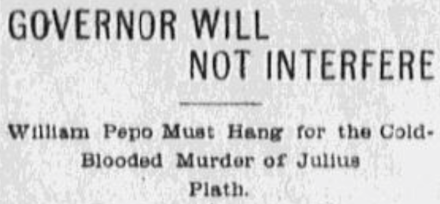
Helena, April 3. — An appeal to Governor Smith in behalf of executive clemency for another murderer was turned down to-day, when the governor announced that he could not see his way clear to interfere with the judgment of the courts in the case of William Pepo, under sentence of death to hang at Choteau next Saturday, April 7. Pepo was convicted of killing Julius Plath in a cabin on the banks of the Muddy river, in Teton county, a few miles north of Great Falls.

The murder was committed June 14 or 15, 1898. The decomposed body of Plath was not found until several days after the crime was committed. A farm hand who had occasion to enter the cabin to procure a mowing machine sickle came across the body lying upon a bunk in a sickening state of decomposition.

There appeared to be no clew to the murderer and it was several months afterward before suspicion was attached to Pepo. He was brought back to Montana, tried and convicted. The supreme court refused to grant him a new trial and he was sentenced to expiate his crime upon the gallows.

J.G. Bair, his attorney, appealed to the governor for a commutation of sentence to life imprisonment on the ground of lack of evidence to connect Pepo with the crime. The governor has been examining the record in the case for several days and this afternoon he sent a letter to Mr. Bair stating that he could not interfere. The letter was very brief. It follows:

I have finished reading the transcript in the matter of the application for executive clemency for William Pepo. In this case the evidence is so convincing and clear the jury could not have reached any other conclusion. It shows a most cold-blooded murder and there is no doubt Pepo was the murderer. I must absolutely refuse to interfere with the sentence of the court.

Pepo is said to be without a friend in the world save the Choteau attorney who sought to save his neck. His execution will be the first legal hanging that ever took place in Teton county.


Anaconda Standard, Apr. 8, 1900

Special Dispatch to the Standard.

Great Falls, April 7. — In the yard of the county jail in Choteau this morning at 6:09 o’clock William Pepo was hanged for the murder of Julius Plath. He exhibited no nervousness or fear and his last words were:

Gentlemen, I have nothing to say, only that I am about to be hanged an innocent man.

It was the first legal execution in Teton county, and from start to finish went without the slightest hitch of any kind.

There were about 50 spectators. The only outside officer of the law present was Sheriff Hubbard of Kalispell.

After all visitors had left last night the condemned man employed his time in writing, playing cards and conversation with the death watch until 3 o’clock this morning, when he went to bed and dropped off to sleep at once.

At 5:15 a.m., when he was aroused by Deputy McDonald, he was sleeping so soundly it was necessary to call several times to awaken him. After getting up he greeted the guards pleasantly and ordered breakfast, but later countermanded the order with the remark that his time was too short to waste any of it in eating.

At his request Father Snell was admitted and talked with him alone for some time, after which he asked that Attorney Bair, who has defended him throughout, be admitted to his cell, and in a few moments’ conversation he bade him goodbye and reiterated his innocence. Rev. Cunningham next conversed with him and Pepo listened to him very attentively and answered him earnestly.

At 6 o’clock the death warrant was read to him in his cell by Under Sheriff Haggerty and he was led out into the corridor, where he bade an earnest goodbye to the officers who had been his keepers for the past 18 months, and spoke a pleasant word to each.

His arms were strapped down and the walk to the scaffold began, the condemned man walking firmly and without assistance between Deputies Devlin and Armstrong, followed by Sheriff Hagen and Under Sheriff Haggerty and Rev. Cunningham.


To the Gallows.

As they walked down the north side of the jail in the alleyway formed by the high board fence erected about the yard, the morning air was crisp and chill, and the condemned man, turning to one of the officers, said jokingly: “It’s a little cool out here; this must be like the weather they tell about in North Dakota,” and smiled pleasantly.

Some of the guards had previously been talking of North Dakota weather to him, and his last earthly joke referred to the conversation.

As he turned the angle of the building and stepped under the gallows, he faced the silent, uncovered crowd, who had been admitted a few minutes before, calmly and quietly, by far the most self-possessed man present, and looking them over, he bowed pleasantly three or four times to parties he knew and said in a low voice, though clearly and distinctly:

Gentlemen, I have nothing to say, only that I am about to be hanged an innocent man.

Sheriff Hagen placed the strap about his knees and the condemned looked down with apparent interest and carefully placed his feet together so as to assist the sheriff.

The noose was placed about his neck, but he never flinched a hair’s breadth.

Rev. Cunningham, in a low tone, recited the prayers for the dead. For a moment, Pepo closed his eyes, as if listening.

A meadow lark in the field outside the prison walls whistled its morning note loud and clear; the condemned man opened his eyes again and looked out upon the crowd of awe struck faces and uncovered heads and the early morning sunlight which he never again would see.

The voice of the minister, broken and low, sounded monotonously.

Pepo glanced up inquiringly and Sheriff Hagen dropped down over his head and face the terrible black cap, shutting out all view of the world and sunlight from William Pepo forever.

Instantly the sheriff sprang away and gave the signal to the unknown man in the box alongside the gallows; the 400 pound weight fell to the ground like a plummet and the body shot up in the air four feet and settled down again without a perceptible tremor or more sign of life than if a block of wood. His neck was broken instantly.

Drs. Brooks and Cooper watched the pulse that in 10 minutes was forever stilled, and in 20 minutes the body was cut down and placed in a coffin, and the long strain upon all the officials connected with the case was over.

For the Epworth league was left a long letter of thanks for their services to him. To Rev. Cunningham was left a letter with the superscription, “Not to be opened until after my death.” In this letter he said in part:

“I Am Not Guilty.”

I am not guilty and consequently should not be held responsible for the crime. If this crime is really and truly atoned for by the ator in this world while you live, I hope you will tell those that have been instrumental in fastening it on me that they have my forgiveness as I have been forgiven. When you read this I will stand before the throne of God, whose grace passes all understanding. Amen.

Those are his last written words, and from them can be seen how strongly he urged his innocence and how far from any such thing as an admission he stood.

Since the action of Rev. Warman in the matter of Hurst‘s confession he has been particularly anxious to impress upon every one his innocence and feared lest some one should allege some such thing of him after his death.

He was buried this afternoon, Rev. Cunningham conducting the services.

With the hanging of William Pepo, the man of mystery, was closed a chapter in the book of one man’s life which will never be read by mortal eye, for just as sure as was his taking off, his name was not Pepo, and some time in the past he has trod walks of life other than those which he has during the time that the evidence in his case has been traced to him.

Looking at him last night calmly smoking and chatting cheerfully with those about him it was hard to recognize about him any of the accepted tributes of the common murderer. Pleasant faced, intelligent, well read, iron nerved and ready witted, he showed by every action the man of education and good raising. He refused at all times to give any chance for his photograph being taken, even by a kodak, and his last statement to Attorney Bair, the one man nearer to him in the effort to save his life than any other, was,

They do not know my name, nor do you. I shall not bring disgrace upon my family by letting them know that I have died a felon’s death. I will carry it with me out of the world.

A Man of Mystery.

Absolutely nothing has been learned of his past life further than six years back except what he himself has told and that, when investigated, was found not to be true.

He has not asked that one human being be sent for, nor had he ever mentioned the name of a person whom he wished to know of his terrible position.

Of his past life he has been as silent as the tomb except as to the indefinite stories mentioned.

That a man of his age, intelligence, ability and strong personality should not have in the wanderings of a lifetime one single friend or relative to come forward at such an hour, if called upon, seems incredible. In speaking with Under Sheriff Haggerty yesterday he referred to the Hurst and to the Calder cases. Of Rev. Mr. Warman he spoke very bitterly for giving publicity to the Hurst confession, and said Hurst’s wife and family would curse him for his action in the case until their dying day.

Speaking of Calder, he said:

I had made up my mind to go out of the world as Calder did, cursing God and man, but Rev. Mr. Rogers’, Rev. Mr. Cunningham’s and Father Snell’s talks to me have changed my mind, and I forgive every one connected with my trial. I firmly believe there is a God and I will go to Him expecting to receive the justice in the other world which has been denied in this world.

He expressed thanks for the favors which the sheriff’s office had shown him, breaking down for a few moments and shedding tears. Yesterday, Rev. Mr. Cunningham and members of the Epworth league had services in the corridor, as they have had every day for the past week, and at his request sang certain hymns.

Not once since a week after his sentence has his appetite failed him, and his sleep has been as regular and peaceful as a child’s.

His Iron Nerve.

His favorite pastime when no visitors were present has been playing cards with the death watch, and when he won he laughed as heartily as if he never had a care in the world.

Yesterday his beard was trimmed up and he was dressed in a new suit of clothes, and when the Standard reporter visited him he was received as courteously as though an invited guest.

Pepo was smoking and politely passed a package of cigars out through the iron bars, urging acceptance with the uncanny remark that there was more than enough to last him until 7 o’clock a.m. and after that he wouldn’t need any.

In the corridor with the death watch were many who came to visit him, and as Pepo recognized each one he shook hands heartily and expressed his pleasure at his meeting them and talked pleasantly on the topics of the day, alluding every little while to his own case as though it were an incident which he did not care to have those present feel any embarrassment in commenting on.

To one of the death watch he laughingly related the fact that “Tom” was to be one of the watchers.

“Did you think of it?” he continued. “You and Tom were the death watches the first night of my sentence, and now you will be with me my last night.”

The incident did not appear to strike the death watch addressed as at all humorous, but Pepo laughed softly again at the recollection.

At first he was disinclined to speak of his case for publication, as he believed the newspapers had not treated him fairly, but later he talked quite freely. He asked his attorney, who was present, to write a contradiction of a statement which appeared in a Dupuyer paper, in which he was quoted as saying that certain men in Washington would testify that he was working in that state June 15, 1898, which was the supposed date of the murder of Plath.

He dictated the writing, took the sheet of paper and read it with satisfaction and signed his name without a tremor, asking that Under Sheriff Haggerty and the Standard men sign it as witnesses. The statement reads:

His statement.

In an interview published in your paper some time since you quoted me as having said that I could obtain evidence from Washington showing I was there, in Washington, on or about June 15, 1898. This is a mistake; I meant to say I could get witnesses there who would testify that I was in Washington at work on the date that James Hannan testified to having seen me trying to cross the mountains, namely, on July 29, 1898.

In explaining this, Pepo said:

I don’t wish any injustice done my attorney; had I been able to secure such evidence I would have told him and I would not now be here with but six or eight hours to live; such evidence would have cleared me. Men would testify I commenced work there on July 4, but that would not do. I don’t know when I commenced to work there myself, as I was drunk for a long time. When the sheriff arrested me in Washington for murder I was never so surprised in my life. They say I was seen here after the murder. I never was in Choteau in my life until brought back by the sheriff. On June 14, when I am said to have done this thing, I expressed a package in Lethbridge at the express office there. The newspapers did not treat me fairly. They condemned me before I was tried and branded me a low-browed murderer. Had I friends to call upon, and state my side, the case might have been different. I am innocent and God knows it. But it is all over now, and I don’t want to make you people sick of listening to my troubles. They will soon be over, anyhow; let what is gone by go: it can make no difference now and talking of it does no good.

And all this without the slightest attempt at bravado or whine. One of the guards offered him a whiskey cocktail, but he refused it and said, smilingly:

No; I have had one and that is enough now; I don’t want you to think I need or wish courage to meet the end.

All the evening of the many who visited him he was the most calm and unembarrassed. His voice was clear and even and at no time did he evince the slightest excitement or nervousness, and, though he referred quite frequently to his coming death, it was without regret or a semblance of more interest than if it were the getting of his morning meal.

A little white kitten romped upon the floor of his cell and he expressed concern as to what would be its fate after the morning, when he would be taken away and he could feet it no longer. One of the officials promised to look after the kitten and he seemed much relieved.

For quiet, unostentatious iron nerve and calm placidity in the face of death upon the gallows, Pepo’s every word and movement last night and also this morning must stand alone.

Either he went to death innocent, which the evidence flatly disproves, or his career in crime has sent more men than Julius Plath out of the world unshriven.

He was not in the class of most moral degenerates and must go down, if guilty, as an iron-nerved prince of criminals, who played his last card, and losing, paid the forfeit with his life without the quiver of an eyelash.

The crime for which William Pepo to-day suffered the death penalty was the murder of Julius Plath in a cabin on the Muddy river, about 20 miles from Choteau, in Teton county, about the 15th of June, 1898. The case throughout was circumstantial and most remarkably illustrates that “murder will out,” no matter how carefully guarded.

Pepo and Julius Plath were acquainted in Canada, and early in June, 1898, left Lethbridge together to come to the United States, Plath having $120 in currency on his person.

They came in over the narrow guage [sic] and beat their way over the railroad as far as Pondera, where they left the railway and started together for Choteau.

The last seen of them was June 14, when they were directed to the cabin where the murder was committed.

On June 29, parties finding the cabin door fastened forced it open and found the body of a man who the evidence afterwards tended to show was Plath. The dead man had been killed while asleep by having his skull crushed by a large iron bolt, which was found lying near.

All the dead man’s clothes were taken charge of by the authorities and afterwards identified as belonging to Plath. Near the body was found an overcoat, in the pocket of which was a memorandum book belonging to and written in by Pepo.

The dead man was unidentified and was buried unknown.

Months after, when the murder had almost been forgotten, a letter came from Plath’s brother in Toronto, Canada, asking for the whereabouts of Julius, and by chance it fell into the hands of some one who thought it worth while to refer it to the authorities.

Further inquiry brought a photograph of the dead man, and this photograph was the first link in the chain which brought William Pepo to the gallows to-day and gave Sheriff Hagen the first ray of light upon a murder whose darkness seemed impenetrable.

The dead man when found was too badly decomposed for identification, but a man who had seen Pepo and Plath traveling together identified the photograph as being that of the smaller of the two men.

The clothing shown in the photograph also corresponded exactly with that found upon the dead man. The photograph was taken by Neapole, Pembroke, Canada, and is marked “exhibit D.” Later Plath’s brother came from Canada and identified the clothing as that of his brother Julius.

Then began the search for Pepo, who had disappeared as completely as though the earth had swallowed him up. Search was unavailing, until one day a letter came from a young lady to friends in Canada, who stated that she had met Pepo, but that he was going under the name of William Ferris and did not wish her to say anything about it.

The letter was from Davenport, Wash., and the young lady was unaware that Pepo was wanted on any charge; and again the hand of fate pointed out the murderer when all chances of discovery seemed buried forever.

The information was correct. Pepo was found in Davenport under the name of William Ferris, and was promptly arrested in May last and brought to Choteau, where link by link the evidence was forged against him, and last June he was found guilty of the murder of Julius Plath and sentenced to hang on July 17.

John G. Bair of Choteau was appointed to the defense of Pepo and County Attorney Erickson prosecuted. On both sides the battle was a stubborn one and well contested, but the evidence for the prosecution was too strong to overcome.

After the sentence Pepo’s attorney continued the fight and carried the case to the supreme court on appeal, and the doomed man was given a brief respite, but the judgment of the lower court was sustained, and on the 6th of last month Pepo was again called before Judge Smith in the court room at Choteau and for the second time listened to the death sentence, which was carried out to-day.

During the trial and after Pepo refused to allow his picture to be taken and in going to and from the court house pulled his coat collar above his neck to baffle any chance for snap shots. The accompanying pictures is a very good one and is from a pen sketch done by W.H. Clinkerbread, the Choteau artist. [Unfortunately the picture alluded to does not in fact appear in the paper. -ed.]

Pepo was a German and had not a friend, relative or acquaintance in the United States. He was a man of large frame, weighing about 180 pounds, and being 5 foot 10. He was 40 years of age.

After his second sentence for a while he refused to eat and expressed the intention of starving himself, but his fortitude was unequal to the task and he gave the trial up.

Although without money, his case was fought by his attorney to a finish just the same, and 10 days ago Mr. Bair went to Helena and personally appeared before Governor Smith and made a plea for life imprisonment for his client on the grounds of the evidence being circumstantial throughout and that there was a chance for a reasonable doubt.

When Mr. Bair appeared before the governor the case of Hurst, who was hanged at Glendive, had just been presented, with petitions containing 7,000 names, asking for clemency. For Pepo the case was different. He was unknown, without a dollar and had not a relative or friend in the state but his attorney to speak for him; but the result was the same.

The governor refused to commute the sentence of either man — the one with relatives and thousands of friends petitioning, the other without a friend save his faithful attorney. Hurst was hanged on March 30 and Pepo to-day. In refusing to commute the death sentence in Pepo’s case Governor Smith wrote his attorney Tuesday:

Mr. J.B. Bair, Choteau, Mont. —

Dear Sir: I have finished reading the transcript in th ematter of the application for executive clemency for William Pepo. In this case the evidence is so convincing and clear the jury could not have reached any other conclusion. It shows a most cold-blooded murder, and there is no doubt Pepo was the murderer. I must absolutely refuse to interfere with the sentence of the court. I am, very respectfully,

ROBERT B. SMITH, Governor.

On this day..

1724: Sister Geltruda and Fra Romualdo, at a Palermo auto de fe

(Thanks to Henry Charles Lea for the guest post, which first appeared in his The Inquisition in the Spanish Dependencies: Sicily – Naples – Sardinia – Milan – The Canaries – Mexico – Peru – New Granada. The Inquisition was abolished in Sicily in 1782, but an interesting Palermo museum preserves its artifacts. -ed.)

When, in 1718, Savoy exchanged Sicily with Austria for Sardinia, the Emperor Charles VI would not endure this dependence of the [Inquisition] tribunal upon a foreign power and procured, in 1720, from Clement XI a brief transferring the supremacy to Vienna. In accordance, however, with the persistent Hapsburg claims on the crown of Spain, the Inquisition remained Spanish. A supreme council for it was created in Vienna, with Juan Navarro, Bishop of Albarracin as chief who, although resident there gratified himself with the title of Inquisidor-general de Espana, but in 1723 he was succeeded by Cardinal Emeric, Archbishop of Kolocz.

Apparently it was deemed necessary to justify this elaborate machinery with a demonstration and, on April 6, 1724, an auto de fe was celebrated at Palermo with great splendor, the expenses being defrayed by the emperor.


Detail view (click for the full image) of a French print of the auto de fe.

Twenty-six delinquents were penanced, consisting as usual mostly of cases of blasphemy, bigamy and sorcery, but the spectacle would have been incomplete without concremation and two unfortunates, who had languished in prison since 1699, were brought out for that purpose. They were Geltruda, a beguine, and Fra Romualdo, a friar, accused of Quietism and Molinism, with the accompanying heresies of illuminism and impeccability. Their long imprisonment, with torture and ill-usage, seems to have turned their brains, and they had been condemned to relaxation as impenitent in 1705 and 1709, but the sentences had never been carried out and they were now brought from their dungeons and burnt alive.


Detail view (click for the full image) of an engraving, The Great Auto De Fe At Palermo Italy 6 April 1724

Less notable was an auto de fe of March 22, 1732, in which Antonio Canzoneri was burnt alive as a contumacious and relapsed heretic.

On this day..

1864: Jose Maria Chavez Alonso, governor of Aguascalientes

On this date in 1864, the French executed the governor of Aguascalientes.

Elected to the post during early months of the unfolding French intervention in Mexico, Jose Maria Chavez Alonso (English Wikipedia entry | Spanish) was deposed by the invaders in December 1863 — to be succeeded by a different Chavez who met an equally violent fate.

Alonso formed a popular militia and continued a short-lived resistance against the French but was captured early in 1864, and although this was still some months before the dirty war’s notorious “Black Decree” the French determined to make an example of him.

Alonso aside, the Mexican adventure proved a right catastrophe for France and its adherents.

On this day..

1975: Pierre Galopin, hostage of Hissene Habre

On this date in 1975, French Major Pierre Galopin was executed by Chad rebel Hissène Habré.

Galopin (English Wikipedia entry | French) had been dispatched to the former French colony to negotiate the release of two French nationals* seized as hostages by Habre’s Command Council of the Armed Forces of the North (CCFAN).

You’ll never guess it: CCFAN also took Galopin hostage.**

CCFAN tried to leverage its new captive into an arms trade. When France dragged its feet, the Chadians terminated the negotiation by having Galopin condemned by a “revolutionary tribunal” and hanged to a roadside tree.

Habre would eventually take power as President of Chad in 1982, and was subsequently welcomed on state visits to the former mother country — much to the disgust of those who remembered the Frenchman sacrificed to his ambitions. Galopin was hardly the last man to be so distinguished: as of this writing, Habre is serving an eternal prison sentence in neighboring Senegal for crimes against humanity committed during his eight years ruling Chad.

* Archaeologist Françoise Claustre and development worker Marc Combe. (A third hostage, West German doctor Christoph Staewen, had also been taken, but had quickly been ransomed by his government.) Combe escaped in 1975. Claustre was not released until 1977.

** CCFAN was also riven by a major internal division that by 1976 would split the movement into two rival organs. It has long been murky (French-language pdf here) just whose interest within CCFAN was best served by the hostile course of events.

On this day..

1946: Masaharu Homma, for the Bataan Death March

Laid down on the altar I am
Offered as a victim to God
For the sake of
My newly born country

-Verse written by Masaharu Homma awaiting execution (Source)

Imperial Japanese Lt. Gen. Masaharu Homma was shot by a firing squad outside Manila on this date in 1946 for the notorious Bataan Death March.

Homma commanded the 14th Area Army tasked with occupying the Philippines immediately after the attack on Pearl Harbor opened a Pacific War against the U.S.

Retreating from the Philippines in early 1942, U.S. Gen. Douglas MacArthur famously vowed, “I shall return.” To Homma’s grief, he did just that.

While MacArthur cogitated his revenge, Homma was finishing off the remnants of his last great stand in the Battle of Bataan. Bataan was a victory for Japan, but a bloody and protracted one; it cost the lives of some 7,000 Japanese, and the three-month battle has sometimes been credited with slowing the Japanese advance sufficiently to safeguard Australia; it also left the occupiers with an unexpectedly huge complement of POWs.

On April 9, 1942, the very day fighting ended at Bataan, transfers began for these prisoners, who would be driven by train and then marched overland some 60+ miles to Camp O’Donnell. More than 60,000 Filipinos and about 15,000 Americans endured this harrowing five- or six-day slog — the Bataan Death March.

A few books about the Bataah Death March

Early reports of the death march made grist for this wartime propaganda poster in the U.S.

This crucible of endurance, both physical and spiritual, came by its evil repute honestly; in the age of the Internet, numerous appalling testimonials are within easy reach of a web search. They recount battle-wearied men enervated by hunger and thirst, liable to be summarily shot or bayoneted for making themselves the least bit conspicuous to captors who already disdained them for having the weakness to surrender in the first place.

Some were murdered at the outset: having any Japanese “trophies” on one’s person when captured was liable to be worth a summary bullet, or a quick flash of an officer’s katana. An even more certain death sentence was falling behind on the march, and wounded prisoners could expect no quarter: they had to keep up with their compatriots or the Japanese “buzzard squad” trailing a few score meters behind every marching peloton would finish them off with any other stragglers. In different groups POWs might be thrashed or killed over any trifling annoyance; meanwhile, those suffered to live trudged under a wasting sun, nearly unnourished but for fetid handfuls scooped from mud puddles, dying on their feet hour by hour. Dehydrated to the point of madness, some snapped and ran suicidally for the tantalizing nearby village wells that marchers were prohibited from accessing.

Something like a quarter, and maybe nearer to a third, of the souls who set out on the Bataan Death March never reached Camp O’Donnell. Those who did entered new portals of torment: rent by dysentery and crowded cheek to sunken jowl, prisoners died off daily by the dozens until they were finally dispatched — often crammed like sardines into the bowels of “hell ships” — to different Japanese work camps.

The Bataan Death March was a no-question basket of war crimes, egregiously flouting existing POW treatment accords.* It’s far more questionable whether our man Gen. Homma was the right person to answer for it.

Homma had segued directly from the Battle of Bataan to the succeeding Battle of Corregidor after which he had been cashiered for a homeland desk job.

Ironically, it was an excess of leniency that helped earn Homma his enemies among the brass — the opposite of the thing that hanged him. For many who observed the postwar trial slating him with 48 war crimes violations related to the Death March, Homma was a figure more tragic than wicked, prey to returning victor MacArthur’s pique at the defeat Homma had once inflicted upon him.

Little reliable evidence could show that Homma blessed or even knew of the atrocities committed in the march, but he himself allowed during trial that “I am morally responsible for whatever happened in anything under my command.” According to Homma’s American defense attorney Robert Pelz — a biased source to be sure — the general slipped into genuine disgust and remorse during the trial as a parade of witnesses remembered their ordeals. “I am horrified to learn these things happened under my command,” Homma wrote in a note passed to Pelz at one point. “I am ashamed of our troops.”

The hanging verdict was controversial then and remains so now. “If the defendant does not deserve his judicial fate, none in jurisdictional history ever did,” MacArthur complained. He honored the mercy application of Homma’s wife Fujiko only insofar as to permit the general a more honorable execution by musketry, instead of hanging.

The bulk of the U.S. Supreme Court okayed the procedure by which the U.S. military brought that fate about, although Justice Frank Murphy issued a scorching dissent urging that in the haste and partiality of the proceedings against both Homma and General Tomoyuki Yamashita “we abandon all pretense to justice, let the ages slip away and descend to the level of revengeful blood purges.”

One who would share that sentiment was an 18-year-old Navy man who observed the trial, Bob Perske. Perske would remember this his experiences on the Philippines at the end of World War II “sharpened his sensitivies toward vulnerable persons” and influenced a subsequent career advocating for people with disabilities as well as those caught in the toils of the criminal justice system. Executed Today formerly interviewed Mr. Perske in connection with the wrongful execution of a mentally disabled man in Colorado, Joe Arridy.

* It’s worth noting that Japan was not party to the 1929 Geneva Convention on the Treatment of POWs.

On this day..

1828: William Dyon and John Dyon, all in the family

(Thanks to Meaghan Good of the Charley Project for the guest post. -ed.)

On this date in 1828, William Dyon, 45, and his son, John, 23, were hanged for the murder of William’s brother, who was also named John.

The brothers had fallen out over their father’s inheritance; William Dyon Sr. had favored John’s family over William Jr.’s. Writing dramatically of the case in his book Foul Deeds and Suspicious Deaths in Doncaster, Stephen Wade described the brothers as

sons of a Lincolnshire farmer, and the two boys were so different that this tale almost attains a biblical resonance, with jealousy, brooding and resentment, and finally a deathly hatred that led one brother to a bloody death; and the other to the scaffold. It is a Cain and Abel story, but with more than one layer of evil: William Dyon was joined by his son, John, in the murder.

According to contemporary account, from his youth William was “of a Wild disposition, and addicted to low sports; in his youth, a frequenter of cocking matches [and] bull baits.” While William joined “scenes of riot and dissipation,” John was a much steadier sort and very helpful to his father on the farm. Dyon Sr. was wealthy and he rewarded his more filial son with 63 acres of land, followed by cash gifts amounting to £300 sterling, while giving William nothing.

When he drafted his will he also favored John, virtually ignoring his other son.

William and his son planned out the murder more than a week in advance, enlisting the help of another man named John White who had known both brothers for years. John Dyon was walking through the front gate of his farm, 800 yards from his house, when he was ambushed by his brother and nephew and shot to death on the evening of February 16, 1828. His family didn’t find him until morning.

The victim was lying in the grass by the gate, stiff and cold, shot in the chest. He was carrying about £40 and an expensive watch, so robbery was ruled out as a motive for his death.

The inquest that followed returned a verdict of “willful murder by person or persons unknown,” but suspicion had already fallen on the embittered relatives.

Both Dyon pere and fils had been seen loitering near the farm with guns; they claimed to be hunting, but it wasn’t the right time of year for that. They had also asked people what time the victim normally returned home from the Doncaster market.

Their enmity towards the victim was well­known in the area and many witnesses remembered hearing William threaten his brother and even say outright that he planned to murder him. After John’s death he was seen boasting about his crime in the local pub.

The investigating magistrate actually performed some CSI work: he noticed a pair of boot tracks at the site of the murder and saw that the wearer had walked with their feet turned outward. William Dyon walked in that way.

Furthermore, the prints were from a left boot and a right boot; not many shoes were made left­ and right­footed during that time period, but William owned a pair that was.

The two suspects produced an alibi, initially confirmed by William’s brother­in­law and his servant: they were at home at the time of the murder. But this collapsed when both witnesses recanted. Then their accomplice, White, came forward with his evidence.

Lincoln, Rutland, and Stamford Mercury, April 11, 1828

By the time of the trial, there wasn’t much of a defense left to offer. The jury deliberated five minutes before voting guilty for both defendants.

On the scaffold under 10,000 eyes, John acknowledged the justice of his sentence. William, who had been caught passing notes to his son in gaol enjoining him to keep his silence, merely announced that “the Lord will pardon my sins.” A friend of the victim wanted to buy the execution ropes, but he was turned away.

“The bodies,” Wade wrote, “were dissected by the anatomists and their skins tanned.”

On this day..