2018: Zahid Iqbal

Via UrduPoint.com. A different report give the spur to the murder not as a “minor dispute” but a “robbery bid”.

FAISALABAD, (UrduPoint / Pakistan Point News — 10th Apr, 2018): A condemned prisoner was executed in Central Jail Faisalabad on Tuesday. According to Prisons Department, Zahid Iqbal had murdered three persons Rehana, Anayat Ali and Haris over a minor dispute in 2005 and the session court had awarded him death sentence on three counts.

The apex court also upheld the decision of the trial court whereas the President also turned down his mercy appeal. After the rejection of mercy petition, death warrants were issued against the condemned prisoner Zahid Iqbal and the court fixed April 10 for implementation on his execution. Later, the body was handed over to his heirs after completing necessary formalities.

On this day..

1836: Two English poisoners

On this date in 1836, two different Englishwomen hanged in Gloucester and Liverpool for seeing off their respective husbands with arsenic.

They’re the subjects of an excellent pair of posts by Naomi Clifford, author of such topical-to-Executed Today fare as Women and the Gallows, 1797-1837 and The Murder of Mary Ashford: The Crime that Changed English Legal History, which concerns the long overdue abolition of juridical trial by combat in Great Britain … after an accused murderer used this artifact to escape prosecution in 1817.

Here’s Clifford on our poisoners, bound for separate gallows on April 9, 1836:

Clifford makes a triptych here with a third post about yet another poisoner who shared the same fate five days later.

On this day..

1818: Juan Jose Carrera and Luis Carrera

Juan Jose Carrera and Luis Carrera were shot together in Mendoza as traitors on this date 200 years ago.

They two of the Hermanos Carrera, a generation of siblings that played a prominent role in the Chilean War of Independence during the 1810s. We have already detailed them through the entry on their more notable brother Jose Miguel Carrera … who would go on to share their fate in 1821.


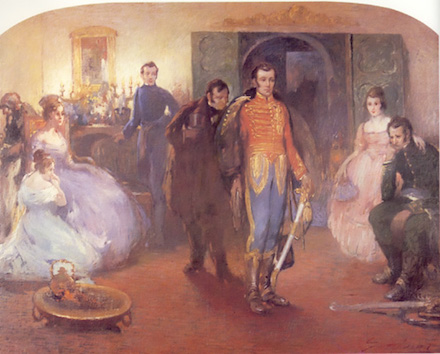
The Carrera Family, by Arturo Gordon Vargas (early 20th c.) features patriarch Ignacio, who was part of Chile’s first independent junta, along with Jose Miguel, flanked by brooding brothers Juan Jose and Luis, as well as their sister Javiera Carrera, the “Mother of Chile” and creator of the Chilean flag.

Said Jose Miguel had established a dictatorship in 1811-1812, with his brothers as trusted lieutenants. But Chile’s initial flower of independence from 1810-1814 was crushed by Spanish reconquest thanks in part to a deadly rift that had opened between the Carreras and fellow independentista Bernardo O’Higgins: prior to the decisive loss to the Spanish, Luis Carrera and O’Higgins had fought a literal battle with one another. They patched things up well enough to fight the Spanish together a few weeks later, but once in exile in Mendoza, Argentina, after their defeat they hurled recriminations at one another for the outcome. Luis even killed O’Higgins’s aide Juan Mackenna in a duel.

In the fullness of time it was the destiny of O’Higgins to be the father of a (permanently) independent Chile … and the destiny of the Carreras to be antagonists he overcame to do it.

O’Higgins attained leadership of the independence movement from exile and after elevated himself to dictator of free Chile in 1817. The Carreras promptly began scheming against him lead in old times, resulting in the arrest of Luis and Juan Jose in Mendoza. They were executed there hours after word reached the city that the Chilean patriot army had finished off the royalists.


The Carreras on their way to execution.

On this day..

1995: Nicholas Ingram

British-American Nicholas Ingram was electrocuted in the U.S. state of Georgia on this date in 1995.*

Born in England to a British mother and an American father, Ingram at age 19 had invaded the Cobb County home of J.C. and Mary Sawyer. The Sawyers complied with the armed intruder’s demands for money ($60) and the keys to their pickup truck, but Ingram still marched them to a nearby woods and executed them. J.C. Sawyer was killed; Mary Sawyer feigned death and survived to give evidence against their tormenter.

Thanks to his nationality and his legal representation (British lawyer Clive Stafford Smith, who would later found the anti-death penalty NGO Reprieve), Ingram’s prospective execution because a cause celebre in Old Blighty. British MPs and the Archbishop of Canterbury issued appeals for mercy, although Tory Prime Minister John Major gave a chilly refusal when solicited for intervention by Ingram’s family:

I found your letter very moving and I can imagine the profound distress you must be feeling. But I have concluded, with deepest regret, that there are no proper grounds for the British Government to intervene with the State of Georgia.

The Georgia prison commissioner who conducted this execution, Allen Ault, later turned against capital punishment.

On this day..

1489: Hans Waldmann, mayor of Zurich

An equestrian monument to Hans Waldmann at Zurich’s the Münsterhof plaza reminds of that onetime mayor’s beheading on this date in 1489.


(cc) image from Roland zh.

His city’s most outstanding personality of the age, Waldmann (English Wikipedia entry | the far more detailed German) sprang from merchant stock. He’d soared to the top in his Swiss city-state via his gift for military command, which stood Zurich in good stead during the Burgundian Wars.

Despite his war heroism, the peasantry of Zurich’s rural proximities soon grew to hate Waldmann as the spear tip of the urban oligarchy. Notoriously, he ordered the destruction of peasants’ dogs to preserve the hunting privilege for the powerful.

On the first of April, a revolt toppled Waldmann’s authority. He was arrested on a diverse slate of accusations including treason, peculation, and sexual corruption.

For the four days intervening, he endured “ceaseless torture, hanging, and stretching,” but the mayor retained enough vigor to walk “manly” and “proud” (in the words of a Bernese observer) to his scaffold.


Waldmann’s Farewell, by Johann Caspar Bosshardt (1847).

Detail view (click for the full-page illustration) of Hans Waldmann’s beheading, from the Lucerne Chronicle (1513).

On this day..

1525: Jakob Wehe, rebel priest

On this date in 1525 the radical priest Hans Jakob Wehe was beheaded.

Wehe led a muster of 3,000 Bavarian peasants which briefly seized the town of Lepheim, during Germany’s bloody Peasants War, ere it was routed by the Swabian League.

On the 5th of April towards evening, they [Wehe and some other captives] were taken to a flowery meadow lying between Leipheim and Budesheim to be executed. As Master Jakob was led forward to the block, Truchsess turned to him with the words: “Sir paster, it had been well for thee and us hadst thou preached God’s word, as it beseemeth, and not rebellion.” “Noble sir,” answered the preacher, “ye do me wrong. I have not preached rebellion, but God’s word.” “I am otherwise informed,” observed Truchsess, as his chaplain stepped forward to receive the confession of the condemned man. Wehe turned to those around, stating that he had already confessed to his Maker and commended his soul to Him. To his fellow-sufferers he observed: “Be of good cheer, brethren, we shall yet meet each other to-day in Paradise, for when our eyes seem to close, they are really first opening.” After having prayed aloud, concluding with the words: “Father, forgive them, for they know not what they do,” he laid himself on the block, and in another moment his head fell in the long grass.

The preacher of Günzburg, who had also taken part in the movement, and an old soldier of fortune, who had joined the rebels, were brought forward in their turn to submit to the same fate, when the old soldier, turning to Truchsess, observed: “Doth it not seem to thee a little late in the day, noble lord, for one to lose one’s head?” This humorous observation saved the lives of himself and the preacher. The latter was carried about with the troops in a cage, until he had bought his freedom with eighty gulden. He lost, however, the right of preaching and of riding on horseback!

On this day..

1902: Clinton Dotson, bad son


Headline from the Salt Lake (Utah) Telegram, April 4, 1902

On this date in 1902, Montana hanged Clinton Dotson.

Dotson was already in prison for the murder-robbery of miner Eugene Cullinane* when he conceived what the Anaconda Standard (April 4, 1902) called “one of the most shocking murders that the world has ever known.” Permitting the newsman a pass for this slight exaggeration, it was indeed a real triumph in mustache-twirling villainy: the assassination of Dotson’s own father as part of a Rube Goldberg scheme to get himself out of jail.

Briefly, the scheme was that James Fleming, alias James McArthur, cellmate of Clinton Dotson, upon his release during the first part of January, 1901, should go to the cabin of Captain [Oliver] Dotson and extract from him by threat or otherwise a confession that it was he, Captain Dotson, who slew Cullinane. If Captain Dotson refused to make such a confession, McArthur was to kill the old man and arrange the body and the furniture of the house in such a way as to leave the impression that the old man had died by his own hand. A confession exonerating Dotson [and his confederates] from responsibility of Cullinane’s murder was then to be forged.

With a devil’s cunning, Fleming carried out this diabolical scheme. So cleverly was it done that, but for the prior knowledge possessed by the prison officers, the theory of suicide would probably have been accepted. Close investigation, however, showed that the suicide theory was impossible, that the deed had been done by one hidden in an adjoining room … [and Fleming] took no steps to conceal his tracks.

Fleming had already been executed in September, on the same gallows that claimed his parricidal sponsor.

* Dotson had also served time for homicide in Wyoming.

On this day..

1951: William Watkins, one man’s life and death

On this date in 1951, William Watkins hanged for drowning his eleventh child.

An execution that was barely noticed in its time and would be nigh-forgotten today, it’s revived in all its messy humanity in a book titled Execution: One Man’s Life and Death. John Mervy Pugh, the son of one of Watkins’s prosecuting barristers, watched Watkins’s two-day trial as a young man and was still so troubled by it many years later that once “it all came tumbling back into my mind” he decided that he “could not let it rest.” Pugh’s empathetic book plumbs the trial and police records, supplemented by interviews with Watkins’s surviving family and even Watkins’s executioner, the ubiquitous Albert Pierrepoint.

“This was one case I never expected would have taken place,” Pierrepoint told Pugh. “In my opinion many men have been reprieved for a lot worse crime than this.” According to Pugh, many others involved the case, from prison warders to court officials, were equally shaken by the unexpected denial of clemency. Watkins’s guards, who had a good feel for how these things played out, had confidently reassured the convict that he would surely never hang.

Forty-nine years old at his death, which was barely ten weeks after the death of the infant for which he was condemned, Watkins was a factory worker who scrabbled an honest if impecunious living with his second family. Once he was charming and gregarious, but an advancing congenital deafness and the strains of Britain’s hard years through Depression and war had left him taciturn and “prematurely old; his once black hair was now steel grey and his face permanently looked as though he needed a shave.” (His vanishing hearing also robbed him of his longtime driving profession.) He’d had nine children with his first wife but had left her for their former boarder whom Pugh anonymizes as “Maisie”. Though never married, the two lived as man and wife in a run-down home at the back of 79 Clifford Lane in Birmingham. They had a four-year-old son together. Then Maisie got pregnant again.

By both parents’ own admissions it was a child that they did not want and could not afford. (Bill still continued dutiful maintenance payments to the family he had deserted; the last one arrived after his arrest.) Maisie gave birth at home — she’d had no medical attention at all during her pregnancy — on the night of January 20, 1951. Minutes after she delivered, the baby was drowned, and Watkins’s fate was sealed.

Bill and Maisie lived cheek by jowl with their neighbors and Maisie’s condition had been obvious; it was no more than a couple of days before their observable comings and goings (specifically, Maisie’s not coming and going) had generated the inference of a birth … and Bill’s evasiveness generated rumors that demanded investigation.

When men arrived bearing papers and sharp questions, Bill’s answers were not very coherent or consistent. His excuses for that — panic in the moment, and the weariness of repeated police questioning later on — did not quite seem equal to the gravity of a dead infant, which he made no effort to hide when pressed. Minutes after the birth, the father said, he was washing the bloody newborn off and “it fell in the bowl.” So … scoop it out? He didn’t, and even said he couldn’t, for no satisfactory reason: alternately because his wife was shouting or, as he once allowed, “I suppose I panicked and we did not want the child.” It’s a disordered story for what in that moment seems for all the world a disordered soul. Quite disturbingly, the child was also found stuffed head-first in a pillow slip; was this because Bill had socked away the corpse in a vain attempt at concealment, or was it because he had callously stuffed the still-living creature inside the sack before “bathing,” intending all along to asphyxiate it?

This last interpretation surely carries an outrage beyond “mere” infanticide, perhaps the very margin by which Watkins swung. In notes before he recommended Home Secretary Chuter Ede against a reprieve (in effect, this recommendation was the decision) Permanent Under-Secretary of State Frank Newsam recorded the view that “this is a shocking case of the massacre of an unwanted infant by drowning as if the infant were a kitten.”

To Pugh’s eye, it seemed Watkins barely helped his own attorneys at all; he remarks that in revisiting the transcripts years later it is obvious how fragmentary was Watkins’s understanding of events, so hard of hearing was he. His near-deafness led others to take him for vacant and stupid; he’s repeatedly referred to as simple-minded by figures who encounter him, even his own barrister, although he was nothing of the sort. Yet Pugh also wonders whether the “prematurely old” Watkins had not indeed simply given up, somewhere along the line. The hangman Pierrepoint shared the same impression when he first spied the prisoner, as he later told Pugh: “he looked so dejected and slightly stooped, as though he couldn’t care less; suddenly I felt sorry seeing a man looking so sad and just waiting to die.”

At 8.00 a.m. the Chaplain arrived and gave Bill communion. Together they said the Lord’s Prayer and in the name of the Christ he served, the Chaplain forgave Bill for what he had done. The two prison officers found themselves affected by the scene and wished that time would not linger; the last hour always seemed the longest.

At 8.40 a.m. Mr Blenkinsop (the Undersheriff) arrived, and was quickly taken to the Governor’s office. Dr John Humphrey (the Prison Doctor) was already there. At 8.55 a.m., Pierrepoint and his assistant stood outside the door of the condemned cell and were joined within a minute by the Governor, the doctor and the Chief Prison Officer.

Within the cell Watkins was now seated with his back to the door, and seconds before the door opened, looked up, sobbing, and said to the Chaplain, “I have never met so many kind people in my life as I have met since I have been here. Why did I have to come to prison before people are so kind?” The Chaplain had to turn away for fear of showing his own emotion. Already the Under-Sheriff had given the signal: it was 30 seconds past 8.59 a.m. The door opened; Pierrepoint was behind Watkins: “Come on, old fellow,” he said in his soft northern voice. He pinioned his arms, and with an officer either side, Bill was escorted through the now opened doors to the scaffold and Pierrepoint remembers that he walked steadily into the chamber. The assistant was down on his knees pinioning his legs, Pierrepoint put a hand under his drooping chin, placed a white hood over his head and then the noose, stepped back and pulled the lever. Since Pierrepoint had entered the room, twelve seconds had passed: William Arthur Watkins was dead.

On this day..

1590: George Schweiger, tough love

In the usual telling the father welcomes back the prodigal son by slaying the fatted calf … not the son himself. This, uh, alternate version comes from the diary of Nuremberg executioner Franz Schmidt.

April 2nd [1590]. George Schweiger of Falckendorf near Nerzogaurach, a thief who, in his youth, together with his brother, first stole 40 florins from his own father. Later, when his father sent him to settle a debt, he kept the money and gambled with it; lastly, discovering that his father had a treasure buried in a barn behind the house, he stole 60 florins of it. He had a lawful wife, but left her and attached himself to two whores, promising marriage to both. Beheaded with the sword as a favour.*

His father let him lie in prison here, and desired and insisted that justice should be done, in spite of the fact that he had recovered his money.

(Emphasis added.)

* i.e., he was sentenced to hanging as a common thief, but was given the quicker and more honorable execution of beheading as a mercy.

On this day..

1592: The Uglich Bell

On this date in 1592, the bell of Uglich had its “tongue” cut out, then was sent to Siberian exile — the crowning indignity of the collective punishment visited on that Volga River town for the murder of Tsarevich Dmitri.

Eight years on from the death of the ferocious and epoch-making Ivan the Terrible, Russia was under the rule of the boyar Boris Godunov, governing in the stead of his brother-in-law, etiolated Ivan heir Tsar Feodor.*

Although rival interpretations exist,** the conventional understanding of events we shall detail here is that Godunov turned assassin in order to maintain his hold on power and, eventually, achieve the tsardom for himself.


Boris Godunov’s 1598 coronation, from the Mussorgsky opera Boris Godunov.

Not yet the tsar himself at this point, Godunov’s problem was that he exercised power only through Feodor … and that heirless sovereign had a (much) younger brother, our victim Tsarevich Dmitri, who in the fullness of time might easily come to supplant both Feodor and Godunov. Boris Godunov had hidden this moppet and his mum away in Uglich, where the child had his own court as Russia’s last appanage prince. The English diplomat Gil(l)es Fletcher† never met Dmitry but his 1591 Of the Russe Commonwealth caught the peril of the situation, with a bit of foreshadowing.

Besides the emperor that now is who hath no child (neither is like ever to have for ought that may be conjectured of his body and the barenness of his wife after so many years’ marriage),‡ there is but one more, viz., a child of six or seven years old in whom resteth all the hope of the succession and the posterity of that house

[The child] is kept in a remote place from the Moscow under the tuition of his mother and her kindred of the house of the Nagois, yet not safe (as I have heard) from attempts of making away by practice of some that aspire to the succession if this emperor die without any issue. The nurse that tasted before him of certain meat (as I have heard) died presently. That he is natural son to Ivan Vasil’evich the Russe people warrant it by the father’s quality that beginneth to appear already in his tender years. He is delighted (they say) to see sheep and other cattle killed and to look on their throats while they are bleeding (which commonly children are afraid to behold), and to beat geese and hens with a staff till he see them lie dead.

The court rumors about Dmitry’s danger were onto something. On May 15, 1591, the eight-year-old princeling was found dead. He’d been stabbed in the neck.

Dmitry’s mother had the local prelates ring the cathedral bell summoning townsfolk to the commons to announce the murder and accuse Boris Godunov’s agents of perpetrating it. Outrage and panic soon whipped people into a mob that rampaged through Uglich, lynching 15 people — including one of Dmitry’s playmates as well as Moscow’s dyak, Mikhail Bityagovsky.
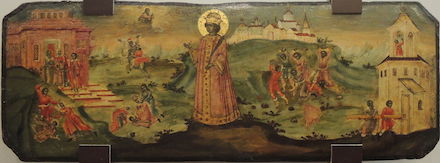

18th century icon of the Tsarevich Dmitry “Uglichsky” (click for larger image) shows his murder (left), and the cathedral bell being sounded to instigate summary justice (right). At the base of the cathedral, Mikhail Bityagovsky tries to batter down the door to silence the alarm.

Dangerous to bystanders, this mob was impotent against the Russian state. Boris Godunov dispatched a delegation that whitewashed Dmitry’s murder and ruthlessly punished Uglich; some 200 are reported to have been put to death for the disturbances.

The bell itself received the crowning punishment on the first of April in 1592, as the literal physical instigator of the riot: hurled from its tower, it was flogged on the public square and mutilated by having its “tongue” (the clapper) torn out. Then it was sent into exile in Tobolsk, where it remained until the 19th century. It hangs today at Uglich’s Church of St. Dmitry on Blood, although — as detailed in the bell’s Russian Wikipedia page — there is some debate about its authenticity.

As for “Saint Dmitry”, his story was just beginning and the canonization wasn’t the half of it.

When Tsar Feodor died in 1598 and Boris Godunov seized the throne outright, Russia entered her “Time of Troubles” — fifteen terrible years of civil war, invasion, and contested succession that ended with the seating of the Romanov dynasty. The Time of Troubles was characterized by, among other things, several imposters claiming to be this very murdered Prince Dmitry and therefore the rightful tsar. False Dmitrys were so ubiquitous during this interregnum that they have their own pretender regnal numbering, but all were failures in the contest for power: False Dmitri I, False Dmitri II, and False Dmitry III each came to violent and sordid ends.

* Ivan the Terrible had a perfectly cromulent heir being groomed for power in the form of one Tsarevich Ivan, but the volatile tsar had struck him during an argument in 1581 and accidentally killed him — which brought the unprepared Feodor into the succession and set up the catastrophic events of this post, as well as this incredible Ilya Repin painting:


Detail view (click for the full image) of Repin’s rendering of the horrified Ivan the Terrible clutching his mortally wounded son.

** The other principal version (Russian link) is that Dmitry suffered an epileptic fit while playing a game with knives, and accidentally stabbed himself. Many Uglichans gave this story to the official investigation (more Russian) that ensued the prince’s death, but their testimony is hard to depend upon since the Godunov-affiliated authorities conducting the investigation (like Patriarch Job, whom Godunov had made metropolitan of Moscow) preferred that version and presumably made sure that they received it. After Godunov’s death the official story reassigned responsibility to him — although this again was driven by the political imperatives of that moment. Some historians down the years have given credence to the “accident” hypothesis.

† That’s Giles Fletcher the elder, who is not to be confused with his son, the poet Giles Fletcher the Younger.

‡ Feodor had only a single daughter, Feodosia, born in 1592 (she died in 1594). As of the time of Dmitry’s murder, Feodor was 33 years old and completely childless.

On this day..