738: Copan king 18-Rabbit (Uaxaclajuun Ub’aah K’awiil)

Mayan history has thus far been difficult to examine due to a major communication gap. Much of the Western world’s understanding of its own history comes from the written word, such that the deciphering of ancient scripts is not only a linguistic triumph, but it also pushes aside centuries of debris to expose a new corner of human culture.

It is this evolving ability to crack codes from classic Mesoamerica that has yielded a close approximation of the true name of the man formerly known only as 18-Rabbit: Uaxaclajuun Ub’aah K’awiil.*

(Alternately, Waxaklajuun Ub’aah K’awiil. The name means “Eighteen Images of K’awiil”; K’awiil was a Mayan divinity.)


Image (c) Matt Stokes of guatemalaholla.blogspot.com and used with permission.

By any name, he was one of the greatest rulers of the Mayan Classical Era, reigning from the Rio Copan Valley in today’s Honduras, near the present border with Guatemala. His life is preserved in several sets of stelae on temples around Copan and describes a man intent on advancing the culture of Copan.

In the city itself, Uaxaclajuun Ub’aah K’awiil greatly contributed to the design of the Great Plaza, which housed one of the great ball courts in the region. More obviously, though, his reign was marked by a drastic sculptural shift away from the angular designs of the Early Classical period and straight into the more complete and rounded designs that persisted through the remainder of the Mayan era.

Reliefs from: the preceding 12th Ruler period (left); and, from 18 Rabbit’s period (right).

In spite of these major cultural moves, little about Uaxaclajuun Ub’aah K’awiil is known directly. However, for the 20th anniversary of his ascension to the throne — on March 27, 715 AD** — Temple 22 was dedicated to the ruler, with a rare inscription ascribed to the ruler himself etched thereon.

It would be another 23 years before Ruler 13 was, as his conquering neighbor put it, “axed”. In 738, the Quirigua region — now in southeastern Guatemala — was considered part of the Copan empire. The Quirigua are now mostly known only for the size of their sculptures, which eclipse others in the region. But in 738, the Quiriga were mostly known for their fearsome king, Kawak Sky, or K’ak’ Tiliw Chan Yopaat, occupied the city just 50 km away and executed (or sacrificed) its former ruler.

That move ended a span of Copan dominance in the area and briefly put the Quirigua on top. Strangely, Yopaat was not apparently responsible for overseeing a particularly fruitful Quiriga culture. Almost nothing was built in his honor until after Uaxaclajuun Ub’aah K’awiil’s death, after which several monuments to Yopaat’s glory were erected. It has been suggested that Yopaat was a brother or cousin of Uaxaclajuun Ub’aah K’awiil, as Kawak Sky’s biography indicates that he both took the throne under Uaxaclajuun Ub’aah K’awiil’s authority and executed his predecessor; this suggests that the move was not a full-on coup.

Regardless of their relationship, in the aftermath of the execution, Copan declined rapidly, presumably as their new Quirigua ruler exploited its labor and material resources to build up his own name. As one Copan scribe later lamented, “[There are] no altars, no pyramids, no places.” But the Copan would rise again: Ruler 15, or Smoke Shell, polished off the unfinished Temple 26 and built up its heiroglyphic staircase to highlight the dynastic history of Copan and its connection to its northerly neighbor, Teotihuacan. His son, Yax Pak Chan Yat, would be the last of the 16 rulers of Copan in the Yax K’uk’ Mo’ line.

* Because of his place in the dynastic sequence of Copan, Uaxaclajuun Ub’aah K’awiil is sometimes referred to simply as Ruler 13.

** Mayan dates are surprisingly easy to nail down once the system is understood. While Europeans moved from Roman to Julian to Gregorian calendars — with the Eastern Orthodox Church and several traditionally Orthodox nations hanging onto the Julian one into the 20th Century — the Mayans had a consistent system that advanced day-to-day and was tied to verifiable events. Hence the ability to date Dec 21, 2012 as the end of the Mesoamerican Long Count calendar, which began on Aug 11, 3114 BCE.

In a way, the MLC is the precursor to the astronomical system of Julian Dates (which are not the same as the Julian calendar).

On this day..

1644: Looters in conquered Beijing

The Shun Dynasty only lasted two months in China, but it still managed to find its way to these pages by deposing the ruling Ming Dynasty and setting the scene for the Q’ing Dynasty.

In the early 1500s, the Ming Dynasty significantly increased contact with Europe, and it immediately saw the value in exploited mineral wealth from the West. At the time, the government was having difficulty maintaining a currency with perceived value: paper money was a massive flop and standard copper coins could not be trusted. Something new was needed, and European silver was a quick and easy answer.

But the decision to move to silver coins backfired a century later, when a variety of converging factors cut the silver supply to China and caused a spike in the price of the metal. As a result, the economy sagged. In the mid-1640s, a drought also gripped the country, and the Ming government was in the unenviable position of watching over a collapsing nation. It didn’t help that the government was highly centralized, with almost all activity occurring in Beijing; a working regional governing mechanism may have allowed it to dig out of the hole, but with the rise of an elite class — and prospective officials seeking every opportunity to serve as close to the power center as possible — there was no hope of a savior once the emperor’s power waned.

Enter the Manchu.

(This is long.)

Originating in Northeast China and Southeast Siberia,* the Manchu occupied their own territory under a local khan. The Manchu army was building strength at the same time that the economic woes under Ming rule increased. While the Manchu originally considered themselves distinct from and superior to the Han Chinese, they made several legal concessions to match the social mores of those they ruled over which enhanced their credibility.

With the Ming Dynasty weakening, the Manchu saw their opportunity to move south.

But even as the Ming fought to repel those Manchu invaders, an internal insurrection was brewing under a man named Li Zu’cheng, an apprentice ironworker from Yan’an. The Chuang Wang (“Roaming King”, Li’s regnal name) was considered a savior of the common folk, even earning a widespread local song looking forward to the day he would arrive:

You’ll feed your mates,
You’ll dress your mates,
You’ll open wide your city gates.
When Prince Chuang arrives, there’ll be no more rates.

(Source)

Li had a strong foothold in the heart of the country, and he was persistent. More importantly, the Ming government was hemorrhaging cash to its frontiers. Eventually, the money began to dry up, and even the ministers within the Chongzhen Emperor’s circle saw the writing on the wall. By mid-March, the Manchus were known to be marching through nearly undefended lines; by mid-April, the treasury stopped paying its military entirely.

On April 24, with Li Zu’cheng at the city gates, Emperor Ch’ung Chen tried in vain to escape his own compound. In his wake, he left the corpse of the empress (suicide), the corpse of his daughter (killed by the drunken emperor in a rage), and a seriously injured crown princess (maimed by the drunken emperor). Having mowed through his family, the emperor joined his chief eunuch Wang Cheng’en, climbed atop a local hill, and, shortly after midnight on April 25, hanged himself.

Li Zu’cheng entered the city unopposed, the gates (as the ditty had promised) flung open for his invading army.

Government officials hid in an attempt to escape retribution, but Li’s forces were reportedly quite orderly and did not seek revenge. Instead, they marched slowly through the city, where many of the locals marked themselves as Shun-min, or subjects of Li’s Shun dynasty.

Looters and bandits, however, were not tolerated, and the well-disciplined force dispatched them quickly and without trial. Their bodies were put on display by nailing them to local streetposts, and by noon, the city was calm.

The Roaming King only managed to hold power for a few weeks before his army was swept away by the Manchus. Li Zu’cheng lived almost two more years on the run, still claiming his title of Emperor of Shaanxi as he fled the newly installed government. It would be several more years before the Manchu would retake Southern China,** but the Q’ing Dynasty would dominate China until the Xinhai Revolution in 1912.

* The Manchurians were technically Tungusic, a significant Chinese minority both then and now. The Manchu largely resisted integration into Han society until the latter half of the 19th century.

** Southern China remained, technically, a distinct entity called the Southern Ming Dynasty, south of the Huai River, until 1662.

On this day..

1979: Gu Shan, of The Vagrants fame

It’s the spring equinox, but here at Executed Today, this date brings no bunnies or pastels.

However, in the spirit of softness, it brings this time only a fictional execution.

On this date in 1979, Gu Shan, the central character of Yiyun Li‘s novel The Vagrants gets a bullet to the heart in the Chinese town of Muddy River. The novel traces the lives of several townspeople in Muddy River who are touched by Shan’s death.

The short life of Gu Shan is secondary to the action of the novel itself: first a revolutionary, then a counter-revolutionary, the 28-year-old is imprisoned for acting against the government. As she sits in jail, she continues to write, and the scribbles in her journals are used in a retrial to garner a death sentence.

In a town of 80,000, her actions can be both consequential and inconsequential, but the people around her are a wholly forgotten lot. In a sense, then, Shan is important mostly because she’s noticed, and, as the saying goes, that really ties the room together.

The story tracks a cluster of characters who interact on the streets but live very different — almost uniformly bleak — lives. These range from Nini, a deformed girl whose mother was brutally assaulted by Shan when the latter was a revolutionary (a crime for which Shan suffered no consequences) to Bashi, the deranged son of China’s best Korean War-era pilot, who mutilates Shan’s corpse and shows a mild obsession for a 7-year-old boy.

Muddy River plays host to dozens of other characters connected to the execution, and Li paints a vividly depressing picture of China immediately after Mao Zedong’s death. The town is a collection of sad lives mired in moral depravity brought about by destitution and Party corruption. The most positive events transpire in quarters in a portable toilet.

Assuming you’re not looking for a pick-me-up on this equinoctial day (and why would you be at this blog if you were?), The Vagrants is well worth the read.

On this day..

1771: Green Tea Hag, the beginning of Dutch Learning

The typical turning-point execution features an illustrious protagonist upon the scaffold: a royal dethroned, a politician overthrown, a revolutionary laid low.

On this day in 1771, an obscure woman executed for everyday crimes launched a new era in Japan.

The Kyoto resident, nicknamed “Aochababa” — roughly translated as the Green Tea Hag — sparked a scientific revolution that would span decades, push Japan into its own Age of Reason called Dutch Learning, and keep an island nation astride goings-on from thousands of miles away in spite of isolationist practices.

The Tokugawa Shogunate, which ruled Japan from the early 1600s through the mid-1800s, was widely regarded as anti-Western for closing down trade with several European nations.

Concerned with what it saw as colonial aspirations in the Americas, the Shogunate clamped down on Catholic missionaries from Spain and Portugal. Starting in the 1630s, the island nation officially enacted the Seclusion Laws, which effectively allowed trade only with China, Korea, and the Netherlands; contact with the last was only legitimated through the Dutch trading outpost in Dejima, an isolated island with strictly controlled access.* Because of these limitations, Japan became a repository of non-Christian Dutch paraphernalia.**

The execution of Aochababa itself is practically forgotten: she was hanged in Kyoto’s Kozukappara (the present day Arakawa ward) in Meiwa 8, the second year of a 15-year drought gripping Japan. Her crime is unknown, and her execution would have been as un-noteworthy as dozens of others that year had her body not been secured for science.

However, under the reign of (though little due to) Shogun Tokugawa Ieharu, Dutch influence was increasing dramatically in Japan.

As a result, Aochababa’s corpse was brought to a medical facility, where Sugita Genpaku, Maeno Ryotaku, Nakagawa Jun’an, Toyo Yamawaki, and others performed and viewed an autopsy. Their medical training was Chinese; their medical texts were a mixture of Chinese and Dutch; as Genpaku reports in his later book Rangaku Kotohajime:†

Ryotaku opened the book and explained according to what he had learned in Nagasaki the various organs such as the lung called “long” in Dutch, the heart called “hart,” the stomach called “maag” and the spleen called “milt.” They looked so different from the pictures in the Chinese anatomical books that many of us felt rather dubious of their truths before we should actually observe the real organs.

Comparing the things we saw with the pictures in the Dutch book Ryotaku and I had with us, we were amazed at their perfect agreement. There was no such divisions either as the six lobes and two auricles of the lungs or the three left lobes and two right lobes of the liver mentioned in old medical books. Also, the positions and the forms of the intestines and the stomach were very different from the traditional descriptions.

After the dissection was over, we were tempted to examine the forms of the bones too, and picked up some of the sun bleached bones scattered around the ground. We found that they were nothing like those described in the old books, but were exactly as represented in the Dutch book. We were completely amazed.

In short, their medical results matched those of the Dutch and flew in the face of a millennium of Chinese anatomical teachings.

Genpaku was intrigued. As he tells it (40-some years after the fact), Ryotaku, Jun’an, and he immediately laid down a plan to translate the Dutch text into Japanese.

The process was a slog. Lacking a dictionary or translator for anatomical studies, the team — bolstered by the Shogun physician Katsuragawa Hoshu — was forced to reverse-engineer the Dutch language using a short phrase book, occasional contacts with the Dutch themselves, and a host of educated guesses based on the anatomical features they were attempting to describe. In addition to the problems of simple translations — turning a language with definite and indefinite articles into one with no such concept — many anatomical features had never been named in Japanese before; Genpaku and his collaborators invented dozens of words just to get by. A brief history is given here.

Finally, in 1774, Kaitai ShinshoThe New Book of Anatomy — based mostly on the Dutch book Ontleedkundige Tafelen (itself a translation from German), was published, the first translation of a Western text into Japanese. The book was four volumes (three of text, one of illustrations) and scribed in a Chinese-based writing style known as Kanbun.‡


An image (more can be seen here) from the 1774 Japanese anatomy treatise.

Topical historical literature, recommendation via Reddit.

The translation was the first in a long line of texts that the Japanese would eventually use to quietly capture the technology of the West.§

Genpaku was at the forefront of Dutch Learning, and his second masterwork, Rangaku Kotohajime (“Beginnings of Dutch Learning”), published in 1815, provides a thorough description of the events which led to these advances in science and medicine in Japan.

It would be 80 years before the United States Navy forced its way into Japanese harbors and used gunship diplomacy to end Japan’s seclusion. During that time, the Japanese reproduced everything from telescopes to automata to steam engines using borrowed texts and dissection of imported goods. Dutch Learning kept Japan abreast scientific advancements even while it maintained its isolation.

The enduring legacy of Dutch Learning was the late-19th century Meiji Restoration, wherein a Japan now officially opened swiftly modernized efficiently enough to trounce Russia in the Russo-Japanese War at the end of the century.

A fairly complete description of the evolution of Japan under Dutch Learning is given in Wakabayashi’s Modern Japanese Thought and De Bray et al‘s Sources of Japanese Tradition (Vol 2).

Today, many of the Dutch words imported to describe new objects, anatomical and otherwise, remain in the Japanese language as a testament to Dutch Learning. Sugita Genpaku is also the namesake of a modern-day attempt to translate texts to Japanese. And Toyo Yamawaki, through his help with dissections of the era, prompted an interesting ritual of memorializing cadaver donors in medical schools. For physical specimens, a museum with sections devoted to Dutch Learning can also be visited at Nakatsu.

* The Dutch were allowed to stay because they weren’t Catholic. The Shogun also enacted laws forbidding missionaries and Christian prosteletyzing, as well as officially outlawing the practice of Christianity; however, an underground group of Christians remained in the country.

** Initially, all foreign texts were outlawed. However, beginning with Shogun Tokugawa Yoshimune, Dutch texts were allowed into the country, generating a new wave of books that were, for several decades, largely illegible to their owners. To go with the anti-Christian theme, however, the Japanese authorities continued to blot out all Christian references.

† Translation by Ryozo Matsumoto, available here.

Kanbun is a mapping of Chinese ideograms and writing style into Japanese-comprehensible language using classic symbolic meanings (a standardized shape to represent a tree) and sound equivalents (using the same standard shape to represent the the sound of the word “tree” rather than its meaning), as well as sentence structure and purpose markings. Using this style, direct Chinese-to-Japense translation is possible, but the onus is on the author to properly annotate the text.

§ Strangely, there is as yet no Dutch-Japanese dictionary in print.

On this day..

1415: French prisoners at the Battle of Agincourt

This day is called the feast of Crispian.
He that outlives this day and comes safe home,
Will stand o’ tiptoe when the day is named
And rouse him at the name of Crispian.
He that shall see this day, and live old age,
Will yearly on the vigil feast his neighbors
And say, “Tomorrow is Saint Crispian.”
Then will he strip his sleeve and show his scars,
And say, “These wounds I had on Crispin’s day.”

…And Crispin Crispian shall ne’er go by,
From this day to the ending of the world,
But we in it shall be remembered-
We few, we happy few, we band of brothers.

Henry V, Act 4, Scene 3

In the world of Henry V, the Battle of Agincourt is a source of bursting pride for the English, a wellspring of superiority over the French and proof of the soul of those from the Isle. In spite of the inspiring speeches, the battle has passed into history as one of the enduring examples of a well-positioned army besting a much larger force.

Were it not for the story of the triumphant underdog, Agincourt would have fallen into international obscurity with much of the Hundred Years’ War, a simmering conflict for the French throne that spanned from 1337 to 1453. The notoriety of the Hundred Years’ War comes not from its intensity but from its longevity and breadth: an international conflict that swept up hundreds of wealthy European houses, it featured the first significant post-Roman standing armies, organized cavalry, and formative nationalism in both France and England.

The interminable war centered around the English crown’s claim to succession of the French throne — a claim events had overtaken by the end of the conflict in 1453 — and had already been going off and on for nearly eighty years as we lay our scene in 1415, with King Henry V of England initiating what would be known as the Lancastrian War.

Henry’s English and Welsh forces battered the French port of Harfleur starting in August 1415, which was the first holding to fall to the invading army. Almost immediately after taking control in late September of that year, the English king made a curious decision to march across Northern France from Harfleur to Calais, approximately 100 miles away.

As he tromped northeast, French troops shadowed his movements, and Henry made several attempts to shake them. After passing through Frévent, Henry turned his men north. He crossed the last major tributary of the Canche River south of Maisoncelle, hopeful that the exhausting trip was nearly through. His scouts, however, had hairy news for their king: the French force had cut the corner and was amassing north of their position. The way was blocked.

Archer? I Hardly Knew Her!

Agincourt (now spelled Azincourt) lay across a ploughed field from Tramecourt, making for a narrow defile not suited to maximizing the French force’s advantage in numbers and heavy cavalry.

Nevertheless, that advantage was considerable, or at least has conventionally been thought so, and it was in the face of desperately dwindling supplies that Henry was forced to initiate battle. The opposing French forces, ostensibly commanded by Constable Charles d’Albret, Comte de Dreux, and Marshal Boucicaut, Jean Le Maingre, allegedly outnumbered the British by at least 2 to 1 (estimates range as high as 6 to 1*).

The English drew up longbowmen in a wedge along the woods adjacent the field (map), and it was these positions that provided the decisive turn.

When the Gallic banners advanced, the English archers moved into firing range and dug in palings they had hastily manufactured from the local forest; this made a direct assault problematic while the woods prevented a flanking maneuver. French cavalry attempted to dislodge them with a concerted assault, but the defensive postures held, and the cavalry was turned away. All the while, the hail of arrows mowed down the flower of French chivalry, whose lines crumbled in panic and disorder.

As one contemporaneous account states**:

Before, however, the general attack commenced, numbers of the French were slain and severely wounded by the English bowmen. At length the English gained on them so much, and were so close, that excepting the front line, and such as had shortened their lances, the enemy could not raise their hands against them. The division under sir Clugnet de Brabant, of eight hundred men-at-arms, who were intended to break through the English archers, were reduced to seven score, who vainly attempted it. True it is, that sir William de Saveuses, who had been also ordered on this service, quitted his troop, thinking they would follow him, to attack the English, but he was shot dead from off his horse. The others had their horses so severely handled by the archers, that, smarting from pain, they galloped on the van division and threw it into the utmost confusion, breaking the line in many places. The horses were become unmanageable, so that horses and riders were tumbling on the ground, and the whole army was thrown into disorder, and forced back on some lands that had been just sown with corn. Others, from fear of death, fled; and this caused so universal a panic in the army that great part followed the example.

A confused chain of command in the French camp (the English, of course, were personally commanded by their sovereign) facilitated the rout.

Despite their military status, d’Albret and Boucicaut were outranked by several of the nobles heading the lines behind them, said nobles being prone to glory-seeking freelance charges as chivalrous as they were tactically unavailing. The Constable led the front line, followed by the Duke of Bar and the Duke of d’Alençon.

After the disastrous first charge, what remained of the second line moved in to join the fray. The French peasantry was massacred during the fight, and Constable d’Albret and the Duke of d’Alençon, along with the Duke of Orleans and Duke of Barant, along with several other nobles, fell during the assault, further disorganizing the French. (The highest-ranking English casualty was the Duke of York.)

With thousands of French dead, the third line, headed by the Count of Merle and Count of Falconberg, fell away before they entered the battle. While England’s longbows dominated the field, France’s bowmen never even participated in the battle, squeezed to the back by too many bluebloods demanding the right to charge.

Only 100-200 English are thought to have died this day; the death toll for the French was in the thousands, with hundreds more taken prisoner.


Uh-oh.

It is a portion of this lot summarily executed during the battle who offer this blog an excuse to survey the battlefield.

After a successful raid on the English supply van — the signal French achievement in the battle, and one that briefly threatened to knock out the monarch himself and turn the tide — Henry got worried that his oversized contingent of French prisoners was liable to get loose and wreak havoc in his rear. He issued the expedient but decidedly unseemly order to put his captives to death.†

Parts 1, 2, 3 and 4 of this documentary, which among other things unpacks the longbow’s actual role in the victory, given that English arrows could not penetrate French knights’ plate armor.

The Battle of Agincourt has inspired innumerable interpreters, from Shakespeare to Star Trek.

Shakespeare’s classic Henry V is frequently staged, and has hit the silver screen multiply — here’s Laurence Olivier’s version of the stirring St. Crispin’s Day speech followed by the start of battle from the 1944 production addressed to the martial fervor of World War II.

There are plans to adapt Bernard Cornwell’s Agincourt to film as well.

In the nonfiction world, Lt. Col Alfred Burne’s The Agincourt War focuses on the military side of the battle while Juliet Barker’s Agincourt: The King, the Campaign, the Battle and Agincourt: Henry V and the Battle That Made England.

The year after Agincourt, Henry V claimed all of Normandy, and in subsequent years forced the French to sign the Treaty of Troyes in 1420, which established the line of succession for Henry’s heirs to unify the crowns of the adversaries. Henry’s grand plan was foiled by his untimely death just two months after the death of King Charles VI of France, which left Henry VI — then less than a year old — as the heir to both English and French thrones.

The Dauphin Charles of France, officially disinherited by Troyes but still widely supported in France, swooped in to claim power in France, but internal dissent made his rule difficult; 30 years later (and after the intervention of Joan of Arc), Charles finally expelled the English from Aquitaine, and brought all France together not under the House of Lancaster but under the House of Valois.

* Accounts are sketchy in this regard. Some modern analysis puts the values at 4:3 for the French. However, contemporaneous accounts suggest a much heavier French advantage. Of course, people are notoriously bad at crowd estimation.

** Translation by Thomas Johnes.

† Shakespeare covers this notorious massacre as well, in Act 4, Scene 6 (the next scene opens with Englishmen horrified at the order, but the matter drops as they realize they’ve won the battle)

Alarum
But, hark! what new alarum is this same?
The French have reinforced their scatter’d men:
Then every soldier kill his prisoners:
Give the word through.

Part of the Daily Double: Agincourt.

On this day..

1857: Adolf Schlagintweit, intrepid explorer

Sometimes it’s better to let your curiosity rest for a little while, especially when a violent despot takes charge of the region you want to do geological studies on. That was the takeaway lesson for Adolf Schlagintweit (English Wikipedia page | German) when Wali Khan discharged the German explorer’s head in 1857 in the Kashgar region of present-day China.

Schlagintweit and his brothers, Hermann and Robert, were in pursuit of knowledge, following up Hermann and Adolf’s drab and long-titled work Untersuchungen ĂĽber die physikalische Geographie der Alpen, in ihren Beziehungen zu den phänomenon der Gletscher, zur Geologie, Meteorologie, und Pflanzengeographie (Studies of the Physical Geography of the Alps, in Relation to the Phenomena of Glaciers, Weather, and Phytogeography) and equally odorless (but far more accessibly titled) successor Neue Untersuchungen ĂĽber die physikalische Geographie und Geologie der Alpen (New Studies of the Physical Geography and Geology of the Alps), authored by all three.

The Schlagintweits were successfully largely because of their ability to draw: their writing left much to be desired, and their scientific skills were frequently a target of ridicule after the voyage that saw the end of Adolf.

The East India Company funded that venture, which was intended to take magnetic field measurements, beginning in 1854. The trek was spurred on by the then-85-year-old Alexander von Humboldt, who had extensively traversed Latin America and attempted the first scientific description of its geology and wildlife; von Humboldt, a noted scientist throughout Europe, convinced the East India Company to pony up large amounts of money for what he expected to be a significant geological study, one that he long sought but could not undertake himself. This relationship is explored in-depth by Gabriel Finkelstein in his well-written History of Science article “‘Conquerors of the KĂĽnlĂĽn? The Schlagintweit Mission to High Asia, 1854–57”.

The brothers made their way to central India and from there journeyed north into the Himalayas. They did not travel together, but separated and re-united occasionally to go over samples, pictures, and notes.

After their last meeting in the fall of 1856, Adolf’s itinerary brought him through the mountains of Tibet and into present-day China, near the borders with Kyrgystan and Pakistan. It was in this Kashgar region that the geologist found himself embroiled in what would be the last in a series of revolts by the East Turkestan Khojas, a group claiming nobility in Eastern Kazakhstan from the time of Genghis Khan.*

Adolf’s end is largely shrouded in mystery, but some contemporaneous accounts given to the British government provide a minimal sketch. Schlagintweit’s ostensible goal was to reach the city of Kashgar; despite much of his party deserting, and in spite of a warning from fleeing refugees that the notably cruel Wali Khan had initiated a rebellion, Schlagintweit pressed on.

He was met at the city’s border and brought before the Khan, who, having little use for European interlopers wandering his territory, accused the scientist of being a spy and had Adolf summarily beheaded.

Adolf’s notebook was later purchased by a passing Persian from the tobacco shop, where its pages were being used to wrap tobacco leaves. The purchaser tracked down a skull he believed to be Schlagintweit’s and brought the chartaceous and skeletal evidence to India.

The book published from the travels of the Schlagintweits is available here. It has been widely panned as dull.

* Four years after Wali Khan was deposed once again by the Chinese, Uighurs successfully battled for the region’s brief independence. Tensions in the region, needless to say, have not settled.

On this day..

406: Radagaisus the Barbarian

Rome in the 5th Century was a difficult place for the general populace. The Roman Empire was at the front end of its long decline, and with its partitioning in 395 on the death of Theodosius I, a series of invasions was to follow that would shake confidence in the leadership of the Empire.

Possible etymological connection to the possibly proto-Slavic barbarian horde: shadowy Slavic god Radegast lends his gnarly visage to a Czech beer — and maybe to a Tolkein character.

Much of the activity in Rome at the time was tied to the young Visigoth King Alaric. Alaric initially invaded the Eastern Roman Empire, but he was met with resistance in Greece. During negotiations, the de facto head of the Western Roman Empire,* Stilicho, who has been claimed by some sources to have been born a Visigoth, marched on the Goths and prepared to engage in what likely would have been Alaric’s downfall.

According to accounts, Stilicho was called out of the neighboring province of Illyricum, and Alaric, now unencumbered of the prospect of a Western reinforcement, marched through Greece.

But Stilicho would not sit still, and in 397, he brought his army against the Goths and forced them into a difficult spot in the mountains of Pholoe, in the southern prefecture of Illia. Alaric slipped away,** moving his forces north and setting his sights on the Western Roman Empire, starting in northeastern Italy, in 400 AD.

While Stilicho was engaged on this eastern front, the Ostrogoths, led by the commander Radagaisus, prepared for their own invasion. While history is uncertain as to how the series of events transpired, it is clear that Stilicho bested Alaric at Pollentia and Verona and, because of a budding camaraderie with the defeated commander, enjoyed a few years’ respite from the Gothic invaders. Which was useful, because the Roman army had shrunken to a point where even small defeats were extremely costly to the Empire.

So it was that, when Radagaisus invaded Italy in 405, Stilicho had nearly all his army in place. Radagaisus marched with 100,000 people (likely) to 400,000 people (highly unlikely), though a relatively small percentage of these were thought to be armed. His trail of terror displaced uncounted Romans as Radagaisus made his way through northern Italy.

Finally, at the start of the 406 campaign, Stilicho had mustered sufficient forces to assault the invaders. As Radagaisus blockaded Florence, Stilicho amassed his regulars and, fortified also with recalled frontier soldiers, massacred the opposition. The battle was decisive, with the Roman army starving out the invading hordes, and Radagasius apparently quickly losing control of his loose band of warriors.

Whether he was turned on by his own men, or whether the Romans simply overran their enemies after a period of famine, Radagasius eventually fled the battlefield and was captured at one of Stilicho’s outposts. On 23 August 406, the man who called himself King Radagasius was beheaded.† Many of his soldiers defected to the Roman army — joining a long line of conscripts from conquered people — and his supporting band was scattered or enslaved.

Like Alaric, Radagasius has sometimes been indicated as King of the Goths, but his history is a little more murky than that. Radagasius (or Rhodogast, or Radegast, depending on the source) issued from northern Germany before making his march. He had united several tribes under his banner, but he could hardly be said to rule any region. And because of the remoteness of Ostrogoth territories and the limited written history on the region, it’s difficult to assess his true nature.

* Stilicho was protector of the underage Honorius, who has been regarded as weak and incompetent. Honorius died in 423, long after Stilicho was murdered.

** Alaric and Stilicho may have been conspiring at this point: Stilicho again claimed to have been recalled from the battlefield, but, owing to their common heritage and their later connections in defense of the Empire, it’s thought that Stilicho was actively recruiting Alaric for military service in defense of Rome.

† “The death of the royal captive, who was ignominiously beheaded, disgraced the triumph of Rome and of Christianity,” sniffed Edward Gibbon.

On this day..

1626: Henri Talleyrand, Comte de Chalais

The name Talleyrand is generally synonymous with the famed “Prince of Diplomats” who spanned the Republic, Empire, and Kingdom.

But that Talleyrand — Charles Maurice de Talleyrand-PĂ©rigord, multiply French foreign minister, former Bishop of Autun, one-time Prince of Benevento, Ambassador to the United Kingdom — was just one in a long line of the Talleyrand-Perigords (pdf link) who made a name for themselves.

In 1626, Henri de Talleyrand-PĂ©rigord, Comte de Chalais, head of wardrobe to King Louis XIII, was one member of that house whose neck was shortened for an offense against the king’s court.

Henri — as he shall be herein known, so as not to confuse him with his many relatives — was the youngest of three children. Born in 1599, he served in the military at the unsuccessful Siege of Montauban in 1621 and 1622. (The defeat (temporarily) preserved Huguenot rights in France.)

In 1623, Henri returned from war and married Charlotte de Castille (not to be confused with the modern porn star!). It was not long after that rumors of Castille’s impropriety started making the rounds, as immortalized in Tallemant de RĂ©aux‘s verse, whose rough translation is as follows:

Pontgibault boasts,
On seeing the slit
Of the Countess of Alais
Who likes the strong ballet,
And says hers is more charming
Than the Chalais’.

And that, not so roughly translated, is why Pontgibault received a visit from an irate Henri.

Henri is alleged to have challenged a duel, where he cock-blocked his cuckold — permanently. The European ideals of chivalry yet persisted, so there was some question whether this affair constituted murder, and the trial was the talk of France through the winter of 1623.

It was at this trial that the lines were drawn: Henri was joined in his effort to fight the charges by the Grand Prieur Alexandre de VĂŞndome, Monseiur Gaston d’OrlĂ©ans (brother to the king), Jean-Baptiste d’Ornano, Louis de Bourbon (Comte de Soissons), and others.

Henri successfully defended himself, but this did not put the fire back into the marital bed. Instead, Henri’s loins turned toward Marie de Rohan-Montbazon, duchesse de Chevreuse.

Madame de Chevreuse, former lover of Henry Rich (later Earl of Holland), had a string of lovers, and it’s questionable whether Henri was among them. Whether he was or not, she ignited in him a passion that would lead to his execution.

The impetus for this execution was ostensibly a plot to save Gaston d’OrlĂ©ans, who, by decree of Louis XIII, was to marry Marie de Bourbon, duchesse de Montpensier. The union would bring significant wealth into the family of Louis XIII.

Backed by his First Minister Cardinal Richelieu, the king was insistent. For several years, Richelieu had also been reducing the power of the nobility and consolidating central authority around the king, which was not the way Madame de Chevreuse envisioned the world.

Instead, she sought to install Gaston d’OrlĂ©ans on the throne, thus advancing her agenda to restore power to the nobility. The forced marriage became a convenient excuse to enact her plan against Richelieu. And her charming way with men made it easy to find participants.

Madame de Chevreuse and d’Ornano were at the heart of the conspiracy, but their reach extended as far as England and Spain. She was also supported by Anne of Austria, who is thought to have played a critical role in organizing the conspirators. At the very least, the collective hope was to make Monseiur abandon Louis XIII’s court and seek an alliance with the Hugenots, who would be sympathetic to a cause against the Catholic Church.

The juicy details of the winter of 1625-1626 are cataloged in H. Noel Williams’ A Fair Conspirator Marie De Rohan, Duchesse De Chevreuse, but a summary version is sufficient here.

At some point, Richelieu caught wind of d’Ornano’s involvement in a conspiracy against the throne; not knowing the extent of the effort, he had d’Ornano detained. Lest their plot be found out, the conspirators encouraged Gaston to initiate a war; this was particularly true of Comte de Soissons, who posted a reward should Monseiur take up arms against his brother.

Gaston hesitated, and a new plan was enacted.

Instead, some of the conspirators would take audience with Richelieu and either detain or kill him, depending on the story. Needless to say, the plan failed, and the conspirators were found out. Chalais tried to lay low while the plot against the king and his minister unfolded, but he did not sufficiently distance himself from Madame de Chevreuse: Gaston was exposed and named names, and Chalais, not well-connected enough to fight the charges against him, was captured at Nantz on July 8.

Henri de Talleyrand-Périgord, Comte de Chalais, was sentenced to death by beheading for lèse-majesté, and on August 19, 1626, he mounted the scaffold at Place de Bouffay in Nantz. In a last, cruel twist, the conspiracy had bought off the town executioner in hopes that, lacking a practitioner of the macabre art, Chalais might be spared. But a replacement had been hastily found: a man himself condemned to death:

The [replacement] was so unskillful that, besides two blows from a Swiss sword, which had been purchased on the spot, he gave him thirty-four with an adze such as carpenters use; and was obliged to turn the body round to finish the severing of the neck, the patient exclaiming up to the twentieth blow: ‘Jesus, Maria et Regina Cali!’

No other conspirators were put to the sword, and Gaston and his brother eventually made up. Richelieu, meanwhile, gained more power and transitioned France from a feudal state to an absolute monarchy under Louis XIII and his successor, Louis XIV. His dealings form the backdrop of The Three Musketeers.

As for Madame de Chevreuse — who also figures in The Three Musketeers, scheming behind the scenes against Richelieu and crushed on by Aramis — she fled to Château d’Dampierre, then was exiled to England, where she fell in with the Duke of Lorraine (and became his mistress); she attempted to organize several more coups against the Red Eminence, but each fell short of the mark.

Madame de Chevreuse eventually ended up in Spain, then moved back to England, then shipped out to Flanders, where she connected once again with the Comte de Soissons and attempted to usurp the throne before it could be passed to Louis XIV. When Richelieu finally passed, she sought to oust his replacement, this time relying on César de Bourbon, duc de Vendôme, who was also involved in the Chalais conspiracy. After this failure, Madame de Chevreuse retired to Gagny.

Elizabeth Stone writes of Madame de Chevreuse in Political Women, “It was not she evidently who made of Buckingham a species of paladin without genius; a brilliant adventurer of Charles IV of Lorraine; of Chalais a hair-brained blunderer, rash enough to commit himself in a conspiracy against Richelieu, on the faith of the faithless Duke d’Orleans; of Châteauneaf, an ambitious statesman, impatient of holding second rank in the Government, without being capable of taking the first.”

Be that as it may, she is a compelling historical figure, and the Chalais conspiracy formed the basis for the operatic tragedy Maria di Rohan.

The conspiracy has also been used in an unusual modern form as an audio drama episode of Doctor Who.

(A complete discussion of Talleyrand-PĂ©rigord’s life can be found here. (French link) Breathless French court gossip in a 19th century biography of Chevreuse here.)

On this day..

1381: Eppelein von Gailingen

On this day in 1381, probably the most infamous robber baron in Germany was flogged, done in on the breaking wheel, and beheaded in Postbauer, near NĂĽrnberg.

Eppelein von Gailingen (or Egkelein Geyling, or some variation thereof) has been dramatized across the ages, but little is known of the man’s life. His death, certainly, but his life is clouded in myth and folklore. What’s clear is that von Gailingen met his grisly end for robbery and a subsequent escape from incarceration. The rest is a tad murky (German link).

Von Gailingen belonged to the class of original robber barons, who supplemented their income with unauthorized tolls and, sometimes, flat-out theft. While the term is more popularly known for its application to the so-called industrial robber barons, it derived from a literal description from centuries past — Raubritter, in German, “men of birth who elected to live, in a lawless age, by saddle and by sword; who sought gain by masterful spoliation, and strove for glory by despiteful deeds of arms.” (Source)

A combination of factors led to the slow and steady dissolution of the former feudal system in favor of a money-based economy during the Middle Ages, and after the Plague swept through Europe around 1350, the accumulated changes and decimated population left much of the continent short on labor and, as a result, short on production. This really was a spot of bother for barons who, unlike their monarchical brethren, had no way to draft extra manpower. With resources thinning and a social lifestyle to keep up, many of these former lords turned to theft and exploitation. Although Rome established the rules governing tolls and trade, many local lords, now charged with obeying distant regulations, opted for a more convenient route: they stopped ships at unauthorized points, shook down the merchants, and sometimes seized wares to stock their own shelves.

Eppelein von Gailingen (German link), a lord in the castle at Gunzenhausen, near Illesheim, was of this group, but apparently one of its more bold and populist members.

He was often felt to be a kind of Robin Hood, and the earliest celebrations of the man were largely in this vein: a knight’s knight, fighting against an out-of-control state disregarding its people. Eppelein got away with his skulduggery until 1369, when he was captured by a political rival and imprisoned in NĂĽrnberg. Von Gailingen was sentenced to death, but shortly before his hanging, an accomplice managed to sneak him a horse, on which he rode out the tower gates and hurdled the enclosing wall and moat.

Now the leader of a loyal band of brigands flouting the Roman Catholic Church, Eppelein went on the run for six years, eventually making his way back near his home. It was there that, after six more years, his minimal forces finally yielded to the Count of NĂĽrnberg, who carried out a much more unpleasant version of the death sentence.

Eppelein’s rise to prominence began in the 16th century, when he was immortalized by a folk song, a medium that continues to be kind to him. Locals still tell a variety of tales of his exploits, and a rendition of these classics is vaguely effected through the film Ekkelins Knecht.

Others have simply waxed poetic on the topic.

As if all that attention weren’t enough, von Gailingen’s run from the law lives on through the legend of NĂĽrnberg: locals pushing the town on tourists claim that two hoofprints from his daring escape are imprinted in the stonework near the the castle’s five-pointed tower.* And perhaps most indicative of his endurance as a cultural icon, a neighboring town has devoted a festival to him, which is more than most robber barons of any day can claim.

* Not surprisingly, the tower was destroyed and rebuilt at least once — just five decades after Eppelein’s alleged leap. But the new sandstone structure does bear the marks of what could conceivably be a horse’s hooves.

On this day..

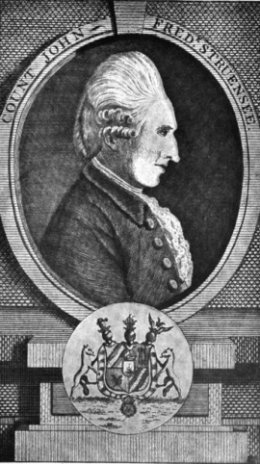
1772: Johann Friedrich Struensee, the doctor who ran Denmark

The 1700s were a time of radical reform, and as the Enlightenment reached the shores of Denmark, it suddenly became possible to be a professed atheist and not lose your head. That is, of course, as long as you didn’t also try to usurp the crown, undermine the aristocracy, and agitate the commoners while you were at it.

Such was the course that ended the rise of Johann Friedrich Struensee on this date in 1772. His friend and sometime cohort Enevold Brandt (Danish Wikipedia entry) was put on the block on the same day.

Struensee was born in 1738 in present day Germany and educated in Prussia, a doctor by trade and a budding Enlightenment political writer by practice. He seemed an unlikely character to involve himself in the court of King Christian VII of both Denmark and Norway, but Struensee was a vain and social man who managed to befriend the right people at the right time.

The first was Brandt. The second was Count Schack Karl Rantzau. A lawyer and Supreme Court justice, Brandt was a court favorite* and planted Struensee’s name as a capable doctor: young, kind, and competent, he would make a perfect personal physician for a king known for being a bit off: Christian was likely schizophrenic. Rantzau, meanwhile, was Count of the Holy Roman Empire, exiled from Copenhagen some 15 years before he met young Struensee, and eager to get back into politics.

In June 1768, Struensee took a post as the king’s traveling physician in England, and he immediately attached to Christian’s loneliness. The regent was interested in literature, philosophy, and music, and Struensee obliged him with patient regard for his charge, for which he was duly rewarded with access to a social life much more fulfilling than in Prussia. As a traveling physician, though, Struensee’s post had a finite span, and he lobbied hard to become a member of the Danish court.

With some help from others in the king’s court, Struensee managed to retain a permanent post, and his clamber up the nearest cliff to power began.

The young doctor, it seems, had a talent for playing two sides for personal gain. It started with the king, who had immense trust in Struensee and began to confide almost everything. Struensee was tactful with this information, adhering to an early form of patient-doctor privilege that endeared him to Christian. The other side was Queen Mathilde, Princess of Wales, by all accounts a beautiful woman who was not happy in Denmark and even less happy to be married to a mad and deteriorating king.

Mathilde initially disliked Struensee — or, at the very least, was indifferent to his actions. But near the end of 1769, the queen finally admitted Struensee into her chambers, and their relationship took off. He ably gamed Mathilde by convincing her that she was the kingdom’s future; Christian, meanwhile, remained ill, and Struensee remained a steady presence in his life. Come spring, Crown Prince Frederick VI also came under Struensee’s care, and as smallpox ravaged Copenhagen, the doctor pressed for inoculation. The king and queen assented, Frederick survived the epidemic, and Struensee garnered himself an official advisorship. It’s also suspected that, while Struensee and Mathilde watched over Frederick as he recovered from the inoculation,** their love affair began.

With a taste of power, Struensee pressed King Christian VII for cabinet changes — which he got — and was named Privy Councilor before 1770 was out. Now the principal advisor to the king, Struensee was able to advance his Enlightenment agenda, notably freedom of the press, the abolition of torture, limiting the death penalty, changing the rules of appointments, numbering the houses in Copenhagen, lighting the streets, and, perhaps in anticipation, removing penalties against those who produced illegitimate children. He was a bold visionary, but he also intoxicated by his growing power … and his programme obviously gored many an ox.

Struensee ascended still further early in 1771 when the king became practically unfit to rule. He was mentally faltering, and Struensee was all but running the show, and more.

In early July, the queen gave birth to a daughter who was widely assumed to be Struensee’s child. Days later, and just three years after being introduced to King Christian VII, Johann Friedrich Struensee effectively appointed himself Privy Cabinet Minister with dictatorial authority through one of King Christian’s edicts. Struensee’s orders would now have the force of law, and, as Christian’s proclamation noted, “They shall be immediately obeyed.”


Enevold Brandt (top), not to be confused with Brandt, the Big Lebowski lackey (bottom).

Struensee spent the next six months turning the European aristocracy inside-out and foisting an aggressive set of cabinet orders on the Danish people — over 1,000, by some counts. Having ridden on the coattails of a queen and king, he now pushed them aside. He moved the court to Schleswig-Holstein, in Prussia, and pleasingly enjoyed both the prerogatives of aristocracy and a middle class contempt for them.

Struensee was, to say the least, not a favorite abroad;† that he and his friends dominated the king and queen did not sit well with Danish commoners. Even Brandt was becoming disaffected, writing in a letter asking for either a larger salary or a resignation from the court:

No despot ever arrogated such power as yourself, or exercised it in such a way. The King’s pages and domestics tremble at the slightest occurrence: all are seized with terror. They talk, they eat, they drink, but they tremble as they do so. Fear has seized on all who surround the minister, even on the Queen…

But Brandt stayed on, and as 1771 drew to a close, Copenhagen became hostile territory for the royal family and their favorite doctor.

After the season’s first masquarade ball, on 16 January 1772, the Queen Dowager — Christian’s step-mother — Juliana Marie exposed Struensee’s affair and had Struensee, Brandt, the queen,‡ and many other Struensee accomplices arrested, ostensibly by order of the king.

Struensee was charged with lèse-majestĂ©, a crime against the crown, for his affair with the queen; though he initially denied the charges — and though Mathilde did her best to shield him from harm — he was found guilty. Brandt was charged with the same crime for allegedly assaulting the king after being himself threatened with a flogging for impertinence (he even had a nip at Christian’s finger). Brandt’s punishment was the same. Each had his right hand chopped off, then was beheaded, drawn, and quatertered.

The queen, meanwhile, went into exile in France. Juliana Marie effectively ruled the kingdom through her son for over a decade, rolling back many of Struensee’s reforms and reverting power back to the aristocracy. This also turned out to be unpopular (the Danes and Norwegians are fickle people), and Mathilde’s son Frederick VI was able to regain power for his father in 1784, eventually moving to liberal reforms more in line with his erstwhile physician’s ideals.

Struensee’s epic rise and fall have spawned a variety of writings since his death. A memoir appeared just months after his execution which detailed his final months. He was also the subject of the Per Olov Enquist novel The Royal Physician’s Visit, which examines his life from multiple perspectives. Queen Mathilde’s life was put to ballet by Peter Maxwell Davies. And for a more contemporary cultural artifact, there’s the 2012 film A Royal Affair.

* Brandt was a court favorite, but after attempting to destroy the position of another minister, he was briefly expelled from Copenhagen, shortly after Struensee accepted his post.

** These inoculations predated “safe” inoculations by non-fatal, related disease strains such as cowpox. Frederick would have been made ill through the small pox strain Variola Minor, which had a mortality rate of about 1%. By contrast, Variola Major was fatal in about 30% of cases.

† While Struensee seems to have been book smart, his feel for international politics was limited, and his standing abroad would have unraveled had it ever raveled in the first place. He repeatedly upset the Russians, and Mathilde’s relatives were not pleased with him. Had he not been downed by public sentiment, it seems likely he would have fallen victim to one of his many royal detractors abroad.

‡ In a curious twist, Rantzau was the queen’s arrestor, and one of the principal conspirators in the dowager’s plot was a cabinet minister Struensee was responsible for ejecting very early in his career.

On this day..