1864: Li Xiucheng, Taiping Rebellion general

On this date in 1864, Qing commander Zeng Guofan had executed his opposite number in the destructive Taiping Rebellion, previously surveyed in these pages.

Stephen Platt‘s acclaimed 2012 history Autumn in the Heavenly Kingdom: China, the West, and the Epic Story of the Taiping Civil War depicts this war along with Li, the illiterate peasant farmer whose brilliance in command flowered as the Taiping undid ossified class hierarchies.

Li’s generalship kept the Taiping in the fight for a long, long time: the war spanned 14 years, with some 20 million estimated killed. In July of 1864 the central government finally overran the rebel capital of Nanking/Nanjing and put that city to a frightful sack. Here’s Platt on Li’s fate:

Zeng Guofan seeded his reports on the fall of Nanjing with fabrications, claiming that a hundred thousand rebel soldiers had been killed in the fighting, inflating the glory of his family and his arm, masking their looting and atrocities against cvilians. He kept careful control over what the cout would know. To that end, from the day he arrived in Nanjing he took over the interrogation of Li Xiucheng for himself. The Hunan Army commanders had already secured a long confession from Li Xiucheng in the weeks since he had been captured — pages upon pages detailing his origins and the history of the war and explaining the tactical decisions he had made, many of which they still did not understand. The honor of beginning the questioning had fallen to Guoquan, who had taken to the job with undisguised relish; his primary tools were an awl and a knife, and he managed to cut a piece out of Li Xiucheng’s arm before the others made him slow down.

When Zeng Guofan took over the interrogations on July 28, at last the two hoary, weatherbeaten commanders in chief of the civil war faced each other in person for the first time: square-shouldered Zeng Guofan on the one side, the weary-eyed scholar, his long beard turning gray;wiry, bespectacled Li Xiucheng on the other, the charcoal maker who had risen to command the armies of a nation. It would be no Appomattox moment, however. There was no wistful air of regret and respect between equals. For the defeated, it was no prelude to reconciliation, to twilight years on a rolling plantation. This war ended not in surrender but in annihilation. Zeng Guofan would spend long hours of the following evenings editing his counterpart’s fifty-thousand-word confession, striking out passages that didn’t paint his own army in a good light and having it copied and bound with thread for submission to the imperial government, before casually ordering Li Xiuceng’s execution — in spite of orders he knew were coming from Beijing, that the rebel general be sent to the Qing capital alive.

On this day..

1936: Josep Sunyol, FC Barcelona President

FC Barcelona is many a sportive leftist’s major European football side of choice, thanks to the club’s longtime identification with its city’s Catalan anti-Francoism.

That identification, stretching all the way back to the club’s formative early-20th century years (“History of FC Barcelona” enjoys its own voluminous Wikipedia page) put the Barca president at the end of fascist guns on this date in 1936.

Josep Sunyol was born into the Catalan elite, and had a varied career in the public eye: left activist, parliamentary deputy, newspaper founder, and, come 1935, president of FC Barcelona. He’d been serving on the Barca board of directors since 1928. There’s a lengthy Sunyol biography here.


At the center of the rail, Sunyol (left) chats with Catalan president Lluis Companys. (Source)

It was in his political, rather than his footballing, capacity that in August 1936 — just days into the Spanish Civil War — Sunyol traveled from Barcelona to Madrid to meet with fellow Republicans.

He never made it back.

On the return trip from Madrid, Sunyol’s chauffeured car flying the Catalan senyera was stopped by pro-Franco Falangist forces in the Sierra de Guadarrama north of Madrid. It may have been only inadvertently that Sunyol crossed this checkpoint of nationalists, who were already gathering for an attack on Madrid that would eventually inspire For Whom The Bell Tolls. (Indeed, this novel is set in the Sierra de Guadarrama.)

Whatever Sunyol’s intention, he was quickly recognized and detained by his foes on the evening of August 6. Shortly thereafter, they decided to shoot him out of hand.

The civil war and the era of Franco are still sensitive topic in Spain, but FC Barcelona’s politically engaged supporters have pushed the present-day club (with partial success) to more overtly embrace its anti-fascist “martyr president”.

On this day..

1993: Joseph Paul Jernigan, Visible Human Project subject

On this date in 1993, Joseph Paul Jernigan died by lethal injection in Texas. Yet he lives on still.

A career burglar, Jernigan was surprised mid-robbery in 1981 by 75-year-old Edward Hale: the thief promptly shot the homeowner dead, then finished his looting. His life as a free man would be over within days.
As a criminal you wouldn’t much notice Joseph Paul Jernigan — unless it was your house he was burgling, of course — and you wouldn’t exactly call his smash-and-grab act state-of-the-art. But little over a year after his death, Jernigan was making headlines for a groundbreaking scientific project.

Jernigan donated his body to science, joining an ancient tradition of condemned men and women whose bodies are “cadaverized” for whatever medical material is required of their own day and age.

But instead of serving as a med school’s pincushion, “science” in Jernigan’s case turned out to be — Jernigan had no idea of it while he lived — the Visible Human Project.

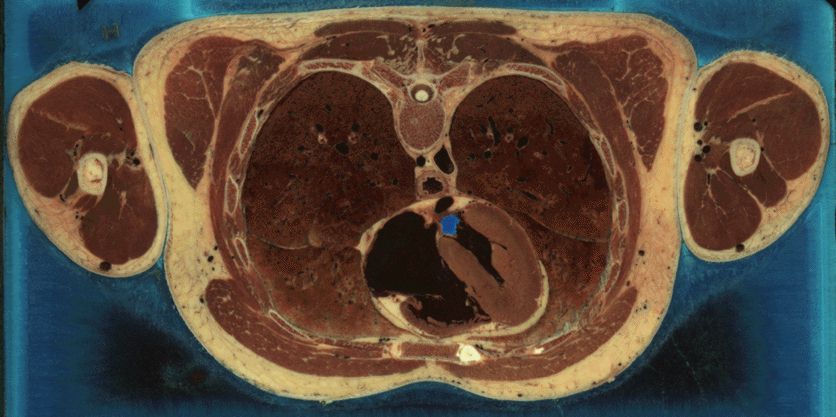
This National Library of Medicine initiative built a data set of digital images depicting the complete anatomy of a normal adult man and woman: Jernigan’s cadaver was selected for the male lead.

So, after his execution, Jernigan’s entire body was “sliced” from head to foot into 1,871 one-millimeter slides. (The “slicing” process ground away the body completely; it did not literally slice it like salami.)


Joseph Jernigan’s thorax, including the heart. (From here.)

The project is still online, and has never yet been replicated/surpassed with the the advancing technologies of the intervening decades. It’s a weirdly beautiful, unsettling, and ethically questionable artifact — a Smugglerius of the digital age — but it’s also inescapably awe-striking.

So here: take a tour down Joseph Jernigan at the, er, cutting edge of anatomization.

On this day..

1899: Three in the Klondike Gold Rush

On this date in 1899, the gallows of gold rush boom down Dawson City, Yukon strained for three murderers.

The 1896 gold strike in the Klondike triggered a huge rush of prospectors warming sub-Arctic climes with visions of sudden wealth. “When the world rang with the tale of Arctic gold, and the lure of the North gripped the heartstrings of men,” as put by that lure’s great muse Jack London, who himself had already come and gone from the Dawson City by this time, and struck his own variety of fortune in the process.

Miners pouring into the Yukon did not, of course, enter virgin territory. Native peoples had occupied it for thousands of years.

In May 1898, two prospectors, Christian Fox and William Meehan, camped near the mouth of McClintock Creek were only mildly uneasy about the arrival of the Nantucks, Tagish brothers who set up an adjacent camp. Relations were amicable for a while, but when returning one afternoon from the day’s work the prospectors were suddenly fired upon from ambush by their neighbors.

Meehan was slain in the fusillade. The injured Christian Fox managed to float away, get to land, and reach a miners’ settlement. He described the attack thus:

I was lying on the sacks against the side of the boat … and I saw Joe standing with his gun like this … and all the boys went into the brush, and I says to myself “Now they have shot us for our outfit, and are hurrying down to the next bend in the river to catch the boat … My only show is to get to the opposite side of the river and try to make for a white habitation” … I took the paddle in my hand and tried to paddle the boat but I was too weak, so I … used it as a pry … The boat ran up to a nice little level place where it was grassy and as I stepped out I stepped over the leg of my partner as he was stretched out over the boat with his head back and his mouth open and I saw that he was dead, and I said “Good by Billy old boy, I can do nothing for you here.”

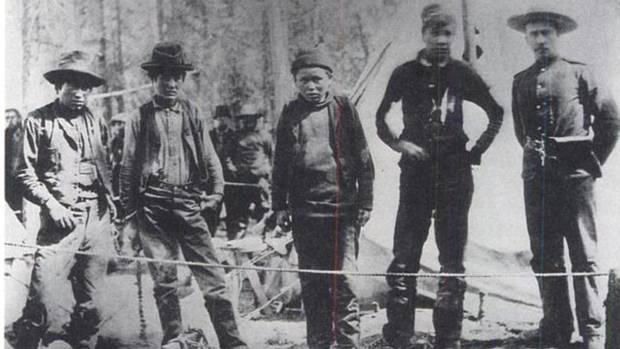
By Fox’s report, the four Nantucks were soon taken into custody.


The four Nantuck brothers, shackled after arrest.

The trial unfolded in a court at the territorial capital of Dawson City. A compelling chapter in Strange Things Done: Murder in Yukon History does wonderful work with the cultural disconnections, including a two-page exchange between judge and interpreter (and, off-camera, Frank Nantuck) in which the court struggles to get the accused sworn “so help me God” since Frank’s cosmology has no idea of an afterlife. “He says, when he is dead he is dead — that is all I can get out of him,” the helpless middleman reports.

Q Has he any knowledge of God at all or any idea about a future state of rewards and punishments?

A No sir.

Q Or any clear belief in religion of any kind?

A No sir.

Q Will you say to him that we want him to tell us the truth and not to tell us anything that is not the truth; that he may be punished if he tells us anything that is not the truth; that we are going to ask him some questions and that he must tell us just the truth; ask him if he will agree to do that.

The outcome of the trial will not surprise and there was no question but that the Nantucks had done the shooting. What the Dawson court only barely noted was that brothers had been detailed to avenge two Tagish deaths. An old woman had previously been given or found some “baking powder” and proceeded to make bread with it: in fact, it was arsenic, which was used in mining. Here again is the cultural dislocation; the Nantucks living next to Fox and Meehan were trying to feel out whether those two prospectors were of the tribe that had provided this poison, and of equivalent social rank to the two men who died eating the arsenic-bread. Basically, neither side in this subarctic tragedy had any concept of what the other was on about.

There’s a play about this case, Justice. Peruse the play’s pdf companion study guide on the real historical case here.

In the end, all four Nantucks were condemned to die; Frank was probably still a minor, and he had cooperated with the investigation, so his sentence was commuted to life imprisonment … which did not turn out to be very long at all, since Frank and his condemned brother Joe both died in jail of tuberculosis during the 1898-99 winter.

Dawson Nantuck and Jim Nantuck remained to hang.

Momentarily sensational, the case was long forgotten among whites; it has, however, remained in the oral tradition of Yukon First Peoples. Both communities, however, saw the case brought to the fore when excavations accidentally turned up their remains — along with those of two other hanged men.

One of the other two was the third man to hang this date, a fellow by the name of Ed Henderson. Henderson was an American prospector whose fate might be a bit less instructive for posterity. He suffered from a horrible bladder infection that caused him to pass bloody water every 15 or 20 minutes. “The tortures of the damned,” he described it to court. Wincing yet?

The fact that Henderson suffered from it meant his two prospector-mates suffered from it as well — call it purgatory-level suffering; a member of their party had to relieve himself constantly and thrashed about in his sleeping bag all night for the agony it caused him.

Their empathy for his situation was overturned along with Ed Henderson’s inside-the-tent piss-bowl one night. The drenched and vengeful Tomberg Peterson started an immediate brawl, but Henderson’s leaky plumbing didn’t impair his ability to shoot Peterson dead. Henderson himself reported the incident when the prospectors reached their destination, possibly thinking that no jury would convict him.

The trio comprises the first men hanged by the Yukon Territory, which was only separated from the Northwest Territory in 1898. In fact, there was a bizarre procedural deficiency for the Nantucks (but not for Henderson): they were condemned by the court of the wrong, former territory since word of the territories’ separation had not reached Dawson City at the time of the trial. Nobody saw fit to remedy this blunder, however.

On this day..

1949: Jacob Bokai, the first Israeli spy executed

On this day in 1949, Jordan hanged Jacob Bokai. The Syrian Jew was the first Israeli intelligence agent put to death in service of the infant state. (At least, the first that’s been publicly acknowledged.)

The flight of Palestinians displaced by the Arab-Israeli War gave Israel a convenient means to insert its agents into its neighboring countries: just disguise them as refugees.

Posing as a Palestinian named Najib Ibrahim Hamuda, Bokai’s mission to infiltrate Jordan started at a Palestinian refugee camp in Jaffa, where he was abused by the guards to establish his credentials. Those beatings went for naught, however, as Bokai never made it past the checkpoint: he was arrested immediately upon passing the Mandelbaum Gate into Jordan on 4 May 1949. Since he refused to cop to his mission or his Jewish identity, he was given a Muslim burial after hanging for espionage.

That charge was indeed well-founded: Bokai is now openly honored at a memorial to Israeli agents opened in 1985.

According to the story related by a former Mossad chief who gave a tour of this place to Tom Friedman back when the latter was the Times‘ Middle East scribe and not its leading nutter columnist — just mind the source is what I’m saying here — the doomed “Mr. Hamuda” still managed to get a message back to his Israeli handlers reassuring them that the enhanced interrogation he enjoyed in Jordan prior to execution had not compromised whatever operations he was privy to: “I did not commit treason.”

On this day..

1996: Sergey Golovkin, the last executed in Russia

The most recent execution in the Russian Federation was that of serial killer Sergey Golovkin on this date in 1996.

Known as “The Fisher” or “The Boa”, Golovkin (English Wikipedia entry | Russian) grew up in Moscow as a shy outsider type (Russian link) with a noticeable slump and a predilection for animal cruelty, the kind of whom oblivious classmates will later say that they never saw it coming. He graduated from an agricultural academy and worked as a horse-breeding expert: people skills just weren’t his thing.

But people killing skills …

Golovkin committed his first murder in 1986,* forcing a 16-year-old boy into the woods near a north Moscow train station where he raped and strangled him and then mauled the corpse. Months later, the same treatment befell a 12-year-old whom Golovkin kidnapped from a summer camp, with even more horrible mutilations: the dead child was beheaded, emasculated and disemboweled. A third victim he killed in 1989.

But Golovkin really got going in 1990, after he bought a car and dug a garage cellar — a spot which he soon realized doubled as a dungeon. There he had the privacy for eight more homicides in the ensuing two years, each of the grisliest particulars.

One example to suffice: after having had his fill of raping, he proceeded to hang one victim to death with a makeshift noose; then, Golovkin trussed the carcass upside-down like a slab of meat, and savaged it from head to toe. Ears, nose, and genitals he sliced off, the skull prised open and the brain torched.** Golovkin even indulged a bit of experimental cannibalism on this occasion, but found he didn’t like the taste and left that particular grotesquerie out of his repertoire thereafter.

Reports and rumors of a monster at work by this time drew the attention of a police force that had been notoriously slow to figure out how to investigate serial killers. Golovkin had his garage in (and, hence, the victims had disappeared from) the vicinity of the outlying horse-stud farm where he worked; however, his registered residence was in Moscow itself, and this discrepancy helped investigators to overlook him as a suspect for a time.

But post-Chikatilo, the police were learning fast. The investigating team was soon able to put together a profile of the killer, and link the furtive and opportunistic 1986 killings to the more methodical maniac at work in the early 1990s. Golovkin was finally arrested in October 1992 and soon confessed all — a confession scarcely required given the macabre artifacts disgorged by his homemade abattoir.

Golovkin was shot on 2 August 1996, with the traditional “single bullet to the back of the head” method. Russia at that time was in the process of implementing a moratorium on executions as part of its entrance into the Council of Europe. Though the moratorium has wavered at times, it has held ever since. Golovkin, as of writing, is the last person judicially executed on Russian soil to date. Even so, the moratorium has never quite become a full de jure abolition of the death penalty.

There the matter rests, for now. For the future, who knows? There’s no indication of a real push to restore the death penalty on the horizon, but it bears remembering that absolutist Russia actually abolished the death penalty for 22 years in the 18th century. That moratorium didn’t stick.

* Golovkin attempted a similar murder in 1984, but the 17-year-old victim whom he raped managed to escape, prompting the rattled newbie predator to lay low for a while. That boy would later testify at Golovkin’s 1993 trial.

** Golovkin worked with animals professionally, and had beyond that the human anatomical expertise appropriate to his avocation. On one occasion when he kidnapped multiple boys together, he dismembered the one in front of the other, giving a little impromptu instructional to the survivor using the viscera. Golovkin later told investigators that the (temporarily) surviving child took it all in with odd calmness.

On this day..

1556: Joan Waste, in Windmill Pit

On this date in 1556, Derby hosted the incineration of a young blind woman who refused to renounce her Protestantism.

The ascendance of Queen Mary briefly restored Catholicism as England’s official religion. The previous decades’ Protestant reforms, however, had been achieved with bloodshed and could only be undone with more bloodshed. (That’s why she’s “Bloody Mary”: because she executed a bunch of people, and because the Protestants who executed a bunch of people won out and got to do the naming.)

In the wrong place at the wrong time was Joan Waste, who though blind proved a deft hand at knitting ropes to support her poor family. Inspired by hearing Scripture in the Queen’s English during Anglican services shaped by Cranmer, Joan scrimped and saved the earnings of her poor profession until she could afford a Bible … specifically (and problematically for the new old faith), one printed in English rather than Latin. Being blind, she then had to recruit friends, townspeople, or other parishioners to read it to her.

This made her a pretty easy target when England reinstated Catholic heresy laws in 1555, although presumably not one selected by the public relations department. Pious Joan preferred the stake to renouncing her heresies.

After enduring an execution sermon from the Catholic churchman Anthony Draycot, Foxe’s martyrology describes the fate of “the poor, sightless object” — which doesn’t look the most felicitous build of a noun phrase — who “was taken to a place called Windmill Pit, near the town, where she for a time held her brother by the hand, and then prepared herself for the fire, calling upon the pitying multitude to pray with her, and upon Christ to have mercy upon her, until the glorious light of the everlasting Sun of righteousness beamed upon her departed spirit.”

The old Windmill Pit execution site can still be found in Derby today. There’s a local legend, of Victorian manufacture, that Joan cursed the location with the words: “never shall this pit, of which ye are about to make a pit of fire, hold drop of water more.”

On this day..

1812: Hölzerlips, Blood Court prey

On this date in 1812, the German bandit Hölzerlips — that’s just “Philip of the Woods”, despite what your dirty mind was thinking — was beheaded with three compatriots at Heidelberg.

They were part of a gang of six vagrant souls (the other two were spared on account of youth) who, finding everything displaced in the time of the Napoleonic wars, made their daily bread robbing around the Spessart in southern Germany.

In this capacity they racked up at least 15 known incidents of highway robbery, going so far as to kill a Swiss merchant on the road in 1811.

Captured shortly thereafter, Heidelberg grandees considered them (in)famous enough to merit a staged Blutgericht (“Blood Court”) followed by beheading this date, a spectacle that drew 30,000 gawking spectators in its day.


Friedrich Rottmann: Blutgericht über Hölzerlips Bande, 1812

On this day..

1976: Christian Ranucci, never yet rehabilitated

On this date in 1976, Christian Ranucci, 22, was guillotined in Marseilles … with the last words addressed to his attorneys, “Réhabilitez-moi”.

If that has not yet occurred, it has not been for want of trying.

Many people think Ranucci was the last person executed by France; in fact, this is not correct. But the confusion is understandable: Ranucci has persisted in the headlines and the public imagination owing to a running controversy over whether he was wrongly convicted. It’s a vexing case rife with ambiguous circumstantial evidence, and observers are usually able to see in it what they want to see.

On June 3, 1974, two incidents — a minor traffic accident, and the request by a young man of a local mushroomer to help his car out of a muddy gallery where it was stuck — placed a gray Peugeot 304 at La Pomme, outside Marseilles. This also happened to be the date that 8-year-old Maria-Dolores Rambla was abducted from St. Agnes by an unknown man in a red sweater reportedly driving a gray Simca 1100, a vehicle that would be possible to mix up with the Peugeot 304.

When news of the abduction broke on the radio the morning of June 4, the people who saw the Peugeot(s) later called it in as a tip.

Police got to the bespectacled young Ranucci (English Wikipedia entry | French; most of the links from here on out are French) via the accident. His car didn’t stop for the other motorist, but limped on down the road another kilometer. The other driver’s vehicle was inoperable, but that driver sent a passerby to follow the hit-and-run Peugeot’s path to see if he could track down a license plate number. Indeed he did do that.

And when that good citizen called police, he said he had seen the driver running into the nearby woods with either a sizable package or a small child. (The story has … evolved.) You can see where this is going: when the area was searched after the tip came in, poor Maria’s dead body was steps away from the spot the car stopped. She’d been knifed to death.

The mushroom-gallery, for its part, yielded up a red pullover sweater like the one the abductor wore, and a bloody knife.

After 17 hours’ grilling by the police, Ranucci broke down and confessed. He would later retract the confession, blaming police pressure. (Here in 2013, everybody does know — right? — that false confessions happen with alarming frequency, and that they’re widely associated with exonerations.)

As open-and-shut as this sounds, Ranucci’s many defenders have found a great deal wanting in the case

Journalist Gilles Perrault has been on about this case for decades. His L’ombre de Christian Ranucci drew a 50,000 euro judgment for defaming the Marseilles police.

Among the sticking-points for skeptics:

  • There’s the inconsistency in the reported make and model of the vehicle vis-a-vis what Ranucci was driving.
  • None of the eyewitnesses to the abduction could identify Ranucci in a lineup … until the lineup was pared down to make it a gimme. Sloppy lineup work has been a significant factor in wrongful convictions; on the other hand, eyewitnesses are extremely unreliable in general.
  • The recovered red pullover was much too small for Ranucci, possibly suggesting that this apparent link to the observed abductor did not reach all the way to the accused.
  • Mr. Red Pullover Simca 1100 was allegedly seen attempting other abductions at times and places that made it certain that he was not Christian Ranucci.
  • Questionable handling of physical evidence by investigators.

That’s basically just to scratch the surface. Here (pdf) is a much lengthier exegesis of the potentially exculpatory evidence, in French. Here’s an English summary covering the same stuff on a site whose resources are mostly also in French. (“We do not assert Christian Ranucci is innocent.”) Countless additional search hits en francais await the interested researcher.

Ranucci himself insisted against advice on pursuing an actual-innocence defense, rather than mounting a mitigation case focusing on avoiding the guillotine while conceding guilt. He was convicted on just a 9-3 jury vote.

But neither in his own time nor latterly has that case gained much purchase on the conscience of his prosecutors. The President who denied Ranucci’s clemency petition, Valéry Giscard d’Estaing, has recently given his 1976 decision a vote of confidence; the father of the victim feels likewise.

On this day..

1781: Francois Henri de la Motte, French spy

On this date in history, the French spy Francois Henri de la Motte was hanged at Tyburn — and, only after hanging, his head was cut off and his heart carved out. Old Blighty was going a bit soft: it didn’t do actual drawings and quarterings at this late enlightened date. (Well, just one.)

Those old enemies Britain and France had renewed hostilities over the American Revolution, which France backed to twist the neighboring lion’s tail.

De la Motte was a French expat living in England, in which capacity he supported the statecraft of his native realm by coyly picking up British army and naval dispositions and sending word home of who was going where, when. His intelligence allegedly enabled the French navy to turn an unusually aggressive gambit against the British in an engagement in the East Indies, with the loss of 207 souls.

“In the whole history of mankind, an instance was not to be produced of a more ingenious, able, and industrious spy than Mr. De La Motte,” his prosecutors charged. (There’s an account of the trial here.)

Perhaps this was flattery, since the operation was not defeated by counterintelligence except de la Motte’s own counter-intelligence. The guy dropped a bunch of incriminating notes he had taken on naval movements in a staircase, and they were there snatched up by King George’s true subjects and forthwith sent their owner to Newgate. His English accomplice quickly turned Crown’s evidence

Days after the spy’s ignominious end, General Cornwallis’s army in the American south arrived from Charleston at Yorktown, Va., a deep-water port from which he meant to command the Chesapeake. There, Cornwallis was surrounded by an overwhelming force of both American rebels and their French armies. The British defeat at Yorktown that October clinched independence for the colonies.


De la Motte’s trial — accused perfidious Frenchman in danger of barbaric old-timey punishment — appears to be the model for the London trial against Charles Darnay depicted at the start of A Tale of Two Cities. See if this sketch by noted death penalty skeptic (but also death penalty obsessive) Charles Dickens doesn’t essentially depict Francois de la Motte’s situation:

“What’s coming on?”

“The Treason case.”

“The quartering one, eh?”

“Ah!” returned the man, with a relish; “he’ll be drawn on a hurdle to be half hanged, and then he’ll be taken down and sliced before his own face, and then his inside will be taken out and burnt while he looks on, and then his head will be chopped off, and he’ll be cut into quarters. That’s the sentence.”

“If he’s found Guilty, you mean to say?” Jerry added, by way of proviso.

“Oh! they’ll find him guilty,” said the other.

…

Charles Darnay had yesterday pleaded Not Guilty to an indictment denouncing him (with infinite jingle and jangle) for that he was a false traitor to our serene, illustrious, excellent, and so forth, prince, our Lord the King, by reason of his having, on divers occasions, and by divers means and ways, assisted Lewis, the French King, in his wars against our said serene, illustrious, excellent, and so forth; that was to say, by coming and going, between the dominions of our said serene, illustrious, excellent, and so forth, and those of the said French Lewis, and wickedly, falsely, traitorously, and otherwise evil-adverbiously, revealing to the said French Lewis what forces our said serene, illustrious, excellent, and so forth, had in preparation to send to Canada and North America.

Darnay is acquitted, obviously, as Dickens was only three chapters in and being paid for a novel-length serial.

On this day..