1916: Robert Digby in Villeret

On this date in 1916, Private Robert Digby was shot by a German firing squad in the tiny northern France village of Villeret.

Digby was the last of a quartet of English soldiers who had been part of the British Expeditionary Force who met the Hun’s first foray into France in 1914.

Digby and his mates, Thomas Donohoe, David Martin and William Thorpe, were stranded behind lines.

Villeret took them in and changed their uniforms for peasant clothes while they worked the fields and tried to keep their heads down.

“Every inhabitant of Villeret knew of the British soldiers in their midst but none breathed a word, although the Germans had threatened to execute anyone harbouring enemy fugitives,” writes Ben McIntyre, who wrote the book on these men. “Even when food ran low and German troops were billeted on every house, the secret was kept safe. It was an astonishing act of collective bravery.”

To the west, in trenches the men could not pass, the war ground uncounted souls into horsemeat.

Digby became the lover of a village girl, and fathered a daughter by her.

This perilous idyll under the very bowers of hell could not last long. The Brits were mysteriously betrayed, and arrested by the Germans in May 1916 — all save Digby, who escaped out the window of a barn.

Donohoe, Martin and Thorpe were shot as spies on May 27.

After a week on the run in the nearby woods, the mayor of Villeret found Digby, and told him that the Germans were threatening to execute the villagers unless he turned himself in to face his comrades’ fate. Digby did so.

McIntyre’s book, A Foreign Field: A True Story of Love and Betrayal in the Great War, explored the village of Villeret and the life of Digby’s daughter Hélène Cornaille-Digby — an infant when her father was shot; an octogenarian when McIntyre met her.

The enduring mystery of the place, at least to McIntyre as an outsider, was the unanswered question of who betrayed the English. Was it a jealous lover? A disapproving family? A fearful neighbor?

Years after the publication of the book, McIntyre (so he thinks) accidentally solved the mystery.

On this day..

1529: Jacob Kaiser, launching the First War of Kappel

On this date in 1529, Zwinglian missionary Jacob Kaiser was burnt at the stake in the Catholic Swiss canton of Schwyz.

His Protestant evangelizing was a violation of the unwritten Cuius regio, eius religio policy keeping peace among the cantons. (Later, it would become written.)

This otherwise routine Reformation martyrdom led Ulrich Zwingli, then Grossmünster of Zurich, to make war on the Catholic cantons, seeking to pry them open for further Protestant inroads.

Let us be firm and fear not to take up arms. This peace, which some desire so much, is not peace, but war; while the war that we call for, is not war, but peace. We thirst for no man’s blood, but we will cut the nerves of the oligarchy. If we shun it, the truth of the gospel and the ministers’ lives will never be secure among us.

–Zwingli, channeling Orwell

The short-lived Erster Kappelerkrieg — the First War of Kappel — was won within weeks, swiftly concluded by a truce favorable to Zwingli’s Protestant alliance.

(Legend has it that the treaty was concluded over a shared pot of milk soup picturesquely resting on the Catholic-Protestant border, the Kappeler Milchsuppe.)

Die Kappeler Milchsuppe (1869) by Gemälde von Albert Anker.

But this initially favorable return on poor Jacob Kaiser’s sacrifice was soon squandered.

Hostilities between the two camps continued, eventually flaring into the Second War of Kappel. Zwingli was again spoiling for the fight, but his under-prepared Protestants were trounced by a Catholic league in October 1531. Zwingli himself died on the battlefield.

On this day..

2002: Napoleon Beazley, who threw it all away

On this date in 2002, Napoleon Beazley was executed by lethal injection in Texas.

A high school class president and football hero, Beazley was 3 ½ months shy of his 18th birthday when he made the first entry on his criminal record.

It was a doozy:

Beazley (with two accomplices who later testified against him) shot a Tyler, Texas, couple in their garage to steal their Mercedes Benz.

The wife survived the attack by playing dead.

The husband was not so lucky. He was businessman John Luttig, the father of archconservative federal judge J. Michael Luttig. When Beazley’s appeal reached the U.S. Supreme Court, a third of its justices recused themselves for their own connections to Luttig.

(J. Michael Luttig testified at Beazley’s trial. “Individuals must be held accountable at some point for actions such as this,” he told the media afterward. “I thought this was an appropriate case for the death penalty.”)

Both in the legal arena and in public opinion, Beazley’s case turned in an unusually uncluttered fashion on the principle of executing juvenile offenders.

Beazley was not mentally impaired, nor warped by childhood trauma, nor even generally underprivileged. His had been the black family accepted by the white community in his native Grapeland.

There was no question of Beazley’s guilt in the crime. None of the typical extenuating circumstances applied, save Beazley’s own eventual remorse.

“I don’t blame anybody else for being here but me,” Beazley would say later.

And since he pulled the trigger just weeks shy of his legal adulthood, even his youth was barely in play.

So, the question of whether Napoleon Beazley deserved to die was a pretty close proxy for the question of how bright a line the age of 18 ought to be where the death penalty was concerned.

Beazley lost crucial votes by the closest of margins: one Supreme Court appeal denied him on a 3-3 tie, and the Texas Board of Pardons and Paroles turned him down 10-7.

If these votes reflected uncertainty over the juvenile death penalty as a policy, the matter would soon pass the tipping point to a resolution: Napoleon Beazley was the 19th person put to death in the modern American death penalty regime for a crime committed as a juvenile. Only three more followed before the Supreme Court (consisting of the same nine justices who had rejected Beazley’s appeal a few years before) ruled the death penalty for minors unconstitutional in the 2005 Roper v. Simmons decision.

There’s cinematic treatment of Beazley’s shocking crime in the recent documentary Two Hours to Tyler. There’s also a play about him.

On this day..

1797: Gracchus Babeuf, for the Conspiracy of Equals

If the “revolutionary extremist” exists at all as an identifiable type, he exists in purest incarnation in Gracchus Babeuf. No revolutionary better fits the description “narrowminded to the point of genius”; few have defined their heaven more clearly or crusaded so fanatically, ascetically, so religiously to bring it to earth.

–Gracchus Babeuf: The First Revolutionary Communist

On this date in 1797, Francois-Noel Babeuf lost his head for the Conspiracy of Equals — the last Jacobin upheaval of the French Revolution, or the first Communist upheaval of post-Revolution modernity.

Francois-Noel — he styled himself “Gracchus” after the populist Roman tribunes — was a young man of Desmoulins‘ generation but from a considerably more hardscrabble background. Like the starry-eyed Dantonist scribbler, Babeuf discovered himself a brilliant journalist and pamphleteer with the onset of the Revolution; he did several prison stints during various revolutionary phases of the early 1790s for his too-radical-for-school opinions.

He did another in 1795 under the French Directory for his firebreathing rag Le Tribun du Peuple, which was particularly unfashionable stuff during the post-Robespierre Thermidorian regime.

Nothing daunted, Babeuf emerged from prison the leading apostle of the Parisian proletariat which had by then been decisively separated from power.

The order of the day was class consolidation with the spoils of the aristocracy apportioned among a new oligarchy of wealth. As France rushed headlong towards Bonaparte and Bourbon restoration, Babeuf was the man left to rally “the party which desires the reign of pure equality.”

The French Revolution was nothing but a precursor of another revolution, one that will be bigger, more solemn, and which will be the last.

The people marched over the bodies of kings and priests who were in league against it: it will do the same to the new tyrants, the new political Tartuffes seated in the place of the old.

–Manifesto of the Equals, 1796

One can see why later revolutionaries — Marx included; Babeuf makes a cameo in the Communist Manifesto — would adopt this sort of thing as a harbinger of the next century’s revolutions.

And if the Directory had known who Nicholas II would be, it would have had no intention of going the way of his family.

Instead, it shut him down in February, 1796: Napoleon Bonaparte personally carried out the operation, just days before he wed Josephine.


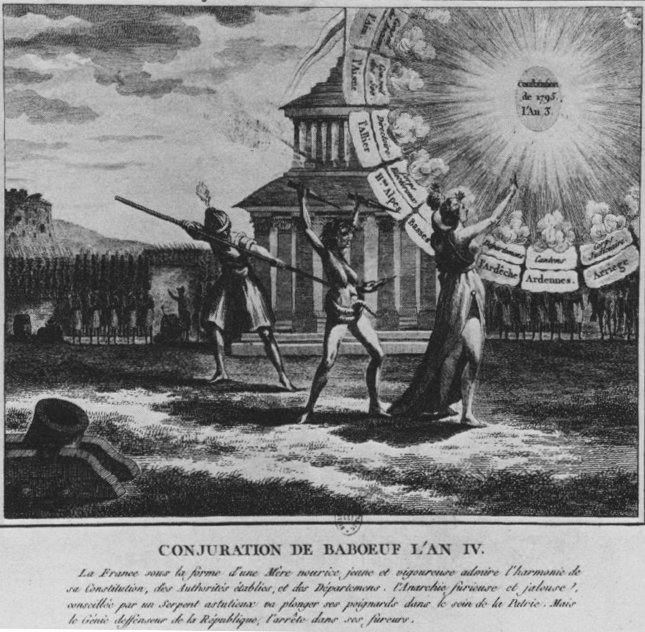
The Babeuf Conspiracy. Anonymous French print.

Babeuf’s party comes down to us as a “conspiracy,” under which word the state would charge him and which his follower Philippe Buonarroti would later rebrand the “Conspiracy of Equals”. It was not so much a grassy-knoll type of conspiracy as it was an underground organization.

When its adherents placarded Paris with the seditious “Analysis of the Doctrine of Babeuf” as the city endured a potentially dangerous economic crisis in April 1796, the government was put to a test of its strength.

It passed.

Having infiltrated Babeuf’s network, it arrested the principals on the eve of the Conspiracy’s intended insurrection. They were hailed out of Paris (a safeguard against sympathetic risings) to the commune of Vendome and there put on trial.* Babeuf and his associate Augustin Alexandre Darthe were condemned to death on May 26th and guillotined the very next day.

The last gasp of the French Revolution dropped with their heads into the basket.

Revolutionary Babeuvism, however, had scarcely just begun.

I don’t know what will become of the republicans, their families, and even the babies still at their mothers’ breasts, in the midst of the royalist fury that the counter-revolution will bring. O my friends! How heart-rending these thoughts are in my final moments! … To die for the fatherland, to leave a family, children, a beloved wife, all would be bearable if at the end of this I didn’t see liberty lost and all that belongs to sincere republicans wrapped in a horrible proscription.

-Babeuf’s last letter to his family

* The trial of Babeuf was itself a jurisprudential milestone: it was the first French trial to be transcribed verbatim.

What might look today like a nifty little advance for efficient judicature was bitterly controversial in 1797. The French Revolution had overturned an ancien regime practice of professional magistrates accepting legal testimony by written deposition and deciding matters behind closed doors. The liberte, egalite, fraternite way would instead demand that testimony be given live in the courtroom where citizen jurors could weigh its credibility.

Babeuf’s lawyer, Pierre-Francois Real, protested against the court stenographers, arguing that “The law insists that the system of written depositions not be restored in any way. That system will undoubtedly return if any means are used to save testimony given orally.”

There’s a fascinating disquisition on the curious and contradictory development of this issue and the way it “violates … common assumptions about the advance of textuality in the West” during the French Revolution in Laura Mason, “The ‘Bosom of Proof’: Criminal Justice and the Renewal of Oral Culture during the French Revolution” The Journal of Modern History, March 2004.

On this day..

1871: Hostages of the Paris Commune

The fall of the Paris Commune on May 28, 1871 launched many a leftist insurrectionary into the martyrs’ firmament.

But the last semaine sanglante that engulfed the Commune there was blood enough for many martyrdoms.

On this date in 1871, just days before the Commune gave way, it executed a clutch of hostages (French link) in desperate reprisal for the Versailles army’s cruelties. For the Commune, it was too little ruthlessness and much too late. For the 52 who stood up against the wall this date, they were just as dead.

These unfortunates were marched from La Roquette prison — whose inmates by dint of timely resistance only narrowly avoided a more extensive massacre — to Rue Haxo and slaughtered.

A number of them were men of the cloth. In 1938, the Catholic church of Notre Dame des Otages was erected on the site and dedicated to the victims’ memory.


A crucifix at Notre Dame des Otages. Copyrighted image used with permission.

(The markers on the spot have settled on 52 as the number of the victims, which might be the historically authoritative count; different sources, however, provide slightly different numbers.)

On this day..

1946: Marcel Petiot, Vichy serial killer

Paris, 1942.

On the run from the Gestapo — as a Jew or a Gypsy, a common criminal or a Resistance fighter whose cover is blown — you get wind of a man who can help.

“Dr. Eugène” will (for a fee) spirit you over the Pyrenees and thence to South America. In his house at rue le Sueur, you make the arrangements. One small matter: the tropics requires an inoculation, which le bon docteur will readily provide. One small prick of the needle and then …

The needle contained cyanide and the destination turned out to be a lime pit, and so “Dr. Eugène” — Marcel Petiot — was guillotined this date in 1946.

His opportunistic exploitation of the dangerous Vichy years is what he’s famous for, but Petiot had decades of crime behind him by the time he got his phony “underground railroad” up and running.

From youthful compulsive thieving, Petiot graduated into a shady medical practice in Villeneuve-sur-Yonne where he was the resident black market abortionist.

He’s thought to have killed a mistress there, and maybe a couple of others, but was able to segue into a political career by winning the mayoralty of Villaneuve when he sabotaged his opponent’s campaign appearances. The sticky-fingered Petiot naturally plundered the town treasury and was forced out of office in 1931.

By the time the war years had rolled around, Petiot had judiciously relocated to Paris where he retained his capacity for professional advancement in the face of profoundly disturbed behavior: he was institutionalized for kleptomania the same year he was appointed an official médecin d’état-civil.

So he had the requisite two-faced background for his whackadoodle wartime “escape route”, which he creepily code-named “Fly-Tox.”

Twists and turns elided — trutv.com and crimemagazine.com both have detailed biographies/case histories — Petiot’s enterprise was quasi-exposed early in 1944 when the stink of incinerating bodies prompted neighbors to summon the police and uncover his charnel house.

Amazingly, Petiot was able to beg off with the claim that he was a Resistance activist — these were French police — and that the victims were Nazis or collaborators who had been eliminated by his network on orders. The Gestapo had sniffed him out too late in the war to do anything about him, but its judgment that Petiot was a “dangerous lunatic” actually turned out to bolster the deranged doctor’s case that he was an anti-fascist.

The alibis fell apart as the war wrapped up, and Petiot was finally recognized in a Paris manhunt and brought to trial for 27 homicides. Police thought 60-plus was more like it — maybe even into the hundreds — but secured 26 of the 27 counts. That’s more than enough to do a man to death, especially since they were the for-fun-and-profit murders of desperate people already on the run from the late and hated occupying army. Bit of a touchy subject in France in ’46.

But there was good news.

This London Times (May 27, 1946) observed that Petiot’s beheading marked

the first time that the guillotine has been used since the war. Until now executions have been by firing squads. Although gruesome, it is one more indication of the return of this country to normal civil ways of life.

On this day..

1906: Ivan Kalyayev, moralistic assassin

On this date* in 1906, Ivan Kalyayev (also transliterated Kaliayev, or Kaliaev) was hanged by his own assent for assassinating Grand Duke Sergei Alexandrovich in Moscow.

The Warsaw-born Kalyayev tread the usual path of student radicals — expulsion, arrest, internal exile — into the camp of the Socialist-Revolutionary Party and the trendy propaganda-of-the-deed philosophy.

He was the very epitome there of what Chaliand and Blin call “the moralistic approach to terrorism”; he would slay, of course, from a profound sense of moral outrage, but contextualized that terrible act with a no less dramatic sense of personal moral responsibility.

Revolutionary fellow-traveler Boris Savinkov remembered** of our day’s principal that he

loved the revolution with the tender, profound love felt for it only by those who have made it an offering of the whole of their lives.

Kalyayev voluntarily aborted his first attempt to murder the Grand Duke when he beheld his target’s wife and child riding along in the carriage where he meant to toss his bomb. Upon successfully carrying out the hit two days later, he made no attempt to flee, and at trial requested the death sentence for himself.†

In this behavior, Kalyayev presents the fascinating specter of a terrorist whose certainty of the justice of his crime does not excuse himself from moral responsibility for the crime.

For Kalyayev, the murder itself and its mortal expiation completed its own redemptive cycle. As the murderer wrote to his mother,

I am happy to know I acted in obedience to the call of my duty … It would be ridiculous to think of saving my life now, when my end makes me so happy. I refused to sign the petition for pardon, and you know why. It was not because I have spent all my physical and mental powers; on the contrary, I have preserved all that life gave me for my last triumph in death … I could not accept pardon because it is against my convictions.

This striking attitude recommended him to Camus, who featured it in Les Justes (The Just Assassins), a 1949 play exploring the morality of terrorism.

The second act of the play features Kalyayev’s revolutionary cell disputing his decision not to follow through on his first opportunity to kill the Grand Duke. Ignacio Gotz describes our killer’s posture as, “kill only when absolutely necessary and then accept your own death as proof that murder is not permitted.”

That’s what love is — giving everything, sacrificing everything, without any hope of it being returned.

-The character Ivan Kalyayev, in Les Justes

This was not the only ethos competing for purchase on the story and the soul of Ivan Kalyayev.

The widowed Grand Duchess Elizabeth Fyodorovna visited her husband’s assassin in prison and unavailingly attempted to convert him to Orthodox Christianity. (The Grand Duchess would take her own solace in a religious life, ultimately being martyred by the Bolsheviks during the Russian Civil War; she has since been canonized.)

The Russian paper Novaya Gazeta published a fairly lengthy Russian-language biography of Kalyayev on the centennial of his entry into the executioner’s annals.

* May 23 was the Gregorian date of the execution; it was May 10 by the Julian calendar still in use in Russia at the time.

** Cited in The History of Terrorism: From Antiquity to Al Qaeda.

† With the requisite grandstanding, of course — a moral indictment given added depth by Kalyayev’s personal conduct.

We are separated by mountains of corpses, by hundreds of thousands of broken lives, by an ocean of tears and blood that is flooding the entire country in a torrent of outrage and horror. You have declared war on the people. We have taken up the challenge … You are prepared to say that there are two moralities, one for mere mortals, stating, “Thou shalt not kill; thou shalt not steal,” and another, political, morality for the rulers, for whom it permits everything.

On this day..

1393: The Muzaffarids, by Timur

On this date in 1393 — or 10 Rajab 795 on the Islamic lunar calendar — the feared conquerer Timur (or Tamerlane) disposed of the squabbling ruling dynasty he had recently overturned, the Muzaffarids.

The House of Muzaffar came to prominence under the Mongol Ikhanate that stretched itslef from Persia to the Mediterranean in the 13th century.

As the Ilkhanate broke up in 1335, a guy like Yazd governor Mubariz al-Din Muhammad ibn Muzaffar could bloodily carve out a state of his own.*

Renowned for his cruelties, Mubariz al-Din ended his life blinded by his heir, Shah Shuja (or Shah Shujaa).

And in this generation, the House Muzaffar rapidly became a house divided, with brothers and cousins vying with each other (and with neighboring princelings). They were easy pickings for the rising Timurid Empire and its eponymous founder.

Exploiting a letter** sent by the aging Shuja (after a lifetime warring with his fellow Muzaffarids) recommending Shuja’s son to Timur’s protection, Timur rolled in and set up his own puppet Muzaffar. (It wasn’t the recommended son. C’est la vie.)

No sooner had Timur decamped for his next conquest than yet another of the Muzaffar clan — a brother of Timur’s puppet by the name of Shah Mansur† — revolted and set himself up as king.

It didn’t work, but Edward Gibbon was moved to pay tribute to Mansur’s intrepidity as he surveyed the Timurid annexations:

[P]etty tyrants might have opposed him with confederate arms: they separately stood, and successively fell; and the difference of their fate was only marked by the promptitude of submission or the obstinacy of resistance. Ibrahim, prince of Shirwan, or Albania, kissed the footstool of the Imperial throne. His peace-offerings of silks, horses, and jewels, were composed, according to the Tartar fashion, each article of nine pieces; but a critical spectator observed, that there were only eight slaves. “I myself am the ninth,” replied Ibrahim, who was prepared for the remark; and his flattery was rewarded by the smile of Timour. Shah Mansour, prince of Fars, or the proper Persia, was one of the least powerful, but most dangerous, of his enemies. In a battle under the walls of Shiraz, he broke, with three or four thousand soldiers, the coul or main body of thirty thousand horse, where the emperor fought in person. No more than fourteen or fifteen guards remained near the standard of Timour: he stood firm as a rock, and received on his helmet two weighty strokes of a cimeter: the Moguls rallied; the head of Mansour was thrown at his feet; and he declared his esteem of the valor of a foe, by extirpating all the males of so intrepid a race.

* The Muzaffarids’ most famous subject was the Persian poet Hafez (or Hafiz), whose lifetime was roughly paralleled the dynasty’s own. Hafez was patronized by the powers that be, though his favor waxed and waned.

** Timur himself would not think of empire-building; he accrued a mighty central Asian realm strictly by happenstance. “God is my witness that in all my wars I have never been the aggressor, and that my enemies have always been the authors of their own calamity.”

“For every war,” observes Gibbon of Timur and his ilk, “a motive of safety or revenge, of honor or zeal, of right or convenience, may be readily found in the jurisprudence of conquerors.”

† The Muzaffarid family tree is unnecessarily confusing, but a genealogy here may clarify matters.

On this day..

1997: Bruce Edwin Callins, in the machinery of death

On this date in 1997, Bruce Edwin Callins was executed in Texas — part of the torrid pace of executions unleashed in Texas in the late 1990s.

This small-timer would hardly rate a notice, but for the fact that Supreme Court Justice Harry Blackmun had chosen this otherwise forgettable murderer’s appeal to announce, in 1994, his belief that the death penalty was irreperably unconstitutional — probably the most famous comment on the death penalty to issue from the bench since capital punishment was reinstated with Blackmun’s concurrence in Gregg v. Georgia.

From this day forward, I no longer shall tinker with the machinery of death.

You’ll see the quote on anti-death penalty placards and apparel from now ’til kingdom come.

But there’s a bit more to it than what fits on a bumper sticker, and Blackmun’s reasoning is worth excerpting at greater length:

Within days, or perhaps hours, the memory of Callins will begin to fade. The wheels of justice will churn again, and somewhere another jury or another judge will have the unenviable task of determining whether some human being is to live or die. We hope, of course, that the defendant whose life is at risk will be represented by competent counsel — someone who is inspired by the awareness that a less-than-vigorous defense truly could have fatal consequences for the defendant. We hope that the attorney will investigate all aspects of the case, follow all evidentiary and procedural rules, and appear before a judge who is still committed to the protection of defendants’ rights — even now, as the prospect of meaningful judicial oversight has diminished. In the same vein, we hope that the prosecution, in urging the penalty of death, will have exercised its discretion wisely, free from bias, prejudice, or political motive, and will be humbled, rather than emboldened, by the awesome authority conferred by the State.

But even if we can feel confident that these actors will fulfill their roles to the best of their human ability, our collective conscience will remain uneasy. Twenty years have passed since this Court declared that the death penalty must be imposed fairly, and with reasonable consistency, or not at all, see Furman v. Georgia, 408 U.S. 238 (1972), and, despite the effort of the States and courts to devise legal formulas and procedural rules to meet this daunting challenge, the death penalty remains fraught with arbitrariness, discrimination, caprice, and mistake. This is not to say that the problems with the death penalty today are identical to those that were present 20 years ago. Rather, the problems that were pursued down one hole with procedural rules and verbal formulas have come to the surface somewhere else, just as virulent and pernicious as they were in their original form. Experience has taught us that the constitutional goal of eliminating arbitrariness and discrimination from the administration of death, see Furman v. Georgia, supra, can never be achieved without compromising an equally essential component of fundamental fairness – individualized sentencing. See Lockett v. Ohio, 438 U.S. 586 (1978).

It is tempting, when faced with conflicting constitutional commands, to sacrifice one for the other or to assume that an acceptable balance between them already has been struck. In the context of the death penalty, however, such jurisprudential maneuvers are wholly inappropriate. The death penalty must be imposed “fairly, and with reasonable consistency, or not at all.” Eddings v. Oklahoma, 455 U.S. 104, 112 (1982).

To be fair, a capital sentencing scheme must treat each person convicted of a capital offense with that “degree of respect due the uniqueness of the individual.” Lockett v. Ohio, 438 U.S. at 605 (plurality opinion). That means affording the sentencer the power and discretion to grant mercy in a particular case, and providing avenues for the consideration of any and all relevant mitigating evidence that would justify a sentence less than death. Reasonable consistency, on the other hand, requires that the death penalty be inflicted evenhandedly, in accordance with reason and objective standards, rather than by whim, caprice, or prejudice. Finally, because human error is inevitable, and because our criminal justice system is less than perfect, searching appellate review of death sentences and their underlying convictions is a prerequisite to a constitutional death penalty scheme.

On their face, these goals of individual fairness, reasonable consistency, and absence of error appear to be attainable: courts are in the very business of erecting procedural devices from which fair, equitable, and reliable outcomes are presumed to flow. Yet, in the death penalty area, this Court, in my view, has engaged in a futile effort to balance these constitutional demands, and now is retreating not only from the Furman promise of consistency and rationality, but from the requirement of individualized sentencing as well. Having virtually conceded that both fairness and rationality cannot be achieved in the administration of the death penalty, see McCleskey v. Kemp, 481 U.S. 279, 313 , n. 37 (1987), the Court has chosen to deregulate the entire enterprise, replacing, it would seem, substantive constitutional requirements with mere aesthetics, and abdicating its statutorily and constitutionally imposed duty to provide meaningful judicial oversight to the administration of death by the States.

From this day forward, I no longer shall tinker with the machinery of death. For more than 20 years, I have endeavored — indeed, I have struggled — along with a majority of this Court, to develop procedural and substantive rules that would lend more than the mere appearance of fairness to the death penalty endeavor. Rather than continue to coddle the Court’s delusion that the desired level of fairness has been achieved and the need for regulation eviscerated, I feel morally and intellectually obligated simply to concede that the death penalty experiment has failed. It is virtually self-evident to me now that no combination of procedural rules or substantive regulations ever can save the death penalty from its inherent constitutional deficiencies. The basic question — does the system accurately and consistently determine which defendants “deserve” to die? — cannot be answered in the affirmative.

Antonin Scalia, never one to let pass an opinion he could just as easily scorn, issued his retort in a concurrence with the 8-1 opinion to execute Callins:

Convictions in opposition to the death penalty are often passionate and deeply held. That would be no excuse for reading them into a Constitution that does not contain them, even if they represented the convictions of a majority of Americans. Much less is there any excuse for using that course to thrust a minority’s views upon the people.

Justice Blackmun begins his statement by describing with poignancy the death of a convicted murderer by lethal injection. He chooses, as the case in which to make that statement, one of the less brutal of the murders that regularly come before us, the murder of a man ripped by a bullet suddenly and unexpectedly, with no opportunity to prepare himself and his affairs, and left to bleed to death on the floor of a tavern.* The death-by-injection which Justice Blackmun describes looks pretty desirable next to that. It looks even better next to some of the other cases currently before us, which Justice Blackmun did not select as the vehicle for his announcement that the death penalty is always unconstitutional, for example, the case of the 11-year-old girl raped by four men and then killed by stuffing her panties down her throat. How enviable a quiet death by lethal injection compared with that!

Scalia’s mention of the “case of the 11-year-old girl” isn’t about Callins at all. The monster Scalia refers to here as obviously execution-worthy for his incendiary crime is Henry Lee McCollum … who in 2014 would be exonerated by DNA evidence after some 30 years on death row.

* Specifically, Callins wasted the patron of a strip bar who was insufficiently prompt at giving up his wallet. The $3 he took from the dying man’s pockets wouldn’t even have been enough to make it rain.

On this day..

1987: Edward Earl Johnson, “I guess nobody is going to call”

On this date in 1987, murmuring “I guess nobody is going to call,”* Edward Earl Johnson was gassed for capital murder in Mississippi’s Parchman Farm prison.

Don Cabana, the prison warden who oversaw Johnson’s gassing, eventually resigned over his misgivings about carrying out executions and wrote this book about it.

Johnson was convicted of raping a white woman and killing the policeman who answered her distress call. These are no-nos for a young person of color in the South.

Johnson fought his execution for eight years on death row, insisting on his innocence even on his last walk to the gas chamber.

And the case against him looks pretty thin — supported, as these things so often are, mostly by a highly suspect confession Johnson miraculously coughed up when he was out on a drive with John Law. (This led the victim, who knew Johnson and had excluded him as the attacker, to decide he did it after all.)

Needless to say, Johnson’s state-appointed public defender was unable to make the most of these gaping lacunae in the state’s case.

Years later, the prison warden Don Cabana — who was on this date overseeing his very first execution, and was deeply shaken by it — recalled his charge’s fearful situation in testimony to the Minnesota legislature:

He insisted to the very end, somewhat oddly, that he did not commit the crime … my experience with condemned prisoners was always that once strapped to the chair, they came around somehow with something, if only something simple as “Tell the victim’s family I’m sorry,” “Tell my mother I’m sorry,” something that indicated something bad had happened, I was there and I was part of it.

But not so with this young man. When I performed my ritualistic function of asking if he had a final public statement, this young man looked me in the eye with tears streaming down his cheeks, and he said: “Warden, you’re about to become a murderer. I did not kill that policeman, and dear God, I can’t make anyone believe me.”

This is a musty old case by now, but with the growing awareness of false confessions as a contributing factor in wrongful convictions, it may soon come in for a long-overdue re-examination.

Johnson, unfortunately, does not have any prospect of an a-ha forensic science win. However, as with Cameron Todd Willingham‘s case, there’s simply no balance of evidence that should point a fair-minded present-day observer to a conviction beyond reasonable doubt, and a good deal that points to an affirmative conclusion of innocence.

As the (admittedly partisan) Wrongful Conviction: International Perspectives on Miscarriages of Justice sums up,

[t]he murder weapon was never connected to Johnson; indeed, no physical evidence linked Johnson to the crime. The case against Johnson is weakened by his claim of inadequate counsel, his immediate recantation of his confession, and his claim that his confession was produced under threat of death. Also, after Johnson’s execution, a young woman came forward claiming to have been with Johnson on the night of the murder, and claiming also that she had come forward during the investigation but was rebuffed by police.

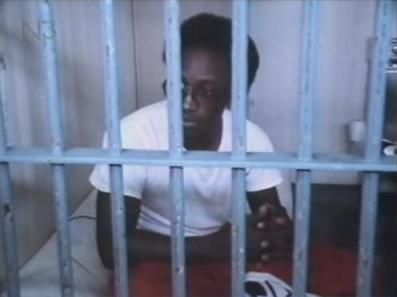
Edward Earl Johnson is the subject of the riveting BBC documentary Fourteen Days in May.

* Quoted in the New York Times, May 21, 1987.

On this day..