1898: The Six Gentlemen of the Hundred Days’ Reform

This afternoon in 1898, six liberals got the chop for their hopeless attempt to give a tottering empire the reforms it desperately needed.

The Hundred Days’ Reform — actually 103 days, from June 11 to September 21 — marked the attempt by China’s Guangxu Emperor to implement a far-reaching modernization programme backed by forward-thinking officials with a mind to correct China’s supine position vis-a-vis the West, and even vis-a-vis its neighbors.

“Reform has never come about in any country without the flow of blood. No one in China in modern times has sacrificed himself for the cause of reform, and because of this China is still a poor and backward country. Therefore, I request that the sacrifices begin with myself.” –Tan Sitong

The Wuxu Constitutional Reform still stands as the great attempt made by Chinese progressives who tried to follow the example of the modern powers in order to save China from extinction. Represented by Kang Youwei and Liang Qichao, the bourgeois reformists were imbued with the spirit of national salvation; they carefully set about designing a blueprint for a constitutional monarchy based on the example of Western countries. They advocated the establishment of parliament and a national conference, and wanted to see honest and fair-minded people with the courage to criticize authority installed in a position of power. National policies should be discussed by the monarch and the people. They also wanted a constitution to stipulate the rights and obligations of the monarch, officials, and the people. The constitution was to be the highest code for all people in the country. They also wanted to establish a system featuring a tripartite balance of forces: parliament was to legislate, the magistracy to deal with issues of justice, the government with administration. All of these would be under the monarch.

The constitutional reform was to take place with radical intellectuals submitting their memoranda to Emperor Guang Xu, who alone had the power to promulgate them. The feudal diehards being in a position of strength and the national bourgeoisie being weak, however, the new politics survived no more than 100 days or so. When the forces of reaction inevitably clamped down on the movement, the six reformists who had inspired the movement for constitutional reform met their deaths like heroes.

Although sincere in its aspirations, the reform movement was bound to fail, as it depended on a reform “from top to bottom”, which ultimately had to be enacted by the emperor. The Hundred Days’ Constitutional Reform, however, remains a landmark event in the modern history of China, its failure notwithstanding. The Chinese bourgeoisie in fact succeeded in spreading democratic and constitutionalist ideas widely, and this had a significant effect on future generations. The political and legal theory of the Western bourgeoisie could now take root in the soil of China.*

The emperor’s Machiavellian conservative aunt, the Empress Dowager Cixi, who had been the power behind the Chinese throne since 1861, made the sure reform didn’t see two hundred days with a “coup” that didn’t formally overthrow the Emperor — just made him irrelevant.

Troublemakers further down the food chain didn’t get off so easily.

Kang Youwei, the reform movement’s chief exponent, escaped to Japan. Six others suffered the wrath of the Dowager Empress: Kang Guangren (Kang Youwei’s brother), Lin Xu, Yang Shenxiu, Yang Rui and Liu Guangdi … along with the young reformer Tan Sitong, who notably refused imprecations to flee arrest.

The sword’s blade across my neck,
I look toward heaven — laughing.
-Etched on a prison wall, allegedly by Tan Sitong
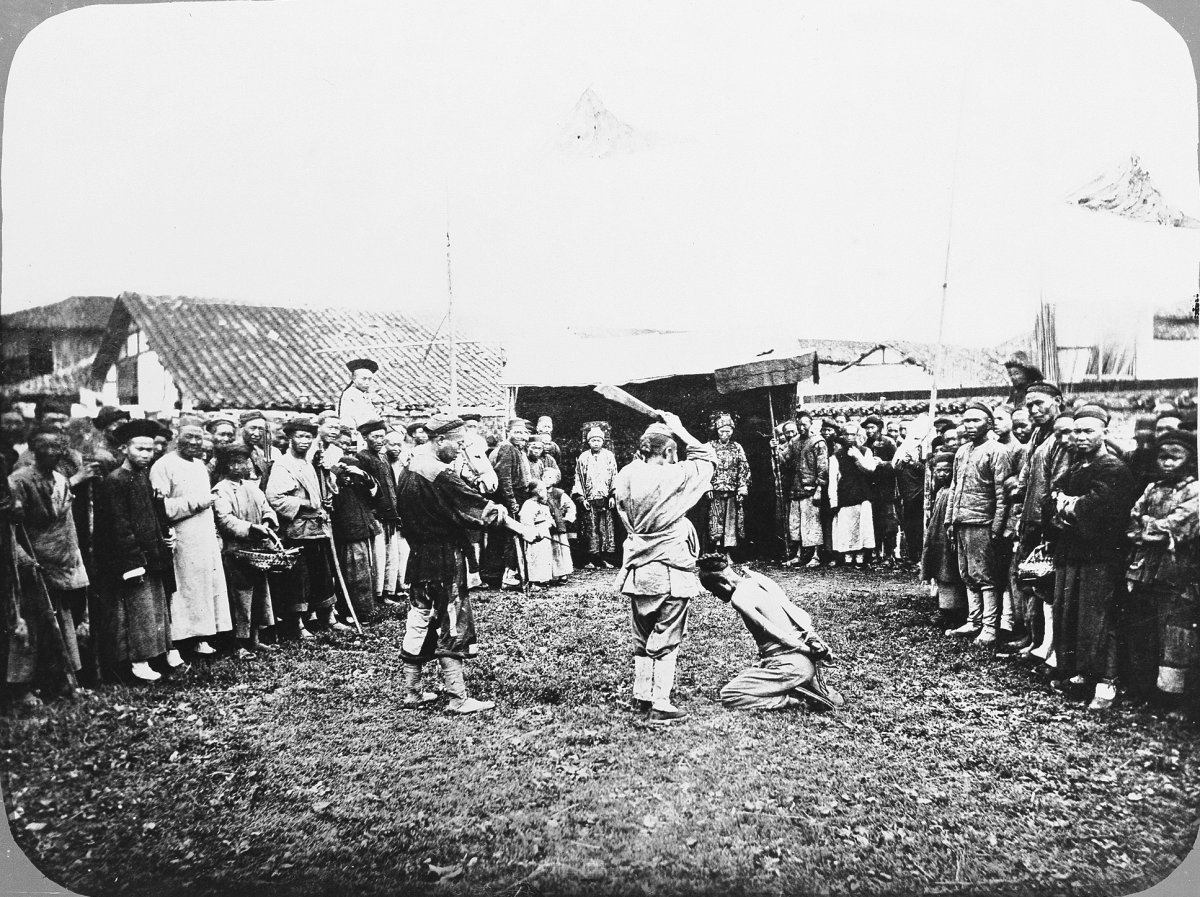

Photo of an unspecified 1867 Qing beheading in Canton.

* “The Chinese Legal Tradition and the European View of the Rule of Law” by Wu Shu-Chen in The Rule of Law History, Theory and Criticism, Part VI.

On this day..

1996: Dr. Mohammad Najibullah

On this date in 1996, the man who once ruled ruled Afghanistan under the aegis of a superpower succumbed to the tender mercies of his country’s fundamentalist insurgency.

Mohammad Najibullah was the last president of the Soviet-backed Democratic Republic of Afghanistan. Unfortunately for Najibullah, he was on the job when Moscow decided to throw in the towel on the Soviet-Afghan War.

After losing the subsequent civil war, the former President was trapped for a nervous few years in Kabul — blocked from joining his family in flight to India by the offices of former Soviet client and present-day American client Abdul Rashid Dostum.

When Kabul finally surrendered to the Taliban in 1996, the hated onetime Communist viceroy — whose stepping-stone to that post was heading the hated Afghan secret police — had a problem.

At the instigation of future Taliban second-in-command Mohammad Rabbani, Najibullah and his brother were hauled out of the U.N. compound where they had taken refuge, publicly beaten, tortured and castrated, and strung up on a traffic barricade.

There was a new sheriff in town.


On this day..

1764: Lt. Vasily Mirovich, for attempting to topple Catherine the Great

On this date* in 1764, one of history’s greatest monarchs cemented her still-uncertain hold on power by beheading a rebellious lieutenant.

Ivan VI: Born under a bad tsar.

Succession in the Russian Empire had been disputatious ever since Peter the Great went and killed off his last male son, eventually putting far-flung branches of the family into a contest for power.

To skip over much regal jockeying, Peter’s vicious niece Anna, who reigned in the 1730s, had installed her infant nephew Ivan VI as successor just before her own death.

The little Tsar of All the Russias was displaced before his second birthday by Peter the Great’s daughter Elizabeth, who clapped the former emperor in a dungeon in Schlusselburg fortress to grow up ignorant and alone, isolated from the parties who might scheme to bid for power in his name. Two Caesars are too many.

Into this dangerous scene stepped Sophia Augusta Frederica, better known to posterity by the name she took upon her politically savvy conversion to Orthodoxy: Catherine.

This Catherine immigrated to wed Elizabeth’s simpleminded heir, then overthrew him a few months into his reign.

Catherine had ultimate power, but she wasn’t yet “Catherine the Great”: as a foreigner with the late Romanov’s blood on her hands (if only indirectly), it was nowhere written that she would rule Russia for 34 brilliant years. And with the throne came its rival claimants … like Ivan, now an adult and potentially more “legitimate” than this imported German princess.

Ivan was held in Man in the Iron Mask-like secrecy, known only as “Nameless Prisoner Number One”; his warders had strict orders to murder him on the spot were any attempt made to liberate him.

Two years into Catherine’s reign, Lt. Vasily Mirovich, “a tormented young officer … with dreams of restoring his family’s fortunes,” attempted just that. As commanded, the guards put an end to Ivan’s troubles.

Those guards got cash rewards and promotions for their diligence. Mirovich got death. (Other soldiers whom he had rallied to his cause were condemned to run the gauntlet; I have been unable to ascertain if any were killed by this punishment.)

Mirovich was executed in St. Petersburg. When his head was held up to the crowd, it had a terrifying impact, the death penalty not actually having been exercised in Russia for 22 years.** Mirovich himself faced his execution calmly, convincing some of the bystanders that he was expecting to be pardoned at the last minute. His remains were left on public display until the evening, when they were burnt along with the gallows.

And so the first two years of the reign of Catherine II, who set so much store by reason and enlightened principles, had included two assassinations and an execution.

The woman of letters, the correspondent of philosophers, the Semiramis of the North … like the age’s other great enlightened despot, Frederick the Great, Catherine had to rule. She had not the luxury to dispense with statecraft’s cruel necessities.

Her admirers would have to be content with making her excuses. Fortunately, admirers always are.

“These are family matters with which I do not meddle,” wrote Voltaire. “Besides, it is not a bad thing to have a fault to repair; this engages her to make great efforts in order to force the public to esteem and admiration”

* September 26 (pdf) was the date on the Gregorian calendar then prevalent in Europe; it was September 15 by the older Julian calendar still used in Russia at the time.

** Not carrying out the death penalty had been a signature policy of Ivan’s usurper Elizabeth. The elimination of capital punishment in “backwards” Russia for an entire generation during the Age of Absolutism surely urges caution against any assumption that death penalty repeal is a one-way street.

On this day..

2007: Michael Richard, whose time ran out

Two years ago today, the U.S. Supreme Court unexpectedly accepted a case, Baze v. Rees, challenging the constitutionality of lethal injection — the supposedly humane execution method that seemed less and less so.

Texas inmate Michael Richard, condemned for raping and murdering Marguerite Dixon in 1986, was slated to die that very evening, also by lethal injection.

As Richard’s Texas Defender Service lawyers scrambled to prepare a last-minute legal challenge based on the pending Supreme Court case — for how could Texas carry out a procedure whose constitutionality was in question? — they tripped over an unexpected stretch of red tape that ultimately claimed their client’s life:

The Texas Court of Criminal Appeals closed at 5 p.m. on the day of the scheduled 6 p.m. execution, and refused to accept an appeal filed a few minutes after 5.

Or more specifically, Judge Sharon Keller refused to accept the appeal, for which she came under immediate fire — and launched campaigns like the website SharonKiller.com.

This bizarre situation, complicated by the fact that the Lone Star State did not have written rules for handling last-minute appeals (it does now), has a thicket of procedural detail best appreciated by lawyers.

But it caught worldwide attention as an illustration of Texas’s cavalier approach to its numerous death penalty cases.

Keller, who has what you might say is an inordinate regard for “finality” (and for prosecutors), has herself been forced to defend her conduct in hearings of the State Commission on Judicial Conduct. Those hearings could result in her removal from the bench over this incident; a decision is expected soon. (Update: She skated.)

Though it was not completely clear for a few more weeks, it was in fact true that the pending Baze decision suspended the death penalty in the United States. As a result, Michael Richard — whose execution would have been stayed had the appeal entered the judicial system — was the last American put to death until May of 2008.

On this day..

1749: Antonio Camardella

On this date in 1749, an unrepentant Antonio Camardella was hanged in Rome’s Piazza di Ponte Sant’Angelo (Italian link).

Camardella offed prelate Donato Morgigni for stiffing him in a business arrangement, and repelled all sanctimonious summons to contrition. When a priest mounted the scaffold with him to make one last go of it, verse has it, Camardella insisted on dying impenitent, crying “vendetta!” even as he dropped.

Dannato fu alle forche un delinquente
Per preticidio, detto Camardella.
Un santo fratacchion ch’era assistente
Dichiarollo per anima rubella,
Perche egli morir volle impenitente.
Invano a pentimento ei lo rappella,
Vendetta grida il reo, ne altrui da retta;
Penzolon cade e grida ancor vendetta.

This devil-may-care display of ferocity evidently made an impression on the denizens of a city still ruled by the papacy: they were still talking about it a century later, when Roman sonneteer Giuseppe Gioachino Belli anachronistically situated him on the scaffold with Belli’s own contemporary, renowned executioner Mastro Titta.

This pairing (written in the Roman dialect) of iconic criminal with iconic headsman, observed by our youthful narrator and his father, makes for a vivid scene of coming-of-age in an Eternal City where the Catholic Church extends ritual control over both life and death.

Il giorno che impiccarono Camardella
Io mi ero appena cresimato.
Mi sembra adesso, che il padrino al mercato
mi comprò un pupazzo e una ciambella.
Mio padre prese poi il carrozzino
Ma prima volle godersi l’impiccato:
E mi teneva in alto sollevato
Dicendo: “Guarda la forca quant’è bella!”
Nello stesso istante al condannato mastro Titta
Applicò un calcio nelle terga, e papà a me
Uno schiaffone alla guancia destra.
“Prendi”, mi disse, “e ricordati bene
Che questa stessa fine è destinata
A mille altri che sono migliori di te.”
The day they hanged Camardella
I had just been confirmed.
It seems to me now that my godfather took me to the market
I bought myself a top and a sweet roll.
My father then took the buggy
But first he wanted to enjoy the hanging:
He lifted me up high
Saying, “See how beautiful the gallows!”
Suddenly Mastro Titta struck the condemned
A kick in the rear, my father struck me
A slap to the right cheek.
“Take it,” he said, “and remember well
That this same fate is destined
A thousand others who are better than you.”

On this day..

1864: Six of Mosby’s Rangers

It was on this date in 1864* that an infamous Union war crime took place in Front Royal, Virginia.

Union forces in the Old Dominion were bedeviled by John Singleton Mosby, whose bold and legendary guerrilla tactics are commemorated in Herman Melville’s “The Scout Toward Aldie”:

All spake of him, but few had seen
Except the maimed ones or the low;
Yet rumor made him every thing–
A farmer–woodman–refugee–
The man who crossed the field but now;
A spell about his life did cling —
Who to the ground shall Mosby bring?

In 1864, the “Gray Ghost” haunted the Shenandoah Valley, and his spooky brand of warfare eventually goaded the Union into crossing the streams.

Allegedly raging from the murder by Mosby’s troops of a surrendering northern cavalryman, the blues rounded up six captured Mosby men — actually only five, plus one 17-year-old civilian who had opportunistically joined the fray — and summarily executed them.

David Jones, Lucien Love and Thomas Anderson were shot. So was the aforementioned civilian, Henry Rhodes, under the eyes of his shrieking mother.

Then, two last unfortunates were hanged. William Thomas Overton spurned an offer of clemency in exchange for information on Mosby’s hideouts with the memorable parting, “Mosby will hang 10 of you for every one of us.”

Not quite so … but not an empty threat, either. Weeks later, Mosby would order the retaliatory executions of a like number** of randomly-selected Union prisoners of war, and communicate this intelligence to his foes along with his (successful) suit to resume more gentlemanly methods of killing one another.

* Some sources (including some cited in this post) claim September 22nd. The consensus of authoritative sources appears to be clearly September 23rd. The Gray Ghost himself may be one source of the confusion; according to Custer and the Front Royal Executions, “In his memoirs, which were published over 50 years after the event, Mosby got the date wrong, apparently based upon one of the newspaper accounts … [which] stated that the Front Royal incident occurred on September 22, not September 23, the date upon which it actually did occur.”

** Seven were condemned in retaliation, for these six plus a separate execution that occurred Oct. 13.

On this day..

2006: Three Sulawesi Christians

On this date in 2006, Catholics Fabianus Tibo, Marianus Riwu and Dominggus da Silva were shot in the Central Sulawesi capital of Palu for inciting murderous anti-Muslim riots six years before.

The riots in question occurred in Poso, a hotspot of Christian-Muslim conflict that over 1,000 lives from 1999-2001. According to the Jakarta Post (September 25, 2006),

Tibo, Marinus and Dominggus were convicted of leading a Christian militia that carried out a series of attacks in May 2000 in Sulawesi, including a machete and gun assault on an Islamic school where dozens of men were seeking shelter.

Though a 2001 treaty stabilized the situation, tension remained, occasionally flaring into violence.

The 2001 death sentences of Christian activists also remained, a legacy of the open conflict. Small wonder that their execution triggered further unrest, not only in Poso but in Silva’s hometown in predominantly-Christian West Timor. And aftershocks for months to come — the murder a month later of a prominent Christian cleric, for instance — quelled by security forces sweetened with a bit of goodwill rebuilding.

Jakarta ignored international as well as domestic clemency appeals in carrying out the executions, including from the European Union and the the Vatican. The latter’s argument may have been somewhat compromised under the circumstances by Pope Benedict XVI’s impolitic citation just days before of a 14th-century Muslim-bashing text.

Apart from the humanitarian objections, others more specific to the case were raised in vain: that the trio executed had not been witnessed killing anyone personally, and that the sentences were disproportionate to that received by anyone else convicted in that era’s violence.

But such contentions were easily outweighed by the simultaneous progress of the Bali Bombers case, with the imminent likelihood of a triple-execution of Muslim militants … and the prospect of political fallout if only one faith’s martyrs were let off the hook.

On this day..

1950: Col. Choi Chang-Shik, military engineer

On this date in 1950, an unfortunate military engineer was shot by the South Korean government for trying to obey his orders.

As North Korea overran South Korea in the opening months of the Korean War, it put the government in Seoul to flight. A predictably chaotic situation attended South Korea’s evacuation of its capital in the summer of 1950, with Korean and American agents frantically destroying anything of potential value to the invading army.

Among the things mooted for destruction were the bridges crossing the Han River south of Seoul, and in the confusion of the evacuation, some bridges were indeed blown early on June 28 — killing hundreds of civilians and soldiers who were trying to escape over them.

All hands on this unpleasant affair quickly scrubbed themselves clean; James Hausman, the (underappreciated*) American military advisor who was instrumental in creating the South Korean military, denied it but seems to have given the order by way of his Korean collaborator Chae Byong-deok.

Choi, the luckless military engineer who carried out the operation, was left holding the bag and drew a death sentence for gross misconduct on September 15, the same date the Americans counterattacked by landing at Inchon.

After the 1961 coup led by Park Chung-hee — a gentleman we’ve met in these pages — Choi’s conviction was reversed upon an appeal from his widow.

[I]n accordance with operational orders from a superior officer. Choi tried to stop people and cars approaching the bridge by firing over people’s heads and delaying the explosion for forty minutes. His behavior was according to military behavior.

* See “Captain James H. Hausman and the Formation of the Korean Army, 1945-1950,” Armed Forces & Society, Summer 1997, Vol. 23, Issue 4.

On this day..

1918: The 26 Baku Commissars

On this date in 1918, 26 Bolsheviks and Left SRs were shot in what is now Turkmenistan, their bid to establish Soviet power in Baku defeated — temporarily.


The Execution of the Twenty-Six Baku Commissars, by Isaak Brodsky (1925)

The 26 Baku Commissars were the men of the Baku Commune, a short-lived Communist government in 1918 led by the “Caucasian Lenin,” Stepan Shahumyan. (He was a good buddy of the Russian Lenin, Vladimir Ilyich Ulyanov.)

In a cauldron of ethnic violence and against the military interventions of Turkey and Britain, these worthies were tasked with extending Soviet writ to the stupendous Azerbaijani oil fields* — the predominant source of tsarist Russia’s oil, and destined to be the engine of Soviet industry as well.

The Baku Soviet was expelled by the British, who inherited the bloody fight against an advancing Ottoman army.

Shahumyan and his fellow commissars, meanwhile, fled by ship across the Caspian Sea to Krasnovodsk (now Turkmenbashi, Turkmenistan), where they fell into the hands of a the anti-Soviet factions — backed, once again, by the British — of a brand new locale’s incarnation of civil war.

The commissars’ “presence in Krasnovodsk was a matter of great concern to the [anti-Bolshevik] Ashkhabad Committee, the members of which were seriously alarmed that opposition elements in Transcaspia might take advantage of the presence of the Commissars to stage a revolt against the government.” Said concern was relieved by the expedient of escorting the Baku Soviet to the desert and shooting them en masse.

The Red Army recaptured Baku in 1920, this time for good, and Shahumyan and friends were raised to the firmament of Communist martyrology, and not only in the Azerbaijan Soviet Socialist Republic. Streets and schools throughout the USSR bore their names.

As with many Soviet icons, the commissars had a rough come-down after the Iron Curtain fell. Their monument in Baku stood untended for many years, its eternal flame extinguished … until it was finally (and somewhat controversially) torn down earlier this year.


The Baku Commissars’ monument and its dead eternal flame, prior to its early 2009 demolition. Image (c) denn22 and used with permission.

* The Nobel family, which established the Nobel Prize, had a significant presence in the Baku petrol industry.

On this day..

1692: Giles Corey, “more weight!”

Monday, September 19, 1692. About noon, at Salem, Giles Corey was press’d to death for standing mute; much pains was used with him two days, one after another, by the Court and Capt. Gardner of Nantucket, who had been of his acquaintance: but all in vain.
–Diary of Salem witch trials judge Samuel Sewall

Pressing to death — peine forte et dure — was a brutal procedure that wasn’t technically a method of execution: courts used it to extract a plea from a defendant, since the law of the time (altered in the 18th century) would not allow criminal proceedings to get underway without one.

Procedure: stake a fellow down and start piling crushing weight on his chest for hours or days until he agrees to enter a plea and start the trial.

For the sufficiently obstinate prisoner, it was a manner of exiting the world quite a bit more unpleasant than hanging. But it came with one significant advantage: since one died without a capital conviction, one could pass on one’s property rather than having it confiscated by the state. For Giles Corey, that was worth two days of agony.

PROCTOR: And Giles?

ELIZABETH: You have not heard of it?

PROCTOR:* I hear nothin’, where I am kept.

ELIZABETH: Giles is dead.

(He looks at her incredulously.)

PROCTOR: When were he hanged?

ELIZABETH (quietly, factually): He were not hanged. He would not answer aye or nay to his indictment; for if he denied the charge they’d hang him surely, and auction out his property. So he stand mute, and died Christian under the law. And so his sons will have his farm. It is the law, for he could not be condemned a wizard without he answer the indictment, aye or nay.

PROCTOR: Then how does he die?

ELIZABETH (gently): They press him, John.

PROCTOR: Press?

ELIZABETH: Great stones they lay upon his chest until he please aye or nay. (With a tender smile for the old man.) They say he give them but two words. ‘More weight,’ he says. And died.

PROCTOR (numbed — a thread to weave into his agony): ‘More weight’.

ELIZABETH: Aye. It were a fearsome man, Giles Corey.

–Arthur Miller‘s The Crucible

Hard core, that Giles Corey.

Giles Cory pleaded not guilty to his indictment, but would not put himself on Tryal by the Jury (they having cleared none upon tryal) and knowing there would be the same witnesses against him, rather chose to undergo what death they would put him to. In pressing his tongue being forced out of his mouth, the Sheriff with his Cane forced it in again, when he was dying. He was the first in New England that was ever prest to death. (Source)

* Arthur Miller availed himself some dramatic license in The Crucible; among the more trifling was that the historical John Proctor was actually hanged a month before Giles Corey’s death.

On this day..