On this date in 1968, Rhodesia earned global opprobrium with a triple hanging in Salisbury (today known as Harare).
Labour M.P. Anne Kerr lays a wreath at the Rhodesian embassy to protest this date’s hangings. A few months later, Kerr would be the one in the world’s headlines … when she was roughed up by Chicago police at the 1968 Democratic Convention.
This was the first “Rhodesian” execution, three years on into the white-supremacist (pdf) breakaway state — which had bucked orderly majority-rule decolonization by declaring independence under its settler government.
So it was hardly a matter of whether James Dhlamini, Victor Mlambo and Duly Shadrack were or were not “guilty”: springing the trap on the gallows was an act fraught with racial hostility within Rhodesia (today, Zimbabwe) and throughout a decolonizing world.
Queen Elizabeth II issued a royal reprieve and the British government warned of the “gravest personal responsibility” attaching to anyone who involved himself in the proposed hanging. Rhodesia royally ignored it.
I have been hanging people for years, but I have never had all this fuss before.
“This fuss” would encompass cross-partisan fury in the British House of Commons as well as a moment of silence in the Indian parliament, denunciations by both America and the Soviet Union … basically everybody. Tanzanian-born British M.P. Andrew Faulds called for criminal sanctions “not excluding the death penalty”. (London Times, , Mar. 7 1968)
There were even demands for humanitarian intervention — amounting to a British military occupation — to protect the other hundred-plus blacks then awaiting the gallows. Needless to say, that wasn’t about to happen, so in the face of Salisbury’s intransigence, was it all just sound and fury?
Does the Secretary of State recall that it was Winston Churchill who said: “Grass grows quickly over the battlefield; over the scaffold, never.”?
Rhodesia insisted on the point by hanging two more Africans five days afterwards … but it also announced 35 reprieves.
In its fifteen years, Rhodesia never did get itself clear of the fuss over white rule; it remained a global pariah and eventually succumbed to its long-running Bush War.
The main character of Richard Wright’s Native Son was condemned to a March 3 electrocution by the state of Illinois.
In Number 666-983, indictment for murder, the sentence of the Court is that you, Bigger Thomas, shall die on or before midnight of Friday, March third,* in a manner prescribed by the laws of this state.
The Court finds your age to be twenty.
The Sheriff may retire with the prisoner.
Readers are not treated to the actual execution scene, but the hopelessness of Bigger Thomas’s situation is the book‘s whole context and theme. There is little room to entertain a reprieve.
“In the first draft I had Bigger going smack to the electric chair,” the author remarked. “But I felt that two murders were enough for one novel. I cut the final scene.”
The first Book of the Month club selection by an African American author was an instant best-seller, but hardly easy reading. Wright tackles the catastrophic “hatred, fear, and violence” suffusing negro life.
Inspired in part by a real-life Windy City murderer, Bigger Thomas grows up wretched and impoverished in Depression-era Chicago and eventually commits an accidental homicide, then rapes and murders his girlfriend. Wright took some heat for staging a character seemingly written to whites’ darkest fears of African-Americans, but it was his object to force the reader to relate to a violent man whose brutality is conditioned by the world he inhabits.
Bigger Thomas’s trial has his lawyer present an overt indictment of structural oppression as the true cause of Bigger’s crime.
“I didn’t want to kill,” Bigger shouted. “But what I killed for, I am! It must’ve been pretty deep in me to make me kill! I must have felt it awful hard to murder … What I killed for must’ve been good!” Bigger’s voice was full of frenzied anguish. “It must have been good! When a man kills, it’s for something … I didn’t know I was really alive in this world until I felt things hard enough to kill for ’em. It’s the truth …”
Whether Wright truly broke out of the existing literary genres may be a matter of debate.
James Baldwin considered Native Son to be of the Uncle Tom’s Cabin tradition, “self-righteous, virtuous sentimentality … the one uttering merciless exhortations, the other shouting curses.”
All of Bigger’s life is controlled, defined by his hatred and his fear … elow the surface of this novel there lies, as it seems to me, a continuation, a complement of that monstrous legend it was written to destroy … Bigger’s tragedy is not that he is cold or black or hungry, not even that he is American, black; but that he has accepted a theology that denies him life, that he admits the possibility of his being sub-human and feels constrained, therefore, to battle for his humanity according to those brutal criteria bequeathed him at his birth. But our humanity is our burden, our life; we need not battle for it; we need only to do what is infinitely more difficult — that is, accept it. The failure of the protest novel lies in its rejection of life, the human being, the denial of his beauty, dread, power, in its insistence that it is his categorization alone which is real and which cannot be transcended.
“Protest novel” or otherwise, Native Son‘s mainstream success extended to the stage, where Orson Welles — fresh from the debut of Citizen Kane — directed a Wright-written adaptation in 1941. Less successfully, Wright himself played the title role in a 1951 Argentinian film.
Though the novel is not yet public domain in the United States, it is in some countries — and can be perused free here.
* For the finicky chronologist: Native Son was published in 1940. At that point, the most recent occasions March 3 had fallen on a Friday were 1939 and 1933.
Our task is not only to destroy you physically, but also to smash you morally before the eyes of the society.
-Major Wiktor Herer, a superior officer at the Office of Public Security, to a prisoner, 1948 (from this cheerful pdf, The Dialects of Pain)
As World War II wrapped up with a rousing Soviet victory on the eastern front, the Red Army and NKVD segued from fighting the Wehrmacht to fighting anti-communist Polish partisans.
The casualties of this massively imbalanced conflict were Poland’s doomed “cursed soldiers”, who carried on a hopeless resistance to Communist power for many years. We’ve met their Warsaw Pact analogueselsewhere in the forests of Russia’s Cold War satellites.
Lukasz Cieplinski; he was the head of WiN in 1947.
And on this date sixty years ago, seven of those Poles were shot at Mokotow Prison — one of the more notorious atrocities of those grim years. They were:
All were members of Wolnosc i Niezawislosc (“Freedom and Independence”), an anti-communist underground formed after World War II; our principals today had been rounded up in 1947-48 and consequently had a good three years or so to enjoy the famous hospitality of their captors.
I even sat on an electric chair with some sort of an apparatus. They attached clamps to my hand and ear. Once they turned it on, blood flowed from every crevice in my body … They also pumped water into me. They suspended me upside down from a beam attached to the ceiling. They gagged my mouth and dunked my face in a bucket full of water. And I would freeze. They told me only to give them a sign that I had hidden weapons. When I did, they freed me and told me to sign my confession. I’d tear them up. So they continued to torture me. They poured kerosene into my brother’s bucket [before they dunked his head in]. In comparison to that the beating all over one’s body was pleasure.
Though some people managed to withstand the torture, quite naturally many broke down and confessed to whatever was proffered and implicated whomever was targeted. Very often, those confessions would lead straight to a capital conviction.
On the strength of such evidence, this date’s harvest, many of them already suffering crippling injuries from their interrogation, received a show trial in October 1950 with no real defense. They were shot one by one several minutes apart on the evening of this date by prolific Polish executioner Piotr Smietanski.
This site maintains a more thorough (and pro-WiN) history of the movement, including many photographs.
On this date in 2000, Hassan bin Awad al-Zubair was publicly beheaded in the Saudi capital of Riyadh for sorcery.
In other news, Saudi Arabia executes people for sorcery.
And not just in the bad old days of the 20th century; a Lebanese television personality who had the impiety to proffer predictions on his call-in show has been facing execution after being collared by the upright citizens’ brigade while on the umrah pilgrimage. (He appears to have escaped beheading; the case made worldwide headlines in 2009-2010.)
Hassan bin Awad al-Zubair, a Sudanese national, was not fortunate enough to have a television audience and months of publicity. Amnesty International thinks that neither he nor his family was even aware that he was death-sentenced until that sentence was actually executed.
The Saudi Interior Ministry statement on this surprise beheading explained that he had asserted the power to heal the sick and “separate married couples.” (Maybe he should have been a television personality after all.)
A mysterious teenage accessory, “Jack”, was never found. Eva was picked up and extradited after the missing rancher’s remains turned up in a shallow grave.
The grizzled former frontierswoman — she followed the Klondike gold rush in her youth — took her fate nonchalantly.
“Wal, I’ll die with my boots on, an’ in full health,” she scolded her jurors. “An’ that’s more’n most of you old coots’ll be able to boast on.”
Eva Dugan’s health may have been full — though she bid unsuccessfully for clemency claiming mental illness — but her body was halved.
At 5 a.m. this date, wearing a homemade silk shroud, a composed Dugan mounted the gallows at the state prison in Florence.
Her death was instantaneous, for the rope, when it snapped at the end of the drop, severed her head from her body.
Five witnesses, two women, fainted. Altogether there were five women in the chamber at the time of the execution. It was the first time in the history of Arizona that an execution was witnessed by women.
Thanks in part to this ghastly scene, Arizona in 1934 replaced the gallows with the western states’ hot new killing technology, the gas chamber … leaving Dugan the last female client of that state’s hangman.
(Another woman, Ruth Judd, narrowly missed swiping Dugan’s distinction; Judd’s hanging sentence was commuted for insanity just days short of her scheduled 1933 hanging.)
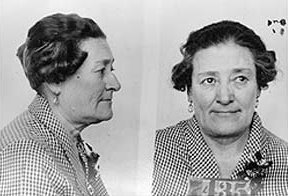
New Zealand got itself permanently out of the execution business after hanging Walter Bolton this date in 1957 for the murder of his wife.
The 68-year-old farmer was condemned after his wife finally succumbed to a year-long bout with some mysterious recurring ailment — and the post-mortem revealed long-term arsenic poisoning. Since Bolton turned out to have been having an affair with his wife’s sister, the pieces just fell right into place.
Jurors found these circumstances credible enough to stretch Bolton’s neck, but there’s the small problem that Walter Bolton himself also tested for arsenic poisoning.
The defense argued that the farm’s wells must have soaked up the poison from sheep dip.
But if you like your wrongful executions more sinister than dunderheaded, you might turn a wary eye to that adulterous sister-in-law, Florence Doherty, who committed suicide a year after Bolton hanged. This 2001 Investigate magazine argues (beginning on p. 24 of the pdf) that Doherty may have been a serial arsenic poisoner.
(Bolton’s hanging was also botched, to complete the official dog’s breakfast.)
It was rather the First World’s collctive mid-20th century move away from capital punishment. Various abolition efforts building in the 1950’s finally led to a 1961 free vote on the matter, in which ten members of the conservative National Party broke party ranks to eliminate the death penalty for all ordinary crimes. (Decades later, a Labour government also eliminated the death penalty for treason; New Zealand has only ever hanged one person for that crime.)
On this date in 1944, French intellectual Jean Cavaillès was shot at Arras for his role in the French Resistance.
The university lecturer had been called up as France mobilized against Germany, and captured in the ensuing German blitz.
Escaping, he started a subversive newspaper, was appointed to the Sorbonne, got captured again, escaped again, made it to London, and returned to occupied France to direct a sabotage campaign.
On this date in 1939, the Canadian province of Manitoba carried out at Headingley Gaol the only triple execution in its history.
Peter Korzenowski and William Kanuka hanged side by side just after midnight that February 16, while their accomplice Dan Prytula waited 14 minutes for his turn on the gallows.
Less than a year before, drunk on moonshine, the trio beat and kicked 81-year-old Anna Cottick to death on her Dauphin-area farm in an attempt to plunder the place of a rumored $1,000. In fact, they only found twenty-three bucks.
The process of finding enough corroborating evidence to obtain murder convictions was the stuff of modern crime dramas.
As soon as the Royal Canadian Mounted Police arrived at the Cottick farm, members noticed fresh tire tracks entering and leaving the yard. They were tracked three miles west to within 150 yards of Kanuka’s residence, and from there to the Gilbert Plains home of Prytula’s sister. The tire marks were a perfect match to the treads on Prytula’s 1929 Ford. It was confiscated and, while casts were taken of its treads, Prytula was arrested and his blood-stained clothes, boots and three .32 calibre bullets were seized and sent to the RCMP crime lab for testing.
As one group of police officers were arresting Prytula and Korzenowski, another searched the Cottick residence for additional evidence. Almost immediately they noticed what appeared to be fingerprints on the glass smashed by the assailants. Fragments were sent to experts in Winnipeg, along with a window frame and piece of wall where the bullets fired by Korzenowski and Prytula lodged.
The RCMP also searched the residence and yard of Korzenowski, located a few hundred yards from where Kanuka had been staying. There they found the revolvers used in the break-ins, hidden in a pile of stones. Korzenowski was promptly arrested, and three days later he and his two friends were part of an identification line-up paraded in front of the hospital beds of the Cotticks.*
To top all that off, they bugged the men’s jail cell with a dictograph and snared them in several incriminating conversations. Representative remark: the lawyers are so expensive, “No wonder one has to go robbing.”
* Anna’s 91-year-old husband survived the home invasion.
On this date in 1984, India hanged Kashmiri nationalist Maqbool Bhat.
A terrorist to his enemies and a freedom fighter to his friends, Bhat was born in the Kashmir region back when it “was ruled by the Dogra Family and the entire Kashmiri nation was living a life of slavery.”
When Bhat was a nine-year-old child, the prince of Jammu and Kashmir inked a bitterly controversial accession of his domain to the foundling independent nation of India. Kashmir has been hitched to the adjective “troubled” ever since.
The broader Kashmir region remains a warren of competing claims among Pakistan, India, and China. Bhat operated not for any of these governments, but for Kashmiri independence … and since he came of age in the revolutionary twilight of colonialism, he did not shy from putting the fight in freedom fighter. Bhat was an early exponent of an armed independence struggle.
Both India and Pakistan proscribed as terrorist Bhat’s Jammu and Kashmir National Liberation Front (forerunner of the still-extant JKLF, which is the same acronym less the middle letter); both those longtime subcontinent antagonists arrested Bhat at different times for subversive activities. The most notable: Bhat engineered an airplane hijacking in 1971 to push his cause onto the world’s front pages.
But the hostage-taking game came a-cropper for the Kashmiri rebel.
Languishing under a dormant death sentence for the 1968 murder of an Indian policeman,* Bhat unexpectedly became the focus of his fellow-travelers’ revolutionary ardor: in Birmingham, England, Kashmiri activists kidnapped Indian diplomat Ravindra Mhatre in an attempt to force a hostage exchange.
When Delhi refused to deal, the captors executed Mhatre. Within days, India traded tit for tat by stringing up Bhat — a man who in life had been known for his boast that “nobody has the rope which can hang men.”
They may not have got their man, but they sure got a martyr.
There is sweeping over Texas, as never before in her history, a wave of crime. Murder, theft, robbery and holdups are hourly occurrences that fill the daily press. The spirit of lawlessness has become alarming. Our loose method of dealing with violators of the law is in a large degree responsible for the conditions that today confront us.
It was just after midnight on this date in 1924 that the state of Texas first used its new electric chair, supplanting public hangings with a regime of private executions administered by the state.
Five men, all black, died in rapid succession on the new contraption. (Although witnesses, “sickened by the odor of burning flesh that filled the room, were given a brief respite” between the fourth and the fifth executions.) It was a half-year’s worth of backlog built up while the new death chamber had been constructed for the transition from county-level hangings.
Robert Perkinson’s Texas Tough: The Rise of America’s Prison Empire chronicles the evolution of that state’s prison regime after the Civil War in lucid, page-turning prose. We’re very grateful that he’s allowed Executed Today to mark the Lone Star State’s era of electrocutions with this brief excerpt from that book.
Although elected as a progressive, Pat Neff was the first Texas governor to make hard-fisted, no-nonsense crime fighting a central part of his political identity.
… Neff proposed tougher penalties for bootleggers, an expansion of the Texas Rangers, and the abolition of the state’s suspended sentencing law, an innovation enacted at the end of leasing. He also radically curtailed executive clemency. …
Walter Boyd, aka Leadbelly, was … caught in Neff’s clutches. “‘Dat man ain’ gonna tu’n you loose, ol’ Walter,'” his fellow convicts told him. “‘He wouldn’ tu’n his own mammy loose.'” … Leadbelly had tried everything but running to regain his freedom. Through hard work on the line, he had convinced a captain to request that his escape record be expunged, which under a different governor would have enhanced his chances of parole. About a year after his arrival at Sugar Land, Leadbelly’s father showed up carrying a “fat roll of bills.” He had sold the family’s last parcel of land and tried, rather brazenly, to buy his only son’s freedom, but the warden turned him down …
[Leadbelly] was well known as a musician. When he heard that Governor Neff was planning a personal inspection, he composed a special song. Neff was “a big, fine-lookin’ man,” he recalled, and “sho was crazy about my singin’ an’ dancin’. Ev’y time I’d sing a new song or cut a few steps he’d roll me a bran-new silver dollar ‘cross the flo'” Once his audience warmed, Leadbelly presented his unusual appeal.
Please, Governor Neff, be good and kind,
Have mercy on my great, long time.
With his boot tapping and strings blazing, the musician hit all the conventional clemency notes. He called himself Neff’s “servant,” pleaded on behalf of his wife Mary (in reality his girlfriend), lamented his thirty-year sentence, and even offered an oblique critique.
Some folks say it’s a sin,
Got too many women and too many men.
… In de pen.
Neff himself remembered the encounter almost as vividly. In his autobiography, The Battles of Peace, he painted the singer as a happy minstrel and himself as the benevolent master. “On one of the farms … was a negro as black as a stack of black cats at midnight,” he wrote. “This negro would pick his banjo, pat his foot, roll his eyes, and show his big white teeth as he caroled forth in negro melody his musical application for a pardon.” In his paternalistic way, the governor was moved, or at least amused. He announced that he would grant the supplicant’s request but in his own time. “Walter, I’m gonna give you a pardon,” Leadbelly remembered Neff telling him, “but I ain’ gonna give it to you now. I’m gonna keep you down here to play for me when I come, but when I get out of office I’m gonna turn you loose.” True to his word, the governor enjoyed Leadbelly’s high-spirited performances on command whenever he visited the lower farms, then set him free on his last day in office.
Few other convicts were as fortunate. Despite the costs to taxpayers, almost a thousand more convicts entered Texas prisons than were allowed to leave during Neff’s four-year reign. Inmates sentenced to death, most of them African Americans and Hispanics convicted of rape or murder, found especially little sympathy. Largely in response to lynching, which the governor condemned, Texas centralized the death penalty in 1923. Previously, every county had carried out its own executions, usually in the form of public hangings. Progressives hoped that by sequestering such events at the Walls, they would discourage mob sentiment and encourage reverence for “the majesty of the law.” But the site and method of execution did not alter its racial dynamics.
Following the lead of New York and other states, lawmakers also ordered prison officials to carry out executions by a new technique, one they perceived as “more modern and humane,” the electric chair. Huntsville officials thus built a new death house, the very same in use today, and by the end of the year a squat, straight-backed throne — soon christened Ol’ Sparky — was ready for operation. Governor Neff wasted little time in authorizing its use.
On a visit to the Walls in January, the governor stopped in to visit with five men he would soon send to their deaths. “A queer feeling creeps over you as you pass the death cell and pause,” he wrote. “They knew, and I realized, that I held within my hand the power to save them from the electric chair. How feeble were words, both theirs and mine, at such a time.” Not long after the governor departed, the men, all of them African American, ranging in age from twenty to thirty-nine, were approved for elimination.
In a dramatic gesture of conscience, Huntsville’s warden, R.F. Coleman, resigned his post only days before. “It just couldn’t be done,” he told reporters. “The penitentiary is a place to reform a man, not to kill him.” But a replacement was quickly found, and the Walls’ inaugural electrocutions went forward as scheduled. At nine minutes after midnight, the first condemned man, Charlie Reynolds, was escorted by two guards into the brightly lit death chamber. He blinked rapidly, reported a witness, was speedily strapped in the chair, and then stiffened violently when the new warden threw the switch. Within the hour, four other men met the same fate.


 Bigger Thomas’s trial has his lawyer present an overt indictment of structural oppression as the true cause of Bigger’s crime.

 A

 On this date in 1944, French intellectual Jean Cavaillès was shot at Arras for his role in the French Resistance.
