Catholic priest Jan Bula was hanged on this date in 1952 at Jihlava
A Rokytnice pastor, Bula (English Wikipedia entry | the more detailed Czech and German) put himself in the gunsights of the postwar Communist state by defying its strictures on proselytization and commenting publicly against them.
Although perhaps a gadfly from the state’s perspective he was by no means a dissident consequential enough to have merited his eventual treatment; however, he was cruelly rolled into a notorious 1951 show trial called the Babice Case. Occasioned by a fatal raid launched by anti-Communist terrorists, the Babice trials targeted a huge number of ideological enemies and eventually resulted in 107 convictions and 11 death sentences.* Bula was among them, speciously condemned a traitor for complicity in the attack — a move that also opportunistically accelerated a case that state agents had for some time been attempting with little success to construct by means of entrapment.
“We human beings do not love God enough,” he wrote in a letter to his parents before his hanging. “That is the only thing for which we must ask forgiveness.”
The Catholic Church is currently considering this modern martyr for beatification.
* After the Cold War these sentences were retrospectively overturned or reduced, and a judge in the Babice case, Pavel Vitek, was prosecuted for his role in it.
“I have murdered in vain,” said India’s most prolific serial killer as he went to the gallows in Jaipur on this date in 1979. “Nobody should become like me.”
Becoming like Kampatiyar Shankariya would entail committing upwards of 70 hammer-bludgeon murders.
Panamanian indigenous leader Victoriano Lorenzo was shot on this date in 1903.
He was a cholo (mixed-race; Lorenzo had both African and Amerindian ancestry) peasant who in the 1890s rose to become the most prominent indigenous leader in Cocle, a Pacific-facing province on the isthmus back when Panama was still a part of Colombia.
Lorenzo (English Wikipedia entry | Spanish) would lead indigenous forces in the Thousand Days’ War — a civil war between Colombia’s Conservative and Liberal Parties. Lorenzo fought in alliance with the Liberals; they lost the war, and with it the native land rights that Lorenzo fought for.
While the war was settled by the last days of 1902, the now-ascendant Conservative government accused Lorenzo and followers of continuing to fight and put him to a rial on grounds of murder and robbery that culminated in his public shooting in Panama City. The affair was so irregular that it’s commonly maligned as an “assassination”.
Scholars have interpreted the strange circumstances of his death as Conservative vengeance, the destruction of a hero and powerful symbol for impoverished people, the establishment of oligarchy, and as the forgetting of indigenous people as emblematic in the new Republic of Panama. Lorenzo has been interpreted as a martyr and the first victim of North American imperialism related to the Canal because he was held aboard the United States ship Bogota before his assassination. Seven days before his assassination, Esteban Huertas publicly announced that there was nothing more dangerous for the Canal construction than “guerrillas” and their activities in the mountains of Cocle …
The Conservative narrative of Lorenzo as “guerrilla” fighter permeated Panamanian national history, and schoolchildren learned to see Lorenzo negatively. National Panamanian history depicted Lorenzo shamefully as a “dirty cholo” …
In contrast, northern Cocle oral history memorializes, in cyclical time, Lorenzo as a cultural hero who continues to live, and understands his fight for land rights and political autonomy as the same fight of Urraca that is still ongoing today. People identify strongly with a liberation theology quote attributed to Lorenzo shortly before his death, “I forgive all. I die like Jesus Christ died,” wherein the cultural hero continued the cycle of death to defend land in this epoch. Rufino Peres J., born in 1941, recalls:
My people were illiterate, when he lived. They wore plant fiber loincloth (pampanillas) to go to Penonome … Why did they kill Victoriano Lorenzo? He died fighting for our land, and they formed a war, and that Victoriano Lorenzo, a cholo, won that war! It was not the president who won the war; it was Victoriano Lorenzo. They could never kill him: they used machetes, sticks, smoke, and they didn’t kill him. How was that? Then Victoriano Lorenzo went to the Presidency, and there they killed him. But Victoriano Lorenzo has stayed in History. So, now, whenever a campesino starts any kind of movement, they are scared because because we are the blood of Victoriano Lorenzo.
Panama broke away from Colombia later that same year of 1903, and its new constitution abolished the death penalty outright. Independent Panama has never conducted an execution — so Lorenzo’s appears to be the isthmus’s last.
Anti-Nazi Danish Resistance turncoat Johannes Rasmussen was shot at Viborg on this date in 1948.
Arrested by the Gestapo in December 1943, Rasmussen (Danish link) broke under torture and informed on his former comrades, but he also extended his collaboration far beyond (more Danish) mere capitulation and became their henchman and collaborator. Rasmussen befriended his captors and working as an interpreter and interrogator until someone from the Resistance shot him in February 1945 and left him bedridden.
Arrested on the day after the German occupation ended, he unsurprisingly got no mercy from the countrymen he had betrayed.
An American Morris-Knudsen civilian contractor captured when the Japanese forces seized Wake Island during World War II was executed on this date in 1942.
Julius “Babe” Hoffmeister’s essential offense was alcoholism; this indeed was the reason for his presence on Wake in the first place, as he’d signed up for this remote hitch in an effort to force himself to cold-turkey detox. Thereafter finding himself in a war zone did no favors for his illness.
During the December 1941 Japanese bombardment of Wake, Hoffmeister looted alcohol from the hospital and stashed it around the atoll, stealing back to them periodically in the subsequent months of slave labor for the occupiers to self-medicate against the misery of his situation. By May those stockpiles had been exhausted, forcing Hoffmeister to more desperate ventures.
We catch a glimpse of this unfortunate man his countrymen’s diaries.
One of those observers was an officer named Leal Henderson Russell, whose rank entitled him to milder treatment and a degree of cordiality with his Japanese opposite numbers. On May 8th, Russell’s journal (self-published in 1987 and hard to come by) recorded —
Wakened by guards on coming into the barracks. They went inside and I could hear them questioning someone. After breakfast I found that they had arrested Babe Hoffmeister who was out of the compound during the night. Okazaki told me later he had broken into the canteen. They called several of the men in to question them concerning it but I think he was alone at the time. I also heard he was drunk. It is apt to go very hard on Babe as he had been repeatedly warned.
Two days afterwards, it did go very hard.
May 10th — Julius ‘Babe’ Hoffmeister was murdered this morning. Nearly all foremen and dept. superintendents were called to witness it. Possibly it will serve as a warning to some who still feel that they have some rights here.
The Japs made Hoffmeister crouch on his hands and knees. A Jap officer took his sword, laid the blade on his neck, brought it back like a golf club and then down on his neck, severing his head with a single blow.
He was fortunate to survive arrest by the Japanese while transmitting from occupied Shanghai in 1942. (The Japanese took him for a mere enthusiast.) Even more fortunate from his handlers’ standpoint was the interest his radio skills subsequently attracted from the nationalist Kuomintang, which recruited him into service that Li Bai was only too happy to accept.
For the next several years, he sent to the Communists voluminous inside information about the disposition of their opponents in the endgame stage of the Chinese Civil War. He was detected in the last days of 1948, sending to the People’s Liberation Army the troop dispositions that would enable it to overrun the capitals in the subsequent months. Not three weeks after Li Bai’s execution in Shanghai that city fell to the Communists; by year’s end, the Kuomintang had evacuated the mainland for its so-far permanent Formosan redoubt.
There’s a 1958 Chinese biopic about him, titled The Unfailing Radio Wave; the embed below is one of many subsequent readaptations:
A century ago today, seven hostages taken from the German pre-Nazi Thule Society were executed by the short-lived Munich Soviet just before it was crushed by right-wing militias.
The Thule Society (logo at right) was a Bavarian volkisch club with a profound interest in stuff like crackpot race theory and Teutonic mythology; its very name alludes to a legendary territory hypothesized since antiquity to lie at the fringes of the world, often associated with Scandinavia and with the origins of the Aryan race.*
Society members figured in the founding of the German Workers’ Party (DAP), the party which became the National Socialist German Workers’ Party (NSDAP), better known as the Nazis. Former Thuler Hans Frank was among those eventually hanged via the postwar Nuremberg trial.
On April 30, 1919, all these seven were executed by order of the Communist sailor Rudolf Egelhofer, together with either two or three captured Freikorps prisoners, an affair known as the Münchner Geiselmorde (“Munich hostage-murder”).
Countess Haila von Westarp
The very next day, the Freikorps broke through Munich’s defenses and commenced the bloody rout that destroyed the Munich Soviet.
The Thule Society as a body survived and briefly prospered after its brush with the revolutionaries’ muzzles — the eventual Nazi party newspaper Völkischer Beobachter was previously a Thule Society-owned periodical called the Münchener Beobachter — but it fizzled out into a memory during the 1920s.
Still, this esoteric nursemaid to the infancy of national socialism features prominently in histories of Third Reich occultism; aficionados might wish to browse some of its iconography in this Pinterest gallery, or just punch their distinctive name into your search environment of choice and feel that third eye opening.
* The element Thulium is named for Thule, because it was discovered by a Scandinavian chemist; the U.S.’s Thule Air Base in Greenland developed from an Arctic Circle trading post established and named by a Scandinavian explorer. (From which he launched a series of early 20th century “Thule Expeditions”.)
Turncoat Czechoslovakian resistance fighters Karel Čurda and Viliam Gerik were hanged for traitors on this date in 1947.
Čurda (left) and Gerik
Both were special operatives trained in England and parachuted into Nazi-occupied Czechoslovakia. Gerik (Czech Wikipedia entry) became separated from his compatriots and couldn’t re-establish contact. Seemingly panicked as he contemplated his lonely situation in Prague, he turned himself in in early April 1942 and became a Gestapo collaborator, informing on his underground compatriots. Among other things, he identified the body of his onetime companion on his parachute jump, Arnošt Mikš — who had committed a well-timed suicide to avoid capture after killing a gendarme in a shootout. Gerik’s helpful ID enabled the Gestapo to shoot Mikš’s brothers by way of collective punishment.
This man did not greatly prosper by his betrayal even during the war years, for after later attempting to break free from his masters and re-establish contact with the resistance he was tossed in Dachau and only released when that camp was liberated by the U.S. Army, going in his case from frying pan to fire.
Čurda’s reward was a half-million Reichsmarks and a German wife with whom he had a child, prior to his postwar arrest; such payoffs obviously make him a ready target of vilification, although more sympathetic interpretations exist suggesting that Čurda acted days after the demonstrative eradication of the village of Lidice because he feared that his own family or town might suffer the same fate.
Spanish general Jose Aranguren was shot on this date in 1939 by Franco’s Spain.
A brigadier general of the Civil Guard — an internal-to-Spain paramilitary/law enforcement force that remained predominantly loyal to the Republic during the Spanish Civil War — Aranguren (the very cursory English Wikipedia entry | the more detailed Spanish) at the outset of hostilities efficaciously suppressed the Nationalist rebels in Barcelona and even gave evidence that contributed to the execution of his mutinous opposite numbers.
From 1937, he served as the Republican military governor of Valencia.
He eschewed the opportunity to flee Spain at the end of the war, counting on his faithful adherence to his plain duty to vindicate himself against the fascists.
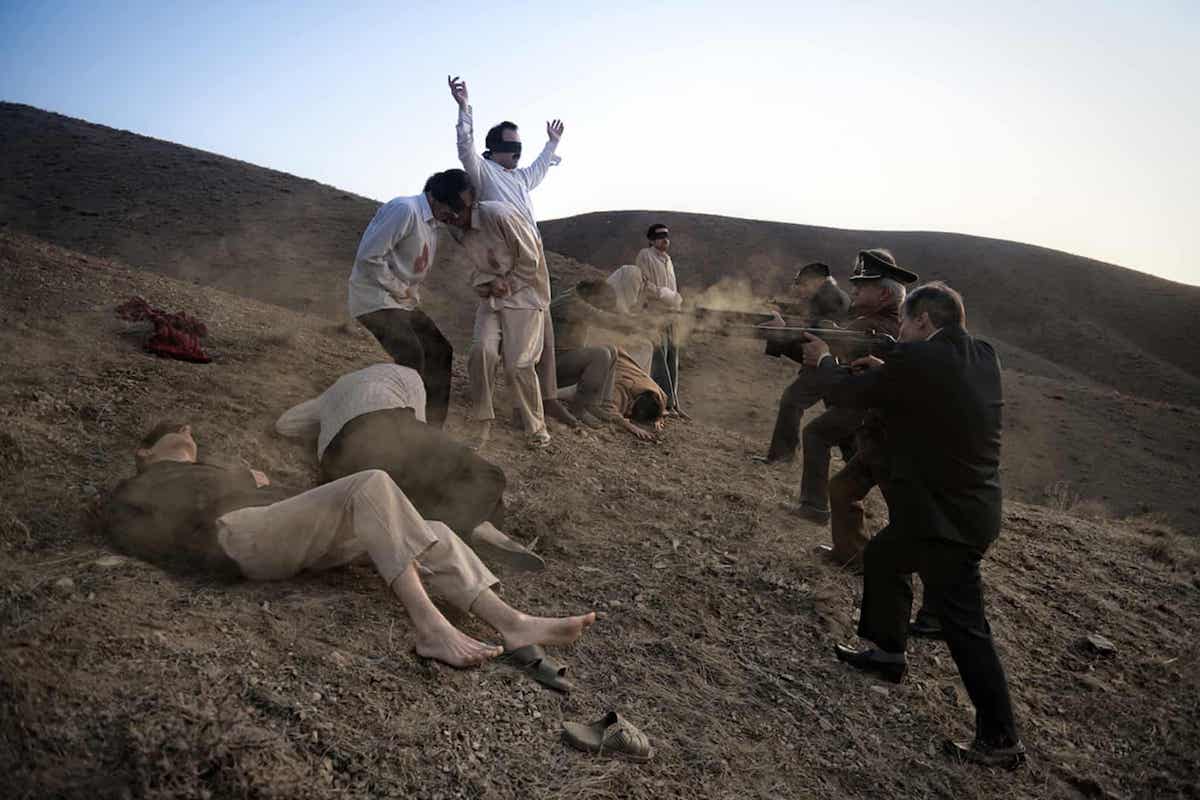
On this date in 1975,* Iran extrajudicially executed nine political prisoners.
This photo is a dramatic re-staging — evocative of a famous photo of executions in revolutionary Iran a few years later, or perhaps in the white-clad central prisoner’s raised arms, the Goya painting that forms this very blog‘s frontispiece. (Contrary to the reconstruction, the executioners had just one Uzi and took turns spraying it at their victims.) It’s part of a fascinatingproject by Azadeh Akhlaghi to portray 17 pivotal deaths in Iran’s history.
We took the prisoners to the high hills above Evin. They were blind-folded and their hands were tied. We got them off the minibus and had them sit on the ground. Then, [SAVAK agent Reza] Attarpour told them that, just as your friends have killed our comrades, we have decided to execute you — he was the brain behind those executions. Jazani and the others began protesting. I do not know whether it was Attarpour or Colonel Vaziri who first pulled out a machine gun and started shooting them. I do not remember whether I was the 4th or 5th person to whom they gave the machine gun. I had never done that before. At the end, Sa’di Jalil Esfahani [another SAVAK agent, known as Babak] shot them in their heads [to make sure that they were dead].
“We took them out of the jail and put them in a minibus and drove them to the hills. We had only one submachine gun, an Uzi, among us, so we took turns shooting them … we didn’t give them a chance to make a last declaration. We blindfolded them and handcuffed them and then shot them. I think was the fourth to shoot. We took the bodies back to the prison. and we had the newspapers print that they were killed during a jailbreak. We had the coroner confirm this version.”
The victims were Ahmad Jalil-Afshar, Mohammad Choupanzadeh, Bijan Jazani, Mash’oof (Saeed) Kalantari (Jazani’s maternal uncle), Aziz Sarmadi, Abbas Sourki, Hassan Zia Zarifi, Mostafa Javan Khoshdel and Kazem Zolanvar.\
The last two named were members of the People’s Mujahedin of Iran, the still-extant MEK back when it was still a standard Marxist revolutionary movement and not a cult.
The first seven named were members of the Organization of Iranian People’s Fedai Guerrillas, a proscribed Communist guerrilla organization.
The proceedings that had landed them in prison in the first place had already put them in the global spotlight especially given the horrific torture applied to the defendants. (Among other things, these seven were adopted by Amnesty International as watchlist political prisoners.) International pressure had staved off juridical death sentences … so the matter was handled extra-juridically instead, with the standard insulting cover story, “shot trying to escape.”
Iran reaped a considerable diplomatic fallout from these murders. Its embassies around the world were rocked by protests of emigres and human rights campaigners in the ensuing weeks; that May, a team of communist assassins gunned down two American Air Force officers stationed in Tehran to train the Shah’s security forces — claiming responsibility “in retaliation for the murder of nine of our members.” (UPI dispatch from Boston (US) Globe, May 21, 1975)
There’s a lengthy lecture on Jazani et al by Communist historian Doug Greene.
* Some sources give April 19 instead. I have not been able to resolve the discrepancy to my satisfaction.

 A Rokytnice pastor, Bula (English Wikipedia entry | the more detailed Czech and German) put himself in the gunsights of the postwar Communist state by defying its strictures on proselytization and commenting publicly against them.
 “I have murdered in vain,” said India’s most prolific serial killer as he went to the gallows in
  He was a
  Arrested by the Gestapo in December 1943,
 The
The 


 A brigadier general of the