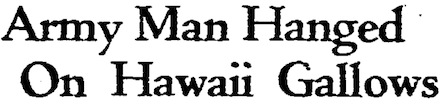
On this date in 1947, U.S. Army Private Garlon Mickles was hanged at a place called “execution gulch” in Honolulu’s Schofield Barracks.
Mickles had enlisted three years before, the 16-year-old son of a St. Louis laundress. (“Tell my mother I died like a man,” were his reported words to the chaplain.)
According to Associated Press reports, army engineers frustrated peeping eyes by “put[ting] up a smoke screen to shield the gallows from the view of the curious.”
He was convicted of raping and robbing a female War Department employee on Guam, where he was stationed with the Twentieth Air Force — from which staging-point the unit conducted bombing raids on mainland Japan. (The Enola Gay, which dropped the atomic bomb on Hiroshima, was part of the 20th.)
Mickles appears to be the last person ever executed on the Hawaiian islands, and also an unusual overlook by the Espy File of U.S. executions, from which he’s totally absent.
On (or very near) this date in 1986, Palestinian terrorist Abu Nidal had British hostage Alec Collett hanged in revenge for the previous day’s U.S. bombing of Tripoli.
Collett, a journalist and U.N. aid worker, had been abducted in Beirut more than a year earlier.
Abu Nidal, his captor, was the brand-name terrorist of his era. Indeed, his own name was a brand: Sabri Khalil al-Banna was the name he was born into, in a wealthy Palestinian family driven to dispossession and refugee camps by the Nakba. It was the Abu Nidal organization‘s assassination attempt on Israeli diplomat Shlomo Argov that triggered Israel’s counterproductive 1982 invasion of Lebanon, perhaps (for its long-term consequences) the crowning achievement of Abu Nidal’s career.*
Stopped at a militia checkpoint on March 25, 1985 where he might have been taken because of an Israeli-stamped passport, Collett became one of about 100 foreigners seized as hostages by various factions over the long course of the Lebanese conflagration.
Only a few of these hostages died in their captors’ hands; they were in the main prisoners for leverage, and so efficaciously did they lever that it was these very souls that Ronald Reagan‘s U.S. administration proposed to retrieve by purchasing the (officially enemy) influence of Iran in the Iran-Contra arms-for-hostages scandal.
Confusingly shifting factional advantage has tangled Middle East politics for many a year, to be sure, and here the prospect of a negotiated release was aborted by the April 5, 1986 terrorist bombing of a Berlin discotheque frequented by U.S. soldiers — two of whom died in the blast.
This outrage proved to be the project of Libyan dictator Muammar Gaddafi, who then stood in a very tense position vis-a-vis the West. Ten days after the disco attack, Reagan responded with an air raid on Libya clearly intended to assassinate Gaddafi — who fled his compound moments before it was crushed by a fleet of 2,000-pound bombs. (The bombing might or might not have slain the dictator’s infant daughter.)
This attack on Gaddafi was also an attack on that arch-terrorist Abu Nidal, whom Gaddafi had recently taken in after a former patronSaddam Hussein made a bid for respectability by expelling him from Iraq.** And it so happened that Collett’s unoffending person offered Abu Nidal the most immediate vehicle for retaliation.
It’s not completely certain that April 16 was the date of Collett’s murder, though there is no real reason to doubt his executioners’ claim on this point. The matter was confused at the time because three other dead westerners discovered on April 17 were initially reported to include Collett among their number — a claim subsequently debunked. On April 23, Collett’s captors released a grainy video of their masked prisoner being hanged;† however, the identification of the noosed man was still questioned for many years. Collett’s remains — confirmed by DNA testing — were only discovered in 2009.
* Israel withdrew from the bloodymorass three years later, having displaced the Palestinian Liberation Organization for a much more effective new resistance movement in Hezbollah. Decades later, Osama bin Laden would cite Lebanon as the event that “gave birth to a strong resolve to punish the oppressors,” including the sight of “demolished towers in Lebanon” to inspire a bit of tower-toppling of his own.
Iran’s Islamic Revolutionary Courts went up in the very first days after the victory of the Iranian Revolution. These courts still exist nearing 40 years on but were oriented initially like many revolutionary tribunals towards clearing out hated servants of the old regime.
And like many revolutionary tribunals they developed a reputation for delivering justice more swift than measured — with one-sitting procedures where defendants faced hectoring judges and surprise charges without benefit of that “Western absurdity,” a defense counsel. For the Ayatollah Khomeini, revolutionary courts weren’t a probative exercise but a vehicle for delivering popular justice. “If the revolutionary courts did not prosecute them, the people would have gone on a rampage and killed them all,” he said of the courts’ targets.
This sentiment was echoed almost word for word by a spectator in this case, who (according to an April 13, 1979 New York Times profile) shouted at the judges during an adjournment that “if the court forgives him, the people won’t and will get him!” The major’s courtroom was packed with 200-plus spectators, many of whom could show the scars that the Shah’s torturers had left them.
Though he must have known he had no real hope at acquittal, Yahyahi fought his corner — for there was still the hope of a prison sentence, which his co-accused received, instead of death. Accused of abusing prisoners at Qasr Prison, Yahyahi protested that he had been forced to do it, that “the system was there, I didn’t create anything … I’m a nobody.”
“You wouldn’t understand it unless you put yourself in my shoes,” he explained unavailingly. “I asked for a transfer. I tried hard to get out. You must take that into consideration.”
A parade of witnesses described the torments of the Shah’s prison; Major Yahyahi’s rank at the facility was enough to condemn him for command responsibility, even absent witnesses who could link him personally this or that thrashing.
“It is not the individual who is on trial,” the mullah-judge presiding explained, repeatedly. “It is the regime.” The toppled regime, after all, had been convicted already.
Major Yahyahi’s trial (together with four others) consumed the court’s business on April the 12th. By that night Yahyahi was condemned to death; he was executed by firing squad the very next day, only one of ten people put to death around Iran on April 13, 1979.
You’ll never guess it: CCFAN also took Galopin hostage.**
CCFAN tried to leverage its new captive into an arms trade. When France dragged its feet, the Chadians terminated the negotiation by having Galopin condemned by a “revolutionary tribunal” and hanged to a roadside tree.
Habre would eventually take power as President of Chad in 1982, and was subsequently welcomed on state visits to the former mother country — much to the disgust of those who remembered the Frenchman sacrificed to his ambitions. Galopin was hardly the last man to be so distinguished: as of this writing, Habre is serving an eternal prison sentence in neighboring Senegal for crimes against humanity committed during his eight years ruling Chad.
* Archaeologist Françoise Claustre and development worker Marc Combe. (A third hostage, West German doctor Christoph Staewen, had also been taken, but had quickly been ransomed by his government.) Combe escaped in 1975. Claustre was not released until 1977.
** CCFAN was also riven by a major internal division that by 1976 would split the movement into two rival organs. It has long been murky (French-language pdf here) just whose interest within CCFAN was best served by the hostile course of events.
Retreating from the Philippines in early 1942, U.S. Gen. Douglas MacArthur famously vowed, “I shall return.” To Homma’s grief, he did just that.
While MacArthur cogitated his revenge, Homma was finishing off the remnants of his last great stand in the Battle of Bataan. Bataan was a victory for Japan, but a bloody and protracted one; it cost the lives of some 7,000 Japanese, and the three-month battle has sometimes been credited with slowing the Japanese advance sufficiently to safeguard Australia; it also left the occupiers with an unexpectedly huge complement of POWs.
On April 9, 1942, the very day fighting ended at Bataan, transfers began for these prisoners, who would be driven by train and then marched overland some 60+ miles to Camp O’Donnell. More than 60,000 Filipinos and about 15,000 Americans endured this harrowing five- or six-day slog — the Bataan Death March.
A few books about the Bataah Death March
Early reports of the death march made grist for this wartime propaganda poster in the U.S.
This crucible of endurance, both physical and spiritual, came by its evil repute honestly; in the age of the Internet, numerous appalling testimonials are within easy reach of a web search. They recount battle-wearied men enervated by hunger and thirst, liable to be summarily shot or bayoneted for making themselves the least bit conspicuous to captors who already disdained them for having the weakness to surrender in the first place.
Some were murdered at the outset: having any Japanese “trophies” on one’s person when captured was liable to be worth a summary bullet, or a quick flash of an officer’s katana. An even more certain death sentence was falling behind on the march, and wounded prisoners could expect no quarter: they had to keep up with their compatriots or the Japanese “buzzard squad” trailing a few score meters behind every marching peloton would finish them off with any other stragglers. In different groups POWs might be thrashed or killed over any trifling annoyance; meanwhile, those suffered to live trudged under a wasting sun, nearly unnourished but for fetid handfuls scooped from mud puddles, dying on their feet hour by hour. Dehydrated to the point of madness, some snapped and ran suicidally for the tantalizing nearby village wells that marchers were prohibited from accessing.
Something like a quarter, and maybe nearer to a third, of the souls who set out on the Bataan Death March never reached Camp O’Donnell. Those who did entered new portals of torment: rent by dysentery and crowded cheek to sunken jowl, prisoners died off daily by the dozens until they were finally dispatched — often crammed like sardines into the bowels of “hell ships” — to different Japanese work camps.
The Bataan Death March was a no-question basket of war crimes, egregiously flouting existing POW treatment accords.* It’s far more questionable whether our man Gen. Homma was the right person to answer for it.
Homma had segued directly from the Battle of Bataan to the succeeding Battle of Corregidor after which he had been cashiered for a homeland desk job.
Ironically, it was an excess of leniency that helped earn Homma his enemies among the brass — the opposite of the thing that hanged him. For many who observed the postwar trial slating him with 48 war crimes violations related to the Death March, Homma was a figure more tragic than wicked, prey to returning victor MacArthur’s pique at the defeat Homma had once inflicted upon him.
Little reliable evidence could show that Homma blessed or even knew of the atrocities committed in the march, but he himself allowed during trial that “I am morally responsible for whatever happened in anything under my command.” According to Homma’s American defense attorney Robert Pelz — a biased source to be sure — the general slipped into genuine disgust and remorse during the trial as a parade of witnesses remembered their ordeals. “I am horrified to learn these things happened under my command,” Homma wrote in a note passed to Pelz at one point. “I am ashamed of our troops.”
The hanging verdict was controversial then and remains so now. “If the defendant does not deserve his judicial fate, none in jurisdictional history ever did,” MacArthur complained. He honored the mercy application of Homma’s wife Fujiko only insofar as to permit the general a more honorable execution by musketry, instead of hanging.
The bulk of the U.S. Supreme Court okayed the procedure by which the U.S. military brought that fate about, although Justice Frank Murphy issued a scorching dissent urging that in the haste and partiality of the proceedings against both Homma and General Tomoyuki Yamashita “we abandon all pretense to justice, let the ages slip away and descend to the level of revengeful blood purges.”
One who would share that sentiment was an 18-year-old Navy man who observed the trial, Bob Perske. Perske would remember this his experiences on the Philippines at the end of World War II “sharpened his sensitivies toward vulnerable persons” and influenced a subsequent career advocating for people with disabilities as well as those caught in the toils of the criminal justice system. Executed Today formerly interviewed Mr. Perske in connection with the wrongful execution of a mentally disabled man in Colorado, Joe Arridy.
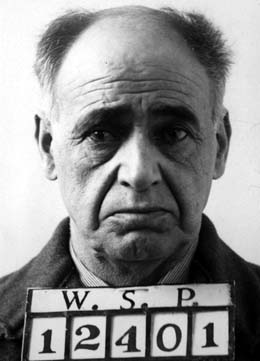
On this date in 1929, Washington state hanged bootlegger Luther Baker for murdering Clark County Sheriff Lester Wood during a Prohibition moonshine raid.
The rare Democrat office-holder in heavily Republican Clark County — which faces Portland, Ore., across the Columbia River — Sheriff Wood favored his dry constituents with “a ruthless war on liquor violators.” (Oregonian, May 23, 1927)
On May 22, 1927, Wood and two deputies found and destroyed an illegal 125-gallon still operated by Baker and his brothers “in the roughest and wildest part of Clark County,” Dole Valley — when the Bakers, alert to the lawmen’s presence, ambushed them. Wood was the only fatality of the wilderness shootout. Well, Wood and Luther Baker.
Luther, aged around 59, was arrested for this along with his brother Ellis and Ellis’s 21-year-old son Ted. Young Ted’s life sentence would be overturned on appeal, but Ellis spent 30 years locked up at Walla Walla and for 28 of those years he had to bear the memory of his older brother’s walk to the gallows* — for, according to the Seattle Daily Times same-day report of the morning hanging, Ellis “was awake in his cell” just “a few yards from the gallows” during the execution and seemed “more shaken than the man who climbed the thirteen steps.”**
* And the fact that Ted, despite his exoneration, succumbed to tuberculosis a few months after Luther Baker hanged. I haven’t been able to establish whether the condition related to his stint in prison.
** Luther and Ellis were allowed a half-hour together during Luther’s last night on earth.
British-occupied Egypt on this date in 1945 hanged two young Jewish assassins for slaying the British plenipotentiary to the Middle East.
Walter Edward Guinness was heir to the barley beer fortune and a Tory politician of near 40 years’ standing. “Lord Moyne”, to call him (as history does, and as we will henceforward) by his aristocratic honorific, allied with his former rival Winston Churchill in the 1930s as a staunch foe of placating Hitler, eventually serving several roles in Churchill’s wartime government.*
The last and perforce most famous was Resident Minister of State in Cairo from January 1944, where he directed British affairs in North Africa, Persia, and the Middle East, crucially including Mandatory Palestine.
Such a figure must necessarily represent many things to different subjects, but to Zionists he represented the hostility to their project of both his own person and (more importantly) of London. While there is endless nitpicking about the man’s precise degree of disfavor for Jewish people or interests, “Lord Moyne was the highest British official in the Middle East,” in the words of Yitzhak Shamir, the emigre terrorist who orchestrated the hit and would one day become Prime Minister of Israel. “Because we fought against the British in this area, we took him for a target. This was the main reason for his assassination.” Nothing personal. (Maybe a little personal.)
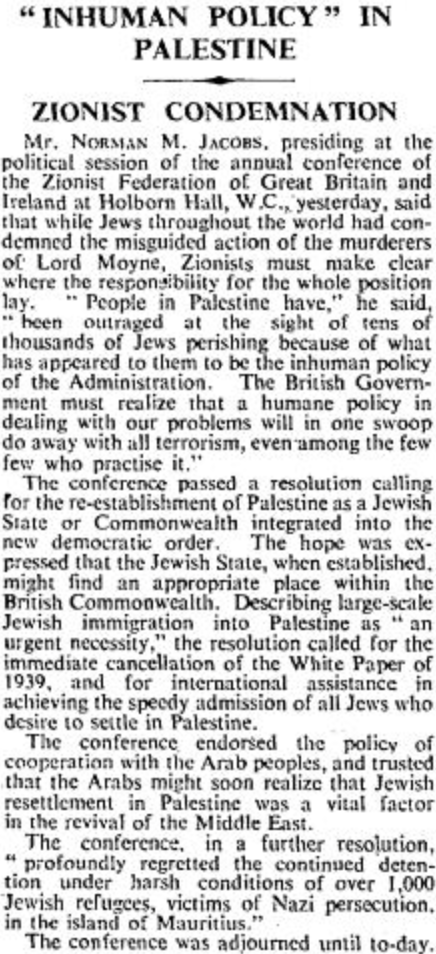
On November 6, 1944, two of Shamir’s young cadres in the late Avraham Stern‘s militantly anti-British Lehi network, Eliyahu Bet-Zuri (Ben Suri) and Eliyahu Hakim, ambushed Moyne as his limousine pulled up at his villa, and shot him dead with pistols. (They also killed Moyne’s driver, a Lance Corporal named Arthur Fuller.) Once their affiliations became apparent it was Jewry’s turn to bask in the collective censorious scowl that minorities everywhere can anticipate given any perceived ethnic affinity to the latest atrocity’s author. These sortings-out from the London Times would do almost word for word for whatever horror tomorrow’s news might bring.
London Times, Nov. 10, 1944
London Times, Jan. 29, 1945
Similarly, Lord Moyne’s killers took every pain to link their martyrdom to Jewish/Zionist patriotism, no matter any moderate rabbi’s attempt to wash his hands of it.
Raised in Mandatory Palestine, both Bet-Zuri and Hakim spoke Arabic but insisted on speaking only Hebrew in the Cairo court. They went to the gallows singing the hymn “Hatikvah” — later to become Israel’s national anthem.
In the near term, their deed hardened hearts: “If our dreams for Zionism are to end in the smoke of an assassin’s pistol, and the labors for its future produce a new set of gangsters worthy of Nazi Germany, then many like myself will have to reconsider the position we have maintained so consistently and so long in the past,” Churchill snarled to Parliament.
But in fact the British reconsideration was soon seen to run counter to the dangerous meddling policing these “gangsters” would have demanded. Within only a few years London struck its colors in the Levant. Bet-Zuri’s and Hakim’s cause triumphed, and they too with it: as Prime Minister, Yitzhak Shamir arranged for the hanged men’s remains to be repatriated from Egypt; today, both rest in honor at Mount Herzl.
* There was a personal side to Lord Moyne’s anti-Naziism: his son, Bryan, had been abandoned by his socialite wife Diana Mitford … who became Diana Mosley in 1936 when she married British Union of Fascists chief Oswald Mosley, in a ceremony held at Joseph Goebbels‘ home no less.
On this date in 1954, East Germany beheaded Ernst Jennrich for the previous June’s short-lived popular protests.
A Magdeburg gardener of socialist proclivities, Jennrich was nothing more than an enthusiast who got swept up in events when metalworkers at the Ernst-Thälmann factory struck for better pay and lower food prices — a protest that quickly metastasized into what looked to the Communist authorities like a treasonable movement calling for liberalization, a release of political prisoners, and reunification with West Germany.
The movement was crushed within a day by Russian tanks — although some Soviet soldiers notably (and sacrificially) refused to fire on protesting workers. But before events played out, Jennrich had disarmed a guard at the prison in nearby Sudenburg. He fired the guard’s carbine twice, then destroyed the weapon.
It’s not certain how many people lost their lives in the suppression of this affair — hostile western estimates ran into the thousands — but two policemen were killed at Sudenburg prison, and in a cruel show of official impunity Jennrich got tapped to answer for their deaths. He said he’d just fired the carbine into a wall or the air in order to empty it … but the state said he’d emptied it into those two luckless officers.
On scant evidence, Jennrich harshly received a life sentence that August. But even this did not suffice for officials racing to manifest their righteous indignation against the late subversion. “The protection of our peaceful state requires the death penalty for the crimes committed by the defendant,” huffed the prosecutor, and appealed the sentence to Germany’s high court … which accordingly upgraded the sentence to “the extermination of the defendant from our society, and therefore the death penalty.”
Jennrich was beheaded on the fallbeil at Dresden still protesting his innocence. A post-unification court finally vindicated that protest in 1991, posthumously rehabilitating Jennrich as having been condemned without evidence even by the terms of East Germany’s 1950s laws.
On this date in 1946, the Dutch journalist/propagandist Max Blokzijl was shot at Scheveningen for wartime Nazi collaboration.
Blokzijl (English Wikipedia entry | Dutch), who had a Jewish grandmother, fought in World War I but had become a war correspondent at Berlin by the end of it, reprising his prewar career.*
From 1918 to 1940 he worked from Germany, and Germany worked on him; in 1935, with National Socialism ascending its zenith in Germany, Blokzijl joined Anton Mussert‘s Dutch knockoff, the Nationaal-Socialistische Beweging party. He also wrote anonymously for the fascist newspaper De Waag.
When Germany occupied the Netherlands in 1940, Blokzijl decloaked as a fascist and accepted a gig as Berlin’s hand for the Dutch press. He was noted for the wartime radio show Brandende kwesties (Burning Issues) which helped make his the calm and measured voice of Dutch national socialism — an identification which soon proved to be a great liability.
The last Nazi redoubts in the Netherlands didn’t surrender until the very end in May, 1945, and that’s when Blokzijl was arrested, too. He stood a half-day trial on September 11, 1945 for his media campaign “aimed at breaking the spiritual resistance of the Dutch people are against the enemy and infidelity of the people to his government and the Allied cause.”
One could argue that the firing squad was a harsh penalty for a guy who had no direct hand in any atrocities. As with the French propagandist Robert Brasillach, the circumstance of facing the nation’s judgment so directly after the war contributed to the severity of Blokzijl’s punishment: indeed, Blokzijl was the very first Dutchman tried for his World War II behavior, which made a death sentence virtually de rigueur. As he wrote to his lawyers in the end, “I fall as the first sacrifice for a political reckoning.”
* One of his prewar careers: he was also a professional singer.
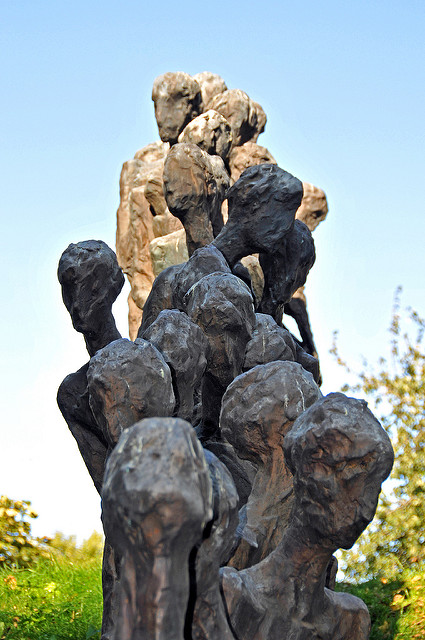
On this date in 1942, the start of Purim,* Nazi forces occupying Minsk massacred approximately 5,000 Jews from the Minsk Ghetto at a site known simply as Yama, “the Pit”.
The site, which hosts memorial events every March 2, was marked with a somber obelisk in the immediate postwar years; unusually for a Stalin-era monument, it is overt about the Jewish character of the victims — for Soviet propaganda often obfuscated this with a technically-correct formulation such as “Russian citizens”. In this case, the 1940s memorial obelisk remarkably had a Yiddish inscription to mirror its Russian one. (The sculpture of a column of faceless people tragically descending the slope into the pit was added in the post-Soviet period.)
All images (cc) Dennis Jarvis.
Minsk’s pre-war Jewish population of more than 50,000 was almost entirely annihilated during World War II.

 Collett, a journalist and U.N. aid worker, had been
  Galopin (
 Homma commanded the
 Luther, aged around 59, was arrested for this along with his brother Ellis and Ellis’s 21-year-old son Ted. Young Ted’s life sentence would be overturned on appeal, but Ellis spent 30 years locked up at Walla Walla and for 28 of those years he had to bear the memory of his older brother’s walk to the gallows* — for, according to the Seattle Daily Times same-day report of the morning hanging, Ellis “was awake in his cell” just “a few yards from the gallows” during the execution and seemed “more shaken than the man who climbed the thirteen steps.”**
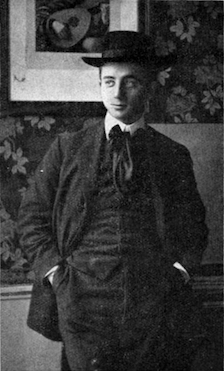 Blokzijl (