1984: Ten members of the Tudeh party

On this date in 1984, the Islamic Republic of Iran completed its destruction of the Tudeh party with ten executions.

In the 1940s, the Tudeh was Iran’s largest mass party and a fair bet to take power in the near future but state repression after Mossadegh was overthrown in 1953 had largely driven the Communist movement to the skulking margins.

Its fragments hung on underground, preparing and organizing for the proletarian revolution — an orientation that would leave the Tudeh entirely unprepared for the Iranian Revolution that really occurred. In fairness, few from Tehran to Moscow to Washington could read those tea leaves: who in the winter of the Cold War anticipated a great regional prize like Iran being captured by … the mullahs?

The Revolution released the once-banned party onto terra incognita as a minor outlet for leftward sentiment and perhaps a show of democratic good faith. But from the start it awkwardly existed on sufferance of an entirely incompatible regime. The venerable English journalist Robert Fisk, who covered the Iranian Revolution, filed a wry dispatch for the Times (Nov. 26, 1979) from the Tehran offices of Tudeh leader Nouredin Kianouri — unconvincingly trying to position his own movement within the events sweeping everyone along.

Tudeh is involved in “the radical struggle against imperialism”, and “the struggle for the reorganization of social life, especially for the oppressed strata of society” … and in so far as it is possible, Tudeh — Iran’s oldest political party — stands for the same things as Ayatollah Khomeini.

That, at least, is the theory: and Mr Kianouri holds to it bravely.

Tudeh demands a “popular front” government in Iran and Mr Kianouri professes to see little difference between this and Ayatollah Khomeini’s desire for national unity. “Popular Front”, however, is not an expression that has ever crossed the Imam’s lips and it is difficult to see how Iran’s new fundamentalist religious administration could form any cohesion with the materialist aims of Mr Kianouri’s scientific Marxism.

The article’s headline was “Ayatollah tolerates Communists until they become too popular,” but Tudeh never fulfilled its clause: it was blown out in the 1980 election, failing to win even a single seat, and maneuvered ineffectually for two years until a crackdown shattered its remnants with over 1,000 arrests early in 1983,* heavily targeting Tudeh-sympathizing army officers.** (The aforesaid Mr. Kianouri was forced to make a humiliating televised self-denunciation in 1983, although he surprisingly avoided execution.)

Those arrests culminated in a large show trial of 101 Tudeh principals in December 1983-January 1984, followed by smaller trials of lesser Tudeh figures in several cities over the months to come.

Eighty-seven Tudeh officials caught prison sentences ranging from eight months to life; these “lucky” ones, along with hundreds of other Tudeh adherents arrested in the years to come, would later be well-represented among the victims of Iran’s 1988 slaughter of political prisoners.

That left ten† reserved for execution on February 25 on charges compassing espionage, treason, and the weapons they had once naively stockpiled to fight against a monarchist coup. Notable among them were four high-ranking military officers: Col. Houshang Attarian, Col. Bezhan Kabiri, Col. Hassan Azarfar, and the chief catch, former Navy Commander Admiral Bahram Afzali.

Formally banned in Iran, the Tudeh party does still exists to this day, an exile shadow of its former glory.

* The U.S., officially abhorred of Iran, was in this period covertly aiding Tehran to raise funds to illegally bankroll Central American death squads — the Iran-Contra scandal. According to the American Tower Commission investigation of those events, the Tudeh were one of the lesser casualties this foreign policy misadventure when U.S. intelligence about the Tudeh network, largely obtained via a KGB defector, was passed to Tehran as a pot-sweetener: “In 1983, the United States helped bring to the attention of Tehran the threat inherent in the extensive infiltration of the government by the communist Tudeh Party and Soviet or pro-Soviet cadres in the country. Using this information, the Khomeini government took measures, including mass executions, that virtually eliminated the pro-Soviet infrastructure in Iran.” (See Appendix B here.)

** Iran at this moment was two years deep into its war with Saddam Hussein‘s Iraq, having in 1982 stalled out with a bloody and ineffectual offensive.

Other background of note: a different, Maoist party had in early 1982 launched a failed rising against the Islamic Republic.

† This doesn’t add up to 101. According to Tortured Confessions: Prisons and Public Recantations in Modern Iran, “when a Japanese correspondent asked why the numbers of those sentenced did not tally with those originally brought to trial, he [Mohammed Reyshahri] hedged, it was rumoured some had died during their interrogation.”

On this day..

1902: Joe Higginbotham, criminal assailant

On this date in 1902, Joe Higginbotham was hanged for raping and slashing the throat of a Mrs. Ralph Webber.

The State (Columbia, S.C.), Jan. 24, 1902

This headline-making outrage occurred in Lynchburg, Virginia, and the town was on the verge of living up to its name before officers spirited the black janitor away to Roanoke for safekeeping; in Roanoke, military guardsmen were scrambled for security against a rumor that Higginbotham’s life would be attempted even there.

One might well wonder why the bother, as the formal proceedings against the culprit blessed by the law entailed very little deliberation beyond Judge Lynch. Mrs. Webber survived her injury and once her condition stabilized, she was brought to the jail on January 21 to make an identification. “She at once identified him as the man who assaulted her. The negro broke down and confessed to the crime with which he is charged, and further stated that he had attempted some months ago to assault a white girl who was a patient in a Lynchburg hospital.” (Charlotte Observer, Jan. 22, 1902)

Two days after that meeting, Higginbotham pleaded guilty at a short trial under heavy guard back in Lynchburg. The sentence was imposed for exactly one month out — plus one more day so as not to fall on a Sunday — and it went off as scheduled, undisturbed by any appeal or reprieve.

The Higginbotham name will be distinctive to students of 20th century American law, as it was borne by Judge A. Leon Higginbotham, one of the greatest jurists never to reach the Supreme Court.* (Higginbotham was reportedly considered for the seat Thurgood Marshall eventually received.) Since it appears from this message board that Higginbotham descendants in the Lynchburg and Amherst County part of Virginia count the judge among their kin, we couldn’t help but wonder whether, like radio host Tom Joyner discovered, there might be an execution hidden in the family tree.

Resident genealogist and occasional guest poster Golde Singer did some research on this proposition.

Judge Higginbotham grew up in New Jersey but census records confirm that his father Aloysius was in fact born in Virginia to a family with deep roots in Amherst County. Aloysius’s move to the Trenton, N.J. area in the first decade of the 20th century would have put him on the leading edge of the Great Migration of southern blacks to northern industrial cities.

Suggestive as that might be, Golde’s search through Aloysius’s family did not appear to turn up any clear link to a Joseph Higginbotham; indeed, Higginbotham the criminal assailant was reportedly himself an adopted or foster child whose lineage appears obscure. The trail from this point dissipates in history’s marshes. The Higginbotham name is quite widespread in the Lynchburg area; family ancestries for the African-American Higginbothams appear to trace back to slavery among the white family of Captain John Higginbotham, a Revolutionary War officer whose own father relocated to Amherst, Va. from Barbados. (Different English Higginbothams made good in India.)

A generalist site such as ours leaves off short of the close reading of archival records or research into family lore that would required here. (Perhaps there are some readers prepared to shed some light?) In the end, of course, any hypothetical family connection between these two very different men would count as little more than historical curiosity.

* Full disclosure: this author never had the privilege of meeting Judge Higginbotham, but counts as a mentor to his death penalty interest one of the judge’s proteges.

On this day..

1944: Missak Manouchian and 21 French Resistance members, l’Affiche Rouge

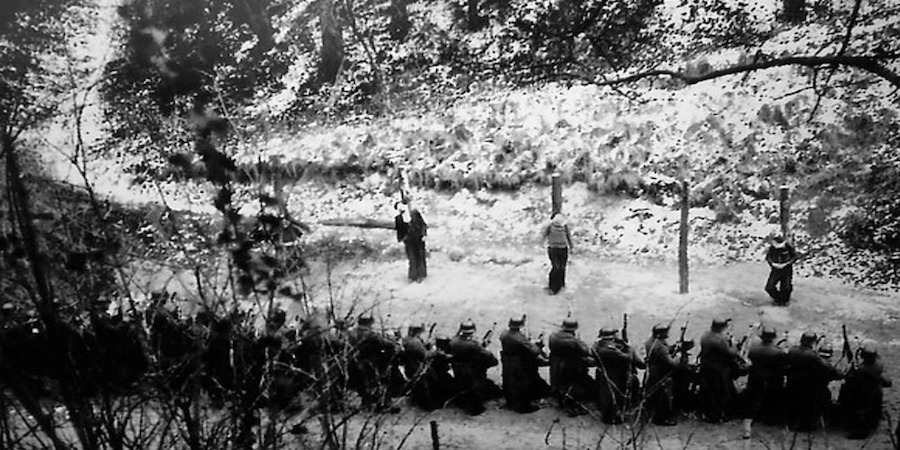
On this date in 1944, 22 members of the anti-Nazi French Resistance’s “immigrant movement” Francs-tireurs et partisans – main-d’œuvre immigrée (FTP-MOI) were executed by firing squad on the outskirts of Paris.

Comprised of foreign communists whose backgrounds amply motivated them to desperate resistance, FTP-MOI was a notably aggressive partisan unit; a few months before this date’s executions, it had stunningly assassinated SS Col. Julius Ritter on the streets of Paris. Risky tactics, including larger-scale operations like the one that claimed Ritter (these required more partisans to know each other) entailed greater risk of penetration, and the November 1943 arrest of the Armenian commander Missak Manouchian and his group devastated FTP-MOI. After the customary interlude of torture, these were subjected to a show trial with 23 condemned to execution.*

As a gaggle of foreign terrorists, heavily Semitic, this clique looked to the occupation like a marvelous tar with which to blacken the Resistance. To that end the Germans produced a scarlet poster denouncing the Resistance as an “Army of Crime,” its soldiery labeled with strange names and alien nationalities converging on the swarthy Manouchian.**

Soon known as l’Affiche Rouge, the poster instead apotheosized its subjects. In the postwar period it became an emblem of the best of the Resistance — its multinational unity, France as an idea powerful enough that men and women of distant birth would give their lives for her. (Not to mention the postwar French Communists’ claim on le parti des fusillés.)

To this day in France, the backfiring propaganda sheet is one of the best-recognized artifacts of the Resistance.

The executions were naturally conducted quietly; the Germans strictly forbade public access to or photography of Resistance heroes in their martyrdoms for obvious reasons.

That made it especially surprising when a few pictures of this execution surfaced recently, surreptitiously snapped from an overlooking vantage by German motorbike officer Clemens Rüter, who kept them hidden for decades. They are to date the only known World War II photos of French Resistance members being executed.

* The 23rd, and the only woman in the group, was Romanian Olga Bancic, also known by the nom de guerre Pierrette; she was not shot on this date but deported to Stuttgart and beheaded there on May 10, 1944. There was also a 24th, a man named Migatulski, who was initially part of the same trial; he was instead remanded to French custody. (See coverage in the collaborationist La Matin from Feb. 19, 1944 and Feb. 22, 1944.)

** We’ve noted before that a Polish Jew named Joseph Epstein who was part of the same cell (and a prime candidate for racist demagoguing) avoided a place on l’Affiche Rouge thanks to his preternatural talent for remaining mum under interrogation.

On this day..

1906: Robert E. Newcomb and John Mueller

(Thanks to Meaghan Good of the Charley Project for the guest post. -ed.)

On this day in 1906, Robert E. Newcomb and John Mueller were hanged together in Chicago, Illinois. Both were multiple murderers, with six deaths between them.

Newcomb, who was, described as “crazed” and “maddened,” hanged for the murder of Chicago police sergeant John Peter Shine.

On October 10 the previous year, Shine heard reports of a gunman terrorizing people on the streets of Englewood. Newcomb had already shot three people and one, a woman named Florence Poore who was the wife of Newcomb’s friend, was dead. Shine found out the gunman had barricaded himself in his apartment. Although he was off duty, he decided to make the arrest himself.

When he knocked on the apartment door and demanded entry, however, Newcomb simply fired through the closed door, hitting Shine in the abdomen and mortally wounding him. The officer died two hours later at Englewood Union Hospital, at the age of 42. Walter Blue, one of the others Newcomb had shot, also died of his wounds.

After Shine was shot, over 100 police officers surrounded Newcomb’s apartment and fired into it, hoping to apprehend or kill the gunman. After a long siege, Newcomb surrendered to an equally certain death in the judiciary.

Little is known about John Mueller or his crimes. Daniel Allen Hearn, in his book Legal Executions in Illinois, Indiana, Iowa, Kentucky and Missouri: A Comprehensive Registry, 1866-1965, describes Mueller as “a drunk and a loser who went berserk when refused money with which to buy liquor.” The 32-year-old slaughtered his wife, Annie, and their two daughters, two-year-old Martha and 18-month-old Mary, by shooting them and slashing them repeatedly with a razor.

The two killers were executed in the Cook County Jail. It was an integrated execution: Newcomb was black and Mueller was white.

On this day..

1943: Dora Gerson, cabaret singer

Jewish cabaret singer and silent film actress Dora Gerson was gassed with her family at Auschwitz on this date in 1943.

IMDB credits the Berlin entertainer (English Wikipedia entry | the more detailed German) with two silver screen roles,* both in 1920 and both now believed lost.**

Gerson’s cabaret career was the more robust through the roaring twenties but with benefit of retrospection we admit with Liza Minelli that from cradle to tomb, it isn’t that long a stay.

And the ominous next act would not belong to Weimar Jews.

After being elbowed off German stages by Reich race laws, Gerson recorded several songs in German and Yiddish; her “Vorbei” (“Beyond Recall”) hauntingly commemorates the lost world before fascism — “They’re gone beyond recall / A final glance, a last kiss / And then it’s all over.”

Gerson fled Nazi Germany to the Netherlands; once that country fell under its own harrowing wartime occupation, she tried to escape with her family to neutral Switzerland but was seized transiting Vichy France. Gerson, her second husband Max Sluizer, and their two young children Miriam (age 5) and Abel (age 2) were all deported to Auschwitz and gassed on arrival on Valentine’s Day 1943.

* Her first marriage was to film director Veit Harlan, who would later direct the notorious anti-Semitic propaganda film Jud Süß — based on an executed Jewish financier. From the German-occupied Netherlands, Gerson unsuccessfully appealed to this powerful ex for protection.

** Future horror maven Bela Lugosi also appeared in both Gerson films, Caravan of Death and On the Brink of Paradise. Gerson’s German Wikipedia page also identifies her as the voice of the evil queen in the 1938 German-language dub of Disney’s Snow White and the Seven Dwarves.

On this day..

1956: Elifasi Msomi, witch doctor

(Thanks to Meaghan Good of the Charley Project for the guest post. -ed.)

On this date in 1956, Zulu witch doctor Elifasi Msomi was executed in at Pretoria Central Prison in South Africa for the murders of fifteen people.

The devil made him do it, he said. Or, rather, Tokoloshe, an evil spirit in Zulu folklore.

Msomi had not been successful in earning a living at witch-doctoring, so he consulted an experienced colleague for advice. According to Msomi, the man introduced him to Tokoloshe and said, “Get me the blood of 15 people.”

Over the next year and a half, Msomi stalked KwaZulu Natal, slaughtering victims as the demon pointed them out, and collecting their blood in bottles. He would attack them with a knife, hatchet or knobkierie after luring them to an isolated area.

The first victim was a young girl. To prove to the demon just how dedicated and obedient he was, Msomi hacked his victim to death in front of his girlfriend. Tokoloshe was delighted, but the girlfriend was horrified. She went straight to the cops and had Msomi arrested. Then he escaped from custody … with Tokoloshe’s help, he said.

Msomi followed up on his first act by slaying five children. In April 1955, he was linked to multiple murders and arrested again, but again he escaped and picked up where he’d left off.

In his book Murder By Numbers: The 100 Most Deadly Serial Killers From Around The World, Robert Keller says,

Serial killers seldom stop killing of their own accord, but that is exactly what happened with Elifasi Msomi. Having collected the blood of his fifteenth young victim, he said that Tokoloshe thanked him for his service, then bathed with him in the river before they parted company.

Without Tokoloshe to help him anymore, Msomi soon came to police attention again when he was arrested for petty theft. In custody once more, he freely confessed to the murders and led authorities to some bodies, but he said he wasn’t responsible for his actions and was only following Tokoloshe’s orders.

There was, however, the problematic fact that he had raped some of his victims and robbed others; Tokoloshe hadn’t requested THAT. At the trial, two psychologists testified that Msomi was very intelligent and got sexual pleasure by causing pain to other people.

Writing of this case in Real Vampires, Night Stalkers and Creatures from the Darkside, Brad Steiger says,

Such was the reputation of the witch doctor’s power of channeling the Tokoloshe that prison officials granted permission to a deputation of tribal chiefs and elders to view Msomi after he had been hanged on February 10, 1956. These men were thus able to return to their respective tribes and proclaim that the witch doctor was really dead and that Tokoloshe had left him to seek out another host body.

On this day..

1943: The five martyrs of the lycee Buffon

On this date in 1943, Nazi guns immortalized five student martyrs of the French Resistance.

The Five Martyrs of the lycee Buffon were Parisian high school students who greeted the fascist occupation of their republic with every form of opposition they could command.

Jean-Marie Arthus (“Marchand” by his nom de guerre), Jacques Baudry (“Andre”), Pierre Benoit (“Francis”), Pierre Grelot (“Paul”) and Lucien Legros (“Jeannot”)* started small with subversive pamphleting and placarding but soon moved on to sabotage and armed opposition in affiliation with the Francs-Tireurs et Partisans.

The arrest of one of their teachers, Raymond Burgard, in 1942 spurred them to lead a student demonstration whose mass arrest they barely escaped. By that time their identities were known, and the boys had to go underground; for their remaining months at liberty they lived on the run and participated in occasional (albeit not very damaging) armed attacks on occupying forces — until that summer, when French intelligence arrested Arthus, Baudry, Grelot and Legros, and French police later caught Benoit.

All five were handed off by their collaborationist countrymen to the eager claws of the Germans, who condemned them as terrorists at a military trial.

A number of public places in France honor their memory, like the 14th arrondissement’s Place des Cinq-Martyrs-du-Lycée-Buffon. Their touching and determinedly optimistic last letters to their families can be read at the Cinq martyrsFrench Wikipedia page.

* A sixth school chum, Michel Agnellet, could easily have joined them at the execution posts and in the martyrologies, but the five who were captured did not permit their interrogators to extract his name.

On this day..

1940: Peter Barnes and James McCormack, the last IRA men hanged

“The two that swung in Birmingham, with ordered step
From off the gallows floor.”

Brendan Behan

On February 7, 1940 — Ash Wednesday, as it happened to be — Peter Barnes and James McCormack became the last Irish Republican Army men executed by the British

They were condemned by the outraged British after a then-shocking terrorist bombing that has largely vanished from the historical memory, subsumed by the simultaneous outbreak of World War II.

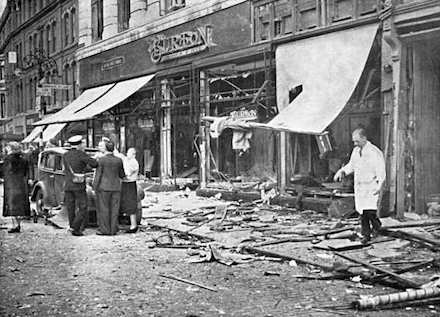
Although it was neither the first nor the last strike in the 1939-1940 campaign of Irish Republican attacks on English soil aimed at forcing London to relinquish control of Northern Ireland, the five-pound bicycle-mounted bomb that ripped apart Broadgate on August 25, 1939, might have been the one that most hardened British hearts against the authors.* Five people were killed in the explosion and some 70 injured; the scene resembled a war zone.**

The resulting investigation — explored in great detail here — never laid hands on the man who actually planted this bomb, eventually revealed to be Joby O’Sullivan.

Many years later and near his death, O’Sullivan claimed that the bomb was supposed to be parked at the Coventry police station; other reports have it destined for an electrical station, and the decision to abandon the ticking bicycle in a crowded street a freelance cock-up by O’Sullivan. Maybe. What is known is that on August 24, London police had busted an IRA plot to place explosives at Westminster Abbey, Scotland Yard, and the Bank of England — all timed to explode at the very same moment as the Coventry package, 2:30 the next afternoon. Had that coordinated fourfold bombing occurred, it would have rated one of the bloodiest and most spectacular terrorist events in history.

But the single blast that did take place was more than enough to bring down the crown’s fury.

Five faced trial for their lives, even though no hand among them had actually set the Coventry bomb. In Ireland and many other places, this latter stipulation made the entire affair an outrageous injustice, especially if one takes as a given that the bomb was not meant to hit civilians. We leave that interesting question of justice to the reader’s consideration, but it must be understood that our hanged men were certainly party to the IRA’s bombing project. The accused, for a trial that December, were:

  • Barnes, an IRA operative in London who had delivered bomb components to Coventry
  • McCormack, part of an IRA cell in Coventry who had rented the house where the bomb was constructed
  • Joseph and Mary Hewitt, and Mary’s mother Brigid O’Hara, Irish immigrants who had taken on McCormack as a lodger

Little evidence could be produced against Hewitt family, who appeared to be quite innocent of their tenant’s intentions. The latter three were cleared of all charges, and then vengefully deported.

McCormack kept stoically silent during the trial, rising only at his sentencing to announce “that the part I took in these explosions since I came to England I have done for a just cause. As a soldier of the Irish Republican Army I am not afraid to die, as I am doing it for a just cause. I say in conclusion, God bless Ireland and God bless the men who have fought and died for her.”

Barnes, whose role on the far end of the supply was even more remote from the final detonation, said as he would maintain to the end, “I am innocent and later I am sure it will all come out that I had neither hand, act or part in it.”

The pair hanged together in Birmingham’s Winson Green Prison. The return of Barnes and McCormack’s remains from that gaol’s unmourned yards to Irish soil soon became a running national demand; the remains were finally repatriated (to great fanfare) in 1969.

Amid the patriotic encomia, civil war veteran Jimmy Steele gave an address on the occasion of the republicans’ reburial critical of the Sinn Fein leadership — an address that is often considered a milepost en route to the imminent (December 1969) splitting-away of the Provisional IRA.

* And in a less justifiable expression, against the Irish generally; Coventry’s Irish immigrant populace faced an immediate racist backlash.

** A chilling preview, for the next year Coventry was devastated by German planes — one of the cities hardest hit by the Reich’s bombing campaign.

On this day..

1967: Sunny Ang, a murderer without a body

On this date in 1967, Sunny Ang hanged in Singapore for murder.

“This is an unusual case insofar as Singapore, or for that matter Malaysia,* is concerned,” said the prosecutor. “This is the first case of its kind to be tried in our courts that there is no body.”

The missing corpse did not present anything like the difficulty the barristers might have anticipated for this landmark conviction.

For one thing, everyone knew where and how 22-year-old waitress Jenny Cheok Cheng had died: on a diving trip near the Sisters’ Islands, Cheng had slipped under the waves while her betrothed waited in the boat … and she had never resurfaced. Frogmen combing the area could find only a single swimming flipper: it had been sliced with a knife to make it slip off during the swim, the inference being that the bladehandler had been interested in the inexperienced diver “accidentally” losing her maneuver while the forceful straits currents went to work on her.

Loverboy Sunny Ang, a vain wastrel facing bankruptcy,** just so happened to be in line to benefit, having insured his bride-to-be to the tune of nearly $1 million over several policies — including one which he had extended mere hours before the murder, and extended by only five more days. One imagines here that the tampered flipper might have been just one of several innocuous-looking accidents, each one a little lure for the Angel of Death, slated to cross Jenny Cheng’s path during the couple’s seaside canoodle courtesy of her own personal Final Destination.

In his young life, Ang had washed out of teacher school, pilot school, and law school. Ang’s laziness went on full display in the murder caper because the hired boatman who took the couple out diving — a witness whom Ang was probably expecting to provide his alibi — took the stand to describe the amazing extent of his guest’s unconcern about his lover going missing.

In a situation where the reasonable homicidal villain would anticipate means, motive, and opportunity all implicating him like blazing klaxons, Ang couldn’t be arsed to allay suspicion with the duest of panic-stricken diligence, like putting on his own suit and jumping in the water to look for her, or even raising his voice a few decibels to feign alarm. He did not, however, neglect to file his insurance claims very promptly.

Small wonder with bloodless banter like this that his jury only needed two hours to convict him, body or no body.

Justice Buttrose: Did you realise that this girl, whom you love and whom you were going to marry, had gone down and disappeared, and you calmly turn round to the boatman and said, ‘All right. Go to St John’s’?

Ang: If she was anywhere around the boat we would have seen her air bubbles.

Justice Buttrose: It didn’t occur to you to go down and search for her?

Ang: No.

Justice Buttrose: Why?

Ang: Because I thought there was obviously a leak and also if she was anywhere around the boat, we would have seen her air bubbles.

Mr Seow: You had skin-diving equipment with you in the boat?

Ang: Yes.

Mr Seow: The girl you were going to marry was obviously in difficulty, if not actually dead already. Why didn’t you use your skin-diving equipment to go down?

Ang: I was not quite sure what sort of difficulties she was in. It occurred to me — it was a vague thought — that she might have been attacked by sharks. In fact, I remarked upon that to Yusuf [the boatman]. Not then, but long after the incident.

Justice Buttrose: You could have gone down to find out?

Ang: She might have been attacked by sharks.

Mr Seow: When did you change back into your street clothes?

Ang: I think I remember I put them on, on my way to St John’s Island.

Mr Seow: So that when the Malay divers were going in, you were then in your street clothes, and you saw no point in joining them?

Ang: I do not say I saw no point. I was in my street clothes and there were more experienced skin-divers, and there were five of them. Besides I knew the chances of finding her were very slim.

Justice Buttrose: You never got into the water at all that day? You never got your feet wet?

Ang: That is so.

* Ang went on trial in April 1965, when Singapore was still part of Malaysia — hence the reference to the scope of the country as a whole. By the time Ang hanged, Singapore had been expelled from Malaysia and become an independent polity.

** He had also previously stolen from his father and police already knew that, so he didn’t enter his capital trial with much existing credence for rectitude.

On this day..

1939: Maurice Pilorge, Le Condamné à mort

On this date in 1939, the murderer Maurice Pilorge dropped his beautiful head under the blade.

This strange execution by retrospect almost marks the pivot between eras of crime and culture. Public executions were about to disappear entirely; the Third Republic that ordered them would not long outlive them.

And Pilorge’s death specifically would prove to be the last performance of the guillotine in Rennes. It was also to have been the 396th in the legendary career of 75-year-old headsman Anatole Deibler … except that Deibler dropped dead on a Paris metro platform two days before, as he set out for the lethal rendezvous.

So too did Pilorge’s crime belong to that interwar moment of cosmopolitan decadence. He fatally slashed the throat of a Mexican visitor named Escudero after what Pilorge claimed, in an unsuccessful attempt to leverage the “gay panic” defense, was an indecent proposition. The facts of the case appear better to fit the hypothesis that indecent propositions were Pilorge’s stock in trade: a black book full of dates and initials whose owners he would not identify, a short late-night visit to Escudero’s hotel room, and a total refusal to explain his activities.

Pilorge, who maintained a wry and mirthful attitude throughout his trial, could not but laugh at the judge’s speculation — inspired by the swarthiness of his victim in the case at hand? — that his prisoner was involved in traite des blanches, the white slave trade: “I was never cut out for that. I assure you that I have never fallen so low.”

If Pilorge’s character entered the public gaze awash in same-sex eros, he was fixed in the firmament as such by the pen of Villonesque criminal/writer Jean Genet after the war years.

Claiming (falsely) to have had a prison intimacy with this doomed “Apollo”, Genet dedicated to Pilorge, “assasin de vingt ans,” one of his breakthrough works. Written in prison in 1942, Le Condamné à mort is a homoerotic hallucination of lovemaking ahead of a gathering doom and it helped to launch the theretofore Genet into literary superstardom. I’ve found the lengthy poem available online only in the original French, but here’s a translated excerpt via The Columbia Anthology of Gay Literature:

O come my beautiful sun, o come my night of Spain,
Arrive in my eyes which will be dead tomorrow.
Arrive, open my door, bring me your hand,
Lead me far from here to scour the battleground.

Heaven may awaken, the stars may blossom,
Nor flowers sigh, and from the meadows the black grass
Gather the dew where morning is about to drink,
The bell may ring: I alone am about to die.

O come my heaven of rose, o my blond basket!
Visit in his night your condemned-to-death.
Tear away your own flesh, kill, climb, bite,
But come! Place your cheek against my round head.

We had not finished speaking to each other of love.
We had not finished smoking our gitanes.
Well we might ask why the Courts condemn
A murderer so beautiful he makes the day to pale.

Love come to my mouth! Love open your doors!
Run through the hallways, come down, step lightly,
Fly down the stairs more supple than a shepherd,
More borne up by the air than a flight of dead leaves.

O cross the walls; so it must be walk on the brink
Of roofs, of oceans; cover yourself with light,
Use menace, use prayer,
But come, o my frigate, an hour before my death.

The poem was one of several that Genet wrote later set to music by herhis friend, Helene Martin. (It’s also been covered and reinterpreted by several others.)

On this day..