1937: Alexander Chayanov, economist of the peasantry

On this date in 1937, the Soviet economist Alexander Chayanov was shot during Stalin’s purges.

“Our present capitalist form of economy represents only one particular instance of economic life and the validity of the scientific discipline of the national economics as we understand it today, based on the capitalist form and meant for its scientific investigation, cannot and should not be extended to other organizational forms of economic life.” (via)

A specialist in the rural economy, Chayanov was noted for his forward thinking about Russia’s backwards peasantry.

Prevailing Marxist orthodoxy envisioned this class hurtling inevitably towards capitalism as its members sought their own advantage;* against this, Chayanov emphasized the resilience of the peasantry. And not only that, he postulated that the unwaged peasantry operated in an economic constellation alien to the classical model of value maximization — and would rather tend to relax labor once it reached subsistence production, rather than working ever onwards to attain surplus value and Five-Year Plan quotas.

This theory accurately anticipated difficulty for Soviet agricultural policies like collectivization and grain confiscation.

Denounced as an apologist for the refractory kulaks — official agrarian bogeymen of the early Soviet state — Chayanov was arrested in 1930 and found himself shipped to a labor camp in Kazakhstan. He was re-arrested in 1937, tried, condemned, and shot in a single day; his wife Olga also disappeared into the gulag only to be released in 1955, after Stalin’s death. They were officially rehabilitated in 1987 under Mikhail Gorbachev.

Though Chayanov’s own work was cut short by his suppression, his ideas would resurface in the postwar period and find exponents among western economists and social scientists. Nor have those ideas been exclusively of interest to academics studying peasant societies; Chayanov’s emphasis on the family as an essential economic unit found an echo in the New Home Economics field launched in the 1960s by classical economists like Gary Becker, while his appreciation for maintaining a harmonious relationship to the land has been revived in contemporary Russia by Vladimir Megre‘s “Ringing Cedars” eco-cult.

* Marx wrote in Theories of Surplus Value that the “peasant who produces with his own means of production will either gradually be transformed into a small capitalist who also exploits the labor of others, or he will suffer the loss of his means of production … and be transformed into a wage worker.”

On this day..

1944: A Dutch Kapo named Raphaelson

(Thanks to Meaghan Good of the Charley Project for the guest post. -ed.)

On an unspecified Saturday afternoon in September 1944, a Dutch Jew was hanged before a crowd of thousands in Blechhammer, a Nazi forced-labor camp that was a subcamp of Monowitz, which was in turn a subcamp of Auschwitz.

Witness Israel J. Rosengarten, describing the event forty-five years later, identified the executed man as “Raphaelson” and described him as “about twenty-four years old … a very capable carpenter.”

Yad Vashem’s Central Database of Shoah Victims’ Names includes an entry for a Rudolf Israel Raphaelsohn that seems to fit: he was born in Berlin in 1922, spent the war in the Netherlands, and perished in Blechhammer in 1944. His individual page of testimony describes his occupation as “sawmill owner.” This is probably, but not definitely, our man.

Rosengarten wrote about Raphaelson’s execution in his book Survival: The Story of a Sixteen-Year-Old Jewish Boy, published in 1999. According to him, Raphaelson was a Kapo, meaning he had certain privileges and a position of leadership over other Jews in the camp, sort of like a prison trusty.

He met his death through sheer bad luck.

By 1944, Blechhammer was being bombed by the Americans on a regular basis. As Rosengarten records,

Book CoverThis Kapo had seen a bomb lying on the ground, which had not exploded. It was split open, but the mechanism had not detonated. The Kapo saw a yellow powder lying in the middle of the split bomb. He obviously did not realize it was dynamite. Because we had no washing powder in the camp, he got the idea of smuggling some of that yellow powder into the camp in a parcel to see if it could be used as a washing powder.

While he was busy taking the powder in, he was caught by an SS man. He was whipped until he fell down. Next, when he came into the camp he was sent to the Politische Abteilung. The SS of the political department drew up a protocol in which it was stated that Raphaelson … had “plundered” the dynamite and that he had done it with the intention of committing “sabotage.” His deed was stamped as a “terror against the Third Reich.” Raphaelson was then forced to sign the statement.

And then … the SS let him go.

He was not relieved of his position as Kapo. He was not transferred to a punishment detail. A whole four weeks passed by and the incident was never mentioned, and the inmates, who had enough to worry about in their difficult day-to-day existence, forgot all about it.

Raphaelson’s execution took everyone completely by surprise. Everyone came back to camp after a hard day’s work and noticed the SS were all in dress uniform and parading them around as if some important holiday was being celebrated.

The inmates weren’t allowed to go to their barracks as normal. Instead they were assembled in the center of camp, where a gallows had been set up.

It turned out the confession Raphaelson had been signed had been sent all the way up to the leadership of Auschwitz for them to decide what to do about it, and they had taken their time. Only now, a month later, had the SS in Blechhammer gotten their answer, and now the “saboteur” had to pay the price for his “crime.”

“The whole thing,” Rosengarten noted sardonically, “had the appearance of a lawful trial and a truly democratic tribunal.” He happened to be standing in the front row, so had an intimate view of the proceedings:

After a very long wait, the stool was pushed away from under his feet with a firm kick. A panicked chill passed through us as if time were falling away. But then it seemed the rope was not holding. Suddenly, it broke in two. Raphaelson fell unhurt to the ground. Everybody present stood amazed.

We all hoped now that Raphaelson would be given mercy because of that unusual event. But such a thing was, of course, unthinkable for the SS. The rope was repaired and once again the boy was placed on the stool. Again it was kicked away. But the unbelieveable happened again! The rope broke in two a second time!

A sort of providence seemed to have insinuated itself. Everything we saw was so unusual, so unreal! But the Nazis did not give up. For the third time, the Kapo was placed upon the stool, and the noose was put around his neck. Because of what had happened, Raphaelson came more and more to his senses. He seemed to be more clearly aware of what was going on. All of the sudden he yelled, “Friends! Do not lose courage! Those who today want to murder us will themselves soon be kaput!” The two SS who stood next to him could not believe what they were hearing. “Hold your beak, you!” they shouted. Quickly they again kicked the stool away. And then Raphaelson sank down. For a couple of long minutes we had to look him in the eyes. After that, he was no longer among the living.

After Raphaelson finally expired, the six thousand prisoners were required to stand there another fifteen minutes, then march around the scaffold so everyone could see him. “Only after this,” Rosengarten recorded, “were we allowed to crawl quietly and dejectedly to our barracks.”

Israel Rosengarten survived several concentration camps and death marches before he was liberated in Buchenwald on April 11, 1945. By then, he was near death from starvation and exhaustion.

After he recovered his health he went home to Belgium and discovered he was, at eighteen years of age, the sole survivor of his large family.

On this day..

1904: Newly caught Herero prisoners-of-war

“Newly caught Herero prisoners-of-war were hung by the neck. Since that day, I would often see Herero swaying from the branch of a tree.”

-Diary of German soldier Emil Malzahn, writing of prisoners captured and summarily executed 26 September 1904 at the waterhole of Owisombo-Owidimbo during the Herero genocide

On this day..

1911: Dmitry Bogrov, Stolypin’s assassin

On this date in 1911,* Dmitry Bogrov was hanged in Kiev for assassinating Russian Prime Minister Pyotr Stolypin.

Many could diagnose the long-advancing rot of the Russian state, but few had the physic to abate it. Stolypin, a resolute conservative landowner, might have been tsarism’s last, best hope.

During the cataclysmic 1905 revolution, Stolypin was governor of Saratov and kept his province notably free from disturbances.

That earned him a kick upstairs in 1906 in hopes that he could work the same magic on the turbulent country. To a greater extent than most, he did: Stolypin was tsarist Russia’s last great statesman, notably introducing capitalistic land reforms in an effort to germinate a new rural middle class of small, freeholding landowners with skin in the Romanov dynasty. To break liberal obstruction, he also mounted a coup to weight the Duma in favor of propertied classes. “Give me 20 years of peace,” he vowed, “and you won’t recognize Russia.”

It’s left to the speculation of posterity whether he could have pulled the trick: in the event, Stolypin did not get 20 years and Russia did not get peace.

For some, like Solzhenitsyn, Stolypin is the lost chance for a Russia without either despotism or revolution: “He brought light to the world and the world rejected him.” For many others, that Great Man theory is a bit much. Russia’s issues with class and governance were a pretty long-term concern.

One of its long-term products was Russia’s energetic radical underground, and this Stolypin harried Russia’s revolutionaries from pillar to post, greatly intensifying police surveillance and infiltration of agitators’ circles to prevent a repeat of 1905. His secret courts meted out punishment with a greater regard for swiftness than certainty; a staggering 3,000 radicals were hanged for alleged involvement in terrorism from 1906 to 1909, generating worldwide condemnation and causing the phrase “Stolypin’s necktie” to enter the lexicon as a synonym for the noose.

Of course, there was plenty of real terrorism, no small part of it directed at Stolypin himself. He survived or avoided several assassination attempts, including a bomb that took the life of his daughter. In turn-of-the-century Russia, though, there was always a next man or woman up when it came to the propaganda of the deed.

In September 1911, at festivities marking the quinquagenary of the liberation of the serfs, Stolypin attended the Kiev opera’s performance of The Tale of Tsar Saltan.


The (obviously non-operatic) cartoon adaptation of The Tale of Tsar Saltan; the source material for both opera and cartoon is a Pushkin poem.

As the third intermission drew to a close, a young bourgeois approached Stolypin, drew a Browning pistol, and shot the Prime Minister. Legend has it that Stolypin opened his bloodied waistcoat and addressed the close-enough-to-witness-it sovereign with the words, “I am happy to die for the tsar.” The prime minister would linger on and die a few days later; his murderer did not long outlive him.

Despite Stolypin’s reputation as public enemy no. 1 for revolutionaries, the reason for Dmitry Bogrov to commit this particular murder has long remained murky. (pdf)

Bogrov (English Wikipedia entry | Russian) was a revolutionary, but he was also an informer for the Okhrana, the tsarist secret police whose augmentation had been a key Stolypin priority. Just where Bogrov stood at any given time in the vast foggy marches between compromised true believer and agent provocateur is difficult to pinpoint.

The Kiev opera on the night Bogrov shot Stolypin was thick with military personnel, but nobody at all stood watch on the oft-targeted politician — even though there was specific intelligence of a possible threat, issued in his capacity as an informer by the Janus-faced Bogrov himself. The eventual assassin was admitted to the theater that night on a ticket provided by his police handlers.

Considering Bogrov’s very swift execution, and the fact that the tsar suspiciously shut down the investigation (Russian link), many believe that elements of the state security apparatus were the true authors of Stolypin’s death, whether or not Bogrov himself realized it. Russia’s great landholders, never noted for farsightedness, widely opposed the reductions of their estates demanded by Stolypin’s agricultural reforms and rightly saw him as about the only man with the clout to move policy against their considerable opposition. They weren’t sorry to see him go.

As for Bogrov, his departure was a mere footnote. He asked for a rabbi before his hanging, but when he found out that this presumably confessional meeting would be monitored by the public prosecutor, he withdrew the request. (London Times, September 26, 1911) He reportedly died almost indifferently, his last words a disarmingly casual inquiry to the executioner about how best to position his head within his Stolypin’s necktie.

* September 12 by the local Julian calendar; September 25 by the Gregorian calendar.

On this day..

1946: Ernst Lohmeyer, theologian

On this date in 1946, the Soviets occupying East Germany executed Bible scholar Ernst Lohmeyer.

A fifty-five-year-old professor when the NKGB whisked him out of his apartment without explanation to his dumbfounded wife, Lohmeyer (English Wikipedia entry | German) was an important Protestant theologian of the interwar period with a knack for eschewing the opportunistic choice.

By refusing to disavow Jewish associates, his academic career got derailed in the 1930s, despite his producing influential critical commentary on the Gospel of Mark;* by patriotically serving in the Wehrmacht despite his reservations about the Third Reich, he set himself up to profile as an undesirable after World War II.

For a long time, Lohmeyer’s fate was, if not difficult to guess, obscure in its particulars. Not until 1957 was his execution in a forest near Hanshagen officially confirmed; he had been condemned by a military tribunal for participating in the German occupation of Sloviansk even though he wasn’t personally associated with any known atrocities.

The post-Soviet Russian state officially exonerated Lohmeyer in 1996. The University of Greifswald, where Lohmeyer was teaching when arrested, has a theology faculty building named for him.

* Lohmeyer postulated that the Gospel of Mark reflected a contemporary-to-the-evangelist (that is, post-Jesus) conflict between Christian communities in different locales, and that Mark himself was associated with Galilee’s Christians and therefore structured his narrative to exalt this location.

On this day..

1971: Victor Apaza Quispe, Arequipa folk saint

From Frank Graziano’s Cultures of Devotion: Folk Saints of Spanish America:


In Arequipa, there is active devotion to Victor Apaza Quispe, who was born in the Miraflores district in 1932. Apaza led a vagrant life supported by odd jobs after fleeing his abusive father. In a variant version that he related to inmates, he was sold by his father into farm labor. Apaza married in 1953, continued a life of transient jobs and petty crime, drank heavily, and physically abused his wife and daughter until he finally abandoned the home. When he returned ten years later, the marriage was beyond repair. In January 1969, Apaza dreamed that his wife was unfaithful to him. He went to the location revealed in the dream and saw the shadowy figure of a man escaping. His wife, also there, was not as fortunate. Apaza beat her to death with a rock.

It was later revealed that the crime was premeditated and carefully planned. Apaza originally denied responsibility but confessed his guilt once the evidence mounted against him. Later, during appeals for clemency, he again declared his innocence. He was convicted partially on the evidence of his two daughters, who wittingly or unwittingly offered testimony that supported the death penalty. Apaza did not understand the sentence until his lawyer translated it for him into Quechua. He hugged his lawyer, the two of them crying, and then collapsed into his chair.

People in the courtroom were shocked by the death sentence. The rarity of the event — this would be the first execution in Arequipa — resulted in extensive press coverage. Apaza suddenly gained a celebrity derived less from his crime than from the punishment. The press represented him as a poor, simple man and a good Christian. According to Apaza’s defense attorney, “the very foundation of society was shaken” when the public learned that Apaza had been sentenced to death. Horror and indignation were aroused because the imminent execution was “an unjust action of human justice.” Divine justice would make amends.

Apaza faced the firing squad in prison on September 17, 1971. (The drama is intensified in some folkloric versions by locating the execution in Arequipa’s main plaza.) Arequipa’s residents were outraged, even traumatized, and some fifteen hundred attended Apaza’s funeral. They organized themselves into squads, taking turns to carry the coffin.

Apaza had been in prison for two years before he was executed. Like Ubilberto Vasquez Bautista in Cajamarca, he became a model prisoner and something of a populist. Fellow inmates described Apaza as a good, hardworking, honest man. In 1971, the 531 men incracerated with him sent a letter to the court petitioning clemency, in part because Apaza had proven himself to be “an honorable man and dedicated to his work.” The prison chaplain, a Jesuit, found Apaza to be pious and God-fearing, and the warden thought he was a “completely good” man. Later, retrospective press accounts described Apaza and Ubilberto together as “innocent men crushed by the Kafkaesque and labyrinthine cruelties of the administration of justice in Peru.”

Book CoverThe devotees with whom I spoke in Arequipa knew little about Apaza. Even the official rezador, a man who prays for tips at the shrine, did not have the story clear. Many devotees had a vague idea that Apaza had been executed under circumstances that suggested injustice, however, and the key word offered by all was “innocent.” Some believed that the true killer confessed the crime after Apaza was executed.

When I asked devotees how they knew that Apaza was innocent, one woman astonished me with her answer: “because a sinner cannot work miracles.” I later encountered this same response in other devotions. Once a folk saint’s fame for miracles is accepted as true, then this truth — this evidence — revises backward to create the conditions necessary for the production of miracles. Miracles make Apaza’s apparent guilt impossible, so the verdict is reversed. Innocence causes miracles, and miracles cause innocence. Miracles occur within the circularity defined by these parameters.

Apaza is miraculous, like all folk saints of this prototype, because “he died innocent and is beside Our Lord.” “You were shot, you suffered,” people said when they requested the first miracles, because these misfortunes qualified Apaza for sainthood.

On this day..

1929: Homer Simpson

Eighty-five years ago today, the state of Georgia executed a gentleman whose most remarkable characteristic to his contemporaries was that he was the onetime Chief of Police of Cleveland, Tenn. — and most remarkable characteristic to posterity is that his name was Homer Simpson.

WORST. EPISODE. EVER.

Other Simpsons characters to face the electric chair include Snake, an unnamed Convicted Man in a hurricane, and (appropriately for this post) Police Chief Wiggum

Despite the inevitable cartoonish riffs in this here post, the Homer Simpson case was a shocking and controversial one. When Simpson was returned to his native Cleveland four days after he died in Georgia’s electric chair, a reported 10,000 souls crowded the funeral, predominantly sharing the sentiment that Simpson’s own father expressed in a subsequent book, The Life and Fate Of Homer C. Simpson: The Man Who Was Electrocuted for a Crime He Did Not Commit.

That father, Jake Simpson, had been a Tennessee legislator who had the opportunity during his single term to cast the decisive vote* cementing not only Tennessee’s ratification, but also nationwide constitutional adoption, of women’s suffrage.

Homer’s vision was not as sharp as his dad’s.

Adrift after a Republican electoral wave swept him out of the sheriff’s office, Homer accepted the invitation of a World War I buddy to hop a train to Jacksonville, Fla. for a dubious “job” just over the Georgia border.

The “job” for Homer was to pose as a wealthy land-buyer in order to lure a local banker off to a lonely property where he could be trussed up while the conspirators emptied his vaults. It was supposed to be a bloodless robbery, but the victim, Carl Arp Perry, energetically fought back when they pulled a gun on him and that army buddy Malcolm Morrow shot him three times.

The bleeding Perry was loaded back into the “buyer’s” car to raid the bank to the tune of $4,600. This was supposed to be the easy part — nobody had a plan B for a mortally wounded man bleeding out in the back. Panicking, they fled back to their safehouse in Jacksonville with Perry still in tow but wrecked one of the two getaway cars. Homer — and again, this man is a former police chief — pulled Perry out and deposited him in the brush near the accident, bustling with his two confederates past a Good Samaritan who had pulled over to find out what was wrong.

The three fled the scene. The Samaritan brought the expiring Carl Perry to a hospital and summoned the police. Perry was a goner but he held on long enough to give John Law a detailed description of that night’s events and of his assailants.

We can see already that former Rep. Jake Simpson’s book implies a far surer claim on innocence than the bare facts might permit for a disinterested observer.

The core argument Simpson pere et fils advanced by way of mitigation was that Homer had no intention of hurting anyone, did not shoot Carl Perry himself, and indeed pled with Morrow at the critical moment to stop firing at their prisoner.

This point does not lack moral weight; in its time, it helped to support a push for a new trial or executive clemency.

As a legal matter, however, Simpson’s fate was determined by the felony murder rule which made all parties to the bank robbery scheme jointly culpable for the homicide that arose out of it. This standard has made a fair few non-triggerman accomplices with even lesser participation than our man here eligible for execution in the U.S. right down to the present day.

And there’s an anti-Simpson case to make as well, beginning with the part where he comes from several states away (bringing guns along with him) and continuing to the part where however sincerely he desired Perry not be shot, he utterly failed to aid Perry once the shooting had occurred. For the state, the acme was dumping the injured man out of the wrecked automobile, presumably to die. (Simpson’s angle was that they were removing him from a dangerous spot and with other drivers stopping Perry was sure to receive aid. So actually, see, they helped him.)

Days before they were to die, Malcolm Morrow unexpectedly confessed to being the sole triggerman in a vain attempt to save his old friend. “I shot Perry and I am willing to take the blame. If Simpson dies for the crime for which I, alone, am responsible, he will be getting a tough break at the hands of the law.” And the governor even took a personal meeting with both men’s mothers hours before the execution.

But there was no relief for either prisoner.

On the day that both Morrow and Simpson were electrocuted, Simpson’s hometown paper The Banner published a last goodbye.

To my dear friends at dear old Cleveland who have been faithful in your efforts to help me: I want to thank each one of you for your kindness in all that has been done both in your petitions and letters, and your faithful prayers. But dear ones it looks like that all is in vain and there seems to be no mercy for me.

After the good jury signed the petition for me and also wrote personal letters in my behalf, and the Chief Justice and his associate justice wrote letters and also went in person to the governor, and said I did not have a fair trial, and also said that according to the laws of the state of Georgia that I did not deserve the death penalty, after all this was done, with the good petitions and letters, and good prayers, I felt encouraged. But after all it looks like I will have to say goodbye to you dear ones.

Now dear kind friends I love you all and appreciate your kindness, but it seems that the time has come when you can do no more for me, and now my last request of you is that please do what you can to comfort and cheer my dear kind old Dad, and my precious darling mother, my sweet sisters and dear brothers, who have been so faithful and done everything that they can do.

He’s buried back home in Fort Hill Cemetery

Homer Simpson’s case has enjoyed a bit of present-day rediscovery. There’s an online book dedicated it; titled The Grave: Murder in the Deep South, it traces Carl Perry’s story and that of his family. A Simpson descendant was also recently reported to be working on a book titled Homer Simpson Must Die.

* Tennessee was the 36th and final state necessary to ratify the 19th Amendment, and the measure carried in Tennessee by one vote: every vote was by definition decisive. The decisivest, though, was that of Mr. (Harry) Burns, who switched his vote at the 11th hour under pressure from his mother.

On this day..

1971: Ishola Oyenusi, smiling to his death

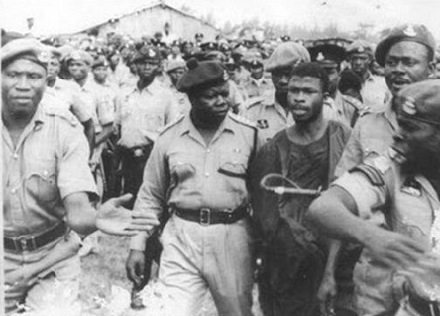
On this date in 1971, the Nigerian robber Ishola Oyenusi — “smil[ing] to his death,” in the words of the next day’s paper — was publicly shot with his gang at Lagos Bar Beach.

Dubbed “the most dangerous criminal of this decade” even though the Seventies were barely underway, “Doctor” Oyenusi — as he liked to style himself — sprang out of the wreckage of the 1967-1970 Nigerian Civil War, a charismatic, cocksure gangster whose lordly disdain for the law cast the terrifying portent of social breakdown.

Beyond Oyenusi loomed a systematic collapse of order that long outlived him. In years to come, other celebrity crime lords would follow; eventually, armed robbery proliferated into a frightfully ubiquitous feature of life in Lagos. Maybe the Doctor smiled at the stake because he foresaw his legacy.

Disturbingly unable to combat the plague systematically, authorities would resort to occasional high-profile executions instead, provided, of course, that the culprit’s misappropriations were of the retail street-crime variety, rather than the fruits of wholesale corruption.

Oyenusi was never in the same universe with such exalted impunity as enjoyed by the masters of the state. He got into the robbery business back in 1959, boosting a car (and murdering its owner into the bargain) to make it rain for his broke girlfriend. While he eventually expanded his operations into a brutal syndicate, he was still just a hoodlum; the infamy that packed the Bar Beach with 30,000 fellow humans who booed and jeered Oyenusi to the stake was merely enough to make him worth the quashing. (He was condemned to death specifically for a raid on the WAHUM factory in March 1971 that also claimed the life of a police constable.)

Six members of Oyenusi’s crime ring went with him to the stake on the same occasion. An eighth man was also shot in the batch for an unrelated armed carjacking.

There is a 1977 film by Nigerian director Eddie Ugbomah based on this flamboyant gangster’s life, The Rise and Fall of Dr. Oyenusi.

On this day..

1914: Seven retreating Frenchmen, with surprising results

One hundred years ago today, during the Battle of the Marne, seven French soldiers were shot without trial for retreating. Most of the resources about this Gallic tragedy are in French, and so are most of the links in today’s post.

The French book Fusille Vivant traces the life of Francois Waterlot, a prolific correspondent who wrote some 250 letters after surviving this date’s execution, before finally dying at the front the following year.

All were enlistees of France’s 327th Infantry Regiment. On the night of September 6, German shelling panicked their sister 270th Regiment into a disorderly retreat away from the front lines. That rout ran right into the 327th, behind them, and panicked that regiment too.

Further in the army’s rear, the hubbub awoke from his farmhouse bivouac division commander Gen. Rene Boutegourd. Boutegard had a simple solution, and ordered seven of the soldiers caught away from their posts to be executed the next morning by way of example. While the war’s later years would feature notoriously unfair courts-martial with predetermined sentences, Gen. Boutegourd didn’t even see the need to pay that much tribute to procedural regularity in this case.

The Battle of the Marne was still ongoing, and the situation in the field, pre-trench warfare, was fluid. Shoot them out of hand and be done with it! Then, the rest of the division will understand the consequences of unauthorized retreat.

Barbieux, Caffiaux, Clement, Delsarte, Dufour, Hubert, and Watrelot were stupefied to learn that they suddenly had mere hours left to live.

According to a postwar newspaper article — printed in 1922, when the bizarre case came to public attention and led to a posthumous pardon — they immediately began pleading for their lives. “Put us in the first wave of the next attack, but I beg you not to subject us to French balls,” Delsarte cried.

In those opening weeks of what was supposed to be a short war, with men’s minds still half at home in the pleasurable prewar idyll, the cruel frequency of the execution pour l’exemple had not yet set its stamp on things. The first such instance had occurred only the week before.

Maybe the men detailed to kill the “deserters” were equally stunned: it is hard to put down the results of the shootings merely to the uncertainties of technology or the hardiness of flesh and bone.

Palmyr Clement survived the fusillade and only died two agonizing days later from his firing squad injuries. This is a bizarre outcome even for those occasional cases where a fellow survives the scaffold. Implicit in such a fate is that there was no coup de grace administered after the volley. Is this oversight intentional — even an expression of distaste for the justice of the sentence soldiers had been tasked with visiting on their comrades?

And could distaste extend so far as an intentional or an indifferent failure of marksmanship by the firing details?

Such doubtful speculation can point to Francois Waterlot, who did Clement one better: he survived the execution full stop (dropping to the ground with the volley even though he was actually uninjured) and returned to the ranks, dying in battle on June 10, 1915. This uncommon feat earned him the nickname “le fusillé vivant”, “the shot alive” (somewhat literally) or “the living corpse” (more to the sense of it). That sobriquet is the title of a French book about Waterlot.

France executed about 600 of her own soldiers during World War I, the second-most (to Italy) of all belligerents in that conflagration. There is a great deal about this particular execution on this French page.

On this day..

1944: Three Soviet infiltrators, the last in Finland

The last executions in Finland occurred on this date in 1944, claiming the lives of three Soviet spies who had been parachuted behind Finnish lines.

I have been unable to locate the names of these men. They’re invariably presented simply in connection with — or as the denouement following — the September 2 execution of Finnish deserter Olavi Laiho.

The next morning (Russian link), Finland announced its disengagement from its problematic German alliance, an arrangement brokered by the western Allies who wanted to keep Finland democratic and non-communist despite sitting in Russia’s back yard and joining the wrong team in World War II. The Soviet Union immediately redeployed its forces away from the Finnish theater; a formal armistice was signed before September was out and prisoner transfers began in October.

Finland abolished the death penalty for all peacetime crimes in 1949, for all crimes full stop in 1972, and wrote the abolition into its constitution in 2000.

On this day..