1943: “Native parachutists” in Morocco

LONDON, Jan. 4 (U.P.) — The Morocco radio tonight quoted an announcement from General Henri Honore Giraud’s headquarters that an unspecified number of “native” parachutists, dropped in North Africa from German planes, had been executed for trying to swing local populations to the Axis cause. [Vichy North Africa had only recently gone over to the Allies -ed.]

The “fifth column” chutists found “only rare complicity,” the announcement said.

“The natives and their accomplices have all been arrested and executed immediately after court-martial,” it continued. “Military authorities contributed efficiently to the arrest of these enemy agents.

“Large rewards have been distributed to all those who helped capture the culprits.”

(Source: New York Times, Jan. 5, 1943.)

On this day..

1997: Eight foes of Qaddafi

On this date in 1997, Libya announced the executions of six military officers and two civilians as “agent-spies who sold their honor, dignity and homeland to their enemies and supplied agents of foreign governments with information relating to the country’s defense secrets.” They had been convicted just the day before.

The unnamed banned organization to which they were accused of passing state secrets was the exiled National Front for the Salvation of Libya, an opposition group which, after the fall of Muammar Qaddafi, reconstituted itself as the National Front Party and presently holds seats in the Libyan Congress.

At the time of the executions, the National Front claimed that their real offense was a failed 1993 revolt.

  • Col. Miftah Qarrum al-Wirfalli
  • Major Ramadhan al-’Ayhuri
  • Major Khalil Salam Mohammad al-Jidiq
  • Col. Mostafa Abu al-Qassim Mas’ud al-Kikli
  • Lt-Col. Sa’ad Saleh Farag
  • Major Mostafa Ihbayl al-Firjani
  • Dr Sa’ad Misbah al-‘Amin al-Zubaydi
  • Sulayman Ghayth Miftah

On this day..

1936: Harry Singer, in the holiday spirit

(Thanks to Robert Elder of Last Words of the Executed — the blog, and the book — for the guest post. This post originally appeared on the Last Words blog. Fans of this here site are highly likely to enjoy following Elder’s own pithy, almanac-style collection of last words on the scaffold. -ed.)

(Said to a guard) “The chair will be a good enough [Christmas] present for me.”

— Harry Singer, convicted of murder, electric chair, Indiana.

Executed December 26, 1936

The twenty-five-year-old former farmhand kept mostly to himself Christmas Day, playing checkers and eating “heartily,” according to the Associated Press. Few details of the crime have survived, except the names of his victims: Mr. and Mrs. John Wesley Kaufman and their daughter, age twelve. In prison, Singer also confessed to the murder of Joseph Bryant, age twenty, of Detroit.

On this day..

1963: Russell Pascoe and Dennis Whitty, Britain’s second-last hanging date

On this date in 1963, gallows traps dropped simultaneously in Bristol and Winchester to hang two men for murdering a Cornish farmer.

Russell Pascoe and Dennis Whitty were laborers living out of a caravan in the Truro area; Pascoe had formerly worked for the victim, William Rowe, and knew a rumor that the 64-year-old recluse kept a small fortune stashed at Nanjarrow farm.

Late the night of August 14, 1963, the young toughs called at Nanjarrow. When William Rowe answered the door, they instantly beat and stabbed him to death. Perhaps they ought to have thought the plan out better, because William Rowe actually did have £3,000 on the premises … but Pascoe and Whitty only found four quid. (They split it.)

The killers were picked up before the week was out.

“We are both over twenty-one, so I suppose we can hang?” Whitty inquired.

Then they both started trying to blame each other. So the answer was yes.

Robert Douglas, later a bestselling author, was then a young prison guard beginning a career in corrections. He was on the detail guarding Pascoe and on friendly terms with the condemned man who was practically his own age.

Years later, with a lifetime’s wisdom at his back, Douglas wrote about it in his memoir of the prison At Her Majesty’s Pleasure. It’s an experience he says he has always remembered:

I can remember saying to Ken [Russell, another guard], ‘I’m not looking forward to this shift — I mean, what the hell are we going to talk about all evening?’ I was only 24 years old myself at the time, and we had built up a good relationship with Pascoe over the previous six weeks – playing cards and Monopoly and listening to the radio.

We went into the cell, and I asked Russell if he wanted a cup of tea. He said he didn’t. So I tried to coax him – ‘I’ve brought you a cream doughnut’ – I’d brought him a cream cake each day as a little treat. With that, he perked up a little and said, ‘ah go on then, I’ll have a tea’.

So we sat drinking tea for a while, none of us really saying anything. Just blathering about nothing to try to fill the silences.

Then Russell suddenly said, ‘They weighed me today, so they’ll know how far I’ll drop.’ Ken and I just looked at each other – what are you meant to say to that?

These were the third- and fourth-last men people put to death under Britain’s capital punishment statutes. (Here’s a picture at the doors of Bristol’s Horfield Gaol.) England would see only one more hanging date, another double execution conducted at two different prisons, before it abolished the death penalty.

* Writing a piece for his local paper about the hanging actually led Douglas into his later career

On this day..

1941: The massacre at Skede in Liepaja

The World War II occupation of the Latvian town of Liepaja (Libau, to the Germans) produced mass executions throughout 1941.

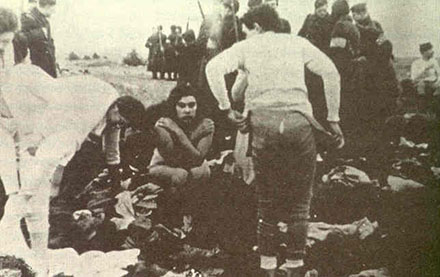
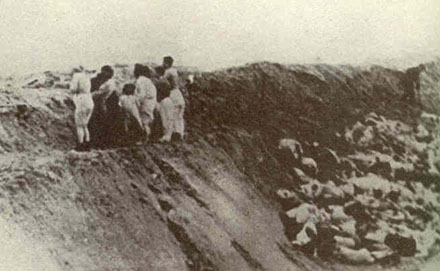
This date in 1941 commenced one of the largest such actions: over 2,700 Jews as well as 23 Communists forced over the course of two-plus days to strip on the freezing Skede dunes overlooking the Baltic and there shot by German and Latvian teams into a vast pit. It’s one of the most recognizable Holocaust atrocities because it was extensively photographed.*

As one can see from the pictures, the victims here were mostly women.


Some of the women in this photographs can be identified by name (pdf). Left to right: (1) Sorella Epstein; (2) presumably Rosa Epstein, her mother; (3) unknown; (4) Mia Epstein; (5) unknown. Alternate identification makes Mia Epstein (5) instead of (4), and (2) Pauline Goldman.

Almost all of Liepaja’s Jews perished during the war.

* Germany’s Bundesarchiv (search on Libau 1941) confirms the precise December 15 dating for these images; it also has some other photographs of atrocities in Liepaja/Libau on other occasions.

On this day..

1980: Erdal Eren, leftist student

On this date in 1980, 17-year-old Turkish student radical Erdal Eren was hanged as a terrorist by the military regime.

Eren (Turkish Wikipedia link; most other links here are also in Turkish) was one of about 50 people executed following the military coup of September 12, 1980.

After a decade of bloody left-right civil strife, the Turkish generals toppled the civilian government on that date. Hundreds of thousands of arrests with rampant torture marked the period, but it did quell the endemic street fighting and terrorism of the 1970s.

Erdal Eren was actually arrested during the chaotic pre-coup period. February 1980 student protests after the murder of Sinan Suner, an activist of the communist Patriotic Revolutionary Youth Association, turned into a melee that resulted in an officer shot dead under confused circumstances. Eren was among 24 students rounded up.

Despite his youth, Eren was sentenced to die in a March 19 trial — but his appeals had legs until the post-coup military junta abruptly sent him to the gallows on December 13.

Eren went to his death with a brave step, gamely writing his family that he had witnessed so much torture in prison that death was a relief and not a terror.

He’s very warmly remembered today. A number of cultural artifacts pay tribute to the young martyr, including two different songs (“Two Children”, “Seventeen”) by Teoman, a relative of Erdal Eren’s.

On this day..

1957: Jorge Villanueva Torres, Monstruo de Armendáriz

On this date in 1957, Jorge Villanueva Torres was shot in Lima, Peru as the notorious “Monstruo de Armendáriz”.

Except Jorge Villanueva Torres wasn’t actually the monster. His case is well-known in Peru but less so beyond, and all links in this post are to Spanish pages.

Villanueva’s hasty transmogrification began on the ninth of September 1954, when headlines announcing the discovery of a dead three-year-old child near Lima commenced a national crime hysteria. Authorities surmised that the little boy had been raped, too.

Vague eyewitness fixing on the suspect’s height and dark skin* brought many arrests of people fitting these loose criteria. Villanueva, a career petty criminal, fit that bill; when police announced him as the suspect, he became the object of his countrymen’s hatred.

Convicted in an atmosphere of prejudicial hysteria on the strength of eyewitness testimony loosely matching him to someone who might have given the victim a sweet to lure him off, Villanueva exploded with rage, even attempting to attack the judge. Naturally this only served to further implicate him as an uncontrollable beast — not as a falsely accused man pitiably near the breaking-point after two years as a nation’s scapegoat.

Villanueva asserted his innocence all the way to the fatal stake.

Those futile protestations are today widely accepted as true. There was little firm evidence against him and even the contemporary autopsy ruled against the incendiary child-rape allegation. Later forensic investigations have suggested that the poor child might simply have been the victim of a hit-and-run car accident. The mingled torments of guilt and relief in such a motorist as the matter played out must have been profound.

This case remains in present-day Peru a standing warning against occasional attempts to reintroduce the death penalty in response to the outrageous crime du jour. (Peru abolished the death penalty for all peacetime offenses in 1979.)

The Peruvian band Nosequien and Nosecuantos muses on the injustice in a single that shares its title with Villanueva — “Monstruo de Armendáriz”.

Whomever was the true “monster” — and whatever that person’s true measure of monstrosity — has never been known.

* Racism in Peru against black skin was then and remains today endemic.

On this day..

1937: Douglas Van Vlack

(Thanks to Robert Elder of Last Words of the Executed — the blog, and the book — for the guest post. This post originally appeared on the Last Words blog here. Fans of this here site are highly likely to enjoy following Elder’s own pithy, almanac-style collection of last words on the scaffold. -ed.)

“I have a right to choose the way I die!”

— Douglas Van Vlack, convicted of murder, hanging, Idaho.
Executed December 9, 1937

Van Vlack kidnapped his ex-wife and killed her, as well as two police officers. A few hours before his hanging was scheduled, Van Vlack broke away from his guards and scrambled over the cell block to cling to the ceiling rafters. He stayed in the ceiling for a half an hour as his lawyer and the prison chaplain begged for him to come down; he jumped thirty feet below just before the guards entered the cell block with a net. Van Vlack’s hanging was unsuccessful; technically he died the next day, December 10, after a few hours in a coma.

On this day..

1934: John and Betty Stam, China missionaries

On this date in 1934, Chinese Communists beheaded John and Betty Stam in the Anhui province town of Miaoshu.

The Stams had settled as China Inland Mission proselytizers in the town of Jingde (at their time generally rendered as “Tsingteh”). Betty Stam (nee Scott) had grown up in China, the daughter of a Presbyterian missionary. John was a New Jersey native who had graduated Moody Bible Institute in 1932. They had a three-month-old daughter named Helen Priscilla.

On December 6, 1934, Communist rebels in China’s long-running civil war entered Jingde and seized the foreign family. According to a tribute page kept by a great-nephew of the, John wrote a short note that evening.

Tsingteh, An.
Dec. 6, 1934

China Inland Mission, Shanghai

Dear Brethren,

My wife, baby and myself are today in the hands of the Communists in the city of Tsingteh. Their demand is twenty thousand dollars for our release.

All our possessions and stores are in their hands, but we praise God for peace in our hearts and a meal tonight. God grant you wisdom in what you do, and us fortitude, courage and peace of heart. He is able-and a wonderful Friend in such a time.

Things happened so quickly this a.m. They were in the city just a few hours after the ever-persistent rumors really became alarming, so that we could not prepare to leave in time. We were just too late.

The Lord bless and guide you, and as for us, may God be glorified whether by life or by death.

In Him,
John C. Stam

The author of John and Betty Stam: Missonary Martyr summarizes his subjects’ “inspiring and instructive story” in a blog post here.

A foreboding message, but Christian evangelizing in China had often proved dangerous to its practitioners.

The next day they were marched 12 miles to Miaoshu where they stopped for the night. Facing martyrdom, the couple stowed their daughter away like Moses, hidden in a sleeping bag with John’s last missive and ten dollars that might serve to care for her.

Miraculously, Helen Priscilla would be overlooked when the Stams’ captors came for them on December 8 and marched them through Miaoshu. It’s said that one Chinese vendor made bold to object, and was added to the doomed party for his trouble. At the end of the march, John was forced to his knees and beheaded before his companions’ eyes; Betty and the shopkeep followed him.

Little Helen survived her parents’ ordeal. A Chinese evangelist named Lo found the girl and carried her 100 miles to a mission hospital. She was taken in from there by Betty’s parents and eventually adopted by Betty’s sister and raised in the Philippines before returning to the United States.

Back in China, another missionary, Frank Houghton, was moved by the sacrifice of the Stams to compose a hymn, “Thou Who Wast Rich Beyond All Splendour” (set to an old French canticle, Quelle est cette odeur agréable?).

On this day..

1982: Dos Erres massacre

On December 7, 1982, a unit of army commandos entered the Guatemalan hamlet of Dos Erres.* There it authored one of the signature atrocities of the bloody Guatemalan Civil War.

This was the Guatemala of Efrain Rios Montt, once a junior officer during the CIA-backed 1954 coup that set in motion decades of civil strife.

Relative brutality in that conflict waxed and waned over the years. In 1982, the now-General Efrain Rios Montt overthrew another general and went full werewolf. “A Christian has to walk around with his Bible and his machine gun,” Rios Montt infamously remarked. And more than walk them: the general’s policy was a you’re-either-with-us-or-with-the-terrorists hard line called Frijoles y Fusiles, “beans and shooting.” Campesinos who were with Rios Montt got the beans.

Shortly before this date’s atrocity, a column of Guatemalan soldiers were ambushed by leftist guerrillas, killing 21. Those guys were going to get the fusiles — them, or any convenient peasants who might hypothetically be on friendly terms with them.

Dos Erres, a remote jungle village of 60 families, was the settlement nearest where the rebels were thought to be operating. The little town had already drawn the ire of the army by resisting recruitment to civil defense patrols.

Late on the night of December 6, 1982, 20 members of Guatemala’s Kaibiles commandos set aside their special forces uniforms and disguised themselves as guerrillas, in green t-shirts and civilian trousers and red armbands. Ostensibly their mission was to recapture the rifles the rebels had seized from the ambushed convoy, which were supposed to be stashed in Dos Erres.

Hiking two hours into the jungle to reach their target, the commandos crept into the still-sleeping settlement at 2 in the morning. With the support of a 40-man regular army detachment to seal Dos Erres’s perimeter, the commandos stormed into residences and drug bewildered townspeople out, herding the men into a school and the women and children into a church.

That commenced an all-day litany of horrors for the residents of what was about to become the former village. Dos Erres was wiped off the map by the end of it.

One of the senior lieutenants on the mission raped a woman, and other commandos immediately availed themselves of the implied license to abuse women and girls. By the end of it, the last sobbing women and children were led out to the forest and machine-gunned en masse.

They were by then the last survivors, save for a little boy who managed to escape into the jungle. Throughout the course of the 7th of December, the Kaibiles brought villagers old and young to the edge of the town well. “As they were brought to the well, they were asked, ‘where are the rifles?’,” one of the participants later described. “They said nothing about rifles, and they were hit on the back of the head with a sledgehammer, and thrown in the well.” Every commando had to participate, so that all were implicated.

Commando Gilberto Jordán drew first blood. He carried a baby to the well and hurled it to its death. Jordán wept as he killed the infant. Yet he and another soldier, Manuel Pop Sun, kept throwing children down the well.

The commandos blindfolded the adults and made them kneel, one at a time. They interrogated them about the rifles, aliases, guerrilla leaders. When the villagers protested that they knew nothing, soldiers hit them on the head with a metal sledgehammer. Then they threw them into the well.

“Malditos!” the villagers screamed at their executioners. “Accursed ones.”

“Hijos de la gran puta, van a morir!” the soldiers yelled back. “Sons of the great whore, you are going to die!”

[Commando Cesar] Ibañez dumped a woman in the well. [Favio] Pinzón, the cook, dragged victims there alongside a sub-lieutenant named Jorge Vinicio Sosa Orantes. When the well was half-filled, a man who was still alive atop the pile of bodies managed to get his blindfold off. He shouted curses up at the commandos.

“Kill me!” the man said.

“Your mother,” Sosa retorted.

“Your mother, you son of the great whore!”

Pinzón watched as the infuriated Sosa shot the man with his rifle and, for good measure, threw a grenade into the pile. By the end of the afternoon, the well overflowed with corpses.

The commandos left town the next morning with six captives: the rebel who had been forced at gunpoint to guide the Kaibiles to Dos Erres in the first place (he would be executed in the field); three teenage girls (the soldiers that night would take turns raping them, then strangled them the next day); and two very small boys (these were returned to the Kaibiles base). A few days later, the army returned and razed the remains of the devastated town to the ground. Only recently has the site been excavated and its many victims’ remains cataloged for proper burial.

The tragedy of Dos Erres became public in the 1990s. Five soldiers who participated in the butchery have each been sentenced to 6,060 years in prison just for this one incident, but there were many more like it in Guatemala in those years — many more people who were put to Frijoles y Fusiles.

A 1990s truth commission after the war pegged the total number of civilians killed during the war above 200,000, mostly indigenous Mayans and (as was the case for most at Dos Erres) mestizos. “State forces and related paramilitary groups were responsible for 93% of the violations documented.”

The truth commission also found that the “government of the United States, through various agencies including the CIA, provided direct and indirect support for some state operations.” Indeed, supporting death squads against leftists in Central American dirty wars was overt U.S. policy during the 1980s; just days before Dos Erres, U.S. President Ronald Reagan returned from a Latin American tour and told reporters that Rios Montt, whom he had just met, was “totally dedicated to democracy in Guatemala.”

“They’ve been getting a bum rap” from human rights nabobs, Reagan averred.

In the fullness of time that rap would eventually encompass Rios Montt’s own remarkable conviction for crimes against humanity and (since the Mayan population was targeted en masse) genocide in a landmark case that’s still being appealed as of this writing. (The May 2013 verdict against Rios Montt was immediately overturned; the case is obviously extremely politically sensitive.) In a separate case, he’s been charged specifically with responsibility for the Dos Erres massacre.

U.S. President Bill Clinton formally apologized for Washington’s role in Guatemala after the truth commission’s findings were issued in 1999.

The PBS radio program This American Life has an hour-long documentary about Dos Erres here; a companion ProPublica series has even richer (and more horrifying) detail.

* Named for its founders, two men named Ruano and Reyes, the name literally meant “two Rs”.

On this day..