1989: Vladimir Lulek, the last Czech executed

On this date in 1989, the then-united Czechoslovakia hanged Vladimir Lulek for slaughtering his wife and four children. (Czech link, as are the others in this post.)

Lulek, who died at Prague’s Pankrac Prison, has the distinction of being the last person executed in what now constitutes the present-day Czech Republic. (A Slovak man named Stefan Svitek was put to death later that same year in Bratislava; Svitek holds that same distinction for both present-day Slovakia and for the former Czechoslovakia as a whole.)

On this day..

1947: Henry Rinnan, Norwegian collaborator

On this date in 1947, a firing squad shot Henry Rinnan for treason at Trondheim’s Kristiansten Fortress.

Standing just 5′ 3″ on tippytoe, Rinnan (English Wikipedia entry | Norwegian) stands tall as Norway’s most notorious World War II collaborator this side of Vidkun Quisling.

That physique got him turned away when he tried to volunteer to fight the Soviets in the Winter War, but it didn’t put the Gestapo off him after Germany occupied Norway in 1940. He formed an informants’ network known as the Rinnanbanden which infiltrated the resistance movement and entrapped anti-occupation Norwegians — a “game in the negative sector,” as Rinnan described it.

The “game” got more than a thousand people arrested and something like 100 killed, including one of the more notorious episodes of the occupation, the Majavatn affair. (Norwegian link) It also eventually got Rinnan a German rank and the opportunity to kill some people personally.

Twelve people in all from the Rinnanbanden were sentenced to death after the war, counting Rinnan. Ten of those did indeed pay the penalty.

There’s a Norwegian page about the Rinnanbanden here.

On this day..

1902: A day in the death penalty around the Pacific Northwest

The U.S. states of Washington and Oregon both hanged murderers on this date in 1902.

Oregon

The death knell for local public(ish) hangings in Oregon took place this morning in the courthouse of Portland’s courthouse under the eyes of 400 invited witnesses and numerous additional gawkers who scaled telegraph poles or stationed themselves on nearby rooftops.

Jack Wade and William Dalton hanged together for murdering one James Morrow just three months for two bits. It was an uncomplicated crime: the villains stuck Morrow up as the latter returned one night from paying court to a young lady, then shot him when Morrow made a sudden move.

On hanging day, the pair addressed an ample breakfast of ham, chicken and eggs, knocked out some hymns and an impromptu rendition of “Where Is My Wandering Boy Tonight?”

… and then took a cavalier stroll to the gallows where Wade displeased right-thinking folk with his devil-may-care attitude towards his own execution. He tossed a cigar to the crowd, and played his fingers over the hemp as the rope was fastened, remarking with a wink, “it is tough.”

While the hanging itself went off without a hitch, the curious onlookers pushed through the rail meant to restrain them once the bodies were cut down and began scrabbling for bits of hemp. The sheriff finally had to clear the courtyard.

Even worse, “ten or 12 women witnessed the execution” from atop a building at Fifth and Main street, according to the Oregonian‘s report the next day. “It is doubtful if such a thing ever occurred before at a legal hanging in this country.”

The legislature some years previous had tried to get a handle on execution decorum by moving hangings off public squares and into jails, so this public(ish) execution wasn’t technically public at all. But as seen, these facilities with their barrier-toppling invited mobs and conspicuously feminized illicit peepers surrounding still affronted the alleged solemnity of the moment and led the legislature at its next sitting in 1903 to enact a statute requiring that “all executions should take place within the walls of the [state] penitentiary, out of the hearing and out of sight of all except officials.”

Wade and Dalton weren’t actually the last to hang publicly(ish) in Oregon, however. Since the law wasn’t retroactive, several additional executions occurred after the penitentiary-hanging law was enacted — the last as late as 1905. (See Necktie Parties: A History of Legal Executions in Oregon, 1851-1905).

Washington

Chinese immigrant Lum You was hanged at South Bend, Washington on January 31, 1902. He shot a man named Oscar Bloom during a drinking bout that turned into a drunken bout.

Lum You actually escaped his condemned cell on January 14 when his dinner was being fetched by the jailer and stayed on the lam for a couple of days, but was recaptured on January 17 by a posse. He allegedly begged them to shoot him dead right there, then changed his mind when some business-minded character actually produced a weapon. (Credit to the great Northwest for its highly accommodating vigilantes.)

On this day..

1928: Ben “Two Gun” Fowler, cinema shooter

(Thanks to Meaghan Good of the Charley Project for the guest post. -ed.)

On this day in 1928, a lawman was electrocuted in Nashville, Tennessee for the drunken double murder he’d committed nearly a year earlier. He walked resolutely to the death chair and even helped the guards adjust the straps before they pulled the switch.

Deputy Sheriff Ben “Two Gun” Fowler possessed three main qualifications for Prohibition-era law enforcement:

  1. He was enormous in size.
  2. He had a menacing demeanor.
  3. He was a World War I veteran. (Although, it’s true, most of his service time had been spent in the hospital battling the Spanish Flu.)

His main duty seems to have been busting up whiskey distilleries; he claimed he had destroyed 200 of them during his three years of service in Scott County, Tennessee.

Not being a wasteful man, he consumed much of the confiscated booze himself. He was thus fortified with moonshine on the night of his crime: March 5, 1927.

The town of Robbins lacked a theater, so its residents regularly screened films in the school auditorium. A large crowd came to see a comedy that fateful March night, Fowler among them. He was armed with his usual two pistols, and also wearing a bullet-proof vest.

Supposedly, he planned to serve a civil warrant on someone whom he thought would also be attending the movie.

But shortly after the film began, Fowler became annoyed by some noisy children and ordered them to keep quiet or he would arrest them. This prompted laughter from others in the crowd, including Dr. Wylie W. Foust. Fowler ordered him to shut up and threatened to arrest him, and Foust replied calmly, “You won’t do that.”

Foust was right: Fowler didn’t do that. Instead he struck him in the face with one of his pistols then shot him two or three times in the head. The doctor fell dead on the spot. If this sounds familiar, it’s because armed moviegoers are still to this day known to demand polite moviegoers.

Dr. Foust’s adult son was sitting behind him, and he was also armed. He pulled out his own pistol and shot at his father’s killer, but the bullets were ineffective against Fowler’s bullet-proof vest.

Fowler returned fire. At least two bystanders were shot in the melee. One of them, 53-year-old John Wesley West, also a deputy sheriff, was fatally wounded and died at the hospital.

For some time after the shootings, the drunken deputy stalked the auditorium, brandishing his pistols. He kept all the filmgoers in a state of terror, and ordered the Widow Foust to stop crying. Finally more level-headed armed men arrived and Fowler was put under arrest.

Justice moved swiftly: the murders happened Saturday night, Fowler was indicted on Monday, his trial started on Thursday, and the jury got the case the following Monday. Fowler’s defense was intoxication: he claimed he was too sauced to know what he was doing, which reduced his crimes to second-degree murder, a non-capital offense.

Although most witnesses agreed “Two Gun” was under the influence at the time of his senseless outburst, they couldn’t agree just how drunk he was, and no one could testify as to how much alcohol he’d actually consumed prior to the shootings. The jury took only two minutes to convict.

It should be noted that this wasn’t Fowler’s only brush with the wrong side of the law, either: he and another deputy had previously been charged with killing two moonshiners, but both men were acquitted in that case.

Fowler, a Kentucky native, was the only Scott County residence to die in the electric chair in Nashville. He was 35 years old when he attained that distinction.

On this day..

1963: Lazhar Chraiti and nine other Tunisian conspirators

Ten men were executed at dawn on this date in 1963 in Tunis for an assassination plot against President Habib Bourguiba.

Lazhar Chraiti. His daughter has founded a center dedicated to rehabilitating his memory.

Bourguiba was first president of the independent Republic of Tunisia, having led that country out of French domination in the 1950s … and this plot was the first major threat to his rule. “It is a miracle that I am still alive,” he told a women’s conference at the western city of El Kef after it was discovered on December 19. Kebair Meherzi, an officer of President’s Guard (who was among those executed this date) had been privy to the plot, and intended to admit the assassins to Bourguiba’s own bedside. (London Times, Dec. 27, 1962)

Twenty-six people faced a military trial for this attempted coup in early January with thirteen death sentences handed down — most notably including legendary Arab independence guerrilla Lazhar Chraiti (by now a respected official in the ruling Neo Destour party).

One of those 13 was condemned in absentia, having already fled the country to Algeria — the plotters’ Algerian ties caused Tunisia to withdraw its embassy — while two other army officers were reprieved to life and hard labor.

On this day..

2000: Spencer Corey Goodman

On this date in 2000, music producer Bill Ham — noted as the manager of ZZ Top — settled into the witness booth at Huntsville to watch Spencer Corey Goodman suffer lethal injection for the murder of Ham’s wife.

“Minutes before the execution, a witness turned to” Ham, one paper reported, “and asked how he was doing. ‘Great,’ Ham replied.”

Ham’s wife Cecile, 48, left her Houston residence on July 2, 1991, and never returned. Five weeks later, her red Cadillac led Eagle County, Colo. deputies on a 32-mile high-speed chase until it plunged over a cliff. The driver survived: he was Spencer Goodman, a repeat felon who had just been paroled.

According to the statement he gave in custody — a statement that helpfully ticks every box a state’s attorney would need for a capital conviction — he’d been very busy during his brief liberty.

On July 1, 1991, I was released from the old Bexar County Jail … I was given a bus ride back to Houston, Texas by Wackenhut [a private prison company -ed.] and dropped off on the east side of town at 9:30 a.m. I was given my papers to report to Texas House at 5:30 p.m. that night. Instead of going to the halfway house I started walking west. I walked most of the night. … During the day on Tuesday, July 2, 1991, I started walking out Memorial Drive. During the mid-afternoon it started raining. I walked up into a Walgreens parking lot maybe about 4:00 p.m. and just hung around the parking lot for about 20 to 30 minutes. I saw a white female drive up in a 1991 red Cadillac. She pulled up in the firelane along the blind side of the parking lot and then went into the Walgreens store. At that time I was not really watching her, but I don’t think that she stayed inside the drug store very long. When the lady came out of the store she opened the driver’s door and started getting into the car. I decided at that point that I wanted to take her car from her. I had been walking for a long time and my feet hurt and I wanted some transportation. I ran up behind her while the driver’s door was still open. She was sitting behind the wheel, and I shoved her over with one hand and punched her just under the left ear, to knock her out. She fell over to the passenger’s side and was knocked unconscious. I got into the driver’s seat. I think that I may have hit her in the back of the neck to make sure that she was unconscious. I think that the keys to the car were in her hand because they fell to the floor. I picked them up and started the car and then looked around to see if anyone had seen what happened. It was raining, and there was nobody around the parking lot. I first pulled out of the parking lot and turned right on Memorial going west, but there was a subdivision down that way, so I turned around and went to the Dairy Ashford for a ways and then turned off towards the west. I know that I was near a high school off of Dairy Ashford. I pulled off the main road and parked on a side road off behind this little building. I then used martial arts and broke the lady’s neck. I don’t know why I did it, but I know that I was lost. I then put her in the trunk of the car. I did not have on a shirt because my shirt was wet from the rain. I was also wearing jogging pants. After I put her in the trunk, I drove down this road. I was right by this high school when I saw this guy in a truck. I then asked him how to get to I-10. . . . I followed the guy’s direction. As I was driving I went through the lady’s purse and got out her wallet. I found about $20.00 and some change in her purse and some credit cards. I saw an Exxon gas station at HWY 6 and Westheimer so I stopped and filled up with gas. I used the Exxon gas card and signed the name on the card. I then got on I-10 and headed west. . . . . . . I knew that she was dead when I put her in the trunk because I felt on her pulse.

The killer’s niece, Megan Goodman, posted a sad memorial to a man who became in his last months “like my older brother”. Though the original host site appears to be several years gone, archive.org preserves it here.

On this day..

1944: Max Sievers, freethinker

On this date in 1944, German freethinker Max Sievers was beheaded at Brandenburg Prison for “conspiracy to commit high treason along with favouring the enemy.”

A working-class Berliner, Sievers (English Wikipedia entry | German) became a prominent communist and atheist writer in the interwar years. He directed the Association of Freethinkers for Cremation from the early 1920s, and in 1927 became the chair of the German Freethinkers League.

This was not a demographic Adolph Hitler was courting. In the wake of the 1933 Reichstag Fire, the Nazis stamped out atheistic movements, even converting the Freethinkers’ building into a Protestant recruitment venue.

Briefly imprisoned, Sievers fled Germany upon his release later in 1933 and from exile in Belgium — and then, after Belgium was conquered, in hiding in France — he kept up a drumbeat of antifascist propaganda, notably the 1939 book Unser Kampf gegen das Dritte Reich: von der nazistischen Diktatur zur sozialistischen Demokratie.

He was finally arrested by the Gestapo on June 3, 1943, and condemned to death by Roland Freisler.

Sievers was posthumously exonerated in 1996, and is today — and on January 17th in particular — an honored martyr for German humanist, atheist, and freethinker groups.

On this day..

1942: Senitsa Vershovsky, Mayor of Kremenchuk

(Thanks to Meaghan Good of the Charley Project for the guest post. -ed.)

On this date in 1942, Senitsa Vershovsky was shot in the city of Kremenchuk in the Soviet Union, in what is now the Ukraine.

Vershovsky was the mayor of Kremenchuk and was also a major in the Red Army. His executioners were members of Einsatzgruppe A, one of Nazi Germany’s mobile killing squads: they killed Vershovsky for “carry[ing] out his duties in gross defiance of German orders … [and] sabotaging the handling of the Jewish problem by having a great number of Jews baptized in order to remove them from German control.”

Approximately 30,000 Jews lived in Kremenchuk, constituting 40% of the city’s population and they had good cause to remove themselves as far as possible from German control. The Einsatzgruppen, as they did in countless other cities throughout the Soviet Union, rounded up the Jewish population, forced them to dig their own graves, and machine-gunned them by the thousands.

Vershovsky’s attempts to help the Jews under his charge, futile though his efforts may have been, nevertheless deserve a footnote in history. For, as historian Raul Hilberg noted, in all the situation reports filed by the Einsatzgruppen during their 22 months of operation,

This incident appears to be the only one of its kind. The counterpressure was evidently too great. Whoever attempted to aid the Jews acted alone and exposed himself as well as his family to the possibility of a death sentence from a German Kommando. There was no encouragement for a man with an awakened conscience.

In a time of great adversity, Senitsa Vershovsky showed himself to be a courageous and fundamentally decent human being, and he paid for it with his life. The least we can do is remember him.

On this day..

1973: Lim Seng, under Philippines martial law

On this date in 1973,* under the then-new martial law regime of Philippines strongman Ferdinand Marcos, a 52-year-old Chinese businessman was shot at Fort Bonifacio.**

Lim Seng was a struggling restauranteur in the 1960s when he dove into the heroin business.

He wasn’t struggling much longer.

He quickly became the Walter White of Manila heroin production, exploiting ties to criminal syndicates in the Golden Triangle to churn out (by the early 1970s) 1.2 tons of smack. Ninety percent of it was exported to the United States. (.pdf source on Lim Seng’s criminal career)

The other 10% helped feed a burgeoning heroin addiction among Manila students, leading to a seminal 1972 anti-drug law under which Lim Seng was arrested days after martial law came down that September. He faced a military, rather than a civilian trial.

Naturally quite wealthy from his enterprise, he evidently believed up until the last moments that he could buy his way out of execution. Little did he understand that he had been ticketed to demonstrate the incipient dictatorship’s iron fist: thousands of civilian spectators crowded the ropeline of the rifle range to glimpse the garishly publicized ceremony, while others took in the radio broadcast or news footage.

Lim Seng was the first person executed by the Marcos regime for drug trafficking.

* Lim Seng was tried in December 1972, and some sources report this as his execution date. Contemporary newspaper accounts unambiguously confirm that the execution took place on January 15, 1973.

** Fort Andres Bonifacio, formerly a base of the U.S. occupation called Fort McKinley, was christened for an executed Filipino patriot.

On this day..

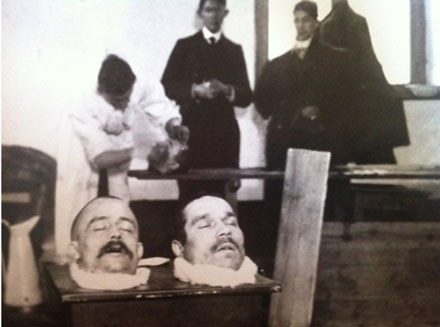
1909: The Pollet gang, breaking the French moratorium

Warning: Graphic severed head pictures await at the bottom of this post.

On this date in 1909, the guillotine returned France after an absence of more than three years.

The sitting president was a staunch death penalty opponent and had blocked all executions since his term began in 1906. That was about the same span of time that the Pollet gang had, in the words of a New York Times wire report,* “infested the Belgian-French frontier, robbing churches, houses, and inns, holding up stage coaches and belated travelers, and torturing and slaying their victims according to the old piratical adage that dead men tell no tales.”

Abel Pollet had been a smuggler who put his native gift for leadership to good use organizing his fellow traffickers into a more lucratively violent line of work. Thanks, presumably, to the syndicate’s pre-existing professional aptitude for evasion, it persisted for years and authored a quantity of robberies and murders that authorities could only guess at. (The official homicide estimation ran north of 50.) It was a spree so atrocious that it helped force the end of the whole death penalty moratorium since sentiment was so strong against the Hazebrouck gang .

Incited by the many depredations and perhaps starved from years without the bloody spectacle of public execution, a vast concourse of 30,000 mobbed the guillotine at Bethune.

“At midnight there were 2,000 watchers in the square,” one report ran. “The main street of the town was crowded as on the eve of a fete. Soon after midnight men brought ladders and benches to the square and mounted them to obtain an uninterrupted view. Others climbed into the branches of trees, where their presence was revealed by the glow of cigarettes and pipes in the dark among the branches.”

Undeterred by the steady winter’s drizzle, they would wait all the night through, their numbers continually augmented as road-trippers arrived by train.

At four in the morning the dread traveling executioner Anton Diebler, who had already plied this trade for a generation and more and would continue in the role for another 30 years, arrived with four assistants to set up the guillotine. It was only with difficulty that police restrained the pawing mob.

By half-past five the public prosecutor officially informed the condemned men what they surely already knew — that there would be no mercy. The crowd on the square would have its prey.

As the first robber, Theophile Deroo, emerged at 7:25 a.m., “there was a painful silence, and then an outbreak of hoots and curses from the crowd.” A wilting Deroo had to be hustled to the board amid the jeers. “A mort! A mort!” came the howls.

Three times in the next eight minutes the executioners furiously scrubbed the apparatus clean while guards (per the Times) “held the crowd back with main force.”

Canut Vromant followed coolly; Auguste Pollet was third, fighting and shouting. His brother, the leader Abel Pollet, went under a rain of curses that he answered with the words “Down with the priests! Long live the Republic!”

People are ghoulish. Far be it from us to deny them.


Top: the heads of the Pollet brothers. Middle: The heads of their two accomplices. Bottom: Canut Vromant’s headless trunk awaits autopsy. All images from the invaluable Bois de Justice, via this goregrish forum.


After the quadruple executions, the heads are cleaned up. (Source)

Perhaps, dear reader, you find the public exhibition of these severed heads objectionable. If so, you have an ally in the French state that did the severing.

For years, French elites had been fretting the indecorous behavior of the crowd at what was supposed to be a solemn occasion. The advent of photography only made matters worse, for now the discomfiting head-chopping exercise could be shared with those indisposed to sitting up all night smoking pipes in trees.

But as the moratorium gave way, the rising media form of cinema promised even more debased exhibitions. Enterprising cinematographers were already staging execution re-creations; now there was the prospect for film audiences to be incited to countless bloodlust frenzies by on-the-scene deathporn footage of hated criminals going under the blade. It was in response to just this fear that France a bit later in 1909 promulgated (French link) its first film censorship rules — forbidding in this case the public display of film liable to disturb the public tranquility.

* Jan. 16, 1909 … under the excited headline “THIRST FOR BLOOD AMONG THE FRENCH”,

On this day..