1908: Massillon Coicou and the Firminists

On this date in 1908, the octogenarian Haitian president Pierre Nord Alexis had a number of political opponents arrested and, that very night, summarily executed.

Nord Alexis, a career officer risen to the post of Minister of War in a provisional 1902 government* when the previous president Tiresias Simon Sam* resigned to avert a constitutional crisis.

That was a strange affair: a misreading of the constitution had Sam set to rule until 1903, until someone caught the mistake. Sam’s diligently on-time resignation proved not the Rule of Law victory he might have hoped when the resulting power vacuum brought civil war.

The contest for power boiled down to Nord Alexis on one side, and the scholar and diplomat Joseph Auguste Antenor Firmin on the other.**

As one can see, Nord Alexis won it — but the conflict flared again in 1908, with the exiled Fermin making an attempt to return to Haiti. Nord Alexis’s response was ruthless and, for now, effective. (Nord Alexis was ousted later in 1908, however.)

Massillon Coicou

Prominent among the victims of the crackdown this date was the novelist and poet Massillon Coicou (English Wikipedia entry | the more detailed French).

Coicou had been in the diplomatic service in France with Firmin, where the two forged a close affinity, and Coicou became a toast of literary circles.

Coicou and his two brothers Horace and Pierre-Louis, staunch Firminists all, were shot together with a several others at the walls of the Port-au-Prince cemetery on the night of March 14-15. (The exact number of others seems a little hard to come by; there are different counts from around 10-15 ranging up to 27+ total people executed in this incident, although the larger count may encompass executions other than those at the cemetery.)

For Francophones, several of Coicou’s poems can be perused via links at the bottom of this biographical page.

* Sam’s cousin Jean Vilbrun Guillaume Sam held that same office for a brief and bloody interval in 1915.

** Firmin is noted for his 1885 book De l’égalité des races humaines, which mounted a strong defense for the fundamental equality of the races, and also predicted a black U.S. president.

On this day..

1947: Walter Graham Rowland

On this date in 1947, William Graham Rowland was controversially hanged for murdering his lover Olive Balchin.

Balchin had been savagely bludgeoned to death with a hammer, but her condemned murderer was once a bit of a cause celebre for the anti-death penalty movement in Great Britain.

Though less compelling and memorable than the likes of Timothy Evans, Rowland’s case was one of those cases where the evidence pointed towards guilt but maybe not with the vehemence you’d like to see for the gallows.

The Crown and the accused fielded clashing eyewitnesses — the former put him on the scene; the latter said he was miles away — and blood on Rowland’s clothes proved to match Balchin’s blood type.

Five weeks before the execution, a convict in Liverpool Prison named David Ware claimed that it was he and not Rowland who actually murdered Olive Balchin. A commission of inquiry was hurriedly assembled to weigh in on whether an innocent man was about to swing. Ware provided them a reassuring retraction.

“I made these statements out of swank more than anything,” Ware told the commission. “I also thought I was putting myself in the position of a hero. I wanted to see myself in the headlines. In the past I wanted to be hung. It was worth while being hung to be a hero.” The inquiry commission issued its finding accordingly, on the very eve of Rowland’s scheduled hanging, which went off just as it had always been scheduled.

After Ware got out, he murdered a different woman by bludgeoning her to death with a hammer, then committed suicide in his jail cell. Rowland, for his part, turned out to have been already convicted of and reprieved from a different murder in 1934.

On this day..

1920: Albert Fournier

Warning: Disturbing Images Below

Albert Fournier was guillotined on this date in 1920 in Tours, by France’s ubiquitous early 20th century headsman Anatole Deibler.

The previous August, Fournier murdered a M. Monmarche, his sister Mme. Vouteau, and their servant Marie Thillier, also raping the latter victim’s corpse.

On this day..

1961: About fifteen anti-Lumumbists, in Stanleyville

Although it occurred some weeks before, the execution/murder of Congolese Prime Minister Patrice Lumumba only became public on February 13, 1961.

A week later, on February 20, pro-Lumumba forces in Stanleyville (today, Kisangani) shot approximately 15 prisoners in retaliation. Stanleyville was the headquarters of Lumumba ally Antoine Gizenga, whose enclave the late Lumumba had been trying to reach when he was captured. In the confused post-Lumumba days, Gizenga elevated himself to head of state for the rebellious Lumumbist state; 21 Communist-backed states would recognize this as Congo’s legitimate government, in opposition to the official one of Joseph Kasavubu.

Those suffering the Lumumba-backers’ wrath this date included ten politicians — notably Alfonse Songolo, a former Lumumbist minister who had prominently broken with that faction after Lumumba was deposed the previous autumn — plus five soldiers in the anti-Lumumba force of the bright young officer and future definitive author of Congolese horrors, Joseph-Desire Mobutu.

The London Times had reported (Feb. 23-24) that “usually well-informed sources” alleged the execution, but that the U.N. was unable itself to confirm the fact independently.

On this day..

1947: Ernst Kundt, Sudeten German

On this date in 1947, Ernst Kundt was hanged in Prague’s Pankrac Prison.


Kundt (right) is honored at Prague Castle by Hans Frank. (Frank was hanged through the Nuremberg Trial.)

Kundt co-founded the Sudeten German Party, a nationalist-fascist party that would play a leading role as one of Nazi Germany’s stalking-horses as the latter maneuvered in the 1930s towards the takeover of Czechoslovakia.

The leaders of this movement were amply rewarded by Czechoslovakia’s new masters; for Kundt, this meant a transition from an MP in Prague to a seat in the Reichstag, a gig in the Luftwaffe, and various state posts around the Third Reich.

And of course, many of these Sudeten big wheels collected a different sort of reward after 1945. He was arrested in Czechoslovakia after the war and tried with a number of other Sudeten German leaders.

On this day..

1943: France Bloch-Serazin, bombmaker

On this date in 1943, French resistance heroine France Bloch-Serazin was executed by the Germans in Hamburg.

Bloch-Serazin English Wikipedia entry | French) was a Jewish Communist who had supported the Spanish Republican cause, so she was right in line for some official persecution after the Germans blitzed France.

No longer employable as a chemist, she put her training to good use manufacturing explosives in her apartment. (Today, a plaque in the 19th arrondissement marks the building.)

Arrested by French police on May 16, 1942, she was condemned to death by a German military court but deported to Germany to suffer that punishment. Her husband, Fredo Serazin, was subsequently murdered by the Gestapo in prison.

As France Bloch-Serazin was born in 1913, she has recently enjoyed a renewed appreciation around the centennial of her birth, including the homage (French link) of her native city of Poitiers.

On this day..

1973: Tom Masaba, Sebastino Namirundu, and 10 other Uganda Fronsana rebels

On this date in 1973, 12 actual or supposed Ugandan guerrillas opposing the Idi Amin dictatorship were shot in groups of one or two at various places around the country — having been condemned just days before in military trials for terrorism and assassination plots.

The Fronasa rebel movement was a new player on the Uganda political scene, and it drew a ferocious government response. Idi Amin’s regime was reluctant even to dignify its opposition by naming it, but it certainly made no secret about the punishments. “The public are to attend,” said the official announcement, ominously. (London Times, Feb. 8, 1973.)

“The execution by firing squad that has been carried out today is a real lesson to the people of Uganda to know that involvement in guerrilla activities means loss of life,” a military spokesman explained, unnecessarily. (Times, Feb. 12) Just to make sure the public turned up thoroughly for the lesson, the shootings were filmed and televised.

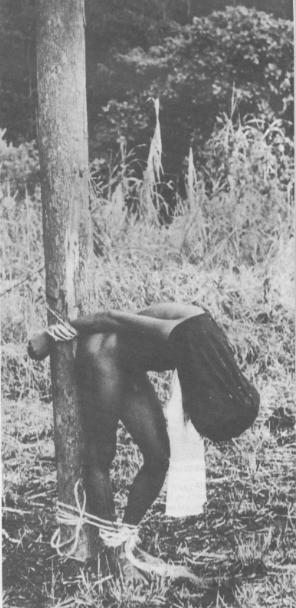
There’s an extensive photographic series of at least one set of executions — that of Tom Mabasa and Sebastino Namirundu in Mbale. It’s viewable here. Per the image captions,

Masaba and Namirundu were interrogated, stripped naked, fitted with short white aprons and tied to their execution posts. Masaba, who was accused of being a terrorist, was reported to have said, “Let those, like me, who are killing innocent people in the country, come out and report to the authorities.”

The book Battles of the Ugandan Resistance contains an account of Namirundu’s capture. According to the author, Namirundu was a mere bystander whe Ugandan troops arrived to his area trying to arrest rebel leader (and present-day Uganda president) Yoweri Museveni. Museveni gave them the slip, but as soldiers rudely searched houses, the teenaged Namirundu made a panicked run to get away from them, which act was taken as self-incrimination and led him to the stake.

On this day..

1844: Hester Foster and William Young Graham

(Thanks to Meaghan Good of the Charley Project for the guest post. -ed.)

At 1:30 p.m. on this date in 1844 at the Columbus Penitentiary in Ohio, William Young Graham, aka William Clark, and Hester Foster, aka Helen or Esther, were hanged together for their respective crimes.

It was an integrated execution: Graham was a white man, and Foster was black.

Foster was the first woman to be executed in Ohio. (There have been just three more … so far.) The previous spring, while incarcerated for some offense lost to history, she beat a white female prisoner to death with a fire shovel. As this history of Franklin County notes, Foster admitted to her actions, but claimed the murder wasn’t premeditated and therefore not a death penalty crime.

Graham’s crime was somewhat similar; within a few months of the murder Foster committed, he killed a prison guard with an ax. He claimed insanity by way of defense.

The pair’s public execution was attended by thousands. In the atmosphere of “noise, confusion, drunkenness and disorder,” one attendee, a Mr. Sullivan Sweet, was accidentally trampled to death. Many more Ohio men would face the death penalty in coming years, but Ohio’s next execution of a woman would not be until almost a century later, with the electrocution of serial poisoner Anna Marie Hahn in 1938.

On this day..

1931: The Longhua Martyrs and the Five Martyrs of the League of Left-Wing Writers

On this date in 1931, the Chinese nationalists executed 23 Communists at Longhua, including five members of the League of Left-Wing Writers.

Early in what would prove to be the very long Chinese Civil War, the Koumintang government in 1930 mounted a suppression* of Communist outposts. That included military campaigns attempting to encircle communist-held regions, as well as an internal crackdown. It’s the latter that concerns us here.

A Communist-founded League of Left-Wing Writers operating in Shanghai was formally banned by the Koumintang in September 1930. Threatened with arrest, the writers struggled to stay underground but at a January 17 meeting in the British concession area,** British police arrested Li Weisen, Hu Yepin, Rou Shi, Yin Fu, and Feng Keng. They were handed over to the Chinese authorities.


The Five Martyrs: From left: Hu Yepin, Rou Shi, Feng Keng, Yin Fu, Li Weisen (Li Qiushi)

They became the Five Martyrs of the League when they were shot this date in 1931 along with 18 other Communist prisoners, one of them a pregnant woman.

Among the five martyrs, Rou Shi† was particularly close to the great writer Lu Xun, who was heartbroken when he received word of his young protege’s untimely end — “one of China’s best youths,” in his estimation. In hiding himself, Lu Xun composed a “Lament for Rou Shi”:

To long and sleepless nights I’ve grown
accustomed in the spring;
Fled with a wife and babe in arms,
my temples are graying.
‘Mid dream there comes an image faint —
a loving mother’s tear;
On city walls the overlords’
e’er-changing banners rear.
I can but stand by looking on
as friends become new ghosts,
In anger face bayonet thickets
and search for verse ripostes.
The poem intoned, my gaze turns low —
one cannot write such down.
Moonlight shimmers with watery sheen
upon my jet-black gown.

(as translated by The Lyrical Lu Xun: A Study of His Classical-Style Verse)

The discerning present-day visitor to Longhua can pay respects at the Longhua Revolutionary Martyrs Cemetery.

* The suppression claimed, among others, the life of Mao Zedong’s first wife.

** The extraterritorial British concession in Shanghai was a legacy of the opium wars.

† There’s an English translation of Rou Shi’s short story “A Slave Mother” here.

On this day..

1999: Leo Echegaray, by lethal injection in the Philippines

On this date in 1999, the Philippines resumed executions after 23 years with its first-ever lethal injection.

Judicial executions had ceased during the Marcos dictatorship’s martial law period — extrajudicial killings were another story — and formally all but abolished after Marcos fell in 1986.

But rampant crime made an execution comeback a potent political issue that helped to carry Fidel Ramos* to the presidency in 1992. The revival would bring along the latest upgrades in killing-people technology: whereas the Philippines had previously used the electric chair, a holdover from its former colonial domination by the United States, it now followed America’s footsteps in preferring the sanitized experience of lethal injection.

Leo Echegaray, destined to become the first person to meet such a fate in the Philippines, was a house painter convicted of raping his daughter or stepdaughter. (Despite Rodessa’s surname, her mother and Leo never married. Rodessa Echegaray’s uncertain biological parentage was at issue in the case, as to the question of whether the rape could be said to be incestuous: rape committed by a father was a specific subcategory of rape under the law uniquely eligible for the maximum penalty.)

The Supreme Court had no interest in parsing DNA, finding that the parenthood “disclaimer cannot save him from the abyss where perpetrators of heinous crimes ought to be.”

“The victim’s tender age and the accused-appellant’s moral ascendancy and influence over her are factors which forced Rodessa to succumb to the accused’s selfish and bestial craving,” it ruled. “The law has made it inevitable under the circumstances of this case that the accused-appellant face the supreme penalty of death.”

That was in 1996. By the time Echegaray came to the actual end of his appeals cycle, Ramos had given way to the mercurial Joseph Estrada. A former actor, Estrada put his showmanship to use by having his telephone hotline to the prison disconnected prior to Echegaray’s execution to underscore his resolve not to entertain any 11th-hour commutation.

The 11th hour was of intense interest to everyone else. The supposedly secret time and circumstances of Echegaray’s move to the death house was leaked and resulted in a circus scene as the doomed prisoner, Bible in hand and “Execute Justice, Not People” pinned his orange prison jumpsuit, pushed through a raucous crowd of journalists to a van waiting to drive him to New Bilibid Prison in Muntinlupa for his milestone date. The undignified “execution fiesta” continued hours later in the official witness room, where media jostled for the best seats, and even to Echegaray’s last rest as reporters hounded the hearse and beyond. (Actual example: “I’m here at the funeral parlor and I’m holding Leo’s leg. It’s a bit warm and it looks like he is only sleeping.”)

Once the death chamber’s seal was cracked, it saw steady traffic: Six other people suffered execution in the Philippines during the ensuing 12 months. Then, as abruptly as capital punishment had returned to the Philippines, it blinked away.

Whether pricked by his conscience or by the political resistance of the Vatican, Estrada’s flamboyant resolve appeared to waver after Echegaray’s execution, even leading to one appalling occasion where he tried frantically to call in a last-second stay for another man but couldn’t get through until the execution was underway. Estrada finally suspended executions once again in March 2000 to honor the millenial Jubilee of Christ‘s birth. Estrada himself didn’t last much longer after that moratorium expired, and his successor President Gloria Arroyo also finalized no death sentences during her term — until in 2006 Arroyo signed repeal legislation and commuted all 1,230 existing death sentences.

* Ramos had formerly been a Philippines Constabulary officer, and in that capacity been personally present at the televised 1973 execution of heroin kingpin Lim Seng.

On this day..