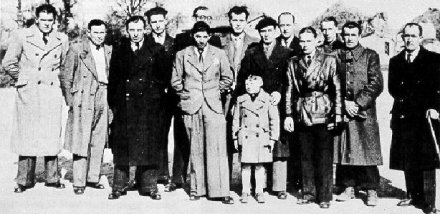
1944: Jakob Edelstein and family

(Thanks to Meaghan Good of the Charley Project for the guest post. -ed.)

On this date in 1944, Jakob Edelstein, his wife Miriam, their twelve-year-son Arieh and his mother-in-law Mrs. Olliner were shot to death at the Auschwitz Concentration Camp in Poland. They had been inmates in Auschwitz since the previous December; Jakob had been in an isolation cell the whole time while the others stayed in the so-called “Family Camp.”

For two years prior they’d lived in Theresienstadt (also known by its Czech name, Terezin), a the former Czech fortress town that had been turned into a city just for Jews. Jakob Edelstein was named Eldest of the Jews and was nominally in charge of the place, but in practice he had no choice but to cater to the whims of the Nazis. He was assisted by a deputy and a council of twelve.

Edelstein, a Czech Jew born in 1903, had been a leader within the Jewish community in Prague and had had papers for himself and his family to emigrate to Palestine. But when the Nazis took over Czechoslovakia, Edelstein and the other Zionist leaders decided it was their duty to stay and do what they could for the community during this time of crisis.

He became a liaison between the Germans the Jewish community and tried to facilitate immigration to Palestine. From 1939 to 1941 he made several trips back and forth between Czechoslovakia and Palestine, with permission from the Germans, trying to find ways for more Jews to emigrate.

Theresienstadt was a strange place: neither concentration camp nor ghetto but something in-between, it was billed as a “paradise” and a “gift” from Hitler to the Jewish people.

Elderly Jews were sent there, as well as Jews who were “prominent” for some reason or had Aryan connections (such as Jews who had a non-Jewish spouse). It was advertised as a luxurious resort community where they could live out the rest of their lives in ease and plenty.

Residents were allowed to receive food packages from the outside, and send postcards (one per month, limited to 30 words, and censored).

Many people believed the propaganda and were persuaded to go there voluntarily, signing all their possessions and assets to the German government in exchange for what they thought would be a comfortable and peaceful retirement.

The 500-ish Danish Jews who weren’t evacuated to Sweden by the Danish Underground right after the Nazi invasion of Denmark were ultimately sent to Theresienstadt. Many talented artists, actors, musicians and scholars lived there. The Nazis would ultimately make a propaganda film about how wonderful life was in Theresienstadt, and a Red Cross delegation toured the place and came away satisfied.

As you might have guessed, living conditions within the fortress city didn’t exactly live up to what it said in the brochures.

It’s true that it was possible to survive in Theresienstadt for an extended time period, even for the duration of the war. There were no gas chambers and relatively few executions. Certainly it was worlds apart from, say, Auschwitz or Treblinka. But that was as close to “paradise” as it got.

Theresienstadt was, as George E. Berkley says in his book Hitler’s Gift: The Story of Theresienstadt, “a joke hatched in hell.”

Yes, there were stores, more than a dozen of them, but their stock consisted of “goods the Nazis had originally confiscated from the residents and later found they didn’t need or want.”

Theresienstadt, like the Lodz Ghetto, had a bank and its own money, but there was nothing to spend it on. “The ghetto crowns,” Berkley says, “were used mostly like Monopoly money in playing cards and other games. Still, the bank staff kept themselves busy balancing their books, and auditors arrived regularly from Berlin to ensure the accuracy of the bank’s essentially fictitious accounts.”

Theresienstadt’s population, at its peak, was 58,497, in a town which before the war had a population of less than 10,000. Nearly everyone had lice, toilets and taps were scarce, and disease was rampant.

Families were separated, with husbands, wives and children each residing in different barracks.

“Horrendous as Theresienstadt housing conditions may have been,” Berkley says, “they were not the residents’ chief source of daily suffering. Food, or rather, the lack of it, weighed on them much more heavily.” The menu, he explains,

consisted chiefly of bread, potatoes, and a watery soup. Some margarine and sugar — about two ounces a week of the former and less than one and one-half ounces of the latter — were sometimes included. The residents were also to receive up to four ounces of meat, mostly horseflesh, and up to eight ounces of skim milk a week, though many a week would see less or none of those foodstuffs available. No fruits were ever officially distributed, and turnips were the only vegetable to show up with any regularity.

Estimates of total per capita calories provided daily ranged from 1300 or less, to 1800, with the lower figure being more frequently mentioned. This should be compared with the “Special Regime” given the worst offenders in the Soviet labor camps which provided about 2,000 calories.

According to modern nutritional guidelines, to maintain a healthy weight, the average adult with an average level of physical activity needs 2,000 to 2,500 calories a day. At Theresienstadt all inmates between age 14 and 70 had to work long hours, many of them at strenuous jobs. In addition to being calorie-deficient, the Theresienstadt rations lacked essential vitamins and minerals. It’s no wonder that one survivor later recalled, “After three months in Theresienstadt, there was only one feeling left in my body: hunger.”

Six months after his arrival, Edelstein and the Council of Elders made a difficult decision about the food problem, as Berkley records:

It became apparent that an even distribution of the food supply would not allow the ghetto to survive. Those doing heavy work needed more than those doing normal work, and the latter needed more than nonworkers. In addition, children required extra rations, for they represented the Jewish future…

Thus, heavy workers … began to receive a little over 2,000 calories of food a day. Children were to get 1,800 and regular workers a little over 1,500. But the daily intake for nonworkers, which included most of the elderly, fell to less than 1,000 calories.

This terrible choice, however necessary to the population’s long-term survival, consigned thousands of people to death.

But even though starvation and disease took many lives, the most deadly aspect of life in Theresienstadt was deportation.

Contrary to what the propaganda messages said about people living out their lives in Theresienstadt, it was largely a transit camp. Most people who arrived would be sent on “to the east” sooner or later; some of them lasted only a few days in the fortress city before being deported.

Although certain classes of people, such as decorated World War I veterans, “prominent” people and those over 65, were in theory exempted from deportation, in practice anyone could be sent away and just about everyone ultimately was.

Approximately 145,000 denizens passed through Theresienstadt during the course of its existence, most of them from Czechoslovakia, Germany, and Austria. About a quarter of these inmates died within Theresienstadt itself. Another 88,000 were deported to Auschwitz and other camps in the East, almost all of them dying there. Out of about 15,000 children who passed through Theresienstadt, less than 2,000 survived, and some estimates put the number in the low hundreds.

When the camp was liberated, it had a population of about 17,000, and most of those had arrived in the during the final months of the war.

Jakob Edelstein didn’t know about the gas chambers when he became Eldest of the Jews at Theresienstadt in December 1941, but he knew that conditions in the East were very bad and realized that, in order for the community to sustain itself, as many people as possible had to remain within Czechoslovakia.

As a committed Zionist, he hoped that the young people in the camp would survive and go on to colonize Israel. Like most other leaders of Jewish communities throughout Nazi-occupied Europe, he made the decision to cooperate with the occupiers in hopes of saving lives.

And as far as that goes, he failed, as the numbers quoted above indicate. But if he failed, so did everyone else.

Unlike many Jewish officials in the Nazi ghettos, he wasn’t corrupt and he wasn’t a toady to the Germans. It’s worth noting that he had many opportunities to flee the country with his family, even after the war started: all he had to do was not come back to Europe after one of his trips overseas.

But he stayed, because he felt he had a responsibility to his beleaguered people.

Edelstein did the best he could with what he had to work with, which is all you can say for anybody. He worked tirelessly, making himself available at all hours, and under his leadership the camp developed a welfare system as well as many cultural and sports activities.

His job as Eldest of the Jews in Theresienstadt, trying to play the balancing act between advocating for his people and not pissing off the Germans, was always extremely stressful, difficult and dangerous.

But things really started to go downhill for him after the city’s first commandant, Siegfried Siedl, got reassigned to Bergen-Belsen in July 1943.

Siedl’s replacement, Anton Burger, hated Czechs and took an immediate dislike to Edelstein as a result. He replaced Edelstein with Paul Eppstein [German language link, as is the next], a German, and demoted Edelstein to first deputy to Eppstein. Benjamin Murmelstein, an Austrian, became second deputy.

This wasn’t enough for Burger, however, as George Berkley records:

As leader of the Czech Jews, [Edelstein] naturally bore the brunt of Burger’s hatred for them. The new commandant had not only deported many of his countrymen and his chief aide … but had also moved Germans and Austrians into key positions formerly held by Czechs. Burger had apparently also stirred up his own superiors against him for during the fall some bakery workers, looking out the window, saw and heard Eichmann sharply dressing down Edelstein and even threatening to have him shot.

The incident alarmed Edelstein’s many loyal followers and the next day the leaders of Hechalutz, the largest Zionist organization in the camp, met with him to urge him to flee. They said they could help him escape … But though he suspected a Nazi scheme to get rid of him, Edelstein refused to run away.

In the end, the Nazis didn’t need to trump up any charges of insubordination or sabotage against their former Eldest of the Jews: they found some real “crimes.” It seems that Edelstein had been saving people from deportation by allowing them to remain in Theresienstadt, off the books, and adding the names of dead people to the transport lists to make the numbers match up.

He was immediately arrested. It was November 9, 1943, the fifth anniversary of Kristallnacht.

Edelstein was kept in custody in Theresienstadt until December 18, when he and his mother-in-law, his wife, and his young son were sent to Auschwitz with a transport of 2,500 others. The transport became part of the Auschwitz “Family Camp”, joining 5,000 Czech Jews who’d arrived there from Theresienstadt in September.

Edelstein’s family was allowed to join the Family Camp. Edelstein himself was put in the punishment block and subjected to interrogation although not, apparently, tortured. He gave nothing away.

In March 1944, the residents of the Family Camp who’d arrived in September were gassed. The December group was allowed to stay alive for the time being.

On June 20, an SS officer went to Edelstein’s cell and told him he’d been sentenced to death. While the condemned man (who’d become quite popular in jail) was taking leave of his fellow inmates, the SS officer got impatient and snapped, “quickly, quickly.”

Edelstein replied, “I am the master of my last movements.”

He was driven to the execution site and then the car went away to fetch Miriam, Ariah and Mrs. Olliner. Miriam had measles and had to be brought on a stretcher. The Nazis forced Jakob Edelstein to watch as his wife, child and mother-in-law were shot to death. He was the last of them to die.

The remaining residents of the family camp were gassed in early July 1944.

Paul Eppstein was executed in Theresienstadt in September. Murmelstein became Eldest of the Jews in his place and actually managed to survive the war. Because he had lived, he spent the rest of his life under a cloud of distrust and suspicion as a possible collaborator.

Siegfried Siedl was hanged for war crimes in 1947. Anton Burger escaped Allied custody (twice) after the war, assumed a new identity and died of natural causes in Essen in 1991. His true identity wasn’t discovered for years after his death.

After the war, the city of Theresienstadt reverted to its former name of Terezin, and the fortress became an internment camp for ethnic Germans, who found themselves quite unpopular in the newly liberated Czechoslovakia and were expelled from the country in droves. The internment camp closed in 1948.

The modern town of Terezin has a population of 3,500 and is noted for its manufacture of knitwork and furniture. Tourists from all over the world come to learn about its important role in one of the most tragic events in modern history.

On this day..

1930: 13 Viet Nam Quoc Dan Dang cadres, for the Yen Bai mutiny

June 17 is an honored day in Vietnam for the sacrifice under the French guillotine this date of 13 early martyrs for national independence.

These were members of the nationalist Viet Nam Quoc Dan Dang (VNQDD, or Viet Quoc). Not averse to the propaganda of the deed, these revolutionaries labored secretly under onerous French pressure following the previous year’s assassination of a labor recruiter.*

A year later (almost to the hour), with the movement crippled by arrests, the VNQDD tried an audacious gambit to revive its fortunes and trigger a general rising against the French.

The Yen Bai mutiny — named for the Tonkin city where it transpired** — saw 40 or 50 Vietnamese riflemen of the Fourth RĂ©giment de Tirailleurs Tonkinois† and a like number of civilian sympathizers attacked the regiment’s officers in concert.

Alas, most of the other Vietnamese tirailleurs declined to join the rising, and it was suppressed within a few hours.

Over 1,000 accused revolutionaries stood trial for the Yen Bai mutiny, and the top leadership paid the top penalty this date — but as quietly as the French could manage. They were whisked out of their cells on the preceding evening and taken by secret convoy on a four-hour ride to the Yen Bai execution grounds, where a guillotine had been covertly erected.

We are going to go to pay our debt for the country. The flag of independence must be dyed with blood. The flower of freedom must be sown with blood. The country needs more and more sacrifices of its people. The revolution would meet success finally. We want to say goodbye to all of you with our respects.

-Nguyen Thai Hoc, taking his final leave of imprisoned VNQDD comrades

From 4:55 a.m. at Yen Bai, the thirteen men one by one were each lashed to the plank. One by one, each of their necks were fixed by the lunette under the blade. One by one, each cried out “Vietnam!” as the blade fell.

  • Bui Tu Toan
  • Bui Van Chuan
  • Nguyen An
  • Ha Van Lao
  • Dao Van Nhit
  • Ngo Van Du
  • Nguyen Duc Thinh
  • Nguyen Van Tiem
  • Do Van Su
  • Bui Van Cuu
  • Nguyen Nhu Lien
  • Pho Duc Chinh, who allegedly asked (it’s unclear to me whether it was granted) to be guillotined face-up — perhaps a show of bravado
  • The founder of the VNQDD Nguyen Thai Hoc, whose name now graces a major street in the heart of Hanoi

The VNQDD at this point was organizationally shattered, and many of its un-arrested cadres fled to China — whose sponsorship would revive it and return it to Vietnam in the 1940s.

By then, the communists were in the saddle in Vietnam. In 1946, Ho Chi Minh purged the VNQDD from the national independence coalition. Its remnants would wind up in South Vietnam; today the Viet Quoc persists mostly in exile.

* The labor recruiter is only tangential to the Yen Bai story, but their function, to dragoon Vietnamese peasants into brutal plantation work on terms next door to slavery, made them particularly hated characters. More about that racket in this 1930 text (pdf) by an outraged Frenchman.

** A few other minor secondary incidents occurred elsewhere in the area, but the epicenter of the rising was always Yen Bai.

† After the mutiny, the French army tried to reduce its dependence on Vietnamese recruits.

On this day..

1923: Daniel Cooper, baby farmer

On this date in 1923, Daniel Cooper was hanged in Wellington, New Zealand for murder.

Cooper and his second wife — his first died under suspicious circumstances; many people suspected Cooper of poisoning her — had a racket as a “health specialist” in the Wellington suburb of Newlands. Their “rest care home” attracted police surveillance as a front for baby-farming/infanticide.

Baby-farming involved taking a payment from a new mother to give up her child with the wink-wink understanding that the child would be placed for “adoption.” Occasionally, this adoption might even happen; in general, however, the mother’s fee would not be enough to maintain the child for any length of time, and the newborn would either be murdered outright or kept in such meager care as to succumb to neglect.

Representative instance from Daniel Cooper’s case: a pregnant woman named Mary McLeod paid £50 for Cooper to arrange her child’s adoption by an unnamed couple from Palmerston North. McLeod delivered the child on October 12, 1922, at the Coopers’ farm, where both mother and daughter were cared for for a few days. On October 20, Cooper told McLeod that the Palmerston North family had collected the infant. Nobody ever saw it again. Cooper also had two children with a lover named Beatrice Beadle, and these were also “adopted” to parts unknown.

Daniel was finally arrested on December 30, 1922 for performing an abortion (completely illegal in New Zealand at the time), and the ensuing investigation turned up evidence of 10 additional abortions and, eventually, three children’s bodies on the couple’s property. Prosecutors would eventually argue that Mary McLeod’s child was one of these.

“Out-Heroding Herod” screamed sensational headlines around the “Newlands baby farmers” case.

While Daniel Cooper was easily convicted of murder, his wife Martha Cooper was adroitly defended by former Liberal M.P. T.M. Wilford — who characterized the wife as “a soulless household drudge without a mind of her own,” and won her acquittal on that basis.

At 8 a.m. on June 16 (shortly after releasing a confession which likewise exonerated Martha), Daniel Cooper was walked with his eyes tight shut to the gallows at Terrace Gaol,* hooded, and hanged.

Original newspaper coverage of this case can be perused freely at New Zealand’s Papers Past database of pre-1945 clippings.

* Since demolished; Te Aro school occupies the site today.

On this day..

1920: Triple lynching in Duluth, Minnesota

On this date in 1920, a white mob perhaps 10,000 strong swarmed into the Duluth, Minn. jail and extracted three young African-American circus workers accused of gang-raping a white woman. Elias Clayton, Elmer Jackson and Isaac McGhie stood an immediate drumhead trial, then were lynched in the heart of Duluth as they vainly protested their innocence.

The self-congratulatory posed photograph of mob members with the bodies was made into a horrifying postcard, a frequent practice in lynch law America.


“What this looks like is the kind of photo you would see at a hunting lodge, where the guys had been out shooting bear, and they came back and they said, ‘We got three.’ You can see people on tip-toe. They’ve crowded into this shot. These are not people who are ashamed to be seen here. This is, ‘I want to be in this picture.'”

–Michael Fedo, author of The Lynchings in Duluth

Nineteen-year-old Irene Tusker and her boyfriend James Sullivan had attended the one-day circus the evening before. What transpired that night remains unknown to this day: Irene eventually took the streetcar home without incident. Hours later, James Sullivan’s father claimed that the couple had been held at gunpoint by black carnies as Irene was gang-raped.

By the evening of the 15th, a vengeful mob had surrounded the police station/local lockup. Officers were ordered not to use deadly force against the townsfolk, so the battle to push into the premises was waged with brickbats against firehoses, and eventually with ineffectual pleas to let the law take its course.*

The incident drew nationwide reaction — usually condemnation (with a couple of exceptions). Occurring as it did in one of the continental states’ northernmost towns, it also underscored lynching as a nationwide problem rather than “merely” a southern one.

“Duluth has disgraced herself and has, by reason of her geographical position, disgraced the north,” the Cleveland Plain Dealer editorialized (June 17, 1920) — just one of innumerable newspaper editorials in the days following the Duluth outrage. “A city that has no more backbone than to submit to the rule of riot cannot be held blameless. But it will be surprising if Duluth and the state of Minnesota do not take steps to punish the murderers. The method of procedure was so deliberate and so brazenly open that identification and conviction of the ringleaders should be an easy matter.”

Brace for a surprise: according to the Minnesota Historical Society’s excellent site on the Duluth lynchings, only three whites served prison time (a shade over one year apiece) for rioting. Nobody was ever convicted for murdering Clayton, Jackson, or McGhie.

One black man, Max Mason, caught a long prison sentence for the supposed rape. He was paroled after five years on condition that he leave Minnesota for good.

“I was just short of nineteen the night that the bodies of McGhie, Jackson, and Clayton swung from a light pole in Duluth. I read the stories in the newspapers and put them down feeling sick, scared, and angry all at the same time. This was Minnesota, not Mississippi, but every Negro in the John Robinson Show had been suspect in the eyes of the police and guilty in the eyes of the mob … I found myself thinking of black people as a very vulnerable us — and white people as an unpredictable, violent them.”

-Minnesota-raised Roy Wilkins, the eventual director of the NAACP, in his autobiography (via)

The great-grandson of one of the lynch mob’s members wrote this book about the hangings’ legacy

The lynching was practically written out of the official state history most white children consumed at school in the middle part of the 20th century,** though the nine-year-old Lithuanian Jewish boy Abram Zimmerman who lived nearby the execution site later told his son all about it. Young Robert Allen Zimmerman tapped his father’s lynching stories under his subsequent nom de troubadour of Bob Dylan, and the Duluth atrocity is alluded to in Dylan’s “Desolation Row”.†

Latter-day Duluth has, to its credit, tried to manage something a little bit more overt.

In 2003, a monument commemorating Duluth’s moment of infamy was dedicated opposite the place where the young men were strung up and photographed. Minnesota Public Radio produced a series on the lynching during the construction of this monument which is still available online.


All images (cc) ArtStuffMatters. The photographer has a thoughtful recent blog post on the [dearth of] public lynch memorials in the United States.

* The law in Minnesota had no death penalty on the books, and still has none today.

** To be fair to the state, its immediate response did include passing anti-lynching legislation in 1921.

† “They’re selling postcards of the hanging/They’re painting the passports brown/The beauty parlor is filled with sailors/The circus is in town.”

On this day..

1944: Massacre at Oradour-sur-Glane


(cc) image from fintbo.

(Thanks to Meaghan Good of the Charley Project for the guest post. -ed.)

On this date in 1944, four days after the Allied invasion of Normandy, an SS battalion from the 2nd SS Panzer Division massacred almost the entire village of Oradour-sur-Glane in west central France, slaughtering in all 642 people.

You can read all about this hecatomb and its aftermath on this very thorough and impressive website dedicated to the atrocity, from which much of the information in this account is drawn.

The tiny village, which you could walk through in all of ten minutes, had been the victim of mistaken identity.

Twenty miles away was a somewhat larger town with a similar name, Oradour-sur-Vayres, which was known for its Resistance activity. Adolf Diekmann, commander of the SS battalion, had been informed that the French Resistance had captured an SS officer (possibly the kidnapped Waffen-SS Sturmbahnfuhrer Helmut Kampfe, who had been executed by the Resistance earlier that same day) in Oradour-sur-Vayres and decided reprisals were needed, but he got the two villages mixed up and went to Oradour-sur-Glane instead.

When the SS arrived in the village at lunchtime, they ordered all the inhabitants to assemble in the fairground to have their papers checked. Everyone had to come, including children and the sick. Six people who were not residents but happened to be in the village at the time were also sent to the fairground.

Twenty villagers who had some compelling reason to avoid the Nazis, or merely had a bad feeling about the whole thing, hid or left the village as soon as the SS division showed up. These twenty survived. One seven-year-old boy, Roger Godfrin, was spotted and shot at, but survived by playing dead. He was the only survivor in his family, and the youngest survivor from the town.

The women and children were locked in the village church, and the men were lead to barns and sheds where the machine guns were set up. They were shot in their lower bodies and legs, in order to prolong their deaths. One of the men, who’d lost a leg in World War I, supposedly cried out, “Those bastards! They have cut my other leg off!”

After the shooting, as the men of Oradour-sur-Glane lay helpless, the SS men locked the sheds and set them on fire.

Only six men were able to escape. They hid in some rabbit hutches for several hours before attempting to escape the village. Five of them made it, but Pierre-Henri Poutaraud was spotted later that day and shot dead. The SS man who shot him then tethered a horse to Poutaraud’s outstretched hand.

In all, 190 men were killed.

The SS division then went back to the church, set off a smoke bomb inside it, and set the building on fire. Anyone who tried to get out of the church was machine-gunned. One woman cried out that she was German, not French, and begged to be released, but the SS shoved her back into the flames.

47-year-old Marguerite Rouffanche was able to slip out the back window, and another woman followed her with her seven-month-old baby, but all three of them were shot and only Marguerite survived, hiding in a garden for more than 24 hours until help arrived. Her two daughters were killed. (Marguerite refused to leave Oradour after the massacre. She remained there for the rest of her ninety-one years and is now buried in the village cemetery.)

The church fire and shootings claimed the lives of 247 children and 205 women.


Children from the village’s girl’s school, in the 1942-1943 school year. All of these girls were killed in the massacre.

Unbeknownst to the Nazis, there were several Jews living in the village, among them five children between the ages of eight and fifteen. Twelve of them were killed. In the case of a Jewish family called Pinede, the parents decided to present themselves for inspection but told their three children to hide. The children survived; their parents did not. One of those three Jewish survivors was still alive as of 2004.

Several days passed for the 26 survivors were permitted to bury their dead. Only 52 of the bodies could be identified; the other ones were burned too badly to be recognizable.

Collective punishment in reprisal for the actions of others was par for the course in Nazi-occupied Europe, and Adolf Diekmann had directed his unit to commit a number of mass shootings. Even so, he didn’t have authorization for the bloody events at Oradour-sur-Glane and his commanding officer requested for a court-martial, saying, “I cannot allow the regiment to be charged with something like this.” Field Marshal Erwin Rommel supposedly volunteered to preside over the court-martial himself.

But before that could happen, the war took care of Diekmann: he was killed on the Normandy front on June 19, hit in the head with shrapnel, a mere nine days after his last atrocity. The front, in fact, took care of most of his unit: only 65 of the 200 members survived the war.

In 1953 in Bordeaux, a military tribunal convened to hear the case against the surviving members of the 2nd Panzer Division. Only 22 of them were present in the courtroom; the others were in East Germany, which refused to extradite them. All but one said they’d been conscripted into the SS; one of them admitted he’d joined voluntarily to fight Communism.

To further complicate matters, 15 of the defendants present were actually French nationals of German descent, from Alsace-Moselle, and 14 of them claimed they’d been drafted against their wishes.

(After they conquered France, Germany declared inhabitants of Alsace to be German citizens whether they wanted to be or not, and drafted the region’s men. The conscripts were known in France as Malgre-nous, meaning literally “despite ourselves.”)

In addition, eight of the French defendants had been under the age of 18 when they were drafted into the SS, making them minors under French law. Many French people, including some of the survivors of Oradour-sur-Glane, viewed the Alsatian conscripts as fellow-victims of Nazi Germany and didn’t believe they should be held responsible for their actions.

Most of the defendants were cagey.

They implicated each other, but not themselves, admitting to some specific offenses but denying other, far more serious ones. One man, for example, said he’d been part of an execution squad that shot 20 men, but insisted he’d only helped load the machine guns and hadn’t personally shot anyone. Another said he hadn’t been in Oradour-sur-Glane at all, but was stationed as a sentry outside the village to prevent escapes. Only one of the defendants had admitted to killing anyone at all prior to the trial.

Twelve members of the victims’ families came to watch the trial proceedings, including an eight-year-old girl whose father and grandfather had been killed. Marguerite Rouffanche was ill at the time of the trial and very weak, but she showed up anyway and testify about her experience. Roger Godfrin, the little boy who played dead, also testified.

The tribunal’s judge demanded the defendants view photographs of the charred corpses of the victims, saying, “Let them look at the glorious work of the valiant Third Company of Der FĂ¼hrer Regiment.”

When the prosecutor summed up the case, he referred to the defendants’ evasive statements and said, “You might as well say despite the heaps of ashes and ruins, that the massacre never took place. But the people of Oradour are dead.”

The tribunal deliberated for thirty-two hours before returning its verdicts. One of the defendants was able to prove he hadn’t been in Oradour-sur-Glane the day of the killings, and was acquitted. The rest were convicted.

The 46 members of the SS unit who hadn’t shown up for trial were sentenced to death in absentia, as was one of the German nationals and one of the French. The others got various prison sentences, mostly between five and eight years, none exceeding twelve years. The Germans tended to get longer prison terms than the French. In addition, the Germans were prohibited from residing in France for at least twenty years.


Survivors of the Oradour-sur-Glane massacre.

No one in France was happy with the tribunal’s ruling: some said the sentences were too harsh, others, too lenient. In the face of widespread protests from the Alsace area and threats to secede from France, the French National Assembly passed a bill granting amnesty to all Malgre-nous (at a vote of 319 to 211, with a whopping 83 abstentions) and 13 of the 14 Frenchmen were released only eight days after the verdict was rendered. (One of them, the one who had volunteered for the SS, got no sympathy from anyone and no such leniency.)

Germany was upset, saying it was unfair to pardon the French SS but not the Germans. But within five years, everyone had been freed. No one was actually executed.

In 1981, East German authorities tracked down Heinz Barth, a second lieutenant in the 2nd Panzer Division, and put him on trial in their country for his role in the Oradour-sur-Glane Massacre.

He never tried to deny his participation in the attack, and used the old “just following orders” defense, saying, “In war one acts harshly and with the means available.” Barth admitted he helped round up the village men and personally shot fifteen times into the crowd. He also acknowledged responsibility for the deaths of nearly 100 people in Czechoslovakia.

Barth was convicted in 1983 and sentenced to life in prison. In 1991, still behind bars, he was awarded a pension as a “war victim” because he’d been wounded in Normandy in August 1944 and lost a leg. The resulting howls of protest led the government of a newly reunited Germany to pass a law stripping convicted war criminals of their pensions.

Barth was released from prison in 1997, and managed to finagle his war pension back somehow. He died of cancer ten years later, at the age of 86.

Marguerite Rouffanche died in 1988. Her fellow-survivor Roger Godfrin died in 2004.

The survivors of Oradour-sur-Glane created a new village after the war, but the burned-out ruins of the old village remain, with rusted cars, sewing machines, bicycles and other personal items lying in plain sight on the street, a grim testimony to what happened there nearly seventy years ago.


The ruins of the village of Oradour-sur-Glane today. (cc) image from Olivier Lepicier.

On this day..

1921: William Mitchell, Black and Tan

On this date in 1921, Great Britain hanged one of its own paramilitaries in Ireland. William Mitchell was, in fact, the only member of the reviled Black and Tans executed during the Irish War of Independence.*

This long-obscure case has been brought back to light by author D.J. Kelly, whose just-published Running With Crows: The Life and Death of a Black and Tan is a fact-based novel about William Mitchell’s execution.

Was Mitchell hanged for political expediency? Did he even commit the murder for which he stood condemned?

Kelly was kind enough to talk with Executed Today about exhuming a dead soul.

ET: What led you to take an interest in this hanging?

DJK: A third cousin of mine, who shares my interest in family history research, asked me to help her verify her late father’s claim that they were related to a Black and Tan who had been hanged for murder.

I knew that the ‘Tans’ were temporary policemen recruited in England from ex-combatants of The Great War and sent to Ireland to bolster the ranks of the beleaguered Royal Irish Constabulary during the Irish War of Independence. It took me no time at all to discovered that only one Black and Tan — indeed only one member of the entire British Crown Forces — had been executed during that conflict, and that indeed he shared a surname with my cousin.

However, I could find only the briefest of mentions of him in any accounts of that bitter struggle for Ireland’s freedom. It took me and my cousin two years to track down the elusive official case papers, to establish exactly who Mitchell was, and to tell his hitherto untold story. To date however, we still have not established a firm link with my cousin’s family.

The Black and Tans are of course still notorious in Ireland and elsewhere. In this book you’re complicating their story quite a bit, making at least this one Tan a sympathetic character. What sort of audience reception has Running with Crows had? Do you find there’s a lot of resistance to the story you have to tell? For that matter, did you have any misgivings to overcome in writing it?

You are right about their notoriety. The ‘Tans’ were bored, drunk and indisciplined during the short period of their service in Ireland. They were also poorly managed and allowed to run amok, robbing and assaulting the Irish population. There is no evidence however to support the popular myth that they included a greater number of criminals than has any police force before or since. They were disillusioned and battle-hardened men who were unable to find employment back in the ‘land fit for heroes’.

Book CoverIronically, one lone reviewer of my book has accused me of not making Mitchell sympathetic enough. It was not my intention though to create sympathy for this flawed and tragic man or to turn him into a folk hero. However, whilst I do not think he was the most honourable of men, I am not persuaded he deserved to hang.

I was indeed wary of uncovering this controversial case, especially as folks in Ireland, my own relatives included, are still sensitive and emotional about the events of the 1920s. The accepted view is that the old IRA were the heroes and the ‘Tans’ were the baddies. Few people realise however that at least a quarter of the Black and Tans were Irishmen, as indeed was Mitchell. However, I am delighted to have received highly positive reviews, from ‘both sides of the divide’, that is from an IRA re-enactment group as well as from supporters and historians of the Royal Irish Constabulary. Moreover, a theatrical production company, based in the town where the murder took place, and where people still remember and sympathise with the murdered magistrate’s family, has adapted my book to a stage play, which will debut there on 15 June at the Dunlavin Arts Festival. They have also kindly invited me to hold an author talk at the festival on the 16th June.

William Mitchell was hanged for killing a magistrate named Robert Dixon. Who was Robert Dixon and why was he a target during the war?

Robert Gilbert Dixon was an Anglo-Irish gentleman; a gentleman farmer who acted as an auctioneer at the local livestock auctions and who served as a district magistrate on the local circuit. He and his wife were descended from noble and philanthropic English forebears, and indeed Robert Dixon was respected in his community for his generosity shown both to his neighbours and to the police.

During the conflict though, both magistrates and police were viewed by the Nationalists as instruments of the occupying power (the British) and as such were prime targets for assassination by the IRA. Dixon’s murder was not a political killing however. He was shot dead, and his war hero son seriously wounded, during the course of a robbery at his home.

This post-war era saw the erosion of the class system and marked the beginning of the end for ‘the old order’. Socialism was gaining popularity and the working classes were shrugging off the idea that they should ‘know their place’. The awful loss of life, mainly through mis-management of the war, meant that many had lost respect for, and indeed were resentful of, the privileged classes. A truce was now imminent in Ireland and so the ‘Tans’, who were being paid per day what the regular Irish constables earned in a week, saw their lucrative employment coming to an end, and meanwhile, in Dunlavin, the Dixon family were conspicuously wealthy …

Coming at last to the main character here, who was William Mitchell? Why was he serving in the Black and Tans, and why did he end up at the end of a noose?

Contrary to what some commentators on the conflict have written, Mitchell was not English but Irish. He was a Dublin-born former professional soldier, who had served King and Empire, both in India and in the trenches of the Western Front. He was the son of Joseph Mitchell, a London-born soldier; a respectable man who had fought in the Boer War and who had married a Dublin Protestant girl.

Another myth, that of the privileged position of those in the ‘Protestant ascendancy’ in Ireland, is dispelled by William Mitchell’s impoverished upbringing in Dublin’s Monto district, which was not only Ireland’s, but indeed Europe’s, biggest slum and red-light district. William Mitchell was a man who did not respect authority — some might say, with good reason. When two masked intruders forced their way into the Dixon household and killed the magistrate during a bungled robbery, and when one of the ‘Tans’ shot himself dead at the local barracks the following day, it was believed the dead ‘Tan’ was the shooter, and so Mitchell was then arrested as his accomplice.

This hanging occurred just as London was determining to wind things down in Ireland; later that June, Prime Minister Lloyd George proposed peace talks. As a political sop, how important domestically within Ireland was William Mitchell’s execution in June 1921? Did it even register? Had he been spared, would that have affected at all the progress towards a truce?

Ah, you have put your finger on the nub of the issue.

As ill-disciplined and unruly as the temporary constables were, there was another arm of the Black and Tans which was far more undisciplined. The Auxiliaries were demobilised officers who had been engaged ostensibly to act as an officer cadre for the temporary constables but who had instead formed themselves into hit squads and set about abducting, torturing and killing suspects without due process of law. It was the Auxiliaries who were identified with some of the worst atrocities of the conflict, including the destruction of whole villages and towns and even of the murder of the mayor of Cork.

Several Auxiliaries had been tried for murder but acquitted, usually because crucial prosecution witnesses had ‘disappeared’. One indicted auxiliary, who was a decorated war hero, but most likely also a psychopath, and was head of the self-designated ‘murder squad’ based in Dublin Castle, was facing his second murder trial. By April 1921, the world’s press were united in condemning the British administration in Ireland for letting loose this uncontrolled ‘pseudo gendarmerie’ upon the Irish population. The number of Republicans who would be executed would run to two dozen, yet thus far, no member of the British Crown Forces had been convicted for any atrocity.

The Americans and the heads of the Commonwealth nations were demanding fair play. The British public were revolted by the way the conflict was being managed and now no less a personage than King George V stepped into the arena and demanded that Lloyd George‘s government show even handedness in the way it dealt with both rebel and law enforcer. Another acquittal was fully expected in the trial of the twice-tried Auxiliary, who had carried out his grisly and murderous duty on behalf of his government, but then along came the hapless Constable Mitchell, a ‘difficult’ Irishman who had allegedly killed, not an Irish rebel, but a magistrate; an Englishman and a representative of the establishment.

The outcome in the April trial of the Auxiliary, whose defence costs (equating in today’s values to £17,600) were met from the personal funds of Hamar Greenwood, Chief Secretary for Ireland, was an acquittal, as expected.

Mitchell’s swift trial a couple of days later, by court martial (so no right of appeal) attracted little publicity. He went stoically to the scaffold, leaving behind him a 23-year-old widow and a seven-week-old baby daughter.

Political events moved fairly swiftly thereafter, so it is hard to judge whether his execution had much effect on the progress of Ireland’s achieving independence. The focus of public attention was taken up next with the internal struggles leading up to the Civil War. It seems Mitchell’s execution had little effect in the grand scheme of things.

So, did Mitchell kill the magistrate? Was he even present at the crime scene or was he a sacrificial lamb, slaughtered to offset criticism of Lloyd George’s administration in Ireland? I have presented all there is to know of this man’s life and death, as found in his military and police records, trial transcripts etcetera, and whether or not he killed the magistrate for whose murder he was hanged, or whether this was an awful miscarriage of justice, I leave for the reader to judge.

What happened to Mitchell’s family afterwards? And all these years later, what do the descendants think about their ancestor’s execution, and about the work you did with it?

I felt I could not let Mitchell’s story end with his execution. Since this is a novel closely based on a true and tragic story, I felt the reader would want to know what happened next. I know I certainly did, so I continued my research, and my narrative, to recount what had happened to many of the players in the story, and this may be found in the book’s epilogue.

Mitchell’s baby daughter lived into her nineties, always believing her father had died a hero in the course of his police service. Her respectable and courageous widowed mother did not want her little girl to grow up with any sort of stigma. Other family members knew of Mitchell’s fate however. When I tracked down his living descendants, I was cautious of the sensitivities surrounding my exposing Mitchell’s history. However, the family were keen for the full story to come out, and moreover they provided me with photographs of Mitchell, for which I am most grateful, as they enabled me to put a face to a man who hitherto had been simply a statistic.

This is not the end of the Mitchell story, however. His mortal remains (which are amongst the few still buried within the precincts of Dublin’s Mountjoy Gaol) will one day be exhumed when planned re-development of the gaol is commenced. When that day comes, my cousin and I will press for his re-interment in a local cemetery. Mitchell may not warrant the hero’s funeral accorded the Republicans who have all be disinterred from Mountjoy, but I believe he deserves at least a Christian burial.

* Still also known as the “Black and Tan War”.

On this day..

1937: Helmut Hirsch, secret bomber

On this date in 1937, the German-American Jewish terrorist Helmut “Helle” Hirsch was decapitated at Plotzensee Prison.

Hirsch (English Wikipedia entry | German) was an architecture student who had been driven from Germany by anti-Semitic laws and studied, therefore, in Prague. (Before the Reich gobbled up Czechoslovakia, of course.)

There he became involved in the Strasserite anti-Hitler “Black Front”. To Hirsch’s grief, this organization had been thoroughly penetrated by pro-Hitler spies.

In December 1936, Hirsch embarked on a train. His mission was to bomb something in Germany. The details of the plan remain murky to this day; Hirsch’s subsequent trial was held in secret and his worried family only learned the whereabouts of their son three months missing when they heard a radio broadcast in March announcing his condemnation for “preparation of high treason and criminal use of explosives endangering the public.”

It seems that Hirsch was supposed to have disembarked in Nuremberg and there picked up some left luggage deposited by a fellow conspirator; he may have been meant to deliver this payload Nazi party headquarters in Nuremberg, or perhaps to the offices of Julius Streicher’s propaganda sheet Der StĂ¼rmer.

The young would-be terrorist would tell his family in prison letters that he had instead bypassed Nuremberg and kept going all the way to Stuttgart to meet a friend, hoping the latter would talk him out of his wavering commitment to the plot. Instead, he was arrested that night by the Gestapo.

This case made news in the United States during the spring of ’37 because Hirsch’s father, Siegfried, was a naturalized American. That made Helmut a U.S. citizen, too, even though the son had never set foot in the United States.* U.S. Secretary of State Cordell Hull and the American ambassador to Germany William Dodd lobbied the Nazi government to spare Hirsch** — but to no avail.

Hirsch’s sister Kaete Hirsch Sugarman later donated her brother’s papers — letters, photos, architectural drawings — to Brandeis University, which maintains them as the Helmut Hirsch Collection. They include this touching final letter the young man wrote to his family on the eve of his execution.

Dear Mother, dear Father,

I have just been told that my appeal for clemency was turned down. I must die then.

We need not say anything any more to each other. You know that in these last months I have really found the way to myself and to life. Real beauty must stand before unswerving honesty. You know that I have lived every moment fervently and that I have remained true to myself until the end. You must live on. There can be no giving up for you. No becoming soft or sentimental. In these days I have learned to say “yes” to life. Not only to endure it but to love life as it is. It is our own inner gravity, the force by which we have entered life.

It must help you in some way that I know I have finally reached my own inner image and feel complete. And in this feeling is much of our time and our world.

The only way I know how to thank you is by showing you until the last moment that I have used all your love and goodness towards becoming a whole being of my time and my heritage. Do not think of the unused possibilities, but take my life as a whole. A great search, a foolish error, but on its path to finding of final truth, final peace.

Please care for Vally [his girlfriend, Valerie Petrova] as for a child. I embrace you, dear mother and you, my father, once more for a long, long time. Only now have I realized how much I love you.

Yours forever,

Helmut.

* Siegfried Hirsch was a naturalized American who had lived in the U.S. for a decade prior to World War I. Siegfried’s U.S. citizenship had been revoked in 1926 because he had left to live abroad, but when the matter came to prominence in 1937 it was reinstated and Helmut Hirsch explicitly acknowledged as a U.S. national.

** The shoe has been on the other foot for death-sentenced German nationals in the present-day U.S.

On this day..

1936: Arnold Sodeman, Schoolgirl Strangler

(Thanks to Meaghan Good of the Charley Project for the guest post. -ed.)

On this date in 1936, Australia’s Arnold Karl Sodeman was hanged at Pentridge Prison in Coburg, Victoria.

The “Schoolgirl Strangler” used the same modus operandi on all of his four victims: strangled, gagged with their own clothing, the arms and legs tied after death, and their bodies dumped with little effort at concealment.

Born in 1899, Sodeman was raised in an unhappy home with a violently abusive father. He ran away at the first chance he got.

He went on to get in trouble with the law, for theft-related offenses and prison escape, and the authorities deemed him an “incorrigible rogue” — which was less charming than it sounds.

By his late twenties, Sodeman seemed to have settled down. He worked various laboring jobs, married in 1926 and had a daughter two years later. When sober he was a mild enough man, but under the influence of drink — which was often — he changed into a different person altogether.

However, his marriage was loving and happy, and he adored his little girl and his dog. Whatever else Sodeman might have done, he never mistreated his family.

His law-abiding life, however, didn’t last.

His first victim was twelve-year-old Mena Alexandra Griffiths, whom Sodeman kidnapped, raped and strangled on November 9, 1930. Her body wasn’t found for two days. She was the only victim who was sexually assaulted.

A month later the police arrested a suspect, a truck driver named Robert McMahon. Mena’s younger sister identified him, and he was committed for trial. Ultimately, after two and a half months in custody, he was released for lack of evidence.

But on January 10, 1931, while McMahon was still in jail, Sodeman struck again, abducting and strangling Hazel Wilson, a sixteen-year-old who suffered from tuberculosis. Hazel was last seen standing near her home, smoking a cigarette and horsing around with an unidentified young man. Her body turned up in a nearby vacant lot the next day.

The police put out appeals for the young man to come forward and “assist with their inquiries,” and even offered a reward for information leading to his identification, but their efforts came to nothing.

Hazel’s father, who reportedly had a violent temper, was looked at as a possible suspect in his daughter’s death, but he was cleared.

Although the police recognized the similarities in the Griffiths and Wilson crimes and realized it was probably the same perp in both cases, they had nothing concrete to go on. Both homicide investigations stagnated.

On January 1, 1935, after a four-year dry spell, Sodeman abducted Ethel Belshaw while she was out buying ice cream, and strangled her. She was twelve. He was her next-door neighbor and sometimes had tea with her family.

Sodeman was actually questioned by the police and admitted he had spoken to Ethel on the day she disappeared, but he said he’d left her alive, and nobody pressed him about it.

Instead, investigators focused on a teenage boy who had given contradictory statements about his movements on the day of the murder. He was arrested and charged with killing Ethel, but there was no evidence against him and the case was dismissed after a couple of days.

Left to right: Mena Griffiths, Ethel Belshaw, and June Rushmer. (Not pictured: Hazel Wilson.)

Exactly eleven months later, on December 1, he killed his last and youngest victim, six-year-old June Rushmer.

This victim he also knew slightly: she was a co-worker’s daughter, and Sodeman took it in his mind to kill her after she asked him for a ride on his bicycle.

(The Belshaws and the Rushmers couldn’t afford tombstones for their daughters. It wasn’t until more than seventy-five years later that the Australian Funeral Directors Association donated bronze plaques to mark their graves.)

It should be noted that Sodeman was drunk at the time of all four murders. “When in this state,” he reflected later, “thoughts would go through my mind concerning men, women and children whom I disliked … I would feel the desire to even it up, not caring what happened to them, but I would shake it off. As soon as the liquor wore off I could reason properly and would wipe it all off.”

At the time of the Rushmer homicide, Sodeman was part of a laboring crew repairing roadways.

Shortly after June’s murder, one of his coworkers joked that he’d seen Sodeman near the crime scene. Sodeman became so angry and defensive that the others got suspicious and went to the police. The cops hauled him away from his work site for questioning.

This time the police had finally got the right man. After twelve hours of interrogation, Sodeman confessed to everything in great detail, describing how he would link his thumbs together to get a better grip on the throats of his victims. He correctly identified the exact type of candy he’d used to lure the girls. He also admitted to the attempted murders of two other children.

At trial, Sodeman’s attorney had little choice but to go with an insanity defense. Sodeman certainly had the genetic background for it:

  • His great-grandfather died of “inflammation of the brain.”
  • His grandfather died in a mental hospital.
  • So did his father.
  • Annnnnd his mother suffered from serious short-term memory loss.

Sodeman himself had bouts of depression throughout his life, and he sustained a serious brain injury years before the murders started when he fell off a horse.

According to author Ivan Chapman, at Sodeman’s trial,

Three doctors — two of them Government medical officers — examined Sodeman and gave their individual opinions. One thought he had a brain disorder that flared when he drank alcohol; another decided he was neither conscious of, nor understood, what he was doing; the third believed Sodeman was not responsible for what he did. All three doctors backed down, however, when Sodeman’s confession was produced in court. They agreed that if it accurately described the facts of the crime, then Sodeman must have appreciated the nature and quality of his acts; none of them was prepared to declare him certifiably insane.

The verdict was, inevitably, sane and guilty as charged.

Although he did appeal his conviction, that went nowhere and Sodeman himself seems to have welcomed death. He said he felt it was necessary for him to die, because if he lived he believed he would kill again.

Sodeman spent the last afternoon of his life playing draughts with another condemned man, then slept soundly during the night. On the scaffold the next morning, when asked if he had anything to say for himself, Sodeman replied simply, “No, sir.” He died without any fuss.

His widow reverted to her maiden name after his death, hoping to escape the notoriety, and raised their daughter alone. She never remarried, and died in the 1980s.

The autopsy did uncover something interesting: it turned out Sodeman had suffered from leptomeningitis, a degenerative disease of the brain. When a person with this condition abuses alcohol, their brain can become seriously inflamed, which can cause irrational behavior among other symptoms.

Needless to say, the finding casts serious doubts on Sodeman’s ability to control his actions at the time of the murders. In fact, according to one criminal psychologist, Sodeman wouldn’t have even been found fit to stand trial if his crimes had occurred today.

But it was too late to do anything about it.

On this day..

1991: Li Xinming, fecund

We seem to lack an exact date to attribute the evocative action so economically described in this May 30, 1991 Reuters wire story:

BEIJING — A man in northwest China has been executed for hacking to death the children of an official who punished him for violating China’s strict birth control rules, the Xinjiang Legal News said.

Farmer Li Xinming murdered his village chief’s two sons and seriously injured his wife after the chief informed him of his punishment for having a third child, the newspaper said in a recent edition reaching Beijing on Thursday.

The execution was carried out immediately after a public trial, the newspaper said.

The world’s most populous country punishes violators of its strict birth control policies, which restrict most couples to one child, with heavy fines and administrative penalties.

On this day..

1942: Stjepan Filipovic, “death to fascism, freedom to the people!”

On this date in 1942, this happened:

The young man striking the dramatic pose is Stjepan Filipovic, an anti-fascist partisan hanged in the city of Valjevo by the Serbian State Guard, a collaborationist force working with the Axis occupation of Yugoslavia.

Filipovic is shouting “Death to fascism, freedom to the people!” — a pre-existing Communist slogan that Filipovic’s martyrdom would help to popularize. Smrt faÅ¡izmu, sloboda narodu! … or you can just abbreviate it SFSN!

In the city where Filipovic died, which is in present-day Serbia, there’s a monumental statue in his honor replicating that Y-shaped pose — an artistically classic look just like our favorite Goya painting, poised between death and victory.


(cc) image from Maduixa.

Filipovic was a Communist so we’re guessing that he would not have had a lot of truck with the ethnic particularism that’s latterly consumed the Balkans. Times being what they are, however, the national hero to Tito’s Yugoslavia has become a post-Communist nationalist football.

That Valjevo monument — it’s in Serbia, remember — calls him Stevan Filipovic, which is the Serbian variant of his given name. But as Serbia is the heir to Yugoslavia, he at least remains there a legitimate subject for a public memorial. Filipovic himself was Croatian, but his legacy in that present-day state is a bit more problematic: in his native town outside Dubrovnik, a statue that once commemorated Filipovic was torn down in 1991 by Croat nationalists; its vacant plinth still stands sadly in Opuzen. (Opuzen’s film festival, however, awards its honorees a statuette replicating the destroyed monument.)

On this day..