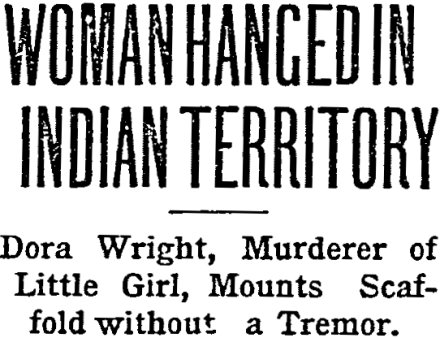
On this date in 1903, Dora Wright was hanged at McAlester in Indian Territory — the present-day U.S. state of Oklahoma.
Wright beat and tortured to death a 7-year-old orphan in her charge named Annie Williams. Wright tormented the little girl over several months until she finally succumbed to a thrashing in February 1903. It was, the local paper said, “the most horrible and outrageous” crime in memory in the area; Wright’s jury only needed 20 minutes’ deliberation to condemn her.
As Oklahoma was yet four years shy of statehood, “Indian Territory” jurisdiction — and with it any decision on executive clemency — fell to U.S. President Theodore Roosevelt. The inclination of the Rough Rider is aptly conveyed by the words of Attorney General Philander Knox‘s brief on the case to the President, which were released for press consumption:
The real facts in this case are that this woman tortured to death a little child seven years old, her niece, whom she was pretending to care for and support. She whipped the child most unmercifully with large switches, struck it about the hand and face so as to cause wounds sufficient to produce death, burned holes in its legs and thighs with a heated poker, and committed other nameless atrocities upon the person of the child. The testimony shows that the woman pursued a course of cruelty which was fiendish and barbarous … The only ground upon which her pardon is sought is that she is a woman, and that the infliction of the death penalty upon a woman would be a shock to the moral sense of the people in the community.
T.R. was incredulous at the feminine special pleading.
“If that woman was mean enough to do a thing like that,” Roosevelt said, “she ought to have the nerve to meet her punishment.”
Wright did have that nerve in the end, and was noted for the calm with which she comported herself on the scaffold. (She was hanged alongside another fellow, Charles Barrett, who shot a man dead in a robbery.)
From the Duluth (Minn.) News-Tribune, July 18, 1903.
On this date in 1955, Albert Pierrepoint escorted the alluringly tragic Ruth Ellis to the gallows at Holloway Prison — the last woman ever hanged in Great Britain.
The former hostess had tracked her inconstant and abusive lover David Blakely to a Hampstead pub a few months before — getting the ride, and the murder weapon, from her unrequited hanger-on Desmond Cussen — and shot Blakely dead on the street. Five bullets: the last, a coup de grace. (Another missed entirely and winged a passerby.)
A bitterly controversial case from the moment it entered the public eye, Ellis’s hanging bolstered the movement to abolish Britain’s death penalty. Juridically, however, it was resolved in the blink of an eye when a crown’s attorney cross-examined the murderess:
Christmas Humphreys: Mrs. Ellis, when you fired that revolver at close range into the body of David Blakely what did you intend to do?
Ellis: It was obvious that when I shot him I intended to kill him.
The jury, which never heard that Blakely regularly beat his killer (including once to induce a miscarriage), needed 14 minutes to convict her.
ET: I think at a certain point in time, everyone in Great Britain would have known who Ruth Ellis was, and quite a few abroad, too. How true is that still, nearing 60 years after her execution?
I think her name is still quite familiar, to be honest.
When I began researching the book, everyone I discussed it with either already knew the very basic facts of Ruth’s story, and at the very least that she was the last woman to be hanged in England. The 1985 biopic Dance with a Stranger left a big impression too, even though it wasn’t entirely faithful to Ruth’s character, making her seem much more hysterical a personality than she actually was, although I thought Miranda Richardson was brilliant in the role — as she always is!
What led you to the Ruth Ellis story?
I’ve always been interested in Ruth and that period in history — and I vividly remember going to see ‘Dance with a Stranger’ when it came out in the cinemas here. But it always struck me that her full story had never been told, particularly the last few months of her life after she shot David Blakely. And a couple of years ago there was quite an intense debate about bringing back capital punishment; Ruth’s name was always mentioned in relation to that particular argument, and I really felt it was time to explore her whole story.
What are the greatest misconceptions people have of her? Have her previous biographies and screen portrayals fed those misconceptions?
Without doubt, many people see Ruth as she was shown in ‘Dance with a Stranger’ — very screechy, out of control and violently jealous.
I think it’s true to say that she and David were both deeply jealous of each other (both giving the other reason to be so), but Ruth was not as hysterical as she was portrayed in the film. In fact, it was quite the opposite — the men were hysterical and it was Ruth who usually vented a sort of quiet fury. There is one scene in the film which shows her smashing the windows of David’s car and screaming in the street. Reading the original police statement about that night reveals a very different story; she was described as very calm and rational. There was no screaming, and although she did damage the vehicle, it was not remotely as it was shown in the film.
I think other adaptations have also done her a disservice. Ironically, probably the most accurate portrayal is in the film ‘Pierrepoint,’ where the character of Ruth appears for no more than a minute or two on screen.
I get the sense that Ruth was always running uphill against her class position, trying to climb a little higher than she could reach — right up to the end where her lover is a well-off cad and the rivals for the lover’s affection are his middle-class friends. What role did England’s class relations have in Ruth Ellis’s life and death, and in the way that others perceived her? Do they still shape the way we talk about her all these years later?
Class and politics played a huge role in Ruth’s life generally.
England was distinctly class-led at the time and when the case hit the headlines, she was described as a working-class floozie who attached herself to the upper-class David Blakely purely in order to hoist herself up the class ladder.
That couldn’t have been further from the truth; if she was only interested in using men to better herself socially, she would surely have married her sometime-lover Desmond Cussen, who was a much steadier prospect with money and property and who wanted very much to marry her. Ruth worked hard to better herself but she didn’t use the men she loved to do so.
And when it came to her trial, the class values of the time were heavy in the courtroom with the male barristers and judge and so on all very much men of the upper classes — and who viewed her accordingly. I hope we have got beyond all that nonsense now — but it does add a very distinct dimension to discussions of her case.
She was working as a hostess when she met David Blakely. What would a hostess do, who worked in this trade, and who were the clientele? Was it usual for “real” relationships to evolve? Do people still have this job in the same form as Ruth had it?
Hostessing in the clubs in which Ruth worked was quite straightforward — or it should have been, but there was Morris Conley to contend with, and he was quite a character.
Ruth’s basic job description was to look good and to chat to customers (mostly men) in the clubs, laugh at their jokes and keep them buying food and drink for as long as possible. Most hostesses were in their late teens and early twenties, working-class girls who thought the lifestyle was more glamorous than toiling in a factory or in a shop.
They were usually paid badly and relied on tips to make ends meet, but were given a dress allowance so that they could look as alluring as possible. The clientele mainly consisted of demobbed servicemen who suddenly seemed to have lost their attractiveness to women after the war — where once they had been heroes, by the late 1940s many of them were down on their luck and working as door-to-door salesmen, very lonely and eager to talk to pretty young girls about their war exploits.
The girls who worked for Morris Conley, like Ruth, were expected to sleep with the clients if that was asked of them, and often had to sleep with ‘Morrie’ and his less than respectable friends too. Many of them were very poor young women who lived in flats owned by Conley and his wife — and if they didn’t toe the line, they lost their jobs and their homes in one fell swoop.
Did real relationships evolve? Yes, they did, but very rarely. There are girls all over the world doing very similar jobs today — from London to Japan and everywhere in between too, no doubt.
You have this quote from Ruth about David Blakely: ‘I thought the world of him; I put him on the highest of pedestals. He could do nothing wrong and I trusted him implicitly.’ Ruth had an alcoholic, abusive father, and then she had two children from marriages with two different men that both fell apart — one from bigamy and abandonment, the second from alcoholism and domestic violence. Blakely himself cheated on her. Why wasn’t she more cynical about Blakely? If you take away the tragic ending to this particular relationship, was something like this a pattern she was doomed to keep repeating ad infinitum?
She loved him — it’s really as simple as that.
Although she obviously had a good degree of self-awareness and knew what David was and always would be, she truly loved him and for a time believed they had a future together. As for a pattern — I don’t know. Perhaps if she had met one good, steady man to whom she was attracted as much as she was to David, her life — and David’s too of course — might have been very different.
I’m going to phrase this inelegantly: what is the DEAL with Desmond Cussen?
Good question! I really think that he was as confused and tormented by everything that was happening as a result of Ruth’s and David’s relationship as Ruth herself.
I think he did love Ruth, and he tried hard to make things work with her, but he knew her heart was with David. His apparent lack of self-respect and backbone is baffling — quite why he kept ferrying her across London and out to Buckinghamshire in pursuit of David is a bit mystifying. I did question in the book why no one seemed to query his state of mind as much as Ruth’s — and as to whether he gave her the gun or not, knowing what she intended to do … I am sure he did, even though he must have known where it would end for Ruth herself.
Perhaps he hoped that with David out of the way, she would be reprieved and they could then have a life together. But I really don’t know!
Ruth’s legal defence was legendarily feeble. That said, I’m very interested in the barrister’s attempt to frame its insanity defense around feminine hysteria — “the effect of jealousy upon a female mind can so work as to unseat the reason and can operate to a degree in which a male mind is quite incapable of operating.” This was bound to be undermined by Ruth’s own calm and the statements about her intent to kill that she gave to police and in court. Was it the case that the law at the time didn’t have the instruments to situate Ruth’s context and state of mind, other than hysterical/not? Or could an abler barrister have presented a different story?
I think part of the difficulty is obviously that the defence of diminished responsibility was not introduced in the courts here until 1957 — largely as a direct result of this particular case.
Ruth’s lawyers tried to argue this as a defence for her to some extent, but it just wasn’t possible legally. That said, I think they served her quite badly and didn’t bring out so much that might have enabled the jury to see her crime in context. There was no mention of the abuse in her childhood, no mention of the violence she had suffered at the hands of her ex-husband and very little said about David’s own brutal treatment of her.
But Ruth herself did not seem to care much what happened in the courtroom, once it became evident that the story as she saw it — David’s friends having, in her view, deliberately destroyed the relationship between them — was not going to come to light. She gave up, and volunteered nothing that could have helped her, minimizing the violence to which she had been subjected and dismissing most of the questions put to her in a short sentence or two.
She also infamously replied to the prosecution’s question of what she intended to do when she set out to find David with the gun, “It is obvious when I shot him I intended to kill him.” That one line completely sealed her fate.
Despite all this, the public did seem to be shocked by Ruth Ellis’s hanging, and it’s supposed to have boosted the anti-death penalty campaign. If one may phrase it this way, were people shocked for the right reasons? How much did the symbolic “Ruth Ellis” that even her supporters among the general public had in view have to do with the real person as you understand her?
I think any case is always immeasurably more complex than it is presented in newspaper columns and headlines.
I think, again, the outcry at her execution has to be seen in context — people were becoming more and more opposed to the death penalty and there had been some very high-profile, contentious cases that really did cause a great deal of debate, anger, and distress: the hanging of Timothy Evans in 1950 and of Derek Bentley in 1953 for instance (both of whom were posthumously pardoned).
The fact that Ruth was a young, attractive, lively woman with two small children caused many people to question the validity of capital punishment. It was her death on the scaffold that gave the abolition movement its emotional spur.
What became of Ruth Ellis’s body after her hanging? And what became of her family and the others who were part of the story?
Ruth was buried in the confines of Holloway Prison after her execution, sharing her unmarked grave with four other women who had been hanged there. In 1971, when the prison was demolished and rebuilt, her body was released to her son for burial.
He had hoped to lay his mother to rest alongside David Blakely at the Holy Trinity churchyard in Penn but the vicar there would not allow it. Ruth was instead buried in the churchyard of St Mary’s in Amersham, a few miles away.
As to what became of her family: her son Andre (who was ten when Ruth was executed) was diagnosed with schizophrenia as a very young man and never came to terms with the loss of his mother. He committed suicide in 1982. Ruth’s daughter, Georgina, had quite a colourful life, becoming a successful model who was in the newspapers fairly often as part of the George Best ‘set.’ She married and had children and worked hard to win a posthumous pardon for her mother, of whom she spoke often. She died of cancer at the age of only 50.
As for Desmond Cussen: he emigrated to Australia and opened a flower shop there. He never married and became an alcoholic, dying in Perth on 8 May 1991 of pneumonia and organ failure following a fracture dislocation of the neck in a fall at his home.
In the earliest years, people sluiced over the long border just anywhere. By Smolka’s time, that perimeter was buffered by an “internal border” that made it difficult for ordinary people to approach near enough to West Germany to escape. Consequently, most emigration by the the late 1950s occurred in the divided city of Berlin — a flow that East Germany would finally stanch in 1961 with the ultimate in immigration reform, the Berlin Wall.
One of the Cold War’s iconic photographs: East Berlin border guard Conrad Schumann leaps over the barbed-wire barrier into West Berlin on Aug. 15, 1961, just days after construction of the Berlin Wall began.
Like that more famous later escapee, Manfred Smolka (German link, as are most that follow) was a border guard; indeed, he was an officer. That gave him the ability, in 1958, to be far enough within the “internal border” to defect into West Germany
The very next year, he arranged to meet his abandoned wife and daughter on the Bavaria-Thuringia frontier to smuggle them over, too. Alas, it was a trap (pdf) laid by the feared East German secret police, the Stasi.
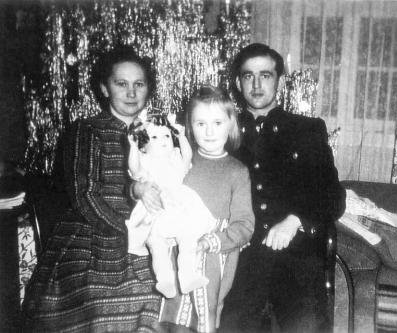
Happier times: Manfred Smolka with his wife and child.
According to press reports, Smolka was actually on West German soil when the Stasi men captured him.* (The Stasi were often up for a bit of kidnapping.)
West Germans were outraged by Smolka’s capture and subsequent death sentence for “military espionage,” but the case was deemed an apt one for the education of East Germany’s border security agents.
Only with post-Cold War German reunification could his family examine his file. “I am innocent, I can prove it a hundred times,” they read in the last letter the onetime defector wrote to his family — a letter which had never been delivered. “You need not be ashamed of me.” In 1993, a reunified, post-Cold War Germany officially agreed and posthumously rehabilitated Manfred Smolka.
There’s a few minutes of documentary video about him, in German, here.
* By a July 5, 1960 account in the London Times, Smolka was shot at and wounded as he crossed into East Germany but still managed to “crawl” back to West Germany — where his pursuers did not fear to follow him.
On this date in 1917, someone was electrocuted in Rockview, Pennsylvania.
“John Nelson”, the cipher alias by which authorities were eventually content to call him, was 5′ 8″ tall and 165 pounds, and looked like an African-American. (“Nelson” himself said that neither white men nor black were of his race.) Papers put this about quizzically because he was also utterly steadfast in refusing to identify himself or his background.
He eventually allowed that he came from Canton, Ohio (but who knows if that’s true). “He reads Shakespeare and seeks high grade newspapers and magazines,” ran news-of-the-weird wire copy all around the country. He boasts “long hair which bears the appearance of having been done up in kids to give a ‘Sis Hopkins’* effect” as well as “long gray whiskers, sideburns and a heavy mustache.” He looked maybe 60 years old.
Anyone?
Aw, heck.
The Scranton Times sent 5,000 of these postcards around the country hoping to scare up information about their mysterious murderer.
Tips poured in from all over — but nothing definitive. An upstate New York sheriff reported discharging a guy named John Nelson from jail a couple of years before. A woman in Butte, Montana recognized the picture and thought it might be her vanished father. The prisoner also resembled a missionary from Ohio and a bank president from Richmond, Va., also both missing; a Scranton woman thought he maybe used to be her gardener. (All but the last of these indefinite tips via Cheryl Kashuba’s two-part series on this case in the March 17 and March 24, 2013, issues of the Scranton Times-Tribune.)
Although nobody could figure out who he was, everyone was pretty sure what he’d done.
On the evening of Oct. 30, 1915, he’d trudged into Mill City, a Wyoming County township outside of Scranton, and made an unexplained sudden attack on three men lolling about a barbershop porch.
According to those three men’s story — and they’re all we have to work with since Nelson kept mum on this, too — a little white boy running down the darkened street bumped into the mystery pedestrian. At that, “Nelson” suddenly produced a knife and charged at the trio of nearby men, bellowing “White people in a tank town like this can’t run over me!”
J.M. Sickler, a prosperous local farmer, bravely intercepted the attacker before he reached Judge Robert Westlake, and suffered mortal stab wounds for his trouble. The attacker fled, but other locals roused by the commotion overpowered him as he escaped; Sickler lived long enough to give a deathbed positive identification.
Of course, it wasn’t really “positive” — that’s the whole point. And “John Nelson”, whoever he might have been, kept his nose in his Shakespeare and his lips enigmatically sealed on the crime and its causes; on his background and biography; on everything whatsoever. “I just wouldn’t care to talk about that,” he would reply when questioned, or similar versions of that polite deflection.
He kept his queer peace all the way to the electric chair.
* Maybe Mr. “Nelson” was just taking Sis Hopkins’ good advice: “There ain’t no sense in doin’ nothin’ for nobody what won’t do nothin’ for you.” As Nelson blithely put it (and who could contradict him?) any name at all would do for his circumstances.
On this day in 1920, Lee Monroe Betterton (addressed by his middle name) was electrocuted in Oklahoma for the murder of his wife, whose unusual name has been given variously as “Elzeana,” “Aldazia” and “Elzadah.” (This account will use the latter spelling, which was the one used in Betterton’s Oklahoma Court of Criminal Appeals syllabus.)
Little is known about Monroe Betterton’s background, other than that he was born in Missouri and was the seventh of twelve children, ten of whom survived to adulthood.
He was a heavy drinker and his violent nature was self-evident: Elzadah was, sadly, not the first wife Betterton killed. Nor was she even the second wife Betterton killed.
Betterton killed his first wife, Laura Elizabeth, in Barry County, Missouri in 1904. They had four young children together, two sons and two daughters. During an argument he beat her unconscious and she was taken to the hospital, where she soon died. For some reason, her husband was not prosecuted.
By 1908, Betterton had remarried and was living with Rosie, Wife #2, in Neosho, Missouri. They were walking to nearby Monett to visit some of his relatives when they started quarreling. Both of them had been drinking. About two miles outside of town, Betterton suddenly pulled out a knife and stabbed Rosie in the heart. She died instantly and he laid her body beside the railroad tracks.
This time he was arrested and charged with the crime. Betterton maintained that “I was guilty of that woman’s death, but it was an accident.” He got 99 years in prison, but served only ten before he was paroled in 1918.
He was 48 by then, and he returned to Monett and began courting Elzadah Lockwood, a widow close to his own age who was unfamiliar with the old adage that while once is a coincidence, twice is a trend. They got married, but their relationship turned rocky almost immediately and they argued constantly.
The couple separated after only a few months and filed for divorce. However, they reconciled after Betterton’s son Clifford married Elzadah’s daughter Mamie. In the first week of July 1919, a mere week after their divorce was final, Monroe and Elzadah remarried and settled in Vinita, Oklahoma.
Their previous problems resurfaced, however, and within days they were fighting like cats.
On July 9, 1919, Elzadah was preparing to leave her son-in-law Arthur Thomas’s house after yet another argument when Betterton shot her three times in the back. One of the bullets blew away the whole right side of her heart, and she was dead before authorities arrived at the scene.
When questioned, Betterton implicated everyone: the son Clifford; the son-in-law Arthur; even Elzadah herself as a phenomenally effective suicide. Mamie had been present at the scene, though. She and Elzadah’s eight-year-old son Raymond saw the whole thing, and both testified against their stepfather at his trial.
The case was pretty open-and-shut: As the Vinita Daily Journalnoted, “The prisoner seems to be the least [a]ffected of the family and pays close attention to the testimony for or against him … There was practically no defense.”
Hobart (Okla.) Daily Republican, June 21, 1920.
Less than an hour before his execution, Betterton gave an interview in his cell and continued to assert his innocence: “I am not guilty of the crime with which I am charged. I am ready to die. I am ready to meet my God. I do not fear death, but I do not want to die for a crime which I did not commit.”
Approximately 100 people witnessed his execution. He had no final statement.
On this date in 1969, alleged North Korean operative Lee Soogeun (other transliterations exist for his given name, such as Soo Keun or Soo-geun) was hanged at a Seoul prison for espionage.
A North Korean party elite, Lee was the Vice President of the North Korean Central News Agency.
On March 22, at the Military Armistice Commission meetings at the border outpost of Panmunjom, Lee suddenly leapt into a UN official’s vehicle and escaped over the frontier.
The high-profile defector got a hero’s welcome in the South. (A U.S. Army captain also copped a medal for helping him escape.)
Lee hit the lecture circuit critically discussing the situation north of the 38th parallel, and worked as an analyst for South Korean intelligence.
However, the KCIA also had Lee under surveillance, and came to believe that he was actually gathering intelligence to send to the north. Realizing his predicament, Lee fled with his niece for Cambodia. They were captured en route in Vietnam.
South Korea’s Truth and Reconciliation Commission has, while stopping short of exonerating Lee, ruled his confinement illegal, and the self-incriminating statements he made in that environment insufficient evidence, and urged his case be re-tried. Lee’s niece served 20 years of a life sentence as his accomplice, but was released in 1989 and eventually won a 6.8 billion won wrongful imprisonment suit.
The Aug. 28, 1955 lynching of Emmett Till and the subsequent acquittal of his murderers by an all-white Mississippi jury were among the American civil rights movement’s pivotal events.
For a certain indecent number of people, however, the passion of the 14-year-old youth — alleged to have flirted with a white woman — was to be mourned only insofar as it confirmed the menace that insatiable Negro libidos posed to southern way of life.
Further to that end, the months following Emmett Till’s death brought to the headlines the formerly obscure* July 2, 1945 hanging of an American G.I. in Italy: Emmett’s father, Louis Till.
The violent Louis Till ruined his marriage to Emmett’s mother Mamie shortly after his son’s birth. Repeatedly violating her restraining order eventually landed Till pere before a judge, who gave him a choice between hard time and enlistment. Till joined the U.S. Army.
In 1945, he was court-martialed for murdering an Italian woman and raping two others. His execution near Pisa — he’s buried in Europe in the Oise-Aisne American Cemetery, the same final resting place as Eddie Slovik — was the no-account end of a no-account man for many years thereafter. Mamie Till said that she wasn’t even told what happened to her ex-husband, and was stonewalled when she sought information.
By the end of 1955, everyone knew.
In Jim Crow’s backlash against nationwide condemnation of the Till lynching, Louis Till came back to life in newsprint all that autumn to visit the sins of the father upon his late son: here was the mirror of the young predator all grown up, violating Italian women. Mississippi’s white supremacistsenators used their rank to obtain his army file, and leaked it to reporters.
According to Davis Houck and Matthew Grindy’s study of the Mississippi media’s conflicting reactions to the events of 1955, “Louis Till became a most important rhetorical pawn in the high-stakes game of north versus south, black versus white, NAACP versus White Citizens’ Councils.”
The pawn’s sacrifice did not figure in the endgame.
Crude attempts to impose blood guilt for Louis Till’s crimes aside, Clenora Hudson-Weems argues in her Emmett Till: The Sacrificial Lamb of the Civil Rights Movement that it was Emmett Till’s shocking death that catalyzed the civil rights movement — that the horrifyingly mutilated face at his open-casket funeral and the insouciant confession of his killers once they had been acquitted shook southern blacks and northern whites alike so profoundly as to dispel any confidence that legal briefs or political incrementalism could grapple with America’s race problem. Civil rights lion Joyce Ladner was an 11-year-old Mississippi girl when Emmett Till was lynched; she would tell Hudson-Weems of the shock it delivered in her world coming on the heels of the Brown v. Board of Education ruling desegregating schools.
A very important thing is that it followed the Supreme Court decision in 1954. It’s like the Whites said that they don’t care what rights we were given … So when the spark came in Mississippi to sit in the public library, for example, people who participated had been incensed by the Till incident and were just waiting for the spark to come. The Till incident was the catalyst.
Emmett Till’s body was exhumed for autopsy and DNA testing in 2005, in part to dispel the old story first promulgated by the attorneys who defended Till’s murderers — that the body wasn’t Emmett Till’s at all. On the corpse’s finger was a ring inscribed with the initials of his father: L.T.
* Louis Till did have one small claim to fame prior to his son’s murder: the fascist poet Ezra Pound chanced to be imprisoned with Till; he mentions the later-famous execution in his Pisan Cantos:
Till was hung yesterday
for murder and rape with trimmings
On this day in 1943, Willem Arondeus and eleven other Dutch resistance members were executed for sabotage and treason in connection with their anti-Nazi activities in the Dutch Underground.
Arondeus, an artist, novelist and biographer, was rather old for a resistance fighter; he was 48 at the time of his death.
He was the son of theater costume designers and one of six children, but became estranged from his family after he came out as gay at the age of seventeen. At a time when homosexuality was still illegal and deeply taboo, Arondeus spoke openly about it.
For seven years in the 1930s he lived with his lover and struggled to make a living. In 1940, after the Nazis invaded the Netherlands, he joined the resistance.
Arondeus utilized his artistic skills by forging identity papers for Dutch Jews. (Being himself part of a persecuted minority, perhaps he felt a special kinship with them.) He urged other artists to stand up against the Nazi invaders.
On March 17, 1943, he and other members of his resistance unit set the Amsterdam General Registry Office on fire, trying to destroy all the original records so the false identity papers couldn’t be checked. They successfully destroyed about ten thousand records, but five days later the entire unit was arrested. Their conviction was a foregone conclusion.
Arondeus said he hoped that by his life and death, he could prove that “homosexuals are not cowards.” Yad Vashem has honored him as Righteous Among the Nations. (pdf)
June 29, 1944, saw several noteworthy mass executions around Axis western Europe.
France: Seven Jewish hostages for the assassination of Philippe Henriot
Poet and journalist Philippe Henriot (English Wikipedia entry | French), the “French Goebbels”, was the Vichy government’s able chief propagandist.
On June 28, 1944, Henriot was assassinated by Maquis operatives disguised as milice paramlitaries.
Incensed, the real milice this morning gathered seven Jews already held in prison as hostages at Rillieux, drove them to the cemetery, and shot them one by one.
(Paul Touvier, who orchestrated this retaliatory execution, managed to stay underground until 1989. At his 1994 war crimes trial, he claimed that the Germans wanted 30 hostages killed, and therefore what he actually did was “save 23 human lives.” Touvier was convicted on the charge of crimes against humanity.)
Italy: Massacres in San Pancrazio, Cornia, and Civitella
As dawn broke this date, German soldiers retreating from liberated Rome fell upon several Tuscan villages.
German columns had been beset by partisans on the way, and standard operating procedure was to retaliate against partisans indirectly, by killing civilians — as in the notorious massacre in the Ardeatine caves. This vengeance was visited on the three towns: over 200 civilians were summarily executed on June 29, 1944.
“My mother later said she went to speak to my father,” remembered one San Pancrazio man. “A soldier turned her back and told her they were taking him to be tortured. She and my father both cried.” The father and those taken with him were shot in the basement of a farmhouse.
Caution: Graphic video.
The towns themselves have kept this date in remembrance, but the massacres were swept under the rug in the postwar settlement as Italy, Germany, and their former western enemies realigned for the Cold War. Only in the 21st century have they come to wider attention, when the discovery of secret archives documenting the atrocities enabled an Italian court to convict an aged German soldier in absentia.
There’s a CNN documentary on these events focusing particularly on San Pancrazio. Called “Terror in Tuscany”, it may be viewable here or here, depending on your location.
On this date in 1934, “the most successful and painless [execution] ever conducted at the penitentiary” claimed the life of William Cody Kelley in Colorado’s brand-new gas chamber.
Nevada had debuted this American contribution to the art of killing 10 years before. Colorado was the second state to gas a prisoner, and stood on the leading edge of gas chamber adoption during the 1930s by a half-dozen states in the American West. (… plus North Carolina.)
Kelley was condemned for bludgeoning pig-rancher Russell Browning to death with a pipe, and his otherwise forgettable case was a milestone for a reason besides the method: Kelley was the first executed in the state of Colorado without review by the state supreme court.
The reason? Dead broke, Kelley couldn’t scrape together $200 required for the appeal.
Journalist Lorena Hickok heard of Kelley’s plight and was about to front the cash when she was talked off it, on the grounds that her sticking up for a condemned murderer might throw a politically difficult light on her close friend Eleanor Roosevelt.
Hickok swallowed her principles but a later letter to the First Lady — the two had a voluminous correspondence; they may well have had a romantic relationship, too — drips with Hickok’s regret.
The thing has nearly driven me crazy. How can you have any faith or hope in us if we do things like that in this supposedly enlightened age? … I feel as though we were living in the Dark Ages, and I loathe myself for not having more courage and trying to stop it, no matter what the consequences were. You would have done it. Well — I guess I’d better not think about it any more.
While an inconceivable fortune stood between Kelley and his life, the execution materiel — a dozen acid capsules — set Colorado back just 90 cents. Such a pittance bought a killing method so reliable that “there was no cutting out of the victim’s heart, as was done after executions under the State’s old system of hanging, to make sure of death,” a gross if well–founded precaution.
Kelley’s partner in the murder, Lloyd Frady, testified against Kelley (both men claimed the other had committed the murder), and had his own death sentence commuted for his trouble. Frady was eventually released in 1949, but not before he made his fortune behind prison walls selling artsy “curio goods”. Those without the capital, as they say, get the punishment — and in this case, vice versa.
Colorado used the gas chamber for all its executions until 1967.





 Kelley was condemned for bludgeoning pig-rancher Russell Browning to death with a pipe, and his otherwise forgettable case was a milestone for a reason besides the method: Kelley was the
