On this date in 1944, Dutch Resistance hero Boy Ecury was shot by the occupying Germans.
Ecury (English Wikipedia entry | Dutch) grew up in Oranjestad, capital of the Dutch-controlled Caribbean island of Aruba, but had packed off to the Netherlands to finish school by the time World War II broke out. He spent the early Forties with a Resistance group sabotaging German assets and the like.
This insurgent clique eventually got rolled up, and Boy Ecury was arrested on November 5, 1944. He had only that one night to enjoy the legendary hospitality of the occupiers before he and several others of his group were shot the next day.
The young martyr’s body was repatriated to Aruba after the war and buried with honors; a public memorial still stands to him in Oranjestad.
Boy’s sister, the venerable poet Nydia Ecury, just passed away earlier this year.
La Paz, Bolivia, Nov. 5 (AP). — Selected by lot to die for the murder ten years ago of former President Jose Manuel Pando, Alfredo Jauregui, 28, was executed this morning. The young man died instantly from eight bullets from the rifles of a firing squad.
–New York Times, Nov. 6, 1927
Jose Manuel Pando (English Wikipedia entry | Spanish), wealthy landowner, military leader, former president, had seen Bolivia’s Liberal Party to power by prevailing in civil war in 1899, then peaceably handed off power to a Liberal successor in 1904.
The Liberals controlled Bolivia until 1920, but Pando grew overtly critical of his increasingly authoritarian successors. Though the circumstances of his murder in 1917 remain murky, his disgruntled affinity for the upstart Republican party is a likely contributing factor.
Jauregui faced the fusillade proclaiming his innocence; his supposed confederates were the beneficiaries of a Bolivian law permitting only one execution for a single murder … even of the former President’s murder. The four drew lots to determine which would be the “one”.
On this date in 1912, investigative reporter Emile Gauvreau saw George Redding hanged at the Connecticut State Prison in Wethersfield.
“When I left the prison to write my story,” Gauvreau later wrote in his memoir My Last Million Readers,* “I found out why newspapermen drank and I had my first half tumbler of cognac.”
Gauvreau was 21 years old, and he wasn’t a pup any longer.
This hard-charging journo from a rough-and-tumbler age would later make a name for himself pioneering the lowbrow Big Apple tabloid style with his New York Graphic. (“The PornoGraphic”, it was nicknamed.)
And he made his bones for that classic career in newsprint — from high school dropout to cub reporter to the heights of the profession — by making bones of George Redding.
The case was the mysterious February 1912 murder of a Hamden produce peddler by the name of Morris Greenberg. Greenberg was lured to a wooded area en route to buy from a local farmer and shot dead there for his cash. Police were stumped.
Gauvreau at the time was busting hard at the police desk of the New Haven Journal-Courier (since merged into the New Haven Register). He took a page from Sherlock Holmes and went to work on the sensational case freelance … painstakingly eliminating Hamden residents until he was left with George Redding.
Redding was a young man on the make himself, a charming 21-year-old playwright who’d been throwing a lot of money around lately and was known to carry a sidearm.
Circling his friends and paramours, Gauvreau sealed the young man’s fate by laying hands on a damning confessional that Redding had sent a friend. Gauvreau even stage-managed the arrest so that he could shock rival papers and police detectives by breaking the whole story in his paper. All that was left for police was extracting Redding’s confession.
On this date in 1907* an audacious would-be suicide bomber was executed by tsarist Russia.
Thousands of Russians immersed themselves in the late 1900s in revolutionary struggle after the Romanovs bloodily stopped the 1905 revolution. So many of them were executed that the gallows became known as “Stolypin’s Necktie”, after the sitting Prime Minister.
Twenty-one-year-old conservatory pianist and singer Evstolia Ragozinnikova got involved in a plot to assassinate the said Stolypin. (It was only one among several such plots, one of which finally succeeded in 1911.)
But “Tolia” feigned madness and then escaped the psychiatric hospital where she’d been confined. She rejoined her Socialist-Revolutionary conspirators, some of whom tried to get her to flee to Milan to further her musical studies.
Instead of concert houses, Ragozinnikova raised the curtain on her magnum opus on October 28* with a bid to land a Guy Fawkes-like blow against the autocracy.
Communist-turned-anticommunist Whittaker Chambers would, much later, remember in his correspondence with William F. Buckley the power that deeds like Ragozinnikova’s had to inspire, notwithstanding Lenin’s eventually-orthodox disavowal of terrorism. For Chambers, it was not material immiseration but spiritual disinheritance, existential despair — the sort that made artists into suicide bombers — that was the true midwife of Communism.
I may presume in supposing that the name of Ragozinikova is unknown to you. But the facts are these. In 1907, the Russian government instituted a policy of systematically beating its political prisoners. One night, a fashionably dressed young woman called at the Central Prison in Petersburg and asked to speak with the commandant, Maximovsky. This was Ragozinikova, who had come to protest the government’s policy. Inside the bodice of her dress were sewed thirteen pounds of dynamite and a detonator. When Maximovsky appeared, she shot him with her revolver and killed him. The dynamite was for another purpose. After the murder of Maximovsky, Ragozinikova asked the police to interrogate her at the headquarters of the Okhrana. She meant to blow it up together with herself; she had not known any other way to penetrate it. But she was searched and the dynamite discovered. She was sentenced to be hanged.
Awaiting execution., she wrote her family: ‘Death itself is nothing, … Frightful only is the thought of dying without having achieved what I could have done How good it is to love people. How much strength one gains from such love.’
Chambers aside, she’s not so well attested on the English-lanuage Internet; there’s a bit about her in Russian here and here, as well as some references to both Ragozinnikova and her peers in an academic pdf, “Women in the World of Gender Stereotypes: The Case of the Russian Female Terrorists at the Beginning of the 20th Century” by Nadezda Petrusenko in International Journal of Humanities and Social Science, April 2011.
* Gregorian dates. By the local Julian calendar in Russia, she committed her murder on October 15, and was hanged on October 18.
On this date in 1942, 17-year-old Helmuth Hübener was executed at Plotzensee Prison for listening to the BBC.
Huebener was a Mormon youth with the political perspicacity to abhor fascism from a very young age: the former Boy Scout (Mormons really take to scouting) ditched the Hitler Youth after Kristallnacht, which happened when Huebener was only 10 years old.
As Germany forged ahead towards worse horrors in the years, conscientious people of all ages had moral dilemmas to resolve. Mormons in Nazi Germany weren’t persecuted per se and to keep it that way that small community generally kept its head judiciously down.
Not Huebener.
Horrified by the privations of their Jewish neighbors, Huebener with fellow Mormon teens Karl-Heinz Schnibbe and Rudi Wobbe began illegally listening to foreign radio broadcasts and using the material to compose anti-fascist pamphlets for distribution around Hamburg.
Themes like Germany’s coming defeat (a Huebener circle favorite) never went over well with the authorities; a 1939 law decreed that “Whoever willfully distributes the broadcasts of foreign stations which are designed to endanger the strength of resistance of the German people will, in particularly severe cases, be punished with death.”
Huebener’s friends, aged 18 and 16, were judged only sufficiently severe for hard labor sentences; both survived the war but have since died. Huebener as the ringleader got the death penalty. (The local Mormon congregation expediently excommunicated him, a judgment later reversed from church headquarters in Salt Lake City.) And clearly Huebener was failing to “support the troops”, in the present-day parlance: his own older brother Gerhard had been drafted into the Wehrmacht and was away at the front.
“My Father in heaven knows that I have done nothing wrong,” young Helmuth wrote shortly before his beheading. “I know that God lives and He will be the proper judge of this matter.”
The Latter-Day Saints church, not usually thought of as a hive of anti-authority activity, has only gradually warmed up to celebrating its appealing young resistance martyr.
In addition to a number of books, Huebener is the subject of the documentary Truth & Conviction as well as the forthcoming feature film Truth & Treason.
Ivorian politics pitted the more prosperous coastal Christian south against the more rural Muslim inlands, but the 2000 election did not: Alassane Ouattara, the northern/Muslim standard-bearer was eliminated from the election by a conveniently-introduced summer 2000 law disqualifying candidates with a foreign parent. Ouattara was a former Ivorian Prime Minister, but for this election, he wasn’t Ivorian enough to stand.
Political bad blood became political bloodsport with the Oct. 22 election.
On Thursday, Oct. 26, 2000 — which was also the day that election’s winner Laurent Gbagbo was officially sworn in, despite thousands protesting — pro-Gbagbo militias went to town on Ouattara supporters, Muslims, immigrants.
In pro-Gbagbo sections of Abidjan like the suburbs of Abobo and Yopougon, ethnic Dyula or Dioula were rounded up en masse, mosques attacked by mobs, and people menaced, beaten, or worse.
In the late afternoon of October 27, the bullet-ridden bodies of fifty-seven young men were found dumped in two piles in a forest clearing on the outskirts of Yopougon. After speaking with two survivors of and several witnesses to events surrounding the massacre, Human Rights Watch researchers established that paramilitary gendarmes based at the Gendarme Camp of Abobo were directly responsible for the killings. This incident was the single worst atrocity of the election period.
The massacre took place on October 26, 2000 in two stages. The first involved the shooting of detainees at the Gendarme Camp of Abobo, where young men rounded up from Abobo neighborhood were taken during the morning and early afternoon of October 26, 2000. Prior to the shooting detainees were subject to … brutality and torture … At approximately 3:00 p.m…. at least two gendarmes opened fire on the detainees held there, killing some thirty to forty.
The second stage showed the signs of being a well-planned operation. Well-armed gendarmes deployed intoa neighborhood bordering the Gendarme Camp of Abobo and rounded up between eight and thirteen young men who were used as porters to load the dead onto a truck and later dispose of the bodies in the forest. The porters and all other survivors were then gunned down, though some were not killed. These survivors described the presence of one truck, two jeeps, and the involvement of some thirty gendarmes in this operation.
Two men (they’re both directly quoted in the Human Rights Watch report) survived the second stage of the massacre by playing dead.
This unpunished incident — eight gendarmes were tried, but all acquitted — has blended into the rich tapestry of grievances stoking Ivory Coast tensions down to the present day.
Laurent Gbagbo … under arrest. (Not for this massacre.)
When outright civil war erupted in 2002, anti-Gbagbo rebels reportedly yelled “This is for Yopougon!” when gunning down policemen.
In 2010 Ouattara beat Gbagbo in yet another presidential election. That led to a fresh round of nastycivil war.
That war’s upshot was to seat Ouattara — he’s President of the Ivory Coast as of this writing — and to extradite Gbagbo for war crimes proceedings at the Hague. But in the course of that more recent bloodletting, Yopougon once again became a massacre site, and its football pitch “an open-air cemetery”.
At 12:09 a.m. this date in 1934, Harry Pierpont — a partner of notorious gangster John Dillinger — was electrocuted at the Columbus, Ohio penitentiary.
This Indiana-born criminal helped Dillinger transition from local malcontent to FBI’s Most Wanted* in prison in Michigan City, Indiana. Pierpont was a professional armed robber and the leader of a gang that knocked over several Indiana banks in the mid-1920s before his capture.
That was right about the time that fellow Hoosier Dillinger was catching an absurdly harsh 10-to-20-year sentence for robbing a local grocer in Mooresville — a sentence Dillinger helped bring on himself when he took his father’s advice to plead guilty and take responsibility and blah blah blah.
The court threw the book at him.
“I will be the meanest bastard you ever saw when I get out of here,” 21-year-old Dillinger is supposed to have said. He’d prove infamously true to his word … with the help of Harry Pierpont.
The two crossed paths in the penitentiary system in 1925. Pierpont was only eight months older, but was a much more seasoned criminal and mentored the young Dillinger in the arts of bank robbery. Both also cribbed from two former associates of the German robber Hermann Lamm, who broke new ground in the larceny game with his disciplined, systematic approach to the job: casing the bank, organizing the crime, plotting and practicing the getaway route.
Dillinger finally made parole after nine long years in the stir on May 22, 1933. The years-long show of rehabilitation that won him his liberty immediately proved to have been a facade: in a pre-arranged plan, Dillinger committed several bank robberies that summer to raise funds to orchestrate a prison break for Pierpont et al.
Pierpont and seven others, who would form the first Dillinger gang (Pierpont reportedly encouraged the branding fronting his charismatic former apprentice), and their escape conveniently occurred just after Dillinger himself had been arrested. His once-and-future associates returned the favor by liberating Dillinger from the Lima, Ohio jail — gunning down Sheriff Jess Sarber in the process.
Dillinger would be dead within the year and Pierpont not much outlive him. But in those months pillaging banks (wildly unpopular at this moment, the very pits of the Great Depression) from the open-road freedom of zooming Terraplanes that could outrace police cars, wielding spectacular Tommy guns that could outgun police, the Dillinger gang staked its social bandit bona fides.**
They robbed several more banks with the discipline and precision that would make them famous; notably, Dillinger and company rarely drank and never when planning heists, evaluating targets with all the businesslike sobriety of corporate raiders.
They weren’t caught in the act, but while trying to lay low in Arizona.
Dillinger and had one more escape in his bag, and that a spectacular one: brandishing a fake wooden “gun”,† Dillinger busted out of the allegedly “escape-proof” Lake County Jail in Crown Point, Ind. and joined up with another gangster.
Dillinger had four months and change yet to go, a cavalcade of Midwestern robberies, an alleged appearance-altering plastic surgery, and a running battle with the young HerbertJ. Edgar Hoover and his star agent Melvin Purvis. Dillinger was finally shot dead in Chicago that summer of 1934. His robbery spree had lasted only 15 months, but it made him a worldwide celebrity.
Three others arrested with Dillinger in Arizona, however, were not with Dillinger when he escaped Crown Point.
Instead, they were destined for Ohio to answer for that sheriff they’d murdered freeing Dillinger the year before. Harry Pierpont and a fellow gang member, Charles Makley, caught capital sentences.
It’s more than likely that they were anticipating another rescue from their famous confederate, but Dillinger’s end in Chicago sealed Pierpont’s and Makley’s fate, too.
On September 22, with death dates looming, those two attempted to replicate Dillinger’s “fake gun” escape gambit with bars of soap carved like pistols and painted with bootblack. (Woody Allen paid it homage.) It was a desperate try, and it ended in a fusillade from an un-bluffed squad of prison guards as Pierpont and Makley tried to spring the gate to their prison block.
Makley, perhaps the luckier of the two, died of his injuries. The hobbled Pierpont lived long enough to make it to the electric chair.
A few books about John Dillinger
* Dillinger was the first person designated as the fledgling Federal Bureau of Investigation’s Most Wanted.
** Anecdote: the Dillinger gang wouldn’t steal from bank customers, telling them “we only want the bank’s money.”
† Or maybe a real gun subsequently replaced with a fake gun, maybe with the connivance of bribed guards or the like … there’s a good deal of unresolved speculation about this escape.
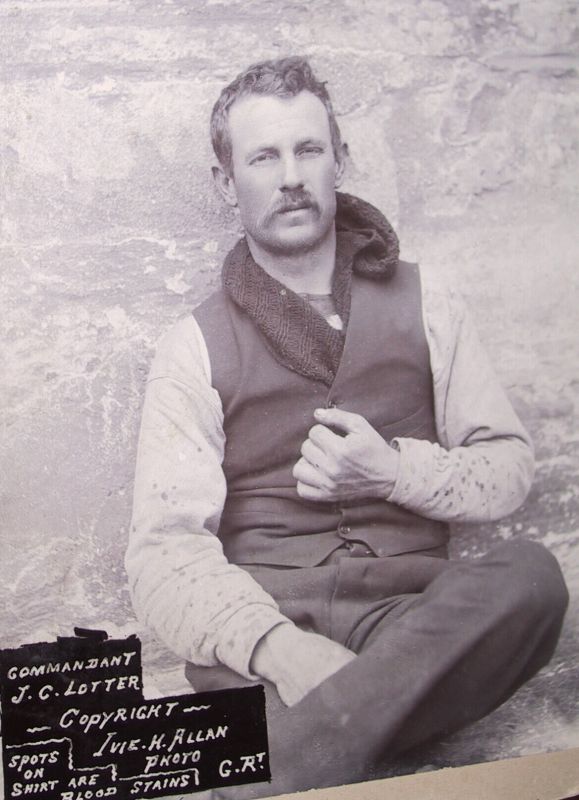
Regarded by the British as one of their most nettlesome adversaries in that dirty guerrilla war, Lotter was captured in a bloody early September ambush when matters were well into an unpleasant scorched-earth endgame.
This was cause for much slapping of backs among the Union Jack set, and earned for his captor an immediate promotion.
Lotter’s captured men being jubilantly escorted into Graaff-Reinet.
Lotter almost immediately found himself in the dock for — well, all the things one does in a dirty guerrilla war.*
And one other thing: sedition.
The British charged Lotter as a rebellious subject of the British Cape Colony — rather than a resident of one of the independent neighboring Boer states — who owed allegiance to the British crown; upon this premise things like “killing troopers in war” became “murdering troopers”.
Lotter’s trial hung on his papers.** The defendant “pleaded that he was a Free State burgher, and, as such, entitled to the usage of civilised warfare and a legal combatant’s privileges.”
But he was in a bit of a pickle when it came to proving that the “Commandant Lotter” the British discovered on voting rolls for the Cape Colony city of Colesburg was a different guy. Innocent Blood: Executions During the Anglo-Boer War (its title telegraphs its Boer sympathies) summarizes:
his Free State citizen document was in a small case, which was lost or destroyed theday of surrender. Witnesses for the defence gave evidence that they had seen these papers. British intelligence stated that it could find no proof of his Free State citizenship in Bloemfontein. Lotter responded by asking how he could prove his citizenship when all his witnesses were still on commando and that he had been granted no time to call upon them.
Hey, the guy had six whole weeks from capture to execution to sort it all out.
A “Chair Monument” — there’s a picture of it on this page — commemorates Lotter and his fellow commando Pieter Wolfaardt at the place outside Middelburg where they were shot together on Oct. 12, 1901.
A number of additional prisoners from Lotter’s command taken with him in that same ambush were also eventually executed.
* Specifically: murdering two native spies; killing three British soldiers; blowing up railway lines; and sjamboking loyalist civilians.
** When the British later captured Scheepers, who was unquestionably not a Cape rebel, they simply charged his similar conduct as war crimes to the same capital effect.
On this date in 1987, Eshan Nayeck was hanged in Port Louis — capital of the Indian Ocean island nation Mauritius, a former Dutch, French, and British colony near Reunion Island.
It was just the second execution (French link) since Mauritius attained its independence in 1968, and it remains to this day the last.*
Nayeck sensationally stabbed to death a man named Abdool Rashid Atchia in Port Louis’s Central Market in 1983.
Scene of the crime: Central Market in Port Louis, circa 2006. (cc) image from erwinkarim.
* Mauritius abolished the death penalty in 1995, but its current Prime Minister Navin Ramgoolam has publicly mooted (pdf) restoring capital punishment “for crimes such as drug trafficking.”
On this date in 1982, Khosrow Khan Qashqai was publicly hanged in Shiraz.
A member of the pastoral Turkic Qashqai people of southern Iran, Khosrow returned from exile* with the Iranian revolution. These were the revolution’s hopeful first days, when SAVAK was gone and a new world was possible.
Before it went all pear-shaped.
Not long after Khosrow’s constituents sent him to the new Iran’s new Parliament, relations with the emerging theocratic dictatorship soured, sending the Qashqai leader fleeing to the hills one step ahead of the new secret police in 1980.

 Ecury (English Wikipedia entry | Dutch) grew up in Oranjestad, capital of the Dutch-controlled Caribbean island of Aruba, but had packed off to the Netherlands to finish school by the time World War II broke out. He spent the early Forties with a Resistance group sabotaging German assets and the like.


 On this date in 1942, 17-year-old
 In the late afternoon of October 27, the bullet-ridden bodies of fifty-seven young men were found dumped in two piles in a forest clearing on the outskirts of Yopougon. After speaking with two survivors of and several witnesses to events surrounding the massacre, Human Rights Watch researchers established that paramilitary gendarmes based at the Gendarme Camp of Abobo were directly responsible for the killings. This incident was the single worst atrocity of the election period.